Film Review: The Crucible (dir by Nicholas Hytner)


In 1692 and 1693, over 200 people were accused witchcraft in colonial Massachusetts.  Thirty people were found guilty.  19 were executed, fourteen women and five men.  One man died while being tortured in an effort to get a confession out of him.  At least five more people died in their jail cells, awaiting their trial.

There’s a lot of debate about how the witch trials actually began but it’s generally agreed that the initial accusations were made by four girls in the village of Salem.  The oldest was 17 while the youngest was just nine.  (One of the girls, 12 year-old Abigail Williams, was related to the village’s pastor, Samuel Parris.  Traditionally, she has been portrayed as being the ringleader of the accusers.)  The girls claimed that the women of the village had caused them physical pain through witchcraft.  Soon, other girls in nearby villages were making similar accusations.  Some of the accused confessed to being witches to avoid execution.  Others claimed to be innocent but also said they knew who the real witches were.  And, of course, many refused to confess and were executed as a result.

Today, it’s easy to see that the Salem Witch Trials were an early “moral panic.”  What is often forgotten is that, even at the time the trials were taking place, there were many prominent thinkers who condemned them as being a case of mass hysteria.  In the years immediately following the trials, the majority of its victims were posthumously exonerated.  The Reverend Samuel Parris wrote an official apology letter for his role in the trials.  One of the legacies of the Salem Witch Trials was that the First Amendment of the United States Constitution made clear that “Congress shall make no law respecting an establishment of religion.”

Arthur Miller’s 1953 play, The Crucible, was set during the Salem Witch Trials and, for many people, it’s the defining work about the trials, despite the fact that Miller acknowledged to taking dramatic liberties with some of the characters and events.  Miller, who had recently been questioned by the House Unamerican Activities Committee, meant for the play to be both a commentary on McCarthyism and a rebuke towards people like his former friend, Elia Kazan, who “named names” to protect themselves.   Of course, one could argue that the main difference between the Salem Witch Trials and the Red Scare is that communists were real while the Salem witches were not.  But, no matter.  It’s one of Miller’s better plays.  If Elia Kazan could justify his testimony by imagining himself as a punch-drunk boxer standing up to a corrupt union, I suppose Arthur Miller could pretend to be a man accused of witchcraft.  The play was initially not as acclaimed as some of Miller’s other works but, over the years, it has come to be widely acknowledged as one of the classic works of American theater.

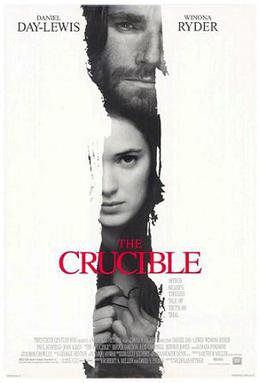
In the 90s, Miller wrote the screenplay for a film adaptation of the The Crucible.  First released in 1996, this adaptation starred Daniel-Day Lewis as the wrongly accused John Proctor, Joan Allen as Proctor’s wife, Elizabeth, and Winona Ryder as Abigail Williams.  For the purposes of Miller’s dramatization, Abigail was reimagined as being a teenage girl who had a brief affair with John Proctor and who was still obsessed with him.  When the Reverend Parris (Bruce Davison) catches Abigail and some of her friends trying to cast a “love spell” on John, the girls try to avoid punishment by accusing Parris’s slave, Tituba (Charlayne Woodard), of being a witch.  Tituba gives a false confession to avoid being hanged.  The girls are soon accusing numerous other women, including Elizabeth Proctor, of witchcraft.

As a film, The Crucible is a fine adaptation of Miller’s play and it’s always a little bit surprising to me that the movie itself isn’t better-known.  Daniel Day-Lewis, Winona Ryder, Joan Allen, and Bruce Davison all give excellent performances, as does Rob Campbell as a reverend who comes to doubt the accusations of witchcraft.  The great Paul Scofield also does a good job as Danforth, the stern judge who attempts to be fair but ultimately is not willing to admit that the law itself is in error.  The film recreates Salem is such detail that you feel as if you’re walking its streets.  The film also recreates the horrible conditions that a colonial prisoner would have to deal with while imprisoned.  Watching Daniel Day-Lewis go from being handsome and rugged to being an emaciated man with rotten teeth really drives home the story’s portrayal of casual, state-sanctioned cruelty.  By the end of the movie, Day-Lewis is a testament to what authoritarians will do to someone who insists on thinking for himself.

The film is at its strongest when showing how a moral panic begins.  The unstable Abigail is looking for revenge against John Proctor.  The other girls, immature and trying to be avoid being punished, make their accusations without giving much thought to the consequences.  Soon, the adults of Salem — all of whom have no excuse for not knowing better — are making accusations because it’s better to be an accuser than to be one of accused.  The film presents a disturbing portrait of how quickly a community can turn on itself.

The film ends on a note of devastating sadness.  Though the witch trials were eventually seen for being the farce that they were, it was too late for the twenty-five people who died as a result of the hysteria.  (Today, with a clear mind, it’s easy to see that the Salem Witch Trials had more in common with Stalin’s show trials and China’s Cultural Revolution than anything else.)  The Crucible is a powerful film adaptation that deserves to be better-known.

Lisa Cleans Out Her DVR: Scorpio (dir by Michael Winner)


(Lisa is currently in the process of cleaning out her DVR!  Having recorded over 150 movies since last January, she understands that this might be an impossible task but she’s going to try anyway!  She recorded the 1973 spy thriller, Scorpio, off of Retroplex way back on January 24th!)

On the surface, Jean Laurier (Alain Delon) would appear to be the perfect man.

He’s handsome.  He looks really good in a suit.  He’s wealthy.  He’s French.  And — get this — he loves cats!  He’s the type of guy who, when he discovers a stray cat in his hotel room, immediately starts to pet it and then gives it a saucer of warm milk.  He and his girlfriend (Gayle Hunnicutt) spend their spare time looking at cats and talking about how cute they are.  At one point, even though he’s just killed a man, Jean pauses when he sees a stray cat watching…

Oh, did I mention that Jean kills people for a living?  Well, he does but I’m sure they’re all bad guys.  Seriously, he’s just so charming (and he really, really loves cats) that you really can’t hold it against him that he’s an independent contract killer.  Add to that, his code name is Scorpio.

I have to admit that the film’s title — Scorpio — is the main reason that I chose to record this movie.  I’m a scorpio myself.  In fact, I’m such a scorpio that if I believed in astrology, I would point to my existence as proof that the stars actually do determine our fate.  Seriously, you don’t want to mess with us scorpios.  We’re scorpions.  We sting.

But anyway, back to the movie.

When Scorpio is busted on a trumped-up narcotics charge (or maybe it was a legitimate narcotics charge, it was kind of hard to keep track), the CIA gives him a choice.  He can either go to prison or he can do a job for them.  Apparently, the CIA believes that Scorpio’s friend and mentor, Cross (Burt Lancaster), is a double agent who has been selling information to the Russians.  They want Cross eliminated.

Scorpio takes the job but it’s not going to be easy.  Cross is a veteran spy.  He has connections all across the world and he’s a ruthless killer, the type who forces a man to swallow a cyanide pill and then says, “You’ve got 30 seconds to live.”  In fact, the only person that Cross seems to care about is his wife (Joanne Linville) but he still doesn’t hesitate to abandon her when he realizes that their house is being watched

Cross taught Scorpio everything that he knows but there’s one lesson that Scorpio is still learning and that is to trust no one.  Is Cross actually a spy or is he being set up?  And, if Cross is being set up, what’s to prevent the same thing from happening to Scorpio?

Scorpio is probably one of the most cynical films that I’ve ever seen.  If Scorpio was a political protest, it would be full of people carrying cardboard signs reading, “Nothing Matters” and “All Is Darkness.”  Remember that annoying as Hell scene in SPECTRE where James Bond got drunk and demanded to know who a rodent was working for?  Well, imagine the disillusionment of that scene stretched out for two hours.

Fortunately, no one in Scorpio is as whiny as Daniel Craig was in SPECTRE.  In many ways, Scorpio is a triumph of old-fashioned movie star charisma.  Burt Lancaster is perfectly cast as the world-weary Cross while Alain Delon makes for a compelling Scorpio.  Both of them are believable killers and the film becomes as much about the competition between Lancaster’s old school Hollywood style of acting and Delon’s more refined (and very French) style of cool as it is about the competition between Scorpio and Cross.

Scorpio‘s a good little spy thriller, more than worth keeping an eye out for.


44 Days of Paranoia #13: Quiz Show (dir by Robert Redford)


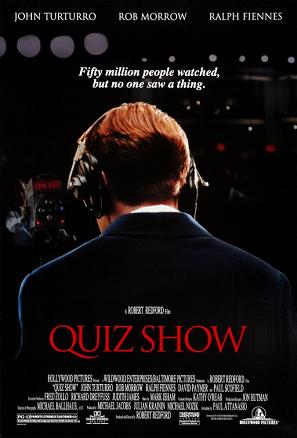
For today’s entry in the 44 Days of Paranoia, I want to take a look at a film that I recently caught on cable — 1994’s Quiz Show.

Directed by Robert Redford and based on a true story, Quiz Show was nominated for the Academy Award for best picture but lost to Forrest Gump.  Among those of us who obsess over Oscar history, Quiz Show is often overshadowed by not only Forrest Gump but two of the other nominees as well, Pulp Fiction and The Shawshank Redemption.  When compared to Pulp Fiction, Quiz Show certainly feels old-fashioned.  At the same time, it’s not quite as much of a sentimental crowd-pleaser as Gump or Shawshank.  Perhaps for those reasons, Quiz Show never gets quite as much attention as some other films that have been nominated for best picture.  However, taking all of that into consideration, Quiz Show is still one of the best films of the 90s.

Quiz Show takes us back to the 1950s.  The most popular show on television is 21, a game show in which two contestants answer questions, win money, and try to be the first to score 21 points.  The American public believes that all of the questions asked on 21 are locked away in a bank vault until it’s time for the show.  What they don’t know is that the show’s producers have instead been rigging the show, giving the answers to contestants who they feel will be good for ratings.

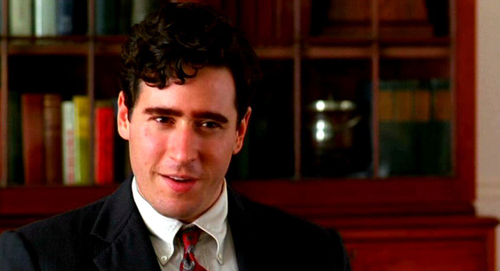
When Quiz Show begins, nerdy Herbie Stempel (John Turturro) has been the champion for several weeks.  However, both the show’s producers and sponsors feel that the untelegenic Herbie has peaked.  Hence, the handsome and charismatic Charles Van Doren (Ralph Fiennes) is brought on the show and Herbie is ordered to lose to him.  Reluctantly, Herbie does so.

john_turturro_quiz_show

Charles is initially reluctant to cheat but, as he continues to win, he finds himself becoming addicted to the fame.  Charles is the son of the prominent academic Mark Van Doren (Paul Scofield) and his success on television finally gives him a chance to escape from his father’s shadow.  Indeed, the film’s subtle and nuanced portrait of Charles and Mark’s loving but competetive relationship is one of the film’s greatest strengths.

ralph_fiennes_quiz_show

Herbie, however, is bitter over having to lose and has subsequently gambled away all of his winnings.  When 21′s producer (David Paymer) refuses to help Herbie get on another TV show, Herbie reacts by going to the New York County district attorney and publicly charging 21 as being fixed.  Though the grand jury dismisses Herbie as being obviously mentally unbalanced, his charges come to the attention of a congressional investigator, Richard Goodwin (Rob Morrow).

rob_morrow_quiz_show1

Goodwin launches his own investigation into 21 and discovers that the show is fixed.  (As the ambitious Goodwin puts it, he wants to “put television on trial.”)  Along the way, he also meets and befriends Charles Van Doren and finds himself torn between his desire to expose the show and to protect Charles from the bad publicity.  Again, the film is to be applauded for the subtle way that it uses Goodwin’s investigation of both Charles and Herbie as a way to explore issues of both class resentment and class envy.  Goodwin may have come from the same ethnic background of Herbie but it quickly becomes obvious that Goodwin has more sympathy for the genteel (and very WASPy) world that produced Charles Van Doren.  When Goodwin tries to justify protecting Charles, his wife (played by Mira Sorvino) responds by calling him “the Uncle Tom of the Jews” and it’s hard not to feel that she has a point.

1quiz3

While I greatly enjoyed Quiz Show, I do have to say that, on one major point, the film fails.  Try as he might, director Redford never convinces us that a rigged game show is really as big of a crime as he seems to be believe it to be.  Perhaps in the 1950s, people were still innocent enough to be shocked at the idea of television reality being fake but for cynical contemporary viewers, it’s hard not to feel that the “scandal” was more about Richard Goodwin’s ambition and less about any sort of ethical or legal issue.  Towards the end of the film, one character suggests that television will never be truly honest unless the government steps in to regulate it.  “What?” I yelled back at the TV.

Seriously, it seemed like a bit of an overreaction.

As I watched Quiz Show, I found it hard not to think about the reality shows that I love.  For instance, I know that The Bachelor and The Bachelorette are largely staged.  I know that the previous season of Big Brother was largely set up so that Amanda could win.  (And, believe me, if Amanda hadn’t sabotaged her chances by turning out to be a mentally unstable racist bully, she would have won and she would probably would have been invited back for the next all-stars season.)  I know that shows like Storage Wars and Dance Moms are “unscripted” in name only.  I know that reality shows aren’t real but my attitude can basically be summed up in two words: “who cares?”  Perhaps I would be more outraged if I lived in the 50s which, to judge from both Quiz Show and a host of other movies, was apparently a much more innocent time.

quiz-show-morrow-scorsese

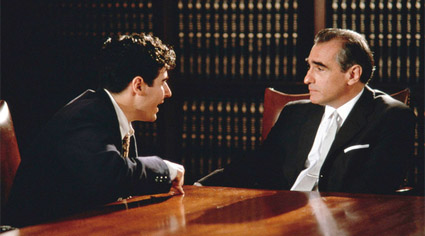
That said, I really enjoyed Quiz Show.  A lot of that is because I’m a history nerd and, therefore, I have a weakness for obsessively detailed period pieces.  But even beyond that, Quiz Show is a well-made, entertaining film that features three excellent lead performances and several strong supporting turns.  If you love to watch great actors playing great roles then Quiz Show is the film for you.  Rob Morrow lays his Boston accent on a bit thick but otherwise, he does a good job of suggesting both Goodwin’s ambition and the insecurities that lead him to desire Charles’s friendship even as he tries to expose him as a fraud.  John Turturro brings an odd — if manic — dignity to Herbie Stempel while Johann Carlo is well-cast as his wife.  Best of all, Ralph Fiennes makes Charles Van Doren into a sad, frustrating, and ultimately sympathetic character while Paul Scofield is the epitome of both paternal disappointment and love as his father.  The film is full of great supporting turns as well, with David Paymer and Hank Azaria perfectly cast as the show’s producers and Christopher McDonald playing the show’s host with the same smarmy charm that he brought to a similar role in the far different Requiem For A Dream.  Perhaps best of all, Martin Scorsese shows up as the owner of Geritol and gets to bark, “Queens is not New York!”

Even if Robert Redford doesn’t quite convince us that the quiz show scandal was as big a deal as he obviously believes it to be, Quiz Show is still an uncommonly intelligent film and one that deserves to rediscovered.

QuizShowPoster

Other entries in the 44 Days Of Paranoia:

  1. Clonus
  2. Executive Action
  3. Winter Kills
  4. Interview With The Assassin
  5. The Trial of Lee Harvey Oswald
  6. JFK
  7. Beyond The Doors
  8. Three Days of the Condor
  9. They Saved Hitler’s Brain
  10. The Intruder
  11. Police, Adjective
  12. Burn After Reading