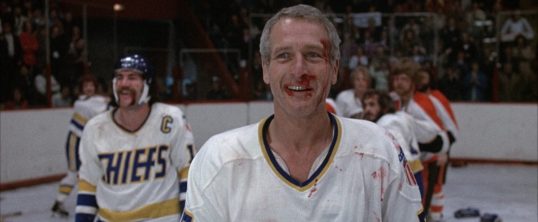
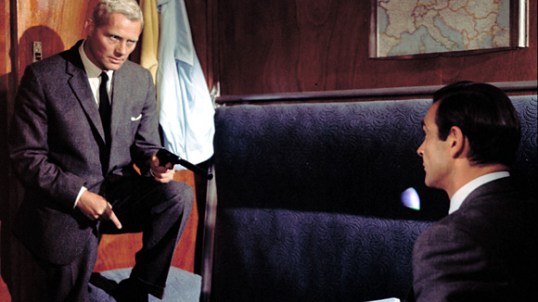
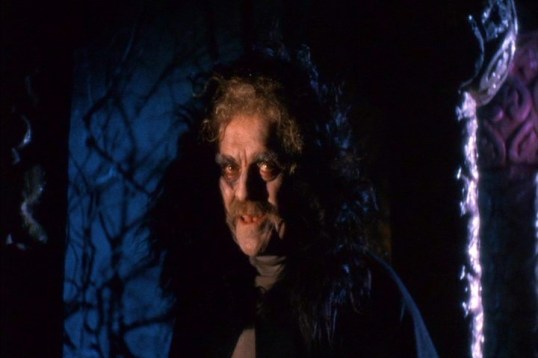
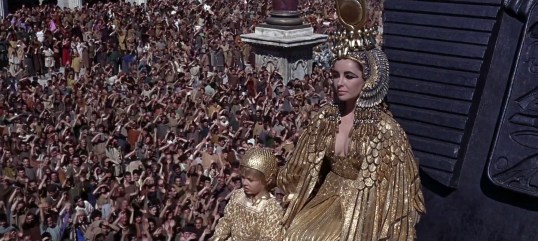
4 Shots From 4 Films is just what it says it is, 4 shots from 4 of our favorite films. As opposed to the reviews and recaps that we usually post, 4 Shots From 4 Films is all about letting the visuals do the talking.
4 Shots From 4 Striking Films
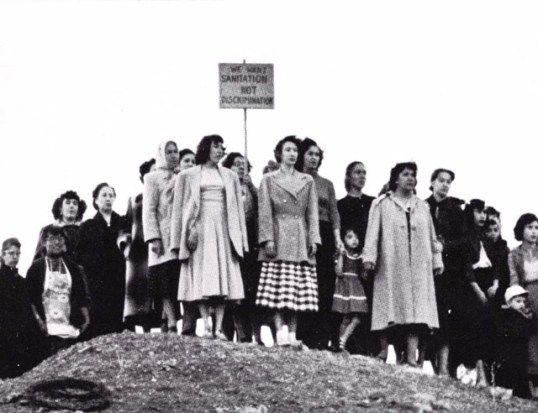
Salt of the Earth (1954, directed by Herbert J. Biberman)
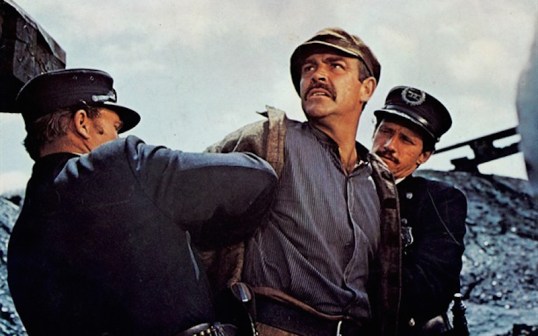
The Molly Maguires (1970, directed by Martin Ritt)
4 Shots From 4 Films is just what it says it is, 4 shots from 4 of our favorite films. As opposed to the reviews and recaps that we usually post, 4 Shots From 4 Films lets the visuals do the talking!
On this day, 112 years ago, Martin Ritt was born in New York City. Like many of the Hollywood directors who came to prominence in the 1950s, he started his directorial career in the theater before moving over to live TV. In 1952, his television career was derailed when he was accused of being a communist. Blacklisted, it would be five years before Ritt could get another directing job. When he did start to work again, he moved from television into the movies, starting with 1957’s Edge of the City. Perhaps due to his own experiences, his films always had a social conscience and always defended the individual against corrupt corporations and governments. In 1976, he directed one of the first films about the Hollywood blacklist, The Front.
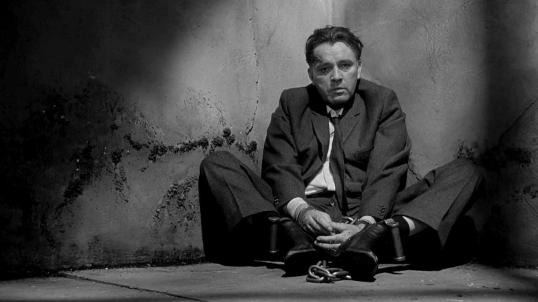
As a director, Ritt was known for his skill with actors. More than anyone, he played a huge role in making stars out of both Paul Newman and Sally Field. He was also one of the few directors to understand how to harness Richard Burton’s self-destructive tendencies and, as a result, Burton gave one of his best performances in Ritt’s adaptation of The Spy Who Came In From The Cold.
It’s time for….
4 Shots From 4 Martin Ritt Films
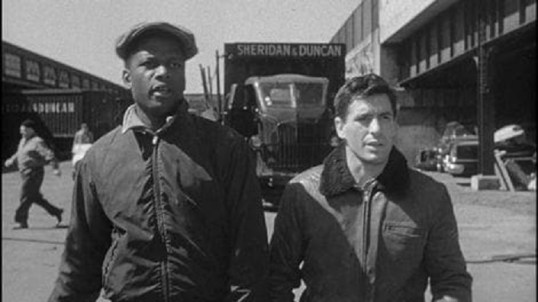
Edge of the City (1957, dir by Martin Ritt, DP: Joseph Brun)
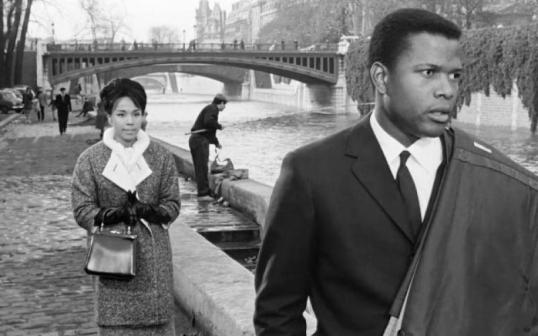
Paris Blues (1961, dir by Martin Ritt, DP: Christian Matras)
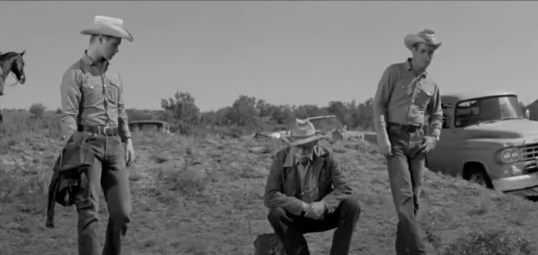
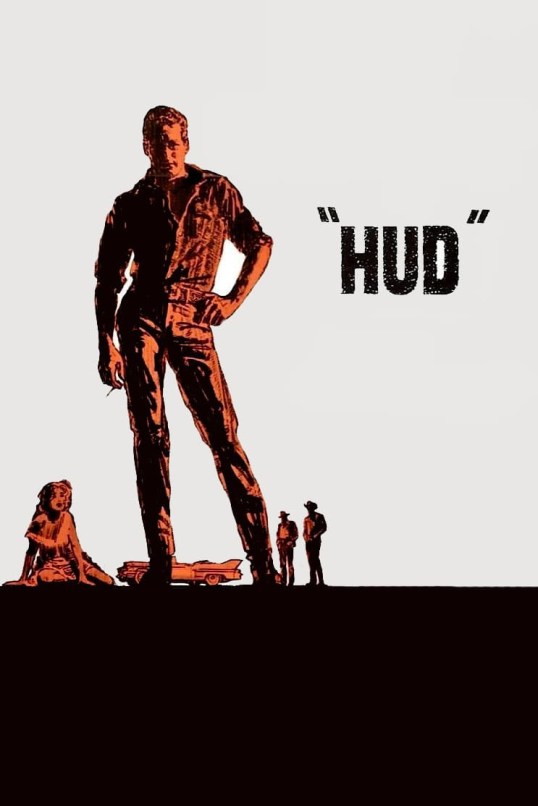
Hud (1963, dir by Martin Ritt, DP: James Wong Howe)
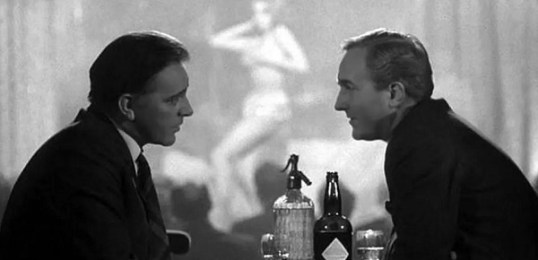
The Spy Who Came In From The Cold (1965, dir by Martin Ritt, DP: Oswald Morris)
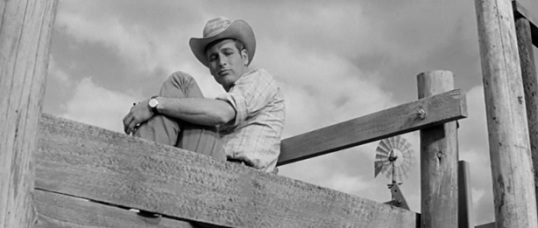
In 1963’s Hud, Paul Newman plays a monster named Hud.
Hud Bannon is the son of rancher Homer Bannon (Melvyn Douglas). Hud lives in a small Texas town, where he’s known for his pink Cadillac, his heavy-drinking, and his womanizing. When we first meet him, he’s leaving the home of a married woman and narrowly escaping the rage of her husband. Throughout the film, he mentions that he’s heading into town to meet “Mrs.” So-and-So. Hud’s father fears that Hud might be incapable of caring about anyone but himself. Hud’s nephew, Lonnie (Brandon deWilde), at first looks up to Hud but, over the course of the film, he comes to see his uncle for who he truly is. Though Hud is quick to defend Homer from others, he himself views Homer with contempt and even plots to have the old man declared incompetent so that he can take over the ranch. His flirtation with the family housekeeper, Alma (Patricia Neal), soon crosses the line into something much more dangerous. Hud is charming and handsome in the way that only a 30-something Paul Newman could be. But he’s also a complete monster.
In Hud, Newman gave one of his best performances and director Martin Ritt and cinematographer James Wong Howe captured some haunting images of the most barren parts of the Texas panhandle. Howe’s black-and-white imagery not only captures the harsh landscape but also the harsh outlook of the people who live there. Hud’s ruthless personality as is much a product of the demands of the land as his own narcissism. The characters in Hud live in a land that doesn’t allow sentimentality. It’s a land that’s allowed Hud to become the monster that he is.
At least, that’s the way that Paul Newman saw Hud. That was also the way that the film’s director, Martin Ritt, viewed Hud. They viewed him as being about as villainous and unlikable as a character could be but, to Newman’s surprise, audiences actually walked out of the film embracing the character and making excuses for him. Newman was shocked to learn that teenagers were putting posters of him as Hud on their walls.
Why did viewers embrace Hud?
Some of it is due to the fact that Brandon deWilde gives a remarkably bland performance as Lonny. We first see Hud through Lonny’s eyes and we are meant to share Lonny’s growing disillusionment with his uncle. But Lonny comes across as being such an empty-headed character that it’s hard to really get emotionally invested in his coming-of-age. When Hud eventually dismisses Lonny and his concerns, Lonny really can’t defend himself because there’s not much going on inside of Lonny. On the other hand, Paul Newman gives such a charismatic performance as Hud that we find ourselves continually making excuses for his bad behavior. When he talks about how he was raised and his difficult relationship with his father, we have sympathy for him even though we know we shouldn’t. The viewer makes excuses for Hud because that’s what we tend to do when it comes to charismatic bad boys who don’t follow the rules.
Indeed, Hud is proof of the power of charisma and screen presence. As a character, Hud does some truly terrible things and yet, because he’s Paul Newman, we want to forgive him. We want to try to figure out why someone who is so handsome and so charismatic would also be so angry. Lonny may be the “good” character but Hud is the one who we want to get to know. When Lonny flips through a paperback to read the sex scenes, he comes across as being creepy. When a drunk Hud flirts with a woman who he has just met, we ask ourselves what we would do if Hud ever tried that with us. The truth is that we all know what we would do. That’s what makes Hud both a dangerous and an intriguing character.
In the end, Hud is an excellent film that features Paul Newman at his best and which uses the downfall of Homer’s ranch as a metaphor for a changing American society. Though Hud was not nominated for Best Picture, it was nominated for almost everything else. Melvyn Douglas and Patricia Neal won acting Oscars. James Wong Howe’s cinematography was also honored. Paul Newman was nominated and perhaps would have won if not for the fact that Sidney Poitier was nominated for playing the exact opposite of Hud in Lilies of the Field. Hud was meant to be a picture about Lonny discovering his uncle was a monster. Instead, the film became about Hud’s refusal to compromise. It turns out that people like good-looking rebels who do what they want.
Even if viewers missed the point, Hud was one of the best films of the early 60s and Paul Newman’s powerful performance continues to intrigue.
1961’s Paris Blues tells the story of four Americans in Paris.
Ram (Paul Newman) and Eddie (Sidney Poitier) are expatriate jazz musicians. Ram has come to Paris to try to find success as a musician. He’s a little cocky. He’s a little arrogant. However, he’s talented and he believes enough in his talent that he takes it a little bit personally when he’s told that he should just focus on being a composer instead. Eddie is Ram’s best friend and someone who has no interest in ever returning to America. In America, he’s judged by the color of his skin. In Paris, no one cares that he’s black. In Paris, they just care about his talent.
Lillian (Joanne Woodward) and Connie (Diahann Carroll) are best friends who are spending two weeks in Paris. They love jazz and eventually, Lillian comes to love Ram while Connie comes to love Eddie. Connie tries to convince Eddie to marry her and come back to America with her but Eddie tells her that “the struggle” in America is not “my struggle.” Ram also finds himself torn over whether he should stay in Paris or return to America with Lillian. In the end, one man leaves and one man stays. It’s not really much of a surprise who does what.
Paris Blues was directed by Martin Ritt, a director who had been blacklisted during the 50s and whose career was revived by several films that he made with Paul Newman. (Newman and Joanne Woodward first met on the set of Ritt’s The Long Hot Summer.) Ritt was one of those reliably liberal directors who made message films that dealt with political issues but were never quite radical. Paris Blues features a lot of talk about the civil rights movement and it makes an attempt to be honest about why two Americans would chose to live in a different country. And yet, as was so often the case with Martin Ritt’s films, the film presents itself as being far more daring than it actually is. Yes, Ram initially hits on Connie but he loses interest once he sees Lillian. Though the film is based on a novel that featured an interracial relationship, there’s never really any doubt that, in the film, Ram is going to end up with Lillian and Eddie is going to end up with Connie. And while the film makes it clear that Ram and Lillian sleep together within hours of first meeting each other, the relationship between Connie and Eddie is romantic but chaste. Paris Blues may be a mature film for 1961 but it’s still definitely a film of 1961.
That said, the music’s great (Louis Armstrong shows up to jam with Ram and Eddie) and Newman and Woodward’s chemistry is off the charts. Ram is like a lot of the characters that Paul Newman played in the 50s and 60s. He can be self-centered and he can be petulant and he can be self-destructive. But he’s never less than honest and the fact that he refuses to compromise or give into self-doubt makes him very appealing. While Poitier struggles with a script that refuses to allow him too much personality (he’s affably pleasant, even when he’s explaining why he doesn’t want to live in America), Newman dominates the film in the role of an artist determined to share his vision.
Paris Blues is never the masterpiece that it tries to be but Paul Newman makes it more than worth watching.
4 Shots From 4 Films is just what it says it is, 4 shots from 4 of our favorite films. As opposed to the reviews and recaps that we usually post, 4 Shots From 4 Films lets the visuals do the talking!
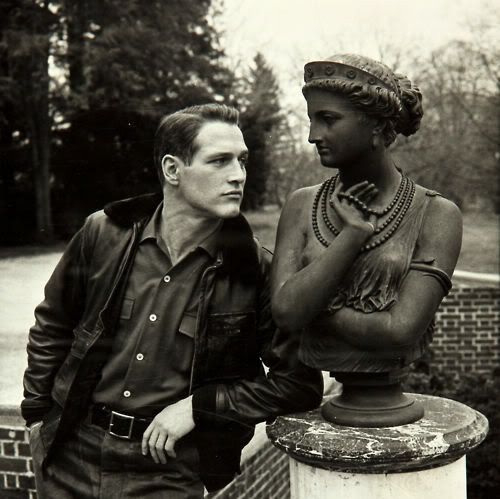
101 years ago today, Paul Newman was born in Shaker Heights, Ohio. He would go on, of course, to become one of America’s greatest film stars, an acclaimed actor who was active from the mid-part of the 20th century to the beginning of our current century. He made his film debut in 1954 with The Silver Chalice(and subsequently paid for an ad in which he apologized for his performance in the film, which I think was a bit unnecessary as he wasn’t really that bad in the film) and he made his final onscreen appearance in 2005 in Empire Falls. (He did, however, subsequently provide the voice of Doc Hudson in Cars, along with narrating a few documentaries.) Time and again, he proved himself to be one of the best actors around. According to most report, he was also one of the nicest. When he died in 2008, the world mourned.
In honor of his cinematic legacy, here are….
4 Shots From 4 Paul Newman Films
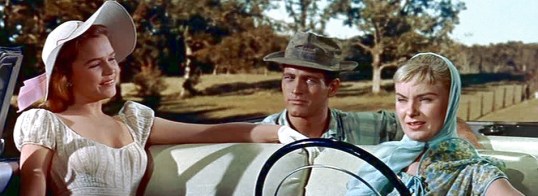
The Long Hot Summer (1958, dir by Martin Ritt, DP: Joseph LaShelle)
Hud (1963, dir by Martin Ritt, DP: James Wong Howe)
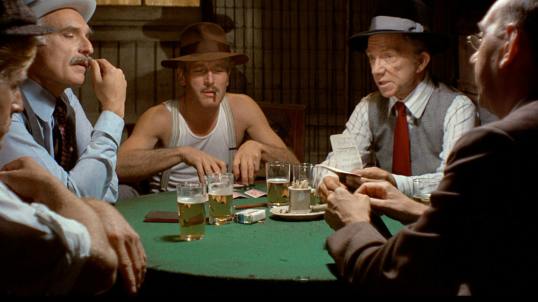
The Sting (1973, dir by George Roy Hill, DP: Robert Surtees)
Slap Shot (1977, dir by George Roy Hill, DP: Victor Kemper)
4 Shots From 4 Films is just what it says it is, 4 shots from 4 of our favorite films. As opposed to the reviews and recaps that we usually post, 4 Shots From 4 Films is all about letting the visuals do the talking.
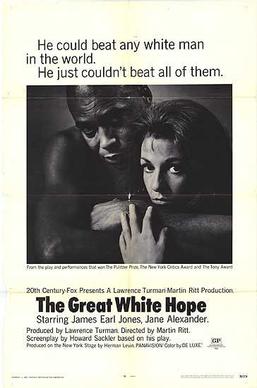
The year is 1910 and the sports world is in a panic. For the first time, a black man has won the title of the heavyweight champion of the world. Jack Jefferson (James Earl Jones) had to go to Australia because no American city would agree to host the fight but he came out of it victorious. The proud and outspoken Jefferson finds himself targeted by both the white establishment and black activists who claim that Jefferson has not done enough for his community.
It’s not just Jefferson’s success as a boxer that people find scandalous. It’s also that the married Jefferson has a white mistress, a socialite named Eleanor Brachman (Jane Alexander, in her film debut). While boxing promoters search for a “great white hope” who can take the title from Jefferson, the legal authorities attempt to arrest Jefferson for violating the Mann Act by supposedly taking Eleanor across state lines for “immoral purposes.” Jefferson and Eleanor end up fleeing abroad but even then, their relationship is as doomed as Jefferson’s reign as the heavyweight champ.
Based on a Pulitzer-winning stage play by Howard Sackler, The Great White Hope features Jones and Alexander recreating the roles for which they both won Tonys. Both Jones and Alexander would go on to receive Oscar nominations for their work in the film version. It was the first nomination for Alexander and, amazingly, it was the only nomination that Jones would receive over the course of his career. (It surprises me that he wasn’t even nominated for his work in Field Of Dreams.) Both Jones and Alexander give powerful performances, with Jones dominating every scene as the proud, defiant, and often very funny Jack Jefferson. Jones may not have had a boxer’s physique but he captured the attitude of a man who knew he was the best and who mistakenly believed that would be enough to overcome a racist culture. (Speaking of racist, legendary recluse Howard Hughes reportedly caught the film on television and was so offended by the sight of Jones kissing Alexander that he thought about buying NBC to make sure that the movie would never be aired again.) Hal Holbrook, Chester Morris, Moses Gunn, Marcel Dalio, and R.G. Armstrong all do good work in small roles.
Unfortunately, The Great White Hope still feels like a filmed stage play, despite the attempts made to open up the action. Martin Ritt was a good director of actors but the boxing scenes are never feel authentic and the middle section of the film drags. Jones and Alexander keep the film watchable but The Great White Hope is never packs as strong of a punch as its main character.
4 Shots From 4 Films is just what it says it is, 4 shots from 4 of our favorite films. As opposed to the reviews and recaps that we usually post, 4 Shots From 4 Films lets the visuals do the talking!
On this day, 110 years ago, Martin Ritt was born in New York City. Like many of the Hollywood directors who came to prominence in the 1950s, he started his directorial career in the theater before moving over to live TV. In 1952, his television career was derailed when he was accused of being a communist. Blacklisted, it would be five years before Ritt could get another directing job. When he did start to work again, he moved from television into the movies, starting with 1957’s Edge of the City. Perhaps due to his own experiences, his films always had a social conscience and always defended the individual against corrupt corporations and governments. In 1976, he directed one of the first films about the Hollywood blacklist, The Front.
As a director, Ritt was known for his skill with actors. More than anyone, he played a huge role in making stars out of both Paul Newman and Sally Field. He was also one of the few directors to understand how to harness Richard Burton’s self-destructive tendencies and, as a result, Burton gave one of his best performances in Ritt’s adaptation of The Spy Who Came In From The Cold.
It’s time for….
4 Shots From 4 Martin Ritt Films
Hud (1963, dir by Martin Ritt, DP: James Wong Howe)
The Spy Who Came In From The Cold (1965, dir by Martin Ritt, DP: Oswald Morris)
The Front (1976, dir by Martin Ritt, DP: Michael Chapman)
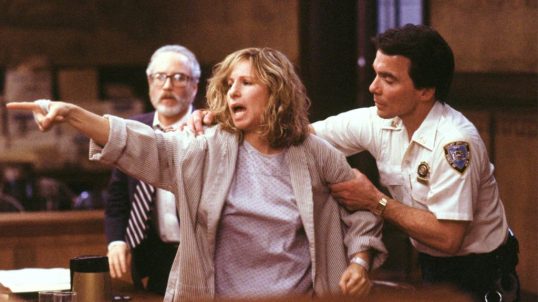
Nuts (1987, dir by Martin Ritt, DP: Andrzej Bartkowiak)
4 Shots From 4 Films is just what it says it is, 4 shots from 4 of our favorite films. As opposed to the reviews and recaps that we usually post, 4 Shots From 4 Films lets the visuals do the talking!
On this day, 109 years ago, Martin Ritt was born in New York City. Like many of the Hollywood directors who came to prominence in the 1950s, he started his directorial career in the theater before moving over to live TV. In 1952, his television career was derailed when he was accused of being a communist. Blacklisted, it would be five years before Ritt could get another directing job. When he did start to work again, he moved from television into the movies, starting with 1957’s Edge of the City. Perhaps due to his own experiences, his films always had a social conscience and always defended the individual against corrupt corporations and governments. In 1976, he directed one of the first films about the Hollywood blacklist, The Front.
As a director, Ritt was known for his skill with actors. More than anyone, he played a huge role in making stars out of both Paul Newman and Sally Field. He was also one of the few directors to understand how to harness Richard Burton’s self-destructive tendencies and, as a result, Burton gave one of his best performances in Ritt’s adaptation of The Spy Who Came In From The Cold.
It’s time for….
4 Shots From 4 Martin Ritt Films
Edge of the City (1957, dir by Martin Ritt, DP: Joseph Brun)
The Long Hot Summer (1958, dir by Martin Ritt, DP: Joseph LaShelle)
Hud (1963, dir by Martin Ritt, DP: James Wong Howe)
The Spy Who Came In From The Cold (1965, dir by Martin Ritt, DP: Oswald Morris)
4 Or More Shots From 4 Or More Films is just what it says it is, 4 shots from 4 of our favorite films. As opposed to the reviews and recaps that we usually post, 4 Shots From 4 Films lets the visuals do the talking!
Earlier, today, it was announced that Sidney Poitier had passed away at the age of 94.
Poitier was, of course, the first black actor to win the Oscar for Best Actor. He won that award for 1962’s Lillies of the Field. He would go on to star in the Oscar-winning In The Heat of the Night, where he delivered the famous line, “They call me Mr. Tibbs!” Poitier was one of the first black actors to be acknowledged as a movie star. In the 70s and the 80s, he chafed at the limited selection of roles that he was being offered in mainstream productions and he started to produce and direct his own films. He also served as a diplomat, serving as the Bahamian ambassador to both Japan and UNESCO.
In honor of Poitier’s life and legacy, here are….
4 Shots From 4 Sidney Poitier Films
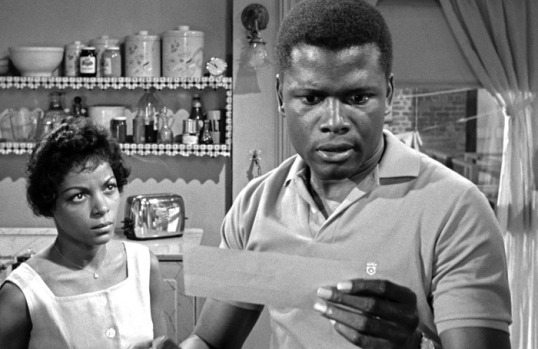
A Raisin in the Sun (1961, dir by Daniel Petrie, DP: Charles Lawton Jr.)
Paris Blues (1961, dir by Martin Ritt, DP: Christian Matras)
In The Heat of the Night (1967, dir by Norman Jewison, DP: Haskell Wexler)
Brother John (1971, dir by James Goldstone, DP: Gerald Perry Finnerman)