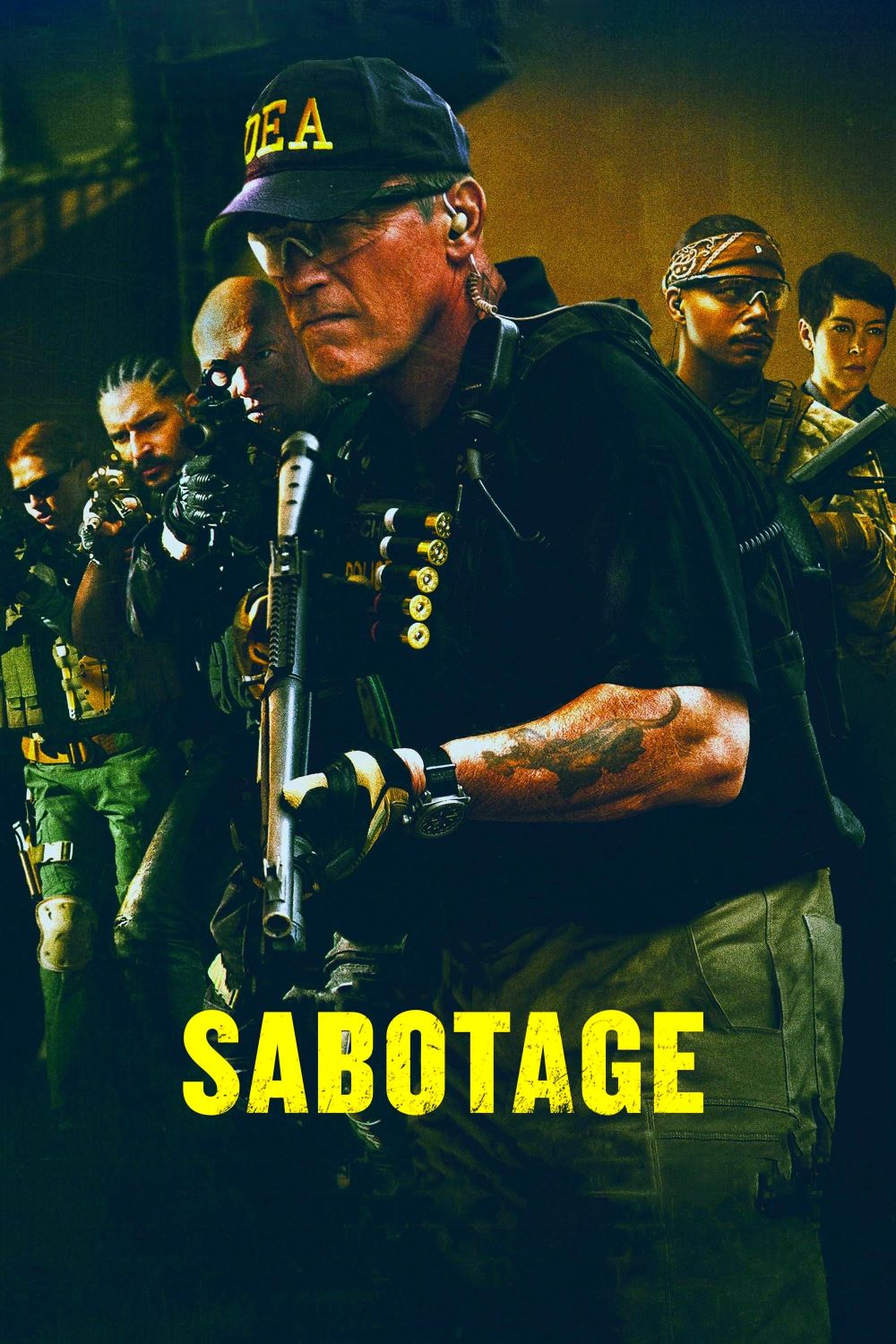
Review: Sabotage (dir. by David Ayer)


“Ammo’s cheap, my life ain’t.” — Joe “Grinder” Phillips

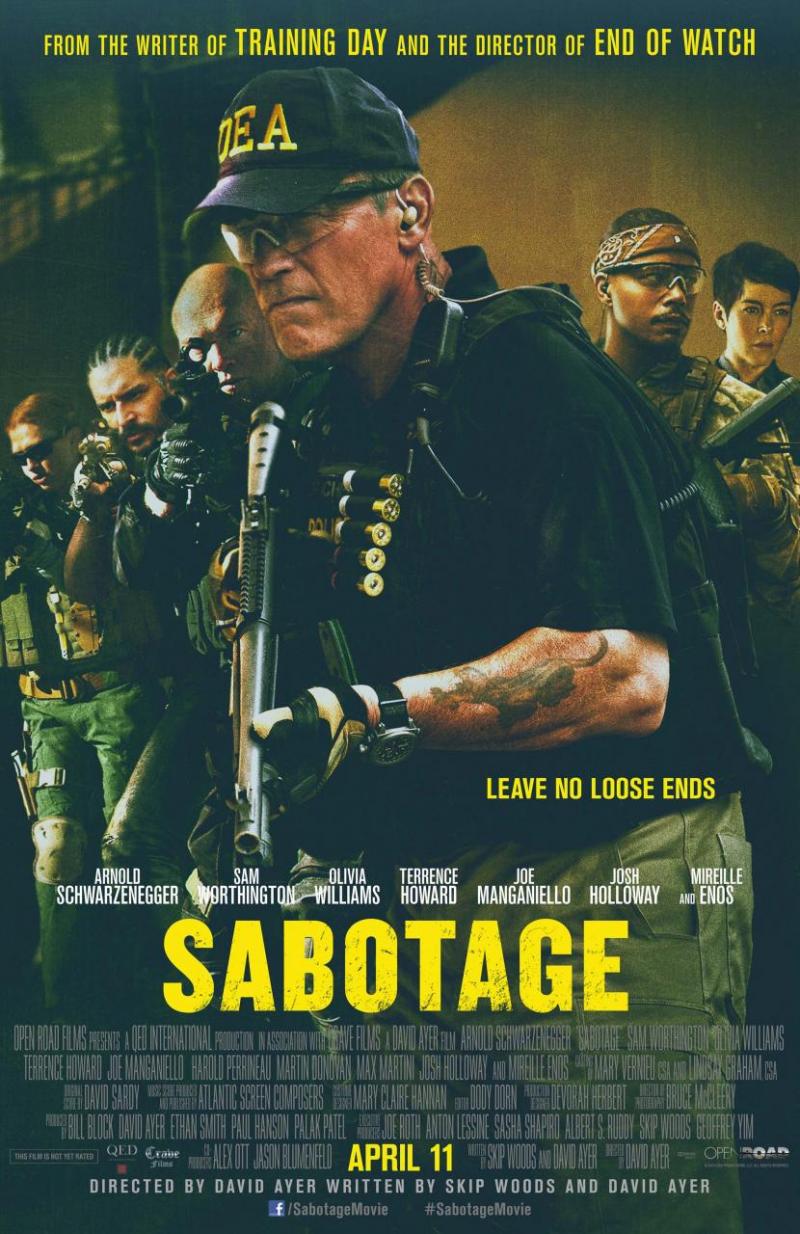
Watching Sabotage, the 2014 David Ayer action-thriller, is a bit like finding a beautiful, high-performance sports car that’s been stripped for parts. It’s got a shiny exterior in Arnold Schwarzenegger, a director known for gritty cop dramas, and a promising cast, but under the hood, the engine is sputtering and the chassis is held together with duct tape and questionable intentions. The film is a strange, often unpleasant beast that seems unsure if it wants to be a complex whodunit, a grim torture-porn horror flick, or a simple action vehicle for its aging star. In trying to be all of them, it mostly succeeds at being a confusing, albeit fascinating, mess.

The film starts with a classic set-up that reeks of potential. Schwarzenegger plays John “Breacher” Wharton, the leader of an elite and ruthless DEA task force. During a cartel raid, the team decides to skim $10 million in cash from the seizure for themselves. Their plan backfires when they go to retrieve the hidden money and find it gone. This creates a perfect powder keg of suspicion and paranoia. While they’re all investigated, no one is charged, and they are put back into action. The plot kicks into high gear when members of the team start getting picked off one by one in increasingly gruesome and inventive ways. Now, Breacher has to find out who is hunting his team, while simultaneously being haunted by a dark secret from his past.

The mystery is clearly meant to be a bloody, modern interpretation of a classic “stranded and hunted” thriller formula. The problem is, the “whodunit” aspect falls flat because the story is just too messy to build any real suspense. The characters are an indistinguishable mass of nicknames like “Monster” (Sam Worthington), “Grinder” (Joe Manganiello), and “Sugar” (Terrence Howard), making it difficult to keep track of who is who, let alone care when they meet their grisly end. The film gives you little reason to invest in them, as they are an intentionally unlikable bunch of thugs who treat civilians with contempt, break the law without a second thought, and generally act like cartoon villains with badges. When a character is killed off, it’s often not a shocking, gut-wrenching twist, but more of a shrug: “Oh, that guy’s gone now.” The plot becomes less about solving a puzzle and more about waiting for the next spectacularly bloody demise.

And those demises are where David Ayer’s direction makes its most “memorable” impact. The violence in Sabotage is not your typical Schwarzenegger shoot-’em-up. It is unflinchingly brutal and hyper-realistic, leaning heavily into the kind of gruesome, elaborate set-pieces that feel borrowed from the horror genre. We’re not talking about clean, one-shot kills; we’re talking about brutal, drawn-out murders involving trains, industrial equipment, and a staggering amount of viscera. The camera lingers on open wounds, bodies nailed to ceilings, and the general gory aftermath of each death with a kind of morbid fascination. The film’s obsession with gore is relentless. It even opens with a scene of Breacher watching a video of his family being tortured, setting a grim, nasty tone that never quite lets up. It feels like Ayer is trying to show the brutal, unglamorous reality of violence, but it quickly crosses the line into exploitation, making the film a punishing watch for anyone not specifically seeking out that level of graphic brutality.

The cast is a mixed bag, and it’s one of the more interesting paradoxes of the film. Schwarzenegger, despite being the star, is a strange fit for this material. Critics noted that he seems to be trying to give a more “dark and complex performance,” mining reserves of darkness he rarely accesses. However, the movie around him doesn’t quite support that ambition. He’s still “Arnold,” and his innate charisma and larger-than-life persona often clash with the grim, nasty world Ayer has created. His presence is too big for the bleak mundanity the movie is striving for, creating a constant tension between the action hero audiences expect and the broken, haunted man the script demands. In stark contrast, it was the supporting female cast that often stole the show. Mireille Enos delivers a truly fearless and unhinged performance as Lizzy, the team’s drug-addicted female member, bringing a level of manic energy that is genuinely engaging. Olivia Williams, as the no-nonsense homicide detective Caroline Brentwood, is also a standout. She plays the “only sane person in the room” with an air of world-weary professionalism that feels like it belongs in a better movie. But even her character is dragged into the muck, with a strange and unnecessary romance that feels forced and out of place.

It’s almost impossible to discuss Sabotage without talking about the tone. The film is relentlessly cynical, presenting a world where the line between law enforcement and the cartels is practically non-existent. Ayer, who has explored the dark side of law enforcement in previous work, seems to be asking a bold question here: what happens when cops are worse than the criminals? The answer, according to the film, is a lot of violence and a total lack of moral compass. This cynical view is further dragged down by a barrage of cheap, sophomoric humor. The script is peppered with scatological jokes, crude sexual banter, and homophobic slurs that feel less like “gritty realism” and more like the writers are trying to be edgy just for the sake of it. This creates a bizarre, off-putting atmosphere where the dark, philosophical musings about corruption are undercut by a high-school-level obsession with bodily functions, making the whole experience feel awkward and juvenile.

In the end, Sabotage is a textbook example of a movie that is sabotaged by its own ambitions. It boasts a director with a distinctive style for crime stories, a legendary action star trying something different, and a cast full of talented actors. Yet, it’s ultimately sunk by a script that can’t balance its whodunit premise with its over-the-top gore, and a tone that can’t decide if it’s a serious crime drama or a nasty, nihilistic joke. It’s not boring, and you can’t say Ayer didn’t try something different with the action genre, but the result is an ugly, mean-spirited, and often just plain unpleasant film. For a fascinating look at what happens when a good idea goes horribly off the rails, Sabotage is a case study in wasted potential. But for a good movie? You’ll want to look elsewhere.
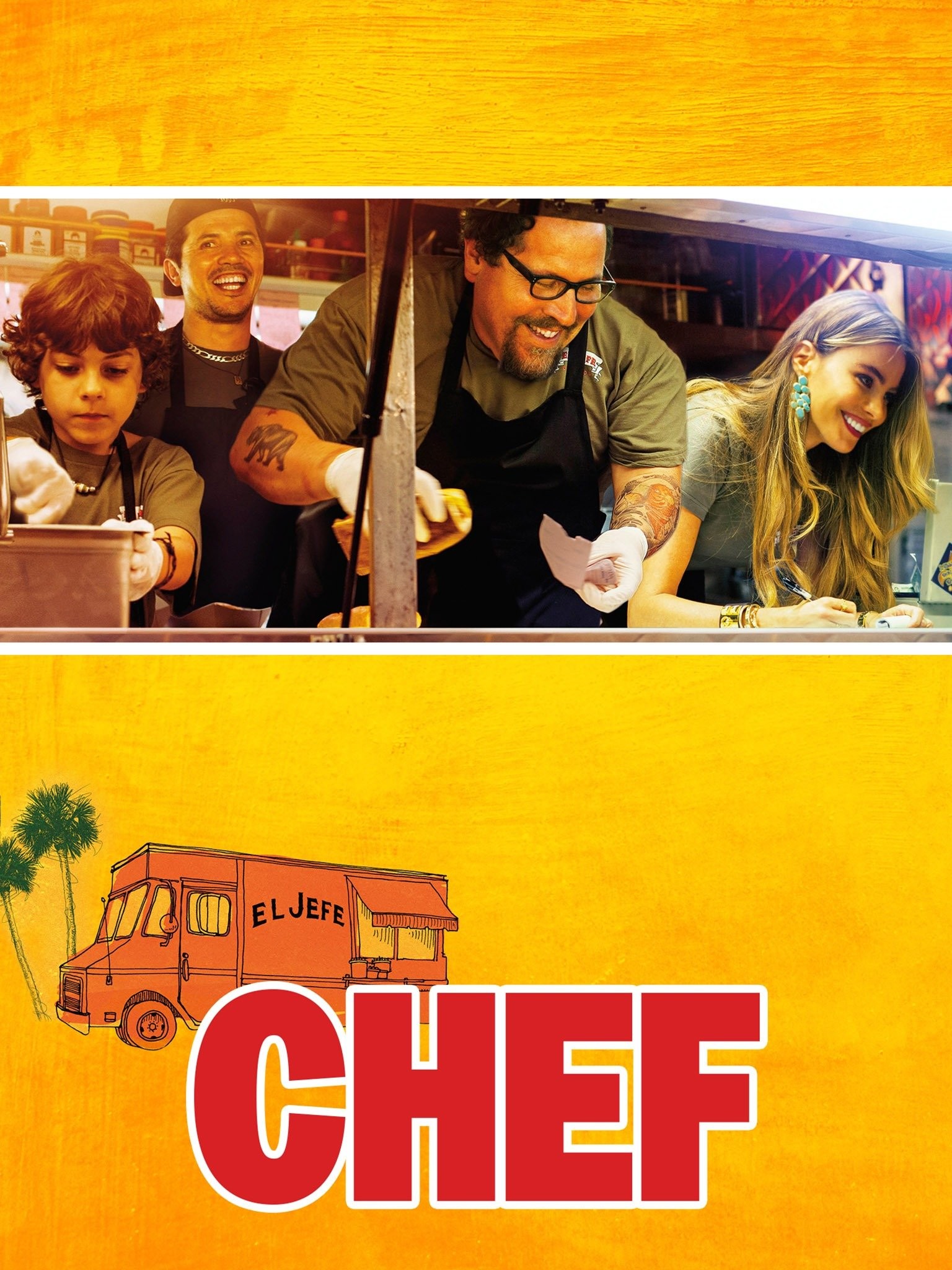
Review: Chef (dir. by Jon Favreau)


“I may not do everything great in my life, but I’m good at this. I manage to touch people’s lives with what I do and I want to share this with you.” — Carl Casper

Jon Favreau’s Chef is one of those modest, crowd‑pleasing films that wins you over by staying sincere. It is not trying to be more elaborate than it needs to be, and that restraint is part of its charm. The movie understands that a good meal, like a good story, does not need to be overloaded to leave an impression.

At its center is Carl Casper, a Los Angeles chef who has spent too long under the thumb of a controlling owner and a punishing routine. Favreau builds the character as a man with genuine talent who has gradually been boxed into serving the same familiar dishes until the spark goes out of his work. That setup gives the film emotional weight without making it needlessly grim, and the early conflict feels grounded in the kind of professional frustration that many viewers can recognize.

What makes Chef work so well is that it treats food as more than decoration. The kitchen scenes have the energy of a workplace movie, but they also carry the warmth of a film about craft, pride, and rediscovery. Favreau clearly cares about the details, and the movie’s culinary authenticity helps make the food feel alive rather than merely photogenic.

The film’s strongest material often comes from its sense of rhythm. Favreau lets scenes breathe, whether Carl is cooking, arguing, bonding with his son, or slowly finding his footing again through the food truck. The road‑trip structure gives the movie a loose, easygoing momentum that matches its themes of starting over and rebuilding a life from something more personal. It is a familiar shape, but Favreau handles it with enough warmth and confidence that it never feels mechanical.

The cast also helps carry the movie’s laid‑back appeal. John Leguizamo brings dependable energy as Carl’s friend and partner, while Emjay Anthony gives the father‑son relationship a needed emotional anchor. Sofía Vergara and Scarlett Johansson add texture to the supporting ensemble, and the cameos help the film feel like it belongs to a broader world without turning into a stunt parade. Robert Downey Jr.’s appearance is especially in the spirit of the movie’s playful, slightly scrappy personality.

If there is a weakness in Chef, it is that the stakes are sometimes as light as the movie’s tone. The conflict is easy to understand, but the film is not interested in digging especially deep into the pressures of restaurant life beyond what it needs for Carl’s personal reset. Some viewers may also feel that the story moves so smoothly that it can occasionally glide past tension rather than fully wrestle with it. Still, those softer edges are part of the movie’s comfort‑food approach, and they fit the film more often than they hurt it.

There is also something undeniably self‑referential about Favreau making a film like this at this point in his career. After years of working in large‑scale studio filmmaking, Chef feels like a deliberate return to basics, a movie about rediscovering joy in the craft rather than chasing spectacle. That choice gives the film a little extra meaning, because it plays not just as a story about a chef but as a story about an artist reconnecting with the thing that made him care in the first place.

That connection carried forward in a very natural way with Netflix’s The Chef Show, which Favreau made with Roy Choi after the film. The show turned the movie’s culinary curiosity into a full‑fledged project, with Favreau cooking alongside celebrity friends and guests across its two‑season run. In that sense, Chef was not just a one‑off passion project; it became the foundation for a longer creative obsession that blended cooking, conversation, and filmmaking into the same kind of easygoing pleasure the movie already had.

What lingers most about Chef is its tone. It is upbeat without being fake, personal without becoming self‑pitying, and relaxed without losing its sense of purpose. Favreau understands that small victories can matter just as much as dramatic ones, and he shapes the film around that idea with real affection. The result is a feel‑good film with enough flavor to satisfy, and enough honesty to keep it from feeling empty.

And for anyone who had never been especially drawn to a Cubano sandwich, Chef also worked like a terrific advertisement for giving one a try. The film made the sandwich look less like a simple handheld meal and more like a kind of culinary payoff, something warm, rich, and memorable enough to make viewers hungry before the scene was even over. While most audiences understandably gravitated toward those rapturous Cubano moments, for me the real standout was the scene featuring the mojo‑marinated pork. There was something about the way the meat was staged—the slow rendering of fat, the caramelized crust, the faint sheen of orange‑garlic sauce—that made it feel less like a quick bit of menu decoration and more like the heart of the film’s culinary language. That sequence, in its quiet way, captured the same blend of craft and desire that the whole movie is built on.

Overall, Chef is a warm, appealing, and thoughtfully made film that succeeds because it knows exactly what it wants to be. It is funny, heartfelt, and easy to enjoy, even when it does not push its dramatic material as far as it could. Favreau serves up a movie that celebrates food, family, and creative freedom in a way that feels genuine, and that sincerity is what gives the film its staying power.

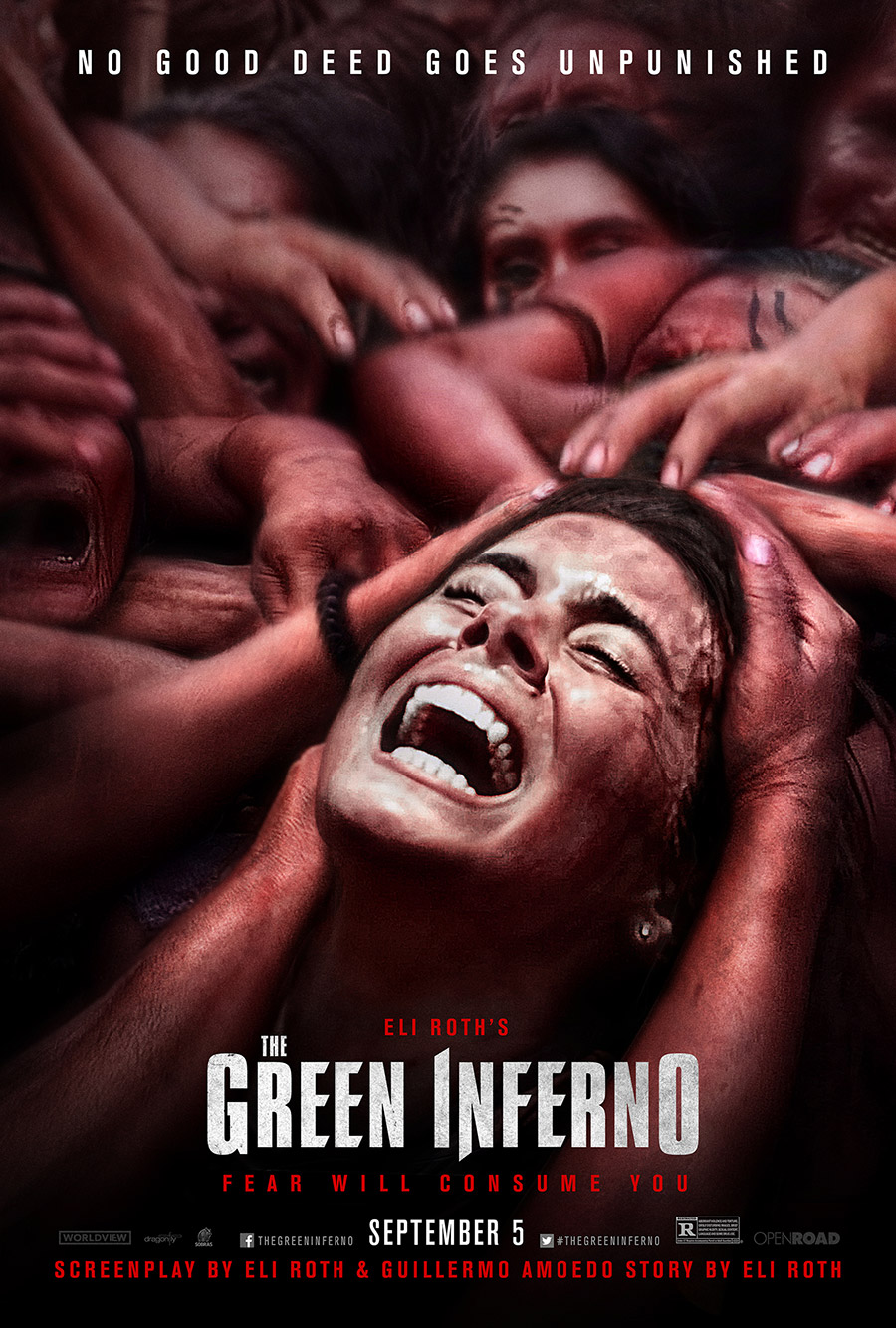
Trailer: The Green Inferno (2nd Official)


green-inferno-poster-900

Ah, the Italian cannibal subgenre of grindhouse and exploitation films. It’s been awhile since we’ve had something like this. Sure, we’ve had cannibal-based films throughout the years with some even becoming cult hits (I look at Ravenous as an example), but not one that takes it’s setting and basic plot straight out of the cannibal films of the late 70’s and early 80’s from the Italian horror filmmakers of that era.

Eli Roth returns to directing after a seven years in hiatus to give horror fans a taste of the old-school cannibal flicks with his homage to Ruggero Deodato’s classic grindhouse film Cannibal Holocaust. The interesting bit about Roth’s film is how it’s title actually is part of the homage to Deodato’s film which was originally suppose to be called….The Green Inferno.

This is the second official trailer for The Green Inferno and it even uses a quaint, serene song to open it up the way Deodato’s film and trailer for said film does over thirty years ago. We don’t see much cannibal feasting going on, but it’s hinted at that it’s what’s for dinner.

Eli Roth’s The Green Inferno is set for an September 5, 2014 release date in the US.

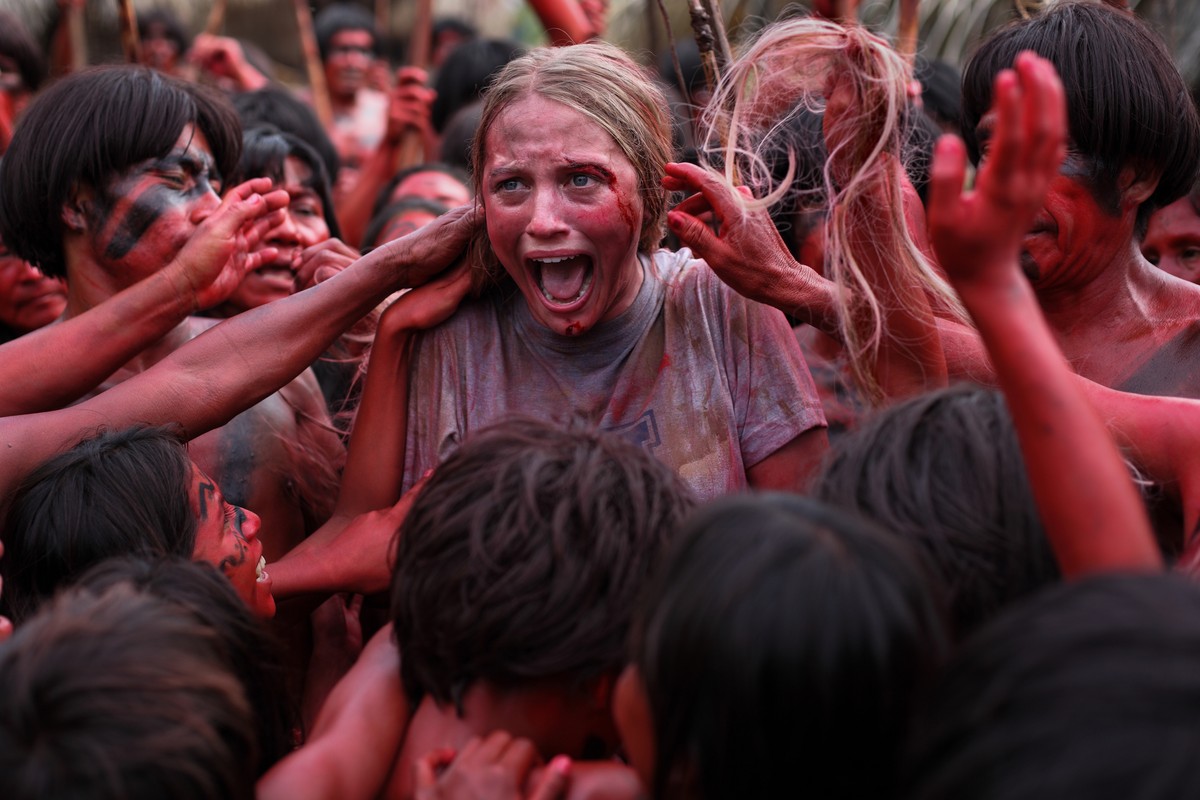
Trailer: Green Inferno


green_inferno_huge

Let’s make it a triple-bill of trailers.

Here’s the first official trailer for Eli Roth’s first film in 6 years. It’s been awhile since we;ve had a proper cannibal film in the theaters and from the buzz coming out of the festival circuit this one could be something to keep a look out for.

Trailer: Sabotage (Red Band)


Sabotage

Since Arnold Schwarzenneger left the California governor’s office and politics he’s gone back to doing what he was good at (or at least good at during the 80’s and 90’s). His first couple of films since getting back in front of the camera has been average at best (though I must say that Last Stand was pretty fun).

Now, we have him back in another film, but this time around one that’s a very hard, gritty R-rating that he hasn’t done since ever. He’s always had rated-R films, but they had a certain fun tone to them. With David Ayer’s Sabotage it looks like Schwarzenneger is trying to flex his hardcore bones. It’s definitely a surprise to hear him curse like a sailor during the red band trailer.

Sabotage is set for a March 28, 2014, release date.

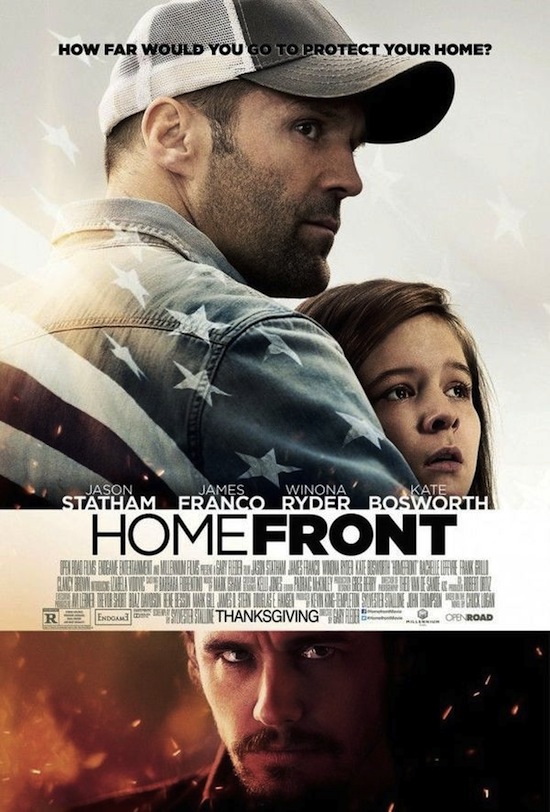
Trailer: Homefront (Official)


homefront

Lisa Marie posted earlier that 2013 was the Year of Franco. She may just be right since there’s another film coming out this year that has him starring.

Homefront has James Franco going mano y mano with another name who seems to be in at least a couple films every year for the past ten years. It’s Statham vs. Franco and while this awkward yet awesome match-up looks like it should be something that went Direct-to-Video there’s a weird vibe around the trailer that looks like it’s the better remake of Peckinpan’s Straw Dogs. We even have Kate Bosworth all up in this film though she’s definitely looking like she may have went a tad bit too method in portraying a meth-head mother.

The cast alone tells me that I must see this when it comes out: Statham, Franco, Bosworth, Winona Ryder, Clancy Brown, Vince D’Onofrio, Frank Grillo and Mischa Barton. One could almost see “guilty pleasure” waving in the background.

So, if there’s nothing else to say about Homefront other than Statham going all Transporter on a meth-dealing biker gang from the bayou it’s the fact that this film will be Hollywood’s birthday gift to me when it comes out on November 27, 2013. Just in time for my birthday.

Franco may have just met his match in Statham.