Insomnia File #33: The Comedian (dir by Taylor Hackford)


What’s an Insomnia File? You know how some times you just can’t get any sleep and, at about three in the morning, you’ll find yourself watching whatever you can find on cable? This feature is all about those insomnia-inspired discoveries!

http://www.youtube.com/watch?v=gLQXUmzXuEo

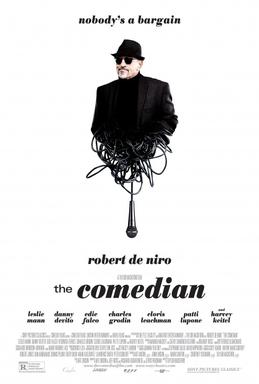
If you were having trouble getting to sleep around two in the morning last night, you could have turned over to Starz and watched the 2016 film, The Comedian.

It probably wouldn’t have helped.  It’s not that The Comedian is a particularly interesting movie or anything like that.  Abysmally paced and full of dull dialogue, The Comedian would be the perfect cure for insomnia if it just wasn’t so damn loud.  Robert De Niro plays an aging comedian named Jackie Burke and, in this movie, being an aging comedian means that you shout out your punch lines with such force that you almost seem to be threatening anyone who doesn’t laugh.  However, the threats aren’t necessary because everyone laughs at everything Jackie says.

Actually, it’s a bit of an understatement to say that everyone laughs.  In The Comedian, Jackie is such a force of pure, unstoppable hilarity that all he has to do is tell someone that they’re fat and literally the entire world will shriek with unbridled joy.  The thing with laughter is that, in the real world, everyone laughs in a different way.  Not everyone reacts to a funny joke with an explosive guffaw.  Some people chuckle.  Some people merely smile.  But, in the world of The Comedian, everyone not only laughs the same way but they also all laugh at the same time.  There’s never anyone who doesn’t immediately get the joke and, by that same token, there’s never anyone who can’t stop laughing once everyone else has fallen silent.  The Comedian takes individuality out of laughter, which is a shame because the ability to laugh is one of the unique things that makes us human.

Anyway, The Comedian is about a formerly famous comedian who is now obscure.  He used to have a hit TV show but now he’s nearly forgotten.  Why he’s forgotten is never made clear because nearly everyone in the movie still seems to think that he’s the funniest guy in the world.  Jackie’s an insult comic and people love it when he tells them that they’re overweight or when he makes fun of their sexual preferences.  This would probably be more believable if Jackie was played by an actor who was a bit less intense than Robert De Niro.  When De Niro starts to make aggressive jokes, you’re natural instinct is not so much to laugh as it is to run before he starts bashing in someone’s head with a lead pipe.

Anyway, the plot of the film is that Jackie gets into a fight with a heckler.  The video of the fight is uploaded to YouTube, which leads to a scene where his manager (Edie Falco) stares at her laptop and announces, “It’s going viral!”  Later on, in the movie, Jackie forces a bunch of old people to sing an obnoxious song with him and he goes viral a second time.  I kept waiting for a shot of a computer screen with “VIRAL” blinking on-and-off but sadly, the movie never provided this much-needed insert.

In between beating up the heckler, ruining his niece’s wedding, and hijacking a retirement home, Jackie finds the time to fall in love with Harmony Schlitz (Leslie Mann), a character whose name alone is enough to The Comedian one of the most annoying films of all time.  Harmony’s father is a retired gangster (Harvey Keitel) and you can’t help but wish that Keitel and De Niro could have switched roles.  It wouldn’t have made the movie any better but at least there would have been a chance of Keitel going batshit insane whenever he took the stage to deliver jokes.

I’m not sure why anyone thought it would be a good idea to cast an actor like Robert De Niro as a successful comedian.  It’s true that De Niro was brilliant playing a comedian in The King of Comedy but Rupert Pupkin was supposed to be awkward, off-putting, and not very funny.  I’m not an expert on insult comics but, from what I’ve seen, it appears that the successful ones largely succeed by suggesting that they’re just having fun with the insults, that no one should take it personally, and that they appreciate any member of the audience who is willing to be a good sport.  Jackie just comes across like a cranky old misogynist.  Watching Jackie is like listening to your bitter uncle play Vegas.  I guess it would help if Jackie actually said something funny every once in a while.  A typical Jackie joke is to refer to his lesbian niece as being a “prince.”  Speaking for myself, when it comes to Robert De Niro being funny, I continue to prefer the scene in Casino where he hosts the Ace Rothstein Show.

Perhaps the funniest thing about The Comedian is that, when it originally released into theaters, it was advertised as being “The Comedian, a Taylor Hackford film,” as if Taylor Hackford is some type of Scorsese-style auteur.  Taylor Hackford has been making films for longer than I’ve been alive and he has yet to actually come up with any sort of signature style beyond point and shoot.  The second funniest thing is that The Comedian was billed as a potential Oscar contender, up until people actually saw the damn thing.

Though it may have failed at the box office, The Comedian seems to show up on Starz quite frequently.  They always seem to air it very late at night, as if they’re hoping people won’t notice.  
Previous Insomnia Files:

  1. Story of Mankind
  2. Stag
  3. Love Is A Gun
  4. Nina Takes A Lover
  5. Black Ice
  6. Frogs For Snakes
  7. Fair Game
  8. From The Hip
  9. Born Killers
  10. Eye For An Eye
  11. Summer Catch
  12. Beyond the Law
  13. Spring Broke
  14. Promise
  15. George Wallace
  16. Kill The Messenger
  17. The Suburbans
  18. Only The Strong
  19. Great Expectations
  20. Casual Sex?
  21. Truth
  22. Insomina
  23. Death Do Us Part
  24. A Star is Born
  25. The Winning Season
  26. Rabbit Run
  27. Remember My Name
  28. The Arrangement
  29. Day of the Animals
  30. Still of The Night
  31. Arsenal
  32. Smooth Talk

Sundance Film Review: Reservoir Dogs (dir by Quentin Tarantino)


The Sundance Film Festival is currently taking place in Utah so, for this week, I’m reviewing films that either premiered, won awards at, or otherwise made a splash at Sundance!  Today, I take a look at 1992’s Reservoir Dogs, which premiered at that year’s Sundance Film Festival.

Technically, I guess I’m obligated to start this review with a spoiler alert.  Though, seriously, is there anyone out there who hasn’t seen Reservoir Dogs?  I guess that there may be.  But surely, even if you haven’t seen it, you know everything that happens in the movie.  You know about the Like A Virgin conversation at the start of the movie.  You know about the ear scene.  You’ve seen countless parodies of that scene where the cast walks down the street in slow motion.  I find it hard to believe that there are people who don’t know everything about this film but still, I guess it’s always a possibility.

Reservoir Dogs is a challenging film to review, though not because it’s overly complicated or difficult to follow.  Instead, the problem is that it’s hard to know what’s left to say about Reservoir Dogs.  Just about every crime film that has come out in my lifetime has owed an obvious debt to Reservoir Dogs.  It’s the film that launched the directorial career of Quentin Tarantino.  It’s also features one of the greatest acting ensembles in the history of American film: Harvey Keitel, Tim Roth, Michael Madsen, Steve Buscemi, Chris Penn, Kirk Baltz, and Lawrence Tierney.  Tierney’s presence was especially important.  By appearing in the film, the veteran tough guy actor passed on the torch of hard-boiled crime to a new generation.

At its most basic, Reservoir Dogs is a heist film.  It employs the type of jumbled timeline that has become a Tarantino trademark.  The film starts with a group of 8 criminals eating breakfast and preparing to rob a jewelry store.  Then it jumps forward to immediately after the crime, with Mr. Orange (Tim Roth) shot in the gut and Mr. White (Harvey Keitel) desperately trying to get them both to the safety of a warehouse.  That’s where they are joined by Mr. Pink (Steve Buscemi).  Mr. Pink is convinced that they were set up.  He rants about being a professional.  He asks if Mr. White had to shoot anyone during his escape.

“A few cops,” Mr. White says.

“No real people?” Mr. Pink replies.

Eventually, Mr. Blonde (Michael Madsen) shows up.  We already know, from the film’s first scene, that Mr. Blonde strongly feels that everyone should tip their waitress.  After he arrives at the warehouse, we discover that he also likes good music and torturing hostages.  Meanwhile, the robbery’s mastermind, Joe Cabot (Lawrence Tierney) and his son, Eddie (Chris Penn), are also on their way to the warehouse.  Neither one is happy about how things are going.

And while all this goes on, Mr. Orange continues to bleed in the background…

Reservoir Dogs is known for being a violent film and, even though the movie is 26 years old, some of the violence can still catch you off-guard and make you flinch.  The scene where Mr. Blonde chops off the cop’s ear is still not easy to watch.  However, the scene that always freaks me out is when Mr. White starts shooting at a police car and the windshield is suddenly smeared with blood.  Mr. White is one of the film’s more sympathetic characters but he doesn’t hesitate to kill.

Of course, I think it could also be argued that Reservoir Dogs is actually as close as Tarantino has come to making a film that condemns violence.  Not counting the flashbacks, the story largely plays out in real time, which means that we basically spend the entire movie watching and listening as Mr. Orange slowly bleeds to death in front of us.

I rewatched Reservoir Dogs for this review and I have to say that I was really surprised to see how well the film holds up.  I was honestly expecting to be a little bit bored with it, just because I’d already seen it multiple times and I knew who the cop would turn out to be.  I already had all of the film’s great lines memorized.  But, as soon as the film started with everyone arguing about Like A Virgin and whether or not to tip their waitress, I was sucked back into Tarantino’s world.  Once again, I found myself laughing at Steve Buscemi’s brilliant delivery of the line: “Why am I Mr. Pink?”  I was enthralled all over again by Tim Roth’s nervous intensity and Harvey Keitel’s weary integrity.  Even Michael Madsen’s psycho routine felt fresh, despite the fact that he’s played numerous cool-as-ice psychos over the course of his career.  Even the way Chris Penn told the story about Lady E still made me laugh.

(To be honest, the line that makes me laugh the most in Reservoir Dogs — and don’t ask me why because I’m not sure of the exact reason — is when the unseen cop who is heard to say, “Yeah, give me the bearclaw,” while following Eddie’s car.)

It’s just a cool movie.  How can you resist this?

What happen at the end of the film?  Well, we all know the basics.  (And here’s where that probably unnecessary spoiler alert comes into play.)  Mr. White kills Joe and Eddie, all to protect Mr. Orange.  Mr. Pink runs from the warehouse.  The seriously wounded Mr. White cradles the dying Orange in his arms.  Orange confesses to being a cop.  Mr. White lets out a wail of both physical and emotional pain.  The police enter the warehouse and order Mr. White to drop his gun.  Mr. White shoots Orange in the head and is then gunned down by the police.

But what happened to Mr. Pink?

That’s a serious question because Mr. Pink is my favorite member of this band of robbers.  (He gets all the best lines, probably because Tarantino was planning on playing the role himself before Steve Buscemi auditioned.)  A lot of people will tell you that they can hear Mr. Pink being arrested outside of the warehouse, shortly before the cops come in and kill Mr. White.  And yes, I realize that, in at least one draft of the script, that’s exactly what happened.

Well, I don’t care.  We don’t actually see Mr. Pink getting arrested.  We don’t hear him getting shot.  As far as I’m concerned, Mr. Pink made it out of there alive and managed to escape with the diamonds.  The police may have yelled at him to stop but, in the end, they were too busy killing Mr. White to keep an eye on him.  Mr. Pink escaped and is currently living on the beach somewhere.  As a result of selling the diamonds, he’s now financially comfortable but he still doesn’t tip his waitress.  That’s just the way Mr. Pink is.

Finally, one little bit of trivia: Reservoir Dogs may have premiered at the 1992 Sundance Film Festival but it didn’t win any awards at the end of it.  Instead, the big winner that year was a comedy called In The Soup.  The star of that film?  Steve Buscemi.

Previous Sundance Film Reviews:

  1. Blood Simple
  2. I Don’t Feel At Home In This World Anymore
  3. Circle of Power
  4. Old Enough
  5. Blue Caprice
  6. The Big Sick
  7. Alpha Dog
  8. Stranger Than Paradise
  9. sex, lies, and videotape

A Movie A Day #153: Blue Collar (1978, directed by Paul Schrader)


Three Detroit auto workers (played by Harvey Keitel, Yaphet Kotto, and Richard Pryor) are fed up.
It’s not just that management is constantly overworking them and trying to cheat them out of their money.  That’s what management does, after all.  What really upsets them is that their union is not doing anything to help.  While the head of the union is getting rich off of their dues and spending time at the White House, Keitel is struggling to pay for his daughter’s braces, Kotto is in debt to a loan shark, and Pryor is lying to the IRS about the number of children that he has.  (When a social worker shows up unexpectedly, Pryor’s wife recruits neighborhood children to pretend to be their’s.)  Kotto, Pryor, and Keitel plot to rob the union but instead, they just discover evidence of the union’s ties to the mob.  The union bosses will do anything to keep that information from being revealed, from trying to turn the friends against one another to committing murder.

Blue Collar was the directorial debut of screenwriter Paul Schrader.  Schrader has said that the three main cast members did not get along during the filming, with Richard Pryor apparently bringing a gun to the set and announcing that there was no way he was going to do more than three takes of any scene.  The tension between the lead actors is visible in the film, with all three of them giving edgy and angry performances.  That anger is appropriate because Blue Collar is one of the few films to try to honestly tackle what it’s like to be a member of the “working class” in America.  While management is presented as being a bunch of clowns, Blue Collar reserves its greatest fury for the corrupt union bosses who claim to represent the workers but who, instead, are just exploiting them.  The characters in Blue Collar are pissed off because they know that nobody’s got their back.  To both management and the union, the workers are worth less than the cars that they spend all day putting together and the money that can be subtracted from all their already meager pay checks.

Since it’s a Paul Schrader film from 1978, the action in Blue Collar does come to a halt, 40 minutes in, for a cocaine-fueled orgy that feels out of place.  While Keitel and especially Kotto give believable performances, Pryor sometimes seems to be struggling to keep up.  Still, flaws and all, Blue Collar has a raw and authentic feel to it, something that few other movies about the working class have been able to capture.  Perhaps because it never sentimentalizes its characters or their situation, Blue Collar was not a box office success but it has stood the test of time better than many of the other films that were released that same year.  Sadly overlooked, Blue Collar is a classic American movie.


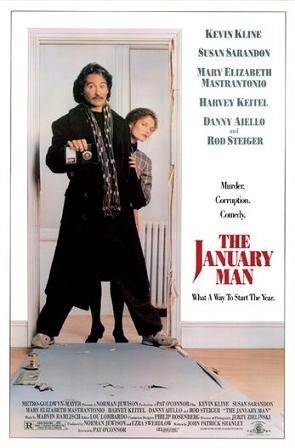
In Praise of Alan Rickman: The January Man (1989, directed by Pat O’Connor)


JanuarymanposterLast week, when the world first learned of the death of the actor Alan Rickman, it was shocking to realize just how many great roles he had played.  He made his feature film debut as Hans Gruber in Die Hard.  He played Colonel Brandon in Sense and Sensibility, Severus Snape in the Harry Potter movies, the Sheriff of Nottingham in Robin Hood: Prince of Thieves, Hilly Kristal in CGBG and Marvin the Paranoid Android in Hitchhiker’s Guide to the Galaxy.  He even played Leonard Nimoy Alexander Dane in Galaxy Quest.  But the first time I ever saw Alan Rickman, he was playing Ed the Painter in The January Man.
As The January Man begins, the new year is barely a day old and already Manhattan is in a panic.  Over the past 11 months, a serial killer has terrorized the city, killing one woman per month.  His latest victim, Allison Hawkins (Faye Grant) was murdered on New Year’s Eve.  Now, it’s January and everyone in New York City is waiting for the killer to strike again.

Mayor Flynn (Rod Steiger, bellowing his lines as only an Oscar-winning “great” actor can) is upset because Allison was a friend of his daughter, Bernadette (Mary Elizabeth Mastrantonio).  Flynn orders the police commissioner, Frank Starkey (Harvey Keitel), to put his brother on the case.  Nick Starky (Kevin Kline) was the best detective in New York but Frank framed him on corruption charges.  Now, Nick is working as a fireman and does not want to return to police work.  However, Nick tells Frank that he will investigate the murders on one condition: Nick wants to make dinner for Frank’s wife (and Nick’s former lover), Christine (Susan Sarandon).

After cooking an octopus for Christine, Nick works the case.  His unorthodox methods get on the nerves of Capt. Alcoa (Danny Aiello, bellowing almost as much as Rod Steiger) but also wins him the heart of Bernadette.  Helping him investigate the case (and repainting his office) is his neighbor, Ed (Alan Rickman).  Ed is not only a painter but he’s also a computer expert who figures out exactly where the killer is going to strike next.

The January Man was Alan Rickman’s second film and followed his debut in Die Hard.  Other than sharing a similarly sarcastic sense of humor, Ed the Painter is the exact opposite of Hans Gruber.  Gruber was a murderer who would do anything for money.  Ed is an artist who wants only to paint and hang out with Nick Starkey.

When I first saw The January Man, I was seven years old and I was on an airplane flying to London.  I was too young to really understand what was happening in the movie but I knew that Ed was my favorite character because he was the one who got all the funny lines and he spoke with a British accent.  When he told one of his models “Don’t molest anything,” I thought it was hilarious even though I did not really understand what he was talking about.  (Years later, I would watch The January Man on HBO and I would discover that Ed made his living painting nudes and that Bernadette and Nick were having sex, all information that was edited out of the airplane version.)

After I heard that Rickman had died, I rewatched The January Man for the first time in years.  I discovered that The January Man is a terrible movie that tries to unsuccessfully to mix slapstick comedy with brutal serial killer action but Alan Rickman still gives a really good performance, the best in the film.  (A close second would be Mary Elizabeth Mastrantonio, whose smile lights up every scene in which she appears.  She married the movie’s director so at least she got something good out of appearing in The January Man.)  That Alan Rickman is one of the film’s few bright spots is a testament to his talent as an actor.  Alan Rickman was such a great actor that he even made The January Man watchable.

Alan Rickman

RIP, Alan Rickman.

Lisa’s Early Oscar Predictions for August!


everest-jake-gyllenhaal

Well, here we are.  The year is more than halfway over.  The fall movie season is approaching.  And yet, not a single true Oscar front-runner has yet to emerge.  Could this be the year that a true populist hit, like Mad Max: Fury Road, or an unexpected art house wonder, like Ex Machina, manages to secure a spot?

Well, probably not.  But still, it’s fun to speculate!

(Are Oscar pundits being too quick to dismiss Straight Outta Compton?  I have not seen it yet but look at those reviews and look at that box office.  It’s an interesting question.)

Anyway, here are my prediction for August!  To see how my thinking has evolved over the year, check out my predictions of January, February, March, April, May, June, and July!

Best Picture

Black Mass

Brookyln

Carol

The Danish Girl

Everest

Inside Out

Joy

Sicario

Suffragette

Youth

Best Actor

Michael Caine in Youth

Don Cheadle in Miles Ahead

Johnny Depp in Black Mass

Michael Fassbender in Steve Jobs

Eddie Redmayne in The Danish Girl

Best Actress

Cate Blanchett in Carol

Jennifer Lawrence in Joy

Julianne Moore in Freeheld

Saoirse Ronan in Brooklyn

Lily Tomlin in Grandma

Best Supporting Actor

Robert De Niro in Joy

Benicio Del Toro in Sicario

Tom Hardy in The Revenant

Harvey Keitel in Youth

Kurt Russell in The Hateful Eight

Best Supporting Actress

Helena Bonham Carter in Suffragette

Jennifer Jason Leigh in The Hateful Eight

Rooney Mara in Carol

Ellen Page in Freeheld

Julie Walters in Brooklyn

Best Director

John Cowley for Brooklyn

Todd Haynes for Carol

David O. Russell for Joy

Paolo Sorrentino for Youth

Denis Villenueve for Sicario

sicario-emily-blunt-trailer

Lisa’s Early Oscar Predictions for July!


Sicario

It’s shaping up to be a strange Oscar race.  Here we are halfway through the year and, yet, there are no front-runners.  Some very acclaimed films have been released this year and yet, few of them seem to be getting the type of buzz that usually accompanies a surprise Oscar nomination.  Last year at this time, there was cautious buzz for Grand Budapest Hotel while almost everyone felt pretty safe assuming that Sundance favorites like Boyhood and Whiplash would be players in the Oscar race and many of us were highly anticipating the release of films like Birdman and The Imitation Game.  (For that matter, a lot of people were also still convinced that Unbroken would win best picture.  The buzz is not always correct but still, the buzz was still there.)

This year, some people are hoping that Mad Max: Fury Road will somehow break through the Academy’s aversion to “genre” filmmaking.  (And seriously, the Doof Warrior deserves some sort of award, don’t you think?)  Quite a few are hoping that Ex Machina will not be forgotten.  Personally, I have high hopes for Inside Out.  The buzz around Bridge of Spies is respectful, largely because it seems like the type of film that usually would be be nominated.  (That said, this film also seems like it could bring out the worst impulses of both Steven Spielberg and Tom Hanks, leading to a movie that will have more in common with The Terminal than with War Horse.)  Carol was beloved at Cannes.

So there are definitely possibilities out there.  When I made my Oscar predictions for this month, I didn’t quite have to blindly guess as much as I did way back in January.  But still, it cannot be denied that — as of right now — this race is wide open and there’s a lot of room for surprise.

Below, you’ll find my Oscar predictions for July.  You can also check out my previous Oscar predictions for January, February, March, April, May, and June!

Best Picture

Black Mass

Brooklyn

Carol

I Saw The Light

In The Heart of the Sea

Inside Out

Sicario

Suffragette

The Walk

Youth

Best Actor

Michael Caine in Youth

Johnny Depp in Black Mass

Michael Fassbender in Steve Jobs

Tom Hiddleston in I Saw The Light

Eddie Redmayne in The Danish Girl

Best Actress

Cate Blanchett in Carol

Marion Cotillard in MacBeth

Sally Field in Hello, My Name Is Doris

Saoirse Ronan in Brooklyn

Lily Tomlin in Grandma

Best Supporting Actor

Albert Brooks in Concussion

John Cusack in Love & Mercy

Benicio Del Toro in Sicario

Harvey Keitel in Youth

Kurt Russell in The Hateful Eight

Best Supporting Actress

Joan Allen in Room

Helena Bonham Carter in Suffragette

Jane Fonda in Youth

Jennifer Jason Leigh in The Hateful Eight

Rooney Mara in Carol

Best Director

John Crowley for Brooklyn

Todd Haynes for Carol

Ron Howard for In The Heart of the Sea

Denis Villenueve for Sicario

Robert Zemeckis for The Walk

tom-hiddleston-hank-3


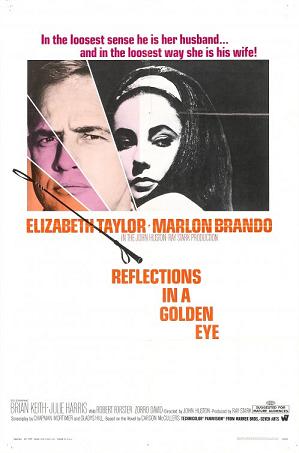
Embracing the Melodrama Part II #33: Reflections in a Golden Eye (dir by John Huston)


Reflections_in_a_golden_eyeFor the past two weeks, I’ve been reviewing, in chronological order, 126 cinematic melodramas.  I started in the 1920s with Sunrise and Wings and now, 33 reviews later, we have finally reached the end of the 1960s.  And what better way to end the 60s than by taking a mercifully brief look at the 1969 film, Reflections in a Golden Eye.

Now, before I get too critical of this film, I should acknowledge that there are some critics who absolutely love Reflections in a Golden Eye.  They think very highly of Marlon Brando’s performance as Maj. Weldon Penderton, a closeted homosexual who is stationed at a military base in the South.  They think that Elizabeth Taylor’s performance as Brando’s wife isn’t somewhat embarrassing.  And they think that the script isn’t overwritten and that director John Huston doesn’t try way too hard to prove himself worthy of the title auteur.  They feel that Reflections in a Golden Eye is a secret masterpiece that does not deserve to be known as an infamous flop.

I’m definitely not one of those people but they do exist.  There are some very respectable and intelligent critics who happen to love Reflections in a Golden Eye.

Well — vive la différence!

Earlier in this series, I pointed out that the 60s were not a great time for old school Hollywood directors trying to compete with both American television and European film.  It was a time when talented directors found themselves trying to keep up with the times and appeal to new audiences.  As a result, Joseph L. Mankiewicz ended up making Cleopatra.  Edward Dmytryk did The Carpetbaggers.  Elia Kazan directed The Arrangement.  William Wyler did The Liberation of L.B. Jones.  Stanley Kramer made RPM.  

And John Huston made Reflections in a Golden Eye.

This painfully slow film follows the affairs of six people on that Southern army base.  Brando is emotionally repressed and spend most of the movie mumbling in one of the worst Southern accents ever.  Taylor is obsessed with horses and spends most of the movie yelling in one of the worst Southern accents ever. Robert Forster is the object of Brando’s repressed desire, a soldier who likes to ride horses while naked and who is obsessed with sniffing Elizabeth Taylor’s underwear.  Brian Keith is in charge of the army base and is having an affair with Taylor.  Julie Harris is Keith’s suicidal wife.  Zorro David is Harris’s houseboy who, at one point, is nice enough to give this film a title by mentioning something about a golden eye.

What’s particularly insane is that Huston took the idea of making this film a reflection in a golden eye literally.  The entire film is tinted a sickly gold color.  Whenever the characters step outside, the sky looks like the sun has just exploded.  Whenever the characters are inside, they all look like they have jaundice.  On the one hand, you have to respect the fact that Huston so committed himself to potentially alienating the audience.  On the other hand, the yellow-tinting renders almost every image so grotesque that I actually found myself growing physically ill as I watched the film.

Watching Reflections in a Golden Eye, I could understand why The Godfather was such a huge comeback for Marlon Brando.  I wouldn’t necessarily say that Brando gives a bad performance here.  He’s watchable throughout the entire film.  But it’s still a performance that’s so strangely modulated (and which features a Southern accent that is just amazingly bad) that it ultimately distracts from the film itself.  If anything, Brando gives a performance that suggests what happens when a talented and eccentric man gets bored with what he’s doing.

(If you want to see a good Brando performance from 1969, see Burn.)

Reflections in a Golden Eye is a pretentious mess but fortunately, both Huston and American film would make a comeback in the 1970s.  We’ll start on that decade tomorrow.

http://www.youtube.com/watch?v=5U2NssXWO5Y

(Yes, this video is a spoiler but it’ll allow you to see the gold tinting.)

(The film was also released in an untinted version.)

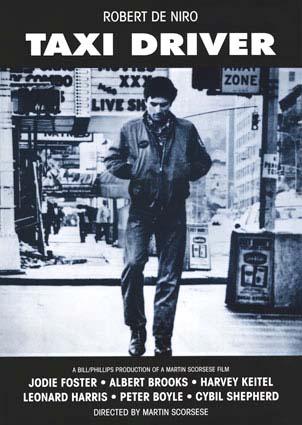
Shattered Politics #39: Taxi Driver (dir by Martin Scorsese)


Taxi_Driver_poster

We’ve never had a President named Charles.  We’ve had several Presidents named John and a quite a few named James.  We’ve even had three named George.  But we’ve never had a Charles.  We’ve come close.  Charles Evans Hughes nearly beat evil old Woodrow Wilson in 1916.  Charles Cotesworth Pinckney was nominated two times in a row by the Federalists but lost to Thomas Jefferson and James Madison respectively.  We’ve had three Vice Presidents names Charles — Fairbanks, Dawes, and Curtis — but never a President.

And, if we ever do elect a President named Charles, he’s probably go by either Charlie or Chuck.  The United States has always liked to think of itself as being a country that has no official royal family and, as a name, Charles probably sounds far to aristocratic for most voters.

That’s why I’m sure that, once U.S. Sen. Charles Palatine won the Democratic presidential nomination back in 1976, he probably insisted that people start calling him Chuck.  Of course, Sen. Palatine probably had no idea how lucky he was to win that nomination.  If not for a few secret service agents, Sen. Palatine could very well have fallen victim to a psychotic taxi driver named Travis Bickle.

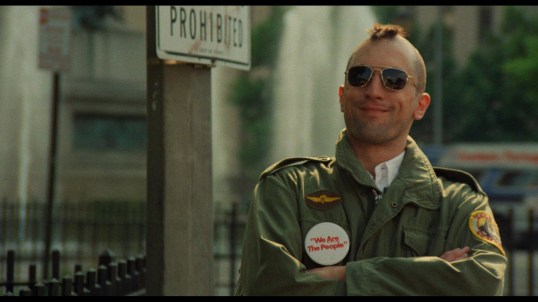
Sen. Palatine’s presidential campaign is a major subplot of Martin Scorsese’s 1976 masterpiece of paranoia, Taxi Driver.  As played by an actor named Leonard Harris, Sen. Palatine appears to be the epitome of a politician.  He may smile at the right moment but his eyes are always shifty.  Even his campaign slogan (“We Are The people!”) is vapid in an all too plausible way.  (How different is “We Are the People” from “We Are The People We’ve Been Waiting For?”)  For the most part, Palatine remains a remote figure, giving speeches and appearing in television commercials.  The only time that we get to know Palatine as a person is when he gets in a taxi being driven by Travis Bickle (Robert De Niro).

Travis recognizes him immediately and tells him that he tells everyone who gets in the cab that “they gotta vote for you.”  Palatine smirks a little as he asks Travis what he thinks the most important issue of the election is.  Travis goes on a bit about how someone needs to destroy all of the scum and filthy lowlifes who seem to populate Travis’s section of New York.  As Travis rambles, Palatine’s smile disappears and it becomes obvious that he’s realized that he is essentially being driven by a psycho.  Oh shit, Palatine is probably thinking, this guy is telling people that they gotta vote for me?  However, Palatine quickly regains his composure and assures Travis that the wisest people that he’s ever met have been taxi drivers.

Of course, what Palatine doesn’t realize is that Travis only knows about the campaign because he happens to be obsessed with a Palatine campaign worker named Betsy (Cybill Shepherd).  And Betsy even goes out with Travis a few times.  But then Travis, who spends the majority of the film showing how little skill he has when it comes to understanding and relating to other people, takes Betsy to an adult film.

With Betsy refusing to take his calls, Travis’s attention shifts to Iris (Jodie Foster), a teenage prostitute.  Obviously seeing himself as being a knight in shining armor, Travis tells Iris that she has to go back home to her parents.  As Travis talks, it becomes apparent that he’s simply repeating talking points that he’s heard on TV.  (If Taxi Driver was made today, Travis would be one of those people constantly sharing “inspirational” Facebook posts.)  Iris laughs at Travis and goes back to her pimp, Sport (Harvey Keitel).

And, of course, Travis goes even crazier than before.

38 years after it was first released, Taxi Driver remains a disturbing and powerful film.  However, what makes it effective is that, in many ways, it’s perhaps the darkest comedy ever made.  Throughout the entire film, Travis essentially tells everyone that he meets that he’s disturbed and potentially dangerous and, throughout the entire film, everyone seems to be determined to ignore all of the signs.

Critics always talks about the scene where Travis points a gun at his mirror and asks, “You talkin’ to me?”  And that’s a great scene.  It deserves to be famous, just as De Niro deserves all of the praise that he’s gotten for his iconic performance in Taxi Driver.

However, for me, there are two other scenes that are just as brilliant.  The first is where Travis attempts to get some advice from an older cabbie named Wizard (Peter Boyle).  Travis says he’s been having a lot bad thoughts.  Wizard shrugs and says that everyone has those.  What makes this scene particularly memorable are the lengths that Wizard goes to in order to avoid acknowledging that Travis is obviously disturbed.

And then, there’s the scene where Travis buys a gun from Easy Andy (Steven Prince).  Andy is such a salesman and is so nonchalant about all of his weaponry that, for a few brief minutes, Steven Prince actually manages to steal the spotlight from Robert De Niro.

Whenever one thinks about Taxi Driver, one automatically pictures Robert De Niro.  That’s why it’s all the more interesting that De Niro was not the first choice for Travis.  When Taxi Driver was in pre-production and a pre-Jaws Steven Spielberg (of all people) was thinking about directing it, Jeff Bridges as briefly attached to the role.  And while it’s always tempting to think about what a Spielberg/Bridges version of Taxi Driver would look like, I think we’re all right to be happy that the actual film was directed by Scorsese and starred De Niro.  They truly made Taxi Driver into one of the most memorable films ever made.

taxi-driver-mohawk

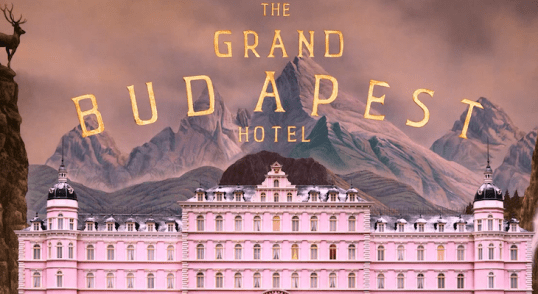
A Few Very Late Thoughts On Wes Anderson’s The Grand Budapest Hotel


grand-budapest-hotel

It took me a while to come around to appreciating The Grand Budapest Hotel.

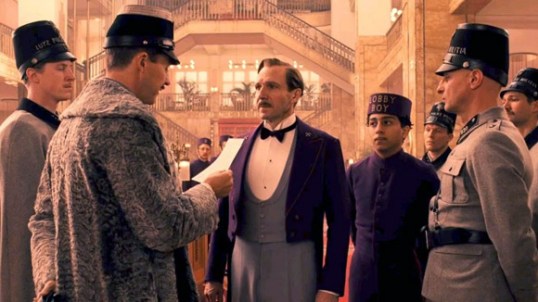
When I first saw Wes Anderson’s latest film, way back in March, I have to admit that I was somehow both impressed and disappointed.  The film’s virtues were obvious.  Ralph Fiennes gave a brilliant lead performance as Gustave, the courtly and womanizing concierge of the Grand Budapest Hotel.  As played by Fiennes, Gustave came to represent a certain type of old world elegance that, I’m assuming, died out long before I was born.  As is typical of Anderson’s film, The Grand Budapest Hotel was visual delight.  Even when the film’s convoluted storyline occasionally grew self-indulgent, The Grand Budapest Hotel was always interesting and fun to watch.

At the same time, I had some issues with The Grand Budapest Hotel.

One of the major ones — and I will admit right now that this will seem minor to some of you — is that halfway through the film, a cat is killed.  The evil Dimitri Desgoffe von Taxis (Adrien Brody) is attempting to intimidate a nervous lawyer, Kovacs (Jeff Goldblum).  Kovacs’s owns a cat and, at one point, Dimitri’s henchman, Jopling (Willem DaFoe), tosses the cat out of a window.  Kovacs runs to window and sees his dead cat splattered on the sidewalk below…

And this is when the audience in the theater laughed and I got very angry.

To me, there was nothing funny about killing that man’s cat.  But the more I’ve thought about it, the more that I’ve come to realize that my reaction had more to do with the audience than the film.  The film was not saying that the cat’s death was funny.  The film was saying that Dimitri and Jopling were evil and dangerous, as their actions throughout the film would demonstrate.  It was the audience that decided, since Grand Budapest Hotel is full of funny moments and has the off-center style that one has come to expect from Wes Anderson, that meant every scene in the film was meant to be played strictly for laughs.  The fact of the matter is that a typical Wes Anderson film will always attract a certain type of hipster douchebag.  They were the ones who loudly laughed, mostly because they had spent the entire movie laughing loudly in order to make sure that everyone around them understood that they were in on the joke.

But that’s not the fault of the film.  Despite what you may have heard and what the Golden Globes would have you believe, The Grand Budapest Hotel is not a comedy.  For all the deliberately funny and quirky moments, The Grand Budapest Hotel is actually a very serious film.  For all of the slapstick and for all of Ralph Fiennes’s snarky line readings, The Grand Budapest Hotel ultimately ends on a note of deep melancholy.

When I first saw The Grand Budapest Hotel, it seemed like it was almost too quirky for its own good.  And, to be honest, I could still have done without some of Anderson’s more self-indulgent touches.  The sequence at the end, where Gustave, who has been framed for murder, gets help from a series of his fellow hotel concierges started out funny but, as everyone from Bill Murray to Owen Wilson put in an appearance, it started to feel less like the story of Gustave and more like the story of all of Wes Anderson’s famous friends.

However, the more I’ve thought about it (and The Grand Budapest Hotel is a film that I’ve thought about a lot over the past year), the more I’ve realized that the quirkiness is only a problem if you made the mistake of thinking that the film is meant to be taken literally.

The more I thought about it, the more obvious it became that the most important scenes in The Grand Budapest Hotel were to be found at the beginning and the end of the film.

The film opens with a teenage girl sitting in front of the grave of a great author.  She opens a book and starts to read.

As soon as the girl starts to read, we flashback 29 years to 1985 where the author (Tom Wilkinson) sits behind his office desk and starts to talk about the time that he visited the Grand Budapest Hotel.  

We flashback again to 1969, where we see how the author (now played by Jude Law) met the owner of the Grand Budapest Hotel, a man named Zero (played by F. Murray Abraham).  Over dinner, Zero tells the author the story of how he first came to the Grand Budapest and how he eventually came to own the hotel.

And again, we go back in time, this time to 1932.  We see how the young Zero (Tony Revolori) first met and came to be the protegé of Gustave (Ralph Fiennes).  We see how Gustave taught Zero how to be the perfect concierge.  Eventually, Gustave would be framed for murdering a guest, Zero would meet and fall in love with Agatha (Saoirse Ronan), and then Zubrowska (the fictional Eastern European country in which this all takes place) would be taken over by fascists who would eventually claim the hotel as their own.

After the story of Gustave, Zero, and Agatha has been told, we suddenly flash forward to the author talking to Zero and then to the old author telling the story to his grandson and then finally back to the teenage reader sitting in the cemetery.

In other words, the Grand Budapest Hotel may be the story of Zero but we’re experiencing it through the memories of the author as visualized by the reader.  Gustave, Zero, and the entire Grand Budapest Hotel are not just parts of a story.  Instead, they become symbols of an old way of life that, though it may have been lost, still exists in the memories of old travelers like the author and the imaginations of young readers like the girl in the cemetery.

As I said at the start of this, I was vaguely disappointed with The Grand Budapest Hotel when I first saw it but, perhaps more than any other movie that I saw last year, this has been a film that I haven’t been able to get out of my mind.  Having recently rewatched the film on HBO, I can also attest that both The Grand Budapest Hotel and Ralph Fiennes’s performance not only hold up on a second viewing but improve as well.

I still stand by some of my original criticisms of The Grand Budapest Hotel.  I still wish that cat had not been thrown out the window, even though I now understand that Anderson’s main intent was to show the evil of Dimitri and Jopling.  And I still find some of the cameos to be jarring, precisely because they take us out of the world of the film.

But you know what?

Despite those flaws, The Grand Budapest Hotel is still a unique and intriguing film.  When I sat down tonight and made out my list of my top 26 films of 2014, I was not surprised that Grand Budapest Hotel made the list.  But I was a little bit surprised at how high I ended up ranking it.

But then I thought about it and it all made sense.

The-Grand-Budapest-Hotel-580


Embracing the Melodrama #43: The Piano (dir by Jane Campion)


I recently watched the 1993 best picture nominee The Piano and all I can say is that it is going to be a struggle to put into words just how much I loved this film.

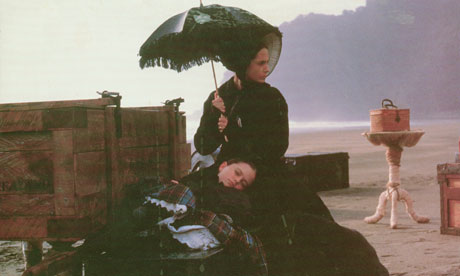
Taking place in the 19th century, The Piano tells the story of Ada (Holly Hunter), a Scottish woman who hasn’t spoken since she was 6 years old.  Like many things in this enigmatic film, the reason why Ada stopped speaking is never clearly stated.  What is known is that she communicates through sign language and by playing her piano.  While Ada is usually a black-clad and somber figure, she comes to life when she plays the piano.  Ada also has a daughter named Flora, the result of a brief affair that Ada had with one of her teachers.  Unlike her mother, Flora (played by 10 year-old Anna Paquin, long before True Blood) is rarely silent and delights in telling elaborate lies about how her father died.

the-piano-01

Ada’s father sells her into marriage to a New Zealand frontiersman named Alisdair (Sam Neill), a man who Ada has never even met.   When Ada and Flora first arrive in New Zealand, they are dropped off on the beach and forced to wait a night until Alsdair can meet them.  In the film’s most hauntingly beautiful scenes, Ada plays her piano on that beach while Ada dances in the surf.  It’s during those scenes that The Piano reveals three of its greatest strengths: the lush cinematography of Stuart Dryburgh, the haunting score composed from Michael Nyman, and the fact that Hunter and Paquin are totally believable as mother and daughter.  Not only is it easy to imagine Paquin growing up to look like Holly Hunter, but the two actresses even manage to perfectly imitate each other’s gestures and facial expressions.  Most of the reviews that I’ve read of  The Piano tend to emphasize the film’s focus on the conflict between the sensual and repressed but to me, the film works just as well as an exploration of the strong bonds that naturally exist between mothers and daughters.  I’m not ashamed to admit that when I look at the picture above, I reminded of how, when I was Flora’s age, I also used to hide behind my mom whenever I saw anyone that I didn’t know coming our way.

When Alisdair does finally show up to take them to their new home, he proves to be a rather cold and distant figure.  It would have been very easy for the film to portray Alisdair as being a completely heartless villain but, as played by Sam Neill, Alisdair is potrtayed as being less a traditional villain and more as just being a painfully unimaginative man who is incapable of understanding why Ada’s piano is so important to her.  To Ada, the piano and its music equals the life and freedom that she’s not allowed to experience.  To Alisdair, the piano is simply a bulky object that will not fit into his small house.  Over Ada’s objections (luckily, Flora is on hand to translate her sign language), Alisdair first leaves the piano on the beach and then agrees to sell it to Baines (Harvey Keitel), another white settler who — unlike Alisdair — is comfortable with the natives and their customs.

Baines, however, allows Ada to come over to his hut and play the piano.  He offers to give the piano back to her — key by key — if she agrees to continue to come to his hut and play while he watches and “pleasures” himself.  Reluctantly, Ada agrees but soon, she and Baines are falling in love.

Needless to say, when Alisdair finds out what has been going on at Baines’s hut, he is not happy.  As he largely considers to be his property, bought and paid for, he also feels that he has the right to decide whether or not she’s capable of playing her piano…

The Piano: Holly Hunter and Anna Paquin

The Piano is a simply an amazing and visually sensual film that is blessed with excellent lead performances from Hunter, Keitel, Neill, and Paquin.  As directed by Jane Campion, The Piano plays out as both a delirious homage to gothic romanticism and a feminist parable about the way that even women who aren’t mute are still punished for expressing their honest desires.

And, of course, there’s that amazing score: