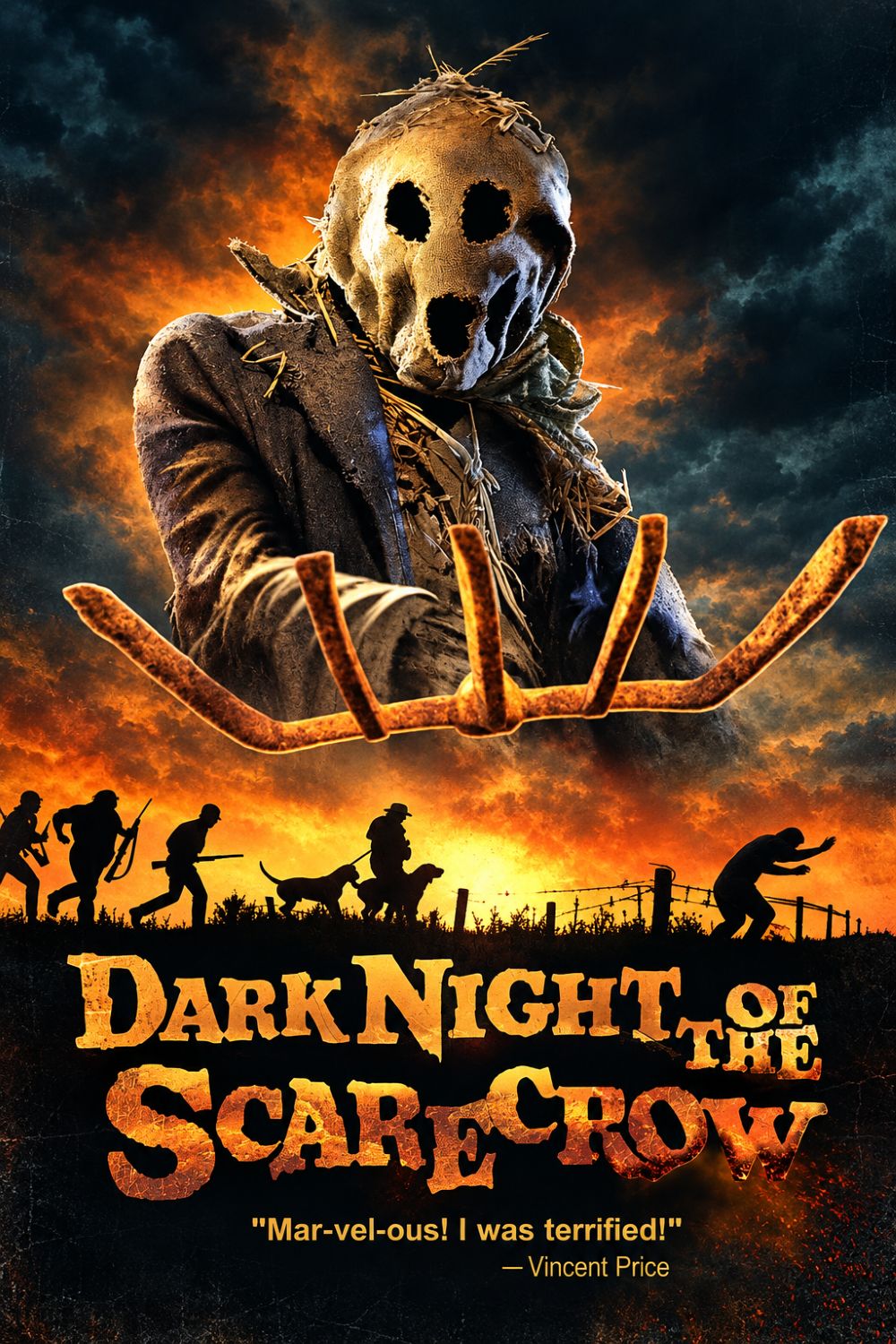
Horror Review: Dark Night of the Scarecrow (dir. by Frank De Felitta)


“You may think you’re getting off free, but there’s other justice in this world besides the law!” — Mrs. Ritter

Frank De Felitta’s Dark Night of the Scarecrow is one of those deceptively modest horror movies that earns its power through atmosphere, patience, and an unusually bitter sense of injustice. Originally made for television in 1981, it has none of the glossy excess or elaborate effects work associated with many theatrical horror releases of its era. What it does have is a sharply constructed premise, a remarkable villain performance from Charles Durning, and a quiet rural setting that becomes steadily more unnerving as the story moves from tragedy into supernatural revenge. It is the kind of film that understands a scarecrow is already an inherently creepy image; it does not need to overexplain or overuse that image to make it work.

The story takes place in a small Southern town where Bubba Ritter, played by Larry Drake, is a gentle, developmentally disabled man whose closest friend is a young girl named Marylee Williams. Their friendship is innocent and affectionate, but it is viewed with suspicion by Otis P. Hazelrigg, a cruel local mail carrier with a personal grudge against Bubba. When Marylee is attacked by a dog and briefly goes missing, Hazelrigg turns the situation into an accusation, convincing three other men that Bubba has harmed the girl. Before anyone bothers to learn the truth, the men hunt Bubba down, shoot him, and stage the scene to make it appear as though he was armed. It is a brutal opening act precisely because the movie refuses to treat its central tragedy as an excuse for cheap melodrama. Bubba is not a monster, and the men who kill him are not panicked heroes making an understandable mistake. They are cowardly, angry men who allow prejudice and resentment to become a death sentence.

That foundation is what separates Dark Night of the Scarecrow from a standard slasher or revenge movie. The supernatural material only becomes effective because the human evil comes first. Bubba’s death is not merely a plot device to unleash a vengeful ghost; it is the film’s moral wound. De Felitta, a veteran novelist as well as the director, approaches the story with an eye for the emotional damage left behind by that act. The film slows down after the killing, allowing the town to sit with the consequences while Hazelrigg becomes increasingly paranoid that Bubba has returned from the grave.

Charles Durning is the movie’s secret weapon. Hazelrigg is one of those villains who is frightening not because he is physically unstoppable, but because he is such a believable bully. Durning gives him a sweaty, blustering confidence that gradually rots into panic. He is the sort of man who believes his position in the community gives him the right to make judgments about everyone else, and he has no trouble manipulating weaker men into sharing responsibility for his own cruelty. Durning never plays Hazelrigg as a cartoonish sadist. Even when he is snarling threats or trying to cover up the murder, there is something painfully recognizable about him: a man who has built his identity around authority and cannot bear the possibility that he has been exposed as morally bankrupt.

Hazelrigg’s hatred of Bubba also has a nasty layer of projection to it. The movie never outright says he is a pedophile, but it heavily implies it through his creepy interest in Marylee, the way he watches her, and Mrs. Ritter’s pointed remarks. That makes his obsessive claim that Bubba is a threat even more grotesque: Hazelrigg seems to be accusing Bubba of the impulses he cannot admit in himself. The implication makes his hostility toward their friendship feel less like misplaced civic concern and more like jealousy, possessiveness, and a desperate effort to hide his own corruption behind moral outrage. It is one of the film’s darkest touches, especially because it remains mostly beneath the surface rather than being presented as a blunt plot revelation.

Larry Drake has a more difficult task because Bubba spends much of the movie absent, concealed, or transformed into a possible supernatural presence. Yet his early scenes are essential. Drake makes Bubba sweet and childlike without turning him into an object of pity or a collection of mannerisms. His relationship with Marylee, played warmly by Tonya Crowe, gives the film its emotional center. There is genuine tenderness in the way Bubba helps her, plays with her, and treats her with uncomplicated kindness. That sweetness makes the later violence feel all the more ugly. Marylee’s grief also carries real weight, because she is one of the only people who completely understands that Bubba was innocent.

The scarecrow itself is used with admirable restraint. There are no elaborate explanations about ancient curses, possession, or elaborate rules governing the entity. The film instead lets the audience wonder whether Bubba’s spirit has actually returned, whether the scarecrow is a physical vessel for vengeance, or whether Hazelrigg is simply losing his mind under the pressure of guilt. That ambiguity gives the movie much of its lasting chill. A scarecrow standing in a distant field, visible at the edge of a frame or appearing where it should not be, is often more frightening than a clearly defined monster charging at the camera. De Felitta recognizes that the image is powerful because it is still, silent, and vaguely human without actually being human.

The television origins are noticeable in some ways. The pacing is deliberate, the violence is largely implied rather than graphic, and the production is understandably small-scale. But those limitations wind up serving the movie. The lack of gore forces the film to emphasize suggestion, shadows, sound, and the ominous openness of its rural setting. Cornfields, dirt roads, farm equipment, abandoned buildings, and dark porches all become part of the film’s horror vocabulary. It feels less like a slick studio shocker and more like a regional ghost story someone might tell you after dark, the kind where the details are simple but the moral is savage.

De Felitta also has a good sense of escalation. The revenge scenes are not huge set pieces, but they are memorable because each one turns something ordinary into a source of menace. The scarecrow’s presence becomes a warning that the men involved in Bubba’s death cannot escape what they did. Instead of relying on body counts alone, the movie builds suspense around Hazelrigg’s growing desperation. Every time he sees the scarecrow—or thinks he sees it—his confidence cracks a little further. The real terror is not just that the dead may be coming for him. It is that there may be no way to outrun the truth.

The ending delivers the kind of grimly satisfying horror-movie justice that the story has earned. It is not triumphant in a cheerful sense, because nothing can undo the tragedy that put the plot in motion. Still, there is a bleak pleasure in watching Hazelrigg finally face the consequences of his actions. The film’s revenge is measured rather than sadistic, and that makes it more effective. It feels like a judgment rather than a spectacle.

Despite its TV roots, Dark Night of the Scarecrow has become a very underrated horror film, with many genre aficionados lauding it as one of the best horror films made, period. That reputation is understandable. It is not the loudest or bloodiest horror film of the early 1980s, and viewers expecting a fast-paced scarecrow slasher may initially be surprised by how much time it spends on character, grief, and small-town malice. But that is exactly why it endures. The film has a soul beneath its scares, and its simple supernatural premise gains force from the cruelty of the world around it.

Ultimately, Dark Night of the Scarecrow works because it never forgets that its monster is born from human wrongdoing. The scarecrow is frightening, but Hazelrigg and the mob that follows him are worse because they are entirely plausible. Frank De Felitta turns a compact television movie into a haunting morality tale about prejudice, guilt, repression, and the terrible cost of refusing to see another person’s humanity. Its effects may be modest, but its mood is potent, its villain is unforgettable, and its final image lingers like something standing motionless at the far end of a field.
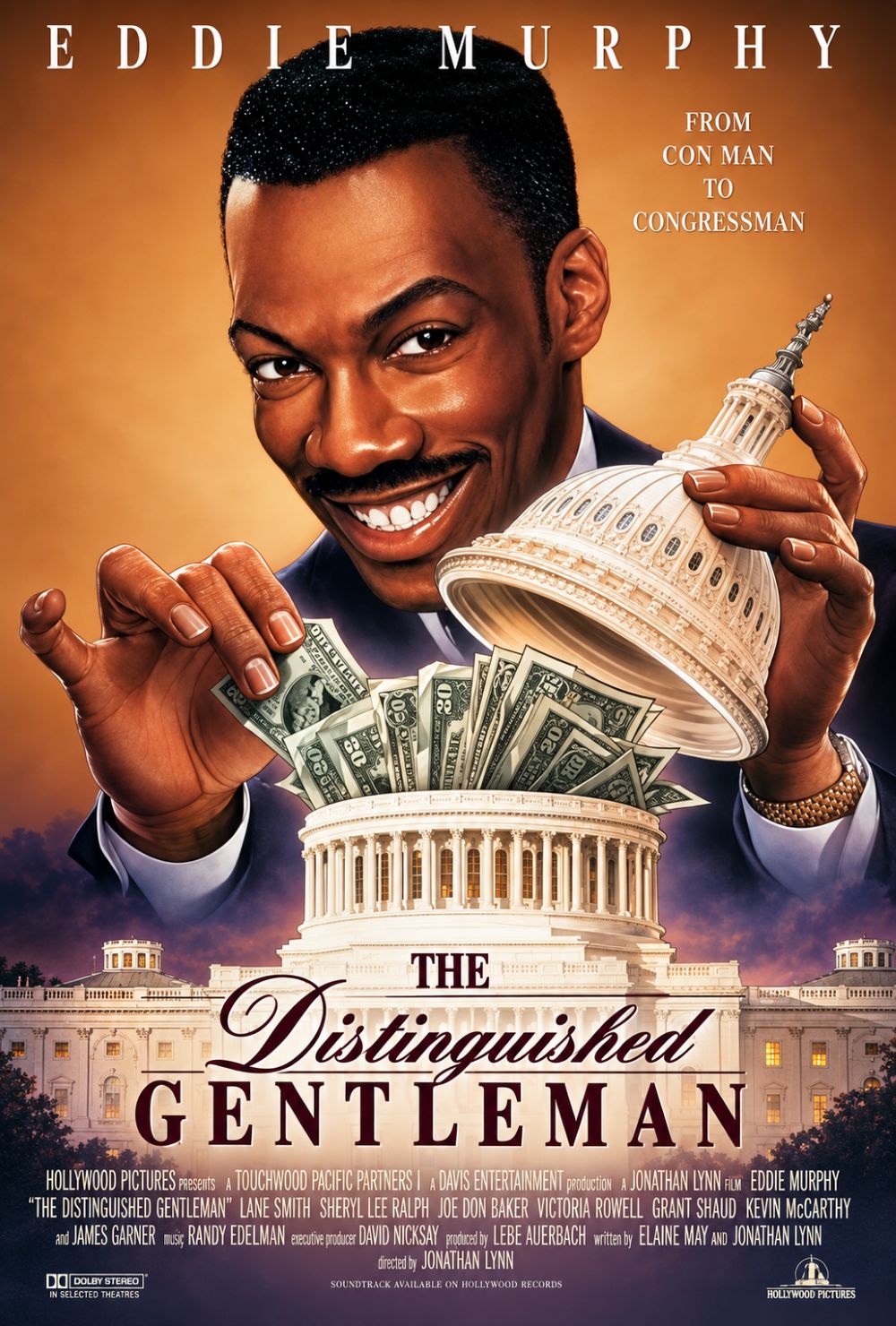
Review: The Distinguished Gentleman (dir. by Jonathan Lynn)


“With all this money coming in from both sides, how does anything ever get done?” — Thomas Jefferson Johnson

The Distinguished Gentleman is an uneven but enjoyable Eddie Murphy comedy whose premise has become more relevant with time. Directed by Jonathan Lynn, the 1992 film casts Murphy as Thomas Jefferson Johnson, a Florida con man who discovers that a recently deceased congressman had the exact same name. Seeing a shortcut to money and status, Johnson runs for the vacant House seat, wins largely on name recognition, and enters Washington with no meaningful political experience. In 1992, that premise played as broad political satire. Today, it carries a more uneasy edge, because its suggestion that image, recognition, and confidence can outrun scrutiny does not seem nearly as far-fetched.

That change in perspective makes the film’s central joke more interesting. Johnson begins as a small-time hustler who understands scams, pressure, ego, and persuasion. Once he reaches Congress, however, he discovers a political world that runs on many of the same instincts. The people around him do not call their dealings scams. They talk about donations, access, relationships, opportunities, and constituent concerns. But Johnson sees the transaction beneath the polished language immediately. The movie’s sharpest idea is that he may be a con man, yet he is not automatically the least honest person in Washington. He merely lacks the expensive suits and professional vocabulary used to make self-interest look respectable.

Murphy is exactly the right actor to make that contradiction work. Thomas Jefferson Johnson has to be selfish enough for the premise to hold together, clever enough to survive in an unfamiliar environment, and charming enough that the audience still wants to follow him after he wins office through deception. Murphy brings all of those qualities to the role. Johnson enjoys the attention, travel, influence, and special treatment attached to public office because he sees Congress as the biggest score he has ever found. At the same time, Murphy gives him enough quickness and warmth that he never becomes unpleasant. Even when Johnson does not understand what is happening around him, he moves through Washington with the confidence of someone who assumes he belongs there.

That confidence drives the movie’s strongest material. Johnson may not know committee procedure, legislative language, or public policy, but he knows people. He can recognize when praise is a setup, when a favor comes with strings attached, and when a supposedly helpful figure is treating him as an investment. This makes him an effective comic guide through Washington’s rituals. He is unqualified in the usual sense, but he is unusually qualified to identify the self-dealing hidden behind political formality. Jonathan Lynn understands the humor in that contrast and keeps the early scenes moving briskly through offices, hearings, fundraisers, press events, and lobbyist meetings. His direction is functional rather than visually distinctive, but it gives Murphy room to work and makes the political setting clear without drowning the comedy in procedure.

The problem is that the movie gradually moves away from the very idea that gives it its satirical bite. Johnson’s election is a pointed joke about name recognition, voter inattentiveness, and political branding. He wins because his name is familiar enough to inspire trust, not because anyone has evaluated his experience, policies, or character. That setup could have supported a more sustained comedy about campaigns, media manipulation, and the ease with which public image can substitute for qualification. Instead, the film shifts into a more conventional pharmaceutical-company corruption plot, giving Johnson an external villain and a clear reason to become more responsible.

That shift is understandable, since the story needs stakes beyond Johnson simply enjoying the perks of Congress. It also gives Murphy a more sympathetic character arc. Once Johnson sees the real-world consequences of corporate influence and political favors, he begins to use his instincts against people whose schemes are more damaging than his own. The change works because he does not become a completely different person. He remains fast-talking, opportunistic, and alert to every available angle. What changes is his sense of scale: his scams are about quick money, while the larger political and corporate schemes around him can hurt ordinary people while remaining hidden behind legal language and respectable appearances.

Still, making the conflict so clear-cut also weakens the satire. The opening suggests that corruption is part of a broader culture of money, access, public relations, and political influence. The later plot makes it easier to imagine that the problem lies mainly with a few especially corrupt people. Lane Smith’s Dick Dodge represents that polished form of corruption effectively. Dodge has the calm authority and practiced respectability of a politician who can make unethical behavior sound like normal procedure. He is a good villain precisely because he does not need to look obviously sinister; he simply treats power as something to be managed for private benefit.

Dodge’s presence becomes more useful because the film gives him a genuine counterweight in Charles S. Dutton’s Congressman Elijah Hawkins. Hawkins is almost Dodge’s opposite: plainspoken, principled, and committed to the idea that public office should mean public service. Dutton gives the role enough strength that Hawkins does not come across as a bland symbol of virtue. He is not there simply to lecture Johnson. Instead, he demonstrates that integrity and competence can exist within the same institution that has rewarded Dodge’s cynicism. Through these two men, Johnson sees both versions of political life: Dodge shows how power can be abused, while Hawkins shows what it is supposed to accomplish.

That contrast helps the film’s best themes land even when the plot becomes more routine. Johnson starts out believing that public office is just another hustle, only with better benefits and larger payouts. Hawkins gives him a reason to see the job differently, while Dodge proves that the cynicism Johnson brought to Washington is not entirely misplaced. Johnson’s eventual decision to push back against corruption therefore feels earned, even if the film resolves the conflict more neatly than its setup deserves. He does not become an idealist so much as a hustler who finally recognizes that the people above him are running a far bigger and more harmful game.

Viewed now, that idea carries more weight than it did in 1992. George Santos’s rise and eventual expulsion from Congress following repeated revelations about his background and finances offered a modern example of political presentation outpacing public scrutiny. Tommy Tuberville’s move from high-profile college-football coach and broadcaster into the U.S. Senate reflects a different but related reality: name recognition built outside politics can be a major electoral asset. The point is not that either man is literally comparable to Thomas Jefferson Johnson. It is that the film’s basic concern—how easily familiarity and confidence can be mistaken for qualification—has become harder to dismiss as mere comic exaggeration.

The same pattern can be seen beyond Congress. Donald Trump reached the presidency after decades as a celebrity businessman and television personality, while Arnold Schwarzenegger’s worldwide fame as a bodybuilder and movie star became a significant advantage in his successful run for governor of California. Celebrity alone never explains an election, and prior careers in sports or entertainment do not automatically make someone unfit for public office. Still, those examples show why the film’s name-recognition joke now feels more pointed. A highly recognizable candidate begins with a built-in audience, a simple public identity, and the kind of familiarity that many traditional candidates spend years trying to earn.

That dynamic has only become more visible as media personalities from different ideological camps seek office. Television hosts, pundits, podcasters, athletes, entertainers, and online figures can launch campaigns with established audiences, fundraising networks, and brand recognition already in place. In that environment, Johnson’s path to office feels less like an impossible gag and more like a deliberately exaggerated version of a real political tendency. The Distinguished Gentleman is not predicting every modern development, but it understands that voters may attach trust to a familiar name or face before they ask harder questions about qualifications, judgment, or policy.

This added relevance does not erase the film’s flaws. The comedy is still inconsistent, and the lobbyists, politicians, and corporate villains are often broader than they are funny. Murphy can make routine scenes entertaining, particularly when Johnson bluffs through official settings with total confidence despite not knowing the rules. But the movie often settles for familiar Washington stereotypes when it could push its satire further. It is rarely dull, yet it repeatedly avoids the messier implications of its best idea.

Even so, The Distinguished Gentleman remains worth revisiting as a mid-tier Murphy vehicle with more ambition than its reputation suggests. It does not have the comic consistency of Trading Places, the invention of Coming to America, or the effortless momentum of Beverly Hills Cop. Its pharmaceutical-company plot is too conventional, and its ending is more reassuring than genuinely sharp. Yet Murphy gives it a strong center, Dutton and Smith create an effective moral and political contrast, and the premise has gained resonance with time. What began as a funny story about a con man finding his way into Congress now plays as a reminder that political satire becomes less comfortable when reality starts catching up to it.

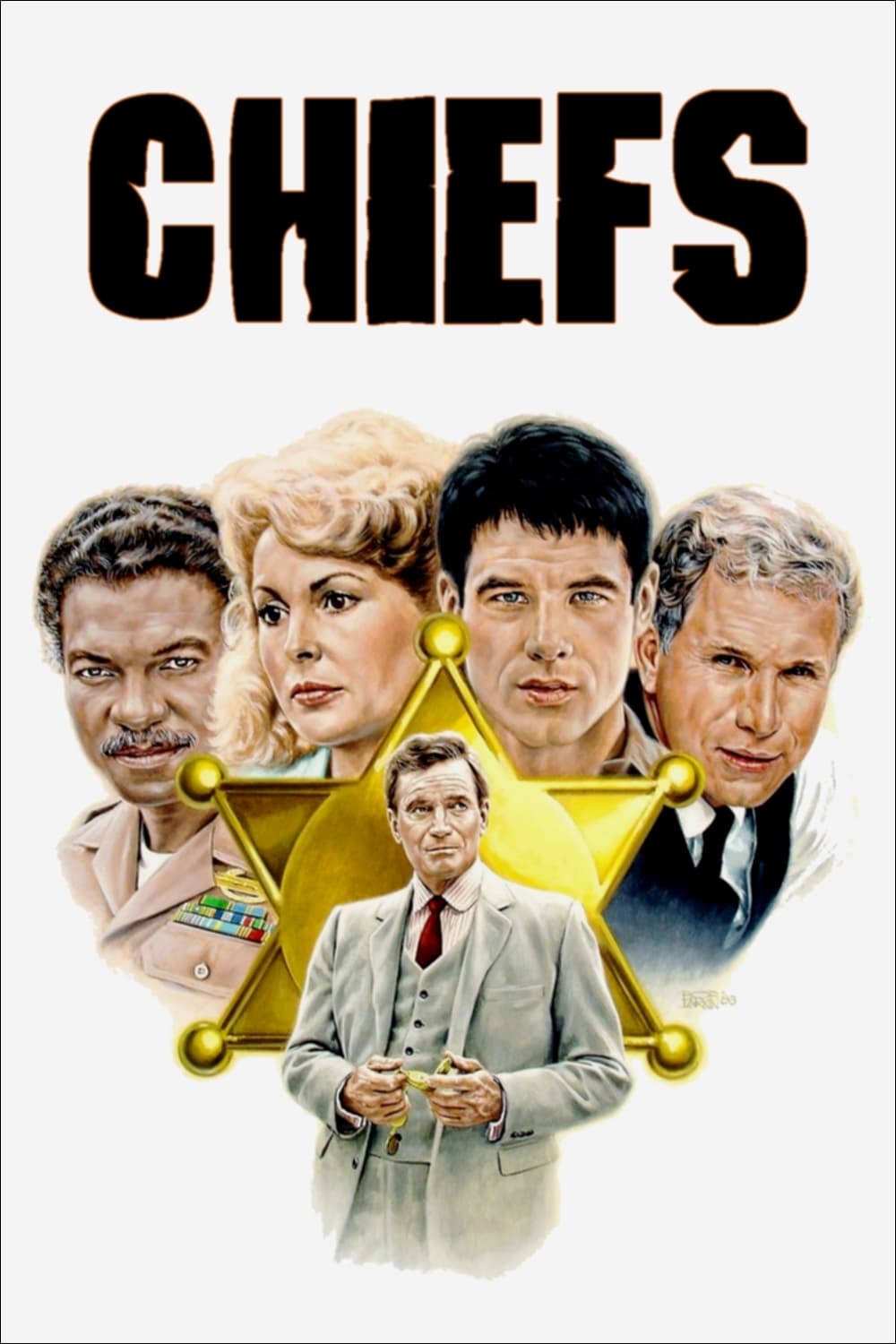
Review: Chiefs (dir. by Jerry London)


“It’s gonna take a lot of good people to make this place decent again.” — Hugh Holmes

Chiefs, the 1983 CBS miniseries adapted from Stuart Woods’ Edgar Award-winning novel, triumphs as a faithful yet inventive translation of a sprawling literary thriller into television’s constrained canvas. Unfolding across four decades in Delano, Georgia (1924-1963), it chronicles three generations of deeply flawed police chiefs pursuing a serial killer who targets young boys, their quest shadowed by the American South’s seismic shift from Jim Crow’s iron grip to the civil rights revolution.

Woods’ debut novel uses the murders as a piercing allegory for societal rot—Delano a claustrophobic organism where racism, class divides, and omertà-like codes nurture evil. The miniseries scores a major win by distilling this 400-page epic into six compelling hours, preserving the book’s generational rhythm and thematic spine while leveraging TV’s strengths in visual dread and ensemble intimacy. Yet, as a TV production, it inevitably stumbles under the medium’s inherent drawbacks: commercial interruptions, budgetary limits, network sanitization, and episodic structuring that blunt the novel’s novelistic nuance.

Performances drive Chiefs, with Keith Carradine and Brad Davis towering as the absolute standouts, breathing transcendent life into Woods’ most vivid creations and elevating the adaptation beyond its TV trappings. Carradine’s Foxy Funderburke, the killer—a vulpine everyman whose sly charm cloaks bottomless depravity—is nothing short of revelatory. Woods crafts him as Delano’s perfect predator, evading justice across decades because prejudice and small-town loyalty provide endless cover; the miniseries unleashes Carradine’s eerie genius, his lanky frame slinking through scenes with piercing eyes and smirks that chill deeper than any scream. Watch him whistle casually amid shadows or flash a fox-like grin during backyard chats—it’s understated psychopathy at its peak, a masterclass in menace that makes Foxy scarier than modern slashers, his longevity indicting the chiefs’ every failure. Carradine doesn’t just play the monster; he inhabits its everyday skin, sly pauses and folksy drawl turning every frame into taut wire. It’s career-best work, haunting long after credits, the performance that cements Chiefs as essential viewing.

Matching that blaze is Brad Davis as Sonny Butts, the post-WWII chief whose war-hero shine curdles into tyrannical fury—one of the most volcanic turns in ’80s TV. Woods luxuriates in Sonny’s hypocrisy: brutalizing Black neighborhoods, shaking down suspects, half-chasing the killer amid integration’s tremors, his “heart of darkness” blending trauma with bigotry. The adaptation amps kinetic brawls absent in prose, but Davis owns it all—brooding intensity erupting in guttural snarls, trauma-flashed eyes, coiled physicality that dominates every standoff. His Southern accent locks authentic, chortles flipping to wide-eyed betrayal in heart-stopping beats; Sonny becomes tragically magnetic, a damaged bully whose rage mirrors Delano’s resistance, derailing justice while stealing the show. Davis channels raw, Brando-esque power without caricature, making mid-century arcs electric—visceral theater that rivals Carradine’s creeps for MVP crown.

The supporting ensemble holds strong but orbits these twin suns. Wayne Rogers brings MASH-grit to Will Henry Lee, the 1920s everyman chief, his weary resolve fitting the book’s naive obsession amid lynch-mob shadows. Stephen Collins’ crisp poise suits Billy Lee, the ambitious son bridging eras with subtle unease. Billy Dee Williams layers charismatic fire into Tyler Watts, the trailblazing ’60s Black chief, urgent under threats. Charlton Heston’s gravelly narration as Hugh Holmes anchors the old guard. Solid work all, but Carradine and Davis are the revelation, their chemistry with the killer-chief dynamic supercharging Woods’ prose.

Thematically, Chiefs touts adaptive victory: murders scalpel Southern sins—killer’s span enabled by whitewash, chiefs’ flaws (naivety, rage, complacency) echoing Jim Crow’s throes. Woods’ restraint (dread over gore) translates via Jerry London’s direction: TV-budget grit evokes Roots-sweep—rally torches, unearthed graves—pruning romances tautens pace, foregrounds racism’s backbone.

Yet television’s pitfalls drag it earthward, exposing media frailties the novel evades. Network TV demands commercial breaks, fracturing tension—cliffhangers feel forced, mid-episode lulls kill momentum where Woods’ chapters flow seamless. Budget caps hobble scope: no sweeping location shoots, recycled sets make Delano static vs. book’s vivid evolution; period details (cars, garb) ring true but cheapen under fluorescent lighting. CBS sanitization softens edges—Woods’ grayer morals binarize (heroes nobler, Sonny’s bigotry punchier for prime time), racial arcs gain clunky exposition (“We can’t let ’em take our way of life!”) where prose implies slyly. Episodic format sags pacing: generational pivots drag with filler (subplots padded for hours), killer’s decades-long credulity strains more on screen, visuals exposing logistical gaps the page glosses. Accents waver under non-native casts, a TV-casting haste; direction, competent, lacks cinematic flair—static shots, TV-gloss lighting mute novel’s sweaty dread. Ensemble shines brightest via leads, but supporting roles flatten into types, ensemble dilution print sustains. Flaws compound: preachiness in ’60s beats (TV’s social-message itch), conveniences (plot devices for act breaks), and era-inaccurate tweaks (anachronistic attitudes) betray source fidelity.

In the end, Chiefs succeeds more than it fails as an adaptation—capturing Woods’ generational prisms and Southern reckonings with enough fidelity and flair to transcend its era’s TV limitations, delivering cathartic release amid rising dread, propelled by Carradine and Davis’ unforgettable peaks. Its triumphs in atmosphere, those two volcanic turns, and thematic resonance outweigh the medium’s drags: clunky pacing, sanitized nuance, and budgetary blandness. Remarkably, it presages the true-crime boom on television decades later, laying groundwork for anthology masterpieces like True Detective, The Killing, and Fargo. Like those, Chiefs blends procedural hunts with existential rot, flawed antiheroes navigating moral quagmires, and killers embodying societal fractures—here, racism as the true long-game predator, with Carradine’s Foxy as proto-Rust Cohle eerie. Where modern series revel in cinematic polish and nonlinear flair, Chiefs proves the blueprint: small-town secrets, generational hauntings, justice as bloody evolution.

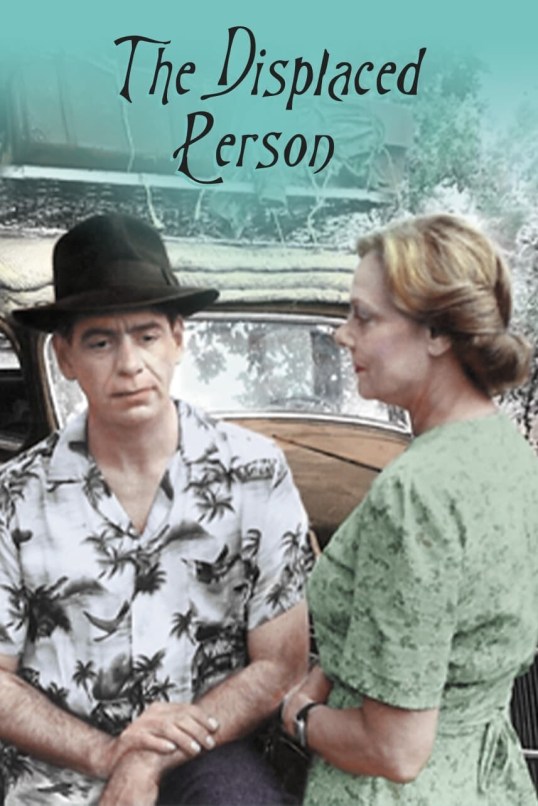
Retro Television Review: The American Short Story Episode 7: The Displaced Person


Welcome to Retro Television Reviews, a feature where we review some of our favorite and least favorite shows of the past!  On Saturdays, I will be reviewing The American Short Story, which ran semi-regularly on PBS in 1974 to 1981.  The entire show can be purchased on Prime and found on YouTube and Tubi.

This week, we have an adaptation of Flannery O’Connor’s longest short story.

Episode #7: “The Displaced Person”

(Dir by Glenn Jordan, originally aired in 1977)

Life at a Georgia farm is thrown into turmoil when the farm’s owner, widow Mrs. McIntyre (Irene Worth), agrees to give a job to a Polish refugee named Mr. Guizac (Noam Yerushalmi).  As World War II has just ended and Father Flynn (John Houseman) has assured Mrs. McIntyre that Guizac can drive a tractor, Mrs. McIntyre is happy to give Guizac a home in America.  Less happy are the people who already work at the farm, most of whom see the hard-working Guizac as being a threat.  Mrs. Shortley (Shirley Stoler) worries that her husband (Lane Smith) is going to lose his job to Guizac.  Meanwhile, a young farmhand named Sulk (Samuel L. Jackson) enters into a business arrangement with Guizac, one that causes Mrs. McIntyre to change her opinion of Guizac.  Needless to say, it all ends in tragedy.

This adaptation is based on a short story that Flannery O’Connor wrote after her own mother hired a family of Polish refugees to work at their family farm, Andalusia.  This adaptation was actually filmed at Andalusia, only a few months after Flannery O’Connor’s death.  The furniture seen in the house was O’Connor’s own furniture.  The peacocks the drive Mrs. McIntyre crazy and which cause Father Flynn to have a religious epiphany are the same peacocks that roamed the farm when Flanney O’Connor lived there.  The cemetery that Mrs. McIntyre visits is the O’Connor family cemetery.  It brings a sense of authenticity to the film, one that is often missing from films made about the South.

The adaptation moves at a deliberate pace but it’s well-acted and it stays true to O’Connor’s aesthetic.  Those who might complain that there are only two likable characters in the film — Mr. Guizac and Father Flynn — are missing the point of O’Connor’s story.  Even Mrs. McIntyre, who initially seems to be trying to do the right thing, is blinded by the prejudices of race and class.  Father Flynn never gives up on trying to redeem both Mrs. McIntyre and the rest of the world but one gets the feeling that he might be too late.

The cast is what truly makes this adaptation stand-out.  Irene Worth, John Houseman, Lane Smith, Robert Earl Jones, they all give excellent performances.  Samuel L. Jackson was very young when he appeared in The Displaced Person but he already had the screen presence that has since made him famous.  The best performance comes from Shirley Stoler, who plays Mrs. Shortley as being a master manipulator who, unfortunately, happens to be married to a worthless man.  Mrs. Shortley does what she does to protect her husband.  Mr. Shortley does what he does because he’s a loud mouth bigot.  Everyone has their own reasons, to paraphrase Jean Renoir’s The Rules of the Game.  In this story, those reasons lead to tragedy.

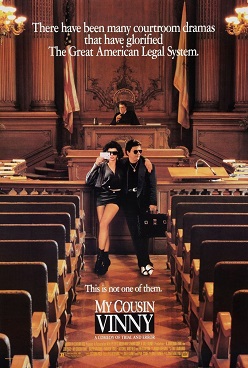
MY COUSIN VINNY (1992) – Joe Pesci heads way down south!


There are certain movies in my life that I consider “comfort movies.” These are the movies that I love so much that they always help me relax because I feel better just by watching them. I often turn on a comfort movie when I really need to fall asleep. Examples in my life include most of Charles Bronson’s filmography, RIO BRAVO, the ZATOICHI films, THE OTHER GUYS, and pretty much anything directed by Alex Kendrick. MY COUSIN VINNY fits comfortably under my categorization of a comfort movie.

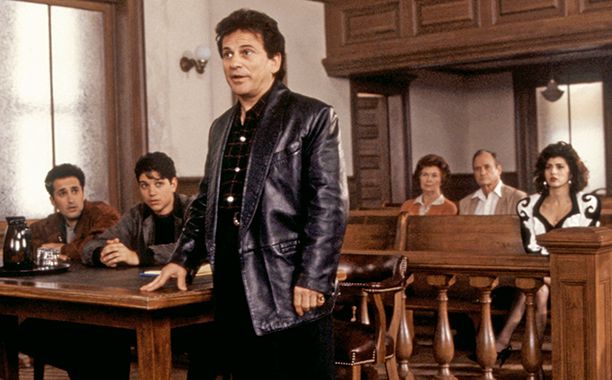
The movie opens with friends Bill Gambini (Ralph Macchio) and Stanley Rothenstein (Mitchell Whitfield) taking the scenic route down south as part of a cross-country trip to attend college at UCLA. Unfortunately, while in Alabama, the two are arrested soon after leaving a convenience store. Thinking they are being charged for accidentally shoplifting a can of tuna, it turns out the actual charges are robbery and murder as the place was robbed and the clerk killed soon after they left. Knowing they are in big trouble, Bill calls his cousin Vinny Gambini (Joe Pesci), who’s pretty much the only lawyer that he knows. The problem, Vinny has never actually tried a murder case. Vinny heads down south with his fiance Mona Lisa Vito (Marisa Tomei) where he must contend with a judge (Fred Gwynne) who doesn’t like him, a prosecutor (Lane Smith) who has way more experience than him, and a mountain of circumstantial evidence that he has almost no hope of contradicting. Will Vinny be able to prove his cousin’s innocence before they end up with life in prison, or even worse?

There are many reasons that I love MY COUSIN VINNY. The cast consists of a couple of my personal favorite actors in Joe Pesci and Ralph Macchio. GOODFELLAS is certainly one of the best movies ever made, and Joe Pesci gives an unbelievably powerful performance, a performance that would win him the Academy Award. Pesci took a short break from filming MY COUSIN VINNY to attend the Acadamy Award ceremony and pick up the gold. He even took the statue to the set to show the cast and crew. Maybe that helped inspire Marisa Tomei to give her own Academy Award winning performance in this film. My favorite scene of the entire movie is when Vinny is treating Mona Lisa as a hostile witness on the stand, just before she proceeds to prove that nobody knows more about cars than she does. It’s such a satisfying scene as she makes the prosecutor’s “expert” look like a novice. As for Ralph Macchio, many times in my life I’ve made the statement that I wanted to be the karate kid when I was growing up. I think I was in the fifth grade when I saw the film for the very first time. I’ve been a fan of Ralph Macchio, and in love with Elisabeth Shue, ever since. It’s the kind of movie I’d just sit around thinking about when I was a kid. I even wanted to learn karate, but being just a little over 4 feet tall at the time, I didn’t need to be getting into any fights. I also like that MY COUSIN VINNY was partially filmed in the town of Covington, GA. My wife and I were driving from Arkansas to Myrtle Beach back in 2020 and we stayed the night in Covington. I had done a little research while I was looking for a place to stop for the night, and I found out that Covington is sometimes referred to the “Hollywood of the South” due to the large number of movies and TV shows that are filmed there. We snapped a couple of shots of the downtown before heading on down the road. But I think the thing I love most about MY COUSIN VINNY is also the reason I love movies like THE KARATE KID and ROCKY so much. I love movies where a person is completely underestimated, and rightfully so. But then, through some combination of intelligence, hard work, heart, and will, that same person is able to rise to the occasion and prevail against those very same people who underestimated them. Vinny has no business in the courtroom, but somehow, he’s able to win the case, and he does it in a smart, funny and exciting way. I love an underdog, and MY COUSIN VINNY just makes me feel good!  

Film Review: My Cousin Vinny (dir by Jonathan Lynn)


In the 1992 film, My Cousin Vinny, two college students from New York City, Bill Gambini (Ralph Macchio) and Stan Rothstein (Mitchell Whitfield), make the mistake of driving through Alabama.  The two students stop off at a convenience store.  When the clerk is subsequently shot dead during a robbery, Bill and Stan are arrested for the crime.  The viewers know they’re innocent.  Bill and Stan know they’re innocent.  But the entire state of Alabama seems to be determined to send Bill and Stan to prison for life.

Fortunately, Bill’s cousin, Vinny (Joe Pesci, star of Half Nelson), is a lawyer.  Unfortunately, he just recently passed the bar exam and he has yet to actually try a case.  Still, Vinny and his fiancée, Mona Lisa Vito (Marisa Tomei), come down to Alabama.  Vinny takes the case, lying to the judge (Fred Gwynne) about his qualification as a trial attorney.  Vinny is momentarily impressed when the prosecutor (Lane Smith) shares with him all of the files about the case.  “It’s called disclosure, dickhead!” Lisa snaps at him, revealing that she actually has more common sense than Vinny.  That becomes increasingly important as Vinny tries to keep Bill and Stan from spending the rest of their lives in prison.

To be honest, considering how much I complain about stereotypical portrayals of the South, I really shouldn’t like My Cousin Vinny as much as I do.  Almost every character in the film is a stereotype to some extent or another, from the farmers and rednecks who take the witness stand to Fred Gwynne’s no-nonsense judge who rules that Vinny is in contempt of court because he’s wearing a leather jacket.  Fortunately, though, the Southern stereotypes don’t bother me because both Vinny and Lisa are New York stereotypes.  Just as the judge and the townspeople seem to confirm every prejudice that someone like Vinny would have against the South, Vinny seems to be the epitome of everything that people in the South dislike about the North.  When Vinny first shows up on the scene, he’s loud and brash and obnoxious.  But, as the film progresses, Vinny reveals himself to not only be a better attorney than anyone was expecting but he also calms down and adjusts to the more relaxed pace of life in the country.  Just as Vinny reveals himself to be not as bad as everyone originally assumed, both the Judge and the prosecutor are also allowed to reveal some hidden depths.  Neither one is the cardboard authority figure that viewers might expect.  The Judge does sincerely want justice to be done and the prosecutor sincerely wants to keep the county safe, even if he is prosecuting two innocent men.  Just as Vinny learns not to be too quick to judge them, they learn not to be too quick to judge Vinny.  The end message is that everyone is innocent until proven guilty and deserves a fair hearing, whether in a court of law or just in the courts of public and private opinion.  It’s not a bad message.  In fact, it’s one that more than a few people could still stand to learn today.

Of course, the best thing about the film is Marisa Tomei, who not brings a lot of energy to the film but whose hair is amazing and whose clothes are to die for.  Tomei won an Oscar for her performance in My Cousin Vinny, a victory that was so controversial that there were unfounded rumors that presenter Jack Palance had read the wrong name by mistake.  (As we all learned a few years ago when Warren Beatty and Faye Dunaway actually did read the wrong winner, the accountants aren’t going to let anyone get away with that.)  Watching the film last night, it was obvious to me that Tomei deserved that Oscar because Lisa is the heart of the film.  Pesci, Gwynne, and Lane Smith are all give good performances but, without Marisa Tomei’s performance, My Cousin Vinny would ultimately just be another culture clash comedy.  A lesser actress would have just played Lisa as being a stereotype.  But Tomei turned Lisa into the most believable and sincere character in the film.  While Lisa won the case, Tomei saved the movie.

(And needless to say, I’m a fan of any movie that features a Lisa saving the day.)

My Cousin Vinny holds up as an enjoyable film.  Watch it the next time you’re losing faith in humanity.

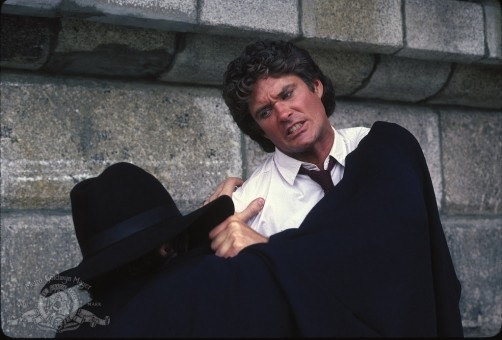
Horror Film Review: Terror at London Bridge (dir by E.W. Swackhamer)


On a foggy London night in 1888, the shadowy killer known as Jack the Ripper is pursued by a combination of police and citizens.  Cornered and facing certain execution if captured, Jack jumps off of London Bridge and disappears into the murky waters of the Thames.

Jump forward to the late 80s.  London Bridge has been transported, brick-by-brick, to a town in Arizona and it now serves as a somewhat tacky tourist attraction.  Unfortunately, it turns out that Jack the Ripper’s spirt is inside in the bricks and transporting the bridge has also transported Jack.  Considering that Jack died in the Thames, I’m not really sure why his spirit will still be trapped in the bricks of the bridge.  It seems like his spirit should still be in the river but whatever.  Let’s just go with it.  One tourist accidentally cuts her finger while walking across the bridge.  Her blood hits the wrong brick and suddenly, Jack the Ripper is alive and killing in Arizona!  Can the murders be stopped before they interfere with the tourist season!?

Only Detective Don Gregory (David “The Hoff” Hasselhoff) thinks that Jack the Ripper has returned to life.  His captain (Clu Gulager) doesn’t believe him.  The sleazy city councilamn (Lane Smith) doesn’t believe him.  His potential girlfriend, Angie (Stepfanie Kramer), has doubts about Don’s theory.  His own partner (Randolph Mantooth) doesn’t buy it.  Even Angie’s best friend, a librarian named Lynn (Adrienne Barbeau), doesn’t think that there’s any connection between Jack the Ripper and the handsome Englishman (Paul Rossilli) who has recently been stopping by the library and flirting with her.

And really, why would anyone believe Don?  His theory makes no sense, even if it does turn out to be true.  Indeed, Don is remarkably quick to accept the idea of Jack the Ripper traveling through time.  Of course, what also doesn’t make sense is the city council’s refusal to shut down the bridge until the killer’s been caught.  It’s the tourist season but seriously, it seems like a serial killer — whether he’s Jack the Ripper or not — would be bad for business!

This 1985 movie was made for television.  The premise is intriguing but the execution is a real let-down.  It’s a 90 minute film and the Hoff doesn’t really seem to get serious about trying to hunt down Jack the Ripper until 60 minutes in.  This is the odd Jack the Ripper film in which the Ripper is often treated as an afterthought.  Instead, the majority of the film is taken up with Don flirting with Angie and trying to come to terms with an accidental shooting that occurred when Don was a cop in Chicago.  The whole Jack the Ripper subplot is almost treated like a red herring, which is an odd way to treat a 19 century villain who can travel through time.  I mean, sometimes, romance has to wait until the time-traveling serial killer has been taken care of.  It’s all about priorities.

In the end, this one is for hardcore Hasselhoff fans only.  Those who want to watch a Jack the Ripper time traveling movie would be better served by watching Time After Time, featuring David Warner as the Ripper and Malcolm McDowell as H.G. Wells.

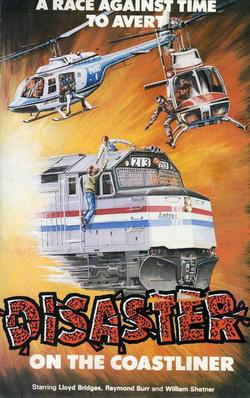
Disaster on the Coastliner (1980, directed by Richard C. Sarafian)


A completely computerized passenger train is traveling across the country, with the Vice President’s wife as one of the passengers.  When Jim Waterman (Paul L. Smith), a man who blames the railroad for the death of his family, manages to hijack the train he plans to ram into a locomotive until his demands a met.  He wants railroad president Estes Hill (Raymond Burr) to take responsibility for the crash that killed his wife and children.  With Waterman determined to crash the two trains, it falls to dispatchers Al Mitchell (Lloyd Bridges) and Roy Snyder (E.G. Marshall) to try to figure out a way to stop the collision.  Helping them out on the train is a con artist named Stuart Peters (William Shatner!) who may be wanted by the police but who is still willing to do whatever it takes to save his fellow passengers.

Disaster on the Coastliner is an above-average made-for-TV disaster movie.  Even though it was obviously made for a low-budget and that the majority of the money was probably spent on securing the B-list cast, there are enough shots of the train careening on the tracks to bring happiness to the hearts of most disaster movie fans.  The cast is full of the type of people who you would typically expect to find in a movie like this, people like Raymond Burr, Lloyd Bridges, and William Shatner.  Bridges, interestingly enough, gives the same performance here that he gave in Airplane! and when he starts ranting about how everything’s computerized, he sounds like he could be reciting dialogue from that film.  The only difference is that Airplane! was a comedy while Disaster On The Coastliner is meant to be a drama.  Raymond Burr also does a good job hamming it up as the president of the railroad.  He spends most of the movie sitting behind his desk and looking annoyed, which was pretty typical of Burr in the years after Perry Mason and Ironside. 

For a lot of people, the main appeal of this film will be seeing what William Shatner was doing in between Star Trek movies.  This is a typical early 80s Shatner performance, when he was still trying too hard to win that first Emmy but also when he had just starting to develop the self-awareness necessary to poke fun at his own image.  Shatner really digs into the role of a conman with a heart of gold.  He delivers his lines in his trademark overdramatic style but, in scenes like the one where he sheepishly discovers that a door that he’s been pounding on was unlocked all the time, Shatner actually seems to be in on the joke.  Shatner also did his own stunts in this film, including one where he had stand on top of a speeding train.  In his autobiography, Shatner wrote that he wasn’t even wearing a safety harness in the scene so give it up for Bill Shatner.  That took guts!

Fast-paced and agreeably unpretentious, Disaster On The Coastliner is an enjoyable runaway train movie.


Bubba’s Revenge: Dark Night of the Scarecrow (1981, directed by Frank De Felitta)


Dude, this movie.

Charles Durning plays Otis P. Hazelrigg, a postman in a small town who has an unhealthy interest in a ten year-old girl named Marylee (Tanya Crowe).  When Marylee is mauled and nearly killed by a dog, Otis decides that she was attacked by Bubba Ritter (Larry Drake), a mentally challenged man who has the mind of a child.  With Otis and his redneck friends looking to lynch him, Bubba’s mother disguises him as a scarecrow and tells him to stand out in a field and not move.  When Otis and his friends discover Bubba hiding, they all shoot him until he’s dead.  Otis puts a pitchfork in Bubba’s hands and tells the police that Bubba was attacking them and they didn’t have any choice but to shoot him.

Otis thinks that he’s gotten away with murder but he’s wrong.  After Marylee sings a song in the same field where Bubba was killed, Otis’s friends start dying.  One is suffocated in a grain silo.  Another falls into a thresher.  Before each one dies, they report seeing a scarecrow on their property.  Otis thinks that Bubba’s mother is behind the murders but what if Bubba has actually come back to life?

Dark Night of the Scarecrow will mess up your mind, give you bad dreams, and leave you with a lifelong phobia o scarecrows.  It’s that scary.  I remember that they used to frequently show this movie on TV when I was  growing up and even the commercials were scary.  (The part of the movie that always messed with me were the shots of Bubba’s frightened eyes darting around underneath the scarecrow mask.)  Scarecrows are naturally creepy and the movie’s atmosphere is unsettling but the most frightening thing about Dark Night of the Scarecrow is Otis and the redneck lynch mob that he puts together.  Otis is a thoroughly loathsome character and Charles Durning goes all out playing him.  Otis is a civil servant, which gives him some prestige in the town but he uses that prestige to bully Bubba and harass Marylee.  His concern with Marylee especially feels wrong and the movie does not shy away from the subtext of his interest.  The scarecrow might frighten you but you will absolutely loathe Otis and everyone who follows him.

Dark Night of the Scarecrow was made for television but it’s just as good as any theatrical release.   It is also might be the first movie to feature a killer scarecrow.  Several have been made in the years since but Dark Night of the Scarecrow was the first and it’s still the best.

A Movie A Day #270: Prison (1987, directed by Renny Harlin)


In 1964, the state of Wyoming executed Charles Forsythe (Viggo Mortensen) for killing another inmate at Creedmore State Prison.  Forsythe was innocent of the crime but the only other two people who knew, a prisoner named Cresus (Lincoln Kilpatrick) and a guard named Eaton Sharpe (Lane Smith), kept silent.  Twenty-three years later, Cresus is still an inmate and Sharpe has been named the new warden of Creedmore.  When a group of prisoner open up the old execution chamber, Forsythe’s electrified spirit escapes into the prison and starts to kill the prisoners and the guards, one-by-one.  A convict named Burke (also played by Mortensen) understands what is going on but can he get anyone to believe him?

If the idea of an executed murderer turning into an electrified spirit sounds familiar, that’s because the exact same idea was used in Destroyer, The Horror Show, and Wes Craven’s Shocker, all of which went into production and were released at roughly the same time.  Why did the late 80s see so many director making movies about convicts coming back to life after being sent to the electric chair?  We may never know.

Of the four electric ghosts movies, Prison is the best.  Lane Smith is a great villain and Prison makes good use of its claustrophobic setting.  Since Charlie is stalking inmates instead of horny teenagers, there literally is no way for anyone to escape him.  (It never makes sense, though, why Charlie is killing “innocent” prisoners when Sharpe, who hates all of this prisoners, is the one that Charlie is targeting for revenge.)  The best scenes are the ones where the warden desperately tries to force the inmates to confess to the murders so he won’t have to confront the truth about Charlie’s revenge.  Lane Smith, who would later be best known for playing Richard Nixon in The Final Days, acts the hell out of those scenes.

Prison was the first American film to be directed by Finnish director Renny Harlin and it is a hundred times better than many of the overproduced action films that Harlin would later be best known for.  Of course, it’s no Die Hard 2 but I would gladly watch Prison over Cutthroat Island.