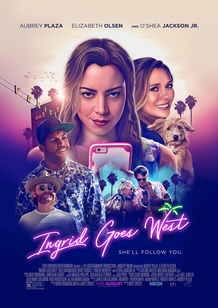
Playing Catch-Up With The Films of 2017: Ingrid Goes West (dir by Matt Spicer)


We start with a wedding.  The bride is beautiful.  The groom is handsome.  Everything looks so perfect that you’re almost relieved when Aubrey Plaza suddenly shows up.

Seriously, why wouldn’t you be?  We all know Aubrey Plaza from her role as the apathetic and sarcastic April Ludgate on Parks and Recreation.  If anyone’s going to bring this potentially bland wedding to life, it’s going to be Aubrey Plaza!

Aubrey Plaza walks up to the bride and starts screaming at her … wait a minute, that’s not typical Aubrey Plaza behavior … where’s the deadpan snarker that we were all expecting…

Suddenly, Aubrey is pulling out mace and spraying the bride in the face.  The bride is writing in pain while Aubrey screams at her…

So begins Ingrid Goes West.

Aubrey Plaza, of course, plays the title character.  Ingrid spends some time in a mental hospital after crashing that wedding.  She explains to both her doctors and the bride that she was just acting out because she was upset over her mother’s recent death.  Ingrid seems to feel that she and the bride were good friends but, as we quickly learn, they actually barely knew each other.  The bride just made the mistake of commenting on one of Ingrid’s social media posts, leading to Ingrid deciding that they were actually best friends.

Using the money that she inherited from her mother, Ingrid heads out to Los Angeles.  She has a new obsession, Taylor Sloane (Elizabeth Olsen).  Taylor is a paid social media influencer, famous for being famous.  Ingrid left a comment on one of Taylor’s pictures and Taylor left an innocuous reply.  It’s the type of thing that happens every day on social media but to Ingrid, it means that she and Taylor are destined to be BFFs.

And, amazingly, it all seems to work at first.  Online, Taylor shares just enough about her life to allow Ingrid to come up with a plan to meet her.  Ingrid not only gets to know Taylor and her husband, a painter named Ezra (Wyatt Russell), but she is briefly allowed to enter into Taylor’s world.  Of course, Ingrid fails to notice that no one in that world seems to be very interested in her.  To Ingrid, everything is perfect.  Or, at least it is until Taylor’s obnoxious, junkie brother (Billy Magnussen) shows up and starts to call Ingrid out…

Ingrid Goes West really didn’t get as much attention as it deserved when it was released earlier this year.  Unfortunately, it was advertised as being some sort of wacky comedy when, in fact, it’s a deeply unsettling and, at times, rather disturbing movie.  Yes, there is humor but very little of it is of the “laugh out loud” kind.  Instead, it’s the type of humor that makes you pause the movie so you can make sure all of the doors and windows are locked.  Ingrid Goes West eventually goes to a very dark place.  In some ways, it’s a Taxi Driver for the social media age.

Holding the film together is Aubrey Plaza, giving a performance that is both bracingly vulnerable and frighteningly angry.  Plaza makes Ingrid both sympathetic and annoying at the same time.  Your heart cries for her but you still wouldn’t necessarily want her to live next door.  Ingrid Goes West is not a perfect film.  At times, it’s hard to believe that Taylor wouldn’t know better than to invite a complete stranger into her life and some of the scenes with her brother are a bit too over the top.  But Aubrey Plaza’s brilliant lead performance makes up for all of those flaws.

Definitely see Ingrid Goes West.  Just expect to be paranoid for a week afterward.
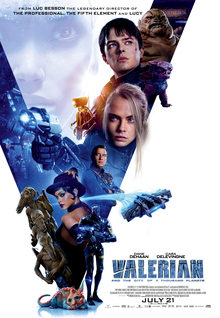
Playing Catch Up With The Films of 2017: Valerian and the City Of A Thousand Planets (dir by Luc Besson)


Valerian and the City Of A Thousand Planets is another film, much like The Dark Tower and this year’s Transformers movie, that I watched in a state of total and thorough confusion.

More than once, I asked myself, “What the Hell’s going on?  Who are those people?  Why are they blowing stuff up?  Why are they shooting at each other?  Who’s fighting who?  Wait, is he a good guy or a bad guy?  Is Valerian human or alien?  WHAT’S GOING ON!?”

But I have to admit that it really didn’t bother me that Valerian and the City of A Thousand Planets is an almost totally incoherent movie.  After all, Valerian is a Luc Besson film and Besson has always been a supreme stylist above all else.  That’s not to say that there’s nothing going on underneath the glossy visuals of a Besson film.  It’s just to say that Besson is one of the rare directors where the subtext is usually less interesting than what’s happening on the surface.

Take Valerian and the City of a Thousand Planets.  It takes place in the far future, on Alpha.  Alpha used to be the International Space Station but now it’s become a floating city where the inhabitants of a thousand different planets mix and socialize.  It’s a very cosmopolitan city, one where the only disturbance comes from obnoxious human tourists who are all either extremely British or extremely American.  Now, you could argue that Besson is making the argument that Alpha is meant to represent France but, if you spend too much time doing that, you’re going to miss just how amazingly Alpha has been visualized.  It’s not just that everyone in the movie says that Alpha is home to a million different creatures.  It’s that when the film travels to Alpha, you take one look at the screen and you believe it.

The film’s plot … well, this is where it gets difficult. It gets off to a truly brilliant beginning, with an intergalactic summit that takes place while David Bowie’s Space Oddity plays in the background.  After that, the film’s visuals were so amazing that I have to admit that I was usually too busy taking it all in to pay much attention to what was actually going on.  Valerian (Dane DeHaan) and Laureline (Cara Delevigne) are members of the special police force that has been created to protect Alpha and apparently the rest of the universe as well.  Valerian has strange dreams about a primitive race of people who live on a beach.  Laureline frets about Valerian’s recent proposal of marriage.  They’ve both been assigned to track down a creature, the last of its species, that is currently being sold in a black market.  It all links back to some secrets concerning their superior (Clive Owen) and a plot involving intergalactic refugees.

And, obviously, if you’re someone who insists on finding political subtext in every movie that you watch, there’s a lot to be found in Valerian‘s story about space refugees and government cover-ups.  But, honestly, none of that is as interesting as the effort that Besson has put into making his flamboyant universe come to life.  Valerian may be narratively incoherent but visually, it come close to proving Lucio Fulci’s theory of “absolute film.”  The plot is less important than the film’s visuals and how you, as the viewer, reacts to those visuals.  Even Dane DeHaan and Cara Delevingne seem to have been cast less for any acting ability they may have and more because the boyishly rugged DeHaan and the achingly pretty Delevingne both compliment the film’s visual scheme.  Valerian and the City of a Thousand Planets is cinematic pop art.

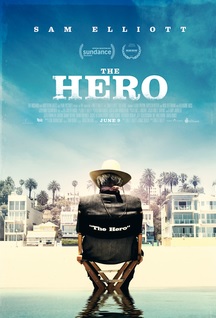
Playing Catch-Up With The Films of 2017: The Hero (dir by Brett Haley)


It’s too bad that The Hero didn’t get that much attention when it originally released because, towards the end of the film, Sam Elliott has a scene that features some of the best cinematic acting that I’ve ever seen.

I’m not going to spoil the scene, because I think you should experience it for yourself.  I’ll just say that it’s a scene that will take you totally by surprise and force you to reconsider everything that you had previously assumed about both the film and the lead character.  I’m not ashamed to say that the scene brought tears to my mismatched eyes.  When you hear Elliott say, “I’ve wasted your time,” it will bring tears to your eyes too.

And that’s all I’m going to say about that scene.

As for the rest of the film, it’s a character study of an actor.  Sam Elliott plays Lee Hayden, who we’re told was one of the top actors in the world in the 70s.  He specialized in westerns, films and TV shows in which he always played the hero.  Of course, that was a while ago.  Lee is 70 years old now and both westerns and heroes are out of date.  At this point, Lee’s only steady work comes from doing the voice over for a series of steak commercials.  He spends most of his time smoking weed with his best friend, Jeremy (Nick Offerman).

It’s not a bad life though Lee certainly has his regrets.  For instance, he hasn’t always been the best father.  His daughter (Krysten Ritter) doesn’t seem to want much to do with him.  He misses acting.  As is made clear in the film’s opening scene, doing 6 different takes for a commercial voice over isn’t exactly the most challenging or rewarding way for a former star to spend his semi-retirement.  But he has his one friend and he has marijuana and what else does he need?

But then one day, Lee is told that he might have cancer.  He might be dying.  Lee starts to think about his life and his legacy.  He tries to reconnect with his daughter.  He accepts a lifetime achievement award from the Western Hall of Fame and, just when you think both the film and Lee are about to get snarky, they surprise you by treating the award and Lee’s aging fans with a poignant respect.  Lee also pursues a relationship with a much younger stand-up comedienne (Laura Prepon) and while I did arch an eyebrow at the huge age difference between them, the film itself actually addresses the issue in an unexpected way.

It’s not the most tightly constructed film.  Darren Aronofsky’s The Wrestler was an obvious influence but The Hero never quite matches that film’s fatalistic glory.  But no matter!  The Hero is mostly about celebrating Sam Elliott, an underrated actor who shows that, much like Lee, he’s capable of much more than most viewers assume.  Elliott gives a poignant, wonderfully human performance as a flawed man who still deserves to be known as The Hero.

Playing Catch Up With The Films of 2017: The Glass Castle (dir by Destin Daniel Cretton)


The Glass Castle, which some people expected to be an Oscar contender until they actually sat through the damn thing, is a film that nearly inspired me to throw a shoe at my television.

Seriously, I was curled up on the couch and watching the movie on TV.  On the screen, Woody Harrelson was playing an obnoxious, selfish alcoholic who resented both his daughter’s success and her boyfriend.  According to the alcoholic who was living in a trash-strewn hovel with his wife, success meant selling out and money was the root of all evil and blah blah blah.  Anyway, the drunk ended up punching his son-in-law.  The very next scene featured the son-in-law whining about getting punched and that’s when I realized that the film somehow expected us to be on the side of the drunken asshole.

I reached down and picked a shoe up from the floor.  I was just about to throw it at the television when my sister Erin reached out from behind me and grabbed my hand.

“Lisa Marie,” she said, “you are not throwing your shoe at the TV.”

“But Errrrrrrrin,” I whined, “this movie really sucks!”

“Well, then write a review about how much it sucks.  But you’re not going to throw another shoe at the TV.”

Reluctantly, I dropped the shoe.  Though I may have been annoyed at the time, I see Erin’s point.  The Glass Castle is not worth losing a shoe over.

The Glass Castle is based on a powerful memoir by Jeannette Wells.  It tells the story of how she and her siblings were raised by an alcoholic father and an artist mother.  It’s a story that’s full of adventure and pathos and everything else that you could hope for from a family memoir.  It’s also a memoir that works because Walls refuses to idealize her life.  Though she writes about how her childhood seemed like a grand adventure when she was actually living it, she’s also very honest about the fact that it really wasn’t.  Though her love for her family comes through on every page, she never shies away from the darker aspects of growing up as American vagabonds.

The film largely takes the opposite approach to the material.  As played by Woody Harrelson and Naomi Watts, Walls’s parents are portrayed as being somewhat lovable eccentrics.  Early on, when her mother’s carelessness leads to young Jeannette being burned and permanently scarred in a fire, there’s a scene where Harrelson compares it to the fire that burns inside of the entire family.  When I realized that we were supposed to be moved by this asinine comparison, I ended up rolling my eyes so hard that the world literally looked like it was upside down for five minutes.  “ARE YOU FUCKING KIDDING ME!?” I yelled at the movie.

This was followed by another scene where, at a public pool, Harrelson attempts to teach Jeanette to swim by repeatedly tossing her into the deep end and nearly drowning her.  And while the film acknowledged that this wasn’t exactly the best parenting technique, it was hard not to feel that we were supposed to think that Harrelson had a point when he said that he was preparing Jeannette to be a strong and independent person who would be able to survive being plunged into the deep end of existence.  “NO!”  I shouted at the TV, “YOU JUST NEARLY DROWNED YOUR DAUGHTER, YOU PRICK!”

(Full disclosure: My Dad once tried the same thing with me.  Fortunately, he only nearly drowned me once — as opposed to Jeannette’s father who just keeps dunking her in the deep end.  Still, it was frightening enough to not only leave me with with an obsessive fear of drowning but it also kept me from ever really learning how to swim.)

When Jeannette grows up, she’s played by Brie Larson, who does a passable Virginia accent and gives about as good a performance as anyone could, considering the script and the direction.  Her husband, David, is played by Max Greenfield.  David is a good, responsible person who doesn’t drink much and who makes a lot of money.  Jeannette’s father looks down on him for those two reasons and the film seems to expect us to do so as well.  But why?  David hasn’t done anything wrong.  He’s certainly not the one who tried to drown his own daughter or who came up with some bullshit explanation about why it was a good thing that she was allowed to burst into flame.  But, if we accept that David’s not a bad guy then we also have to accept that Jeannette’s father is being an asshole.  The film’s not sure how to handle that so instead, we’re just supposed to laugh at David because he gets the worst lines in the script.

It’s a very dishonest film.  Unlike the memoir on which it’s based, it has no interest in honestly examining what it’s like to grow up with an alcoholic.  Instead, it’s too busy giving us Woody Harrelson playing yet another redneck with a drinking problem.  Harrelson does a good enough job but fuck it.  If I want to spend time watching a drunk Woody Harrelson, I’ve got The Hunger Games on Blu-ray.

The Glass Castle ends with footage and pictures of Jeannette’s actual family and, as I watched them, it occurred to me that I would happily watch a documentary about the Walls family.  That would presumably have the honesty that is so lacking in The Glass Castle.

Playing Catch-Up With The Films of 2017: Paris Can Wait (dir by Eleanor Coppola)


Anne (Diane Lane) is the wife of Michael (Alec Baldwin).  Michael is an internationally renowned film producer.  As is established early on, their marriage is not perfect.  Michael is consumed with work and, at one point, Anne spots him deep in conversation with a young actress.  Anne’s reaction tells us all we need to know about Michael’s history as a husband.  While Michael obsesses on making the latest deal, Anne takes pictures of inanimate objects.  None of the pictures are particularly good but everyone in the movie raves about them.  I imagine that has something to do with the fact that Anne is based on Eleanor Coppola, who wrote and directed Paris Can Wait.

When the film opens, Anne and Michael are at Cannes.  Michael has spent the entire festival making deals but he’s promised Anne a Paris vacation afterward.  However, the day that they’re vacation is supposed to begin, Michael gets a call!  He’s needed in Budapest!  And Anne can’t fly because she has an ear infection…

No worries!  Their friend Jacques (Arnaud Viard) is willing to drive Anne to Paris and keep her company while she waits for Michael to return.  And so, while Michael flies off to Budapest, Anne and Jacques head off for Paris.  However, Anne soon finds herself questioning Jacques’s intentions.  Is he being flirtatious or is he just French?  When he stops off at every restaurant along the way and uses Anne’s credit card to pay the exorbitant bills, is he taking advantage of her or is he just being French?  When Anne isn’t doubting Jacques’s intentions, she’s questioning her marriage.  Is Michael really in Budapest to work on a movie or is he having an affair?

One of the good things about being rich is that you occasionally get to make a movie about how difficult it is to be rich.  That certainly seems to be the case with Paris Can Wait, which was written and directed by Eleanor Coppola, the wife of Francis Ford Coppola and the mother of Sofia and Roman Coppola.  Paris Can Wait is said to be autobiographical, which would seem to suggest that Eleanor and Francis aren’t particularly interesting human beings.

There are some positive elements to the film, of course. Diane Lane gives about as good a performance as one can when you’re playing an idealized version of a film’s director.  Also, Alec Baldwin manages to make it through the entire movie without bellowing.  In fact, Baldwin’s barely in the movie and that’s not a bad thing.  The French countryside looks beautiful but, quite frankly, it’s impossible for the French countryside not to look beautiful.  On the negative side, it just doesn’t add up to much.  You never really care whether or not Michael and Anne stay together.  You’re just thankful that you’ll never get stuck beside them on an airplane.

I think the main problem is that, as a director, Eleanor Coppola doesn’t really seem to know what she’s trying to say with her film.  For instance, I could imagine Sofia Coppola taking the exact same material and creating a movie that would be achingly poignant and full of ennui.  But, with Eleanor, it’s just another travelogue to nowhere.

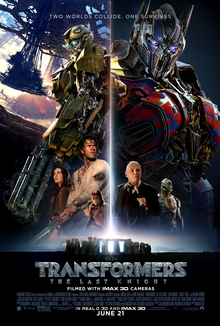
Playing Catch-Up With The Films of 2017: Transformers: The Last Knight (dir by Michael Bay)


So, I’m just going to be honest here.

I did watch Transformers: The Last Knight.  I didn’t see it at the theaters, of course.  To date, I’ve only seen one Transformers movie on the big screen.  It was the fourth one and not only did I get motion sick but when I left the theater, I discovered that I was having trouble hearing.  Even though I watched Transformers: The Last Knight on a small screen, I still made sure to take some Dramamine beforehand.  That may have been a mistake because this movie somehow drags things out for 2 hours and 30 minutes.  That’s a lot of time to spend trying to stay awake while watching something that doesn’t even try to make sense.

So, yes, I did watch Transformers: The Last Knight but I’m not really sure what I watched.  I know that there was a lot of camera movement.  There was a lot of stuff blowing up.  Robots would fly into space.  Robots would return to Earth.  Robots turned into cars.  All of the robots spoke in these gravelly voices and half the time, I couldn’t really understand what they were saying.  Mark Wahlberg was around and he spent the entire movie with this kind of confused look on his face.  His Boston accent really came out whenever he had to deliver his dialogue.  One thing I’ve noticed about Wahlberg is that the less he cares about a movie, the more likely he is to go full Boston.  To be honest, if I just closed my eyes and listened to Wahlberg’s accent and tuned out all of the explosions and robot talk, I probably would have thought I was watching Manchester By The Sea.

Anthony Hopkins was also in the movie, playing a character who might as well have just been named “Esteemed British Person.”  It’s always fun to see Hopkins in a bad movie, just because he knows that his deserved reputation for being a great actor isn’t going to suffer no matter how much crap he appears in.  He always goes through these movies with a slightly bemused smirk on his face.  It’s almost as if he’s looking out at the audience and saying, “Laugh all you want.  I’ll still kick anyone’s ass when it comes to Shakespeare…”  Anyway, Hopkins is mostly around so that he can reveal that the Transformers have been on Earth since time began.  Why, they even saved King Arthur!

The plot has to do with a powerful staff that can be used to bring life back to the Transformers’s home planet.  The problem is that using the staff will also destroy all life on Earth or something like that.  So, of course, the good Transformers are trying to save Earth and the bad Transformers are like, “Fuck Earth, let’s blow stuff up.”  Or something like that.  The main good Transformer — Optimus Prime, I guess — gets brainwashed into becoming an evil Transformer.  Of course, since Anthony Hopkins is in the movie, the majority of the film takes place in England and that can only mean a trip to Stonehenge!

And…

Look, I’ve exhausted myself.  I’m not going to say that Transformers: The Last Knight is a terrible movie because, obviously, someone out there loves this stuff.  I mean, they’ve made five of these movies so someone has to be looking forward to them.  They’re not for me, though.

Some day, I hope Micheal Bay directs a Fifty Shades of Grey movie.  I look forward to watching Christian and Ana discuss consent while the world explodes behind them.

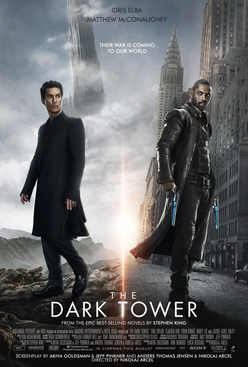
Playing Catch-Up With The Films of 2017: The Dark Tower (dir by Nikolaj Arcel)


What the Hell was The Dark Tower about, anyway?

It’s a legitimate question.  I know that the film was technically a continuation of Stephen King’s overrated Dark Tower books.  Matthew McConaughey was Walter, the Man in the Black, the man who is kidnapping psychic children so that he can weaponize their powers and destroy The Dark Tower.  Idris Elba was Roland, the last of the gunslingers, who is obsessed with killing Walter because Walter killed his father.  And Tom Taylor is Jake, an eleven year-old boy who lives in New York City and who keeps having visions of the Tower, Walter, and Roland.  Walter wants Jake.  Roland wants Walter.  Jake wants to understand it all…

And that’s pretty much the entire movie.  Jake switches back and forth between his world and Roland’s world.  Walter occasionally pops up in New York so that he can kill Jake’s family and assure that Jake won’t have any reason not to continue traveling with Roland at the end of the movie.  It all basically feels like the pilot for a television series and, to be honest, it probably wouldn’t be that bad of a show.  For one thing, if The Dark Tower was a tv show, there would be more of an opportunity to develop the characters of Roland, Walter, and Tom.  The Dark Tower movie only last 95 minutes and the majority of those minutes feel very rushed.

Obviously, if you’ve read Stephen King’s Dark Tower books, this film will be easier for you to follow than it will be for people who have never had to suffer through them.  I know I’m in the minority as far as this is concerned but I find The Dark Tower series to be King at his most pretentious.  Interestingly enough, a little bit of pretension probably would have helped the film version of The Dark Tower.  As it is, The Dark Tower is almost too workmanlike and straight-forward.  It could have really used a pointless Stephen King-style soliloquy about faith, innocence, and horror.  At the very least, they could have had someone in the background, droning on about politics in a Maine accent.

I have to admit that I really, really, really wanted to like The Dark Tower.  I love Idris Elba.  I love Matthew McConaughey.  Even more importantly, I love being a contrarian.  Whenever a film gets as many negative reviews as The Dark Tower, my natural instinct is always to assume that it has to be a secret masterpiece.  I mean, seriously, who trusts critics?  I really wanted to watch The Dark Tower and then write a 1,000-word defense of it.  I was hoping that, much like The Counselor, it would turn out to be a masterpiece that only I could recognize.

Sadly, that didn’t turn out to be the case.  I will say that Matthew McConaughey seemed to be having a sincerely good time playing the bad guy.  And Idris Elba had just the right mix of weariness and compassion to play Roland.  But otherwise, the movie just felt so pointless.

Overall, this has been a pretty good year for Stephen King film adaptations.  It deserves to be nominated for an Oscar, though it won’t be.  Gerald’s Game made people thankful for Netflix.  The Dark Tower, though, will be quickly forgotten.

Playing Catch-Up With The Films of 2017: Fist Fight (dir by Richie Keen)


While I wouldn’t begin to argue that it’s been a great year for movies, there were still some really good movies released in 2017.

Unfortunately, there were also some really bad ones.

Which do you think Fist Fight was?

If you answered really bad, congratulations!

Actually, I don’t think anyone was expecting Fist Fight to be a classic or anything like that.  Basically, the film is about a conflict between two teachers, a conflict that seems destined to end with the event promised by the title.  The two teachers are played by Ice Cube and Charlie Day.  Of course, in the movie, they have different name but it doesn’t matter.  Neither character has an identity outside of the actor who plays him.  Charlie Day is nerdy and quick to yell.  Ice Cube is tough and intimidating and not the type to back down from a fight.

Now, at the risk of losing all credibility, I’m going to be honest about something.  When I first saw the trailer for Fist Fight, I thought it might not be as bad as it turned out to be.  Charlie Day is hilarious on It’s Always Sunny In Philadelphia.  One of the more appealing things about Ice Cube is his willingness to poke fun at his tough guy image.  More often than not, I tend to like movies about teachers acting like children because, when I was in school, I always suspected that was the way teachers actually behaved when they were safely in the teacher’s lounge.  Charlie Day desperately running around the school, hyperventilating while Ice Cube pops up to remind him that they have a fist fight scheduled?  Seriously, it sounded like it could be funny in a dumb way.

Well, I was wrong.  Fist Fight is one of the most painfully unfunny films that I’ve ever seen.  This is a movie that should have been focused on one thing: the fist fight at the end of the day.  The entire movie should have been Charlie Day preparing for a fight that he knows he can’t possibly win.  Instead, the movie kept getting distracted with unnecessary subplots.  For instance, because it’s the last day before summer, all of the students are pulling pranks on their teachers.  In fact, the entire student body is out-of-control.  But who cares?  We’re here to see Charlie Day try to throw a punch at Ice Cube.  We don’t care about a bunch of obnoxious students pulling pranks that seem like they were directly lifted from a Crown International high school movie.  If we want to see that, we can rewatch The Pom Pom Girls or Joy of Sex.  And if we want to watch a teacher stand up to his students, we can watch Class of 1984.

The film is full of funny people but it never really takes advantage of them.  Actors like Tracy Morgan, Kumail Nanjiani, and Christina Hendricks pop up but just as quickly disappear.  Charlie Day does his best but the level of writing never rises to the level of It’s Sunny In Philadelphia.  (I personally would love to see “The Gang Gets In A Fist Fight With Ice Cube.”)  Compared to Fist Fight, even something like Horrible Bosses looks like nuanced and subversive humor.  There’s a lot of screeching in Fist Fight but very little of it is funny.

Here Are The 2017 Nominations From The Chicago Independent Film Critics!


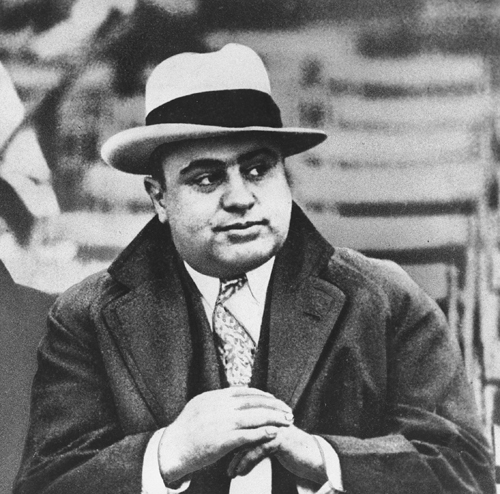
The Chicago Independent Film Critics Circle should not be mistaken for the Chicago Film Critics Association.  However, since they’re both in Chicago, that does give me an excuse to once again use this picture of Al Capone.

Here are the nominees!

THE 10 BEST INDEPENDENT FILMS (in alphabetical order):

The Big Sick, Call Me By Your Name, The Florida Project, Get Out, A Ghost Story, Lady Bird, Lucky, Mudbound, The Shape of Water, Three Billboards Outside Ebbing, Missouri

THE 10 BEST STUDIO FILMS (in alphabetical order):

Baby Driver, Blade Runner 2049, Dunkirk, Logan, The Lost City of Z, mother!, Phantom Thread, The Post, Star Wars: The Last Jedi, Wonder Woman


The complete list of nominees for the 2017 CIFCC Awards:

BEST INDEPENDENT FILM

BEST STUDIO FILM

BEST FOREIGN FILM

  • Raw
  • The Square
  • Thelma

BEST DOCUMENTARY

  • Faces Places
  • Jane
  • Whose Streets?

BEST ANIMATED FILM

BEST DIRECTOR

  • Greta Gerwig, Lady Bird
  • Christopher Nolan, Dunkirk
  • Jordan Peele, Get Out

BEST ORIGINAL SCREENPLAY

  • The Big Sick– Emily V. Gordon and Kumail Nanjiani
  • Get Out- Jordan Peele
  • Lady Bird- Greta Gerwig

BEST ADAPTED SCREENPLAY

  • Call Me By Your Name- James Ivory
  • The Disaster Artist- Scott Neustadter and Michael H. Weber
  • Mudbound– Dee Rees and Virgil Williams

BEST ACTOR

  • Timothée Chalamet, Call Me By Your Name
  • Daniel Kaluuya, Get Out
  • Gary Oldman, Darkest Hour

BEST ACTRESS

  • Sally Hawkins, The Shape of Water
  • Frances McDormand, Three Billboards Outside Ebbing, Missouri
  • Saoirse Ronan, Lady Bird

BEST SUPPORTING ACTOR

  • Willem Dafoe, The Florida Project
  • Richard Jenkins, The Shape of Water
  • Sam Rockwell, Three Billboards Outside of Ebbing, Missouri
  • Michael Stuhlbarg, Call Me By Your Name

BEST SUPPORTING ACTRESS

  • Tiffany Haddish, Girls Trip
  • Allison Janney, I, Tonya
  • Laurie Metcalf, Lady Bird

BEST ENSEMBLE CAST

  • Get Out
  • Mudbound
  • The Post
  • The Shape of Water
  • Three Billboards Outside Ebbing, Missouri

BEST CINEMATOGRAPHY

  • Blade Runner 2049– Roger Deakins
  • Dunkirk- Hoyte van Hoytema
  • The Shape of Water– Dan Laustsen

BEST PRODUCTION DESIGN

  • Blade Runner 2049– Dennis Gassner
  • mother!- Philip Messina
  • The Shape of Water- Paul D. Austerberry

BEST EDITING

BEST COSTUME DESIGN AND MAKEUP

  • Darkest Hour– Jacqueline Durran (costumes), Kazuhiro Tsuji, Lucy Sibbick and David Malinowski (makeup)
  • Phantom Thread– Mark Bridges (costumes), Paul Engelen (makeup)
  • The Shape of Water– Luis Sequeria (costumes), Jordan Samuel and Paula Fleet (makeup)

BEST ORIGINAL SCORE

BEST VISUAL EFFECTS


TRAILBLAZER AWARD

  • Sean Baker, The Florida Project
  • Jordan Peele, Get Out
  • Dee Rees, Mudbound

IMPACT AWARD

  • Greta Gerwig, Lady Bird
  • Patty Jenkins, Wonder Woman
  • Jordan Peele, Get Out