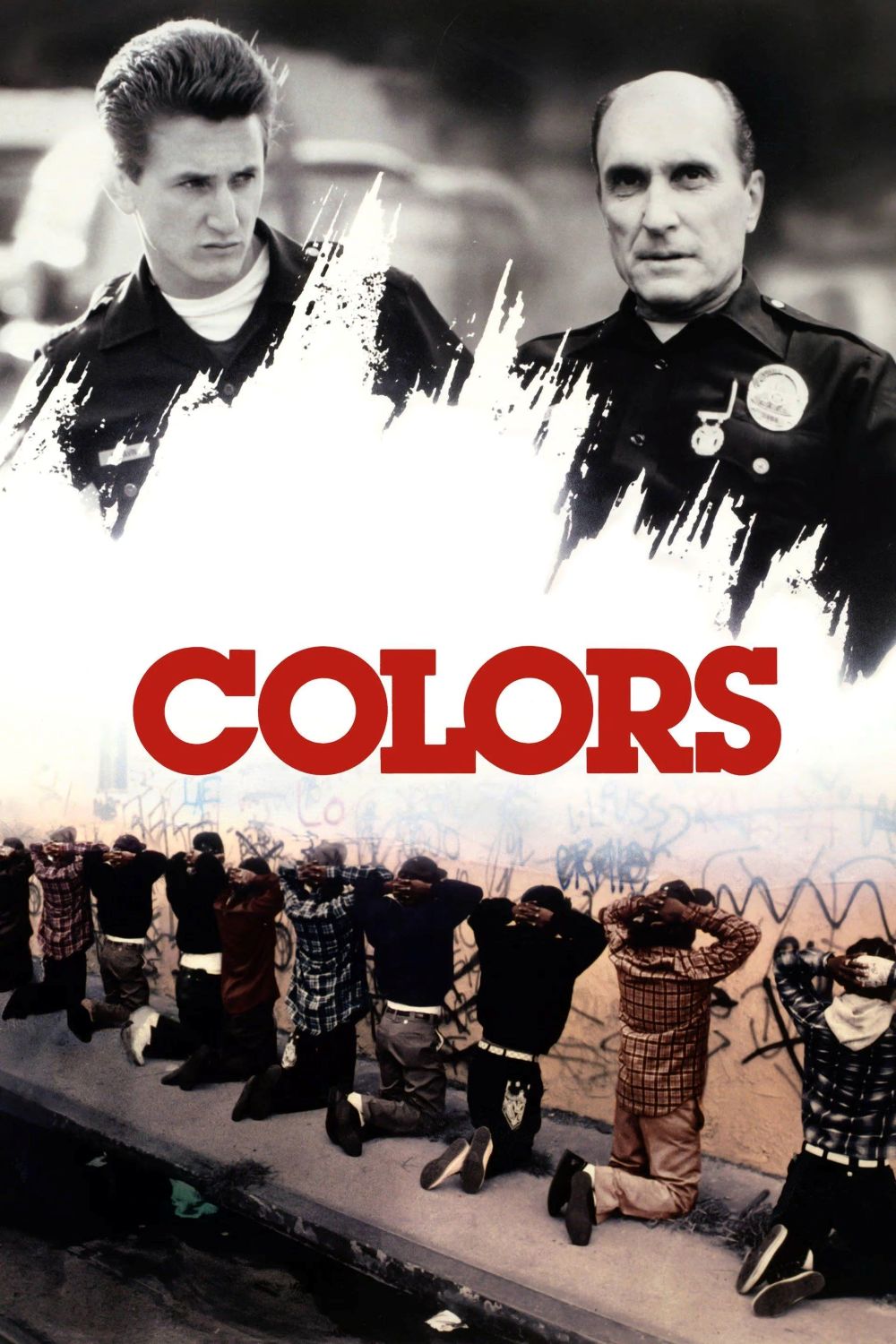
Review: Colors (dir. by Dennis Hopper)


“You got problems with the whole fuckin’ world.” — Officer Bob Hodges

Consider, for a moment, the cultural landscape of 1988. Inner-city gang violence was hardly a new phenomenon, but it remained largely relegated to local news broadcasts and distant urban nightmares for most of the country. Dennis Hopper’s Colors changed that dynamic almost overnight, serving as a brutal, unfiltered introduction to a world that mainstream America had collectively chosen to ignore. Hopper, whose own countercultural credentials were cemented decades earlier with Easy Rider, took a considerable risk here, and while the final product is undeniably uneven, its cultural footprint is impossible to overstate. The film functions simultaneously as a historical document, a cautionary tale, and a cinematic watermark that forever altered how audiences perceived the volatile landscape of Los Angeles.

The basic setup is old-school buddy-cop material. Robert Duvall plays Bob Hodges, a seasoned LAPD officer in the CRASH unit—Community Resources Against Street Hoodlums—who has spent enough years policing Los Angeles to understand that aggression does not automatically produce respect. Sean Penn plays Danny McGavin, his hotheaded new partner, a guy who approaches every situation like he has something to prove. They are assigned to patrol neighborhoods divided by Bloods, Crips, and Chicano gangs, attempting to keep retaliation killings from escalating into full-scale warfare. The main plot is not especially complicated, and that is probably intentional. Hopper is less interested in a twist-heavy police procedural than in dropping the viewer into a city where tension seems to hang over every street corner, traffic stop, and act of public bravado.

Duvall is the film’s anchor. Hodges is not written as a saint—he is still a cop working inside a hostile and often brutal institution—but Duvall gives him a weary, almost paternal quality that makes him more compelling than the standard “veteran teaching the rookie a lesson” archetype. He understands that policing gangs is not as simple as walking in, making arrests, and congratulating yourself afterward. He has a kind of street fluency, knowing when to talk, when to threaten, and when to step back before a small humiliation becomes a body count. Penn, meanwhile, is all sharp edges. McGavin is reckless, racist in ways he may not fully recognize, and always a half-second away from making a situation worse. Penn can be exhausting here, but that is the point. His character embodies the movie’s fear that a badge, a gun, and an appetite for confrontation can be as combustible as any gang rivalry.

Hopper directs Colors with a lot of energy and an almost documentary-like alertness to its setting. The film’s Los Angeles feels sun-blasted, crowded, and perpetually unstable, not the glossy dream factory of postcards and celebrity magazines. Haskell Wexler’s cinematography does huge work in making the city feel tactile and lived-in. Hopper also has a sharp ear for the way music, cars, clothing, graffiti, and neighborhood boundaries become a visual language of identity. The title is not subtle, but it works: colors signify affiliation, pride, danger, and the instantly visible lines people are willing to kill or die over. The film’s soundtrack, including Ice-T’s title song, further locks it into the cultural moment, giving the movie a rawness that separates it from more generic police thrillers.

What makes Colors uncomfortable is also what makes it valuable. Its attention to gangs was controversial from the beginning, with critics and community voices arguing that it risked sensationalizing violence and reducing Black and Latino communities to dangerous backdrops for a cop story. The criticism is fair. The film sees gang life largely from the windshield of the LAPD cruiser; its gang-affiliated characters are often treated as threats, symbols, or tragic consequences rather than people granted the same interiority as Hodges and McGavin. Even at its strongest, Colors can make complex social realities feel like an arena in which two white cops test their methods and masculinity.

Still, it would be wrong to dismiss it as empty exploitation. Colors does not really romanticize its violence. Hopper shoots drive-bys, funerals, and retaliations with a nasty abruptness; nobody comes out looking triumphant. The gang members are not cleanly divided into monsters and victims either. Some are cruel, some are frightened, some are locked into a status they may not know how to escape, and some clearly enjoy the power that comes with being feared. The movie may not fully examine poverty, segregation, institutional racism, the drug economy, or generational trauma, but the instability of its world comes through. The police are not presented as saviors, either. They are frequently antagonistic, operating through intimidation and humiliation, while McGavin’s actions repeatedly demonstrate how easily law enforcement can intensify exactly the conflict it claims to contain.

This is where Colors matters most historically. Before it, movies had certainly depicted urban crime, racial conflict, and youth violence, but Hopper’s film made contemporary L.A. gang culture recognizable as a major studio subject. It helped bring gang culture, strained police-community relations, and inner-city issues into a much wider popular conversation. The film did not invent the genre that followed, but it helped clear a path for the wave of gang-related and urban-crime movies that arrived in the late ’80s and especially the ’90s. Films such as Boyz n the Hood, American Me, South Central, New Jack City, and Menace II Society inherited some of its urgency, its focus on neighborhoods under siege, and its refusal to pretend gang violence was merely a distant news-story problem.

The major difference is that many of those later movies also corrected Colors’ biggest limitation: they shifted the point of view inward. Boyz n the Hood does not treat South Central as a backdrop for police work; it makes the residents’ friendships, families, dreams, grief, and daily routines the emotional center. American Me follows the historical and institutional roots of Chicano gang identity with a scope Colors never attempts. South Central turns toward redemption, fatherhood, and the possibility—however fragile—of interrupting the cycle. In that sense, Hopper’s film can feel like an important opening statement rather than the final word. It showed mainstream audiences the subject; the films that followed increasingly demanded that audiences understand the people living inside it.

Its influence can also be felt internationally, though it is best understood as part of a broader transnational exchange of urban-crime cinema, hip-hop culture, and anti-police sentiment rather than a simple one-to-one blueprint. Mathieu Kassovitz’s La Haine is far more formally daring and politically focused than Colors, but both films draw power from a city divided by territory, race, policing, and simmering retaliation. La Haine brought France’s banlieues to mainstream French audiences and put police violence and marginalized youth at the center of the frame. Where Colors views the street crisis through law enforcement’s eyes, La Haine makes its young Black, Jewish, and Arab protagonists the whole point. Yet the resemblance is there in the oppressive sense of escalation, the combustible police encounters, and the idea that one violent incident can send an already alienated community toward catastrophe. Colors helped establish a mainstream vocabulary for this kind of story, while La Haine transformed that vocabulary into something more intimate, stylized, and politically devastating.

In the end, Colors is messy, dated in places, and frustratingly narrow in its perspective, but those flaws are part of why it is worth revisiting. It captures a Hollywood industry beginning to confront an issue it did not fully understand, using the sturdy frame of a cop thriller to look at a social wound much larger than its plot. Dennis Hopper brings volatility, Duvall brings soul, Penn brings danger, and Los Angeles itself does the rest. It is not the definitive gang film—later movies would surpass it in depth, perspective, and emotional force—but it is a crucial precursor. Colors made the subject visible to the mainstream, and the films that came after kept pushing the camera closer to the people trapped inside the picture.

Playing Catch Up With The Films of 2017: Valerian and the City Of A Thousand Planets (dir by Luc Besson)


Valerian and the City Of A Thousand Planets is another film, much like The Dark Tower and this year’s Transformers movie, that I watched in a state of total and thorough confusion.

More than once, I asked myself, “What the Hell’s going on?  Who are those people?  Why are they blowing stuff up?  Why are they shooting at each other?  Who’s fighting who?  Wait, is he a good guy or a bad guy?  Is Valerian human or alien?  WHAT’S GOING ON!?”

But I have to admit that it really didn’t bother me that Valerian and the City of A Thousand Planets is an almost totally incoherent movie.  After all, Valerian is a Luc Besson film and Besson has always been a supreme stylist above all else.  That’s not to say that there’s nothing going on underneath the glossy visuals of a Besson film.  It’s just to say that Besson is one of the rare directors where the subtext is usually less interesting than what’s happening on the surface.

Take Valerian and the City of a Thousand Planets.  It takes place in the far future, on Alpha.  Alpha used to be the International Space Station but now it’s become a floating city where the inhabitants of a thousand different planets mix and socialize.  It’s a very cosmopolitan city, one where the only disturbance comes from obnoxious human tourists who are all either extremely British or extremely American.  Now, you could argue that Besson is making the argument that Alpha is meant to represent France but, if you spend too much time doing that, you’re going to miss just how amazingly Alpha has been visualized.  It’s not just that everyone in the movie says that Alpha is home to a million different creatures.  It’s that when the film travels to Alpha, you take one look at the screen and you believe it.

The film’s plot … well, this is where it gets difficult. It gets off to a truly brilliant beginning, with an intergalactic summit that takes place while David Bowie’s Space Oddity plays in the background.  After that, the film’s visuals were so amazing that I have to admit that I was usually too busy taking it all in to pay much attention to what was actually going on.  Valerian (Dane DeHaan) and Laureline (Cara Delevigne) are members of the special police force that has been created to protect Alpha and apparently the rest of the universe as well.  Valerian has strange dreams about a primitive race of people who live on a beach.  Laureline frets about Valerian’s recent proposal of marriage.  They’ve both been assigned to track down a creature, the last of its species, that is currently being sold in a black market.  It all links back to some secrets concerning their superior (Clive Owen) and a plot involving intergalactic refugees.

And, obviously, if you’re someone who insists on finding political subtext in every movie that you watch, there’s a lot to be found in Valerian‘s story about space refugees and government cover-ups.  But, honestly, none of that is as interesting as the effort that Besson has put into making his flamboyant universe come to life.  Valerian may be narratively incoherent but visually, it come close to proving Lucio Fulci’s theory of “absolute film.”  The plot is less important than the film’s visuals and how you, as the viewer, reacts to those visuals.  Even Dane DeHaan and Cara Delevingne seem to have been cast less for any acting ability they may have and more because the boyishly rugged DeHaan and the achingly pretty Delevingne both compliment the film’s visual scheme.  Valerian and the City of a Thousand Planets is cinematic pop art.

Music Video of the Day: Autodrive by Herbie Hancock (1983, dir. Godley & Creme)


I of course knew about Rockit. However, I had no idea that Hancock made any other music videos. I’m so glad he did. What’s even better is that he did this one with Godley & Creme like he did for Rockit. That’s a triple whammy that, at the very least, is guaranteed to make something interesting.

Just enjoy!

Music Video of the Day: Rockit by Herbie Hancock (1983, dir. Godley & Creme)


I don’t have much to say about this music video that I assume everyone has seen at this point. MTV & VH1 used to bring it up all the time whenever they would look at their early history and for good reason. Not only is it amazing, but it also won five VMAs at the first Video Music Awards in 1984. That’s particularly notable since it was the year people generally agree is when the color barrier at MTV basically disappeared.

In the time since I wrote about Rapture by Blondie, I went and read the article on Wikipedia about the color barrier at MTV. There seems to be only three things that people agree on.

  1. MTV started off deciding to go with the radio format known as Album-oriented Rock, or AOR for short, before moving to a Top 40 model in 1984.
  2. They had really bad research about their audience that they ran with to one degree or another.
  3. Billie Jean broke the color barrier.

Even that third one is in dispute and isn’t entirely accurate. Some people believe that Pass The Dutchie by Musical Youth broke the color barrier. Also, while Billie Jean certainly put a big crack in the barrier, it really didn’t fully come down till the summer of 1983 with other music videos by black artists, which I imagine included this one.

The fact that there was even a barrier in the sense that people think of when they hear the word “barrier” is disputable. Rapture by Blondie aired as the 48th music video on the very first day of MTV, and it is basically Debbie Harry advertising rap music along with numerous black artists featured in the music video and some names included in the song. It seems like there was an almost day to day set of decisions about which videos would fly with their audience. I really would love to know the details about when Eddy Grant’s music video Electric Avenue aired. It must have been a confusing time for all the parties involved at MTV, the record companies, and the artists because they all had to know they were leaving a bunch of money on the table.

I put up that this music video came out in 1983 because while IMVDb says 1984, both mvdbase and the music video itself say 1983. I would love to know for sure if we got such an experimental music video with minimal insertions of Hancock because of the color barrier. An article on How We Get To Next seems to indicate so with a link to the book I Want My MTV (the pages were locked so I couldn’t view them). The other thing that hints that he was relegated to the TV is because it is smashed at the end. Regardless, I love that Hancock only shows up on short shots of the TV. It’s as if he isn’t just performing the song, but is a person behind the scenes controlling both the robots and the video itself through his song. In the process, it also places a heavy emphasis on the music and its visual representation.

It is a great example of an early MTV music video that really showcased the potential for the medium. The song itself helped to popularize scratching and turntablism, which was done by Grand Mixer DXT.

Roo Aiken was the Editor.

Jim Whiting and Roger Deacon were art directors.

Lexi Godfrey and John Gayden/Gaydon were producers.

Hancock still gets around today. He is slated to appear in an upcoming Luc Besson sci-fi movie and even made a cameo appearance on Girl Meets World.

Enjoy!

Embracing the Melodrama #42: Indecent Proposal (dir by Adrian Lyne)


This one is just dumb.

First released in 1993 and something of a perennial on AMC, Indecent Proposal tells the story of David (Woody Harrelson) and Diane (Demi Moore), two kids who meet in high school, get married, and end up living what, in Hollywood, passes for an average, middle class lifestyle — which is to say, Diane is a successful real estate broker, David is an architect, and they’re in the process of building their dream house on the beach.  (Just like everyone else you know, right?)  However, the economy goes bad, David loses his job, and they find themselves deep in debt.

Desperately, they decide to take a gamble.  Literally.  They go to Las Vegas and, at first, it seems like everything’s going to be alright.  David has a run of luck and makes a lot of money.  They make so much money that David and Diane end up having sex on top of it.  Now, I have to admit, if I ever won $25,000 dollars in Vegas, I would probably spread it on a bed and roll around naked on it as well.  But only if it was paper money.  Coins would probably be uncomfortable and I’d hate to end up with a hundred little impressions of George Washington’s profile running up and down my body.

But anyway, David and Diane make the mistake of sticking around in Vegas for a second day and they end up losing all of the money that they previously won and you better believe that when the chips are pulled away, Diane is shown trying grab them in slow motion while going, “Noooooo!”  Soon, David and Diane are sitting in an all-night diner and trying to figure out what to do next.  A waitress overhears them and sadly shakes her head.  Obviously, she’s seen a lot of movies about Las Vegas.

Anyway, this movie is too dumb to waste this many words on its plot so let’s just get to the point.  David and Diane meets John Gage (Robert Redford), a millionaire who offers to give David a million dollars in exchange for having one (and only one) commitment-free night with Diane.  David and Diane agree and then spend the rest of the movie agonizing over their decision.  Eventually, this leads to Diane and David splitting up, John Gage reentering the picture and proving himself to be not such a bad guy, and David eventually buying a hippo.

It’s all really dumb.

Anyway, I was planning on making quite a few points about this set-up but, quite frankly, this film is so dumb that I’m getting annoyed just writing this review.  So, instead of breaking this all down scene-by-scene, I’m just going to point out a few things and then move on to better melodramas.

1) Every character in the movie has a scene where they eventually ask what we (the viewing audience) would do if we were in a similar situation.  “Would you have sex for a million dollars?”  Well, let’s see.  Basically, the deal seems to be that you have safe, non-kinky, missionary position sex with a millionaire who you will never have to see again after you get paid.  And you’re getting a million dollars in return.  Would I do it?  OF COURSE, I’D DO IT!  It’s a million dollars, it’s just one night, and it’s not like you’re being asked to fuck Vladimer Putin or something.  If the film wanted to create a true moral dilemma, they should have cast someone other than Robert Redford as John Gage and they should have had Gage propose something more than just one night.  If Gage had been played by an unappealing actor (or perhaps if the film were made today with Redford looking as craggly as he did in Capt. America or All Is Lost) or if it had been a million dollars for Diane to serve as a member of Gage’s harem for a year, the film would have been far different and perhaps not any better but at least all of the subsequent angst would have made sense.

2) What really annoyed me is that, after Diane returns from her night with Gage, neither she nor her husband ever cash that million dollar check.  If you’re going to agree to the stupid deal, at least take advantage of it.

3) Finally, why would you accept a check for something like that?  Did Gage write, “For letting me fuck your wife” in the memo line?  Why not get paid in cash so, at the very least, you don’t have to deal with IRS?

Seriously, this movie is just dumb.

Original Cinema Quad Poster - Movie Film Posters