Review: Yurusarezaru Mono (dir. by Lee Sang-il)


“Wait for me in hell.” — Jubei Kamata

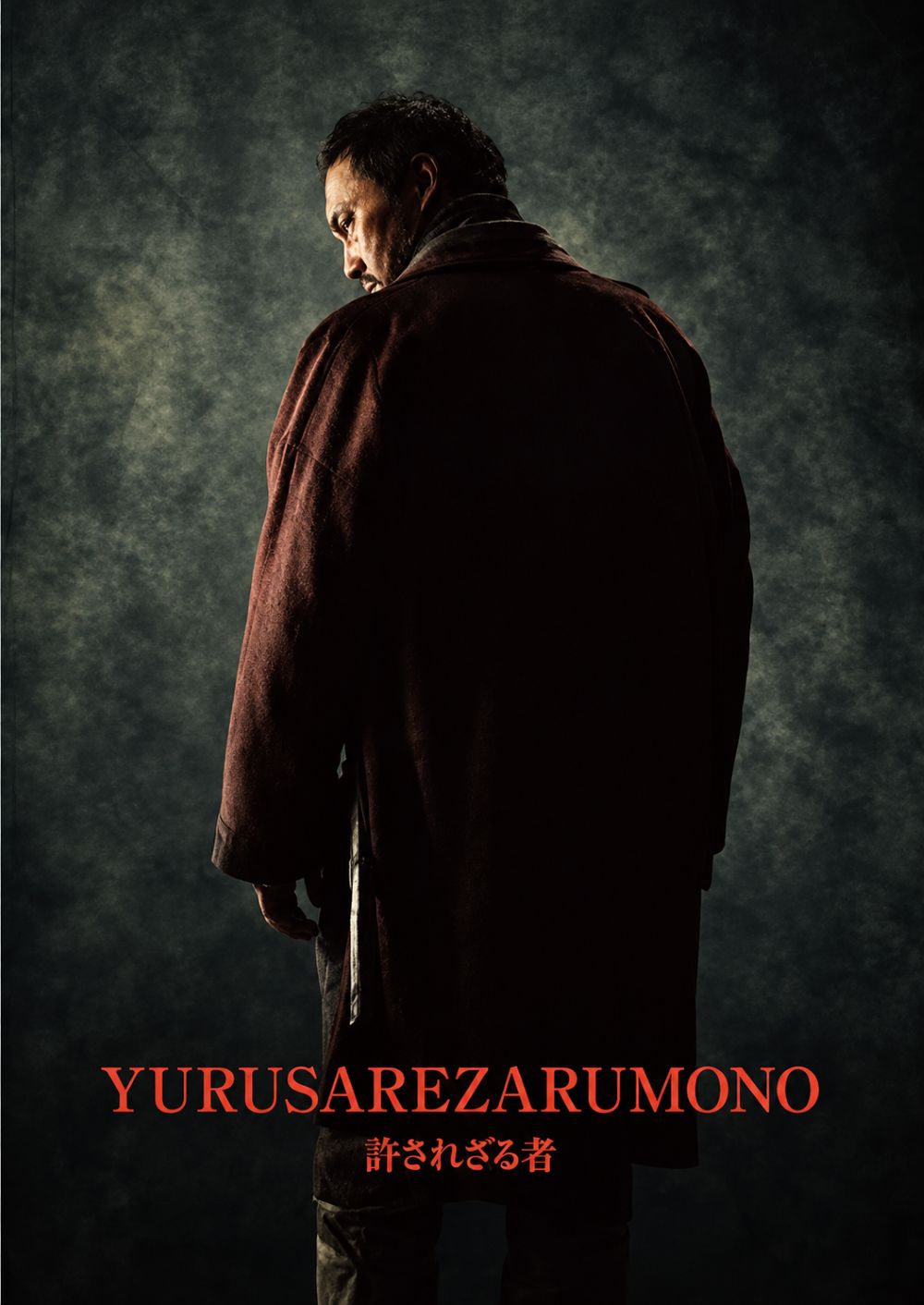
Unforgiven, released in Japan as Yurusarezaru Mono—literally “The Unforgiven” or “Unforgivable”—is the 2013 Japanese remake of Clint Eastwood’s 1992 revisionist Western. Rather than treating the original as a sacred object that cannot be touched, director Lee Sang-il and star Ken Watanabe prove that its central ideas can travel surprisingly well. The story moves from the fading American frontier to Hokkaido in the early Meiji era, when Japan was modernizing quickly and the samurai class was becoming a relic of a vanishing order. In that sense, the film finds the perfect Japanese equivalent to Eastwood’s aging gunslingers. Just as William Munny belongs to an Old West that is dying around him, Jubei Kamata belongs to a Japan that no longer has a clear place for men like him.

It also belongs to a much longer tradition in which samurai and Western gunslingers have become closely intertwined character types. Both are often portrayed as isolated men shaped by violence, reputation, personal codes, and the decline of the worlds that made them useful. Both can drift into a troubled town, become involved in someone else’s conflict, and turn into a larger-than-life figure whether they want to or not. The exchange between the genres has gone on for decades, most famously when Akira Kurosawa’s Yojimbo became the basis for Sergio Leone’s A Fistful of Dollars. Yurusarezaru Mono feels like an especially appropriate continuation of that conversation: a Japanese filmmaker takes an American Western that was itself deeply interested in dismantling the gunslinger myth and uses it to confront the equally romanticized myth of the samurai.

The original Unforgiven was already a film about stripping the glamour away from violence. Eastwood took the familiar image of the weathered gunfighter coming back for one final job and showed the ugliness underneath it. Violence is not clean, heroic, or especially skillful when it happens for real. It is frightening, clumsy, painful, and impossible to undo. Lee Sang-il keeps that moral core but finds a distinct cultural target. The Japanese version examines the idealized samurai image: the disciplined swordsman, the honorable warrior, the proud survivor of a more noble age. It asks whether any of those myths can survive when the man behind them has killed people, carries terrible memories, and no longer knows who he is without violence.

Ken Watanabe plays Jubei Kamata, a former samurai once feared as “Jubei the Killer.” He is the film’s William Munny equivalent, but Watanabe does not simply imitate Eastwood’s performance. Jubei is introduced as an exhausted farmer and widower raising two children in hard conditions. He is poor, physically worn down, and clearly ashamed of the person he used to be. Watanabe gives him an almost painful heaviness. Jubei is not merely an old warrior who wants peace; he is a man who has spent years trying to become someone else because he knows exactly what “Jubei the Killer” was capable of.

The early-Meiji setting gives that character arc a stronger historical charge. Jubei is not just retired from a bloody life. He is part of a fading warrior caste in a country remaking itself through new laws, new institutions, modernization, and expanding state power. The samurai may still exist in memory and in popular myth, but their old social role is slipping away. That mirrors the original film’s dying Old West perfectly. The gunslinger and the samurai are both figures from a violent past who have become obsolete, yet neither can completely escape the reputation that past gave them.

The plot begins after a prostitute is viciously assaulted and scarred by two men in a northern settlement. The town’s authorities treat the crime as an economic issue instead of an act of cruelty against a human being, so the women of the brothel raise a bounty for the attackers’ deaths. Kingo Baba, Jubei’s old companion, approaches him about the bounty and offers him a share of the reward. Jubei refuses at first because he has children, a failing farm, and a life he is trying to preserve. But poverty, desperation, and the lingering pull of his former identity eventually drag him back into violence.

The film’s real power is that it never turns this decision into a simple revenge fantasy. The men being hunted deserve condemnation for what they did, and the film does not soften that. Still, it never suggests that killing them will restore the woman they harmed or somehow balance the moral scale. Murder does not solve the original injustice; it only broadens the cycle of pain. Like Eastwood’s film, Yurusarezaru Mono constantly pushes against the audience’s instinct to treat revenge as satisfying or cleansing.

Jubei teams up with Kingo Baba, played by Akira Emoto, an old companion who fills the role of Ned Logan from the original. Their relationship is one of the remake’s best qualities. Emoto gives Kingo a tired, approachable decency, but he also makes clear that the man has lived long enough to understand the price of violence. He and Jubei do not need to explain their history in long speeches. Their shared past comes through in their guarded conversations, familiar irritation, and unspoken awareness that they are both far too old to be pretending this job will end cleanly.

Goro Sawada, played by Yuya Yagira, is just as important because he represents the fantasy of violence before reality destroys it. He wants a name. He wants to be feared. He wants stories about himself that will make him sound larger than life. But the film dismantles him in the same way Unforgiven dismantled the Schofield Kid. The first time he confronts the real consequences of killing, there is no rush of glory. There is only confusion, panic, and guilt. A legend is always easier to believe in when someone else has done the killing.

One of the Japanese remake’s most meaningful additions is its inclusion of the Ainu people, the Indigenous people of Hokkaido. The original film largely avoided directly engaging with the history of Native Americans in the American frontier, but Yurusarezaru Mono brings Indigenous displacement and discrimination into the story in a major way. Jubei’s late wife was Ainu, and his children therefore carry that heritage. Goro is also connected to the Ainu community and can speak the language. The film takes place during a period in which the Japanese state was expanding its control over Hokkaido, dispossessing and assimilating Ainu people while suppressing their culture and language.

That addition does not merely provide a local equivalent for the Western’s Native American history. It changes the emotional stakes of the entire story. Jubei is not only a former samurai made obsolete by Japan’s new order; he is tied by family to people being actively marginalized by that order. His farm, his children, and his dead wife become part of a larger historical wound. The film’s frontier is not empty land waiting for settlement. It is land already inhabited by people whose rights, identities, and futures are being threatened. By including the Ainu, the remake adds racial and colonial dimensions that the original’s story did not fully explore.

It also reframes Goro’s desire to prove himself. His hunger for reputation is not just youthful swagger. It comes from living in a society that treats people connected to the Ainu as inferior or disposable. He wants to be seen as somebody in a world eager to reduce him to less than that. Jubei understands this more deeply than he initially lets on. His eventual concern for Goro is shaped not only by friendship but by a recognition that the authorities could use Goro’s participation in the killings as an excuse to punish or target Ainu people more broadly.

Koichi Sato plays the local lawman, the Japanese counterpart to Gene Hackman’s Little Bill. He does not copy Hackman’s performance, which is a smart choice. Hackman’s Little Bill had a bluff, talkative confidence and an almost absurdly casual capacity for brutality. Sato’s version is colder and more calculating, with a distinctly bureaucratic edge. He sees himself as the defender of law and social order, but his version of order is built on intimidation, humiliation, and selective cruelty. He treats the abused woman as a problem, the prostitutes as a nuisance, and anyone outside his preferred hierarchy as someone to be controlled.

The emerging Meiji state may promise progress, but the film refuses to portray it as automatically enlightened. The samurai system’s decline does not erase injustice; it simply gives power a newer, more bureaucratic face. The lawman claims to hate disorder, yet he creates the kind of world where people can only pursue justice through murder because the law refuses to recognize their suffering. That makes him more than a simple villain. He is the embodiment of a new authority that insists it is civilized while using the same old cruelty to keep vulnerable people in their place.

The snowbound Hokkaido landscape gives the movie a visual identity that sets it apart from the dusty Wyoming imagery of the original. The cold, mud, wind, and vast stretches of white make the characters look even more vulnerable and lost. This is not the kind of samurai story built around beautiful duels and graceful swordplay. Lee Sang-il keeps the violence ugly and exhausting. When Jubei finally falls back into the terrifying persona of “Jubei the Killer,” it does not feel like he has rediscovered his true heroic self. It feels like a man surrendering to the worst part of himself because grief, anger, and desperation have burned away his restraint.

The ending closely follows the original in the way it brings Jubei’s buried reputation and frightening capacity for violence back to the surface. The climactic confrontation itself remains broadly faithful to Eastwood’s version, so the remake’s biggest distinction is not really in the setting or moment-to-moment mechanics of the final fight. The more meaningful change comes afterward, in what the film suggests about Jubei’s future once he has once again become “Jubei the Killer.”

Yurusarezaru Mono gives this question more weight through its focus on shame, guilt, and the possibility that some actions cannot be left behind simply because a man has spent years living differently. Jubei built a quieter life with his wife and children in the hope of becoming more than the killer he once was. But revisiting that past, even for reasons the audience can understand, forces him to confront whether he has truly escaped it—or whether he was only temporarily pretending it was gone. The remake’s final variation gives the story a sadder and more personally haunted edge, making Jubei’s past feel less like a legend he can reluctantly put back on and more like a moral burden that may have permanently separated him from the life he tried to build.

Those changes are important because they give Yurusarezaru Mono a distinct identity beyond simply being a Japanese version of a famous American film. The original Unforgiven ends with its own deliberately uneasy ambiguity. This remake reaches a similarly tragic, morally unsettled place, but it does so through the specific burdens of early-Meiji Hokkaido: the decline of the samurai, the oppression of the Ainu, and the false promise that modernization automatically means justice. The result is an ending that honors the emotional power of Eastwood’s film while still finding its own voice.

Ultimately, Yurusarezaru Mono works because it understands that Unforgiven was never only about the American West. It was about the myths societies build around violent men, the damage hidden by those myths, and the painful impossibility of separating a person from what he has done. By placing that story in early-Meiji Hokkaido, adding the history and oppression of the Ainu people, and revising key elements of the final act, Lee Sang-il’s film becomes more than a competent remake. It is a serious reinterpretation of a great Western through the lens of Japan’s own fading warrior mythology, colonial violence, and troubled modern identity.
Guilty Pleasure No. 64: Karate Warrior (dir by Fabrizio De Angelis)


“Oh, come on,” I said last week, “this is a perfectly fine film.”

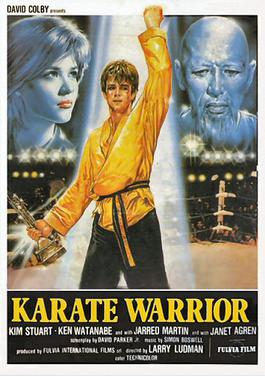
I was saying that because I was watching the 1987 film, Karate Warriors, with a group of friends.  They felt that it was a largely pointless film that didn’t really have much of a plot.  I felt that it was an interesting piece of history, seeing as how it was an Italian rip-off of The Karate Kid that was made by several associates of Lucio Fulci.  And while Fulci himself wasn’t involved with the film, the scene where the lead character, young Anthony Scott (Kim Rossi Stuart), is savagely beaten up with the bad guys is so unnecessarily bloody that it feels like an homage to Fulci if nothing else.  The scene, which makes this rip-off of The Karate Kid too graphic for the film’s target audience, really does epitomize everything that made the Italian exploitation industry so memorable.

Teenager Anthony Scott is in the Philippines so he can visit his father (Jared Martin, who starred in Fulci’s Warriors of the Year 2072), a journalist who is apparently in semi-hiding because of a series of articles that he wrote that exposed government corruption.  (Don’t worry too much about the father’s backstory because it doesn’t really play any sort of role in the film.)  Anthony runs afoul of the local teenage crime lord, Quino (Enrico Torralba).  Quino is not only running a protection racket but he’s also the local karate champion.  When Anthony stands up to Quino, he gets beaten up and Anthony’s girlfriend, Maria (Janelle Barretto), nearly loses her home when Quino’s gang sets it on fire.  The half-dead Anthony is discovered by Master Kimura (Ken Watanabe — no, not that Ken Watanabe).  Master Kimura takes Anthony into the forest and teaches him the “Stroke of the Dragon.”  One montage later, Anthony is ready to enter the local karate tournament and take on Quino.  For some reason, it never occurs to Anthony to let his father know that he’s now living with Master Kimura so, while Anthony is training, his father and his mother (Janet Agren, who co-starred in Fulci’s City of the Living Dead) are desperately searching for him in Manila.

Karate Warrior is only 84 minutes long and, for reasons that are not quite clear, Anthony’s training and the final tournament are all crammed into the film’s final 20 minutes.  Before that, the film is a travelogue of Anthony wandering around Manila, getting conned by nearly everyone that he meets, and trying to flirt with Maria.  So yes, the film is a bit plotless but I found the film’s meandering spirit to be a bit charming.  It’s rare to see a film that’s so honest about only having 20 minutes worth of plot.  The English language version also has the extra treat of some really bad dubbing.  At one point, it sounds as if a totally different actor took over dubbing Anthony.  The cheerful of ineptness of it all was rather likable.

The film was directed by Fabrizio De Angelis, who produced Fulci’s Beyond trilogy.  My friends may have disliked it but the film was a big enough of a success in Italy that it led to 6 sequels.  I can’t wait to watch every one of them!

Previous Guilty Pleasures

  1. Half-Baked
  2. Save The Last Dance
  3. Every Rose Has Its Thorns
  4. The Jeremy Kyle Show
  5. Invasion USA
  6. The Golden Child
  7. Final Destination 2
  8. Paparazzi
  9. The Principal
  10. The Substitute
  11. Terror In The Family
  12. Pandorum
  13. Lambada
  14. Fear
  15. Cocktail
  16. Keep Off The Grass
  17. Girls, Girls, Girls
  18. Class
  19. Tart
  20. King Kong vs. Godzilla
  21. Hawk the Slayer
  22. Battle Beyond the Stars
  23. Meridian
  24. Walk of Shame
  25. From Justin To Kelly
  26. Project Greenlight
  27. Sex Decoy: Love Stings
  28. Swimfan
  29. On the Line
  30. Wolfen
  31. Hail Caesar!
  32. It’s So Cold In The D
  33. In the Mix
  34. Healed By Grace
  35. Valley of the Dolls
  36. The Legend of Billie Jean
  37. Death Wish
  38. Shipping Wars
  39. Ghost Whisperer
  40. Parking Wars
  41. The Dead Are After Me
  42. Harper’s Island
  43. The Resurrection of Gavin Stone
  44. Paranormal State
  45. Utopia
  46. Bar Rescue
  47. The Powers of Matthew Star
  48. Spiker
  49. Heavenly Bodies
  50. Maid in Manhattan
  51. Rage and Honor
  52. Saved By The Bell 3. 21 “No Hope With Dope”
  53. Happy Gilmore
  54. Solarbabies
  55. The Dawn of Correction
  56. Once You Understand
  57. The Voyeurs 
  58. Robot Jox
  59. Teen Wolf
  60. The Running Man
  61. Double Dragon
  62. Backtrack
  63. Julie and Jack

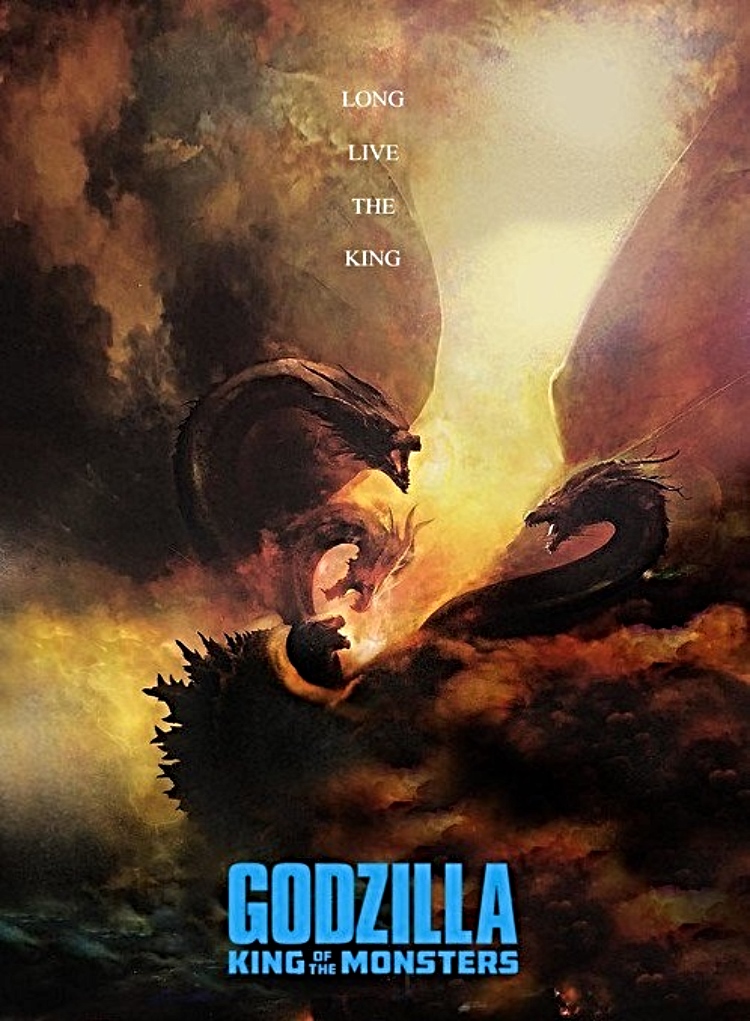
Godzilla: King of the Monsters, Review by Case Wright, Dir: Michael Dougherty


GOD.jpg

Godzilla: King of the Monsters is like eating a huge handful of different colored Jelly Bellys all at once; it’s fun and kinda sticky.  It was written and directed by Michael Dougherty (Trick ‘r Treat, Krampus, or anything that’s filmed for a few hundred bucks and a sandwich).  Dougherty is known for inexpensive genre films like Krampus, which was kind of fun in a goofy way.  This is a much bigger budget and if it weren’t for the dialogue, it would’ve been great.  Honestly, you don’t really need to listen to the dialogue and Dougherty is a lousy writer; so you’re better off tuning the people out.

The cast was everyone you like: Coach Taylor, Eleven, Tywin Lannister, That Lady from the Conjuring, That Science Teacher from Stranger Things, West Wing Guy, What’s His Face, and the guy who was in the last one who wanted the monsters to fight.  On the monster side: there was Mothra, King Ghidora, Rodan, Michaelangelo, Godzilla, and the rest.  They were all thrown at the screen like water balloons hitting you in the face.

The movie opens with Dr Emma Russell (Vera Farmiga) and Madison (Millie Bobby Brown) at a Monarch facility where baby Mothra wakes up and everyone seems to want to touch it.  Gross.  They’re gonna get a dino-rash! Terrorists enter, kill everyone, and take ….. did I write take … I meant pick up Dr. Russell and Madison.

Why? Dr. Russell lost her son to the last Godzilla attack and has decided that everyone should die because that makes sense…somehow. So, she sets up her Doctor Doolittle machine to talk/wake up all the Kaijus to kill everyone.  Her argument is really annoying and has a makeshift powerpoint presentation.  She is the embodiment of every sanctimonious Seattleite, Vegan, Composting, Apologist, Whiner all rolled into one; she figures if the monsters kill all the people that the world will be better off- think if that horrible Lorax finally got the money to kill for the trees.  They’re why I refuse to recycle …. EVER!

Anywho….she wakes up all the monsters and Coach Taylor who is Dr Russell’s quasi-ex-husband scientist is granted crazy authority over the military to figure out how to stop all the monsters from killing everyone.  And man do they ever fight?!!! I mean it do they ever fight?  I counted only four monster on monster fight scenes- kinda skimpy.  Also, Godzilla had to be recharged with nukes or radioactive spa time to keep going; I guess Godzilla decided to upload the latest Apple Update.

Godzilla ends up on top….literally. He gets on top of a mound in Boston and all the other monsters bow down to Godzilla, except Mothra – She curtsies (she’s from another time).  There’s good CGI and Monster fighting- when they do fight.  Just don’t go trying to find deeper meaning.  I loved these movies because they’d be on tv for the nerd set when I was a kid.  I saw them all.  In fact, in King Ghidora v Godzilla, Godzilla tries to help the Japanese win world war II or at least one battle. It was awesome.  These movies are great because you can unplug and watch some awesome destruction.  This movie brings the boom.  Enjoy!

Clear eyes.gifgod3.gif


Godzilla: King of Monsters 2nd Official Trailer


Godzilla King of Monsters

This past summer we saw the first trailer to Godzilla: King of Monsters. To say that the reaction to that trailer was positive would be an understatement. It was one of the highlights of San Diego Comic-Con 2018.

Now, Warner Brothers Pictures saw fit to release the second trailer for the film. This time with less classical music and more Kaiju mayhem visuals instead. Michael Dougherty takes over directing duties from Gareth Edwards and this time it shows as the film stresses the action in the film rather than the human interactions underfoot.

Kaiju films have been fan-favorites for decades upon decades because of the monsters and less about the humans. The humans really were just there to give voice to the different factions of monsters duking it out. It looks like this time this sequel will follow the same formula.

Godzilla: King of Monsters is set for May 31, 2019.

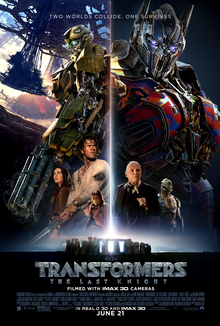
Playing Catch-Up With The Films of 2017: Transformers: The Last Knight (dir by Michael Bay)


So, I’m just going to be honest here.

I did watch Transformers: The Last Knight.  I didn’t see it at the theaters, of course.  To date, I’ve only seen one Transformers movie on the big screen.  It was the fourth one and not only did I get motion sick but when I left the theater, I discovered that I was having trouble hearing.  Even though I watched Transformers: The Last Knight on a small screen, I still made sure to take some Dramamine beforehand.  That may have been a mistake because this movie somehow drags things out for 2 hours and 30 minutes.  That’s a lot of time to spend trying to stay awake while watching something that doesn’t even try to make sense.

So, yes, I did watch Transformers: The Last Knight but I’m not really sure what I watched.  I know that there was a lot of camera movement.  There was a lot of stuff blowing up.  Robots would fly into space.  Robots would return to Earth.  Robots turned into cars.  All of the robots spoke in these gravelly voices and half the time, I couldn’t really understand what they were saying.  Mark Wahlberg was around and he spent the entire movie with this kind of confused look on his face.  His Boston accent really came out whenever he had to deliver his dialogue.  One thing I’ve noticed about Wahlberg is that the less he cares about a movie, the more likely he is to go full Boston.  To be honest, if I just closed my eyes and listened to Wahlberg’s accent and tuned out all of the explosions and robot talk, I probably would have thought I was watching Manchester By The Sea.

Anthony Hopkins was also in the movie, playing a character who might as well have just been named “Esteemed British Person.”  It’s always fun to see Hopkins in a bad movie, just because he knows that his deserved reputation for being a great actor isn’t going to suffer no matter how much crap he appears in.  He always goes through these movies with a slightly bemused smirk on his face.  It’s almost as if he’s looking out at the audience and saying, “Laugh all you want.  I’ll still kick anyone’s ass when it comes to Shakespeare…”  Anyway, Hopkins is mostly around so that he can reveal that the Transformers have been on Earth since time began.  Why, they even saved King Arthur!

The plot has to do with a powerful staff that can be used to bring life back to the Transformers’s home planet.  The problem is that using the staff will also destroy all life on Earth or something like that.  So, of course, the good Transformers are trying to save Earth and the bad Transformers are like, “Fuck Earth, let’s blow stuff up.”  Or something like that.  The main good Transformer — Optimus Prime, I guess — gets brainwashed into becoming an evil Transformer.  Of course, since Anthony Hopkins is in the movie, the majority of the film takes place in England and that can only mean a trip to Stonehenge!

And…

Look, I’ve exhausted myself.  I’m not going to say that Transformers: The Last Knight is a terrible movie because, obviously, someone out there loves this stuff.  I mean, they’ve made five of these movies so someone has to be looking forward to them.  They’re not for me, though.

Some day, I hope Micheal Bay directs a Fifty Shades of Grey movie.  I look forward to watching Christian and Ana discuss consent while the world explodes behind them.

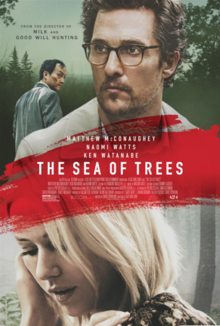
Film Review: The Sea of Trees (dir by Gus Van Sant)


The_Sea_of_Trees

Nobody wants to admit it but there was a time when all of us self-styled award divas were convinced that Gus Van Sant’s latest film, The Sea of Trees, would be a huge Oscar contender.

Can you blame us?

Sure, you can!  But, before you do, look at it from our point of view.  Gus Van Sant is an acclaimed director who has split his time between Oscar-baity mainstream movies (Good Will Hunting, Milk) and deliberately obscure art films (Elephant).  Two of Van Sant’s films have been nominated for best picture and he has twice been nominated for best director.  The Sea of Trees stars two Oscar nominees (Naomi Watts and Ken Watanabe) and an Oscar winner (Matthew McConaughey).  Much like the 2003 best picture nominee Lost in Translation, The Sea of Trees dealt with an American in Japan.

Yep, The Sea of Trees definitely looked like a contender but then it premiered at the Cannes Film Festival and everything went downhill.  The audience laughed.  The critics booed.  The negative reaction to the film quickly became legendary.  Suddenly, it looked like this former Oscar contender would be lucky to even get an American release.  Both Lionsgate and Roadside Attractions acquired the U.S. distribution rights and both companies dropped the film.

As a result, I found myself growing fascinated with The Sea of Trees.  How bad could it be, I wondered.  The fact that I might never get a chance to actually see the movie only added to my interest.

Well, fortunately, A24 eventually acquired the distribution rights to The Sea of Trees and they have now given the film a limited release in the States.  I saw it last night and…

Meh.

Seriously, after all the publicity and drama, I was expecting that The Sea of Trees would be a total and complete fiasco, one of those train wreck movies that you just can’t look away from.  But, to be honest, The Sea of Trees is not an artistic fiasco in the style of Batman v Superman, nor is it unintentionally amusing like April Rain.  Instead, it’s just a really boring film.

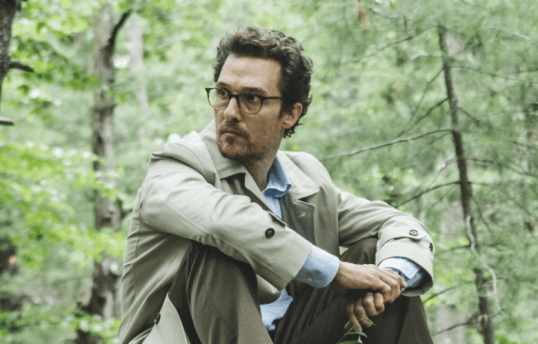
When I heard the plot of the film, I thought it would be an unofficial companion piece to Van Sant’s acclaimed Death Trilogy.  In many ways, the plot sounded a lot like the plot of Gerry.  Arthur Brennan (Matthew McConaughey) is a widowed professor who goes to Japan and visits Aokigahara Forest, the famous suicide forest at the foot of Mt. Fiji.  Brennan is planning to end his life but he’s distracted by a Japanese man, Takumi Nakamura (Ken Watanabe), who claims to be lost in the forest.  However, Nakamura has deep cuts on his wrists.

Brennan tries to help Nakamura find his way out of the forest but soon, the two of them discover themselves to be lost.  Brennan spends a lot of time talking about life philosophy and I have to admit that I had a hard time following what he was saying because I was bored out of my mind.  (It doesn’t help that McConaughey delivers his dialogue in the same style that he used for his infamous car commercials.)  Nakamura doesn’t say much at all.

We also get several flashbacks to Brennan’s former life with his wife (played by Naomi Watts).  The scenes all have a definite Nicholas Sparks feel to them.  And yet, the flashbacks were the best part of the film because of the chemistry between McConaughey and Watts.  The flashbacks are openly and unapologetically sentimental, without any of the pretension that mars the scenes between Brennan and Nakamura.

On a positive note, the film’s cinematography is often striking and the opening, with Brennan walking past random corpses while looking for the perfect place to end his life, is nicely done.  Otherwise, almost the entire film is a misfire.  Matthew McConaughey is one of those actors who is naturally so full of life that it’s hard to buy him as a suicidal academic and the film, which is already overlong at nearly two hours, drags.  This is one of those films that has about a dozen false endings before the final credits finally roll.  Meanwhile, as the action slowly plays out, the original score pounds you over the head.  Important Important Important, the score demands even as the film fails to deliver.

And so, that’s The Sea of Trees.  

It’s not exactly a fiasco but it is unforgivably forgettable.

You gotta keep livin', man! L-I-V-I-N!

You gotta keep livin’, man! L-I-V-I-N!

Here’s Another (!) Trailer For The Sea of Trees!


You know what?

After all the delays and all the negative reviews, I have become rather obsessed with finally getting the chance to actually see Gus Van Sant’s The Sea of Trees.  At this point, it really is a case of simply having to know if it’s truly as bad as people have been saying since last year.

Well, it looks like I’m finally going to get a chance!  The Sea of Trees finally has a release date here in the States and that date is August 26th!

Here’s the latest trailer for The Sea of Trees:


Hey, It’s The Trailer For The Sea of Trees!


PCAS

If I wanted to play a really mean April Fools Day joke, I would announce that, after getting thoroughly booed at Cannes last year and suffering from some of the worst word-of-mouth in cinematic history, Gus Van Sant’s The Sea Of Trees has finally gotten an American release date.

But I’m not mean and I’m not going to play that joke on you.

Instead, I’m going to tell you that not only is Van Sant’s Sea of Trees never going to be released in the U.S. but that the script is also currently being reshot by Terrence Malick…

April Fools!

Bleh, what a stupid holiday.

Anyway, the truth of the matter is that Sea of Trees still does not have an American release date but it will be released in Europe later this month.  Eventually, if nothing else, Sea of Trees will make it to Netflix and we’ll get to discover what everyone was booing about in Cannes.

Here’s the international trailer!

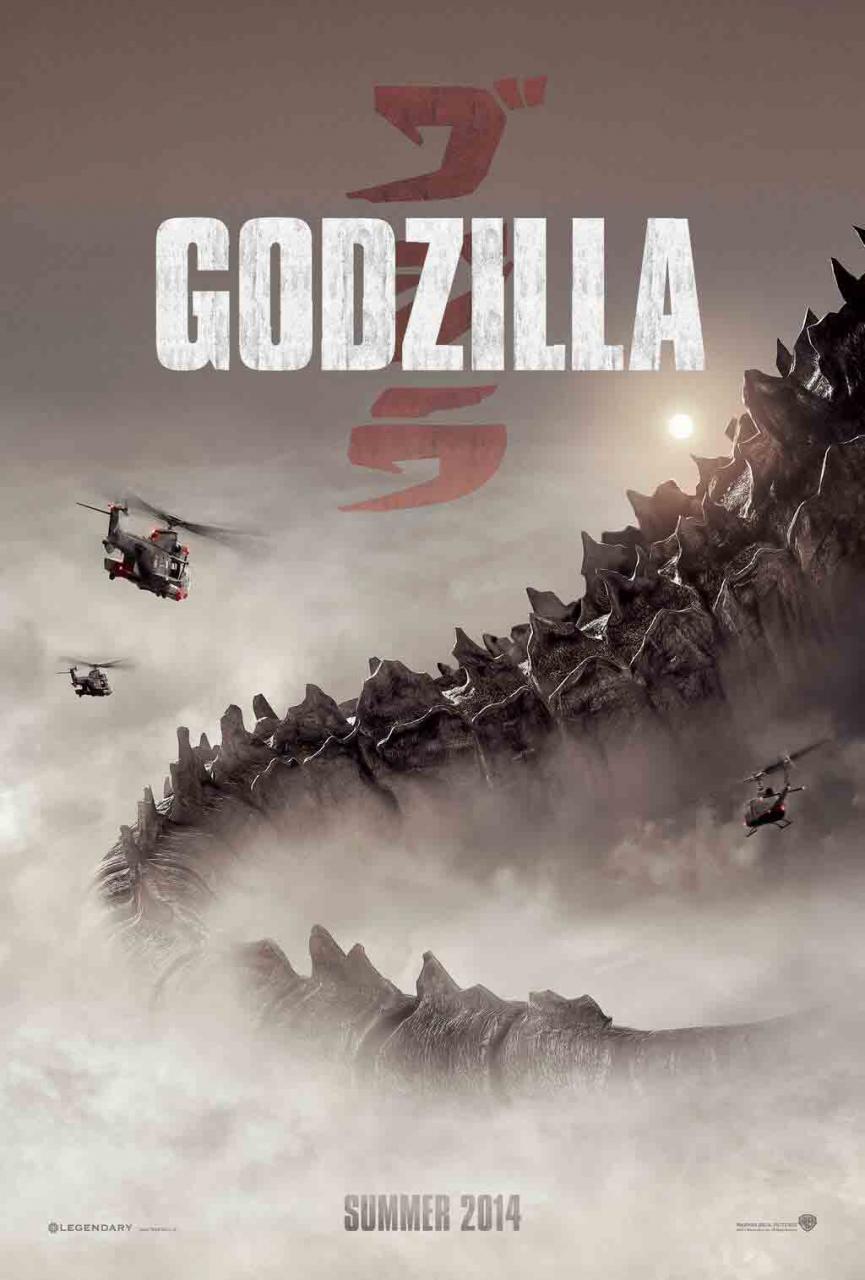
Trash Film Guru Vs. The Summer Blockbusters : “Godzilla”


godzilla2014_poster2

Here’s the thing when it comes to any and all Westernized takes on Japan’s most famous movie monster — Hollywood’s just never going to “get it” because, frankly, it can’t. Oh, sure, Gareth Edwards’ 2014 Godzilla is head and shoulders above Roland Emmerich’s 1998 abomination of a film, but the simple fact is that the Big Green Guy and all of his scaly, serpentine brethren that came to us courtesy of the venerable Toho studios were, at their core, celluloid manifestations of a deep-seated atomic angst that only a country that had been on the receiving end of, as Sting put it, “Oppenheimer’s deadly toy” could ever really give birth to. And while Ken Watanabe’s Dr. Ichiro Serizawa character does, in fact, explicitly mention Hiroshima and Nagasaki in this flick, it’s pure window dressing — Edwards and screenwriters Max Borenstein and Dave Callaham didn’t actually live through a time when they had to actively wonder what sort of nuclear fission-induced mutations were lurking beneath the waves just a few miles offshore, so they just can’t communicate that sort of unease with the same authenticity that the original Godzilla did.

And to those who would argue that a young Japanese filmmaker wouldn’t be able to imbue a project such as this with any more immediacy than Edwards does because they wouldn’t have lived though those horrific final days of WWII either, I’ve got one word for you : Fukushima.

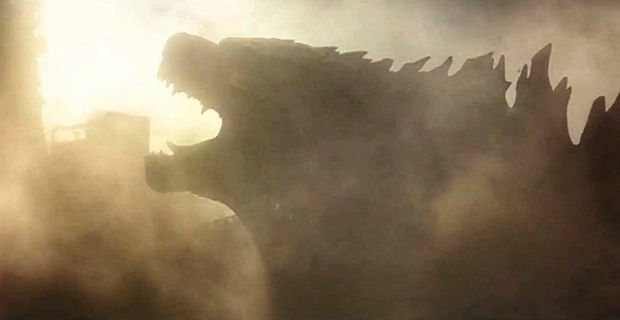
Godzilla-2014-Roar

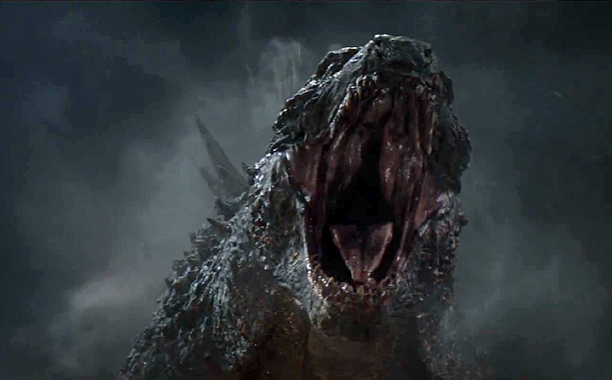
There’s also something about CGI in these flicks that always has, and always will, suck, no matter how “good” it is : you know, in the back of your mind, that it’s just not there. To be sure, Edwards and his visual effects crew do a bang-up job of realizing their monster once they do, finally, reveal him, but no matter how “unrealistic” watching the original Godzilla smash cardboard miniatures of buildings may be by today’s standards, it still feels more “real” than the essentially flawless computer graphics of 2014 can ever hope to. But maybe that’s just me —-

godzilla-trailer-02

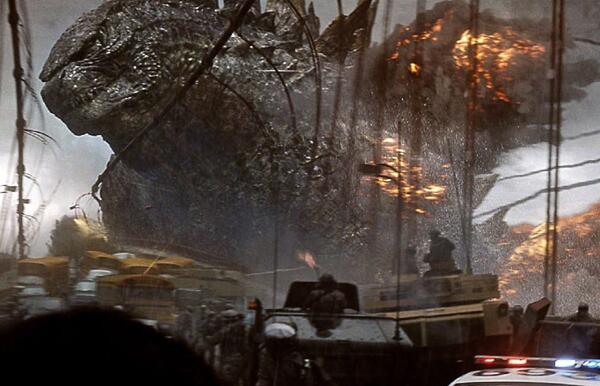
Still, don’t get the wrong idea : I’m not so much “down on” the new Godzilla as I am completely indifferent to it. To be sure, Edwards’ heart seem to be in the right place here, and he’s very likely doing the best job that he can do — it’s just that his best is nowhere near good enough. A slow-burn plot doesn’t help matters much, either, and while I’m all for a prolonged buildup that leads to a big payoff, frankly the “character arcs” of all the principal players are so dull and uninvolving that when Compu-Zilla finally does make the scene, it feels more like a relief from soap opera-style tedium than anything else. Thankfully, there’s some effectively-realized mass destruction to bump up the “wow” factor a bit, and Godzilla doesn’t turn out to a solo act (that’s all I’ll say about that), but it’s still definitely a case of “too little, too late” as far as excitement here goes and a smorgasbord of good performances (Bryan Cranston, Juliette Binoche, David Strathairn, Sally Hawkins, and the aforementioned Ken Watanabe) and bad (Aaron Taylor-Johnson, Elizabeth Olsen) find themselves having equally gone, more or less, to waste when the proverbial train finally leaves the station.

Plot recaps probably make as much sense here as they do for a Hulk comic book — sure, the set-up matters on some level, but it’s all about “Hulk smash!” at the end of the day, isn’t it? Suffice to say that the main reason the various intermingling sub-plots here really don’t work is because the film goes from small-scale to so-big-it’s-off-the-scale at the drop of hat, with no transition period in between for either the characters or the audience. It’s all just a bit jarring — but maybe that’s not such a bad thing when I think about it because, truth be told, I was getting a little sleepy.

The “who are the real monsters?” theme that Edwards toys with is frankly a little bit old, too, and honestly represents something of a cop-out ( and here’s where my “Westerners will never get this right” thesis comes into play, by the way) :  sure, humans are bad news, we’re destroying everything, etc. I know that. But some of us are worse than others, and any side willing to drop a nuclear bomb and murder hundreds of thousands of innocent people in order to “win” a war is due for some special criticism, in my view . The makers of the original Godzilla understood that fact, even if they couldn’t say so explicitly, while in the franchise’s 2014 iteration we just all suck. No one, specifically, is to blame, and hey, it’s too late for recriminations anyway when you’ve got an overgrown reptile tearing up the town. Or something like that.

godzilla-attacks-golden-gate

Still, the film’s third act is enough to make even a hardened cynic like me gasp in awe on numerous occasions, and the “childlike wonder factor,” for lack of a batter term, really does kick into high gear here as events steamroll toward their conclusion. It’s worth the price of admission for the awesome (even if it is computer-generated) spectacle the final 45-or-so-minutes deliver. Sure, I wish we’d gotten nothing but a bad ride on a  bumpy road from start to finish, but I guess I’m still willing to take what I can get. Felling like you’re 12 years old all over again for even a little while is better than never feeling like it at all.

And yet — in addition to being this film’s greatest (perhaps even only) saving grace, perhaps that last act is also its greatest weakness, because it exposes the essential, unavoidable truth at the heart of Edwards’ Godzilla : it’s good enough to make you remember why you love monster movies in the first place, but nowhere near good enough to actually be one of those monster movies  that you love.

Godzilla – Attack at Pacific Promo Scene


Godzilla2014

It is just a week to go before the premiere of Gareth Edwards’ Godzilla and the marketing has begun to go into overdrive.

In addition to trailers and the latest tv spots, Warner Bros. has begun to release clips and behind-the-scenes to help announce the latest arrival of the King of Monsters.

We have here a brief clip that shows the Big Guy taking on the U.S. Navy as it tries to defend Golden Gate Bridge and the Bay it straddles. This marks two straight years that the Golden Gate Bridge has been threatened and/or destroyed by these damn kaiju.