I will say it now that when I first heard that Sony was going to reboot the Spider-Manfilm franchise I wasn’t enthused by their decision not to mention saying bye to Sam Raimi as the franchise director. I saw this decision as Sony’s attempt to hold onto the licensing rights to the character. Without a new film coming out soon the rights were going to revert back to it’s parent company in Marvel Comics (something comic book fans probably hope would’ve happened). So, a new film was rushed, with a new director in Marc Webb and a new Peter Parker in Andrew Garfield.
This reboot will retell Spider-Man’s origin story once again and much more grittier than the more fun, pulpy Raimi trilogy. I think the fact that it was going to be another origin story is what made me hesitant to embrace this reboot. I’m still not fully committed to this film, but with each new trailer released my interest continues to rise. With this latest trailer we can see that the effects look to be much improved from the first three films which is understandable with advancement in CGI. We can also see in this new trailer the “grittier” aspect Sony was promising. I will say that I’m still not sold on Andrew Garfield as Peter Parker/Spider-Man, but maybe seeing the finished product will prove me wrong.
The Amazing Spider-Manis set for a July 3, 2012 release date.
Paul Verhoeven’s 1990 scifi classic, Total Recall, remains one of Arnold Schwarzenneger’s better films. The film was an adaptation of the Philip K. Dick novellete, We Can Remember It for You Wholesale, and in 2012 it will once again go up on the big-screen as a Len Wiseman remake.
Wiseman’s film looks to take the basic premise of Dick’s novellete and some of the changes made for the Verhoeven production. What looks to have been changed in this upcoming remake is the absence of Mars as the backdrop for the character Douglas Quaid who believes he is actually a secret agent working to free Mars from the tyrannical rule of one Cohagen. This time around the setting is instead a dystopian future Earth where the planet has been split into two super-factions the rule planet. There’s Euroamerica which combines the North American and European Union into one sovereign entity and it’s rival in New Shanghai which puts together the economic powerhouses of China and the nations of South East Asia.
It is in this new backdrop that Colin Farrell’s Quaid must run from the forces of Cohaagen (played by Bryan Cranston) and help the freedom fighters trying to change things for the better. The trailer itself shows less of the cheesy look of the Verhoeven film and instead goes for a much slicker art design that some people have called the Mass Effect-look. I must admit that the fully-armored forces chasing after Quaid look like Blue Suns mercenaries from that BioWare scifi rpg.
I will say that the trailer does a great job in referencing similar scenes and sequences from the original Verhoeven film while adding in new touches to give the film it’s very own unique look. For one of this summer season’s last films before fall season begins this one looks like a must-see.
Total Recallis set for an August 3, 2012 release date.
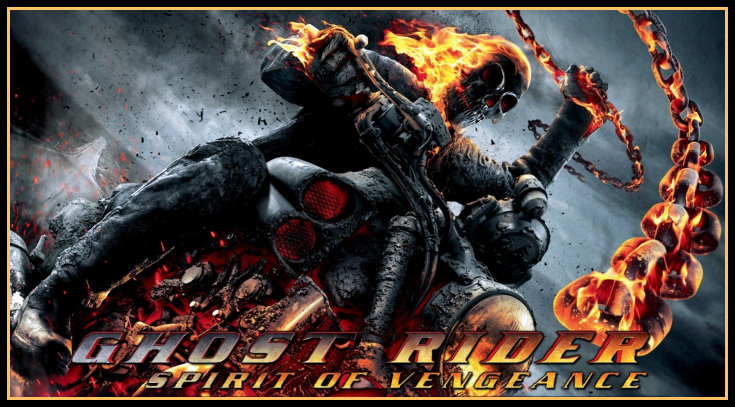
Ghost Rider has always been a niche character for Marvel Comics. The character was born out of an earlier Marvel character named Night Rider. After Marvel writers Roy Thomas and Gary Friedrich and artist Mike Ploog had rein-visioned the character into Ghost Rider during the early 70’s it has always remained on the extreme fringes of the Marvel Comics universe. This wouldn’t stop Sony (which owned the film rights to the character) to go ahead and adapt it for the big-screen. 2007’s Ghost Riderby Mark Johnson was the first and failed attempt to turn the character into a film franchise. It still made enough money despite a near-universal panning of the film by critics and audiences alike. This turn of profit is why Sony once again dipped into the Ghost Rider well and come up with 2012’s Ghost Rider: Spirit of Vengeance.
This “sort of” sequel ditches Mark Johnson and brings in the dynamic (and I’d say somewhat insane) directing duo of Mark Neveldine and Brian Taylor to helm the film. It brings back Nicolas Cage for the role of Johnny Blaze/Ghost Rider. Working from a script by Scott Gimple, Seth Hoffman and David S. Goyer one would think the film had nowhere else to go but up especially with the wacky and frenetic filming style by Neveldine/Taylor. To say that this sequel failed to do anything but finally give this film franchise a final nail in it coffin would be an understatement.
Ghost Rider: Spirit of Vengeanceditches pretty much most of what transpired with the first film and tries to retcon things for the sequel. I’d say this would’ve been a good idea seeing the first film was truly awful, but what the sequel ended up doing was confuse things even more. The film tries to turn the Ghost Rider persona from just a spirit of vengeance but an angelic being called the spirit of justice which had become corrupted. We get the Devil in the form of Roarke (played by Irish actor Ciaran Hinds) searching for the young boy Danny who is to be his perfect vessel. Johnny Blaze comes into the picture after being recruited by a drunk French warrior-monk by the name of Moreau (Idris Elba whose performance was one of the lone highlights of the film) who promises to exorcise the demon from Blaze in exchange for finding and saving Danny.
This would’ve been a good premise if it had several more drafts of it worked on. Though there’s still a chance the film would’ve still sucked in the end. Even the direction from Neveldine/Taylor (Crank, Crank: High Voltage, Gamer) failed to add any heat to the proceedings. They come up with some unique camera angles and action sequences, but gone was the hyper-realistic and frenetic style they’ve become known for. Their previous films were not stuff to write to one’s film critic circles about but they at least had a sense of fun built into them even if their stories defied any sort of logic.
Even the performances by the cast seemed to be something that barely reached the level of one-dimensional. Nicolas Cage tries to channel his inner crazy by way of Bad Lieutenant: Port of Call New Orleans, but it’s too little too late to save the film which never found any sort of footing on the side of competent. Really, the only good thing worth of note was my previous mention of Idris Elba as Moreau who chews the scenery every time he shows up on the screen like it was his last meal. This performance alone wasn’t enough to save the film or even make it somewhat entertaining.
Ghost Rider: Spirit of Vengeancewas not worth seeing in the theater (especially in 3D though that part of the film was actually quite well done despite being a post conversion) and I’d be willing to admit that it’s still not worth seeing on video unless it was for free. What could’ve been a restart to the series with the inclusion of Neveldine/Taylor instead gives this franchise it’s death-knell and most likely help Marvel get the rights back from Sony. Here’s to hoping that the flaming skull rider stays on the fringes of the Marvel Cinematic Universe for decades to come.
“Remember, Red. Hope is a good thing, maybe the best of things, and no good thing ever dies.” — Andy Dufresne
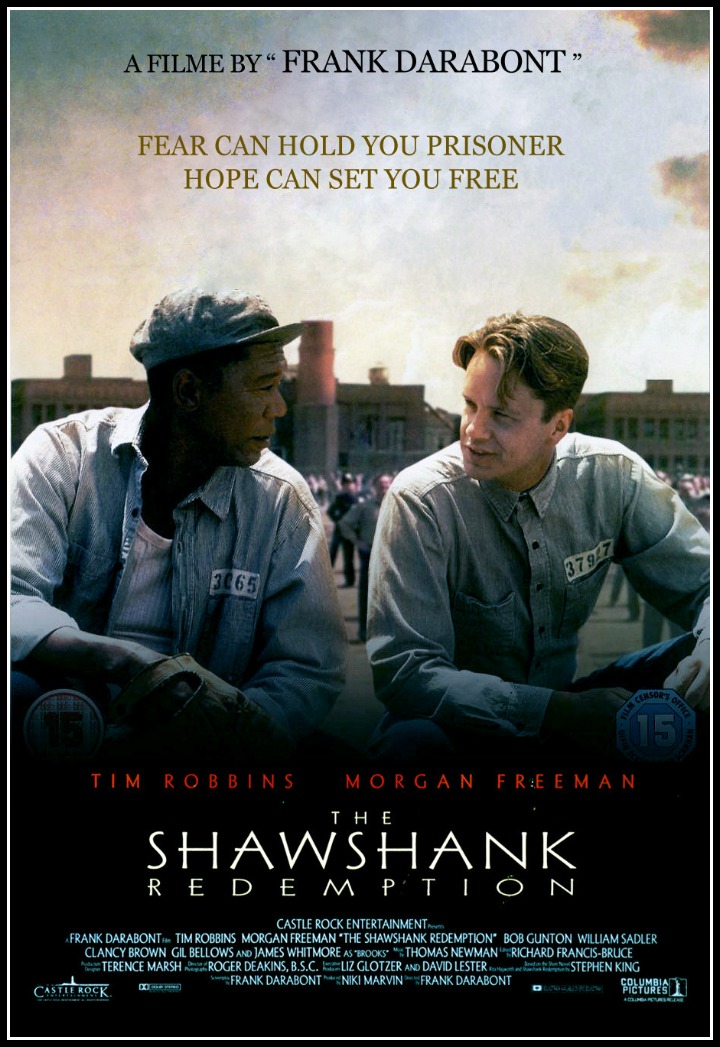
1994 was the year that men finally got their version of Fried Green Tomatoesand Beaches. We men we’re always perplexed why so many women liked those two films. Even when it was explained to us that the film was about the bond of sisterhood between female friends and how the march of time could never break it we were still scratching out heads. In comes Frank Darabont’s film adaptation of the Stephen King novella Rita Hayworth and Shawshank Redemption.
Using a script written by Darabont himself, the film just takes the latter half of the novella’s title and focuses most of the film’s story on the relationship between the lead character of Andy Dufresne (played by Tim Robbins) who gets sent to Shawshank Penitentiary for the crime of killing his wife and her lover and that of another inmate played by Morgan Freeman. The film doesn’t try to prove that Andy is innocent even though we hear him tell it to the convicts he ends up hanging around that he is. The relationship between Andy and Red becomes a great example of the very same bond of sisterhood, but this time a brotherhood who are stuck in a situation where their freedom has been taken away and hope itself becomes a rare and dangerous commodity.
Darabont has always been a filmmaker known for his love of Stephen King stories and has adapted several more since The Shawshank Redemption, but it would be this film which has become his signature work. It’s a film that’s almost elegiac in its pacing yet with hints of hope threaded in-between scenes of men clinging to sanity and normalcy in a place that looks to break them down and make them less human. It’s nothing new to see prison guards abusive towards inmates in films set in prisons, but in this film these scenes of abuse have a banality to them that shows how even the hardened criminal lives and breathes upon the mercy and generosity provided by the very people who were suppose to rehabilitate them.
While the film’s pacing could be called slow by some it does allow for the characters in the film, from the leads played by Robbins and Freeman to the large supporting cast to become fully formed characters. It doesn’t matter whether it’s Clancy Brown playing the sadistic Capt. Byron Hadley to James Whitmore as Brooks Hatlen the inmate who has spent most of his life in Shawshank and whose sudden parole begins one of the most heartbreaking sequences in the film. The whole cast did a great job in whatever role they had been chosen to play. Freeman and Robbins as Red and Andy have a chemistry together on-screen that makes their fraternal love for each other very believable that the final scenes in the film doesn’t feel too melodramatic or overly sentimental.
The Shawshank Redemptionwas a film that lost out to Forrest Gump for Best Picture, but was a film that would’ve been very deserving if it had won the top prize at the Academy Awards. It was a film that spoke of hope even at the most degrading setting and how it’s the very concept of hope and brotherhood that allows for those not free to have a sense of freedom and camaraderie. Darabont’s first feature-length film remains his best work to date and one of the best Stephen King adaptations which is a rarity considering how many of his stories have been adapted. So, while the fairer sex may have their Fried Green Tomatoes, Beachesand the like, we men will have ours in the fine film we call The Shawshank Redemption.
When one sees the name Roland Emmerich attached as the director to a film on any given year one almost has to audibly groan. He’s not on the level of Uwe Boll in terms of awful films, but he does give Michael Bay a run for the title of worst blockbuster filmmaker. It’s quite a shame to see Emmerich’s films one after the other get worse and worse. This was a filmmaker who showed some talent in the scifi-action genre with such cult classics as Universal Soldier and Stargate. He would reach his apex with the popcorn-friendly and thoroughly enjoyable Will Smith alien-invasion flick, Independence Day. Since reaching those lofty heights each successive film has been more groan-inducing and worse than the previous one. For a brief moment in 2009 this would change as he finally succeeded in destroying the world that he had only hinted at with previous films such as ID4, Godzilla and The Day After Tomorrow. The film 2012 was released in late-2009 and, while it was universally lambasted by critics and a large portion of the public, I thought it was his most fun film since ID4.
2012 literally has the world greet it’s apocalypse according to the Mayan Calendar in the year 2012. The first forty or so minutes has Emmerich explaining the details of how the world will end in 2012 either through the film’s lead scientist (played by Chiwetel Ejiofor) or through a conspiracy-theorist played with manic glee by Woody Harrelson. The bulk of this film is almost like disaster porn for film lovers who are into disaster flicks. We have earthquakes which sends the whole California coast sliding into the Pacific. Supervolcanoes erupting in what is the Yellowstone National Forest right up to mega-tsunamis that dwarf the highest mountain ranges.
The cast might be called an all-star one, but I rather think it’s more a B-list with such names as John Cusack playing a goofy everyman who must save his ex-wife and two young children right up to Danny Glover playing the lame duck of lame duck presidents (I guess Morgan Freeman was unavailable or already done with disaster films after doing Deep Impact). The performance by this cast ranged from alright to laughable, but even with the latter the sense of fun never wavered. This was a flick about the world ending and Emmerich delivered everything promised.
It’s the scenes of world devastation which made this film so enjoyable for me and has become one of my latest guilty pleasures. No matter how bad the dialogue got or how wooden some of the acting came off the sense of wonder from Emmerich destroying the world on the big-screen and on my TV made this film fun to watch. Maybe those who hated it or thought it was trash were aiming to high. I will admit that the film is trash, but in a good way that past enjoyable disaster flicks of the 70’s were fun. It took the premise serious enough, but the filmmakers involved didn’t skimp on over-the-top destruction. I mean this film’s premise means we get to see in high-definition billions of people die as the planet decides to suddenly switch things around to get a better feng shui vibe to the planet.
Scenes such as the mega-tsunamis topping over the Himalayan mountain range was awesome. But even that scene couldn’t top the super-quake which destroys Los Angeles around Cusack’s character who tries to outdrive the quake and the resulting chasms which appear to chase his limo with is family inside. Seeing Los Angeles and the bedrock it’s on upheave and slide into the Pacific was one of the best disaster porn sequences I’ve ever seen and I don’t see anything topping it in the near future.
2012 as a Roland Emmerich production already has a black mark on it because of his reputation as a filmmaker, but for once he actually made a film that was able to surpass all the glaring flaws from it’s one-note, stereotypical characters to it’s wooden dialogue. He did this by making a film with disaster scenes of such epic spectacle that one had no choice but to just sit back and enjoy the ride. It’s a bad film, but it sure was a fun ride. This is why I decided on a fan-made trailer which best exemplifies this film and not the one made by the studio.
I eagerly await the sequel I fully expect from Hollywood: 2013:Disaster Strikes Back.
I’ve probably gone back and rewritten this review multiple times over the past few hours. I’ve been struggling to come to a final conclusion to how I felt about the film. On one hand it is a hollow crime thriller, all polish and no substance, and on the other it is an exceptionally crafted dark and mysterious tale of sex, corruption and murder that oozes with atmosphere. One could make the case for either, and many critics have argued in favor of one side or the other. After a lot of contemplation, I’ve come to decide that it actually seems to rely on both being hollow and atmospheric, but what continues to conflict me is whether the former can truly be overlooked even if crucial to the final product.
‘The Girl With The Dragon Tattoo’ stars Daniel Craig as Mikael Blomkvist, a journalist who has recently come under a lot of scrutiny after being accused of making up a story about a wealthy executive and losing the case of libel brought upon him. Facing financial and credibility problems he is hired by Henrik Vanger (Christopher Plummer) a wealthy entrepreneur who wants Mikael to solve a ‘cold case’ that has haunted him for forty years, that being the disappearance of his grand-niece Harriet who he believes was murdered by a member of his corrupt family filled with Nazis and recluses. As Mikael delves deeper into the mystery of her disappearance he hires the assistance of Lisbeth Salander, a goth-hacker with a dark past who has her own personal issues to deal with, specifically a financial guardian who wants sexual favors in order for her to access her money. When they are finally brought together they discover the dark secrets of the Vanger family and its links to a serial murderer case that begins to threaten their own lives.
David Fincher, who directed ‘Zodiac’ and ‘Se7en’, is no stranger to graphic and dark thrillers so it is no surprise that he handles the creation of ‘The Girl With The Dragon Tattoo’ with a level of competence few other directors could have. Along with the help of cinematographer Jeff Cronenweth and being set in Sweden the film has a very dark and cold (often literally) tone, making an atmosphere just as chilling as the subject matter and beautiful to look at. Sadly under the gorgeous and dark visuals and the bleak and mysterious atmosphere there isn’t much to be had. There is a real lack of emotion and soul.
I can only assume that Fincher’s intentions from the beginning were to avoid any real substance, and to make a film just as hollow and sadistic as the story is was trying to tell. There is just about no emotion and so no reason to be attached to anyone except Lisbeth, but our empathy for her stems more from the vial acts we see acted upon her and less from truly knowing who she is, and why she is so emotionally restrained. It is not until the last twenty minutes that she gets any sort of development, but was it too little too late? Again I cannot decide. One could argue that this insight into the character earlier on would have made us care for her more, which I can understand. But I also question whether or not she could have even opened up the way she does at the end without having first gone through the events of the film, in particular the relationship she has with Mikael. Either way, I’m just glad Fincher went with Rooney Mara to play Lisbeth.
It is hard not to compare both film versions of the Lisbeth character, and even harder to choose which was better. This is mainly because both films, although similar in many ways, have very different tones. The Swedish version is a much more straight forward thriller and Rapace’s Lisbeth fits that film in being just a strong and tough individual, though there doesn’t seem to be too much below her surface and most of the development of her past is shown. Mara’s Lisbeth is a much more complex character, and although the film doesn’t give her much depth in terms of story until the very end, Mara gives off hints of a disturbing past just in the way she talks and moves, especially when men get too close to her. In reality she is a much weaker character than in the Swedish version. I personally liked that soft side because it makes her feel more like a vulnerable woman so when she fights back it feels more powerful.
It is this humanization that really helps propel Fincher’s adaptation over the Swedish version in my eyes. Even Daniel Craig, who put on a very good performance, is given a lot more to do and a much more interesting personality. He gives the character a bit of charisma, and wasn’t just a monotonous individual, like in the original, making it easier for us to care for both him and Lisbeth. It also makes their odd but provocative relationship seem more genuine and intimate.
All of this stuff I loved…but then I fall back to feeling like it was all for nothing. I mean it looks pretty, and the mystery is intriguing and the atmosphere is dark and cool, but once it is all over nothing really sticks other than the technical aspects. This isn’t helped by the fact that it over stays its welcome for the last few minutes, even if it adds to the characters. Luckily the pacing is done well enough to never make it feel boring but it does end up being rather anti-climactic. But I feel a second viewing is necessary.
With that said, as conflicted I am about everything else one thing that I can say for certain was fantastic is the score. It was crucial in the creation of the moody and dark atmosphere. Trent Reznor and Atticus Ross, who did the Oscar winning score for ‘The Social Network’, continue to impress and help give the film a pounding and chilling heartbeat. Also the ‘Bondesque’ opening credits, a brilliant animation of dark tar, leather and gothic imagery set to Karen O’s cover of Led Zeppelin’s ‘Immigrant Song’, was absolutely stunning.
So overall I will say that it is an incredibly well-crafted and dark thriller with fantastic visuals and a wonderful performance by Rooney Mara and because of that it certainly deserves a lot of credit but below the surface it is a rather hollow and anti-climactic story making it hard for me to love it as much as I might have wanted to. It also did not help that going into it my anticipation was at an all-time low due to the hype that was built up around it and by how much I liked the original. So for now I’ll just say I enjoyed it for what it was, it certainly is well crafted enough to deserves the praise it is getting, but a second viewing will determine whether or not I truly thought it was a great film. Still I recommend it for those interested.
Ok, the first Ghost Rider wasn’t what one would call something great or even good. I’d say that in the scheme of how we judge films that one was quite awful. Yet, it also had a certain charm which made watching it on cable. Maybe not paying to see it makes it more enjoyable in a “guilty pleasure” sort of way. The fact that 2007’s Ghost Rider actually made a profit is why we have this sequel now set to come out in a couple months.
Ghost Rider: Spirit of Vengeance was suppose to be a sequel, but people involved in the project say it’s a sort of retooling/reboot. Whatever they need to do to make themselves justify this second film is ok by me as long as it’s entertaining in the end. From looking at the trailer, Ghost Rider: Spirit of Vengeance has less of the camp of the previous film and is all about action. Some of the action scenes look to be ludicrous, but cool looking and having directing-duo Neveldine/Taylor of Crank series and Gamer controlling the project means be prepared for even more over-the-top action.
If this film can be entertaining in a grindhouse way despite it’s flaws (like another early year film of Cage’s in 2011, Drive Angry) then I’d say making this second film would’ve been worth the price of admission (at least a matinee-ticket).
Ok, I have to admit that I was a huge fan of the Fox Network early 90’s cop show 21 Jump Street. What can I say other than it was a show about cops who looked like teenagers so using TV logic they go undercover in high school as students to catch bad guys. I mean the show gave birth to Depp and Grieco, nuff said.
It’s been twenty years since that show first first premiered and now we have the long-awaited, much-anticipated film adaptation of said show set for spring of 2012. It’s going to be an action-comedy but still using the same premise as the show, but instead of taking the original characters from the show and just having new actors play them the film just returns to the 21 Jump Street program with a new batch of recruits. So, instead of Johnny Depp and Richard Grieco we get Channing Tataum and Jonah Hill instead. I did read that Depp will appear in this film in a major cameo. Now, here’s to hoping they’re keeping Grieco’s appearance as a major secret.
The first trailer has been released and it’s in glorious red band. So, as I look at the trailer I will assume that this film will either be a very hard PG-13 or a soft R rating.
21 Jump Street has a release date of March 16, 2012.
During the late 1970s and early 1980s, one could hardly step into a theater during the fall or winter movie season without seeing a trailer for the newest Stephen King adaptation. His name had become synonymous with cinematic horror, and nearly every year brought a new film promising supernatural terror or psychological unease.
Among this wave of adaptations came a 1983 film that united two masters of the genre—Stephen King, the reigning literary giant of horror, and John Carpenter, the filmmaker who had already cemented his reputation with Halloween and The Thing. Their collaboration resulted in the sleek, deadly story of a boy and his car: Christine.
The film opens on the assembly line of a Plymouth factory in 1957, immediately signaling that something is off about this particular 1958 Plymouth Fury. From the first note of the retro rock soundtrack to the gleam of that deep crimson paint, Carpenter frames the car with both nostalgia and menace. The lighting in this opening feels almost clinical—bright, sterile, mechanical—yet Christine’s red sheen cuts violently through it, a visual omen that this machine is infused with something beyond metal and chrome. Carpenter wastes no time making it clear that this car is not an inanimate prop; it’s a living entity from the moment it’s born.
We’re soon introduced to the film’s human core—Arnie Cunningham (Keith Gordon), a shy, bookish teenager tormented by bullies and smothered by his controlling parents, and his best friend Dennis Guilder (John Stockwell), the confident star athlete who often looks out for him. One afternoon, during their drive home from school, Arnie spots a rusting, decrepit Plymouth Fury in the front yard of an old man named Roland D. LeBay. Where Dennis sees a heap of junk, Arnie sees perfection. Ignoring his friend’s concerns—and later, his parents’ outrage—Arnie buys the car and names it Christine.
As Arnie begins restoring Christine to her former glory, a transformation occurs—not just in the car, but in Arnie himself. The once timid, acne-scarred teenager grows into a confident, even arrogant young man, donning slicker clothes, sharper speech, and a darker aura. Christine becomes his obsession, his refuge, and ultimately, his identity.
Carpenter crafts this metamorphosis with eerie precision, pairing the car’s physical renewal with Arnie’s psychological decay. The cinematography shifts accordingly—the lighting grows darker, drenched in neon reds and shadowy blues, mirroring Christine’s two faces: seductive allure and demonic possession. Carpenter’s score, a pulsing blend of electronic rhythm and minimalistic dread, underscores these shifts. It functions almost like Christine’s heartbeat—steady, mechanical, and ominously sensual.
Between the vintage rock tracks that accompany Arnie’s moments of infatuation and the electronic motifs that follow Christine’s predatory stalks, Carpenter manipulates sound to blur the lines between teenage romance and supernatural horror. Every rev of the engine feels rhythmic, almost musical, as if the car itself communicates through vibration and tone rather than words.
Arnie’s newfound confidence even earns him Leigh Cabot (Alexandra Paul), the most desired girl in school—a relationship that initially feels like a symbol of his triumph. But Christine is no fairy tale. When Arnie’s bullies vandalize his beloved car, the story turns from eerie to vengeful.
In a now-iconic sequence, Christine repairs herself before Arnie’s stunned eyes—the crumpled metal expands, glass re-forms, headlights ignite like eyes opening from a nightmare. Carpenter lights the scene with a soft, golden underglow that turns mechanical resurrection into a hauntingly beautiful transformation. It’s both horrifying and hypnotic—a perfectly scored ballet of vengeance set to the hum of machinery and the director’s unmistakable electronic pulse.
What follows is a furious killing spree. Christine prowls the night streets for retribution, a creature of fire and gasoline more alive than metal should ever be.
While Carpenter’s adaptation diverges from King’s novel, it remains faithful to its emotional and thematic essence. King’s book delves deeply into the idea of objects absorbing the evil of their owners, suggesting that malevolence can linger in things as much as in people. Carpenter, however, turns the focus inward.
His version becomes a tragic character study—a battle for Arnie’s soul between the cold, seductive power of obsession and the fragile warmth of human connection. In one corner stands Christine, the car that offers Arnie unconditional love but demands total possession. In the other are Dennis and Leigh, desperate to save the friend they’re rapidly losing to something they can’t fully understand.
Carpenter’s signature touches—his electronic score, minimalist framing, and cynical tone—imbue the film with a dark romanticism. Christine is less a haunted object than a femme fatale: a mechanized embodiment of jealousy and desire. The film’s atmosphere bridges two eras, combining the nostalgic vibe of 1950s Americana with the grim realism of Reagan-era suburbia.
By the end, Christine becomes both a story of supernatural obsession and a commentary on teenage identity—the hunger to shed weakness, to command respect, and to control one’s fate, even at the cost of one’s soul.
Upon its release in December 1983, Christine performed modestly at the box office but was far from a failure. Over time, it has developed a strong cult following, cherished by both Carpenter devotees and Stephen King fans. Though often overshadowed by Carpenter’s heavier-hitting works like The Thing or Escape from New York, Christine remains one of his most technically polished films. It also stands as a fascinating bridge between studio horror and Carpenter’s independent sensibilities—where the shine of a Hollywood production mingles with the grit of a B-movie heart.
If Christine teaches any lesson, it’s that love and possession are two sides of the same coin. Arnie’s tragedy lies not in falling for the wrong woman, but in falling for one that burns with literal hellfire. In Carpenter’s vision, the road to damnation isn’t paved with good intentions—it’s lined with chrome, lit by headlights, and always hungry for one more ride.
San Diego Comic-Con is just less than a day away from official opening up it’s doors for 2011 and already we’ve gotten the official trailer for the fourth film in the Spider-Man film franchise, The Amazing Spider-Man. This time around the trio of Sam Raimi, Tobey Maguire and Kirsten Dunst have been replaced by Marc Webb, Andrew Garfield and Emma Stone as the franchise goes through a major franchise reboot.
The trailer pretty much shows a new take on the Peter Parker/Spider-Man origin story. There looks to be some changes in this version of the character’s origin. For one thing there’s no Mary Jane Watson to be seen as this reboot takes a page from the first issues of the Stan Lee and Steve Ditko comics as Gwen Stacy comes in as Peter Parker’s love interest. Emma Stone as a blonde still needs some getting used to, but then again she’s Emma Stone and I haven’t seen her in anything where she didn’t rock. Another major change to this origin story in the inclusion of Peter Parker’s biological parents in the early scenes before Uncle Ben and Aunt May make their entrance.
The question really is how does Andrew Garfield look as Peter Parker. He definitely looks the part to a certain degree, but from some of the scenes shown of him being Peter it looks like the filmmakers may be going a tad too much on the angst-part of Peter’s personality. Hopefully, Peter’s initial awkwardness and goofy attitude didn’t get toned down too much. If there’s anything about Peter Parker’s personality which long-time fans will agree on it’s that Peter’s always been a goofball and all-around smartass which is why Spider-Man was always a fan-favorite. He was never a brooding, emo-driven character.
Did the trailer blow me away or raise my anticipation for the film which is still a year away from release? Sadly, I will have to say no. The trailer looked good, but showing scenes of another take on the origin story that everyone who saw the first film already knows may be a misfire decision. I had trepidation about both X-Men: First Class and Green Lantern before those films’ releases. The former surprised me with how well the filmmakers pulled off that franchise’s reboot while the latter was a major disappointment despite having such positive buzz after WonderCon 2011.
Will The Amazing Spider-Man be the former or the latter? We shall find out in a year when the film official comes out on July 3, 2012.