If there was ever a Marvel Comics character who was perfectly suited to star in a grindhouse film it would be Frank Castle aka The Punisher. He’s a character who takes the term anti-hero past its limits and who makes other film vigilantes seem like sissy, choir boys. In December 2008 Lionsgate released a sort of reboot of The Punisher by Jonathan Hensleigh and starring Thomas Jane in the titular role. This time around the role of Frank Castle goes to Ray Stevenson (The Other Guys, Thor, Kill the Irishman) with German-filmmaker Lexi Alexander taking on the director’s reins.
Punisher: War Zone takes much of the characters in the film from story-arcs found in the Marvel Knight’s Punisher MAX series which took the character and his stories into a darker realm of violence. This latest film definitely owes much of it’s darker and more violent tone from that comic book line while at the same time creating a look which brings to mind the garish and over-the-top grindhouse action films of the early 80’s. The film quickly establishes who the Punisher is and what motivates him to take on and kill (heavy emphasis on kill) the criminal underworld of the city. In an opening sequence that probably out-violences every other film released in 2008, the Punisher wipes out a gathering of mobsters in every bloody way as possible. Blood and gore flows and splatters a-plenty in the first 10-15 minutes of this film.
There’s a semblance of a story which involves Castle mistakenly killing an undercover FBI agent which causes him a momentary crisis of conscience, but it really doesn’t last too long as there are more criminals to kill, main and blow up. If there’s one thing the Punisher knows how to do best it’s those three things. Ray Stevenson in the title role doesn’t get to emote much, but does a great job in showing the characters ice-cold ruthlessness paired with a sort of dead-man walking persona which rings true to how the Punisher has been written up of late. His Frank Castle is dead inside and only when he’s the Punisher does he even show any sort of life (even if it’s the barest hint). His foil this time around brings one of the Punisher’s earliest arch-enemies in the disfigured mobster (caused by the Punisher) Jigsaw (played with over-the-top campy relish by Dominic West). Where Castle is deadly serious to the point of morbidity his opposite was all garish with a liberal dose of crazy.
Punisher: War Zone really dispenses with any complexities to it’s plot and just finds reasons and excuses for the Punisher to go on another killing spree against criminals that for some it might not be enough. As a lover of grindhouse and exploitation films what this film offers was enough and really goes a long way in entertaining in such an 80’s fashion. It’s a film that revels in its violent absurdities and campy storytelling. Even the acting by all in the film passes the line of campy and into a sort of Looney Tunes level which makes the extreme violence and gore of the killings more cartoonish than realistic. This was a film that celebrated it’s grindhouse roots from the actors, the filmmakers all the way down to it’s cinematographer and art directors. It’s disposable entertainment and it knows it so doesn’t bother to try and hide that fact and just tries to entertain in every manner possible and then some.
The last couple years have seen the return of an old trend from the 50’s and and 60’s. Those decades were what one would call the Golden Age of alien invasion films and stories. We had alien invasion films both serious and comedic. They ranged from classics like The Day the Earth Stood Still and The Thing to the awful like Plan 9 From Outer Space and tons of titles I could barely put down. In 2009 we had an alien-themed film which one could call the return of the genre back to the forefront. District 9 by South African filmmaker Neil Blompkamp was universally hailed as one of the best scifi films of the decade and even got nominated for an Academy Best Picture.
Then there’s the other alien-invasion film from 2010 which covers the low-end of the equation. The Strause Brothers’ own Skyline was universally panned by critics and audiences alike. While some did enjoy the film for it’s “so bad, it’s good” quality (I use that term as loosely as redlight hooker). This film was everything that was opposite of District 9. While I did enjoy that film because it was bad I don’t look back at it too fondly.
The latest film in this alien-invasion resurgence is from another South African filmmaker and one whose body of work is mostly genre films of the low-budget variety. Jonathan Liebesman’s own entry into this scifi genre is Battle: Los Angeles and it lands smack dab between District 9 and Skyline in regards to overall execution. It’s a workman-like film which takes an epic alien invasion war and brings it down into the pavement. We see the film through the eyes of a rifle squad of Marines and that’s where the film really becomes a really fun experience.
Battle: Los Angeles begins in medias rea with the war between the unknown alien invaders already having made their initial surprise landings and the U.S. military making it’s countermoves. We learn from a hasty news conference held by a military commander that the alien forces have landed at over a dozen or so coastal cities around the world have begun to move inland. I was somewhat discouraged to find out that San Francisco didn’t even last half a day and was lost. With Los Angeles the last major coastal city on the west coast that still had a viable military presence we hear one of the film’s tagline in that they cannot lose Los Angeles.
After this brief intro we go back 24 hours before the battle begins to get the character introductions sorted out. We see the Marines who will make up the squad the audience will follow through the rest of the film get their brief time to get introduced with some basic backstory to give them some personality. The one which stood out from all the war film archetype characters was Aaron Eckhart’s grizzled and retiring Staff Sgt. Nantz. He becomes the anchor that holds all the players into a cohesive unit and who also keeps the film from spiraling out into Skyline territory. Some of the cookie-cutter characters we meet would be the commanding officer straight out of Officer Training School who has never seen combat but is eager to lead his men and sees the combat-experienced SSgt. Nantz as someone who might usurp his authority. We also get the Marine whose previous combat tour has left him psychologically damaged and tries to earn his mind back into fighting state. We even get the young Marine who everyone sees as the little brother and who also happens to be a virgin.
To say that the characters in Battle: Los Angeles looked like they came out of old-school World War 2 war film casting call would be an understatement. The film just gives these characters (outside of Eckhart’s veteran noncom) enough personality that we’re able to distinguish one jarhead from another. Characterization is not one of this film’s strong suit, but once the bullets and alien stuff begin to start flying the need to get more character moments from these individuals really go out the window and the audience just holds on as they follow this Marine rifle squad into combat with an enemy force better equipped.
The film borrows much from battle sequences from Ridley Scott’s Black Hawk Down and Spielberg’s Saving Private Ryan as director Liebesman opts to use a cinema verite style to give the audience a documentary, imbedded reporter look to the whole proceeding. The shaky cam look this filmmaking style uses may turn off some people, but the way the action sequences (which pretty much takes up close to 3/5’s of the film’s running time) were edited actually keeps the shaky cam from becoming too overwhelming. The film actually does a very good job of showing the confusing nature of battle, but also the fog of war for the grunts on the ground.
Before I get to what about this film really worked for me I will have to admit that the film’s screenplay is it’s biggest weakness. It’s a major weakness that for some viewers will sink the whole film no matter whatever bright points it might have. The film’s core story was actually pretty good. A story about an alien invasion told from the point of view of human soldiers on the ground trying to repel the invaders was a concept that hasn’t really been explored in this type of film. While that foundation for the film is strong the dialogue and how the characters were written left much to be desired. I put the onus on the flimsiness of most of the characters on the screenplay more than the characters themselves. Spielberg and Scott were able to use the very same war film character archetypes and make them work in their film, but that was possible due to much stronger screenplays.
In this film the dialogue’s very hokeyness doesn’t inspire as much as it makes for some wince inducing moments. I can’t say that all of the dialogue was bad. They’re no worse than most war films both good and bad. The dialogue just didn’t seem to have any energy to them and sounded as if it was still being read from an earlier and much rougher draft. I do believe that if the screenplay had been given a couple of doctoring by competent, veteran screenwriters the film would’ve benefitted greatly from it. Instead, the film ended up having to have a strong veteran actor in Aaron Eckhart deliver these average lines with enough conviction and gravitas to keep the film from becoming a parody of a war film. The fact that the film still manages to hold together despite the weaknesses in the screenplay is a testament to one actor performing the hell out of that script. I won’t even go into some people’s issues about the science or battle tactics in the film since I believe the film was consciously built to keep those vague. The film is not about the who or what about this invasion and why the aliens are here, but about that rifle squad from the 2/5 Marines.
Now, what really worked for me about this film is the battle itself. For a fan of both alien invasion and war films this one combined the two and succeeding in delivering what the filmmakers promised. Battle: Los Angeles gave a visceral look into the trials and tribulations of a squad of Marines as they do their part on the ground to fight off a much more advanced enemy. There’s a scene when the Marines are flying over Santa Monica on their way to their Forward Operation Base and we see a running battle on the gorund below between human defenders and the aliens who have moved up from the beach. Even the firefights Nantz and his squad were in once they entered the battle behind enemy lines looked to be influenced with the many battle footage of American forces conducting ground war in Iraq and Afghanistan.
The special effects both CGI and practical to make Los Angeles look like a wartorn urban battleground was done very well. The aliens and their machines were given a look that wasn’t sleek and shiny but utilitarian and efficient. Some have said that the design of the aliens and their machines looked lazy, but I actually believe that if the filmmakers had fallen back on traditional advanced futuristic designs that would have been lazy. These aliens looked like they were design with only one thing in mind and that was to wage war on a people.
The score to the film by Brian Tyler was good and serviceable as his own modern riff on the old-school World War 2 film score, but I thought what this film needed was a veteran composer who knows how to bring out the machismo, gung-ho and esprit de corps of the Marines the audience followed throughout the film. It’s a shame that film composer passed away several years ago because he definitely would’ve given Battle: Los Angeles the kind of score which would’ve elevated the film from a thrilling war film into an epic one.
In the end, Jonathan Liebesman’s first foray into a bigger budget production hit more than it miss though one of those misses many of it’s detractors have seen as a fatal flaw in the film. Battle: Los Angeles doesn’t reinvent the alien invasion film, but just takes a new angle on the whole proceedings. It’s a film that shows influences from better war films by better filmmakers, but also gives hints that this young South African filmmaker has shown glimpses of talent that could take him places that his compatriot Neil Blompkamp has reached with his own alien-themed film. Battle: Los Angeles is just an old-school war film dressed up with modern fatigues and arrived onto the screen with all the positives and negatives of those very same traditional war films people love and hate since film as entertainment was created. It’s not on the same level as District 9 but it is definitely heads and shoulders above the very laughable Skyline of 2010.
As an aside, while I was watching the film I was struck by how this film looked like a preview of what Blompkamp’s potential sequel to his District 9 would look if and when Christopher Johnson came back to Earth with an armada of very pissed off Prawns…and speaking of pissed off Prawn: pig cannon.
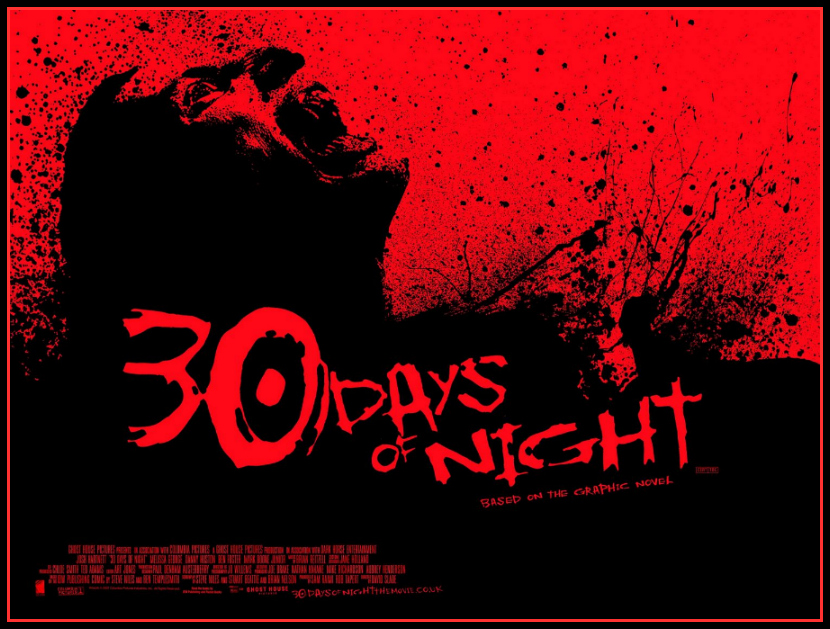
30 Days of Night is pretty much a siege movie with heavy elements of horror and gore. Siege movies always succeed and fail depending on whether the tension and dread built up from the beginning of the film suspends the audience’s disbelief. Siege films like The Thing and Romero’s Living Dead trilogy works well because right from the get-go we see the tension build not just on the location the cast are put in but within the besieged survivors as well. Survival becomes that much more difficult due to human frailties and an inability to work together bringing the whole group down. The monsters outside are bad enough, but sometimes it’s the survivors themselves who must share the blame.
David Slade’s (director of the excellent Hard Candy) movie does a very good job of bringing the initial tension and dread the comic brought to life in its first chapter. The story takes place in Barrow, Alaska which happens to be located within the Arctic Circle. This location allows it a very peculiar yearly event of having pitch-black night which lasts for a period of an entire month. The movie begins just as the town of Barrow prepares for this month-long prolonged night. Most of the town decide to move down south for the month where the night doesn’t last as long, but enough stay in Barrow to give it a semblance of life and activity.
The build-up of the characters in 30 Days of Night marks one of the weaknesses in the film. There’s barely much characterization in distinguishing one Barrow, Alaskan from another. The lack in character development from all the characters whether human or vampire doesn’t invest the film with anyone we want to see make it out through the night and into dawn. Even Danny Huston, a very underrated and overly capable actor in past films fails to elevate his lead vampire character Marlowe beyond it’s genre trappings. Known only as The Stranger in the credits, Ben Foster’s Renfield-like character edges between caricature and genuine creepiness in his performance. Foster knows he’s in a genre movie and has fun with the character. He’s the only one to truly take on his character and roll with it.
I now get to the subject of the vampires themselves. Most vampire movies seem enamored in portraying the vampire as some sort of seductive, fashion-obsessed, or in the case of the Anne Rice-type anachronistic in their dress, with an unnatural immortality they either live as hedonistically as possible or bemoan their cursed existence. Then there’s the more recent trend that Twilight has brought into the vampire mythology and it’s not good. There’s never been a true portrayal of the vampire as a pure, hunger-driven monster with an appetite to match their status as one of folklore and legend’s top-tier boogeymen. Slade goes for speed and agility in his vampires instead of hypnotizing and mesmerizing their victims. The vampires in this movie owes much to the frenetic and over-amped infecteds of 28 Days Later.
The attack itself and the subsequent siege worked well enough in the early going. There were some great overhead shots of the town’s people losing it’s fight during the initial feeding frenzy as the camera shoots the scene high overhead. The only thing Slade had a misstep in terms of the siege itself was after those first couple of nights. The rest of the 30 days didn’t seem to show enough desperation on the faces and bodies of the last few survivors. Really, the only way the audience even knew a couple weeks have passed were the caption telling them how many days into the month-long night has passed. I think with some better editing and a better sense of structure in the middle section of the movie to show time actually progressing the movie would’ve been better on so many levels.
All in all, 30 Days of Night was just good enough to be a fun watch. The premise itself was original and put a new spin on the vampire genre that has rarely been tapped. The performances were pretty average with no one bringing the whole film down with a misstep performance or raising the bar with a great one. The final product had a chance to be something great, but just ends up being a good and original take on the vampire story with elements of Night of the Living Dead.
There’s not much else I can say about this upcoming alien invasion film coming out on 3-11-2011. I shall be there on Day One to see it in all it’s big-screen glory. This third trailer show’s a bit more of the alien race doing the invading and the unit of U.S. Marines set to repel and fight them off. I will say that final scene in the trailer with what looked like a massive construct made out of the rubble of Los Angeles just whetted my appetite to see this film even more. Talk about a moneyshot.
Below are the two other official trailer released for Battle: Los Angeles.
In 2009, a small film from South Africa turned the film industry on its ears. Neil Blomkamp’s District 9 was a sci-fi film which took the well-traveled alien invasion subgenre and added a new twist to the whole thing. The invasion wasn’t malicious and the bad guys ended up being the puny humans themselves. The ending of that film mentioned something about a possible real invasion of the aliens who were being oppressed, but until Blomkamp and Peter Jackson decide on making a follow-up sequel then we’ll just have to settle for the sudden wave of alien invasion films which seem to be popping up out of nowhere the last couple months.
There’s the little-to-no budget film Monsters which dealt with the landing of large tentacled aliens in the Central American jungles and how the world has come to cope with the aftermath. This one was more of a character piece with the aliens themselves little-seen til the very end. But it definitely falls under the alien invasion genre.
Then there’s Skyline by The Strause Brothers which comes out November 12 and while it also has a very low-budget compared to epic alien invasion films in the genre the film looks to have some top-notch special-effects. The story and acting may not be up the par with the visuals but then Roland Emmerich’s Independence Day was the same and it made a ton.
While late to the party it looks like Battle: Los Angeles by filmmaker Jonathan Liebesman (another South African) may be the one to pull off not just being a dramatic piece, but a sci-fi war film and FX-heavy visuals. From what could be seen in the trailer it definitely has a look that some people has called Black Hawk Down meets Independence Day.
It stars Aaron Eckhart, Michelle Rodriguez, Bridget Moynihan and Michael Peña and is set for a 03-11-2011 release.