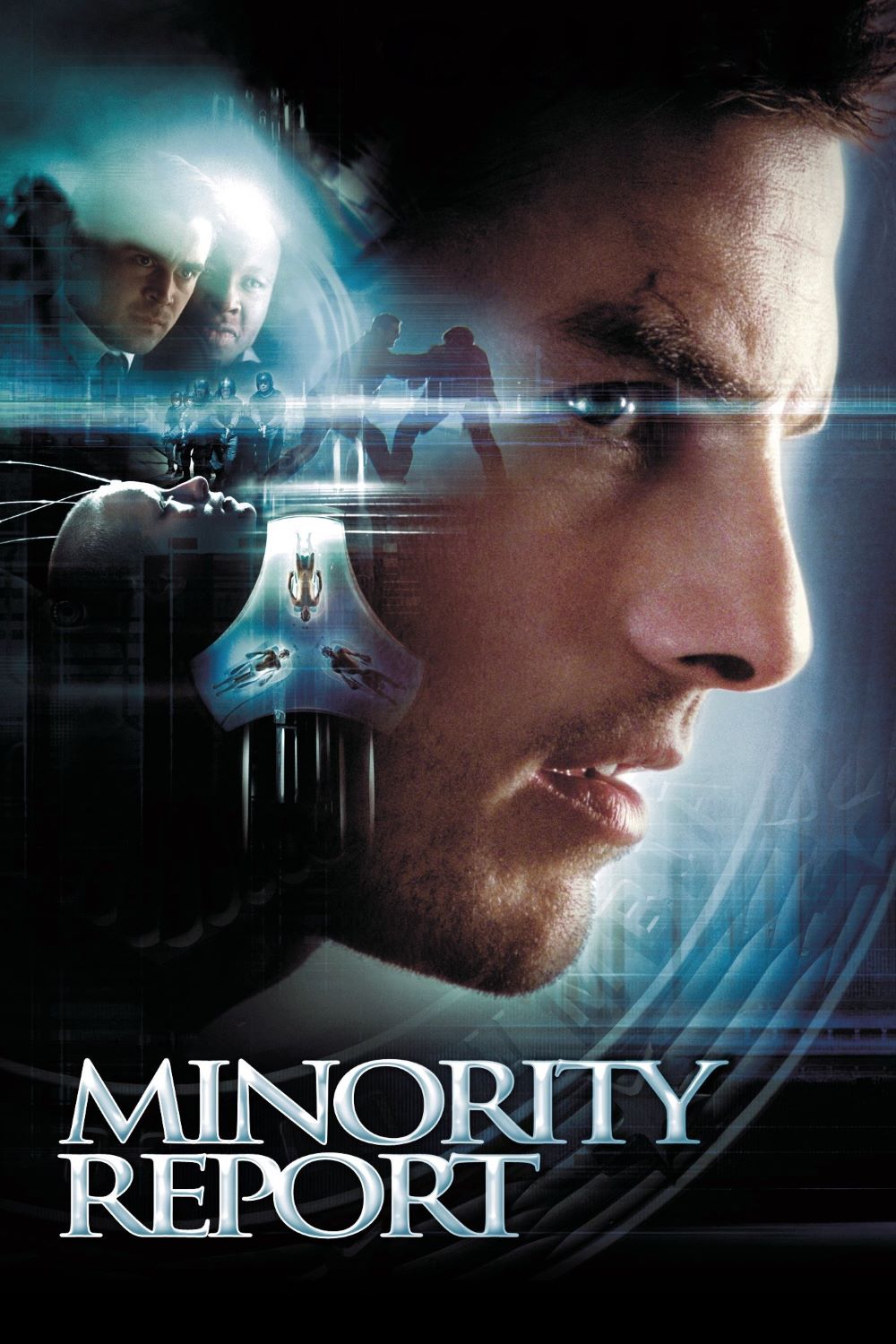
Review: Minority Report (dir. by Steven Spielberg)


“Sometimes, in order to see the light, you have to risk the dark.” — Dr. Iris Hineman

There’s a particular pleasure in revisiting Minority Report now, decades removed from its 2002 release, because it’s aged in the strangest possible way: it hasn’t dated so much as it’s caught up to us. Steven Spielberg’s adaptation of Philip K. Dick’s short story plays like a glossy, big-budget action thriller on the surface, all sleek gestural interfaces and Tom Cruise sprinting across rooftops, but underneath that polish is a film that’s quietly become one of the most unnervingly accurate predictions of how surveillance, data, and policing would actually evolve in the real world.

The premise is simple enough to fit on a poster. In a near-future Washington D.C., a special police unit called PreCrime uses three psychic “precogs” to see murders before they happen, allowing cops to arrest people for crimes they haven’t committed yet. John Anderton, played by Cruise with a kind of haunted, grief-soaked intensity, is the unit’s star detective, a true believer in the system who lost his son years earlier and has thrown himself into the work as a substitute for healing. Then the precogs name him as a future murderer, and the rest of the film is Anderton on the run, trying to prove his innocence inside a system explicitly designed to make innocence irrelevant. It’s a clever structural trick because it forces the audience to watch the hero discover, in real time, all the holes in a system he’s spent his career defending.

What makes the film work as more than just a stylish chase movie is how seriously Spielberg and his screenwriters, Scott Frank and Jon Cohen, take the philosophical rot at the center of the premise. PreCrime isn’t framed as a dystopian villain organization; it’s framed as something genuinely good and genuinely popular, a program that’s driven murder rates to near zero and that ordinary citizens are grateful for. That’s the unsettling part. The film isn’t asking you to be afraid of an obviously evil system. It’s asking you to be afraid of aSteve Harris system that works, that delivers real safety, and that nonetheless requires you to accept punishment without due process, fate without appeal, guilt assigned before the act. Cruise’s Anderton spends the film discovering that the machinery he trusted contains exactly the kind of ambiguity and abuse it was built to eliminate, and the film never lets you forget that the most dangerous systems are the ones that feel necessary.

Visually, this is one of Spielberg’s most distinct collaborations with cinematographer Janusz Kamiński, who bleached the color out of nearly every frame to give the film a cold, overexposed, almost silvery look. It’s a future that feels lived-in and grubby rather than chrome and gleaming, which was a deliberate choice; Spielberg and his production designers consulted with actual futurists and technologists to imagine a 2054 that felt plausible rather than fantastical. That’s part of why the gestural data interfaces Anderton uses, swiping and conducting evidence in midair like an orchestra conductor, became such a cultural touchstone; they didn’t feel like science fiction gadgetry so much as a believable next step from where computing was already heading.

And that brings us to the part of the film’s legacy that’s only grown more pointed with time. Minority Report arrived in June 2002, less than a year after September 11th, and it’s impossible to separate the film’s anxieties from that specific American moment. This was the period when the Patriot Act had just been signed, when warrantless surveillance and preventive detention were being normalized in the name of safety, when the entire architecture of American security policy pivoted toward stopping threats before they materialized rather than responding after the fact. Minority Report dramatizes that exact logic and then methodically exposes its flaws, showing a security state so committed to preventing harm that it’s willing to imprison the innocent, manipulate evidence, and treat dissent as a structural malfunction.

It’s worth situating the film alongside the other two movies Spielberg made in the years immediately following 9/11, because together they form a loose, unofficial triptych about post-9/11 American fear. War of the Worlds, his 2005 alien invasion film, restaged the trauma of a sudden, incomprehensible attack on home soil, with Tom Cruise again playing an ordinary man trying to shepherd his children through a landscape of falling ash, mass panic, and faceless threats descending from above, imagery that’s hard not to read as a direct echo of lower Manhattan that morning. Munich, released the same year, dug into the moral wreckage of a state’s decision to respond to terrorism with a covert campaign of targeted assassination, asking hard questions about whether vengeance dressed up as justice actually makes anyone safer or just perpetuates the cycle. Minority Report is the third leg of that stool, the one concerned not with the attack itself or the retaliation but with the surveillance and preemption apparatus built in the name of preventing the next one. Together, the three films trace a kind of emotional arc through American anxiety in that period: the shock of the unknown threat, the morally compromised vengeance that follows, and the paranoid, technologically enabled security state erected to make sure it never happens again. None of the three films name 9/11 directly, but all three are unmistakably shaped by it, by a culture suddenly suspicious of the outsider, willing to trade liberty for the promise of safety, and uncertain whether the institutions built to protect them could be trusted.

What’s remarkable is how much more relevant the surveillance angle feels today than it did in 2002. Predictive policing software is real now, with departments across the country having actually used algorithms to flag individuals or neighborhoods as high risk for future crime, often with the same built-in biases and feedback loops the film gestures at. Data brokers and advertising networks track movement and behavior with a granularity that makes the film’s retina-scanning ad billboards look almost quaint by comparison. The conversation about predictive algorithms making consequential decisions about people’s freedom, hiring, credit, and policing based on probabilistic models of future behavior is now a mainstream policy debate rather than science fiction. Watching the film now, the gap between its imagined 2054 and our actual 2026 feels uncomfortably narrow, less a futuristic warning than a documentary about tendencies we’re already deep inside of.

That’s what makes Minority Report so achingly prophetic, not just in its prediction of our tech, but in its prediction of our mindset. We live in a world now where predictive policing algorithms are actually being used, where social credit scores are a reality in some places, and where the debate over privacy versus security is a constant, exhausting hum in the background. We’re not at the level of precogs, but we don’t need to be. We have big data, machine learning, and a populace that’s been slowly conditioned to accept that if you have nothing to hide, you have nothing to fear. The film is a warning shot across the bow of that complacency. It asks us to consider the cost of a crime-free society, and it suggests that the price might be our very souls. Spielberg, ever the optimist even in his darkest films, ultimately comes down on the side of human fallibility. He prefers a world with crime and free will to a world of perfect, totalitarian peace. And watching it today, in an age of deepfakes, biometric tracking, and algorithm-driven justice, that preference feels less like a luxury and more like an urgent, desperate necessity. It’s a hell of a ride, with more twists than a pretzel factory and a car chase that still holds up, but the real thrill of Minority Report isn’t the action—it’s the haunting feeling that we’re not watching a dystopian future anymore. We’re watching the news.
Review: War of the Worlds (dir. by Steven Spielberg)


“This is not a war any more than there’s a war between men and maggots… This is an extermination.” — Harlan Ogilvy

When looking back at the vast filmography of Steven Spielberg, science fiction usually evokes a sense of sweeping wonder, starry-eyed optimism, or at the very least, a deeply felt humanism. Films like Close Encounters of the Third Kindand E.T. the Extra-Terrestrial taught generations to look at the stars with hope rather than dread. Even when things took a darker turn in Jurassic Park or the neon-drenched corridors of Minority Report, there remained a foundational thrill—a cinematic ride that ultimately leaves the audience exhilarated. However, his 2005 adaptation of H.G. Wells’ classic novel, War of the Worlds, stands as a radically different beast altogether. It is arguably the bleakest, most claustrophobic blockbuster Spielberg ever directed, operating less as an adventurous alien invasion epic and more as a raw, nerve-shredding analog for collective trauma. Emerging a mere four years after the collapse of the Twin Towers, the film strips away the romanticism of cosmic exploration and replaces it with a visceral, ground-level nightmare of sudden, inexplicable annihilation.

The brilliance of Spielberg’s approach, working alongside screenwriter David Koepp, lies in how intensely localized the narrative remains. Rather than tracking the invasion from the traditional perspective of military command centers, global leaders, or brilliant scientists, the audience is trapped inside the chaotic, deeply flawed perspective of Ray Ferrier, played with a brilliant, unheroic franticness by Tom Cruise. Ray is not a savior; he is a deadbeat, blue-collar crane operator living in a graying New Jersey suburb. He is the kind of father who doesn’t know his son’s school schedule and has an empty refrigerator when his ex-wife drops off their two children, Robbie and Rachel. By centering the apocalypse around a fractured, working-class American family, Spielberg roots the cosmic terror in a painful reality. The impending destruction of the planet mirrors the collapse of Ray’s domestic stability, forcing a man who can barely manage basic parental accountability to suddenly navigate the literal end of the world.

From a purely technical standpoint, the first act of War of the Worlds features some of the most masterful suspense and terror ever committed to celluloid, heavily leaning on a barrage of explicit 9/11 visual imagery. The sequence where the first Martian Tripod emerges from beneath a New Jersey intersection is a masterclass in modern cinematic dread, directly weaponizing the fresh, collective trauma of the post-9/11 American public. Spielberg eschews the clean, omniscient visual language of standard disaster cinema for an organic, chaotic documentary style, mirroring the sudden, disorienting informational and electronic blackout experienced by millions during the real-world attacks. The camera lingers on heavy, ominous storm clouds moving against the wind, the eerie crackle of localized lightning strikes, and the unsettling silence of a neighborhood stripped of electronic life. When the asphalt fractures and the colossal, three-legged war machine rises from the earth, the sound design hits the audience like a physical blow. The Tripod’s horn—a terrifying, mechanical foghorn groan—instantly triggers an ancient, mammalian fight-or-flight response. As the machine opens fire with its disintegration beams, turning nearby pedestrians into literal puffs of ash, the camera tracks Ray running for his life through a massive, rolling cloud of dust and debris. When Ray finally makes it back to his house, the ash of his vaporized neighbors covers his clothes and face, an unmistakable and deeply unsettling visual that explicitly echoes the horrific reality of the streets of Manhattan on September 11, 2001.

This deliberate invocation of post-9/11 anxiety is the thematic engine that drives the entire film. Spielberg does not hide these parallels; he highlights them with a devastating accuracy that makes the film difficult to watch even decades later. When the invasion begins, a terrified, screaming Rachel asks her father if it is “the terrorists,” a line that perfectly encapsulates the collective, reactionary psyche of the mid-2000s American consciousness, where any sudden, catastrophic violence was instantly filtered through the lens of domestic terrorism. The imagery of walls plastered with photocopied missing-persons flyers, crowds of refugees trudging down desolate highways with whatever belongings they can carry, and a derailed, blazing passenger train hurtling past an abandoned station all tap into a very specific, historical vulnerability. In Independence Day, an alien invasion was an opportunity for global unity and triumphant, cigar-chomping counter-offensives. In Spielberg’s hands, the invasion is an overwhelming, asymmetric slaughter that reduces the world’s most powerful military to a collection of burning tanks rolling over a ridge into an invisible abyss.

However, while the film masterfully handles the grand-scale terror of the invasion, it stumbles significantly when navigating its internal family dynamics, particularly regarding Ray’s son, Robbie, played by Justin Chatwin. I completely agree with the widespread criticism that Robbie is an intensely annoying, deeply self-destructive presence whose actions and decisions repeatedly defy basic human survival instincts. Throughout the crisis, his behavior goes beyond typical teenage rebellion and crosses into pure narrative absurdity. Instead of helping protect his traumatized, screaming younger sister, Robbie consistently sabotages his family’s safety to aggressively gawk at a hopeless war zone. His sudden, obsessive urge to join a military force that is clearly being pulverized by an unearthly power feels entirely unearned and maddening to watch. His character arc reaches a peak of irritation when he blindly runs over a burning ridge directly into a mechanical meat grinder, abandoning his family for a bizarre, suicidal patriotic impulse. This makes his miraculous survival at the end of the film a massive narrative misstep; having him casually show up at his grandparents’ pristine Boston home after witnessing a literal military massacre completely undermines the high-stakes realism Spielberg spent two hours building, turning what should have been a tragic consequence of his own foolishness into a cheap, unearned happy ending.

As the narrative progresses past the family friction, the film shifts its focus from external spectacle to the internal breakdown of human morality under the weight of existential terror. This transition is embodied by the mid-movie introduction of Harlan Ogilvy, played with an unsettling, unhinged intensity by Tim Robbins. Trapped in a dark basement while the Martians harvest the surrounding countryside, Ray and Ogilvy represent two radically different, yet entirely believable, reactions to trauma. Ogilvy is consumed by a vengeful, nihilistic madness, obsessed with digging tunnels and launching a futile, suicidal guerrilla war against an enemy that operates on a completely different evolutionary plane. Ray, conversely, is driven solely by a desperate, animalistic urge to protect his daughter. The sequence culminating in Ray’s decision to kill Ogilvy behind closed doors to keep him from alerting the aliens is one of the darkest thematic beats in Spielberg’s career. It forces the audience to confront a disturbing truth: the true horror of the apocalypse is not just what the monsters do to us, but what we are willing to do to each other to survive another hour.

The film’s visual palette, masterfully crafted by cinematographer Janusz Kamiński, reinforces this pervasive sense of rot and despair. Kamiński utilizes a heavily bleached, high-contrast aesthetic that drains the world of vibrant color, leaving behind a cold, metallic landscape dominated by sickly slates, deep shadows, and stark whites. This visual harshness reaches its zenith during the infamous “Red Weed” sequence. As the Tripods begin carpet-bombing the landscape with human blood to fertilize an invasive, crimson alien flora, the film transforms into a surrealist, gothic horror show. The Earth itself is literally being terraformed by the bodily fluids of the slaughtered, creating a grotesque, bleeding ecosystem that visually mirrors the internal rot of the surviving human populations. It is a sequence that feels closer to the cinematic nightmares of H.R. Giger than the traditional whimsy of a Spielbergian adventure.

Despite its immense strengths, War of the Worlds is frequently criticized for its final act, a critique that deserves a nuanced evaluation. The abrupt resolution—wherein the seemingly invincible Martians suddenly succumb to Earth’s microscopic bacteria—is lifted directly from H.G. Wells’ original 1898 text. While narratively faithful, its execution in a modern Hollywood blockbuster can feel jarring, functioning as a biological deus ex machina that robs the human protagonists of a traditional, heroic victory. Furthermore, Robbie’s unearned survival represents a sudden, almost desperate pivot back toward Spielberg’s traditional family-first sentimentality. This neat resolution feels somewhat unearned given the preceding two hours of unrelenting, uncompromising nihilism, momentarily fracturing the film’s gritty, documentary-like reality.

Yet, looking past these structural stumbles, the final voiceover adaptation of Wells’ text offers a profound philosophical punctuation mark to the nightmare. The realization that humanity has earned its right to survive on this planet not through military might or moral superiority, but through millions of years of evolutionary struggle alongside the tiniest microbes, recontextualizes the entire ordeal. It reminds the audience of our inherent fragility and the hubris of believing ourselves to be permanently secure in our modern, technological fortresses. Spielberg’s War of the Worlds remains an incredibly potent piece of mainstream filmmaking precisely because it refuses to comfort its audience for the majority of its runtime. It stands as a brilliant, terrifying time capsule of an era defined by sudden vulnerability, demonstrating that even the master of cinematic wonder could look into the abyss of the cosmos and see nothing but our own reflections looking back in sheer terror.