Today would have been the 82nd birthday of the great German actor, Udo Kier.
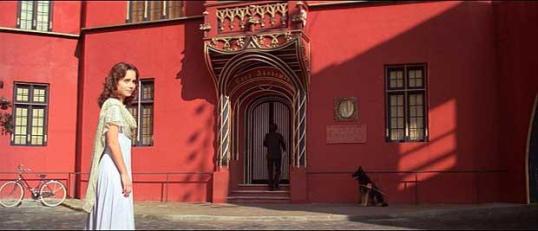
Today’s scene that I love features Kier in the only version of Suspiriathat matters, the original one directed by Dario Argento. In this scene, Kier discusses witchcraft with Jessica Harper.
The opening of Dario Argento’s 1977 masterpiece, Suspiria, is about as perfect an opening as one could hope for. American ballet student Suzy Banyon (Jessica Harper) arrives in Freiburg, Germany. Both Argento and Harper perfectly capture Suzy’s confusion as she makes her way through the airport and, as torrential rain drenches her, attempts to hail a taxi and get a ride to the dance academy. (What Suzy doesn’t know, of course, is that the dance academy is home to the ancient witch known as The Mother of Sighs.)
With this opening scene, Argento both immediately establishes the off-center, nightmarish atmosphere of Suspiria and establishes Suzy as a character who we, as the audience, relate to and care about. Suspiria is a great film and it all begins with this brilliant opening.
(And just as Suzy is starting her journey to the school, we are just starting Horrothon! Get ready for the best 31 days of the year!)
“Sometimes, in order to see the light, you have to risk the dark.” — Dr. Iris Hineman
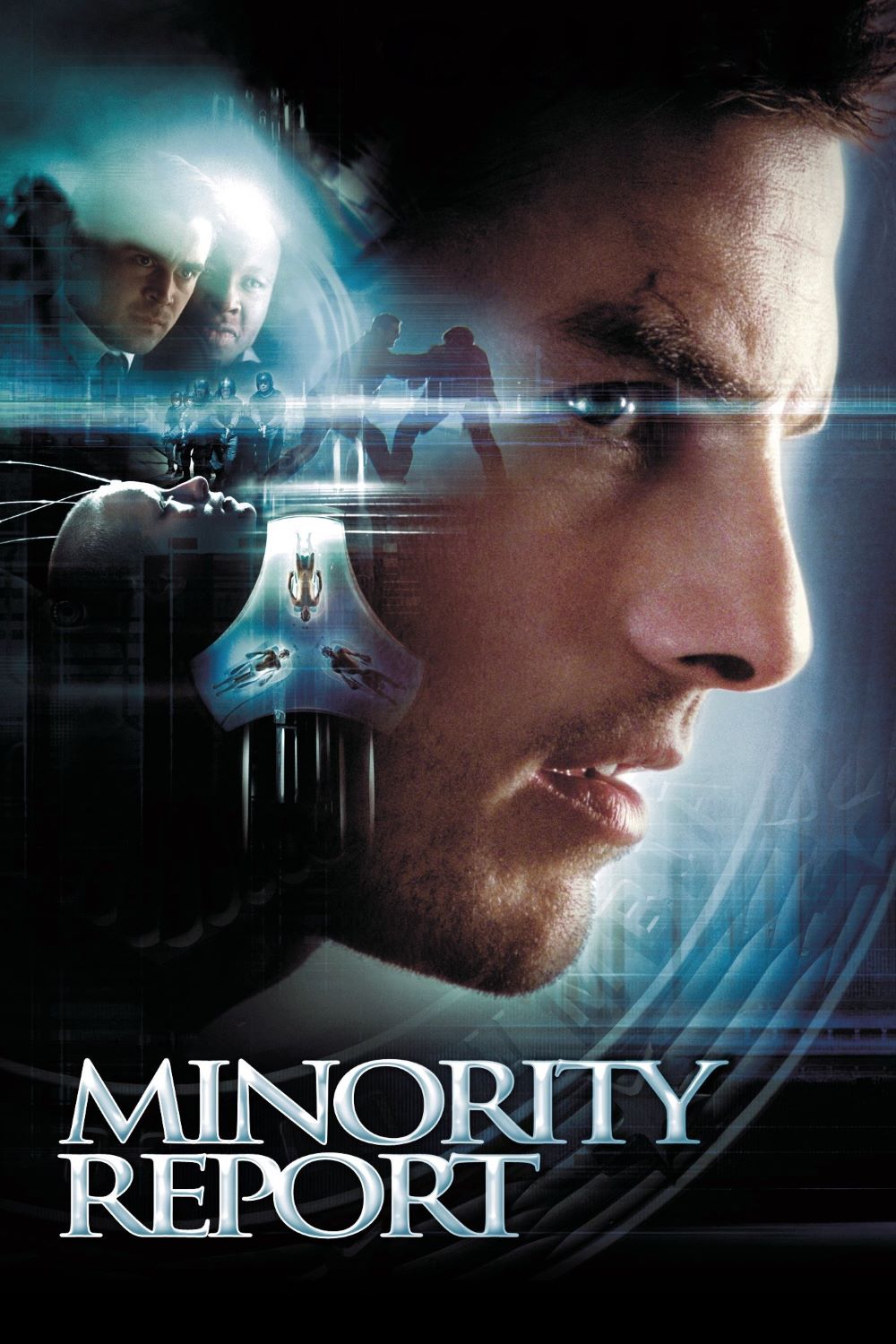
There’s a particular pleasure in revisiting Minority Report now, decades removed from its 2002 release, because it’s aged in the strangest possible way: it hasn’t dated so much as it’s caught up to us. Steven Spielberg’s adaptation of Philip K. Dick’s short story plays like a glossy, big-budget action thriller on the surface, all sleek gestural interfaces and Tom Cruise sprinting across rooftops, but underneath that polish is a film that’s quietly become one of the most unnervingly accurate predictions of how surveillance, data, and policing would actually evolve in the real world.
The premise is simple enough to fit on a poster. In a near-future Washington D.C., a special police unit called PreCrime uses three psychic “precogs” to see murders before they happen, allowing cops to arrest people for crimes they haven’t committed yet. John Anderton, played by Cruise with a kind of haunted, grief-soaked intensity, is the unit’s star detective, a true believer in the system who lost his son years earlier and has thrown himself into the work as a substitute for healing. Then the precogs name him as a future murderer, and the rest of the film is Anderton on the run, trying to prove his innocence inside a system explicitly designed to make innocence irrelevant. It’s a clever structural trick because it forces the audience to watch the hero discover, in real time, all the holes in a system he’s spent his career defending.
What makes the film work as more than just a stylish chase movie is how seriously Spielberg and his screenwriters, Scott Frank and Jon Cohen, take the philosophical rot at the center of the premise. PreCrime isn’t framed as a dystopian villain organization; it’s framed as something genuinely good and genuinely popular, a program that’s driven murder rates to near zero and that ordinary citizens are grateful for. That’s the unsettling part. The film isn’t asking you to be afraid of an obviously evil system. It’s asking you to be afraid of aSteve Harris system that works, that delivers real safety, and that nonetheless requires you to accept punishment without due process, fate without appeal, guilt assigned before the act. Cruise’s Anderton spends the film discovering that the machinery he trusted contains exactly the kind of ambiguity and abuse it was built to eliminate, and the film never lets you forget that the most dangerous systems are the ones that feel necessary.
Visually, this is one of Spielberg’s most distinct collaborations with cinematographer Janusz Kamiński, who bleached the color out of nearly every frame to give the film a cold, overexposed, almost silvery look. It’s a future that feels lived-in and grubby rather than chrome and gleaming, which was a deliberate choice; Spielberg and his production designers consulted with actual futurists and technologists to imagine a 2054 that felt plausible rather than fantastical. That’s part of why the gestural data interfaces Anderton uses, swiping and conducting evidence in midair like an orchestra conductor, became such a cultural touchstone; they didn’t feel like science fiction gadgetry so much as a believable next step from where computing was already heading.
And that brings us to the part of the film’s legacy that’s only grown more pointed with time. Minority Report arrived in June 2002, less than a year after September 11th, and it’s impossible to separate the film’s anxieties from that specific American moment. This was the period when the Patriot Act had just been signed, when warrantless surveillance and preventive detention were being normalized in the name of safety, when the entire architecture of American security policy pivoted toward stopping threats before they materialized rather than responding after the fact. Minority Report dramatizes that exact logic and then methodically exposes its flaws, showing a security state so committed to preventing harm that it’s willing to imprison the innocent, manipulate evidence, and treat dissent as a structural malfunction.
It’s worth situating the film alongside the other two movies Spielberg made in the years immediately following 9/11, because together they form a loose, unofficial triptych about post-9/11 American fear. War of the Worlds, his 2005 alien invasion film, restaged the trauma of a sudden, incomprehensible attack on home soil, with Tom Cruise again playing an ordinary man trying to shepherd his children through a landscape of falling ash, mass panic, and faceless threats descending from above, imagery that’s hard not to read as a direct echo of lower Manhattan that morning. Munich, released the same year, dug into the moral wreckage of a state’s decision to respond to terrorism with a covert campaign of targeted assassination, asking hard questions about whether vengeance dressed up as justice actually makes anyone safer or just perpetuates the cycle. Minority Report is the third leg of that stool, the one concerned not with the attack itself or the retaliation but with the surveillance and preemption apparatus built in the name of preventing the next one. Together, the three films trace a kind of emotional arc through American anxiety in that period: the shock of the unknown threat, the morally compromised vengeance that follows, and the paranoid, technologically enabled security state erected to make sure it never happens again. None of the three films name 9/11 directly, but all three are unmistakably shaped by it, by a culture suddenly suspicious of the outsider, willing to trade liberty for the promise of safety, and uncertain whether the institutions built to protect them could be trusted.
What’s remarkable is how much more relevant the surveillance angle feels today than it did in 2002. Predictive policing software is real now, with departments across the country having actually used algorithms to flag individuals or neighborhoods as high risk for future crime, often with the same built-in biases and feedback loops the film gestures at. Data brokers and advertising networks track movement and behavior with a granularity that makes the film’s retina-scanning ad billboards look almost quaint by comparison. The conversation about predictive algorithms making consequential decisions about people’s freedom, hiring, credit, and policing based on probabilistic models of future behavior is now a mainstream policy debate rather than science fiction. Watching the film now, the gap between its imagined 2054 and our actual 2026 feels uncomfortably narrow, less a futuristic warning than a documentary about tendencies we’re already deep inside of.
That’s what makes Minority Report so achingly prophetic, not just in its prediction of our tech, but in its prediction of our mindset. We live in a world now where predictive policing algorithms are actually being used, where social credit scores are a reality in some places, and where the debate over privacy versus security is a constant, exhausting hum in the background. We’re not at the level of precogs, but we don’t need to be. We have big data, machine learning, and a populace that’s been slowly conditioned to accept that if you have nothing to hide, you have nothing to fear. The film is a warning shot across the bow of that complacency. It asks us to consider the cost of a crime-free society, and it suggests that the price might be our very souls. Spielberg, ever the optimist even in his darkest films, ultimately comes down on the side of human fallibility. He prefers a world with crime and free will to a world of perfect, totalitarian peace. And watching it today, in an age of deepfakes, biometric tracking, and algorithm-driven justice, that preference feels less like a luxury and more like an urgent, desperate necessity. It’s a hell of a ride, with more twists than a pretzel factory and a car chase that still holds up, but the real thrill of Minority Report isn’t the action—it’s the haunting feeling that we’re not watching a dystopian future anymore. We’re watching the news.
RIP to the great actor, Udo Kier. He died yesterday at the age of 81, in Palm Springs, California.
Today’s scene that I love features Kier in the only version of Suspiriathat matters, the original one directed by Dario Argento. In this scene, Kier discusses witchcraft with Jessica Harper.
The opening of Dario Argento’s 1977 masterpiece, Suspiria, is about as perfect an opening as one could hope for. American ballet student Suzy Banyon (Jessica Harper) arrives in Frieburg, Germany. Both Argento and Harper perfectly portray Suzy’s confusion as she makes her way through the airport and, as torrential rain drenches her, attempts to hail a taxi and get a ride to the dance academy. (What Suzy doesn’t know, of course, is that the dance academy is home to the ancient witch known as Our Mother of Sighs.) With this opening scene, Argento both immediately establishes the off-center, nightmarish atmosphere of Suspiria and establishes Suzy as a character who we, as the audience, relate to and care about. Suspiria is a great film and certainly one that didn’t need a pretentious remake. The greatness of the original Suspiria all begins with this brilliant opening.
Suspiria (1977, dir by Dario Argento, DP: Luciano Tavoli)
I can’t wait to re-watch Dario Argento’s Suspiriatonight! Today’s horror scene of the day is one of my favorite scenes from that film.
As you probably guessed from the title of this post, that scene is the famous “Names that start with S” scene. This is the scene in which dance student Suzy Banyon’s new roommate explains that names that start with S are often the names of snakes! Suzy’s new best friend, Sarah, disagrees.
When I first saw Suspiria, this was a scene to which I, as a dance student, could immediately relate. As odd as the dialogue may have sounded and as silly as the two students may have appeared to be, it actually felt very authentic. By nature, dancers are competitive and we are dramatic. If anyone is going to accuse you of having the name of a snake, it’s probably going to be dancer.
Admittedly, no one ever told me that I had the name of the snake. But there was the girl who told me that I was “soooooo pretty,” or at least I would be pretty if I got the nose job that I obviously required if I ever had any hope of being happy or successful. “But,” she added as she turned away from me, “I guess you’d have to figure out how you could possibly pay for it.” Of course, she was also quick to explain that she was only telling me the truth and that she had the best of intentions. I had about the same reaction to her advise as Sarah has to be calling a snake.
(Sarah stuck out her tongue. I may have said something about her boyfriend not having any issue with the size of my nose when he was hitting on me the night before. But basically, it was pretty much the same reaction…)
This scene made such an impression on me that, in the months after I first saw Suspiria, I would often randomly launch into the name of snakes monologue. Unfortunately, I had failed to take into account that I was literally the only student at my high school who would actually take the time to watch an Italian horror film from the 1970s. As such, no one knew what I was talking about and I lost a few friends named Susan and Sarah as a result.
Oh well!
Anyway, you can watch the scene below! Pay special attention to the way Jessica Harper reacts to being caught in the middle of the conversation. Dario Argento will probably never be known as a great director of actors but Jessica Harper is great in Suspiria!
In this horror scene that I love, from Dario Argento’s Suspiria, Susie Bannion (Jessica Harper) finally meets the Mother of Sighs, Helena Markos (Lela Svasta).
To make clear, this scene is from the original Suspiria. This isn’t from the remake or the rehash or the reboot or whatever it’s supposed to be that Film Twitter is currently going crazy over. Don’t get me wrong. I haven’t seen the new Suspiria yet so it could be brilliant. It could be the best film ever made, for all I know. But regardless, Dario Argento’s Suspiria will always be the only true Suspiria for me.
In my absense, it looks like other people have flourished, but now I think it’s time to make a return and this time for good.
What better way to mark my return than to show and talk about the first official full-length trailer for what could be one of the more divisive horror remakes set to arrive in a couple months.
I am talking about Suspiria by Italian filmmaker Luca Guadagnino (Call Me by Your Name, A Bigger Splash and I Am Love). The original film by Italian giallo maestro Dario Argento many horror fans consider a great example of the Italian giallo of the late 70’s and early 80’s. Just like most fandoms, whenever there’s talk about one of the classics being remade there’s levels of trepidation, anger and guarded optimism.
While I’m never one to look at remakes as ruining the originals. IF that was the case then we wouldn’t have excellent horror remakes such as Carpenter’s The Thing and, to an extent, Zack Snyder’s Dawn of the Dead.
While I’m excited to see what Guadagnino brings to the table when it comes to his remake of Suspiria, I am also somewhat guarded in that the original film was such a surreal experience that remaking it note for note wouldn’t add anything new to the experience.
Here’s to hoping this is one horror remake that falls under the great side of the equation instead of the trash end.
The world of 1950’s live TV gets the comic treatment in Richard Benjamin’s MY FAVORITE YEAR, a hilarious homage to those golden days of yore. Executive producer Mel Brooks had first-hand knowledge of the era, and much of the hysterical Norman Steinberg/Dennis Palumbo screenplay is based on his experiences, though completely exaggerated and laugh-out-loud funny. The film earned star Peter O’Toole an Oscar nomination for his role as Alan Swann, a dissipated movie star based on swashbuckling Errol Flynn .
Swann arrives at NBC’s 30 Rock, scheduled to be the week’s special guest on “Comedy Calvacade”, totally smashed, much to the displeasure of gruff show host Stan ‘King’ Kaiser (Joseph Bologna in a brilliant Sid Caesar parody), who immediately wants to fire him. But young comedy writer Benjy Stone (Mark Linn-Baker, later of TV’s PERFECT STRANGERS), who idolizes the movie great, pleads with Kaiser to give Swann another chance. He…
I’m using this October’s horrorthon as an excuse to take rewatch and review all of Dario Argento’s films! Today, we take a look at one of Argento’s best known and most popular films, 1977’s Suspiria!
I’m going to start things out by admitting that this is an intimidating review to write. I once had a discussion with fellow TSL contributor Leonard Wilson about why it’s always so much easier to write about films that we hate than it is to write about films that we love. That’s certainly something that I’m thinking about right now, as I try to think of where to begin with Suspiria.
It’s not just that I like Suspiria. Anyone who has ever visited this site before knows how much I appreciate Italian horror in general and Argento in specific.
No, it’s that I absolutely love this film. I was sixteen the first time that I saw it and I’ve loved it ever since. To me, Suspiria is not just one of the best horror films ever made. It is truly one of the best films period. And I know that I’m not alone in feeling like that. Suspiria is a classic in every sense of the word.
Compared to almost every other film that Argento has made, the plot of Suspiria is remarkably straight forward. Suzy Banyon, an American ballet student, enrolls at the prestigious Tanz Dance Academy in Frieburg, Germany. From the minute she arrives, she gets the feeling that there is something strange happening behind the garish walls of the school and she’s right. While the film may be best known for Argento’s directorial flourishes and Goblin’s classic score, the story itself unfolds with the simplicity of a fairy tale.
The film even opens with a narrator who informs us, “Suzy Banyon decided to perfect her ballet studies in the most famous school of dance in Europe. She chose the celebrated academy of Freiburg. One day, at nine in the morning, she left Kennedy airport, New York, and arrived in Germany at 10:40 p.m. local time.” It’s the film’s equivalent of starting things off with, “Once upon a time…” Having let us know that we’re about to watch a fairy tale and therefore having served his purpose, the narrator isn’t heard for the rest of the film.
Instead, we watch as Suzy first arrives in Germany:
As played by Jessica Harper, Suzy Banyon is yet another neurotic but brave Argento protagonist who has found herself in a strange land. One of the things that I love about Suspiria is that Suzy is such an ordinary and relatable character. She’s not “the chosen one.” She’s not a witch or an aspiring witch or the daughter of a witch or the reincarnation of a witch. She’s not desperately looking for a husband or dealing with a family tragedy or any of that other BS that we have to deal with in today’s cinema.. She doesn’t have any dark secrets or untapped magical powers. She’s not seeking vengeance. She has no trendy agenda. She’s not the protagonist of the latest YA novel. Instead, she’s a dancer. She is someone who is attempting to pursue something that she is good at and that she loves. In short, she is the viewer. Suzy Banyon is us and we are Suzy Banyon. Like us, she’s sometimes scared. Like us, she’s sometimes brave. And, like us, it’s just not in her nature to leave a mystery unsolved.
It’s obvious, from the moment that Suzy arrives, that there’s something strange happening at the school. We, of course, already know that it involves witchcraft. This is largely because we’ve been listening to the film’s score and we’ve heard Goblin’s Claudio Simonetti chanting “WITCH! WITCH!” as Suzy’s taxi drives through the woods and arrives at the school. (The journey through the woods adds to Suspiria‘s fairy tale atmosphere.)
However, for Suzy, her initial concern is that everyone at the school appears to be trying to cheat her out of her money. Madame Blanc (Joan Bennett) has arranged for Suzy to stay in an apartment on which she’ll have to pay rent. When Miss Tanner (Alida Valli, a force of pure nature in this film) finds out that Suzy’s bags have yet to arrive and Suzy doesn’t have any ballet shoes, she tells her to borrow a pair from another student. The student immediately offers to sell them to Suzy and is visibly deflated when Suzy says that she’s just needs to borrow them for a day.
And, of course, there’s Olga (Barbara Magnolfi), a student who thinks that names that start with S are the names of snakes.
(I have to admit that, as a former dance student, that scene brought back a lot of memories.)
But it’s not just money that Suzy has to worry about. There are also maggots that fall from the ceiling, the result of a shipment of spoiled meat. There’s the strange and labored breathing that Suzy occasionally hears behind the walls. There’s the fact that her new roommate, Sarah (Stefania Casini), is convinced that the teachers are hiding a secret. Sarah’s therapist, Dr. Frank Mandel (Udo Kier, playing an oddly respectable role) thinks that Sarah is suffering from delusions but is she?
And, of course, there’s all the mysterious deaths.
For instance, Daniel, a blind piano player, has his throat ripped by his seeing eye dog. Interestingly enough, Daniel is played by Flavio Bucci who, in The Night Train Murders, played a murderer. One of his Night Train victims was played by Irene Miracle, who would later have an important role in Suspiria‘s semi-sequel, Inferno.
Another former student, Pat Hingle (Eva Axen) is brutally stabbed to death and, after her body falls through a skylight, the shattered glass kills her best friend as well. Of course, the killer wears gloves. It wouldn’t be an Argento film otherwise. (Pat’s murder is one of Suspiria‘s best known set pieces, one that is so brutal and violent that it retains its power to shock even after you’ve seen it a few times. For the most part, if someone is going to stop watching or walk out on Suspiria, it’s going to happen during Pat’s murder.)
And through it all, you have Goblin playing on the soundtrack. The film’s score is so important and so relentless that, in its way, it becomes just as important a character as Suzy, Sarah, Madame Blanc, Miss Tanner, or even Udo Kier! The score is relentless and, depending on how loudly you play the film, almost deafening. I saw an interview with Goblin’s Claudio Simonetti where he said that he wanted the score to be “almost annoying” in its relentlessness. The score overpowers you, in much the same way that the witches of Suspiria overpower their victims.
Suspiria was co-written by Daria Nicolodi, Dario Argento’s girlfriend and the mother of Asia Argento. Nicolodi has long claimed that Suspiria is based on something that happened to her grandmother. Argento, meanwhile, has said that nothing in the film was based on fact. Reportedly, Nicolodi wanted to play the role of Suzy and was so offended with Argento instead offered her the role of Sarah that she went off and made Mario Bava’s Shock instead.
(Suspiria is often cited as the start of the long and acrimonious process that would eventually end with Argento and Nicolodi ending their relationship 8 years later.)
Personally, I think that Nicolodi would have been wasted in the role of Sarah but, at the same time, it’s hard to imagine anyone other than Jessica Harper as Suzy Banyon. For that matter, it’s also impossible to imagine anyone other than Dario Argento directing Suspiria. Suspiria is Argento’s masterpiece, taking all of his frequent and familiar motifs (bloody murders, artistic protagonists, the constantly roaming camera, the use of primary colors) and pushing them to their natural extreme. It’s hard to imagine anyone other than Argento telling Suspiria’s story.
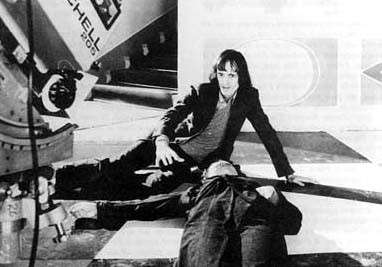
Dario Argento on the set of Suspiria
And yet, that is exactly what is about to happen. For years, of course, I’ve heard rumors of a remake and, perhaps naively, I’ve dismissed them. I took some comfort in the fact that even Dario Argento himself came out and forcefully denounced the idea of anyone remaking his masterpiece. Remake Suspiria? I would think to myself, Surely no one is that stupid.
Well, it’s happening and if that doesn’t outrage you, perhaps you should leave right now. Reportedly, the remake is set to be released in 2017. It’ll be directed by Luca Guadagnino and it’ll star Dakota Johnson, Chloe Grace Moretz, and Tilda Swinton. Guadagnino says that his remake will be all about the “power of motherhood.”
Whatever, Luca. Suspiria doesn’t need you and it doesn’t need to be remade.