Review: The Predator (dir. by Shane Black)


“Gentlemen, remember… they’re large, they’re fast, and fucking you up is their idea of tourism.” — Traeger

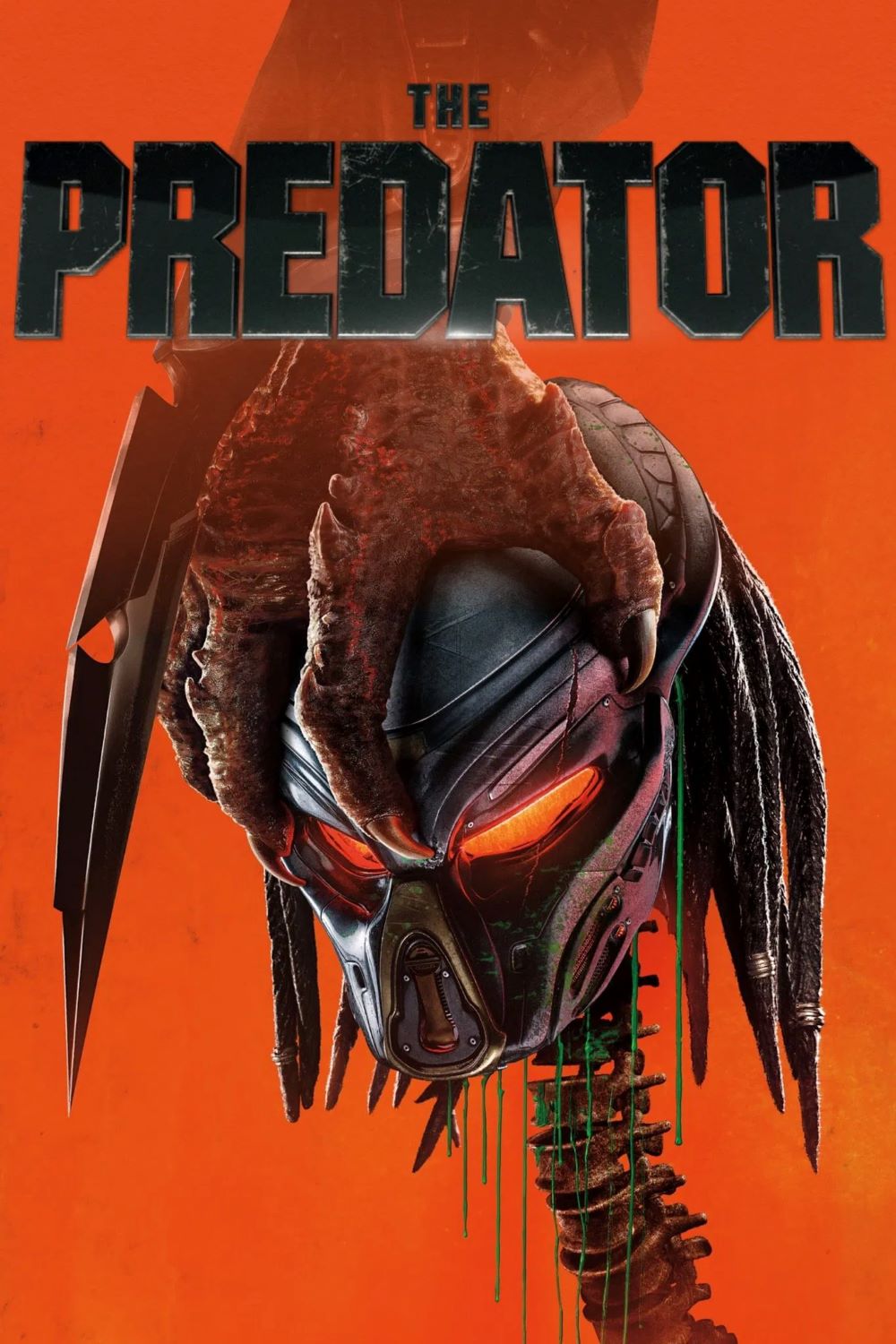
Shane Black’s The Predator (2018) lands with a bang, offering a spectacle heavy on action, gore, and the signature snarky humor Black is known for. If you come looking for a suspenseful, tightly wound survival story in the tradition of the original 1987 film, you’re in for something very different—a gonzo mashup of nostalgia, R-rated slapstick carnage, and creature-feature excess that leans gleefully into genre absurdity.

The plot barrels forward with almost reckless energy. Boyd Holbrook stars as Quinn McKenna, a sniper whose mission goes haywire when a Predator spaceship crashes to Earth. Through a sequence of provocatively silly events, McKenna’s autistic son, Rory (Jacob Tremblay), ends up with the alien’s high-tech gear, unwittingly drawing attention from both the government and the technologically advanced Predators themselves. McKenna teams up with a ragtag bunch of soldiers, each with their own collection of quirks and psychological scars, plus Olivia Munn’s biologist Casey Bracket. This time, the hunt spills out of the jungle and into suburbia, with the chaos quickly escalating as a souped-up, genetically upgraded Predator enters the mix.

Where the 1987 original thrived on tension and jungle-stalking suspense, Black’s take is more about velocity, bloody spectacle, and loud, rapid-fire banter. The tone is set early, never letting up: The jokes fly thick and fast, the action is relentless, and there’s barely a lull for actual character development. The chemistry among “the Loonies,” McKenna’s loose-cannon squad, is the highlight—Keegan-Michael Key and Thomas Jane, in particular, deliver a mix of comic relief and bruised pathos that provides Black with fertile ground for his trademark dialogue. Sterling K. Brown chews the scenery as Traeger, the government antagonist, with a kind of joyous villainy that’s hard not to enjoy, even when the narrative slides into pure chaos. Olivia Munn starts strong as a scientist thrown into the deep end but is ultimately brushed aside by the film’s mayhem-heavy set pieces.

The film’s comedic pulse is strong, sometimes to its own detriment. Shane Black fills out every moment with his specific brand of irreverence, which works best in the banter between the Loonies but can undercut the menace of the Predators themselves. The violence is over-the-top, with practical splatter and digital effects combining for set pieces that are more monstrous brawls than hunting sequences. The movie rarely worries about internal logic—kids instantly deciphering alien technology and scientists surviving actions that would doom most is par for the course here. For fans of the previous films, there are enthusiastic callbacks and plenty of Easter eggs, though these are delivered more as punchlines than as foundations for new franchise mythology.

One of the film’s major issues is its kitchen-sink approach: it tries to be a throwback action movie, a gory sci-fi thriller, and a self-aware parody all at once. The result is a film constantly threatening to come apart at the seams—some viewers will find the tonal whiplash exhausting, with jokes about mental illness and disability that are more dated than daring. The narrative bounces between subplots and characters so quickly that plot armor and convenient twists abound, while the stakes themselves grow ever more implausible. If you’re looking for slow-burn tension or the primal fear that powered John McTiernan’s or even Stephen Hopkins’ installments, you’ll find yourself unmoored by the gleeful chaos and genre self-parody that Black serves up.

Still, for all its messiness, The Predator is never boring. It’s an action movie that refuses to slow down, boldly swapping iconic mud-soaked hunting for suburban street battles, and musclebound brawn for damaged, wise-cracking outcasts. It is, in its own profane, ADD-addled way, a love letter to the kind of big, dumb, fun genre movies that Black himself helped define in the late ’80s and ’90s.

Ultimately, The Predator isn’t a triumphant reinvention of the franchise nor a true return to the original’s nerve-shredding simplicity. Fans looking to see a return to the franchise’s glory days will be sorely disappointed. However, taken on its own merits and not dragged down by the expectations brought by the franchise, the film does entertain with its wild, unruly, blood-spattered romp that wears its flaws on its sleeve and dares the audience to laugh along with the carnage. If you’re in it for straight-up monster mayhem, creative kills, and a barrage of one-liners, you’ll have a blast. If you’re looking for restraint, genre evolution, or old-school suspense, you’ll probably end up shaking your head—grinning, maybe, but shaking it all the same.

Horror Review: Ravenous (dir. by Antonia Bird)


“Morality… is the last bastion of a coward.” — Colonel Ives

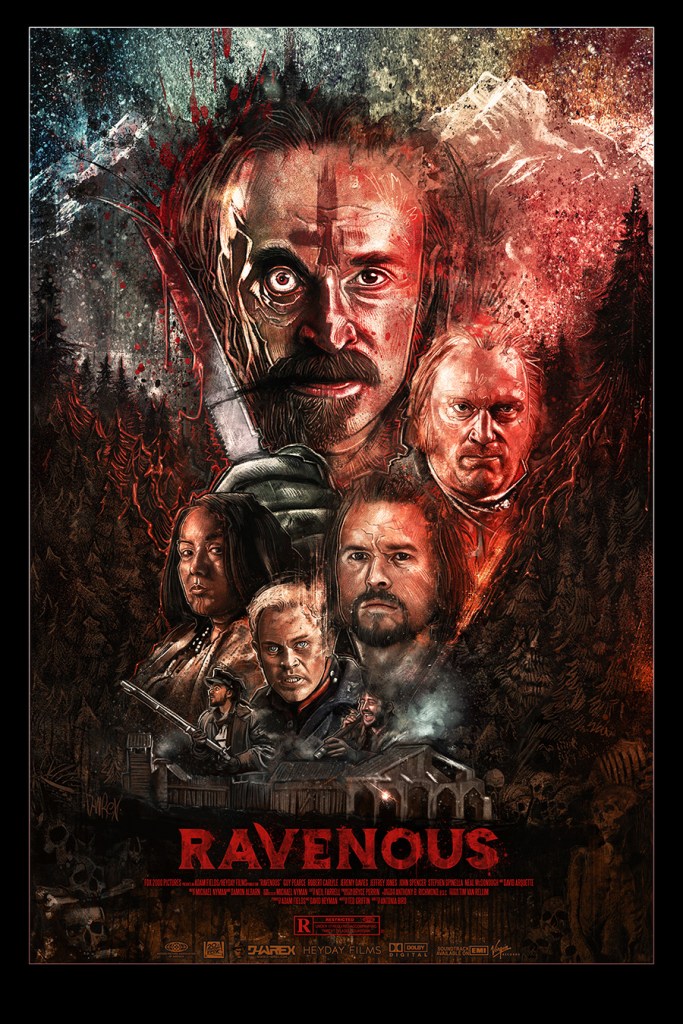
Ravenous remains one of the most fascinating and thematically daring horror films of the late 1990s—a layered meditation on hunger, morality, and the consuming appetite of empire disguised as a tale of survival. Set against the punishing winter backdrop of the Mexican-American War, the film centers on Lieutenant John Boyd, a soldier burdened by cowardice and guilt, sent to an isolated military outpost in the Sierra Nevadas. When a frostbitten stranger stumbles into camp with a horrifying tale of survival, the line between the living and the devoured—and between humanity and monstrosity—begins to blur.

At first glance, Ravenous is a dark horror film about cannibalism in a remote frontier fort. What distinguishes it is the way it transforms that premise into a meditation on civilization and consumption. The screenplay, written by Ted Griffin, draws inspiration from historical accounts such as the Donner Party and Alfred Packer—stories of pioneers who resorted to cannibalism to survive brutal winters. Griffin threads these historical horrors into a broader allegory about 19th-century American expansionism: a national hunger for land, power, and progress that consumes everything in its path, including its own humanity.

The mythological backbone of Ravenous lies in the inclusion of the wendigo, a spirit from Native American folklore. In Algonquin and Ojibwe tradition, the wendigo is born of greed and gluttony, a monstrous being that grows stronger and more grotesque with each act of consumption. The tale served as a warning against selfishness, warning that those who devour others—figuratively or literally—lose their humanity in return. Bird and Griffin seamlessly integrate this legend into the film’s themes, using the wendigo to mirror the psychological and cultural costs of empire. The story implies that the wendigo is not confined to mythic forests but lives in the blood of every nation that feeds on others to survive.

The fort where the story unfolds functions as both a stage and symbol: an outpost of civilization planted in the wilderness, claiming righteousness while sustained by exploitation. As starvation and moral decay take hold, the soldiers’ pretense of order crumbles. The isolated setting reflects the broader American project—civilization advancing through conquest yet losing its moral center in the process. The Native nations displaced and destroyed during expansion, reduced to resources or obstacles, become the unseen victims of this devouring drive. The film reframes cannibalism as a metaphor for Manifest Destiny itself—the act of consuming people, land, and spirit under the guise of progress.

That central metaphor gains power through the film’s performances. Guy Pearce delivers a subdued yet deeply expressive performance as Boyd, embodying the moral paralysis of a man trapped between guilt and survival. His silences, glances, and hesitations speak louder than any dialogue, conveying an internal conflict between virtue and instinct. Through him, the film explores how the will to endure can erode the boundaries of conscience.

Robert Carlyle, as Colonel Ives, stands in vivid contrast—charismatic, witty, and terrifyingly self-assured. He plays the role with the infectious energy of a man liberated by his own monstrosity, wearing sin as philosophy. For Ives, cannibalism is not horror but a revelation—a means to transcend weakness and embrace dominance. His eloquent justifications turn atrocity into ideology, echoing the rationalizations of expansionist politics. It is no coincidence that his confidence parallels Boyd’s doubt; the two men form mirror halves of a single corrupted ideal.

Director Antonia Bird’s touch elevates Ravenous from a historical thriller to a surreal moral fable. She handles violence and absurdity with equal precision, oscillating between grim horror and deadpan humor in a way that keeps viewers uneasy yet enthralled. Her direction never treats the horror as spectacle alone—every moment of gore carries weight, testing the limits of empathy and survival. Moments of unexpected humor punctuate the brutality, serving as a reminder that even atrocity can become ordinary when normalized by power.

While the fusion of dark comedy and horror lends the film its originality, it may also unsettle some viewers. The tonal shifts—helped by Michael Nyman and Damon Albarn’s strange, minimalist score—create an atmosphere that feels intentionally dissonant. This mix may challenge those expecting a traditional horror film, but it reinforces Bird’s vision of moral chaos. The unease generated by those shifts mirrors the absurdity of history itself: how horrors can coexist with banality, how laughter can accompany destruction.

The wendigo myth binds all these elements together. Bird portrays it less as a creature and more as a condition—one that spreads through ideology, greed, and the illusion of progress. The spirit of the wendigo thrives wherever ambition turns men into predators and justifies their violence as destiny. In this sense, every character becomes a reflection of national hunger, caught in a metaphorical cycle of consumption. The act of eating flesh becomes a stand-in for the broader devouring inherent in colonization: of land, of native culture, of moral identity.

By framing the frontier as an arena of both physical and spiritual starvation, Ravenous reimagines American history as a feast of self-destruction. It suggests that survival is often indistinguishable from conquest—both are rooted in the urge to consume. Even at its most surreal or ironic moments, the film refuses to let its viewers forget that the hunger at its center is not merely for sustenance but for dominion.

Though underappreciated upon release, Ravenous has since earned recognition as a rare film that wields gore and satire to expose deeper truths. Bird’s control of tone, Griffin’s allegorical writing, and the actors’ opposing energies fuse into something that transcends genre. The result is a story that both horrifies and compels, holding a cracked mirror to the myth of progress.

The wilderness of Ravenous is vast, beautiful, and pitiless—a perfect reflection of the American spirit it depicts. It is a land that promises renewal but demands devouring, a landscape haunted by the ghosts of all it has consumed. The film endures not simply as a parable of survival, but as a meditation on empire, appetite, and the fragile line separating civilization from savagery.

Both grotesque and profound, Ravenous gnaws not only at flesh but at the conscience, forcing us to confront what happens when hunger—whether for life, for power, or for victory—becomes the only morality left.

The Final Alien Romulus Trailer shows more than it should.


When I recommended AMC’s Interview With the Vampire to my cousin, she watched the final episode of Season 2 in reverse, despite having read the novels numerous times. She doesn’t handle anxiety when it comes to stories very well, and as such, she never reads a book or watches anything unless she can know the ending in advance. Watching her view a film for the first time is like tossing a person into a room with whatever they fear. She gets squirmy, and asks tons of questions. Whenever I watch a new movie, I tell her everything about it, scene for scene (which is partially how I got into writing about movies). On the one hand, you could argue that knowing ruins all the surprises. On the other, you’ve moviegoers that spoil movies online while they’re still in the theatre.

She’d be fine with the final trailer for Fede Alvarez’s Alien Romulus, which really does give too much of the story away. If you’re planning to go in blind this August, I wouldn’t recommend watching this. I love how they worked in Ripley’s “Lucky Star” song into this. It looks great, and anything’s a step up from Alien Covenant.

Enjoy!

West Side Story (dir. by Steven Spielberg)


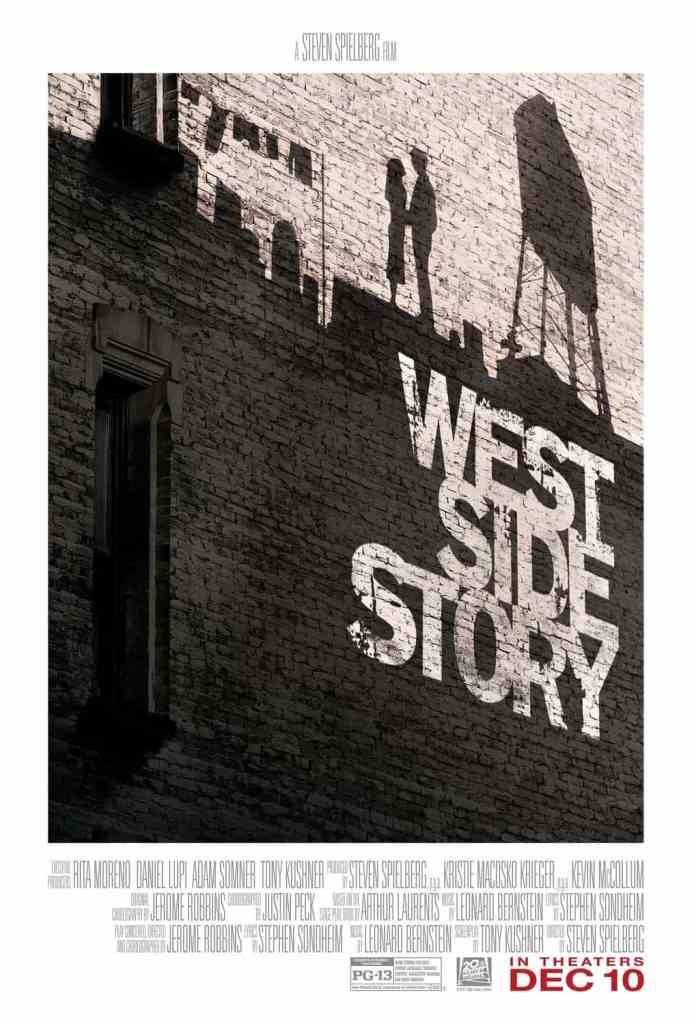
Although it lacks an Overture and an Intermission, Steven Spielberg’s rendition of 1961’s West Side Story flows well and does the story justice. Remakes are tricky things, you know. Stay too close to the source material and you end up with the line for line, shot for shot weirdness of Gus Van Zant’s Psycho. Stray too far from it and you discover something experimental and head scratching, like Luca Guadagnino’s Suspiria. West Side Story is in the middle of it all. It’s the same story you know and love, just taken from some new angles. I just wish the supporting cast hadn’t overshadowed the leads. My Aunt was a huge fan of the original, and I like to think she might have appreciated this one. It was worth catching it on the big screen back in December, and as of this writing, West Side Story is now available on Disney Plus and other streaming networks.

West Side Story is basically Romeo and Juliet, with two rival gangs (the Jets and the Sharks), fighting for territory in a battered New York City. When Tony (Ansel Elgort) meets Maria (Rachel Zegler), sparks fly between them, but it sets the stage for a dangerous confrontation between both gangs.

West Side Story marks another Spielberg production that doesn’t have John Williams at his side. While it saddens me that the two aren’t working together (and let’s face it, having just celebrated his 90th Birthday, Williams has easily earned a well deserved rest), the music for the film is in great hands. Originally composed by Leonard Bernstein and Stephen Sondheim, the music was handled by David Newman (Serenity) this time around, at Williams’ recommendation. One thing to learn here if you’re new to movies – David Newman is part of the Newman family of musicians that includes Thomas Newman (Wall-E, The Shawshank Redemption and just about any film Sam Mendes made), Randy Newman (Toy Story), and Alfred Newman, who created that 20th Century Fox fanfare you used to hear when watching Star Wars. Things remain mostly unchanged for the songs that were in the 1961 original, but there’s one additional piece (at least to me, anyway). “Somewhere” is sung by Rita Moreno’s character, rather than the leads. Not every song is exactly the same as the original (and it really shouldn’t be), but it’s very close. The only quirk I really had was for my favorite song, “Officer Krupke”, which changes things up just a little. It should be noted that everyone on screen is signing here, whereas in the original, it was mainly George Chakiris and Russ Tamblyn who sung their own parts (something I only learned just now in writing about this). I loved the whole element with Riff getting whacked over the head with the newspaper. Every other song has some magic to it, and with Janusz Kaminski as Spielberg’s Director of Photography, there are some fantastic uses of the camera in many shots. Guillermo Del Toro recently raved about the dance sequence, and it’s a great sequence. Sometimes, it’s also the subtle moments. My favorite comes in “A Boy Like That”. In the original, there was a glass door with a blue, yellow and red glass paneling. Spielberg still showcases the color pattern, but with the drapes instead. It was a cute homage to the original, I felt.

I also enjoyed what Tony Kushner did with the script. There’s a lot of Spanish in the film that’s given without any subtitles at all. I’m not sure if that was his decision or Spielberg’s, but for the most part, the feelings are clearly conveyed, whether you can understand what’s being said or not.

Writing is usually supposed to be without bias. I believe the sexual assault allegations against Ansel Elgort (Baby Driver) affected West Side Story’s success, somewhat. At my 7pm showing back in December, there weren’t many seats taken up for the film. That, or perhaps musicals aren’t as popular as they used to be (used to be being only a month prior with Lin-Manuel Miranda’s Tick Tock Boom!). Add to that a Pandemic we thought we were slowly breaking out of only to discover a return with renewed fervor and what could have been gigantic just didn’t seem so. My own biases were in part to blame for not writing about this movie sooner. I didn’t hate the film by any means – I really enjoyed it – I just didn’t want to throw in to the whole cancel culture that screamed “This person did bad things, smite him from our film and shun them from our memories.” (though I suppose by adding this, I am doing just that). Whatever the case, Elgort’s Tony isn’t terrible in any way. Based on his performance in Baby Driver, he would have been my go to pick as well. I just didn’t feel as much for the character as I thought I would, knowing that I found about the actor. Tony’s the only character in this one where I felt they could have swapped in a CGI Richard Beymer and it would have worked fine.

The opposite could be said of Zegler. She has an incredible voice and screen presence, and fits into Maria so well that you might forget you’re watching actors on screen. I hope to see her do more in the future (and while we’re on that topic, let her sit in at the Oscars. What’s one more seat, anyway?)

From top to bottom, West Side Story is stacked with a mix of veterans and young talent that we hope to see more of in the future. Rita Moreno, who played Anita in the original, returns a Doc, the owner of a store (which also makes a nice connection to the previous film). Brian D’Arcy James (Molly’s Game) is on hand as Officer Krupke. Corey Stoll (Ant-Man) plays Lt. Schrank, and that’s about the bulk of the adults you’ll run into other than teachers and the like. For the Jets and Sharks, we have Maddie Ziegler (who is Sia’s Muse) as Velma. We also have Mike Faist as Riff and David Alvarez as Bernardo, who were just fantastic. It is an absolute shame that either actor didn’t gain some kind of recognition during the award season. Thank goodness that at least Ariana DeBose (Hamilton) portrayal of Anita is getting some love. She lights up every scene she’s in, whether it’s dancing or showing grief. She’s my pick for Best Supporting Actress this year, though that position is stacked with some strong nominees.

Overall, West Side Story was a surprise for me. Spielberg hits the right marks, and I feel you can sit it next to Wise’s production. Whatever mood you happen to be in, you can pick one and enjoy. The supporting cast may overshadow the leads, but not so much that it ruins the film.

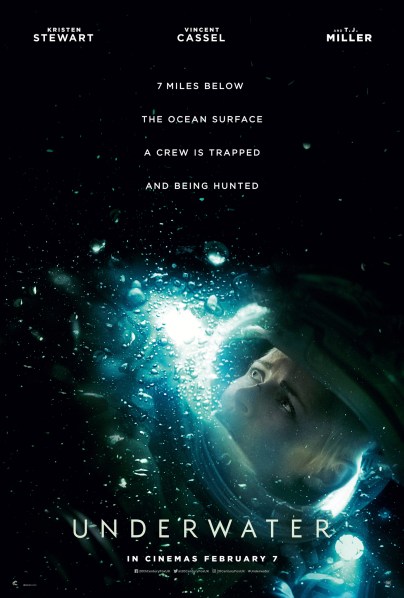
Quick Review: Underwater (Dir. by William Eubank)


Underwater-movie-poster

“There is no such thing as a new idea. It is impossible. We simply take a lot of old ideas and put them into a sort of mental kaleidoscope. We give them a turn and they make new and curious combinations.” – Mark Twain

I wasn’t entirely sold on William Eubank’s Underwater after leaving the theatre.

I’d seen that kind of film before in movies like Alien, Resident Evil, The Abyss, Leviathan, Deep Rising and Deep Star Six. It didn’t feel like it was giving me too much of anything new (especially when compared to last year’s genuinely jumpworthy Crawl), but I have to admit I did spent quite a bit of the film watching it from between my fingers. I’ll give it that. Additionally, I have to give the movie credit for taking no time to get things moving and staying pretty even throughout. Within 5 to 10 minutes of the movie’s start, you’re thrust right into a mix of terror from the unknown and claustrophobic environments. For someone with an attention span as short as mine, it’s impressive to see a film hit the ground running like that. It’s the kind of opening one would expect from one of the John Wick films. Longtime readers here on the Lens know that January really isn’t the month for the greatest films, though every once in a while, you’ll have one or two that dowell.

I think enjoying Underwater may be dependent how much comparing is done between it and older films. If you walk in blind, not expecting anything and are just looking to be entertained, you may enjoy the film more than I did. Do you absolutely have to rush to a movie theatre to see it? No, I don’t feel you do. Give it 3 months and you’ll have it on Digital/Blu-Ray. Would I run back to it in the theatre? Nah. If you’re a Kristen Stewart fan, or if the film’s something you’re genuinely interested in, have at it.

A group of miners find themselves struggling to survive after their rig suffers intense damage. Their goal is to reach a set of escape pods that can take them to the surface, but reaching it poses a set of challenges. The team comes to find that they may not be alone in the depths, which adds to their problems.

underwater-trailer

Kristen Stewart navigates the ocean depths in William Eubank’s Underwater.

The cast does well as can be expected, with Kristen Stewart (Charlie’s Angels) taking the lead as Norah, the team’s engineer. Joining her are Vincent Cassel (Eastern Promises) as the Captain, Jessica Henwick (Marvel’s Iron Fist) as  the biology scientist, John Gallagher, Jr. (Hush), Mamoudou Athie (The Get Down), and JT Miller (Deadpool) as the comic relief.  JT Miller in particular voices what would be the audience’s take as a fellow who just wants to get out of the situation. It’s Stewart and Henwick that carry the most weight with the film, and they handle it well. Their characters are smart and try their best to make it through the situations presented to them.

Visually, Underwater’s deep sea sequences have an interesting feel to them. Some of them feel more like the shaky cam shots from As Above So Below. There’s a bit of claustrophobia with watching certain scenes from behind the helmets. The monsters themselves are reminiscent of the ones you’d find in Cloverfield or The Mist with a number of jumpscares throughout. There’s very little in the way of blood and gore, since the film is PG-13.

I would have liked a larger body count. For the size of the rig, part of me expected to see more then just the 6 or 7 characters we have. Seeing more individuals face the creatures or the crumbling buildings could have added a bit of weight. That’s just a nitpick. The Nostromo was huge, yet only had a crew of seven.

Overall, I enjoyed Underwater more than I thought I would. It spends a lot of time doing things that other films already did, but does so in such a way where it’s not entirely wasted.


The New Mutants has a new date and trailer.


Marvel’s The New Mutants was a film that was supposed to come out in mid 2019, but was pushed back. The New Mutants focuses on a set of kids in a hospital and takes more of a horror/drama stance that’s similar to F/X’s Legion.  It’s a little different for Marvel, and fits for the Fox banner.

The New Mutants, starring Anya Taylor-Joy, Maisie Williams, Alice Braga, and Charlie Heaton, is set to premiere in cinemas on April 2020.

Ryan Reynolds improves his game in the Free Guy Trailer


You have to hand it to Ryan Reynolds, he knows how to market his projects. In the course of a few days, he made an advertisement for a TV that linked to a new film and his gin company, Aviation Gin. He also made a separate commercial for Aviation Gin starring Monica Ruiz, who everyone knows as the wife in the Peleton ads. Now, 20th Century Fox reunites Reynolds and his Green Lantern co-star, Taika Waititi in Free Guy.

Free Guy has Reynolds playing an NPC (Non-Playable Character) in a Video Game that is due to be shut down. Using classic video game items like power ups, guns and dance emotes, Reynolds’ character decides it’s time to level up. While we’re not sure of where this all goes, it’s good to see Ryan bring some of that Deadpool flair under the Disney umbrella.

Free Guy, Directed by Shawn Levy (Date Night), is set to release on July 3, 2020.

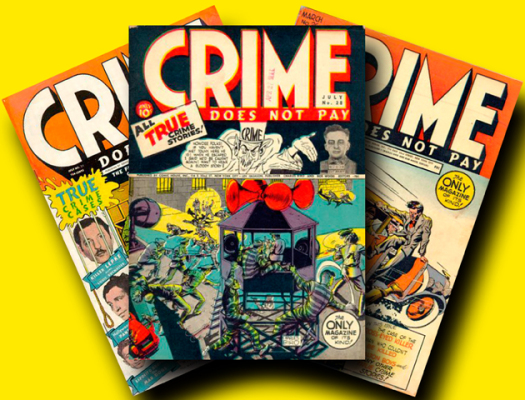
Cleaning Out the DVR #24: Crime Does Not Pay!


gary loggins's avatarcracked rear viewer

We’re way overdue for a Cleaning Out the DVR post – haven’t done one since back in April! – so let’s jump right in with 4 capsule reviews of 4 classic crime films:

SINNERS’ HOLIDAY (Warner Brothers 1930; D: John Adolfi) – Early talkie interesting as the screen debut of James Cagney , mixed up in “the booze racket”, who shoots bootlegger Warren Hymer, and who’s penny arcade owner maw Lucille LaVerne covers up by pinning the murder on daughter Evalyn Knapp’s ex-con boyfriend Grant Withers. Some pretty racy Pre-Code elements include Joan Blondell as Cagney’s “gutter floozie” main squeeze. Film’s 60 minute running time makes it speed by, aided by some fluid for the era camerawork. Fun Fact: Cagney and Blondell appeared in the original Broadway play “Penny Arcade”; when superstar entertainer Al Jolson bought the rights, he insisted Jimmy and Joan be cast in the film version, and…

View original post 549 more words

You’re Killing Me, Smalls!: Let’s Play in THE SANDLOT (20th Century-Fox 1993)


gary loggins's avatarcracked rear viewer


Baseball movies are as American as apple pie, and everyone has their favorites, from classic era films like THE PRIDE OF THE YANKEES and TAKE ME OUT TO THE BALL GAME to latter-day fare like THE NATURAL and FIELD OF DREAMS. There’s so much to choose from, comedies, dramas, and everything in-between. One of my all-time favorites is 1993’s coming of age classic, THE SANDLOT.

Like most baseball movies, THE SANDLOT is about more than just The Great American Pastime. Director David Mickey Evans’ script (co-written with Robert Gunter) takes us back to 1962, as young Scotty Smalls has moved to a brand new neighborhood in a brand new city. His dad died, and his mom (Karen Allen of NATIONAL LAMPOON’S ANIMAL HOUSE fame) has remarried preoccupied Bill (young comedian Denis Leary…. hmmm, I wonder what ever happened to him??), who tries to teach the nerdy kid how to play…

View original post 433 more words

A (Not-So) Brief Note On WELCOME TO MOOSEPORT (20th Century Fox 2004)


gary loggins's avatarcracked rear viewer

Sometimes while scrolling through the channels one come across a pleasant surprise. So it’s Saturday afternoon,a thundershower has cancelled my plan to hit the beach, the Red Sox don’t start for awhile, and I’m clicking the old clicker when I land on WELCOME TO MOOSEPORT. I wasn’t expecting much, just a way to kill time; instead, I found an underrated little gem of a comedy that kept me watching until the very end.

Don’t get me wrong, I’m not saying WELCOME TO MOOSEPORT is an undiscovered classic or anything like that. It’s just a solidly made piece of entertainment about small-town life starring Ray Romano (riding high at the time thanks to his successful sitcom EVERYBODY LOVES RAYMOND) and Oscar winning Gene Hackman. Romano uses his nebbishy TV persona to portray Mooseport, Maine’s local hardware store owner “Handy” Harrison, who gets involved in a mayoral campaign against Hackman’s Monroe “Eagle”…

View original post 438 more words