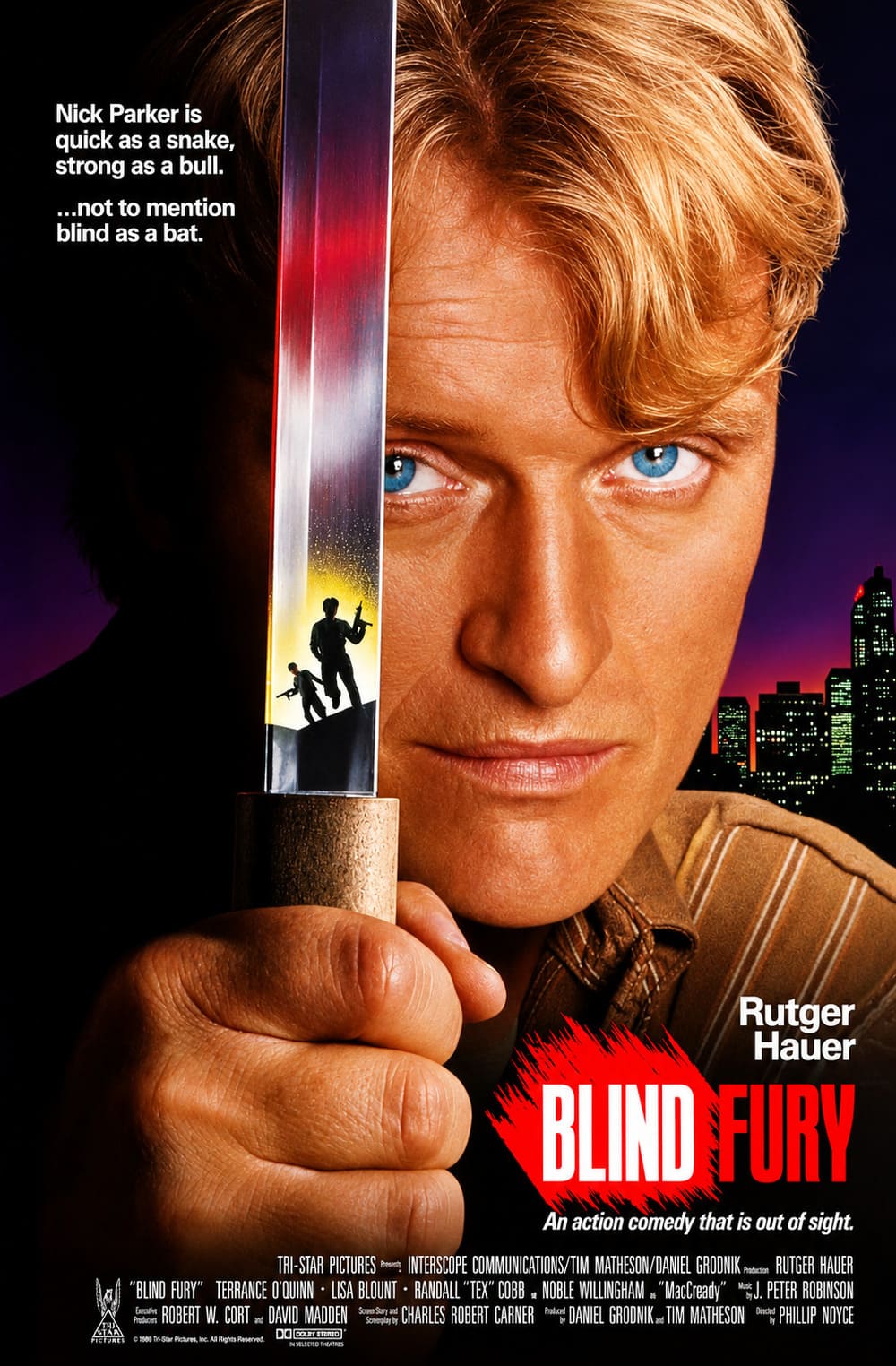
Film Review: Blind Fury (dir. by Phillip Noyce)


“Oh, nice guy, I hope. Everybody’s trying to kill me lately.” — Nick Parker

Rutger Hauer’s smile does almost as much work as his sword in Blind Fury (1989). It gives this cheerfully far-fetched action movie something that an elaborate fight sequence cannot supply on its own: a reason to enjoy hanging around its hero. Directed by Phillip Noyce, the film mixes bloody confrontations, broad comedy, and an unlikely friendship without always finding a comfortable balance. Yet Hauer moves through it with such relaxed charisma that the rough patches rarely become deal breakers. The story may be about getting a child out of danger, but the movie’s real attraction is watching an unconventional action star make an outrageous character feel strangely approachable.

Hauer plays Nick Parker, a Vietnam veteran blinded during the war and rescued by villagers who teach him to fight using his remaining senses. Years later, he sets out to find his old army buddy Frank Deveraux, played by Terry O’Quinn. Instead of a happy reunion, Nick discovers that Frank is mixed up with criminals and that his son Billy, played by Brandon Call, is in danger. After Billy’s mother is killed, Nick takes the boy under his protection. Their journey supplies the film with its basic rhythm: uneasy bonding, trouble, swordplay, and another stretch of uneasy bonding.

The film is an English-language remake of Zatoichi Challenged, the 17th entry in the long-running Japanese film series about the blind swordsman. Rather than simply borrowing a distinctive fighting gimmick, Blind Fury carries over the appeal of a capable outsider whom people consistently misjudge. Nick’s walking stick conceals a sword, but his friendly manner disguises his abilities just as effectively. Putting that figure into an American crime adventure creates an entertaining clash of styles. The gangsters belong to a familiar world of threats and brute force; Nick seems to have wandered in from a different kind of movie altogether.

Hauer makes that difference work by resisting the obvious tough-guy approach. Nick does not spend every quiet moment looking tortured or every confrontation trying to sound intimidating. He jokes, listens, and occasionally seems genuinely amused by the people around him. There is sadness beneath that warmth, but Hauer lets it register without demanding that the whole film stop and acknowledge it. His performance gives Nick a life beyond his usefulness in a fight. That matters because a character built entirely around extraordinary abilities can become dull surprisingly quickly. Here, the abilities are entertaining, but the person using them is usually more interesting.

The action follows the same principle: personality matters more than plausibility. Nick’s awareness of his surroundings is precise enough to make the premise work, and the film does not invite much scrutiny of the mechanics. Instead, Noyce builds sequences around timing, misplaced confidence, and sudden reversals. Someone decides Nick is helpless, moves in too close, and receives an unpleasant correction. The fights are often structured like physical punch lines, with a brief pause before the payoff. That playful quality keeps the swordplay from becoming monotonous, even when the outcome is obvious. We know Nick will handle the situation; the fun lies in how.

The villains give him plenty to handle, although they are more colorful obstacles than fully developed characters. Noble Willingham brings blustering nastiness to crime boss MacCready, while Randall “Tex” Cobb gives Slag an imposing presence. Their broadness suits a film that has little interest in subtle criminal psychology. They threaten, scheme, and underestimate their opponent, giving Hauer room to remain comparatively understated. The contrast is useful: Nick does not need to compete with their volume to control a scene. Still, the criminal plot itself is not especially compelling, and whenever the film spends too long explaining its machinery, the energy starts to sag.

The relationship with Billy is more important and more uneven. Their partnership brings out Nick’s patience and gives the journey something warmer than a string of violent encounters. But Billy’s resistance can feel like a screenplay requirement rather than a fresh observation about a frightened child. The movie needs them to clash before they connect, and sometimes you can see that calculation too clearly. Its handling of grief is similarly hurried. A devastating event becomes the starting point for an adventure that frequently wants to be breezy. Hauer helps bridge those gaps, though he cannot entirely erase the awkwardness.

That uneven tone is the film’s biggest limitation. Blind Fury wants its violence to sting, its jokes to land lightly, and its central relationship to carry genuine feeling, sometimes within the same scene. Not every transition works. Its fantasy of blindness also belongs firmly to action-movie invention rather than a grounded portrayal of disability. But the film remains enjoyable because it rarely becomes self-important about any of this. Noyce generally keeps the story moving, and Hauer gives its competing moods a common center. Even when the writing shifts gears abruptly, Nick still feels like the same person.

For a movie built around a concealed weapon, Blind Fury is surprisingly dependent on what its leading man leaves out in the open. Hauer’s humor, gentleness, and easy confidence make the familiar plot worth following and the ridiculous action worth accepting. A more generic performance might have left nothing but a novelty premise and a pile of defeated henchmen. Instead, there is a character whose company makes the journey enjoyable. The film is scruffy, sometimes clumsy, and never particularly deep, but it has the good sense to trust its star. Long after the plot details fade, that smile still does the trick.

Guilty Pleasure No. 94: Revenge of the Nerds (dir. by Jeff Kanew)


Revenge of the Nerds captures the wild, unfiltered spirit of 1980s college comedies, blending underdog triumph with over-the-top raunchiness that feels both nostalgic and awkwardly dated today. Released in 1984, this Jeff Melman-directed flick stars Robert Carradine and Anthony Edwards as Lewis and Gilbert, two freshmen nerds who face relentless bullying from the jock-dominated Alpha Beta fraternity at Adams College. What starts as a straightforward tale of misfits fighting back evolves into a chaotic mix of pranks, parties, and questionable morals, making it a polarizing watch that still packs a punch for fans of the era’s humor.​

The story kicks off with Lewis and Gilbert arriving full of optimism, only to have their dreams torched—literally—when the Alpha Betas accidentally burn down their dorm during a hazing gone wrong. Relocated to a rundown gym with other campus outcasts, the nerds band together under the banner of Tri-Lam, turning their rejection into fuel for clever retaliation. From panty raids to talent show showdowns, the film barrels through a series of escalating antics, peaking at the Greek Games where brains battle brawn in absurd competitions like tricycle races and tug-of-war twists. It’s pure 80s escapism, with a runtime under 100 minutes that keeps the energy high and the laughs coming in rapid-fire succession, even if not every gag is a home run.​

The nerd ensemble steals the show, each character a walking stereotype brought to vivid life. Carradine’s Lewis is the slick-talking instigator with a knack for schemes, while Edwards’ Gilbert provides the earnest heart, delivering a pivotal speech about acceptance that gives the movie unexpected emotional depth. Curtis Armstrong as Booger delivers unforgettable gross-out moments, from belching symphonies to shameless flirtations, and Larry B. Scott’s Lamar brings flamboyant athletic flair that subverts expectations. The jocks, led by Ted McGinley’s smug Stan, serve as perfect foils—arrogant, muscle-bound villains who embody the era’s macho excess. Supporting turns, like Julia Montgomery’s Betty navigating boyfriend drama, John Goodman’s boorish Coach Harris, or Bernie Casey’s wise U.N. Jefferson, add layers to the campus power struggle.

​

Humor-wise, Revenge of the Nerds leans hard into juvenile territory: fart jokes, streaking, and wild panty raid sequences filmed with hidden cameras that push boundaries even for the time. The film’s climax involves Lewis impersonating Stan to woo Betty, a plot point that plays as triumphant revenge but lands as deeply problematic through today’s lens, highlighting consent issues amid the cheers. Similarly, the sorority spying and casual objectification reflect 80s attitudes toward women and minorities that feel crass now, contributing to its mixed modern reception. Yet, these elements are balanced by genuine camaraderie among the nerds, fostering a sense of belonging that resonates as a counter to real-world bullying.​​

Technically, the movie holds up as a product of its time. The soundtrack, featuring the iconic title track by The Rubinoos and funky cues during party scenes, amps up the fun, while practical effects like the nerds’ gadget-filled house add quirky charm. Cinematography emphasizes the divide between polished frat row and the nerds’ scrappy turf, with wide shots of campus chaos underscoring the rebellion. Written by Tim Metcalfe, Steve Zacharias, and Jeff Buhai, the script zings with quotable lines—”We are the sons of the sons of bitches”—and smartly flips the slobs-vs-snobs formula by rooting for the geeks.​

Culturally, Revenge of the Nerds helped define the “nerd pride” archetype, paving the way for films like PCU and influencing pop culture’s embrace of geek culture from The Big Bang Theory to Marvel dominance. It spawned three sequels, a musical adaptation, and endless references, cementing its place as a time capsule of Reagan-era college life—rowdy, rebellious, and unapologetically politically incorrect. For balance, its strengths lie in infectious energy, memorable characters, and a pro-outsider message, but weaknesses include uneven pacing in setup scenes and humor that too often punches down rather than up.​

The film continues the trend of 80s raunchy teen comedies first popularized by Bob Clark’s Porky’s, ramping up the gross-out gags and frat-house antics while shifting the focus to nerd empowerment over sexual hijinks. The nerds’ talent show finale, uniting misfits in a joyous medley, delivers pure catharsis, proving brains and heart can topple bullies. It’s not flawless—some jokes bomb, and the ending rushes a bit—but its scrappy spirit endures for those who grew up quoting Booger’s lines or cheering Tri-Lam’s win. Fans of Animal House or Old School will find familiar thrills, while modern audiences might prefer the cleaner satire of The Good Place. Ultimately, Revenge of the Nerds earns a solid recommendation with caveats: a rowdy good time if you roll with the 80s vibe, but skip if consent gags are deal-breakers.

Previous Guilty Pleasures

  1. Half-Baked
  2. Save The Last Dance
  3. Every Rose Has Its Thorns
  4. The Jeremy Kyle Show
  5. Invasion USA
  6. The Golden Child
  7. Final Destination 2
  8. Paparazzi
  9. The Principal
  10. The Substitute
  11. Terror In The Family
  12. Pandorum
  13. Lambada
  14. Fear
  15. Cocktail
  16. Keep Off The Grass
  17. Girls, Girls, Girls
  18. Class
  19. Tart
  20. King Kong vs. Godzilla
  21. Hawk the Slayer
  22. Battle Beyond the Stars
  23. Meridian
  24. Walk of Shame
  25. From Justin To Kelly
  26. Project Greenlight
  27. Sex Decoy: Love Stings
  28. Swimfan
  29. On the Line
  30. Wolfen
  31. Hail Caesar!
  32. It’s So Cold In The D
  33. In the Mix
  34. Healed By Grace
  35. Valley of the Dolls
  36. The Legend of Billie Jean
  37. Death Wish
  38. Shipping Wars
  39. Ghost Whisperer
  40. Parking Wars
  41. The Dead Are After Me
  42. Harper’s Island
  43. The Resurrection of Gavin Stone
  44. Paranormal State
  45. Utopia
  46. Bar Rescue
  47. The Powers of Matthew Star
  48. Spiker
  49. Heavenly Bodies
  50. Maid in Manhattan
  51. Rage and Honor
  52. Saved By The Bell 3. 21 “No Hope With Dope”
  53. Happy Gilmore
  54. Solarbabies
  55. The Dawn of Correction
  56. Once You Understand
  57. The Voyeurs 
  58. Robot Jox
  59. Teen Wolf
  60. The Running Man
  61. Double Dragon
  62. Backtrack
  63. Julie and Jack
  64. Karate Warrior
  65. Invaders From Mars
  66. Cloverfield
  67. Aerobicide 
  68. Blood Harvest
  69. Shocking Dark
  70. Face The Truth
  71. Submerged
  72. The Canyons
  73. Days of Thunder
  74. Van Helsing
  75. The Night Comes for Us
  76. Code of Silence
  77. Captain Ron
  78. Armageddon
  79. Kate’s Secret
  80. Point Break
  81. The Replacements
  82. The Shadow
  83. Meteor
  84. Last Action Hero
  85. Attack of the Killer Tomatoes
  86. The Horror at 37,000 Feet
  87. The ‘Burbs
  88. Lifeforce
  89. Highschool of the Dead
  90. Ice Station Zebra
  91. No One Lives
  92. Brewster’s Millions
  93. Porky’s