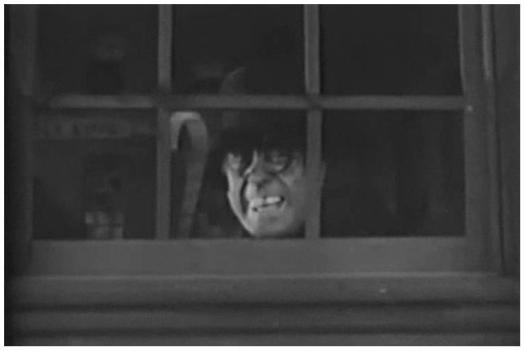
“Alex! Alex! You’re walking away from history! History! Did Chris Columbus say he wanted to stay home? No! What if the Wright Brothers thought that only birds should fly?” — Centauri
The Last Starfighter is one of the most purely enjoyable science-fiction adventures of the 1980s: earnest, inventive, occasionally corny, and driven by the kind of wide-eyed imagination that modern blockbusters too often confuse with sheer scale. Directed by Nick Castle, the 1984 film builds an entire intergalactic adventure around a premise that could have been dismissed as a gimmick: an arcade champion discovers that his favorite game is actually a recruitment test for a real war in space. Instead of treating that premise ironically, the film commits to it wholeheartedly, and that sincerity is ultimately what makes it endure.
Lance Guest stars as Alex Rogan, a teenager living in the Starlite Starbrite trailer park with his mother and younger brother, Louis. Alex is smart, resourceful, and visibly restless. He wants to get out of his small-town surroundings, attend college, and build a better future, but financial strain and family responsibility keep making those ambitions seem less realistic. His one reliable escape comes from an arcade machine outside the local store called The Last Starfighter. Alex plays constantly, eventually achieving a record score that attracts the attention of the game’s mysterious creator, Centauri.
Robert Preston’s Centauri is one of the film’s great pleasures. He is an interstellar recruiter who behaves like a flamboyant carnival salesman, arriving in Alex’s life with a strange vehicle, flashy clothes, a rapid-fire sales pitch, and a proposition that sounds completely insane. Centauri reveals that The Last Starfighter is not merely a video game; it is a test designed to identify young people with the reflexes, tactical instincts, and courage needed to become Gunstar pilots for the Rylan Star League. Alex has not just beaten a difficult arcade game. He has qualified to defend an entire civilization from the Kodan Armada.
That central idea remains the movie’s strongest asset. It transforms a familiar adolescent fantasy into something emotionally resonant. Alex is not gifted with a magical sword, superpowers, or an ancient royal lineage. He is selected because he became exceptionally skilled at something the adults around him would probably regard as a waste of time. His ability to master a video game becomes proof that he has discipline, intelligence, hand-eye coordination, and the ability to make decisions under pressure. For anyone who grew up playing arcade games, it is an irresistible fantasy: the thing you are good at for fun might one day turn out to matter more than anyone realizes.
The film understands, however, that being offered a larger life is not the same as being ready for it. Alex initially reacts to the truth with disbelief and fear rather than instant heroism. He wants to return home. He assumes there has been a mistake. That response helps ground the movie, because Alex is not a prepackaged action hero. He is a teenager who has dreamed of escaping his circumstances but has never seriously considered the sacrifices that escape might require. It is easy to want a more exciting future when it is only an idea. It is harder when that future involves leaving your family, crossing the galaxy, and possibly dying in a war you barely understand.
Lance Guest gives Alex enough insecurity and frustration to make his eventual growth satisfying. Alex can be impatient and occasionally self-centered, but he never comes across as unlikable. He feels trapped, and the film makes that frustration understandable. His conflict is not simply whether he can destroy enemy ships; it is whether he can accept that he deserves a larger destiny than the one he has assumed is available to him. By the time he decides to fight, he has moved beyond wanting adventure as an escape. He has chosen to take responsibility for something greater than himself.
Catherine Mary Stewart is also appealing as Maggie Gordon, Alex’s girlfriend. Maggie is not given an enormous amount to do, but she has more personality than the standard passive romantic interest in many 1980s adventure films. She cares deeply about Alex, yet she also has every reason to be hurt and confused when he suddenly disappears and begins acting strangely. Her scenes with Beta Alex, the android duplicate sent to take Alex’s place on Earth, provide some of the movie’s most amusing moments. Beta Alex looks exactly like him, but his behavior is just strange enough to create an entertaining mixture of comedy and unease.
The Beta Alex subplot is one of the film’s cleverest touches because it allows the story to explore Alex’s absence without simply abandoning the Earthbound characters. Beta Alex is a convincing physical duplicate, but he cannot quite replicate the nuances of being human. His overly literal responses, awkward attempts at social interaction, and bizarre behavior around Maggie make him a memorable comic creation. The device also reinforces the contrast between Alex’s old life and the extraordinary new situation he has been pulled into. While the real Alex is in space facing a galactic conflict, the people at home are left trying to make sense of a version of him that seems familiar but fundamentally wrong.
Robert Preston’s performance gives the entire movie energy whenever Centauri appears. He could easily have become an irritating eccentric, but Preston makes him funny, charismatic, and unexpectedly warm. Centauri sees Alex’s potential before Alex sees it himself. Beneath the fast talking and theatrical mannerisms is a real belief in the people he recruits. He does not merely need another pilot; he genuinely wants Alex to become the person he is capable of being. Preston’s presence adds an old-fashioned show-business charm to a film otherwise built around futuristic hardware and computer-generated spacecraft.
Dan O’Herlihy is equally important as Grig, the reptilian alien navigator assigned to work with Alex. Grig initially seems like the typical stern mentor figure, but he gradually becomes one of the movie’s most likable characters. He has experience, discipline, and a personal history with the war that gives the conflict some added seriousness. His partnership with Alex works because they begin from very different places. Grig is a hardened veteran who has seen the cost of battle, while Alex is an overwhelmed rookie who still wants to go home. As they learn to trust each other, their relationship becomes the heart of the space-adventure material.
The villains are broad but effective. Xur and the Kodan Armada are not psychologically complex antagonists, yet the movie does not need them to be. Their purpose is to represent a threat large enough to force Alex into a defining choice. Xur’s willingness to betray the Star League and sacrifice innocent lives for power makes him an appropriately clear villain for this kind of adventure. The conflict is straightforward: a small group of defenders must stand against an overwhelming enemy force, and Alex must decide whether he will be one of those defenders.
The visual effects are perhaps the most historically fascinating part of The Last Starfighter. The film was an early showcase for computer-generated imagery, using digital effects for its spacecraft, alien environments, and space-combat sequences. At the time, this was revolutionary. Seen today, the visual effects are obviously dated. The ships have a smooth, artificial quality, the textures are basic, and the movement lacks the weight and complexity audiences expect from modern computer animation. Yet there is still something charming about them. They represent a major transitional period in science-fiction filmmaking, when filmmakers were beginning to discover what computers could do for cinematic spectacle.
The early CGI gives the movie a distinctive visual identity rather than simply making it look obsolete. The Gunstar fighter, the Kodan fleet, and the distant alien landscapes have the clean, geometric appearance of an advanced arcade game brought to life. That is fitting for a story about a teenager whose gaming skills translate into real combat ability. The computer-generated imagery may not have the tactile realism of the practical miniature work seen in films such as Star Wars or Blade Runner, but it has an important place in the history of visual effects. The movie was imagining a future that the technology of its day could only partially create, and that ambition remains visible in every digital battle.
The Gunstar itself is a memorable piece of science-fiction design. It looks futuristic while still retaining the simplicity of a classic arcade spaceship, and the cockpit scenes effectively sell the sensation of Alex being thrown into something far beyond his experience. The climactic use of the “Death Blossom” maneuver is especially satisfying because the film treats it as a genuine last resort. It is the cinematic equivalent of unleashing a devastating power-up at the exact moment an arcade game seems impossible to win. The sequence is flashy, uncomplicated, and immensely fun.
What makes The Last Starfighter last is not its special effects alone, nor is it just nostalgia for the arcade era. The movie works because it is fundamentally optimistic. It believes that potential can emerge from unlikely places and that someone who feels ignored, trapped, or underestimated may still possess the ability to do something remarkable. Alex is not chosen because he is already fearless. He becomes heroic because he eventually chooses to act despite being afraid.
The film is not perfect. Its dialogue can be cheesy, some characters are thinly developed, and the dated effects may be difficult for viewers accustomed to modern CGI. Even so, those imperfections are part of its charm. The Last Starfighter is colorful, sincere, and unashamedly enthusiastic about its own premise. It remains a lovable science-fiction adventure because it takes the dreams of a video-game-playing teenager seriously. It asks viewers to imagine that the skill everyone dismisses, the hobby that feels like an escape from ordinary life, might actually be the first sign that they are capable of something far greater.