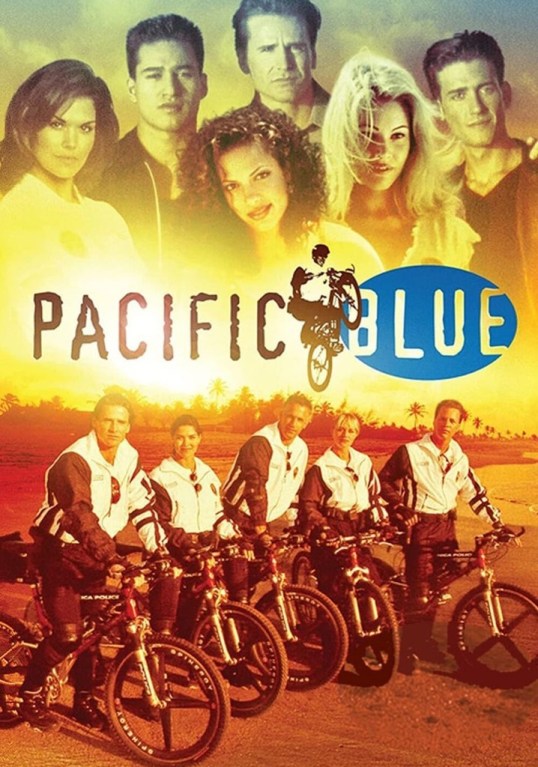
Welcome to Late Night Retro Television Reviews, a feature where we review some of our favorite and least favorite shows of the past! On Tuesdays, I will be reviewing Pacific Blue, a cop show that aired from 1996 to 2000 on the USA Network! It’s currently streaming everywhere, though I’m watching it on Tubi.
This week, Del Toro returns!
Episode 4.13 “Saving Serenity”
(Dir by Michael Levine, originally aired on January 10th, 1999)
When last we saw former series regular Victor Del Toro (played by Marcos A. Ferraez), he was quitting the force after nearly being indicted for killing the man who killed his fiancée. In this episode, Victor finally returns to Santa Monica.
Victor has spent the last five months wandering. He now has bleached blonde hair and a serious drinking problem. When a robber attempts to hold up the bar where Victor is getting drunk, Victor struggles with him. The thief ends up getting shot. Victor grabs the thief’s gun and runs from the bar.
Victor is on the verge of shooting himself on the pier when he sees a woman named Carmen Rios (Angela Alvarado). Carmen reveals that she’s searching for her daughter, Serenity. Serenity was taken away by her biological father. Carmen wants to find her daughter and escape to Mexico with her. Victor agrees to help.
Victor shows up at the Pacific Blue headquarters and announces that he wants to rejoin the force. But, in reality, he just wants to steal the files concerning Serenity’s whereabouts. Later, Victor fakes a bomb threat at the main police station so that he can steal another casefile. TC, Chris, and Cory all reuses to believe that Victor could be involved in anything illegal. Bobby Cruz is convinced that Victor is the one who shot the robber at the bar.
And really, Bobby has reason to be concerned about Victor’s desire to return to Pacific Blue. Victor is a young, handsome Latino who overcame a rough childhood to become a respected bike cop and he’s extremely protective of his younger sister. Bobby, who was introduced after Victor left the show, is also a young, handsome Latino who overcame a rough childhood to become a respected bike cop and he’s also extremely protective of his younger sister. Because the show’s writers were too lazy to actually come up with a new character, Bobby basically is Victor. If Victor returns, the show won’t need Bobby around anymore.
Fortunately, for Bobby, Victor is dead by the end of this episode. He reunites Carmen and Serenity and then drags Serenity’s father out to the pier. Holding a gun to the father’s head, Victor forces the man to repeat the serenity prayer. Cory, TC, and Chris all have their guns drawn. “No!” they all shout in slow motion before opening fire. Victor plunges off the pier and hits the sand below.
OH MY GOD, THEY KILLED VICTOR!
Well, it depends on how you look at it. It turns out that none of them could actually bring themselves to shoot Victor. They just shot up in the air. And then Victor …. well, who knows? The show implies that Victor jumped but, from what I saw, it looks like he was startled and fell backwards. In other words, his friends may not have shot Victor but he might still be alive if they hadn’t fired.
Victor does indeed die at the end of this episode. Wow, Pacific Blue got dark! And I do have to admit that this is actually the best episode of Pacific Blue that I’ve watched so far. Admittedly, it’s a low bar to clear but the whole episode was just so melodramatic and over-the-top that it actually managed to hold my attention in a way that this show usually doesn’t. Those three slow motion shots of people shouting, “Noooooo!” in a row really were worth the price of admission.
So, Victor’s dead. But at least Bobby’s place on the team is secure.
Porky’s is one of those movies that plays very differently depending on when you first see it. On the surface, it is a loud, lewd early‑’80s teen sex comedy about a bunch of high‑school boys in 1950s Florida trying to get laid and get even, but underneath the pranks and bare flesh there are streaks of surprisingly serious material about prejudice, masculinity, and power. That mix of dopey laughs and darker undercurrents is exactly what makes the film interesting to talk about, and also what makes it so divisive today.
Set in the 1950s and released in 1981, Porky’s follows a tight‑knit group of teenage boys whose main goals in life are sex, sports, and practical jokes. Their adventures eventually take them to Porky’s, a sleazy backwater strip club run by the hulking, corrupt Porky, who humiliates them and sets up the revenge plot that drives the back half of the film. Around that spine, the story wanders through locker‑room banter, elaborate pranks, and various attempts to sneak into the girls’ showers or otherwise spy on naked bodies. It is very much a “horny boys on the prowl” narrative, and the film never pretends to be anything else.
What keeps it from being just another disposable sex comedy is the way some of those side stories hit harder than expected. One of the kids is brutally abused by his father, and the film doesn’t treat it like a throwaway detail; those scenes have a rawness and anger that clash with the goofy tone elsewhere. There is also a thread about anti‑Semitism and racism in their community, with one character confronting his own bigoted upbringing as he befriends a Jewish classmate and pushes back against the prejudice around him. That material is handled in a pretty straightforward, earnest way, which is jarring given how crude the surrounding humor can be, but it does show that writer‑director Bob Clark had more on his mind than dirty jokes.
The humor, for better or worse, is what most people remember. Porky’s leans heavily on slapstick and sex‑obsessed gag setups: peeping through holes in shower walls, mistaken identities during sex, ridiculous anatomical bragging, prank phone calls, and elaborate schemes that escalate into full‑on chaos. Some of the set pieces are staged with real comic timing, and if you’re on its wavelength, these sequences can still land as big, cathartic laughs. Others feel juvenile in the worst way, stretching one joke way past its breaking point, or punching down at easy targets rather than punching up at the hypocritical adults the boys are constantly butting up against.
Viewed from today’s lens, a big chunk of that humor is undeniably uncomfortable. The movie is saturated with sexist, homophobic, and racist language, and a few of the “pranks” involving the girls are essentially sexual harassment played for laughs. At the time, it was sold as a gleefully politically incorrect romp; now, those same scenes read as mean‑spirited or creepy in a way that undercuts the supposed lighthearted tone. The film occasionally tries to complicate this by giving some of the female characters sharper edges or letting them turn the tables, but it never fully escapes the fact that the camera is mostly aligned with the boys and their fantasies.
That said, Porky’s is not entirely dismissive of its women. There are moments where adult women, in particular, are allowed to call out the boys’ behavior or assert their own sexuality in ways that undercut the usual “conquest” narrative. The movie also makes a point of ridiculing hypocritical authority figures—teachers, coaches, cops, and parents—whose prudish public morals don’t match their private behavior. When Porky’s is skewering bigotry, religious hypocrisy, and small‑town moral panics, it feels sharper and more progressive than its reputation as a dumb “tits‑and‑ass” comedy suggests. Those flashes of insight are part of why some viewers argue that, beneath the sleaze, the film is quietly critical of the very attitudes it seems to indulge.
Performance‑wise, the cast is made up largely of unknowns who sell the illusion that this is a real, scrappy group of friends rather than polished Hollywood teens. The camaraderie feels genuine; their constant ribbing, in‑jokes, and shifting alliances are believable enough that you can see why the movie became a touchstone for a certain generation of viewers. Bob Clark’s direction is surprisingly controlled for such an anarchic script. He keeps the story moving, balances multiple subplots, and stages the bigger comic payoffs in a way that feels almost like a live‑action cartoon. The downside is that this slickness can make the nastier gags pop more, for better and worse.
On a technical level, Porky’s is very much a product of its time, but not a cheap one. The period detail—cars, music, clothing, diners, and dingy roadside bars—helps sell the 1950s setting, giving the film a nostalgic sheen that softens some of its rougher edges. The soundtrack leans on era‑appropriate rock and roll, which adds energy to the locker‑room and party scenes. The film also doesn’t shy away from male nudity, which was less common in comedies of the time and adds to its reputation as equal‑opportunity when it comes to what it exposes, even if the gaze is still clearly tilted toward ogling women.
Where Porky’s can stumble is in tone. The shifts between broad farce and serious drama can be abrupt. One minute you are watching a drawn‑out gag about a teacher trying to identify a student by his anatomy; the next, you are plunged into a grim confrontation with an abusive parent. That whiplash can pull you out of the movie, because the emotional weight of the dramatic scenes doesn’t always get enough breathing room before the script lurches back to naughty antics. As a result, some viewers feel the darker elements trivialize real issues, while others think those same scenes give the film more substance than its imitators.
Even if someone has never seen Porky’s, they have probably felt its influence. The film was a massive box‑office hit relative to its budget and paved the way for a wave of raunchy teen comedies through the ’80s and ’90s, eventually echoing into movies like American Pie and beyond. Its success made it clear that there was a huge audience for R‑rated, adolescent sex comedies that mixed crude jokes with a veneer of coming‑of‑age sentiment. You can see its blueprint in later films: packs of horny friends, elaborate revenge schemes, school authority figures as comic foils, and a big, raucous set piece as the payoff.
Whether Porky’s “holds up” is going to depend a lot on your tolerance for outdated attitudes and offensive language. If you go in expecting a cozy nostalgia trip, you may be surprised by how sour some jokes taste now, and how casually the film treats behavior that would be framed very differently in a modern story. If you approach it as both a time capsule and the prototype of a genre, it becomes easier to see its strengths—the lively ensemble, the willingness to poke at racism and hypocrisy, the low‑budget ingenuity in its set pieces—alongside its very real flaws.
Porky’s is neither the hidden gem some defenders make it out to be nor the irredeemable trash its harshest critics describe. It is a messy, uneven, often funny, often cringeworthy movie that captures a particular moment in pop culture, both in what it laughs at and what it takes for granted. If you are curious about the roots of modern raunchy teen comedies and prepared for the rough, politically incorrect ride, it is still worth a look as a piece of film history and as an example of how comedy ages—for better and for worse.
The senior class of Angel Beach High finally graduate in Porky’s Revenge, the last official Porky’s film. It’s a good thing, too. Most of the members of the Porky’s cast were already in their late 20s when they were cast in the first Porky’s. By the time Porky’s Revenge was made, most of them looked more like they should be planning for their retirement than for college.
Director Bob Clark did not return for Porky’s Revenge and it really shows. The third film doesn’t have any messages about tolerance or fighting bigotry. Instead, it’s just a typical teen sex comedy with a subplot about Brian Schwartz (Scott Colomby) trying to help Coach Goodenough (Bill Hindman) pay back his gambling debt to Porky (Chuck Mitchell). Otherwise, the gang plays basketball, tries to arrange an orgy with the cheerleaders, and even helps Ms. Balbircker (Ellen Parsons) find love. I guess everyone forgot about Ms. Balbricker allying herself with the Klan during the previous film.
Porky’s Revenge doesn’t really have enough ambition to be terrible though. It’s just bland. Just as it doesn’t have the social conscience of the first two film, it’s also not as raunchy. There’s considerably less nudity and the occasionally rough edges of the first two films have been removed. That makes Porky’s Revenge less problematic but it also makes it less interesting. The first two films may have been imperfect but they did capture the feel of high school. This one doesn’t do that because the actors are too old and suddenly their characters are too nice. If not for the title, you would think this was just another dumb comedy that played for a week at the drive-in as opposed to being the second sequel to the most commercially-successful Canadian film of the 80s.
I did laugh when the gang went to the ruins of Porky’s to make sure that it hadn’t been rebuilt, just to discover that Porky now owned his own steamboat. I’m also glad that everyone finally graduated and gave the Porky’s saga a fitting close.
There was a direct-to-video sequel to Porky’s Revenge. It came out in 2009 and was called Porky’s Pimpin’ Pee Wee. I think I can live without watching it.
The teens of Angel Beach, Florida are back! They’re still trying to get laid, they’re still playing pranks on each other, and, this time, they’re …. FIGHTING THE KLAN!?
Porky’s II continues with the first Porky’s mix of raunchiness and social commentary. While Pee Wee (Dan Monahan) tries to get back at his friends for spending the whole previous movie making fun of the size of his dick, the other members of the large ensemble cast thwart an attempt by the Klan to keep them from putting on a Shakespearean showcase. The Klan is upset that a Seminole has been cast as Romeo so they burn a cross and do everything they can to sabotage the production. Also trying to keep the show from going on is the hypocritical Rev. Bubba Flavel (Bill Wiley) and Mrs. Balbricker (Nancy Parsons), who both consider Shakespeare’s plays to be obscene. When Wendy (Kaki Hunter) discovers that one of the county commissioners has been lying about supporting the play, she humiliates him in public by pretending to vomit in a fountain and accusing him of impregnating her. It’s slightly funnier than it sounds but just slightly.
The first Porky’s took a stand against anti-Semitism while the second Porky’s takes a stand against censorship and the Klan. That’s actually pretty cool when you consider that both of these films are usually just thought of as being dumb sex comedies. Just like the first film, Porky’s II may be raunchy but it has a conscience. That was due to director Bob Clark, who obviously meant for the Porky’s films to be about more than just T&A.
Unfortunately, Porky’s II is never as funny as the first Porky’s. Too many of the jokes are recycled from the first film and the cast’s habit of laughing at their own “humorous” lines is even more grating the second time around. Even the film’s most famous scene, where Wendy humiliates the duplicitous commissioner, goes on for too long and doesn’t have as much of a payoff as it should. The best scenes in the film are the scenes that were lifted from Hamlet, Romero & Juliet, and A Midsummer Night’s Dream. You wouldn’t expect the ensemble of Porky’s to feature that many Shakespearean actors but apparently it did. Fans of A Christmas Story, which was also directed by Clark and which came out the same year as Porky’s II, will especially want to pay attention to the MacBeth sword fight scene just because the famous holiday leg lamp makes an appearance.
Porky’s II is nowhere near as good or memorable as the first Porky’s but its heart is in the right place. While not as big of a success as the first Porky’s, it still did well enough to lead to Porky’s III, which I’ll review tomorrow.
On the one hand, it’s a crude, juvenile, and raunchy sex comedy where a bunch of teenagers in 1960s Florida think that it’s a hoot and not at all problematic to spy on the girls shower and to hire a black man to scare all of their (white) friends.
On the other hand, it’s a heartfelt plea for tolerance where Tim (Cyril O’Reilly) finally stands up to his abusive father (Wayne Maunder) and makes friends with Brian Schwartz (Scott Colomby), who is apparently the only Jewish person living in Angel Beach, Florida.
What’s strange about Porky’s is that everyone knows it for being the template for almost every bad high school film that followed, with tons of nudity, jokes about sex, and characters with names like Pee Wee, Miss Honeywell, Cherry Forever, and Porky. But, when you sit down and watch the movie, you discover that, for all the raunchiness, it actually devotes even more time to Brian Schwartz dealing with the local bigots than it does to any of the things that it’s known for. Everyone remembers the shower scene but it’s obvious the film’s heart is with Brian and his attempts to make the world a better place. Porky’s is a sex comedy with a conscience.
Porky’s is an episodic film about a group of teenage boys trying to get laid and also trying to get revenge on the owner of the local brothel. There’s a lot of characters but I’d dare anyone to tell me the difference between Billy, Tommy, and Mickey. I went through the entire movie thinking that Billy was Mickey until I turned on the subtitles and discovered who was who. Porky’s has a reputation for being a terrible movie but it’s actually a pretty accurate depiction of the way that most men like to imagine how their high school years went. It captures the atmosphere of good-spirited teenage hijinks if not the reality.
One of the interesting things about Porky’s is that Bob Clark went from directing this to directing A Christmas Story. The innocence of A Christmas Story might seem like it has nothing in common with raunchiness of Porky’s but, actually, they’re both nostalgic films that are set in an idealized past. (If you still think A Christmas Story has nothing in common with Porky’s, just remember that Ralphie didn’t actually say “fudge.”) Of course, A Christmas Story struggled at the box office and only became a hit when it was released on video while Porky’s is still the most successful Canadian film to ever be released in the U.S. Sex sells. As cool as it was to see Brian Schwartz stand up for himself, I doubt the people who made Porky’s a monster hit were buying their tickets because they had heard the film struck a blow against anti-Semitism. They were going because they knew there was a shower scene.
Porky’s deserves its reputation for being a not-so great movie but I would be lying if I said that I didn’t laugh more than once while watching it. (Of course, I still didn’t laugh as much as the characters in the films laughed. I’ve never seen a cast that was as apparently amused with themselves as the cast of Porky’s.) There’s a lot of bad moments but it’s hard not to crack a smile when Miss Honeywell demonstrates why she’s known as Lassie or when one of the coaches suggests that wanted posters can be hung around the school to help catch the shower voyeur. Plus, everyone learns an important lesson about tolerance and how to destroy a brothel. As bad as it is, it’s hard to really dislike Porky’s.