Donny Jackson (Keon Joel) has just been released from prison. He was convicted of a murder that was actually the fault of his corrupt, criminal-minded Uncle Tim (Marx Mitchell). As Donny explains it, he spent five years as a Marine, fighting in the desert, and then he came home to find the police waiting for him at the airport.
The only reason why Donny has been released early is because of his brother Jerry (Justin Ross Martin), a well-connected lawyer. From the minute Donny gets out of prison, it’s awkward. He has a huge tattoo on his neck and a manner that makes it clear that it’s been a while since he’s been able to let down his guard and trust anyone. He moves in with Jerry and his wife (Melissa Chick) but he’s haunted not just be his time in prison but also by what he saw while serving in the Middle East.
His probation officer finds him a job as a maintenance worker at a dance studio. That’s where he meets Claire (Isabella Olivas), a dance instructor who doesn’t flinch when Donny tells her that he was in prison for murder. Claire can see who Donny is on the inside. (Claire’s father claims that Claire has a weakness for people who need someone to fix them.) Donny and Claire start to fall for each other. But then Uncle Tim shows up….
2024’s Dance is a low-key and low budget film about redemption and I really liked it. I appreciated that neither Donny nor Claire were idealized. Donny wasn’t portrayed as just being a victim of the system. Instead, he was someone who was frequently his own worse enemy. Claire’s compassion felt real but so did her family’s concern. This wasn’t one of those films where love was able to magically solve every problem. I also appreciated the way that Claire’s love of dancing was incorporated into the movie. Again, this wasn’t one of those dance films where Claire and Donny were suddenly perfect dance partners. This isn’t the type of dance film where all of the problems in the world are solved by coming in first in some competition. Instead, it was a film about two damaged people trying to make a connection.
I appreciated that the film dealt with the difficulty that that recent incarcerated often have when trying to adjust to life on the outside. After I graduated from college, I worked as an administrative assistant in a law office and I got see firsthand how crime and incarceration was often a never-ending cycle. Someone committed a crime. They went to jail. When they got out of jail, they were required to get a job but very few people were willing to hire anyone with a criminal record. When someone is released into a world where they don’t have any real prospects, it shouldn’t be a surprise when they return to doing the stuff that got them sent to jail in the first place. Crime becomes a career and doing time just becomes a part of the job. It’s a viscous cycle and one that Dance seemed to understand.
Finally, I should mention that Dance was at least partially shot in Carrollton, Texas. The fact that it was shot in a real town as opposed to some glitzy recreation of a town adds to the film’s effectiveness. Dance is a real story that takes place in the real world.
“That is my family, but that’s not my home. My home is back in 1978!” — David Freeman
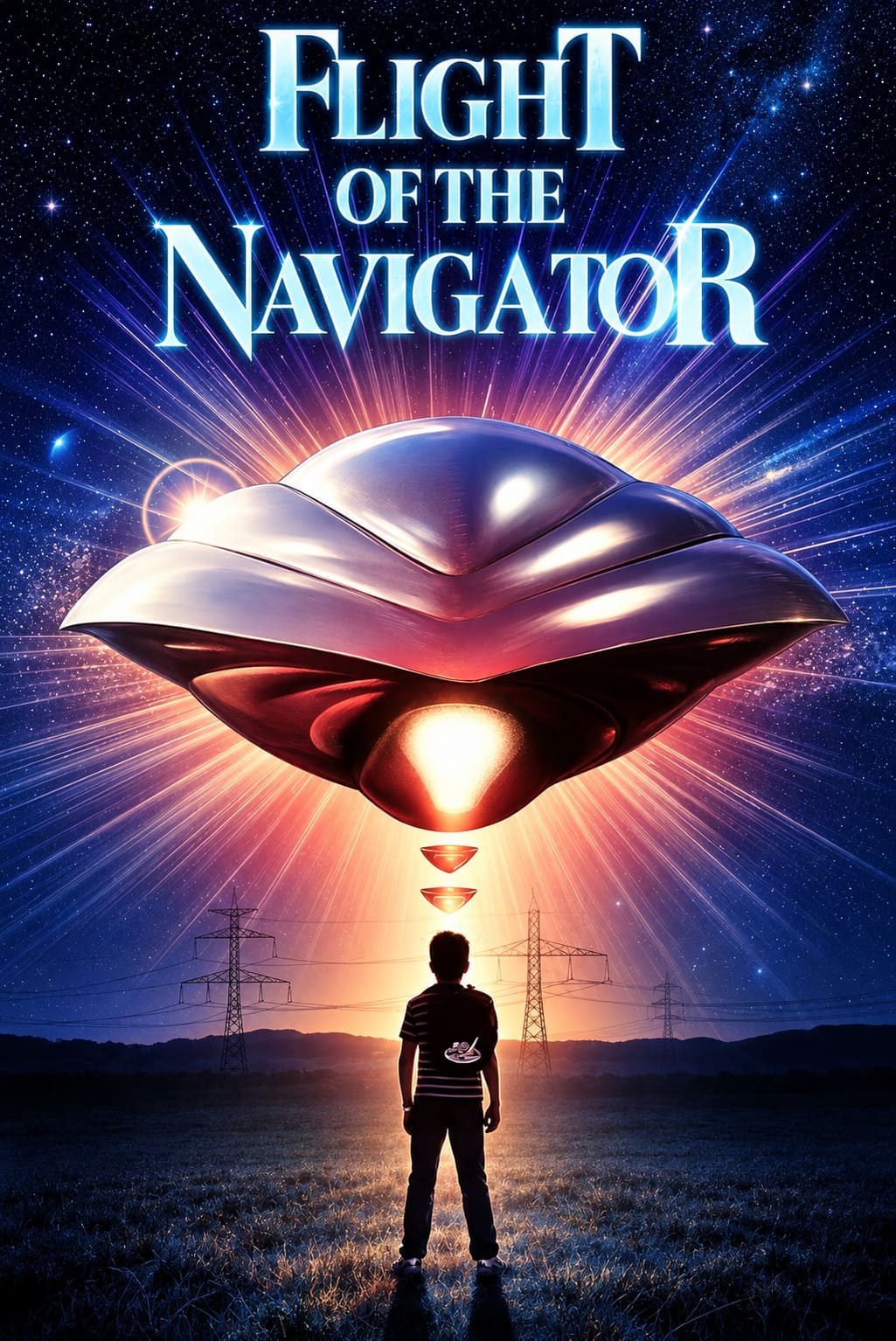
Flight of the Navigator turns a child’s worst possible homecoming into an unexpectedly funny, wistful, and imaginative science-fiction adventure. Released in 1986, it begins as a modest suburban mystery before expanding into a story about time displacement, missing years, alien technology, and the strange loneliness of returning home to a life that has moved on without you. It has the glossy, accessible surface of a Disney adventure, but there is a surprisingly melancholy idea at its center: what would it feel like to lose eight years of your life while everyone you love has had to live through them without you?
The movie follows David Freeman, a 12-year-old boy who disappears in 1978 after going into the woods to retrieve his younger brother Jeff. David wakes up in 1986, apparently having been gone only a few hours from his own point of view. The shock is immediate. His parents are older, Jeff is now his taller teenage brother, the family has moved, and David has become a long-unsolved missing-person case. This opening stretch is probably the film’s strongest material because it plays the scenario straight enough to make it genuinely unsettling. David is not simply a kid dropped into a flashy futuristic world; he is a child abruptly disconnected from the only reality he knows.
That emotional hook gives Flight of the Navigator more weight than many similar children’s adventures. David’s confusion is easy to understand, and the film wisely lets the situation breathe before revealing all of its science-fiction machinery. The sight of his family recognizing him after years of grief is touching, but it also comes with discomfort. David wants everything to return to normal, while his parents are overwhelmed by the impossible fact that their vanished son has returned unchanged. The movie does not dig into the full psychological consequences of that situation, because it is still fundamentally a family adventure, but it gives the idea enough attention to make the stakes feel personal.
Once NASA becomes involved, the story shifts into a more conventional but still entertaining sci-fi mode. Doctors discover that David has advanced knowledge in his brain that he cannot consciously explain, and the mystery leads him to a crashed alien spacecraft. The ship, known as the Trimaxion Drone Ship, is the movie’s most iconic element. Its smooth silver form, with no visible seams or conventional cockpit, still looks appealing because it has a simple, alien elegance. It is not overly busy or mechanical in the way many science-fiction vehicles are. Instead, it resembles a floating metallic organism, something sleek and strange that could plausibly have appeared in a child’s dream.
The ship’s computer, MAX, is what really gives the movie its personality. Voiced by Paul Reubens, MAX begins as a calm, efficient artificial intelligence but gradually becomes sillier and more mischievous after downloading human information from David’s era. Reubens’ performance is a major reason the character works. He does not simply do a recognizable Pee-wee Herman routine, although the playful vocal energy is certainly there. MAX’s changing voice and increasingly erratic sense of humor make him feel like an alien intelligence trying to imitate human behavior and getting it only partly right.
There is a fine line between amusing and annoying when a movie lets its comic sidekick become too hyperactive, and Flight of the Navigator occasionally crosses it. MAX can become a little much, especially during the later scenes where he starts cracking jokes, changing his vocal effects, and behaving like an overexcited child with access to interstellar technology. Still, that energy is part of what makes the film feel uniquely of its era. MAX is not as polished or emotionally sophisticated as later animated or CGI companions, but he remains memorable because he is odd. His humor feels less like a studio-tested collection of one-liners and more like a machine that has accidentally discovered cartoons, pop culture, and sarcasm all at once.
Joey Cramer carries much of the movie as David, and he gives the role more sincerity than the material sometimes requires. He is believable as a regular kid who becomes frightened, angry, curious, and eventually exhilarated by what is happening around him. David is not written as a perfect young hero. He can be stubborn and impulsive, especially when he decides he has to take control of his own situation, but that makes sense. Adults have spent much of the story examining him, restraining him, and treating him as a scientific puzzle. His decision to escape with MAX is reckless, yet it also feels like the response of a child who is desperate to reclaim some agency.
The film’s visual effects deserve credit for helping sell its larger ideas. By modern standards, the effects are obviously dated in places, particularly when the ship changes shape or moves at impossible speeds. Yet the movie uses its effects well enough that they remain charming rather than distracting. The morphing sequence in which the ship transforms into its sleeker form was especially impressive for the time, and even now it has an appealing practical-digital hybrid quality. It does not look completely real, but it looks imaginative. The ship has presence, and the movie understands the pleasure of simply watching it fly through clouds, skim across water, or streak through the night sky.
The electronic score by Alan Silvestri is another major part of the film’s identity. Silvestri is often associated with larger, more overtly heroic scores, especially in films such as Back to the Future, but his work here is more synthetic and futuristic. The music helps create a sense of wonder while also grounding the film in the mid-1980s. It can sound very much of its time, with prominent synthesizers and a clean electronic texture, but that is not a weakness. The score fits a movie about an ordinary kid encountering a cold, shiny, unknowable piece of advanced technology.
One of the better things about Flight of the Navigator is that it does not make its protagonist’s adventure entirely consequence-free. David gets to fly an alien ship, travel at incredible speeds, and encounter a universe beyond his suburban life. That is the wish-fulfillment element, and the film delivers it well. At the same time, the adventure exists because something has gone wrong in David’s life. His journey begins with loss. The movie never becomes as emotionally dark as its premise could allow, but it never completely forgets that David has been separated from his family and displaced in time.
The ending is satisfying because it returns the story to that emotional core. David’s ultimate choice is not just about whether he wants to keep flying around with MAX. It is about whether he can go home, even if home is no longer exactly what it was. The resolution is neat and arguably a little too convenient, but it earns its feel-good payoff. This is a family film, after all, and the movie knows that its audience wants the wonder of space travel without being left in despair over the time-travel implications.
In the end, Flight of the Navigator remains a warm, inventive, and slightly strange piece of 1980s science-fiction. It is not a perfect movie. Some of the comedy is broad, the adults at NASA are more functional than memorable, and the story occasionally rushes past ideas that could have been explored more deeply. But its central concept is strong, its spaceship is iconic, its score is distinctive, and its combination of melancholy and fun gives it more staying power than many nostalgia-driven family movies. It captures the feeling of being a kid who wants to escape into the unknown, while also recognizing that the people waiting at home are what make that escape matter.
“Journalism is just a gun. It’s only got one bullet in it, but if you aim right, that’s all you need. Aim it right, and you can blow a kneecap off the world.” — Spider Jerusalem
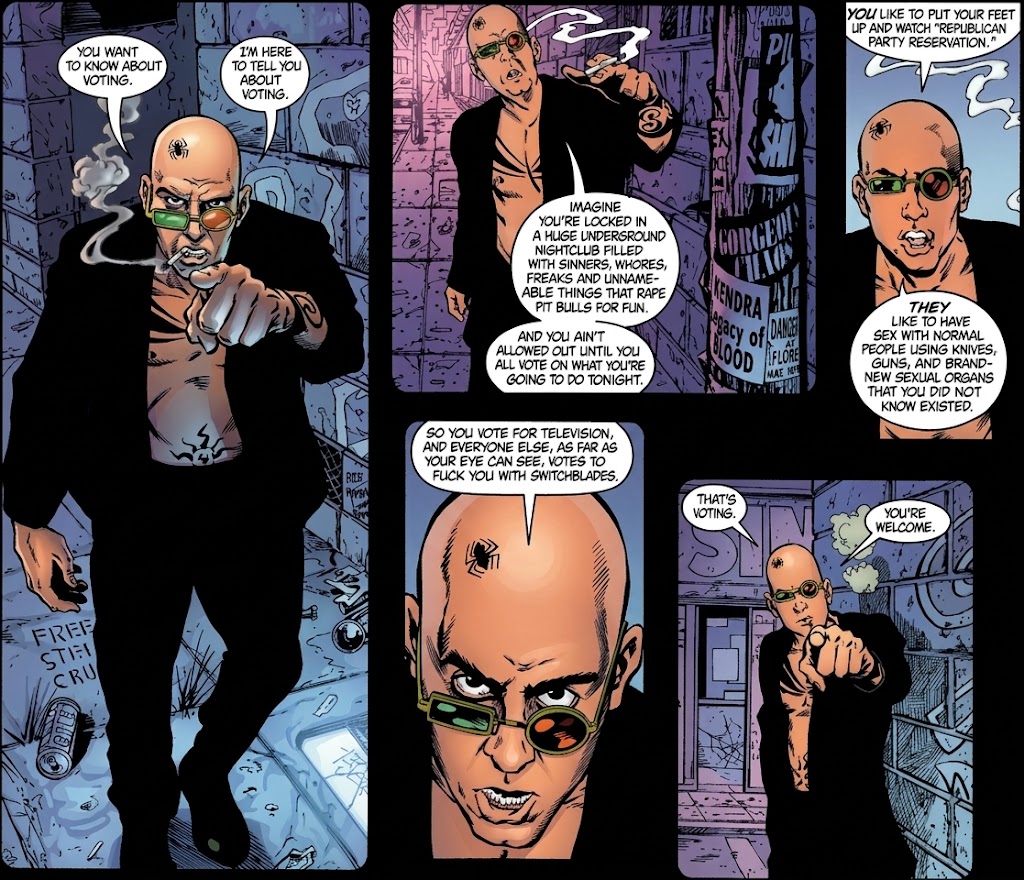
Transmetropolitan Vol. 3: Year of the Bastard is where Warren Ellis and Darick Robertson’s series fully locks into its political purpose. The earlier volumes establish the wild, filthy, hilarious, and relentlessly overstimulating future world of the City, while also introducing Spider Jerusalem as one of comics’ most aggressive and unconventional protagonists. This third collection gives that chaos a more direct target. Spider’s reporting increasingly centers on President Gary Callahan, known as “the Beast,” and the book becomes a sharper examination of political corruption, media manipulation, public apathy, and the ugly necessity of speaking truth to power.
Spider remains the main reason Transmetropolitan works as well as it does. He is not a conventionally likable hero, and the series has no interest in sanding down his worst edges. Spider is arrogant, filthy, confrontational, casually cruel, and frequently unbearable to everyone around him. He insults his assistants, attacks people with little warning, abuses his position as an employer, and seems to approach most conversations as though they are a competition he needs to win. His anger is not performative, though. Spider is furious because he sees how the City works, how easily people are exploited, and how often institutions that are meant to serve the public instead exist to preserve wealth, influence, and power.
That is what separates Spider from a standard rebellious antihero. He does not simply dislike authority because it tells him what to do. He hates authority when it becomes insulated from consequence. His journalism is not neutral in the shallow sense of pretending that every side of an issue deserves equal moral consideration. Spider believes that facts matter, that evidence matters, and that powerful people deserve aggressive scrutiny. He wants documents, interviews, proof, and a story solid enough to survive legal threats and political spin. But he also wants that story to make its target feel exposed. For Spider, journalism is both a public service and an act of combat.
Year of the Bastard makes that approach feel especially urgent through the arrival of Gary Callahan. The Beast is an amalgamation of all the worst traits associated with the fictional politician: narcissistic, shameless, opportunistic, cruel, dishonest, charismatic when it suits him, and utterly willing to use ordinary people as tools in his pursuit of power. He is the kind of leader who can speak in a language of public service while treating the public as disposable, who can turn fear into political currency, and who can rely on supporters to dismiss his most obvious sins as either necessary strength or a conspiracy against him.
Callahan is exaggerated in the way that much of Transmetropolitan is exaggerated, but that does not make him feel safely distant from reality. The series filters him through dystopian satire, giving him the monstrous nickname, the heightened rhetoric, and the almost grotesque confidence of a villain who believes consequences are for other people. Yet the deeper qualities behind him are painfully familiar. He thrives on division, contempt for truth, resentment, spectacle, and the belief that accountability is something to be attacked rather than accepted. In recent memory, that has only made the Beast feel more unsettling. Political figures with traits that once seemed too bluntly villainous for anything but fiction have repeatedly demonstrated how easily cruelty can be reframed as authenticity, dishonesty as strategy, and public anger as a route to power. The book’s details are futuristic and extreme, but its political instincts feel less like prediction than recognition.
Spider recognizes Callahan for what he is long before the system is ready to confront him. That is where the volume’s central conflict becomes stronger than a simple “reporter versus corrupt president” story. Spider is not just investigating a bad man; he is fighting the machinery that allows bad men to flourish. The City’s citizens are overwhelmed by media noise, consumer distractions, social trends, technological novelty, and the endless stream of minor scandals competing for their attention. In such an environment, truth can be buried not only by censorship but by excess. A revelation does not have to be disproven if it can simply be drowned beneath louder, stupider, more entertaining material.
The City continues to be one of the series’ best creations because it is more than a colorful science-fiction backdrop. It is a civilization that has commodified every aspect of life. Identity can be altered, sold, copied, upgraded, discarded, and turned into another lifestyle product. Entertainment is invasive and often grotesque. Technology has expanded human possibility without necessarily expanding human empathy. Politics has become entertainment as well, reduced to personality contests, public outrage, tribal loyalties, and marketable images. The City is often funny in a deliberately ridiculous way, but the humor always has a sour edge. Its people are not simply stupid targets for Spider’s contempt. They are citizens living under a system designed to exhaust their attention and turn their frustration into something profitable.
That context complicates Spider’s relationship to the public. He clearly cares about people, especially the people who are harmed by the City’s power structures, but he also finds people maddening. Spider’s rage at ignorance, conformity, and complacency can make him seem almost as contemptuous of the public as the politicians he despises. The difference is that Spider’s contempt is not rooted in a desire to dominate them. He wants them to wake up, pay attention, and demand better, even when he expresses that desire through insults, threats, and spectacularly unhealthy behavior. His empathy is real, but it is buried beneath layers of cynicism and hostility.
That is why Channon Yarrow and Yelena Rossini remain so important to the book. They keep Spider from becoming a purely self-contained force of rage. Channon often brings a more immediate human response to the stories they cover. She can be tough and sarcastic, but she has not completely absorbed Spider’s defensive habit of treating emotional vulnerability as weakness. Her presence highlights the people behind the headlines, which is essential in a series where the main character can sometimes become so consumed by the larger fight that he risks forgetting the individual lives at stake.
Yelena offers a different kind of balance. As Spider’s editor, she understands the importance of his work, but she also has to deal with the consequences of his methods. She recognizes his talent and his instincts, while refusing to indulge every destructive impulse as if it were a sign of genius. Their relationship is built on tension, professional respect, and mutual exasperation. Yelena knows that Spider can find the story nobody else wants to touch, but she also knows that his self-destructive behavior can jeopardize the very work he believes in. She is one of the few people capable of treating him as both an indispensable journalist and a deeply difficult human being.
The visual side of Year of the Bastard remains a major strength. Darick Robertson makes the City feel constantly alive, crowded, unpleasant, and funny in equal measure. Every street scene suggests a thousand strange subcultures, consumer products, body modifications, and private disasters unfolding at once. Robertson’s detail is not merely there to make the book look weird. It reinforces the idea that this is a society drowning in visual information. The City is so busy that horror can pass as background decoration, and the reader has to look closely to notice what its inhabitants have learned to ignore.
Robertson’s Spider is equally effective. The sunglasses, tattoos, bald head, cigarettes, and permanent scowl make him immediately recognizable, but the art also captures how tired he is. Spider does not look like a sleek futuristic revolutionary. He looks worn down, unhealthy, and held together by stimulants, spite, and a professional obligation he cannot escape. That physical exhaustion matters because it keeps him from becoming an invulnerable fantasy figure. For all his bravado, Spider is a man who is being consumed by the same world he is trying to expose.
The volume still carries the abrasive humor and deliberately offensive energy that define Transmetropolitan, and that will remain a dividing line for readers. Ellis often pushes jokes, imagery, and dialogue to extremes. Sometimes that excess adds to the punk-rock force of the series, making the City feel like a place where every cultural impulse has been turned up beyond the point of sanity. At other times, the shock-heavy approach can feel like it is fighting for attention with the book’s more serious political and emotional material. Even so, Year of the Bastard benefits from its willingness to be ugly. A story about corruption, exploitation, and media spectacle would lose something if it presented its world too cleanly.
Ultimately, Transmetropolitan Vol. 3: Year of the Bastard is a strong escalation of the series because it gives Spider Jerusalem a political enemy worthy of his fury. The Beast represents the worst kind of public figure: someone who turns cruelty into strength, dishonesty into strategy, and division into a campaign platform. Spider, for all his cruelty and instability, becomes compelling because he refuses to accept that kind of power as normal. He may be an awful boss, a reckless friend, and a man whose personal life is largely a disaster, but he understands that journalism has to do more than politely record the world’s failures. Sometimes it has to expose the bastards responsible for them.
Jesper Kyd’s Immortal Imperium is one of those tracks that immediately tells you exactly where you are: deep in the grim, overbuilt nightmare of Warhammer 40,000. It has that massive, oppressive scale the setting needs, but it never settles for sounding like generic sci-fi battle music. The heavy electronic pulse, ominous choir work, and mechanical textures make it feel like a hymn being blasted through the speakers of a hive city while factories churn, alarms scream, and thousands of people march toward jobs or wars they probably will not survive.
What makes the piece work so well is how naturally it channels 40K’s particular brand of gothic industrial opera. The choirs bring in the religious side of the Imperium, with all its worship, ceremony, and Emperor-centered fanaticism, while the synths and pounding rhythms supply the cold machinery beneath it all. It sounds sacred, but in an intimidating and almost inhuman way. You can picture enormous cathedral walls covered in smoke, servitors working beneath statues of saints, and the constant hum of ancient systems that nobody fully understands anymore.
Kyd also captures the fact that the Imperium is supposed to be impressive and horrifying at the same time. Immortal Imperium has real grandeur to it; the music makes the setting feel enormous, ancient, and powerful. But there is no clean sense of triumph in it. The momentum feels more like an endless machine pushing forward, powered by fear, faith, violence, and habit. That is very much the Darktide version of 40K: humanity is still standing, technically, but it is surviving inside a decaying system that treats every person as another disposable part.
As a soundtrack piece, Immortal Imperium does a great job of making Tertium feel bigger than the missions themselves. Even when the player is just fighting through corridors, sewage systems, transit stations, or ruined manufactorums, this kind of music reminds you that those spaces are part of a colossal and uncaring empire. It is dramatic, grimy, religious, mechanical, and weirdly beautiful—the exact mix that makes Warhammer 40,000 such a distinctive universe.
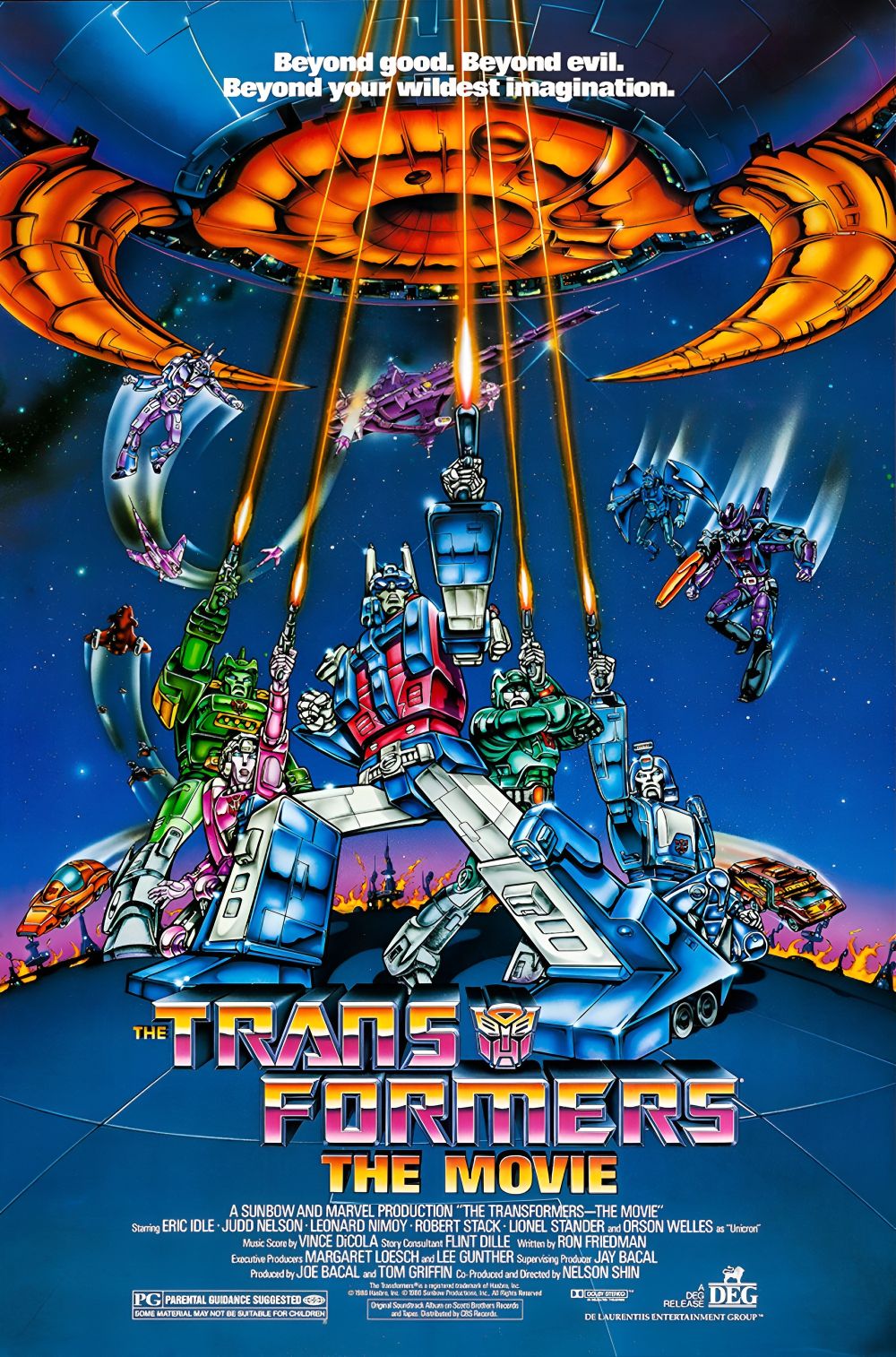
The Transformers: The Movie from 1986 was a must-see for me as a 13-year-old boy, but the anticipation of watching it and the actual experience were two entirely different things. The former was filled with excitement, the kind that comes from counting down the days until you finally get to see your favorite characters on the big screen. The latter, however, was something else entirely—a scarring moment that taught me, in the final year before entering high school, that not even afternoon cartoon characters were exempt from onscreen deaths. It was a harsh lesson in the unpredictability of storytelling, and it left an impression that has lasted a lifetime. And I wasn’t alone. The film shocked and scarred millions of children who flocked to theaters or gathered around their VHS players, expecting their beloved Transformers cartoon to simply be bigger and louder on the big screen. Instead, they were met with the brutal, unforgiving reality of watching their favorite characters die in battle, one after another.
The film was released during the height of Transformers mania in the mid-1980s, a time when the toy aisle was dominated by Hasbro’s robotic heroes and villains. But here’s the thing: The Transformers: The Movie wasn’t just about selling toys—it was about replacing them. Hasbro had a new line of Transformers ready to hit the shelves, and the movie served as a way to phase out the older generation of characters. The result? A shockingly brutal narrative that saw many fan-favorite characters meet their end in ways that were far removed from the relatively tame Transformers TV series. This wasn’t just a Saturday morning cartoon stretched to feature length; it was a full-blown sci-fi epic with stakes that felt real, and consequences that were permanent. For kids like me, who grew up watching the TV show, the film was a jarring wake-up call. The deaths of major characters like Ironhide, Prowl, and even Optimus Prime himself were not just unexpected—they were traumatic. It’s no exaggeration to say that The Transformers: The Movie left an entire generation of children with lasting emotional scars, all because it refused to sugarcoat the cost of war.
And yet, that’s exactly why it worked. The film’s willingness to go dark and take risks is what set it apart from so much of the animated fare of the era. The story picks up in the year 2005, with the Autobots and Decepticons still locked in their eternal struggle. The Decepticons, led by the ever-scheming Megatron, launch a full-scale assault on Autobot City on Earth, and the battle that follows is one of the most intense and visually stunning sequences in the film. The animation, while a product of its time, holds up surprisingly well, with vibrant colors and dynamic action that still feels exciting today. But what really sticks with you is the emotional weight of the story. The film doesn’t shy away from showing the cost of war, and the loss of life—even for animated robots—feels genuine. It’s a far cry from the often lighthearted and episodic nature of the TV series, and that contrast is part of what makes the movie so memorable.
At the heart of the film’s emotional impact is Peter Cullen’s iconic performance as Optimus Prime. Cullen’s voice work in the Transformers TV series had already made Optimus Prime a beloved figure, but in the movie, his role takes on an even greater significance. Though his screen time is brief, Cullen’s delivery of Optimus’s final words—“Until that day, ‘till all are one”—is nothing short of legendary. It’s a moment that has been etched into the minds of fans for decades, a testament to Cullen’s ability to convey both strength and vulnerability in a single line. Even now, nearly 40 years later, that scene remains one of the most powerful in the entire Transformers franchise. Cullen’s work helped elevate Optimus Prime from a toy commercial mascot to a genuine hero, and his influence can still be felt in every iteration of the character that has followed.
The film’s legacy is a fascinating study in how a movie can transcend its origins. On paper, The Transformers: The Movie was a 90-minute commercial designed to sell a new wave of toys. But in practice, it became something much more. The bold storytelling choices, the emotional depth, and the sheer audacity of killing off major characters in a children’s animated film ensured that it would be remembered long after the toys it was promoting had been forgotten. For the kids who saw it in theaters or on VHS, the film was often their first exposure to the idea that stories could have real consequences, and that heroes didn’t always make it out alive. It was a formative experience, one that left a lasting impression and helped shape the way a generation of fans engaged with media.
Of course, the film isn’t without its flaws. The pacing can feel uneven at times, and some of the new characters introduced in the movie—like the Dinobots and the Junkions—don’t get as much development as they deserve. The humor, while present, sometimes feels out of place amidst the darker tones of the story. But these quibbles do little to detract from the overall impact of the film. The Transformers: The Movie is a product of its time, but it’s also timeless in the way it handles its themes of sacrifice, leadership, and the cost of war. It’s a film that refuses to be pigeonholed as just a kids’ movie, and that’s part of its enduring appeal.
Today, The Transformers: The Movie holds a special place in the hearts of those who grew up with it. It’s a cult classic, a film that’s celebrated as much for its flaws as for its strengths. For many adults, revisiting the movie is like opening a time capsule, a chance to reconnect with the wide-eyed child they once were, the one who sat in front of the TV or the big screen, completely unprepared for the emotional rollercoaster they were about to experience. The film’s legacy is a testament to the power of storytelling, and to the idea that even something as seemingly commercial as a toy-based animated movie can leave a lasting impact. Whether you’re a lifelong Transformers fan or just someone who appreciates a good underdog story, The Transformers: The Movie is a film that’s well worth revisiting. Just be prepared for a few emotional gut punches along the way.
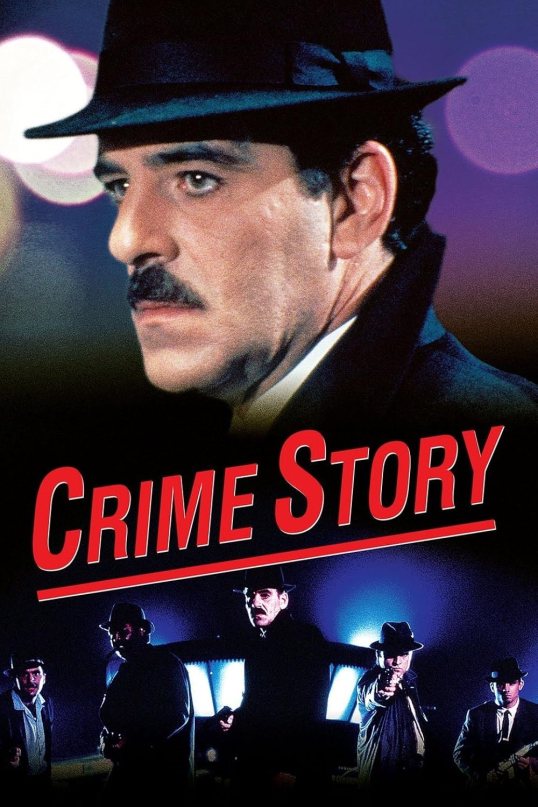
Welcome to Retro Television Reviews, a feature where we review some of our favorite and least favorite shows of the past! On Mondays, I will be reviewing Crime Story, which ran on NBC from 1986 to 1988. The entire show can be found on Tubi!
This week, the show changes locations. We’re going to Vegas and we’re getting new opening credits!
Episode 1.16 “The Kingdom of Money”
(Dir by James A. Contner, originally aired on January 30th, 1987)
Welcome to Las Vegas!
Ray Luca is very happy to be in Vegas. Along with Max Goldman, Pauli, and Steve Kordo (Jay O. Sanders), Ray has taken over a casino and is pushing his way into the local rackets. He gives a speech to the casino’s employees, telling them that from now on everything in the casino will be run honestly and that anyone who steals any money will be fired. He then has a meeting with Max in which they discuss all the ways to skim the profits.
Luca’s wife, Cori (Johann Carlo), isn’t happy about the move. She misses Chicago, so instead of hanging out around the house, Luca goes out and hires a prostitute named Jackie (Debra Feuer). Luca tells Jackie that she will be working exclusively for him from now on. Jackie points out that she already has a “manager.” Luca smirks.
The only problem for Luca is that Mike Torello is in Vegas, and now he’s working for the Justice Department. Luca and his team are headquartered in a small Vegas motel. When David Abrams sees that someone has brought a bowl of Justice Department matchbooks into the motel, he tells Torello’s men to throw them out. “We’re not a recruiting station,” Abrams says.
Torello decides that the best way to get Luca is to go after one of Luca’s Vegas associates, a loan shark named Al (Mike Starr). They visit a diner owner (Graham Beckel) who owes Al money. They convince him to call Al and say that he has Al’s money. When Al comes to collect, Torello will arrest him. Sound like a good plan, right?
Unfortunately, someone is dumb enough to leave behind the bowl of Justice Department matchbooks in the diner. Additionally, it doesn’t occur to Torello to have someone watching the diner 24/7. When Al shows up early and discovers the matchbooks, he guns down not only the owner of the diner but also his wife and 5-year-old son.
Torello’s angry. Well, Torello should be angry. He should also be feeling guilty, seeing as how he and his men basically got the diner owner killed through their own incompetence. Torello decides to go undercover as someone who needs a loan. He and his men even set up a fake strip club where Torello and Al can meet to discuss the terms of the loan. Torello’s attempt to arrest Al falls apart when one of Al’s men pulls a gun and starts firing. Danny takes a bullet in the arm before killing the gunman. As for Al, he runs through the streets of Vegas before Torello guns him down.
Abrams looks down at Al’s body and says that he doesn’t think Al is going to be testifying.
This was a good episode. If the previous Chicago-based episodes emphasized the professionalism of Torello and the impulsivity of Luca, the roles are reversed in Vegas. Luca is in his element, and Torello and his men are the ones who are now having to adjust to a new city. If the previous Chicago-based episodes tended to be cold and gray, this Vegas episode is visually defined by neon and excess. The sallow, grim-faced Torello looks out of place here. This is Luca’s world.
I’m looking forward to seeing how the rest of season one plays out.
“If the people we love are stolen from us, the way to have them live on is to never stop loving them. Buildings burn, people die, but real love is forever.” — Sarah Mohr
The Crow is one of those films whose reputation has become inseparable from the tragedy surrounding it, yet reducing it to that tragedy misses why it has endured so powerfully. Alex Proyas’s 1994 adaptation of James O’Barr’s graphic novel is a revenge story, a gothic romance, a comic-book nightmare, and an MTV-era industrial-rock mood piece fused into something singular. It is not flawless, and its storytelling is often more archetypal than psychologically deep, but that directness helps its emotional force. The movie does not ask viewers to untangle a complicated moral puzzle. It asks them to feel the enormity of a love violently interrupted, and then to watch that grief return from the grave with black feathers, white face paint, and a very personal sense of justice.
The premise is almost mythically simple. On the night before their wedding, musician Eric Draven and his fiancée Shelly Webster are murdered by a gang of thugs who break into their Detroit apartment. A year later, on Devil’s Night—the annual pre-Halloween ritual of fires and chaos that hangs over the film’s ruined cityscape—Eric rises from his grave, guided by a crow, to hunt down every person responsible. The classic revenge-movie structure is there: identify the killers, stalk them, punish them, move closer to the figure at the top. But The Crow distinguishes itself by making revenge feel less like triumphant macho fantasy and more like an extension of mourning. Eric does not become a cool killer because pain has made him stronger. He becomes an avenging specter because he cannot accept a world in which Shelly’s final moments are left unanswered.
Proyas directs the film like a fever dream built from wet asphalt, broken glass, empty tenements, and perpetual night. The Detroit of The Crow barely operates as a realistic city, but realism is not the point. It is an expressionist landscape, a metropolis that seems permanently trapped between a crime scene and a graveyard. The production design gives the movie its extraordinary visual identity: towering shadows, alleyways lit by flame, apartments that look like mausoleums, and a skyline that appears to have been abandoned by daylight itself. This is Gothic cinema filtered through comic-book panels, German Expressionism, punk fashion, and the darkly romantic visual language of early-1990s alternative music videos. It has been imitated constantly, sometimes lovingly and sometimes clumsily, but the original still feels unusually tactile. The grime, rain, fire, and shattered architecture have physical weight.
That sense of atmosphere is helped enormously by the soundtrack, which operates as more than a collection of era-specific needle drops. Songs by The Cure, Nine Inch Nails, Stone Temple Pilots, Pantera, and others create a sonic environment around Eric’s grief. The music gives the movie a pulse that is melancholy, furious, and seductive all at once. For many viewers, The Crow became a gateway text for a specific kind of 1990s gothic-alt identity: black clothing, industrial textures, romantic despair, and the conviction that heartbreak could be transformed into style without becoming trivial. Its aesthetic influence is obvious, but it worked because it was attached to an actual emotional core rather than simply a pile of cool images.
Brandon Lee is the center of that emotional core. His Eric Draven is handsome and charismatic, obviously, but the performance’s real strength lies in its shifts of tone. Lee can play Eric as tender and playful in the brief memories of his life with Shelly, then turn him into a creature of eerie stillness and explosive violence. He delivers some of the film’s most famous lines with a theatrical flair that could have become silly in another actor’s hands, but he never entirely loses the sense that Eric is broken underneath the black leather and corpse-like makeup. When he says, “It can’t rain all the time,” it does not land merely as a quotable gothic slogan. It is a declaration of faith from someone trying to recover one small piece of warmth from an overwhelmingly cruel world.
Lee’s death during production makes that performance almost unbearably charged. He was accidentally shot on set during the filming of a scene involving a prop firearm and died at age 28. The production had to regroup, rewrite and restructure parts of the film, and use a combination of body doubles, careful editing, visual effects, and previously filmed material to complete Eric’s story. That practical disruption is visible only in limited ways in the finished product; remarkably, The Crow generally feels cohesive rather than patched together. Still, the tragedy affected more than the logistics of production. It fundamentally changed the public’s relationship to the film. Eric’s resurrection, his grief over a stolen future, and the repeated imagery of a dead young man returning to finish unfinished business all acquired a terrible real-world resonance.
That connection could easily have overwhelmed the movie, turning it into a morbid curiosity. Instead, it made the film feel elegiac. Audiences did not merely see a fictional tragic hero; they saw Lee’s final completed role, an image of an actor whose life had ended before the public had a chance to see where his career might go. The contrast is particularly painful because Lee’s work here suggests enormous range and movie-star potential. He is not just doing martial-arts action or inheriting the legacy of his father, Bruce Lee. He is creating an icon of romantic anguish and dark humor. The public reception of The Crow therefore carried an unusual mixture of admiration, grief, and protectiveness. Its cult status was built partly on its style, soundtrack, and comic-book mythology, but also on the feeling that viewers were witnessing a final gift from an artist taken much too soon.
The supporting cast gives the film much of its flavor, especially because Proyas treats its villains as grotesque figures in a corrupted fairy tale. David Patrick Kelly’s T-Bird is nervy and cruel, Michael Massee’s Funboy has a sleazy unpredictability, and Angel David’s Skank brings a wild, cartoonish energy to the gang. Rochelle Davis, playing Sarah, provides something vital in the opposite direction. She is not merely a child sidekick; she represents the lingering human connection between Eric’s former life and his revenant existence. Her scenes with Eric remind us that he is not simply a supernatural executioner. He is still someone capable of care, humor, and memory.
But Michael Wincott’s Top Dollar is the film’s true villainous masterstroke. Wincott has one of cinema’s most instantly recognizable voices: smoky, velvety, sardonic, and faintly predatory. As Top Dollar, he makes every line sound like it has been exhaled through cigarette smoke in a cathedral. He is not a conventional crime boss in the realistic, procedural sense. He is a decadent king of the city’s underworld, a man who appears to have converted criminal power into a private religion of violence, ritual, and spectacle. His lair, his manner, and his relationship with his half-sister Myca all push him beyond ordinary gangster territory into something operatic and mythic.
What makes Wincott mesmerizing is that he does not overplay Top Dollar’s eccentricities. The character has plenty of theatrical material to work with—occult touches, ominous speeches, a penthouse filled with weaponry and strange décor—but Wincott approaches him with a serene confidence. He rarely seems rushed or rattled, even as Eric systematically destroys his organization. That calm makes him more intimidating. Top Dollar understands the city as a machine of corruption, and he sees himself as the person with his hands on the controls. Wincott’s performance gives the villain intelligence, sensuality, and a distinctly sinister elegance. He is evil, certainly, but he is never bland. In a movie full of striking images, his voice alone becomes part of the visual texture.
The action in The Crow is effective precisely because it avoids pretending that Eric’s vengeance is a balanced fight. For much of the movie, he is invulnerable, and the violence plays like supernatural punishment. The standout set pieces—Eric’s assault on the gang’s hideout, his confrontation with T-Bird, and the final tower sequence—have the heightened, almost ritualistic quality of comic-book action rather than the grounded impact of a crime thriller. That can make some of the antagonists feel less like people than targets, but again, the film is working in the language of myth. Eric is a ghost walking through the consequences of someone else’s cruelty.
If The Crow has a weakness, it is that the love story depends heavily on fragments. Shelly is more an emotional presence than a fully developed character, preserved in Eric’s memories as warmth, laughter, music, and suffering. Yet the film understands that grief often works that way. We do not always remember a person as a complete biography when they are gone; sometimes we cling to specific gestures, rooms, jokes, songs, and images. The flashes of Eric and Shelly together are deliberately idealized because they are being recalled by a man who has lost everything. The movie’s romanticism may be blunt, but it is sincere.
More than three decades later, The Crow still works because it is a film of conviction. It believes in the visual poetry of rain and ruins, in the melodrama of eternal love, in the power of a memorable face framed in black-and-white makeup, and in the possibility that a soundtrack can become part of a movie’s mythology. Brandon Lee’s death will always remain a heartbreaking part of its history, and it is impossible to watch the film without feeling that absence hovering around it. But The Crow is not remembered simply because of what happened behind the scenes. It is remembered because Proyas, Lee, Wincott, and the rest of the cast made a pulpy revenge tale feel like a dark romantic elegy—one that still takes flight every time the crow returns to the skyline.
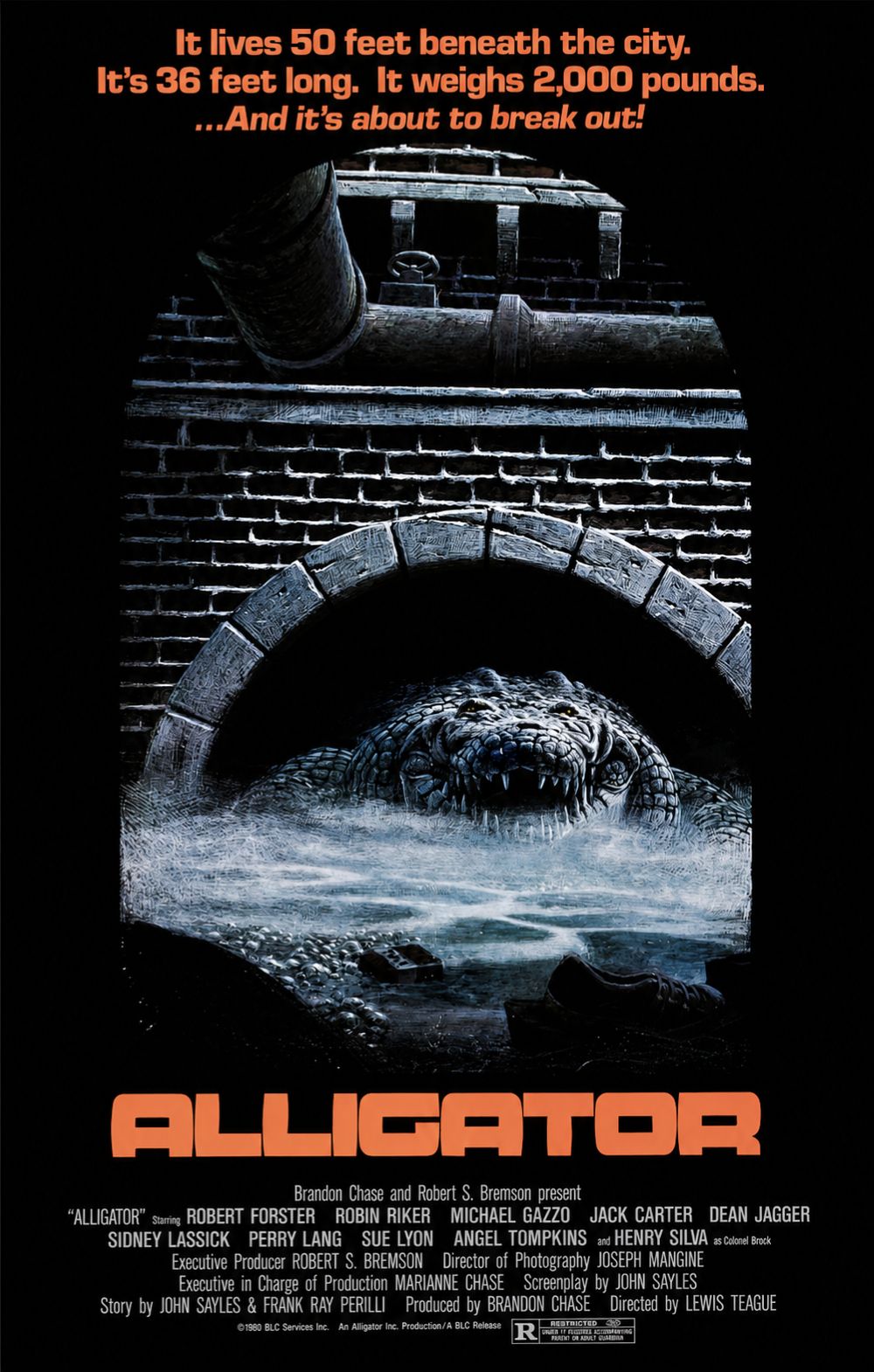
Lewis Teague’s Alligator is exactly the sort of movie that sounds like a bad joke until you sit down with it and realize it is having a much better time than most “serious” creature features. The premise is pure drive-in delirium: a baby alligator is flushed down a toilet, survives in the sewer system beneath St. Louis, Missouri, feeds on discarded laboratory animals pumped full of experimental growth hormones, and eventually becomes a gigantic, people-eating urban nightmare. It is absurd from the start, but that absurdity is the movie’s best asset. Alligator is not a good film in the polished, tightly controlled sense. It is too clunky, too broad, and too openly ridiculous for that. But it is never boring, and it understands that a movie about a giant alligator stalking the sewer tunnels under St. Louis should be grimy, nasty, funny, and just a little bit stupid.
The film arrives in that sweet spot between the straightforward animal-attack movies of the 1970s and the increasingly self-aware horror comedies of the 1980s. It has some of the structure of a Jaws knockoff, of course: authorities dismiss warnings, a difficult investigator takes the danger seriously, and a creature grows into an outsized public threat before the final confrontation. But Alligator does not have the resources, atmosphere, or aquatic terror of Spielberg’s film, and to its credit, it does not really pretend to. Instead, it leans into the cheapness of its materials. The alligator is mostly an oversized practical effect, sometimes convincing enough to be threatening and sometimes looking like the kind of thing that should be knocking over miniature buildings in a 1950s monster movie. The difference is that Teague knows how to frame the thing. He keeps the creature partly hidden when that helps, lets the sewer setting do much of the atmospheric heavy lifting, and saves the full ridiculousness of the monster for when ridiculousness is exactly what the audience wants.
There is an immediately appealing trashy logic to the story. The alligator is not simply an animal that wandered into the wrong place; it is a product of environmental carelessness, corporate experimentation, and the city’s tendency to throw its problems underground. The movie opens with a young girl’s pet alligator being flushed away after it bites someone, a cruelly comic act that functions as the film’s entire moral universe in miniature. Humans dispose of an inconvenient creature, neglect the consequences, and then act shocked when the creature becomes a gigantic murderous problem. The idea is broadly ecological and vaguely anti-corporate, but Alligator never becomes preachy. It keeps those elements in the background as an excuse for gore, sewer crawling, and a steadily escalating body count.
Robert Forster plays David Madison, a St. Louis cop with the permanently tired demeanor of someone who has been forced to listen to too many witnesses describe impossible things. Forster is a major reason the movie works as well as it does. He does not play the material like a joke, but he also does not strain to elevate it into prestige horror. His performance is dry, irritated, and completely appropriate for a man investigating missing-person cases that increasingly point toward a subterranean reptile large enough to eat a car. Madison is not a particularly complicated protagonist, but Forster gives him enough weary professionalism that the audience can follow him through the nonsense. His deadpan approach also makes the film funnier without turning it into outright parody.
The supporting cast is a strange, entertaining mixture of familiar character-actor energy and exploitation-movie weirdness. Robin Riker plays Marisa, a reptile expert and Madison’s eventual love interest, and she is better than the role strictly requires. She has a brisk, practical presence, which is useful in a movie where most characters either refuse to believe the obvious or exist to become alligator food. The romance between her and Madison is thin, but it is handled with enough low-key charm that it does not stop the movie cold. It feels like a necessary B-movie ingredient rather than a desperate attempt to convince viewers that they are watching something emotionally profound.
Then there is Henry Silva. Honestly, the presence of Henry Silva alone tells you what kind of movie Alligator is trying to be. Silva plays Colonel Brockman, a professional hunter hired by the evil pharmaceutical company to find and kill Ramon, the giant gator created by its illegal growth-hormone dumping. He is not the mastermind behind the scientific mess; he is the company’s hired cleanup crew, brought in once the whole operation has become too big and too toothy to bury. Silva approaches the role with exactly the degree of swaggering, oily menace it needs. He is here to be Henry Silva in a monster movie, which means glaring, sneering, and acting as though the chance to hunt a massive sewer reptile is simply another profitable afternoon at work. Every time he shows up, the movie gets a little more fun.
The screenplay comes from John Sayles, which is almost comically overqualified on paper, though it makes more sense once the dialogue starts landing. Sayles gives the movie flashes of wit and an edge of social satire that keep it from being totally disposable. There are jokes about cops, politicians, wealthy elites, and corporate corruption, and while none of them are especially subtle, they have the right bite for a film this grubby. The story’s best satirical impulse is its refusal to make the rich and powerful merely unlucky victims of the monster. The alligator’s rampage eventually collides with a wealthy social gathering, and the movie takes obvious pleasure in turning a fancy event into a feeding ground. It is not exactly The Texas Chain Saw Massacre in its class consciousness, but it does understand that watching an enormous reptile crash through the polished facade of upper-class respectability is satisfying.
Teague directs with the workmanlike confidence of someone who knows that the material only needs to get from one entertaining set piece to another. The sewer scenes are the film’s strongest visual material. They are damp, shadowy, cluttered, and full of the sort of industrial grime that exploitation cinema loves. The setting is inherently creepy because it is both unreal and plausible: everyone knows a city like St. Louis has tunnels, pipes, forgotten chambers, and places where things can disappear, even if nobody really believes a giant alligator lives down there. The movie uses that unease effectively. When characters descend into the darkness, the tension is simple but real. You know something huge is moving nearby, and you know the special effects are not going to hold up to close inspection, but the atmosphere carries you through.
The attacks are uneven, but that is part of the charm. Some are genuinely nasty, particularly when the movie lets the creature strike suddenly from the shadows. Others are so exaggerated that they become funny in ways the filmmakers likely anticipated. There is a particularly memorable moment involving a child and a swimming pool that has the gleefully tasteless punch of old-school grindhouse horror. Alligator is never as graphic as the nastier exploitation films of its era, but it has enough blood, torn bodies, and monstrous chomping to satisfy an audience looking for low-rent carnage. It knows the basic rule of this kind of movie: if you are going to ask viewers to accept a mutant sewer alligator, you had better let it eat some people.
What makes Alligator last beyond its premise is that it does not seem embarrassed by what it is. There are many creature features that feel apologetic, as if the filmmakers know they are making junk and are waiting for the audience to laugh at them. Teague’s film is junk, absolutely, but it is crafted junk. It has actual pacing, committed actors, useful atmosphere, and a screenplay that occasionally has more on its mind than the average monster-on-the-loose picture. It is bad enough that its flaws become part of the entertainment, especially whenever the huge reptile lumbers into view or the plot makes a leap that only makes sense if nobody involved pauses to think for ten seconds. Yet it is not so bad that it becomes a chore. That is the crucial distinction.
By the time Alligator reaches its climax, it has delivered nearly everything its title promises: sewers, corrupt businessmen, cops with guns, practical monster effects, socialites getting their comeuppance, and Henry Silva looking like he would gladly accept a corporate paycheck to hunt an enormous mutant reptile. It is the kind of film best watched with an appreciation for grime, excess, and the noble tradition of exploitation cinema turning a ridiculous idea into a perfectly decent Saturday-night monster movie. Alligator will not make anyone forget the great creature features, but it earns its place as a scrappy, trashy, oddly lovable B-movie. It is not awful. It is not even truly bad. It is just delightfully cheap, mean, and goofy enough to remind you why bad movies can sometimes be more fun than good ones.
The Wisconsin primary will go down in history. As much as I disagree with Frances Hong on the issues, I felt a bit sorry for her. There was a time when it was very trendy to claim to be mentally ill on social media. I think a lot of people are going to run into the same problem that she ran into when they try to run for office.
Kitchen Nightmares (Disney Plus)
I watched the two latest episodes. I am amazed that anyone would allow their business to appear on this show. Personally, I am never going to eat again.
Survivor 50 (Wednesday Night, CBS)
That 90-minute run time is going to be the death of Survivor. Every episode feels so dragged out now.
Top of the Pops (YouTube)
I watched two episodes from the 80s on Saturday morning It featured some of the least danceable music that I’ve ever heard.