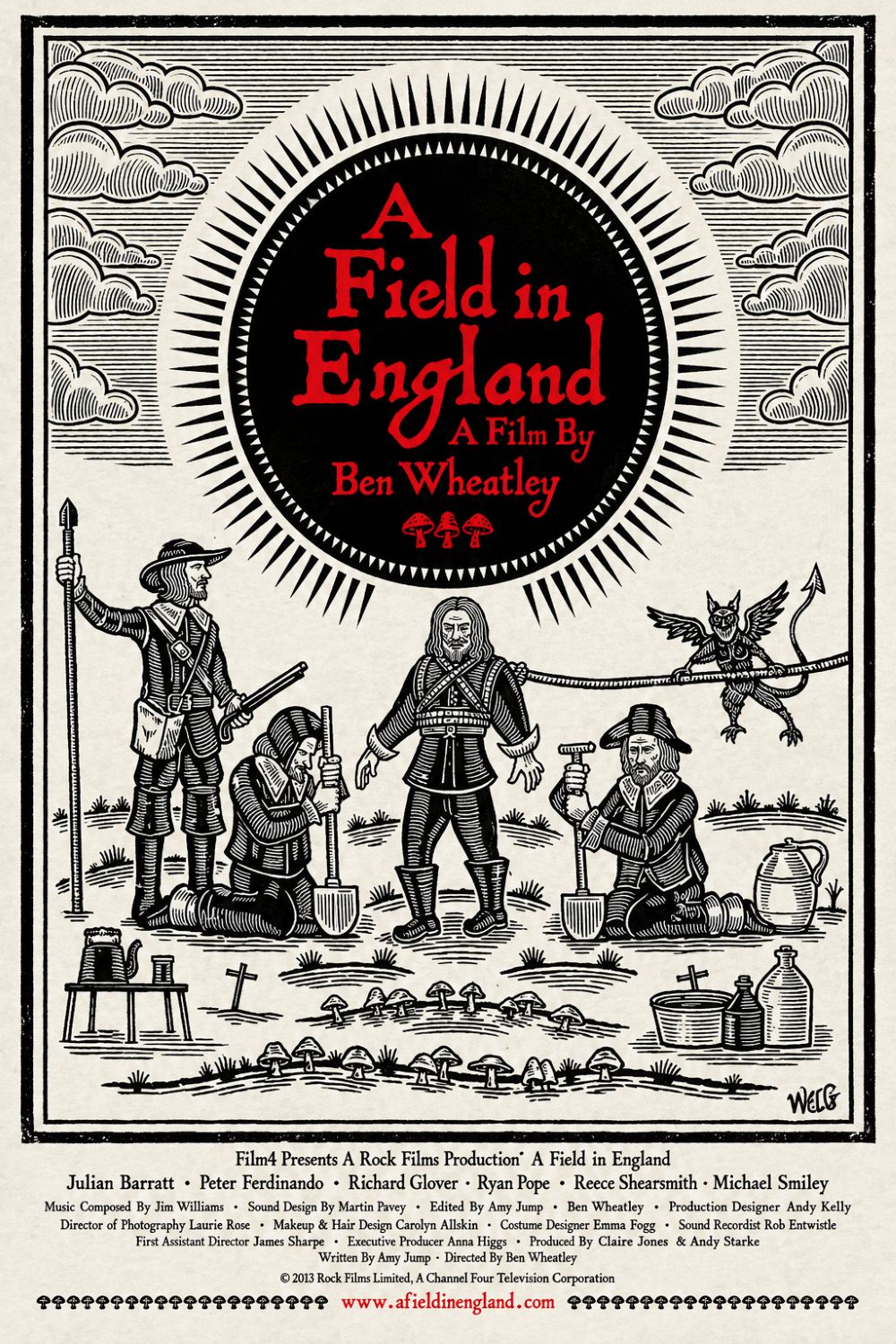
Horror Film Review: A Field in England (dir. by Ben Wheatley)


“It does not surprise me that the Devil is an Irishman. Though I thought perhaps he might be a bit taller.” — Friend

There is something deeply unsettling about a horror film that takes place almost entirely in broad daylight, and A Field in England uses that unease to devastating effect. Ben Wheatley’s 2014 release is a black-and-white nightmare about deserters, mushrooms, occult power, buried treasure, and men slowly losing whatever grip they had on reality. It is cryptic, abrasive, occasionally funny, deliberately repetitive, and sometimes so visually and sonically intense that it feels less like watching a film than being trapped inside a bad trip with several deeply unpleasant Englishmen.

Set during the English Civil War, A Field in England begins with Whitehead, played by Reece Shearsmith, fleeing an unseen battle. He is an educated man and an apprentice to an alchemist, although he is not particularly brave, heroic, or prepared for the chaos around him. Whitehead soon falls in with a small group of deserters: the blunt Cutler, the nervous Friend, and the worldly Trower. Their immediate goal is basic survival. They want food, ale, somewhere safe to rest, and preferably no more involvement in the war. Naturally, things do not work out that way.

The group crosses an enormous field and encounters O’Neill, played with unnerving authority by Michael Smiley. O’Neill is an alchemist, a manipulator, and possibly something more supernatural. He claims there is treasure buried in the field and forces the men into helping him dig for it. From there, the story gets progressively stranger, particularly after the men consume mushrooms that may or may not be supernatural in origin. The film’s central question is never simply whether the characters are hallucinating. Wheatley keeps pushing the viewer toward a more uncomfortable possibility: what if the hallucinations are revealing something real?

That ambiguity is the movie’s greatest strength and its biggest obstacle. A Field in England gives the audience fragments rather than firm answers. There are references to stolen papers, alchemical knowledge, magical control, a rival master, buried riches, and rituals that may have been going on long before these men stumbled into the field. But Wheatley and screenwriter Amy Jump never stop to explain the rules. The field seems both ordinary and impossible. It is a place where history, warfare, class resentment, religious anxiety, superstition, and psychedelic terror all collapse into one ugly patch of grass.

The setting is especially impressive because it is so limited. Much of the film takes place in one open field, but Wheatley makes that restriction feel like a trap rather than a budgetary compromise. The wide, empty landscape should offer freedom, yet it becomes increasingly claustrophobic. There is nowhere to hide, no landmark to guide anyone out, and no real sense that walking away would accomplish anything. The field becomes a purgatory, a prison, and an altered state of mind all at once. The characters are technically outdoors the whole time, but they might as well be locked in a dungeon.

Laurie Rose’s black-and-white cinematography is essential to that effect. The movie is beautiful in a harsh, unfriendly way. The high-contrast images turn grass, clouds, trees, faces, and dirt into something almost mythic. Instead of giving the Civil War setting a polished historical-drama look, the monochrome photography makes it feel ancient and unstable, like a series of damaged photographs or illustrations pulled from a cursed old book. The lack of color also helps detach the film from realism. Blood, mud, sweat, and the field itself lose their normal visual identity, making everything feel one step removed from the world the audience recognizes.

The film’s most famous stylistic choices arrive during its hallucinatory stretches. Wheatley uses strobing images, freeze frames, abrupt flashes, distorted sound, overlapping dialogue, and violently fractured editing to turn the characters’ mushroom-induced breakdowns into sensory assaults. These sequences are not designed to be pleasant or even easily readable. At times, they are exhausting. That is clearly the point. The men are losing control of time, memory, language, and physical space, and the film wants the viewer to feel that disorientation rather than observe it safely from a distance.

This can make A Field in England a demanding watch. There are stretches where the characters repeat themselves, argue in circles, dig holes, pull ropes, or speak in riddles that do not immediately add up. Some viewers will probably find this fascinating, while others will feel that Wheatley is testing their patience for the sake of being weird. Both reactions are fair. The film occasionally comes close to mistaking opacity for depth. Not every bizarre image carries the same force, and the narrative sometimes feels like it is daring the audience to keep watching rather than drawing them in naturally.

Still, the performances keep the movie from floating completely away into abstraction. Shearsmith is especially good as Whitehead, whose intelligence does not save him from terror or humiliation. He plays the character as someone who desperately wants to understand the occult forces surrounding him but may be too frightened and compromised to confront them. There is something deeply sad about Whitehead’s weakness. He is not a clean-cut innocent, but he is also clearly outmatched by O’Neill.

Michael Smiley, meanwhile, is fantastic as O’Neill. He does not play the role as a standard screaming madman. That would be too easy. Instead, he is controlled, smug, and almost conversational, which makes him much more threatening. O’Neill treats cruelty like an intellectual exercise. He speaks as though he is always several steps ahead, and his certainty becomes frightening because nobody else in the film can confidently say whether he is a fraud, a sorcerer, or a man who has simply learned how to exploit frightened people. Smiley gives the character the exact kind of ugly charisma needed for a villain who may be entirely human but feels almost demonic.

The supporting cast also deserves credit. Peter Ferdinando, Richard Glover, and Ryan Pope give the film its rougher, more grounded energy. Their banter provides an odd kind of dark humor, especially early on, before the nightmare fully takes over. Wheatley has always had a talent for making people sound casually vicious and absurd at the same time, and A Field in England contains that familiar bite. These are not noble historical figures delivering grand speeches. They are exhausted, hungry, crude men trying to survive a war they barely understand.

What makes the movie linger is how it turns that survival instinct into something ugly. The field strips away the characters’ supposed identities. Religion, social rank, education, loyalty, and military allegiance all become flimsy protections. Whitehead may be literate and knowledgeable; O’Neill may possess real occult power; Cutler may be physically capable; Trower may seem more practical than the others. None of it guarantees safety. Everyone is vulnerable to fear, manipulation, and the possibility that they have walked into a place where ordinary rules no longer apply.

As horror, A Field in England is less interested in jump scares than spiritual contamination. It is about the horror of not knowing whether you are seeing reality, madness, divine punishment, or the Devil at work. Wheatley uses the English countryside not as a comforting pastoral image, but as something ancient, indifferent, and possibly hostile. The movie shares some DNA with folk horror, but it is rougher and less traditionally structured than something like The Wicker Man. It also has the psychedelic aggression of a 1960s or 1970s experimental film, filtered through Wheatley’s mean streak and dark sense of humor.

Ultimately, A Field in England is not an easy movie to love, but it is difficult to dismiss. It is too committed to its mood, too visually striking, and too full of uneasy ideas to be written off as empty weirdness. Wheatley makes the viewer work, and sometimes he pushes that demand to the point of frustration. But when the film locks into its nightmare rhythm, it is genuinely haunting. The sound design rattles around in your head, the images feel burned into your memory, and the field itself starts to seem like the kind of place you would never want to wander into alone.

For viewers who want a straightforward historical horror movie, A Field in England may feel like a punishing experience. For anyone willing to follow Ben Wheatley into a muddy, surreal, pitch-black vision of war, magic, and madness, it is one of the strangest British horror films of its era. It does not explain itself, it does not comfort the audience, and it definitely does not care whether everyone comes out of it satisfied. That stubbornness is exactly what makes it memorable.
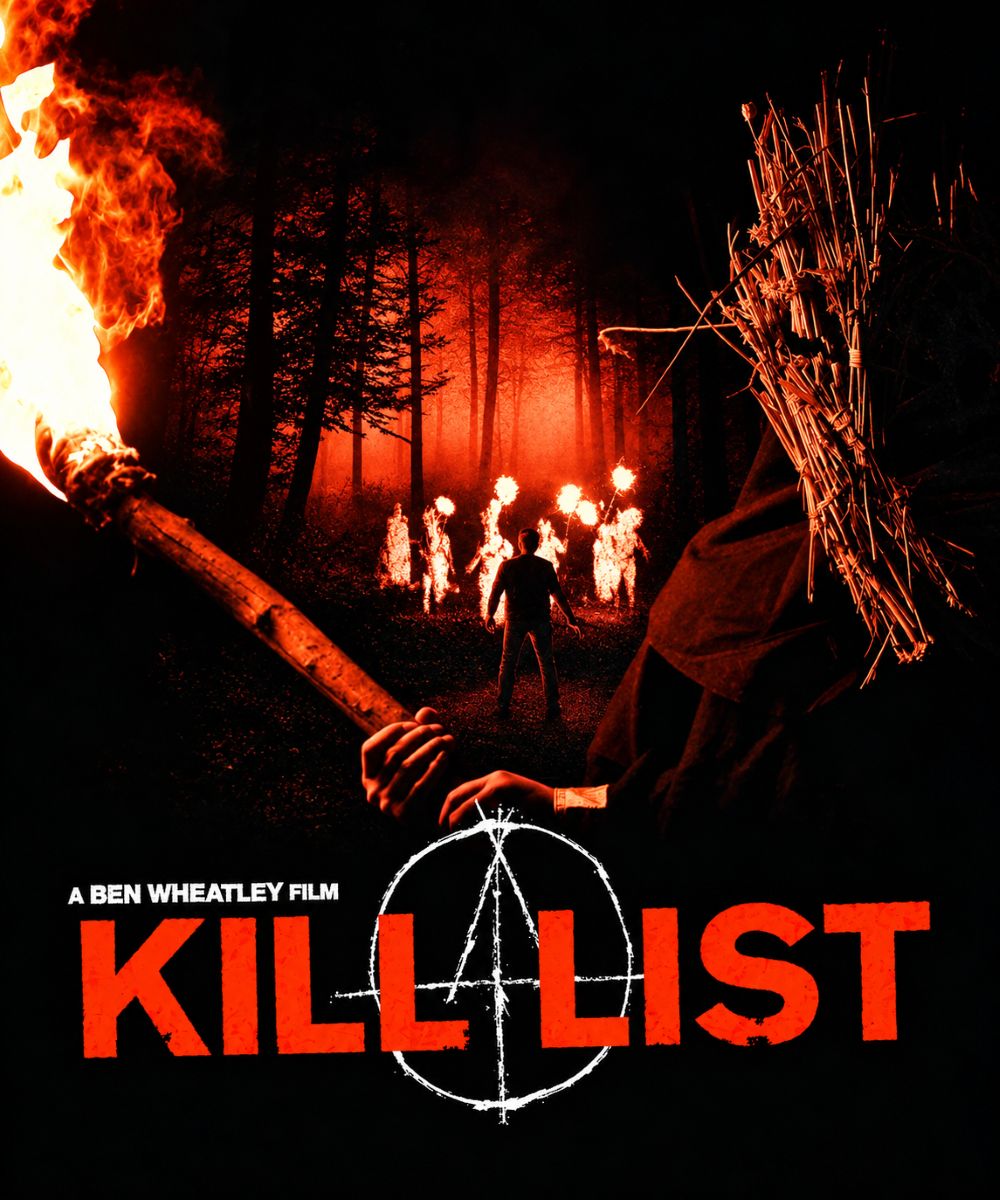
Horror Film Review: Kill List (dir. by Ben Wheatley)


“It doesn’t feel wrong. They’re bad people. They deserve to suffer.” — Jay

There is something especially unsettling about a horror film that refuses to let you know it is a horror film until you are already trapped inside it. Ben Wheatley’s Kill List begins in the familiar, grimy territory of a British crime thriller, but its slow, deliberate transformation into full-blown cosmic and folk horror makes it one of the most unnerving films of the 2010s.

Jay, a former soldier turned contract killer, has been out of work for months after a botched assignment in Kyiv. His wife Shel is fed up with his anger, his drinking, and his lack of direction. Their marriage is strained, their finances are collapsing, and their home feels less like a place of comfort than a pressure cooker waiting to explode. Rather than starting with a monster, a murder, or a flashy supernatural hook, Kill List starts with domestic tension. It places the audience in a home where every conversation feels like it could become a screaming match, and every small complaint seems connected to a much larger emotional wound.

That grounded, unpleasant realism is a huge part of why Kill List works so well. Wheatley does not rush to tell the audience what kind of movie they are watching. For a while, it plays almost like a rough, deeply uncomfortable British domestic drama, with the sort of bickering and passive-aggressive resentment that feels overheard rather than scripted. Jay and Shel’s arguments are messy, mean, and often funny in a dark way, while Jay’s friendship with his old colleague Gal has a lived-in quality. These are not glamorous movie hitmen trading cool one-liners. They are middle-aged men with bills to pay, bad tempers, old wounds, and a job they would probably rather not be doing if they had any other viable option.

Jay’s decision to accept a new killing contract with Gal initially pushes Kill List further into thriller territory. The assignment comes from a wealthy, unsettling client who hires them to eliminate three targets: a priest, a librarian, and a member of Parliament. That setup sounds straightforward enough, and Wheatley lets the film function for a time like a grimy, morally rotten crime thriller. Jay and Gal investigate their targets, plan their attacks, and move through a world of rural estates, anonymous offices, abandoned buildings, and shadowy back rooms. There is tension, but it is the tension of men entering dangerous situations without knowing whether they are being watched or manipulated.

What makes the film increasingly unnerving is that every target seems to know more than Jay and Gal do. The victims do not merely fear death. In some cases, they appear grateful for it. They refer to Jay as though he has been expected, almost as if he has been chosen for a role he does not understand. The priest calls him “the harbinger,” while the librarian thanks him after being killed. These details are not explained in a neat, comforting way. Wheatley plants them casually, allowing confusion to gather in the background while Jay becomes more violent, unstable, and paranoid.

That gradual descent is what makes Kill List so effective. It starts off more like a thriller, or even a bleak crime drama, but slowly makes its way into full-blown horror by the time the end credits begin rolling. The film does not suddenly flip a switch and announce that it has become a supernatural nightmare. Instead, it lets the atmosphere become stranger one scene at a time. A symbol appears carved into a mirror. A strange man silently watches from the woods. A dinner party turns from awkward to deeply hostile. A pair of masked figures emerge at the edge of a field. By the time the movie reaches its final stretch, the feeling is no longer one of criminal danger but of being trapped inside a ritual that began long before Jay understood he was involved.

Wheatley’s direction is crucial here. Kill List has a raw, handheld, low-budget immediacy that makes the violence feel especially ugly. There is very little stylization separating the audience from what is happening. The film is not interested in making murder look slick, cathartic, or exciting. When Jay attacks someone, it feels brutal, chaotic, and emotionally damaging. The violence is often sudden, but it is never casual. It leaves a stain on the scene, on the characters, and on the viewer. Jay’s behavior becomes increasingly alarming because his anger is not framed as toughness. It is framed as a dangerous loss of control.

Neil Maskell gives an excellent performance as Jay, a man whose emotional state is always sitting somewhere between numbness and eruption. He is not an easy protagonist to like, and that is part of the point. Jay can be cruel, childish, frightening, and self-destructive. Yet Maskell also makes him feel recognizably human, especially in the quieter moments with his son, Sam. Those scenes matter because they give the final act its real emotional weight. Jay is not just a professional killer being targeted by an unknown force; he is a husband and father whose damaged life is about to be pulled into something far worse than a failed job.

Michael Smiley is equally strong as Gal, who initially comes across as the more stable, reasonable half of the duo. He is calmer than Jay, more socially functional, and less openly volatile. But the movie gradually reveals that Gal has his own weaknesses and blind spots. Their friendship feels genuine, even when it is poisoned by secrecy, resentment, and the increasingly bizarre circumstances surrounding the contract. MyAnna Buring also deserves credit as Shel. She could have easily been reduced to the stereotypical nagging wife in a lesser film, but Buring makes her sharp, vulnerable, manipulative at times, and visibly exhausted by the life she shares with Jay.

The horror in Kill List becomes especially potent because it draws from both cosmic and folk-horror traditions without fully settling into either one. The cult imagery, hidden rituals, strange symbols, rural landscapes, and anonymous masked figures all give the film a folk-horror texture. There is a distinctly British unease to the countryside in the final act: fields that should feel open instead feel isolating, and a rural community becomes a place where ancient, secretive violence can exist just out of sight. At the same time, the movie’s cosmic-horror side comes from the sense that Jay has stumbled into a system too vast and unknowable for him to comprehend. He thinks he is taking a contract. In reality, he may be participating in a process that has been designed around him from the beginning.

That sense of predestination is one of the film’s most disturbing qualities. Kill List never overexplains the cult, its beliefs, or exactly how much control it has over the characters’ lives. Some viewers may find that frustrating, especially because the ending refuses to provide a clean mythology or a tidy resolution. But that ambiguity is also why the film lingers. The cult is scary not because the audience receives a detailed rulebook, but because its reach appears to be everywhere. It can infiltrate a job, a social gathering, a family home, and even the choices Jay believes he is making freely.

The ending is famously shocking, but it is not shocking only because of its cruelty. It works because the movie has carefully built Jay into a man who responds to fear with rage and violence. The final revelation turns that trait against him in the most devastating possible way. It is bleak, tragic, and almost mythic in its nastiness. The final image does not feel like a twist for the sake of a twist. It feels like the horrifying completion of a ritual that the audience has been watching take shape without fully recognizing it.

Kill List is not a comfortable watch, and it is not a horror movie that tries to please the audience with easy scares or a reassuring explanation. Its slow burn can feel deliberately abrasive, especially in the early domestic scenes, but that patience pays off. Wheatley takes a grim thriller about two hitmen and gradually transforms it into a nightmare of conspiracy, fate, cult ritual, cosmic dread, and folk-horror menace. By the end, the film has moved so far from its seemingly familiar premise that it feels like the ground has disappeared beneath it. That is what makes Kill List so memorable: it does not simply become horrifying. It reveals that horror was there all along, hiding inside every uneasy conversation, every unexplained symbol, and every choice Jay thought was his own.

Film Review: Free Fire (dir by Ben Wheatley)


Last night, I saw Free Fire, the latest film from the visionary British directing-and-screenwriting team of Ben Wheatley and Amy Jump.

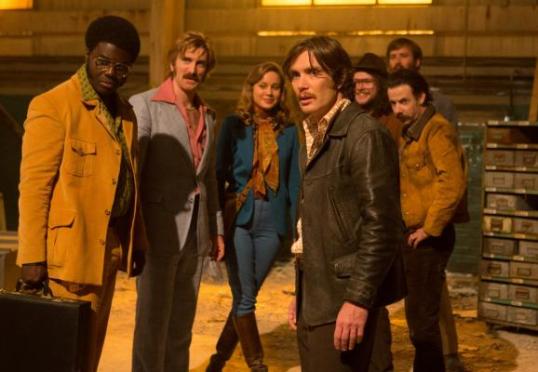
Free Fire takes place in Boston in the 1970s.  We know it’s the 70s because of all the wide lapels, the flared jeans, and the impressive facial hair.  In short, everyone looks like an extra from Thank God, It’s Friday.  Note that I said Thank God, It’s Friday and not Saturday Night Fever.  None of the characters in Free Fire could pull off John Travolta’s white suit.  As much as they try to pretend otherwise, everyone in this film is low rent.  No one is as clever or street smart as they believe themselves to be.  Even more importantly, no one is as good a shot as they think.

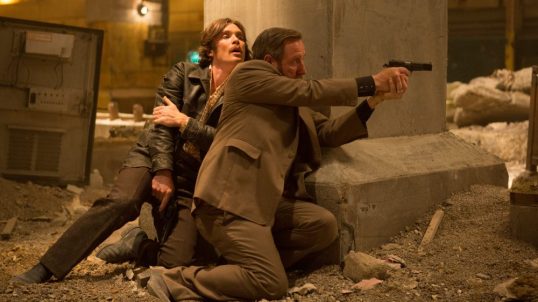
The film takes place in a decrepit warehouse, the type of place that is strewn with rats and hypodermic needles.  Chris (Cillian Murphy), Frank (Michael Smiley), Steve-O (Sam Riley), and Bernie (Enzo Cilenti) are members of the Irish Republican Army and they’ve come to the U.S. to purchases weapons.  Chris and Frank are no-nonsense professionals.  Bernie is a well-meaning moron.  Steve-O is a drug addict who, the previous night, got beaten up after he smashed a bottle across the face of a 17 year-old girl.

Working as intermediaries are Justine (Brie Larson) and Ord (Armie Hammer).  Justine specializes in keeping jumpy people calm.  She and Chris flirt as they wait for the guns to arrive.  As for Ord — well, let’s just say that Ord was my favorite character in the film.  He’s always calm.  He looks really good in a suit.  And, whenever things get intense, he’s always quick to light up a joint and make a sarcastic comment.  This is probably the best performance of Armie Hammer’s career so far.  (Or, at the very least, it’s the best performance of his that I’ve seen.  I hear that he gives an excellent performance in the upcoming Call Me By Your Name.)  Certainly, this is the first film that I’ve seen, since The Social Network, in which Hammer seemed to be truly worthy of the hype that has surrounded his career.

Finally, there’s the gun dealers themselves.  There’s Martin (Babou Ceesay), who seems to be fairly low-key professional.  There’s Gordon (Noah Taylor), who is a henchman who looks disconcertingly similar to Chris.  And then there’s Vernon, who is from South Africa and who is constantly talking and smiling.  Not surprisingly, Vernon is played by Sharlto Copley.  Finally, Harry (Jack Reynor) is a driver who desperately wants to impress Ord.  Harry loves John Denver and he also loves his cousin.  In fact, he loves his cousin so much that, when he recognizes Steve-O as the junkie who smashed a bottle across her face, Harry pulls a gun and starts firing.

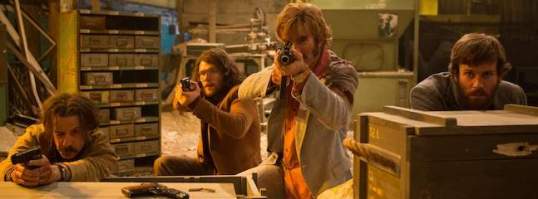
The rest of the film deals with the resulting gun fight, which is complicated with two mysterious snipers (Patrick Bergin and Mark Monero) suddenly open fire on both of the groups.  Who hired them and why?  That’s a mystery that could be solved if everyone stops shooting and yelling at each other.  Of course, that’s not going to happen because 1) no one is a good enough shot to actually get the upper hand and 2) almost everyone in the warehouse is an idiot.

At it’s best, Free Fire mercilessly parodies the excessive violence of modern crime cinema.  When it comes to crime films, most people just remember the shoot outs so Free Fire takes things to their logical extreme by just being a 90-minute gun fight.  At its weakest, Free Fire occasionally becomes exactly what it’s parodying.  The film’s structure — one night in one location — proves to be limiting.  At times, you find yourself really wishing for a flashback or at least a little exposition to explain who everyone is outside of that warehouse.  The cast is full of good actors and they all give good performances but the characters are, at best, thinly drawn.  At times, it was difficult to keep track who was who.  I especially found myself mixing up Michel Smiley and Sharlto Copely.  It was all the facial hair.

About 30 minutes into Free Fire, I was already composing a bad review in my head but, by the final shot (and yes, the double meaning is totally intentional), Free Fire had won me over.  It’s an experiment that doesn’t really work but it’s so relentless and dedicated to seeing its story to its conclusion that I couldn’t help but appreciate the film’s efforts.  When the guns finally did stop firing and the end credits started, I was shocked to discover that, without even realizing it, I actually had gotten just a little caught up in the film’s story.

Ben Wheatley and Amy Jump previously gave us one of the most memorable films of the decade (so far), A Field in England.  Free Fire might not quite work but I’ll always make the time to see the latest from Wheatley and Jump.


Here’s The Red Band Trailer For Free Fire!


Hi, everyone!

When Jeff and I went to see Logan on Thursday night, one of the many trailers that played before the film was this red band one for Free Fire.  Free Fire is an action comedy, one that I think is meant to satirize the ultra violent heist films of the 90s and early aughts.  Seriously, there are parts of this trailer that should make Guy Ritchie cringe.

That said, this trailer is also about a minute too long.  At first, everyone in the theater thought it was kind of funny but then, around the two minute mark, the yawns started to kick in.  “Are they just going to shoot at each other for the entire trailer?” someone asked.

The answer is yes.  And you know what?  The trailer probably doesn’t do Free Fire justice because this movie was directed by Ben Wheatley and I’m still having dreams inspired by his oddly hypnotic A Field in England.  I’ll follow him anywhere!

Free Fire has a March 31st release date in the UK and an April 21st release date in the States.

Anyway, here’s the red band trailer for Free Fire!