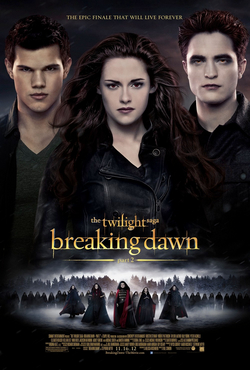
Earlier today, Lis and I finished up the Twilight Saga with Breaking Dawn Part 2.
Bella (Kristen Stewart) is now a vampire and a mother to Renesmee (Mackenzie Foy), who is developing quicker than a normal child because she is half-vampire. Before Edward (Robert Pattinson) even lets Bella see her daughter, he takes her hunting, and he has to stop her from attacking a mountain climber who has scratched his arm on a rock. While Bella adjusts to being a vampire, Jacob (Taylor Lautner) adjusts to being Renesmee’s soul mate, and the Volturi prepare to make their move against the Cullens.
I’m going to get in trouble with my sister for saying this, but I was a little disappointed with the second Breaking Dawn movie. It bothered me that the entire movie was about the Cullens bringing together allies for their inevitable battle with Aro (Michael Sheen) and the Volturi, but then, when the big battle finally happens, it turns out that it was just one of Alice’s visions, and they end up deciding not to fight. After two hours of everyone talking about this huge battle and how everyone had to be prepared to fight for the lives, it was anticlimactic not to have a real one. It seemed like the whole movie could have just been 30 minutes long without really losing anything important. I really didn’t see the point of splitting the book into two movies because hardly anything happened during the second one.
Breaking Dawn Part 2 might not work as a standalone movie, but it does work as an end to the saga. After four movies and the longest senior year on record, Bella and Edward are finally together and they’re happy. And Jacob is happy too. At the end of the movie, when they showed everyone who had appeared over the course of the entire saga, I was really touched.
And that’s it for the story of Bella, Edward, and Jacob.
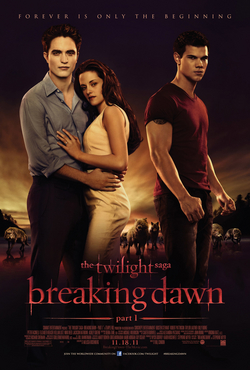
Earlier today, Lis and I watched the second-to-last Twilight film, The Twilight Saga: Breaking Dawn: Part One.
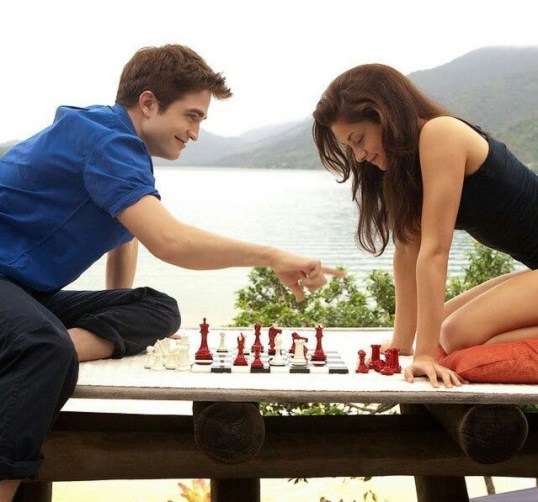
The movie starts with Bella (Kristen Stewart) finally marrying Edward (Robert Pattinson). They get married in the woods, and almost everyone from the entire saga is there, including Bella’s mother. Bella’s father (Billy Burke) and Jacob (Taylor Lautner) don’t approve of her marrying Edward, and Jessica (Anna Kendrick) thinks Bella is pregnant—why else would she be getting married at 18? I probably would have thought the same thing if I were at the wedding, but actually, Bella and Edward are virgins when they marry. Even though Jacob warns that a human could die having sex with a vampire because of how strong vampires are, Bella and Edward still consummate their marriage without Edward turning Bella into a vampire. Edward does not want to turn Bella for some reason. Lis and I agreed that Edward probably wants Bella to get old and die so that he can find someone else. There’s also a weird scene when Edward confesses to Bella that he briefly rebelled against his father and drank the blood of men in the 1920s. Bella says that’s fine because all the men were bad. Team Jacob is looking better and better.
Bella ends up getting pregnant with a hybrid baby. The pregnancy progresses at a faster rate than Bella’s body is prepared for. Edward tries to talk Bella into having an abortion, but Bella refuses. Instead, they return to Forks and stay with Edward’s family. Bella starts to drink blood so that the fetus will stop feasting on her. Jacob, meanwhile, tries to keep the wolf pack from killing Bella to prevent her half-vampire baby from harming anyone.
I have to respect that Twilight built an entire movie around one very difficult pregnancy. That’s probably why the acting in Breaking Dawn is considerably better than in the previous Twilight movies—there’s more at stake than just Bella missing her boyfriend or trying to decide between Edward and Jacob. Though I didn’t realize it until I rewatched the movie, Taylor Lautner really poured his heart into Jacob in this film. I also remember that, when I first saw this movie, I wasn’t comfortable with the “imprinting” scene, and watching it again, I still wasn’t comfortable with it. If you’ve seen the movie or read the books, you know what I mean.
After all this time, I don’t know if it’s really a spoiler to say that this movie ends with Bella opening her eyes and revealing that she is now a vampire. She got a husband, a baby, and immortality! Way to go, Bella!
Tomorrow, we’ll be finishing things up with Breaking Dawn: Part Two.
“It doesn’t feel wrong. They’re bad people. They deserve to suffer.” — Jay
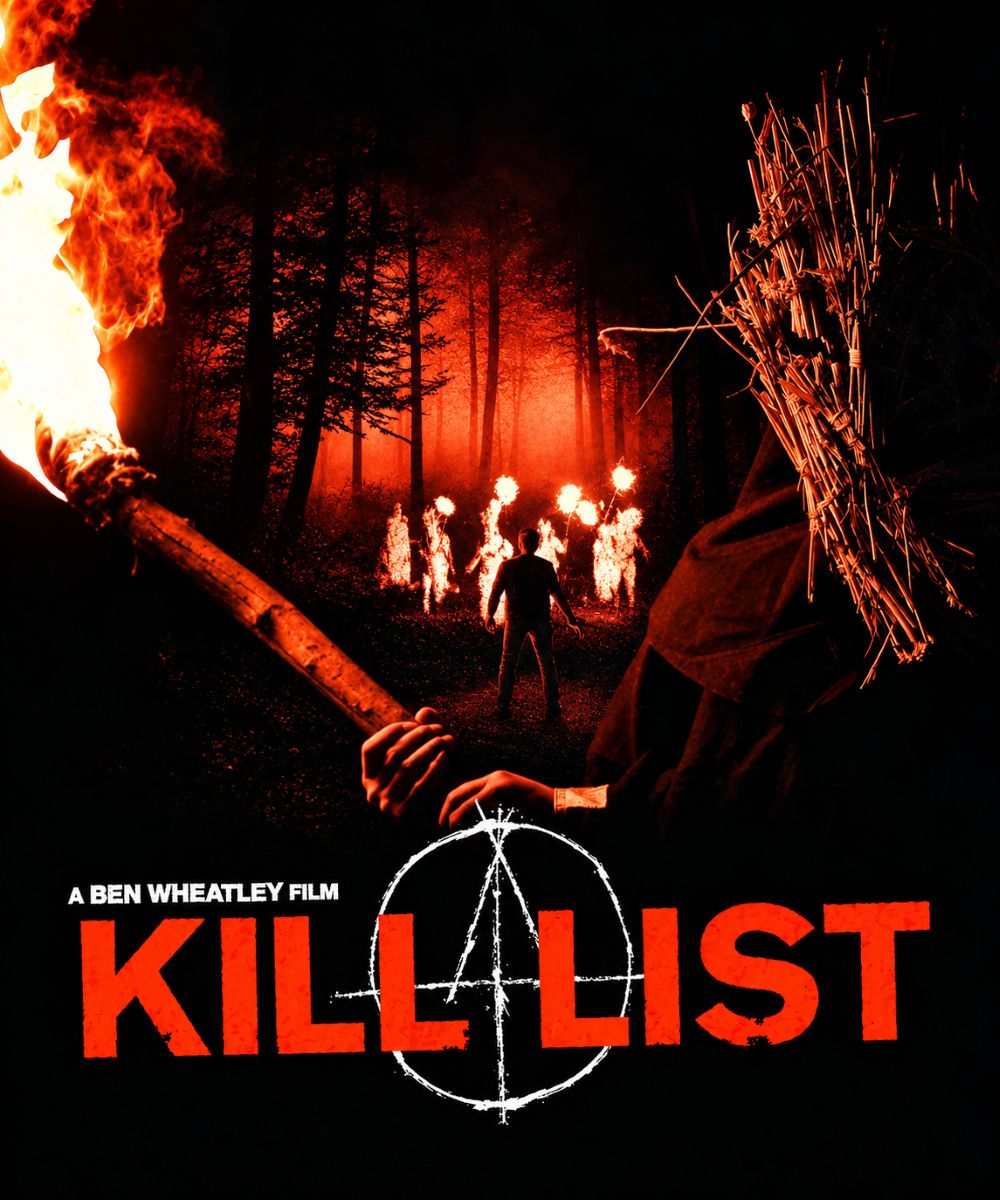
There is something especially unsettling about a horror film that refuses to let you know it is a horror film until you are already trapped inside it. Ben Wheatley’s Kill List begins in the familiar, grimy territory of a British crime thriller, but its slow, deliberate transformation into full-blown cosmic and folk horror makes it one of the most unnerving films of the 2010s.
Jay, a former soldier turned contract killer, has been out of work for months after a botched assignment in Kyiv. His wife Shel is fed up with his anger, his drinking, and his lack of direction. Their marriage is strained, their finances are collapsing, and their home feels less like a place of comfort than a pressure cooker waiting to explode. Rather than starting with a monster, a murder, or a flashy supernatural hook, Kill List starts with domestic tension. It places the audience in a home where every conversation feels like it could become a screaming match, and every small complaint seems connected to a much larger emotional wound.
That grounded, unpleasant realism is a huge part of why Kill List works so well. Wheatley does not rush to tell the audience what kind of movie they are watching. For a while, it plays almost like a rough, deeply uncomfortable British domestic drama, with the sort of bickering and passive-aggressive resentment that feels overheard rather than scripted. Jay and Shel’s arguments are messy, mean, and often funny in a dark way, while Jay’s friendship with his old colleague Gal has a lived-in quality. These are not glamorous movie hitmen trading cool one-liners. They are middle-aged men with bills to pay, bad tempers, old wounds, and a job they would probably rather not be doing if they had any other viable option.
Jay’s decision to accept a new killing contract with Gal initially pushes Kill List further into thriller territory. The assignment comes from a wealthy, unsettling client who hires them to eliminate three targets: a priest, a librarian, and a member of Parliament. That setup sounds straightforward enough, and Wheatley lets the film function for a time like a grimy, morally rotten crime thriller. Jay and Gal investigate their targets, plan their attacks, and move through a world of rural estates, anonymous offices, abandoned buildings, and shadowy back rooms. There is tension, but it is the tension of men entering dangerous situations without knowing whether they are being watched or manipulated.
What makes the film increasingly unnerving is that every target seems to know more than Jay and Gal do. The victims do not merely fear death. In some cases, they appear grateful for it. They refer to Jay as though he has been expected, almost as if he has been chosen for a role he does not understand. The priest calls him “the harbinger,” while the librarian thanks him after being killed. These details are not explained in a neat, comforting way. Wheatley plants them casually, allowing confusion to gather in the background while Jay becomes more violent, unstable, and paranoid.
That gradual descent is what makes Kill List so effective. It starts off more like a thriller, or even a bleak crime drama, but slowly makes its way into full-blown horror by the time the end credits begin rolling. The film does not suddenly flip a switch and announce that it has become a supernatural nightmare. Instead, it lets the atmosphere become stranger one scene at a time. A symbol appears carved into a mirror. A strange man silently watches from the woods. A dinner party turns from awkward to deeply hostile. A pair of masked figures emerge at the edge of a field. By the time the movie reaches its final stretch, the feeling is no longer one of criminal danger but of being trapped inside a ritual that began long before Jay understood he was involved.
Wheatley’s direction is crucial here. Kill List has a raw, handheld, low-budget immediacy that makes the violence feel especially ugly. There is very little stylization separating the audience from what is happening. The film is not interested in making murder look slick, cathartic, or exciting. When Jay attacks someone, it feels brutal, chaotic, and emotionally damaging. The violence is often sudden, but it is never casual. It leaves a stain on the scene, on the characters, and on the viewer. Jay’s behavior becomes increasingly alarming because his anger is not framed as toughness. It is framed as a dangerous loss of control.
Neil Maskell gives an excellent performance as Jay, a man whose emotional state is always sitting somewhere between numbness and eruption. He is not an easy protagonist to like, and that is part of the point. Jay can be cruel, childish, frightening, and self-destructive. Yet Maskell also makes him feel recognizably human, especially in the quieter moments with his son, Sam. Those scenes matter because they give the final act its real emotional weight. Jay is not just a professional killer being targeted by an unknown force; he is a husband and father whose damaged life is about to be pulled into something far worse than a failed job.
Michael Smiley is equally strong as Gal, who initially comes across as the more stable, reasonable half of the duo. He is calmer than Jay, more socially functional, and less openly volatile. But the movie gradually reveals that Gal has his own weaknesses and blind spots. Their friendship feels genuine, even when it is poisoned by secrecy, resentment, and the increasingly bizarre circumstances surrounding the contract. MyAnna Buring also deserves credit as Shel. She could have easily been reduced to the stereotypical nagging wife in a lesser film, but Buring makes her sharp, vulnerable, manipulative at times, and visibly exhausted by the life she shares with Jay.
The horror in Kill List becomes especially potent because it draws from both cosmic and folk-horror traditions without fully settling into either one. The cult imagery, hidden rituals, strange symbols, rural landscapes, and anonymous masked figures all give the film a folk-horror texture. There is a distinctly British unease to the countryside in the final act: fields that should feel open instead feel isolating, and a rural community becomes a place where ancient, secretive violence can exist just out of sight. At the same time, the movie’s cosmic-horror side comes from the sense that Jay has stumbled into a system too vast and unknowable for him to comprehend. He thinks he is taking a contract. In reality, he may be participating in a process that has been designed around him from the beginning.
That sense of predestination is one of the film’s most disturbing qualities. Kill List never overexplains the cult, its beliefs, or exactly how much control it has over the characters’ lives. Some viewers may find that frustrating, especially because the ending refuses to provide a clean mythology or a tidy resolution. But that ambiguity is also why the film lingers. The cult is scary not because the audience receives a detailed rulebook, but because its reach appears to be everywhere. It can infiltrate a job, a social gathering, a family home, and even the choices Jay believes he is making freely.
The ending is famously shocking, but it is not shocking only because of its cruelty. It works because the movie has carefully built Jay into a man who responds to fear with rage and violence. The final revelation turns that trait against him in the most devastating possible way. It is bleak, tragic, and almost mythic in its nastiness. The final image does not feel like a twist for the sake of a twist. It feels like the horrifying completion of a ritual that the audience has been watching take shape without fully recognizing it.
Kill List is not a comfortable watch, and it is not a horror movie that tries to please the audience with easy scares or a reassuring explanation. Its slow burn can feel deliberately abrasive, especially in the early domestic scenes, but that patience pays off. Wheatley takes a grim thriller about two hitmen and gradually transforms it into a nightmare of conspiracy, fate, cult ritual, cosmic dread, and folk-horror menace. By the end, the film has moved so far from its seemingly familiar premise that it feels like the ground has disappeared beneath it. That is what makes Kill List so memorable: it does not simply become horrifying. It reveals that horror was there all along, hiding inside every uneasy conversation, every unexplained symbol, and every choice Jay thought was his own.
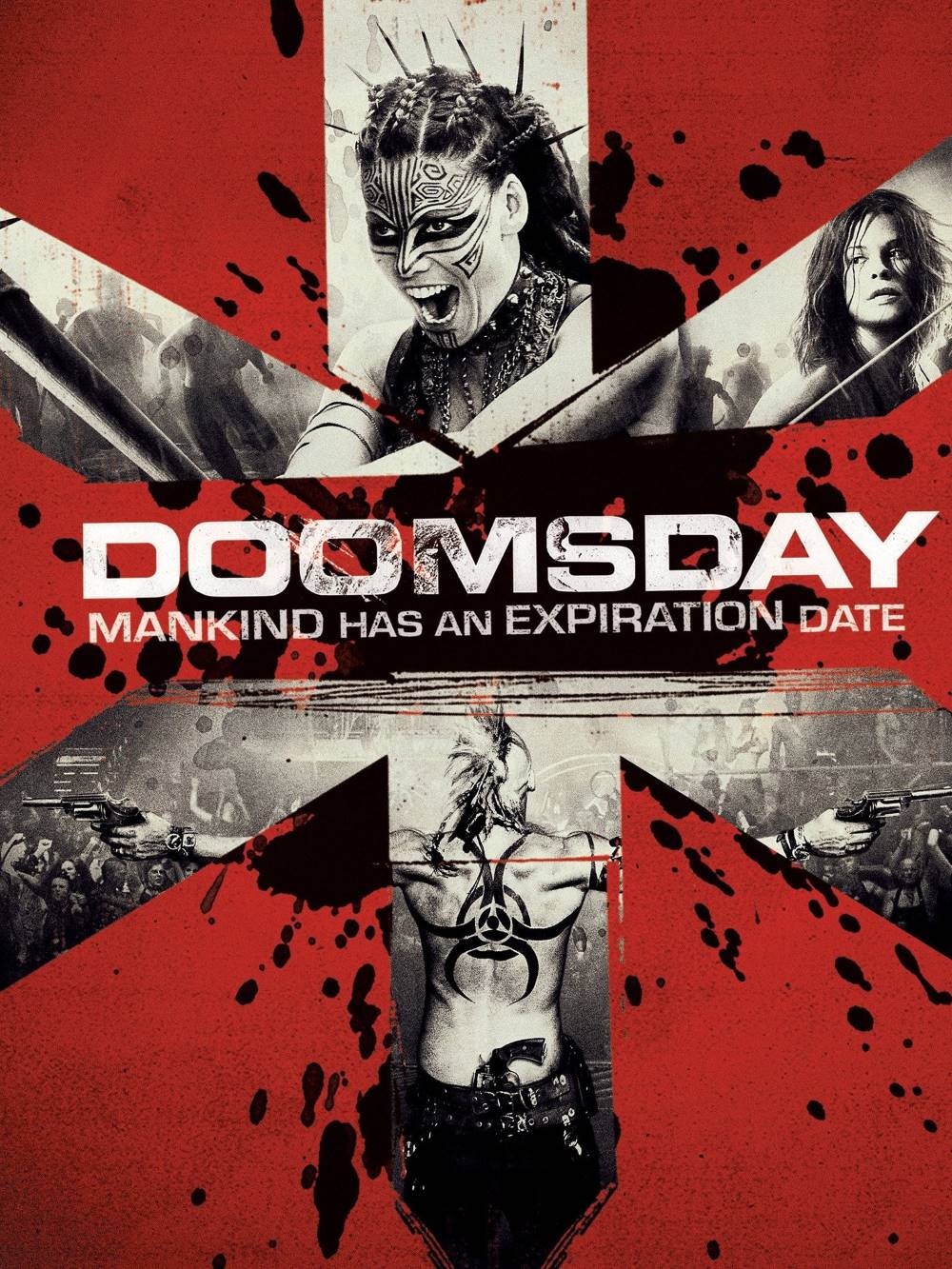
Doomsday tries to be a wild post-apocalyptic romp but ends up as such a profound disappointment, especially coming from Neil Marshall, whose previous two films, Dog Soldiers and The Descent, were much better entries in the horror genre where his attempts to inject new ideas landed the mark with precision and style. Here, Marshall shifts gears into a sprawling, uneven action-horror hybrid that feels like a highlight reel of better movies, bloated and unfocused where his earlier works thrived on tight scripting and fresh twists. While there are flashes of fun in the chaos, the film’s glaring flaws in plotting, tone, and originality outweigh any guilty-pleasure moments, leaving it as more of a curiosity than a recommendation.
The story kicks off with a decent hook: a deadly Reaper virus wipes out much of Scotland, prompting the government to seal it off behind a massive wall and leave the population to fend for itself. Years later, the virus resurfaces in London, and intel suggests survivors—and possibly a cure—lurk inside the quarantine zone. Major Eden Sinclair (Rhona Mitra) leads a ragtag military squad across the wall to hunt down a rogue scientist. It’s a setup that echoes classics like Escape from New York, but Doomsday quickly abandons any tension for a parade of borrowed set pieces that rarely gel, a far cry from the inventive werewolf siege of Dog Soldiers or the claustrophobic crawler terror in The Descent.
Once inside, the movie lurches from one aesthetic to the next without much logic or buildup. First comes a punk-anarchist wasteland with cannibals hosting gladiatorial freak shows amid flames and mohawks, then a sudden pivot to medieval knights in castles complete with jousts and sieges. These shifts feel arbitrary, like Marshall couldn’t decide on a vibe and just threw them all in—a scattershot approach that lacks the confident genre-blending of his prior successes. The worldbuilding is shallow—how did feudalism sprout up so neatly amid the apocalypse?—and the transitions are jarring, undermining any sense of immersion or stakes.
Rhona Mitra holds the center as Sinclair, a one-eyed badass who dispatches foes with grim efficiency, but even she can’t overcome the script’s limitations. Her character is a walking archetype: tough, quippy, and competent, with zero emotional depth or growth. The supporting players, including Malcolm McDowell as a scenery-chewing lord and Bob Hoskins as a gruff boss, are wasted on one-note roles. They’re recognizable enough to highlight how little the film does with its cast, turning potential strengths into reminders of squandered talent.
Visually, Doomsday has some grit thanks to practical effects and location shooting, especially in the grimy urban ruins and over-the-top chases that nod to Mad Max. The gore is plentiful and messy, which might appeal to splatter fans. But the action often devolves into incoherent shaky-cam slogs, and the pacing drags in spots despite the constant escalation. Worse, the film’s self-indulgent excess tips into silliness that undercuts its own grim premise, making it hard to buy the horror of the virus or the desperation of survival.
Tonally, Doomsday is all over the map, swinging from bleak quarantine dread to campy medieval farce without warning. This inconsistency is its biggest sin—serious moments clash with cartoon violence, and the humor lands flat or feels forced. Influences from 28 Days Later, The Road Warrior, and even Excalibur are blatant, but Marshall doesn’t elevate them; he just remixes them into something louder yet less impactful. The result feels like fan fiction for genre nerds rather than a fresh take, missing the spark that made his earlier horrors stand out.
Thematically, there are glimmers of commentary on government abandonment, class divides, and viral panic, but they’re buried under the bombast and never explored. Instead of probing the ethics of walling off a nation, the film prioritizes spectacle, leaving those ideas as window dressing. It’s a missed opportunity that makes the whole endeavor feel hollow, especially when real-world parallels to pandemics could have added bite.
Doomsday struggles to stand on its own amid a crowded genre field, weighed down by narrative sloppiness and tonal whiplash that overshadow its few strengths. The positives—like visceral kills and Mitra’s presence—fail to overcome the disjointed plotting and lack of fresh ideas. Ultimately, it feels like a missed chance for something more cohesive, leaving little reason to revisit beyond a one-off curiosity.
In the end, Doomsday is a swing-and-a-miss for Neil Marshall, ambitious in scope but sloppy in execution, a letdown after the highs of Dog Soldiers and The Descent. The negatives dominate: uneven pacing, logical gaps, borrowed aesthetics without innovation, and a tone that alienates more than it entertains. If you’re in the mood for undemanding B-movie chaos on a slow night, it might scratch a minor itch. Otherwise, skip it for the films it rips off—they deliver the thrills without the frustration. At around 105 minutes, it’s not a huge time sink, but better options abound in the post-apoc genre.
Sarah (Shauna Macdonald) goes back to the caves that she barely escaped from during the first Descent to help the police look for the remains of her friends. Sarah is suspected of killing all of them so I don’t think the police would have gone into a narrow cave with her. Sarah was also traumatized by what happened in the cave so I don’t think she would voluntarily go back down there either. As soon as they enter the cave, they get attacked by the crawlers. What did they think would happen?
I loved the first Descentbecause it was a horror film that featured interesting and multi-layered women who weren’t just put on screen to be whimpering victims. When I watched The Descent, I was just as invested in the personal drama as I was the horror in the caves. I also liked that the first Descent left it open to interpretation about what actually happened in the cave. The sequel didn’t really do that and it also didn’t add anything to the story. Juno (Natalie Mendoza) returns but I’m not sure how considering what happened during the first movie.
The Descent Part 2 also shows a lot more of the crawlers than the first film did. They’re much more visible and much more busy but they aren’t as scary once you can actually see them. Plus revealing the crawlers as much as this movie does also ruins the ambiguity that I loved about the first Descent.
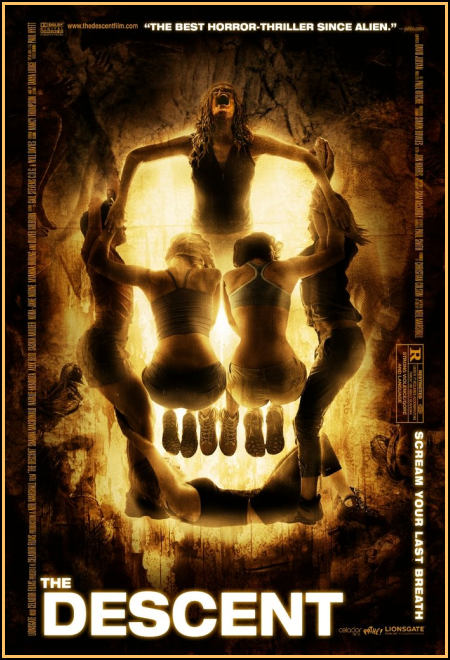
Neil Marshall’s follow-up to his cult-favorite werewolf film Dog Soldiers does not disappoint. Marshall’s filmmaking has improved dramatically since his debut—the film not only cements his skill as a director but also signals the horror genre’s return to a darker, meaner, and more exploitative spirit, reminiscent of a time when filmmakers weren’t afraid to push limits.
The Descent begins with tragedy: Sarah (Shauna MacDonald) suffers devastating losses that form the emotional and psychological foundation of the film. Her grief gives the story a weight that elevates it beyond a typical survival-horror narrative, grounding it in raw emotion and human fragility. Surrounding Sarah are her close friends—Beth (Alex Reid), who travels with her to the U.S. at the invitation of their American friend Juno (Natalie Mendoza)—and newcomers to the group: Holly (Nora Jane-Noone), Sam (MyAnna Buring), and Becca (Saskia Mulder). What begins as a healing adventure for six women soon transforms into a descent not only into the depths of a cave system but into the recesses of fear, betrayal, and survival.
Led by Juno, the group embarks on a spelunking expedition in the Appalachian Mountains—Marshall’s deliberate nod to Deliverance. Though the forest scenes were filmed in Scotland, their authenticity never falters. Yet Marshall doesn’t linger long in the open air; safety and sunlight give way to shadow and claustrophobia as the women push deeper underground. The descent itself is drawn out just enough to build tension until the film snaps into full horror mode. When the inevitable cave-in comes, the sequence is nerve-shredding—an expertly shot, suffocating nightmare that will have claustrophobic viewers flinching and gasping for space.
After the collapse, the women find themselves trapped, nerves fraying and panic growing. Juno, initially portrayed as the group’s confident alpha, begins to reveal a brash, reckless streak masking her deeper insecurities. What started as a confident façade becomes a fragile disguise for fear and guilt, and Marshall uses this shift to explore how leadership and trust erode under extreme pressure.
From this point forward, The Descent becomes a masterclass in oppressive atmosphere. Gone is any trace of daylight—the cave becomes an abyss of darkness, amplifying a universal fear of entrapment and the unknown. Marshall layers internal conflict onto external terror, exposing lies, betrayals, and fragilities within the group. The result is as psychological as it is visceral; survival becomes both a physical and moral test. This is no Steel Magnolias—it’s a blood-soaked exploration of human endurance under primal duress.
Marshall, alongside cinematographer Sam McCurdy, crafts a sensory experience that manipulates both light and sound to devastating effect. The pitch-black sequences—where nothing is visible, yet everything is heard—are among the film’s most frightening moments. Every drop of water, every panting breath, every unseen shuffle echoes with menace. The sound design alone makes viewers feel trapped within the cave alongside the characters, scanning the darkness for unseen horrors.
The titular descent takes on a new layer once the film’s monsters, the Crawlers, make their appearance halfway through. Marshall wisely delays their reveal, letting claustrophobia and suggestion torment the audience first. When these pale, feral creatures finally emerge, their raw physicality and relentless hunger confirm every imagined dread. Their attacks are fast, brutal, and chaotic—filmed with a balance of restraint and brutality that gives the violence a strangely poetic rhythm. Fans of gore will be thrilled, but even skeptics of splatter cinema will find the violence purposeful, anchored by the audience’s genuine investment in the characters’ fates.
The Descent succeeds as a terrifying, pulse-pounding revival of hard-R horror. It straddles the line between primal terror and visceral gore without losing its emotional core. Marshall doesn’t reinvent the genre—the DNA of Alien and Predator is evident—but he honors it with craft and vision. The interplay of light and shadow even recalls Argento’s dreamlike intensity, while the cave setting feels nightmarishly tactile.
In an era where horror films trend toward PG-13 softness, The Descent proudly reclaims the genre’s raw, adult intensity. This is horror meant to unsettle, to overwhelm, and to make you feel the walls closing in. Neil Marshall, once known only for Dog Soldiers, proves here that he’s no fluke. The Descent solidifies him as one of the most promising horror filmmakers of his generation—a director unafraid to go deep into the dark.