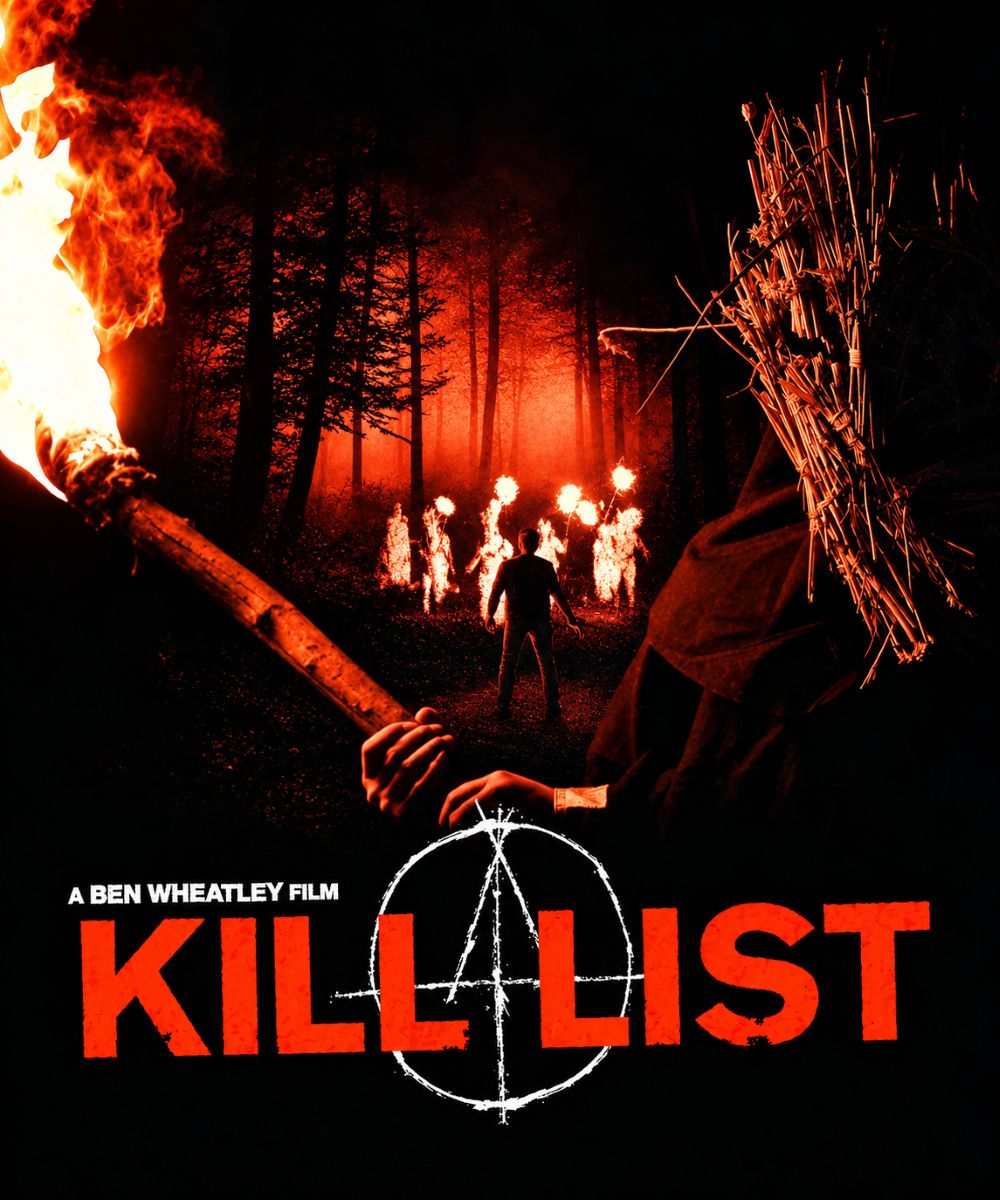
Horror Film Review: Kill List (dir. by Ben Wheatley)


“It doesn’t feel wrong. They’re bad people. They deserve to suffer.” — Jay

There is something especially unsettling about a horror film that refuses to let you know it is a horror film until you are already trapped inside it. Ben Wheatley’s Kill List begins in the familiar, grimy territory of a British crime thriller, but its slow, deliberate transformation into full-blown cosmic and folk horror makes it one of the most unnerving films of the 2010s.

Jay, a former soldier turned contract killer, has been out of work for months after a botched assignment in Kyiv. His wife Shel is fed up with his anger, his drinking, and his lack of direction. Their marriage is strained, their finances are collapsing, and their home feels less like a place of comfort than a pressure cooker waiting to explode. Rather than starting with a monster, a murder, or a flashy supernatural hook, Kill List starts with domestic tension. It places the audience in a home where every conversation feels like it could become a screaming match, and every small complaint seems connected to a much larger emotional wound.

That grounded, unpleasant realism is a huge part of why Kill List works so well. Wheatley does not rush to tell the audience what kind of movie they are watching. For a while, it plays almost like a rough, deeply uncomfortable British domestic drama, with the sort of bickering and passive-aggressive resentment that feels overheard rather than scripted. Jay and Shel’s arguments are messy, mean, and often funny in a dark way, while Jay’s friendship with his old colleague Gal has a lived-in quality. These are not glamorous movie hitmen trading cool one-liners. They are middle-aged men with bills to pay, bad tempers, old wounds, and a job they would probably rather not be doing if they had any other viable option.

Jay’s decision to accept a new killing contract with Gal initially pushes Kill List further into thriller territory. The assignment comes from a wealthy, unsettling client who hires them to eliminate three targets: a priest, a librarian, and a member of Parliament. That setup sounds straightforward enough, and Wheatley lets the film function for a time like a grimy, morally rotten crime thriller. Jay and Gal investigate their targets, plan their attacks, and move through a world of rural estates, anonymous offices, abandoned buildings, and shadowy back rooms. There is tension, but it is the tension of men entering dangerous situations without knowing whether they are being watched or manipulated.

What makes the film increasingly unnerving is that every target seems to know more than Jay and Gal do. The victims do not merely fear death. In some cases, they appear grateful for it. They refer to Jay as though he has been expected, almost as if he has been chosen for a role he does not understand. The priest calls him “the harbinger,” while the librarian thanks him after being killed. These details are not explained in a neat, comforting way. Wheatley plants them casually, allowing confusion to gather in the background while Jay becomes more violent, unstable, and paranoid.

That gradual descent is what makes Kill List so effective. It starts off more like a thriller, or even a bleak crime drama, but slowly makes its way into full-blown horror by the time the end credits begin rolling. The film does not suddenly flip a switch and announce that it has become a supernatural nightmare. Instead, it lets the atmosphere become stranger one scene at a time. A symbol appears carved into a mirror. A strange man silently watches from the woods. A dinner party turns from awkward to deeply hostile. A pair of masked figures emerge at the edge of a field. By the time the movie reaches its final stretch, the feeling is no longer one of criminal danger but of being trapped inside a ritual that began long before Jay understood he was involved.

Wheatley’s direction is crucial here. Kill List has a raw, handheld, low-budget immediacy that makes the violence feel especially ugly. There is very little stylization separating the audience from what is happening. The film is not interested in making murder look slick, cathartic, or exciting. When Jay attacks someone, it feels brutal, chaotic, and emotionally damaging. The violence is often sudden, but it is never casual. It leaves a stain on the scene, on the characters, and on the viewer. Jay’s behavior becomes increasingly alarming because his anger is not framed as toughness. It is framed as a dangerous loss of control.

Neil Maskell gives an excellent performance as Jay, a man whose emotional state is always sitting somewhere between numbness and eruption. He is not an easy protagonist to like, and that is part of the point. Jay can be cruel, childish, frightening, and self-destructive. Yet Maskell also makes him feel recognizably human, especially in the quieter moments with his son, Sam. Those scenes matter because they give the final act its real emotional weight. Jay is not just a professional killer being targeted by an unknown force; he is a husband and father whose damaged life is about to be pulled into something far worse than a failed job.

Michael Smiley is equally strong as Gal, who initially comes across as the more stable, reasonable half of the duo. He is calmer than Jay, more socially functional, and less openly volatile. But the movie gradually reveals that Gal has his own weaknesses and blind spots. Their friendship feels genuine, even when it is poisoned by secrecy, resentment, and the increasingly bizarre circumstances surrounding the contract. MyAnna Buring also deserves credit as Shel. She could have easily been reduced to the stereotypical nagging wife in a lesser film, but Buring makes her sharp, vulnerable, manipulative at times, and visibly exhausted by the life she shares with Jay.

The horror in Kill List becomes especially potent because it draws from both cosmic and folk-horror traditions without fully settling into either one. The cult imagery, hidden rituals, strange symbols, rural landscapes, and anonymous masked figures all give the film a folk-horror texture. There is a distinctly British unease to the countryside in the final act: fields that should feel open instead feel isolating, and a rural community becomes a place where ancient, secretive violence can exist just out of sight. At the same time, the movie’s cosmic-horror side comes from the sense that Jay has stumbled into a system too vast and unknowable for him to comprehend. He thinks he is taking a contract. In reality, he may be participating in a process that has been designed around him from the beginning.

That sense of predestination is one of the film’s most disturbing qualities. Kill List never overexplains the cult, its beliefs, or exactly how much control it has over the characters’ lives. Some viewers may find that frustrating, especially because the ending refuses to provide a clean mythology or a tidy resolution. But that ambiguity is also why the film lingers. The cult is scary not because the audience receives a detailed rulebook, but because its reach appears to be everywhere. It can infiltrate a job, a social gathering, a family home, and even the choices Jay believes he is making freely.

The ending is famously shocking, but it is not shocking only because of its cruelty. It works because the movie has carefully built Jay into a man who responds to fear with rage and violence. The final revelation turns that trait against him in the most devastating possible way. It is bleak, tragic, and almost mythic in its nastiness. The final image does not feel like a twist for the sake of a twist. It feels like the horrifying completion of a ritual that the audience has been watching take shape without fully recognizing it.

Kill List is not a comfortable watch, and it is not a horror movie that tries to please the audience with easy scares or a reassuring explanation. Its slow burn can feel deliberately abrasive, especially in the early domestic scenes, but that patience pays off. Wheatley takes a grim thriller about two hitmen and gradually transforms it into a nightmare of conspiracy, fate, cult ritual, cosmic dread, and folk-horror menace. By the end, the film has moved so far from its seemingly familiar premise that it feels like the ground has disappeared beneath it. That is what makes Kill List so memorable: it does not simply become horrifying. It reveals that horror was there all along, hiding inside every uneasy conversation, every unexplained symbol, and every choice Jay thought was his own.

Arleigh’s 13 Favorite Films of 2011


2011 was a year that wasn’t spectacular by any stretch of the imagination. From January right up to December there were not many films which I would consider event films. This is surprising considering all the superhero blockbusters which arrived during the summer and the final film in the Harry Potter film franchise. Even the prestige films which came out during the holidays never truly captured everyone’s imagination (though one film was very close to achieving it due to one Michael Fassbender).

What 2011 did have was a solid slate of titles which ranged from the pulpy to the cerebral. We even got films which were able to combine the two to come up with something very special. Not every film resonated with everyone and some even split audiences down the extreme middle with half hating it and the other half loving it.

The list below catalogs the films which I consider my favorites of 2011. Some titles on this list I consider some of the best of 2011 while some didn’t make that particular list but were entertaining enough for me to make this favorite list. Once again, the list is not ranked from top to bottom, but only numbered to keep things organized….

  1. Shame (dir. by Steve McQueen) – This character-driven film starring Michael Fassbender and Cary Mulligan was one of those film which got close to becoming the one film everyone ended up talking about as the year wound down. It’s an exercise in minimalist filmmaking as Steve McQueen doesn’t allow too much dialogue to get in the way of telling the visual story of sex-addict Brandon and his downward spiral from addiction to self-hate. Much have been said of how much Fassbender’s penis in full display was a reason why people flocked to see this little existential film, but I rather thought that was probably just a bonus for some and instead it was Fassbender’s uncompromising performance in the role of Brandon which made Shame one of my favorites for 2011.
  2. Rise of the Planet of the Apes (dir. by Rupert Wyatt) – this film was one which didn’t garner too much high-anticipation from genre fans leading up to it’s release. People had been burned by Tim Burton’s reboot of the franchise and saw this second attempt to reboot the series as a failure in the making. So, it was to o everyone’s surprise that Rupert Wyatt’s film managed to not just bring new life to a stagnating franchise but do so in such a way that it became one of the best films of 2011. Sure, there was some flaws in how the human character were written, but in the end it was the performance-capture work by Andy Serkis and the digital wizardry of WETA Digital which made Rise of the Planet of the Apes not just a wonderful and fun film this past summer, but also one which laid the groundwork for more stories in what is a franchise reborn with fresh blood and life.
  3. I Saw the Devil (dir. by Kim Ji-woon) – this little revenge thriller from South Korea was one which I happened to catch just before it left the theaters this part spring. It had played in one of the few arthouse theaters in the Bay Area that hadn’t closed down. I was glad to have seen this film on the big screen instead of on Netflix Instant the way most have seen it. It’s a brutal cat-and-mouse story of a South Korean secret agent who stalks and hunts the serial killer (played by Oldboy‘s Choi Min-sik) who kidnapped and brutally murdered his fiancee. The film is not for the timid and weak of stomach as we see through the eyes of not just Agent Soo-hyun (played by Lee Byung-hun) but that of serial killer Kyung-chul the dark corners of South Korea where hunter has become prey and vice versa.  South Korea has always been good for one great film that I feel personally attached to and for 2011 it was this film.
  4. Cave of the Forgotten Dreams (dir. by Werner Herzog) – I don’t think I could ever make a year’s favorite list of any year that had a Herzog release and not have it as a favorite of mine for the year. It happens that Herzog had two films come out in 2011 and both of them excellent documentaries. It would be his earlier documentary for 2011 that became a favorite of mine. It also happened to be his first (and according to him the only time) foray into 3D-filmmaking. Herzog makes great use of 3D filmmaking’s added epth of field to make the cave paintings in the Chauvet Cave come to life. If this was going to be Herzog’s only film shot in 3D then he made one for the ages and it’s a travesty that those who vote for documentaries to be nominated for the Academy Awards failed to even list this film.
  5. Attack the Block (dir. by Joe Cornish) – this scifi-action film from the UK became the darling for genre fans everywhere. It had everything which bigger-budgeted films of the same stripe failed to accomplish. It was fun, thrilling and, most important of all, had characters which the audience would get to know and care for. John Boyega as the gang leader and, ultimately, the reluctant savior of the block which has become under siege by an alien force is just one of the highlights of the film which boasts one of the best screenplays of 2011. Joe Cornish joins the likes of Neill Blomkamp as a filmmaker whose first feature-length film hits on all cylinders.
  6. Captain America: The First Avenger (dir. by Joe Johnston) – this film was to be the last leg of the Marvel Films before 2012’s highly-anticipated The Avengers film. It introduced the film’s title character and his origins for those not familiar with the name Captain America. This film could easily have been a throwaway one. A film to set-up this year’s The Avengers. Instead what we got was one of the most fun blockbusters in the summer of 2011. Joe Johnston goes back to his Rocketeer days and creates an action film that’s full of genuine nostalgia but not burdened by it. Any doubts fans might have had of Chris Evans in the role as Captain America had them wiped clean with his pitch-perfect performance as the title character. The film also had one of the most romantic relationships on-screen in quite awhile with Evan’s Steve Rogers and Hayley Atwell’s Peggy Carter.
  7. Drive (dir. by Nicolas Winding Refn) – In my opinion, Refn’s existential take on the pulp genre with Drive is also one of the best films of 2011, if not the best of them all. Refn, with Ryan Gosling in the role of  the Driver, has created a film that mashes up so many different genres and does it so well that it’s hard to be sympathetic to those who felt they were misled by the fim’s trailer that it would be a nonstop action film similar to Fast Five. The film is not an action film, but a film which just happens to have some action in it. Action that comes sudden and brutal and none of the whiz-bangs other action films rely heavily on. It’s another film where Refn explores duality of the male persona. It helps Refn’s film that Gosling is so great as the Driver that the film never slows down too much before things revs up once more. The rest of the ensemble cast also does stand-out work with Albert Brooks as an aging, cynical Hollywood gangster leading the pack.
  8. Fast Five (dir. by Justin Lin) – Speaking of Fast Five…this was a film that surprised me in so many ways. It’s the fifth installment in a series that seemed to have evolved from being an action series whose main goal was to highlight the street-racing community and the ridiculous lengths people in it would go to in order to trick out their cars. This latest installment in the franchise has put the street-racing aspect of the series on the back burner and instead has remade the franchise into an action-heist series that just happens to have fast cars in it. This film was loud, fast and fun and despite some major leaps in logic in the storyline it never stopped being entertaining. It also brought back Dwayne “The Rock” Johnson in an action film role that he had stopped doing these past five or so years.
  9. Hanna (dir. by Tom Hooper) – If someone had come to me and said that little Saoirse Ronan (The Lovely Bones, Atonement) would turn out to be kickass action-hero directed by a British filmmaker not known for action films then I would dismiss such a thing as crazy talk. But crazy talk it wasn’t and all that came to pass with Tom Hopper’s excellent modern fairy tale in Hanna. Ronan as the title character was asuch a find in a role that didn’t just need for her to act like the little lost babe in the woods, but to also turn on a dime and kick ass with the best of action heroes past. It helped that everyone else around her were up to the task of supporting her performance whether it was Eric Bana in the role father (huntsman in fable lore) to Cate Blanchett as the cold-hearted CIA chief (evil queen) whose connection to Hanna drives the film’s narrative from beginning to end.
  10. Kung Fu Panda 2 (dir. by Jennifer Yuh Nelson) – in a year where Pixar had one of it’s rare misses (Cars 2 really was awful and such a blatant cash grab for the studio) it was there for the taking for top animated film of the year for everyone else to fight over. There was Rango and there was The Adventures of TinTin, but my favorite animated film of 2011 has to be Kung Fu Panda 2. It continues to adventures of the Dragon Warrior and panda kung master Po and his compatriots, the Furious Five. With the first film having done with him becoming the Dragon Warrior, this sequel was free to explore more aspects of Po’s life and personality such as his true origins and the tragic circumstances which led him to be adopted by his noddle-making goose of a father. The film is much darker than the previous one with it’s storyline exploring such themes as genocide and the destructive march of technology over nature’s harmony. It also had one of the best villains to come out in 2011 with Gary Oldman as the evil peacock, Lord Shen. Plus, it had scenes of Po as a baby Panda…A BABY PANDA.
  11. Tinker, Tailor, Soldier, Spy (dir. by Tomas Alfredson) – a feature-length film remake of the BBC miniseries of the same name (adapted from a John LeCarre novel), this spy thriller/procedural was Tomas Alfredson’s follow-up to his coming-of-age vampire film, Let the Right One In. Once again he has taken a well-worn genre and infused it with his own unique style of storytelling which valued characters and how they all interacted with each other over action and thrilling sequences. With a cast that’s a who’s who of British cinema the film was able to condense many hours of the miniseries into just a couple and still not lose the complex and layered plot involving political intrigue and betrayal. This film also had one of the best performances by any male actor for 2011 with Gary Oldman in the role of George Smiley. With Fassbender being passed over and not nominated for Best Actor for the upcoming Academy Awards I would be very perturbed if anyone else other than Oldman took home the statue.
  12. Kill List (dir. by Ben Wheatley) – I’m not well-versed on the work by Ben Wheatley so I saw this film on the recommendation of many whose opinions I trust when it comes to genre films. To say that I was thoroughly surprised by just how well this filmed turned out would be an understatement. Kill List is one of those films which turns so many horror and thriller conventions right on its head, but do so to serve the film’s narrative instead of a filmmaker trying to show his/her audience just how clever they can be. The film moves at a gradual pace that leads to a surprising ending that has split audiences down the middle. Some have loved the ending and other have hated it. I, for one, thought the ending was the only way the film could end. This was a film that was able to balance the different aspects of what makes a thriller and what makes a horror film. The moment when the film transitions from the former to the latter was so seamless that it takes several viewings to find just where it occurred. The best horror film of 2011, bar none.
  13. 13 Assassins (dir. by Miike Takashi) – many will be saying that I’m cheating with this final entry since the film was released in 2010. I would agree with them, but then again this film wasn’t released in the US until early 2011 so in my own honest opinion it qualifies as a 2011 film. This latest from Japan’s eclectic and prolific filmmaker, Miike Takashi, is his own take on the Japanese jidaigeki and a remake of the 1963 film of the same name. If there was ever a best action film of 2011 then this film would be it. Miike would pull back from his more over-the-top visuals (though he still manages to insert some very disturbing imagery early on in the film) for a much more linear and traditional action filmmaking. It’s a men-on-a-mission film that pits the 13 assassins of the title against 200 or more bodyguards of a sadistic lord who must be killed for the sake of the country. The first 45 minutes or so of the film shows the film gathering the assassins and planning their ambush. It’s that final hour or so of the film with it’s nonstop action which qualified this film not just one of my favorite for 2011, but that year’s best action film. No other film could even get to it’s level.

Honorable Mentions: Warrior, Super 8, Batman: Year One, Green Lantern: Emerald Knights, Sucker Punch, A Dangerous Method, The Adventures of TinTin, The Skin I Live In, Bunraku, The Guard, We Need to Talk About Kevin, Hugo, Tyrannosaur, Thor, The Interrupters, X-Men: First Class, Contagion, Battle: Los Angeles, Project Nim