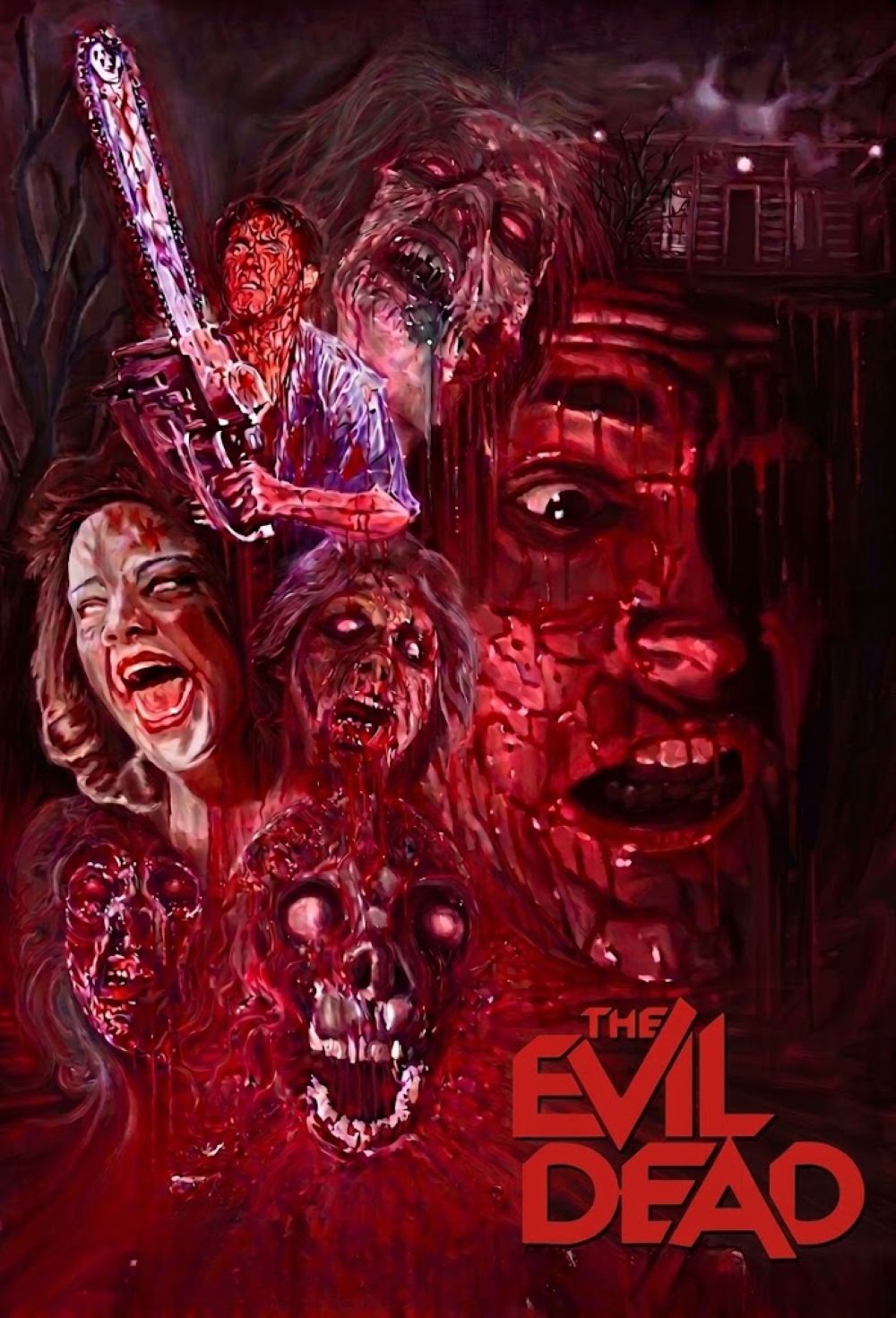
“I fear that the only way to stop those possessed by the spirits of the book is through the act of… bodily dismemberment.” — Professor Knowby
The Evil Dead is the kind of movie that feels like it should not have become a classic, at least not by conventional standards. It was made cheaply, filmed under brutal conditions, packed with unknown actors, and built around an extremely simple premise: five college friends head to an isolated cabin in the woods, unwittingly awaken an ancient evil, and spend the rest of the night being torn apart by demonic forces. Yet more than four decades later, Sam Raimi’s 1981 horror debut remains one of the most energetic, inventive, and genuinely nasty independent films ever made. It is rough around the edges in ways that are impossible to ignore, but those rough edges are a major part of its appeal. The Evil Dead feels handmade, hungry, and a little bit unhinged.
The story starts with Ash Williams, his girlfriend Linda, Ash’s sister Cheryl, and their friends Scotty and Shelly arriving at a remote Tennessee cabin for what is supposed to be a relaxing getaway. It is one of the most familiar setups in horror history now, but Raimi and his collaborators made it feel threatening before the real violence even begins. The cabin is decrepit, damp, and isolated to an almost absurd degree. There is no real sense of civilization nearby. The forest itself seems hostile, with tangled trees, strange sounds, and an atmosphere that makes the woods feel less like a location and more like a living organism surrounding the characters.
The group soon discovers a cellar beneath the cabin, where they find an ancient book bound in flesh, a dagger, and a tape recording left by an archaeologist. The recording describes the Necronomicon, a book of demonic incantations, and naturally the characters make the worst possible decision by playing the tape aloud. That act releases the evil presence that has been lurking in the forest, and the movie moves quickly from creepy cabin story to all-out supernatural nightmare. The concept is simple, but it gives Raimi room to focus on mood, visual invention, and escalation rather than complicated mythology.
What makes The Evil Dead special is how aggressively Raimi directs it. Even in his first feature, he had a style that was impossible to mistake for anyone else’s. The camera is constantly moving, lunging through the woods, creeping around corners, tilting at unnatural angles, and racing toward people as if the audience has become the demon’s point of view. The famous “demon-cam” shots are still startling because of how physical they feel. The camera does not glide elegantly. It charges. It crashes through the environment. It feels like something has broken loose and is hunting the characters.
That restless filmmaking gives the movie a personality far larger than its budget. Raimi turns limitations into an advantage. The cabin becomes a maze of shadows, floorboards, trap doors, windows, and hidden spaces. A cheap-looking hallway can suddenly become terrifying because the editing, sound design, and camera movement make it feel unstable. Raimi understands that horror does not always come from seeing a monster clearly. Sometimes it comes from the sense that the camera itself has stopped behaving normally, that the space around the characters is warping, and that even the trees outside are watching them.
The special effects are another major reason the film still has such a devoted following. They are obviously practical, often messy, and occasionally so exaggerated that they cross into dark comedy, but they have a tactile quality that modern digital effects often lack. The possessed characters look genuinely diseased and wrong: pale skin, dead eyes, rotting makeup, distorted faces, and unnatural movements. When the deadites attack, they do not simply become generic zombies. They taunt their friends, laugh at them, imitate their voices, and enjoy causing emotional pain. That cruel playfulness makes them more disturbing than ordinary monsters.
The makeup work on the possessed Cheryl, Shelly, and Linda remains especially effective because it turns familiar faces into grotesque masks. Ellen Sandweiss, Betsy Baker, and Theresa Tilly bring an unsettling intensity to those transformations, switching from frightened victims to shrieking, mocking demons. The performances are broad and theatrical, but that is exactly what the material needs. Nothing in The Evil Dead is subtle for very long. The film keeps pushing the characters past the point of normal human behavior until they are laughing, screaming, convulsing, and bleeding all over the cabin.
Bruce Campbell’s Ash is interesting because he is not yet the wisecracking, chainsaw-handed cult hero he would become in the sequels. In The Evil Dead, Ash is mostly an ordinary young man who slowly realizes he is trapped in a situation beyond comprehension. Campbell is still charismatic, and there are flashes of the physical comedy and wild-eyed determination that would define the character later, but this version of Ash is more vulnerable. He panics, hesitates, and suffers. By the end, he looks exhausted in a way that feels earned, covered in sweat, dirt, blood, and trauma.
That difference gives the original movie its own identity within the larger Evil Dead series. Evil Dead II would remake and expand many of the first film’s ideas with more money, more comedy, and a much more overtly cartoonish sensibility. Army of Darkness would take Ash into full fantasy-adventure mode. Those later films are arguably more polished and more immediately entertaining, especially for viewers who love Campbell’s comedic performance. But The Evil Dead has a rawness that the sequels never tried to reproduce. It is a horror movie first, even when its excesses become funny.
The film’s tonal shifts are one of its most fascinating qualities. Raimi clearly understands that grotesque violence can become absurd if it is pushed far enough, and the movie occasionally seems aware of its own madness. A possessed hand reaches through a window. A character gets stabbed with a pencil in one of the film’s most infamous scenes. Bodies erupt in streams of colored goo rather than realistic blood. The final destruction of the deadites is so elaborate that it feels like Raimi and his effects team were determined to empty every container of slime they had available. It is disgusting, but it is also gleefully imaginative.
At the same time, The Evil Dead can be more unpleasant than people remember. Its treatment of Cheryl in the woods is difficult to watch and remains one of the film’s most controversial moments. The scene is meant to establish the cruelty and violation associated with the demonic force, but it is not necessary to enjoy the movie, and it has aged badly compared with the more comic-book brutality of later entries. Raimi himself would move away from that kind of material in the sequels. It is worth acknowledging because the scene changes the tone of the film and may be a deal-breaker for some viewers.
The sound design helps make the movie feel more oppressive than its modest production would suggest. The woods groan, doors bang, voices echo from impossible places, and the demonic chants on the tape recording create a sense that something ancient has been invited into the cabin. Joseph LoDuca’s score adds another layer of unease, using shrill strings and harsh musical stabs to make even quiet scenes feel unstable. The soundtrack is not trying to be elegant. It is trying to make the viewer tense up, and it succeeds.
There is also something inspiring about the movie’s independent spirit. Raimi, Campbell, producer Robert Tapert, and their crew famously made the film through determination, ingenuity, and a willingness to endure conditions that sound miserable in retrospect. You can feel that effort on screen. Every strange camera angle, handmade prop, and splattering effect carries the energy of filmmakers trying to prove they can do something bigger than their resources should allow. The Evil Dead does not hide its budget. It turns that budget into part of its legend.
For horror fans, the movie is essential not because it is flawless, but because it is so alive. It captures the feeling of discovering a forbidden VHS tape or stumbling into a midnight screening where the audience is laughing, cringing, and yelling at the screen. It is scary in places, silly in others, and relentlessly committed to its own bizarre nightmare logic. Raimi would go on to make superhero movies, westerns, thrillers, and studio blockbusters, but the wild visual imagination that defined his career is already fully visible here.
The Evil Dead is a scrappy, blood-soaked supernatural horror movie that earns its reputation through pure filmmaking nerve. Its story may be basic, its acting may be uneven, and some of its material has not aged gracefully, but the movie’s pace, practical effects, demonic imagery, and manic camerawork remain unforgettable. It feels less like a carefully manufactured horror product than a curse someone managed to put on film. That is why it still works: Raimi and his team did not just make a movie about evil invading a cabin. They made the entire movie feel possessed.

