“It doesn’t feel wrong. They’re bad people. They deserve to suffer.” — Jay
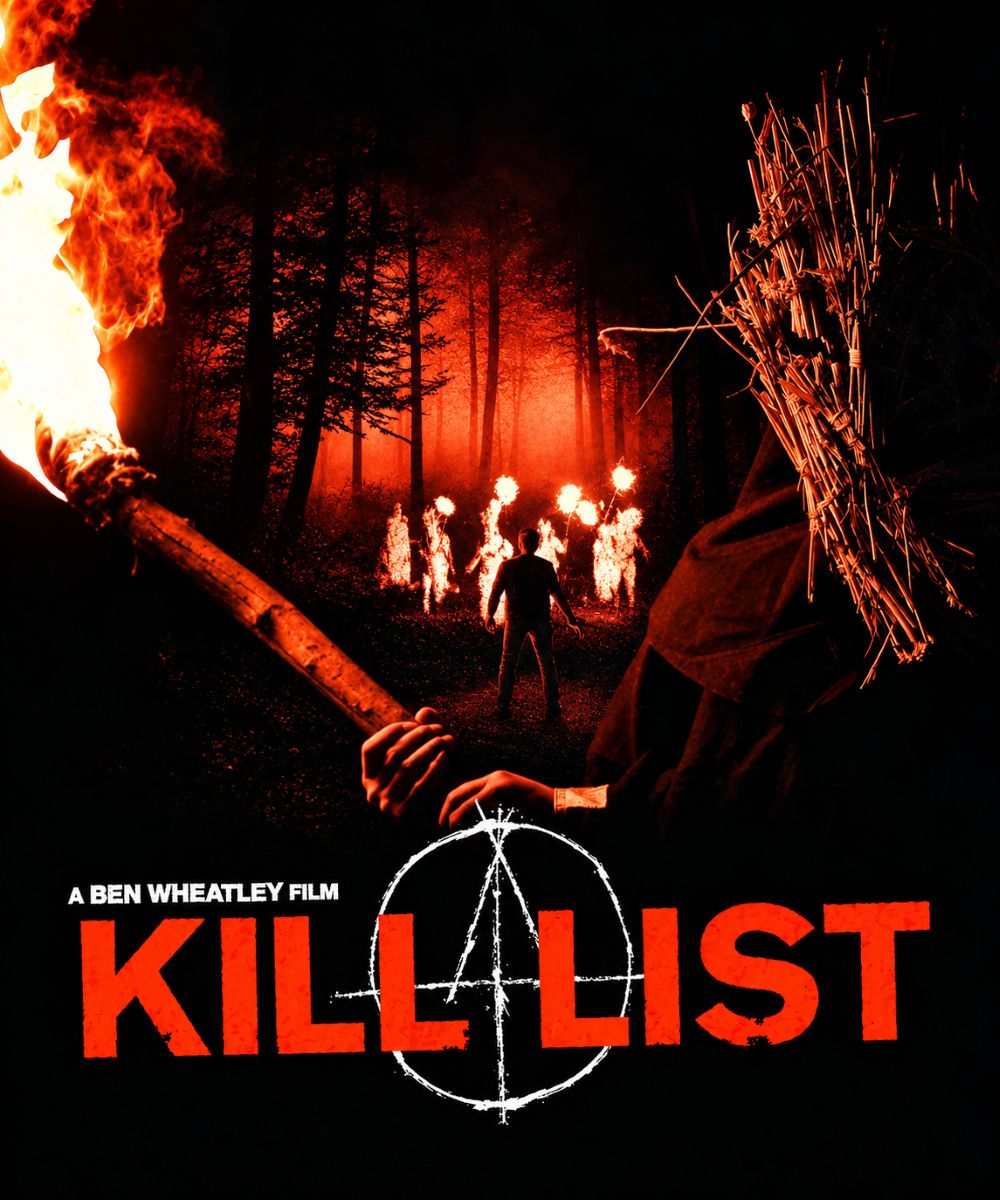
There is something especially unsettling about a horror film that refuses to let you know it is a horror film until you are already trapped inside it. Ben Wheatley’s Kill List begins in the familiar, grimy territory of a British crime thriller, but its slow, deliberate transformation into full-blown cosmic and folk horror makes it one of the most unnerving films of the 2010s.
Jay, a former soldier turned contract killer, has been out of work for months after a botched assignment in Kyiv. His wife Shel is fed up with his anger, his drinking, and his lack of direction. Their marriage is strained, their finances are collapsing, and their home feels less like a place of comfort than a pressure cooker waiting to explode. Rather than starting with a monster, a murder, or a flashy supernatural hook, Kill List starts with domestic tension. It places the audience in a home where every conversation feels like it could become a screaming match, and every small complaint seems connected to a much larger emotional wound.
That grounded, unpleasant realism is a huge part of why Kill List works so well. Wheatley does not rush to tell the audience what kind of movie they are watching. For a while, it plays almost like a rough, deeply uncomfortable British domestic drama, with the sort of bickering and passive-aggressive resentment that feels overheard rather than scripted. Jay and Shel’s arguments are messy, mean, and often funny in a dark way, while Jay’s friendship with his old colleague Gal has a lived-in quality. These are not glamorous movie hitmen trading cool one-liners. They are middle-aged men with bills to pay, bad tempers, old wounds, and a job they would probably rather not be doing if they had any other viable option.
Jay’s decision to accept a new killing contract with Gal initially pushes Kill List further into thriller territory. The assignment comes from a wealthy, unsettling client who hires them to eliminate three targets: a priest, a librarian, and a member of Parliament. That setup sounds straightforward enough, and Wheatley lets the film function for a time like a grimy, morally rotten crime thriller. Jay and Gal investigate their targets, plan their attacks, and move through a world of rural estates, anonymous offices, abandoned buildings, and shadowy back rooms. There is tension, but it is the tension of men entering dangerous situations without knowing whether they are being watched or manipulated.
What makes the film increasingly unnerving is that every target seems to know more than Jay and Gal do. The victims do not merely fear death. In some cases, they appear grateful for it. They refer to Jay as though he has been expected, almost as if he has been chosen for a role he does not understand. The priest calls him “the harbinger,” while the librarian thanks him after being killed. These details are not explained in a neat, comforting way. Wheatley plants them casually, allowing confusion to gather in the background while Jay becomes more violent, unstable, and paranoid.
That gradual descent is what makes Kill List so effective. It starts off more like a thriller, or even a bleak crime drama, but slowly makes its way into full-blown horror by the time the end credits begin rolling. The film does not suddenly flip a switch and announce that it has become a supernatural nightmare. Instead, it lets the atmosphere become stranger one scene at a time. A symbol appears carved into a mirror. A strange man silently watches from the woods. A dinner party turns from awkward to deeply hostile. A pair of masked figures emerge at the edge of a field. By the time the movie reaches its final stretch, the feeling is no longer one of criminal danger but of being trapped inside a ritual that began long before Jay understood he was involved.
Wheatley’s direction is crucial here. Kill List has a raw, handheld, low-budget immediacy that makes the violence feel especially ugly. There is very little stylization separating the audience from what is happening. The film is not interested in making murder look slick, cathartic, or exciting. When Jay attacks someone, it feels brutal, chaotic, and emotionally damaging. The violence is often sudden, but it is never casual. It leaves a stain on the scene, on the characters, and on the viewer. Jay’s behavior becomes increasingly alarming because his anger is not framed as toughness. It is framed as a dangerous loss of control.
Neil Maskell gives an excellent performance as Jay, a man whose emotional state is always sitting somewhere between numbness and eruption. He is not an easy protagonist to like, and that is part of the point. Jay can be cruel, childish, frightening, and self-destructive. Yet Maskell also makes him feel recognizably human, especially in the quieter moments with his son, Sam. Those scenes matter because they give the final act its real emotional weight. Jay is not just a professional killer being targeted by an unknown force; he is a husband and father whose damaged life is about to be pulled into something far worse than a failed job.
Michael Smiley is equally strong as Gal, who initially comes across as the more stable, reasonable half of the duo. He is calmer than Jay, more socially functional, and less openly volatile. But the movie gradually reveals that Gal has his own weaknesses and blind spots. Their friendship feels genuine, even when it is poisoned by secrecy, resentment, and the increasingly bizarre circumstances surrounding the contract. MyAnna Buring also deserves credit as Shel. She could have easily been reduced to the stereotypical nagging wife in a lesser film, but Buring makes her sharp, vulnerable, manipulative at times, and visibly exhausted by the life she shares with Jay.
The horror in Kill List becomes especially potent because it draws from both cosmic and folk-horror traditions without fully settling into either one. The cult imagery, hidden rituals, strange symbols, rural landscapes, and anonymous masked figures all give the film a folk-horror texture. There is a distinctly British unease to the countryside in the final act: fields that should feel open instead feel isolating, and a rural community becomes a place where ancient, secretive violence can exist just out of sight. At the same time, the movie’s cosmic-horror side comes from the sense that Jay has stumbled into a system too vast and unknowable for him to comprehend. He thinks he is taking a contract. In reality, he may be participating in a process that has been designed around him from the beginning.
That sense of predestination is one of the film’s most disturbing qualities. Kill List never overexplains the cult, its beliefs, or exactly how much control it has over the characters’ lives. Some viewers may find that frustrating, especially because the ending refuses to provide a clean mythology or a tidy resolution. But that ambiguity is also why the film lingers. The cult is scary not because the audience receives a detailed rulebook, but because its reach appears to be everywhere. It can infiltrate a job, a social gathering, a family home, and even the choices Jay believes he is making freely.
The ending is famously shocking, but it is not shocking only because of its cruelty. It works because the movie has carefully built Jay into a man who responds to fear with rage and violence. The final revelation turns that trait against him in the most devastating possible way. It is bleak, tragic, and almost mythic in its nastiness. The final image does not feel like a twist for the sake of a twist. It feels like the horrifying completion of a ritual that the audience has been watching take shape without fully recognizing it.
Kill List is not a comfortable watch, and it is not a horror movie that tries to please the audience with easy scares or a reassuring explanation. Its slow burn can feel deliberately abrasive, especially in the early domestic scenes, but that patience pays off. Wheatley takes a grim thriller about two hitmen and gradually transforms it into a nightmare of conspiracy, fate, cult ritual, cosmic dread, and folk-horror menace. By the end, the film has moved so far from its seemingly familiar premise that it feels like the ground has disappeared beneath it. That is what makes Kill List so memorable: it does not simply become horrifying. It reveals that horror was there all along, hiding inside every uneasy conversation, every unexplained symbol, and every choice Jay thought was his own.

