“I was born to murder the world.” — William Nix
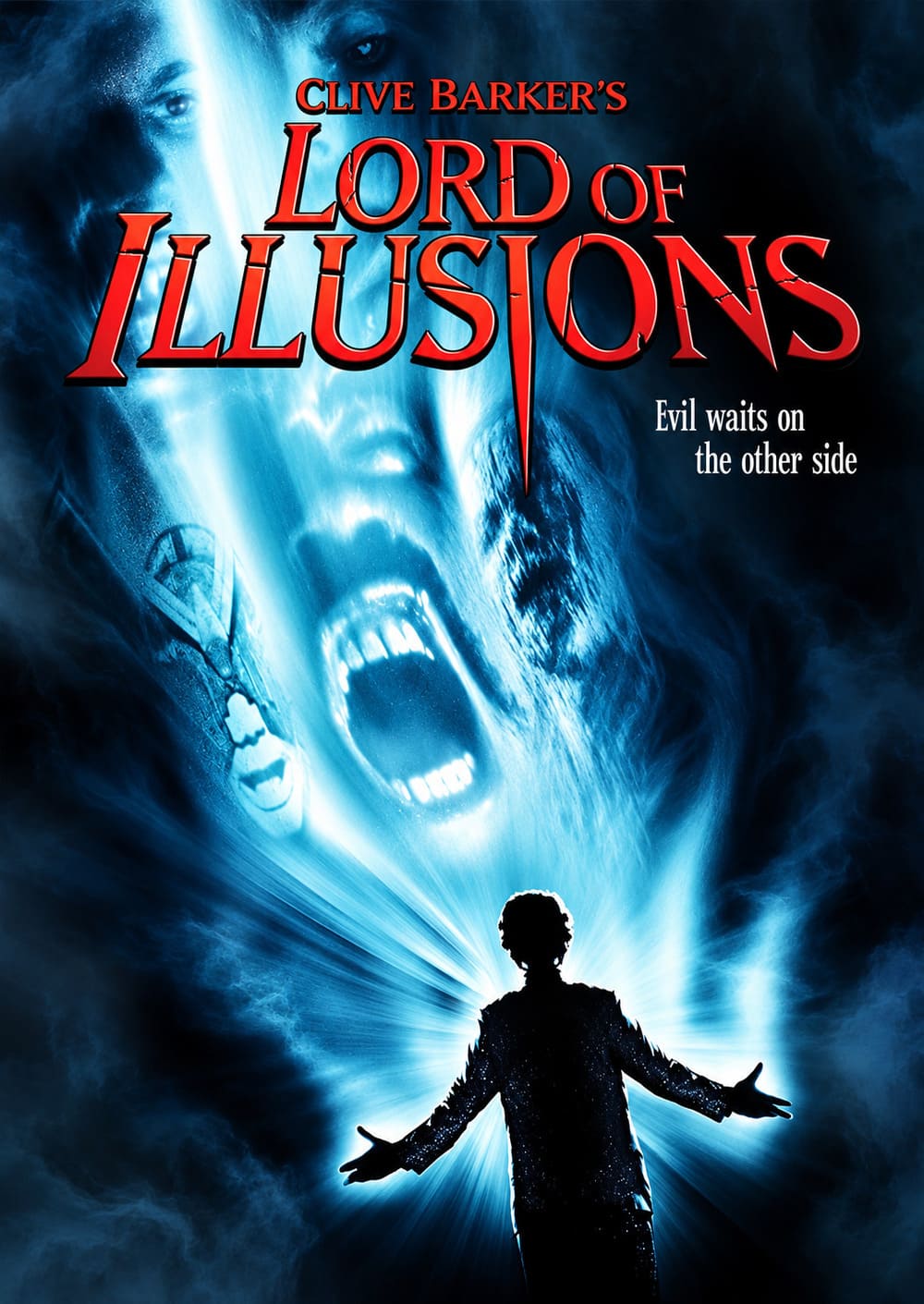
There’s a version of Lord of Illusions that exists only in Clive Barker’s head, and it’s probably a masterpiece. The version that actually made it to theaters in 1995 is something else entirely: a fascinating, frustrating, occasionally brilliant mess of a movie that tries to fuse film noir with cosmic horror and only partially succeeds. Barker wrote and directed the film based on his own 1985 short story The Last Illusion, and while he clearly understands the material better than anyone else could, his direction is surprisingly by the numbers, playing it safe when the source material practically begs for supernatural insanity.
The plot, such as it is, kicks off with a prologue in 1982 at a Mojave Desert cult compound run by a genuinely terrifying figure named William Nix, played with unsettling intensity by Daniel Von Bargen. Nix calls himself “The Puritan,” which is a nice bit of irony given that he’s basically Charles Manson with actual supernatural powers, and he’s about to sacrifice a young girl when a group of his own followers, led by a man named Philip Swann, stage a violent coup. They shoot Nix, screw an iron mask onto his face, and bury him in the desert, assuming that’s the end of it. It’s a strong opening, full of the kind of visceral, apocalyptic imagery that Barker does better than almost anyone, and it sets up a genuinely intriguing mystery about what happened to this cult and why its members turned on their leader.
Thirteen years later, we meet Harry D’Amour, a New York private detective played by Scott Bakula, who has a habit of stumbling into the supernatural the way other noir detectives stumble into dames with secrets. Harry gets pulled into a case in Los Angeles that leads him to Swann, now a world-famous illusionist, and his wife Dorothea, played by Famke Janssen, who seems to know more about the danger lurking around her husband than she’s letting on. When Swann dies on stage in a spectacularly grisly accident involving suspended swords, Harry finds himself drawn deeper into a world where the line between stage magic and genuine sorcery has been blurred past the point of no return. The investigation takes him through a strange subculture of professional magicians, each with their own secrets and rivalries, and gradually reveals that Swann’s death was not an accident but the opening move in a larger, darker game.
What works best about Lord of Illusions is its atmosphere. Barker has always had an eye for the grotesque and the baroque, and here he leans hard into the noir trappings to ground the supernatural stuff in something that feels almost noir-ish in its fatalism. Harry D’Amour is a classic archetype, a rumpled, world-weary guy who’s seen too much but keeps going anyway, and Bakula plays him with a likable, low-key charm that keeps the film from drowning in its own self-seriousness. The Los Angeles setting is used well, too, with the stark contrast between the sun-drenched surface and the darkness lurking beneath feeling very much in line with classic noir like Chinatown or The Long Goodbye. The film’s visual palette is appropriately moody, all shadows and neon and rain-slicked streets, and there are moments where it genuinely feels like it could be a lost noir from the 1940s, just with more blood and occult symbolism.
The thing is, though, Barker’s directing here is quite by the numbers. He knows the material inside and out, obviously, since he wrote the short story and the screenplay, but as a director he plays it safe instead of leaning into the supernatural insanity of the source material. There’s nothing wrong with the film on a technical level, but there’s also nothing that really grabs you by the throat the way Barker’s best work does. It’s competent, it’s professional, and it’s ultimately a little bit forgettable in a way that a Clive Barker movie really shouldn’t be. For a filmmaker whose whole reputation is built on pushing boundaries and going places other horror directors won’t, Lord of Illusions feels oddly restrained, like Barker was holding something back.
And that’s what makes the film so bewildering. Barker definitely knows how to direct a film that matches the over-the-top imagery and narrative of his source material. If his work on Hellraiser is any indication, he’s more than capable of translating his own literary excesses to the screen with style and confidence. Hellraiser is a film that fully commits to its own weirdness, that doesn’t apologize for its cenobites or its flesh-and-blood aesthetics or its genuinely transgressive themes. It’s a movie that knows exactly what it is and leans into it with everything it’s got. So why does Lord of Illusions, which comes from a story that’s every bit as strange and ambitious as The Hellbound Heart, feel so much more pedestrian? It’s not a question of budget or resources, because Lord of Illusions actually had a bigger budget than Hellraiser. It’s not a question of experience, because Barker had already directed one genuinely great film by this point. It’s a question of nerve, and for whatever reason, Barker just doesn’t seem to have the same nerve here that he did with Hellraiser.
Would leaning harder into the weirdness have made the film better? Maybe, maybe not. But here’s the thing: like most of Barker’s stories, Lord of Illusions works best when it goes over the top. Barker’s whole deal as an artist is excess. His best work, whether it’s The Hellbound Heart or Weaveworld or The Great and Secret Show, is unapologetically maximalist, throwing ideas at the wall with reckless abandon and trusting that the sheer force of imagination will carry the reader through. The short story The Last Illusion is no exception. It’s a wild, hallucinatory piece of work, full of reality-bending weirdness that feels like it could have been a genuinely unhinged horror film in the right hands. The movie version sands off a lot of those rough edges in favor of something more conventional, and while that makes the film more accessible, it also makes it less memorable.
The film’s biggest problem, and it’s a substantial one, is its pacing and structure. Barker has always been a writer with more ideas than he knows what to do with, and Lord of Illusions is stuffed to the gills with concepts and imagery that never quite cohere. The theatrical cut, which runs about 109 minutes, is notoriously choppy, jumping from scene to scene with a kind of frantic energy that leaves the audience scrambling to keep up. Characters appear and disappear without much explanation, plot threads are introduced and abandoned, and the whole thing has a rushed, unfinished quality that makes it feel like a much longer film that was hacked down in the editing room. There’s a director’s cut that runs about 121 minutes and restores a lot of the character development and thematic material, and while it doesn’t magically turn the film into a masterpiece, it does make it feel considerably more coherent. If you’re going to watch Lord of Illusions, do yourself a favor and track down the director’s cut. It won’t fix all the film’s problems, but it at least gives you a better sense of what Barker was going for.
The performances are a mixed bag in a way that’s almost charming. Bakula is genuinely good as Harry, bringing a kind of earnest decency to a role that could easily have been a Bogart impression. He’s not the most hard-boiled guy in the world, but that’s part of the point; Harry D’Amour is a detective who keeps finding himself in supernatural situations not because he’s special but because he’s unlucky, and Bakula sells that beautifully. He’s the kind of guy you’d want on your side in a crisis, even if he’s not entirely sure what he’s doing half the time, and that makes him a surprisingly effective audience surrogate for a film this strange.
Famke Janssen, in one of her earliest major roles, is somewhat underused as Dorothea, but she has a presence that makes you wish the film had given her more to do. She’s got the kind of old-Hollywood glamour that fits the noir aesthetic perfectly, and there are hints of a much more interesting character buried in there somewhere. Kevin J. O’Connor as Swann is the weak link; he’s supposed to be a charismatic showman hiding a dark secret, but he mostly comes across as twitchy and unfocused, which undercuts the tragedy of his character. The real standout among the supporting cast is Barry Del Sherman as Butterfield, one of Nix’s acolytes, who brings a genuinely unsettling energy to every scene he’s in. He’s the kind of henchman who seems like he’s enjoying himself a little too much, and that makes him far more memorable than the film’s actual villain.
Then there’s Nix himself. Barker has said that he deliberately made Nix uncharismatic, wanting to subvert the expectation of the magnetic cult leader by making him genuinely pathetic and repellent. The intention, clearly, was to evoke the real-world evil of figures like Jim Jones and Charles Manson, those charismatic monsters whose power came from their ability to bend other people’s wills to their own. It’s an interesting idea in theory, a deliberate rejection of the idea that evil has to be seductive to be dangerous.
But here’s the thing: it doesn’t really work. Nix is meant to be a Jim Jones or Charlie Manson type of evil, a man whose sheer force of personality could convince people to hand over their lives and their sanity, but he comes off as uninspired instead. Von Bargen is a fine actor and he does what he can with the role, but the character as written lacks the magnetic pull that made those real-life figures so terrifying. He’s not a seducer, he’s not a manipulator, he’s just a guy in a mask shouting about being a god. The film tells us he had followers, tells us he was dangerous, but it never really shows us why anyone would have followed him in the first place. And that’s a problem, because if you’re going to build a horror movie around a cult leader, the one thing you absolutely have to nail is the cult leader’s charisma. Nix should be the kind of villain who makes your skin crawl because you can almost understand why people fell under his spell. Instead, he’s just a snarling figurehead.
The film’s climax, where Nix is resurrected and goes on a rampage, is where the movie loses a lot of its goodwill. The special effects, which were probably decent for 1995, have not aged well, and the sequence where Nix buries his followers in the desert via a torrential downpour is more silly than scary. The famous “Origami Man” chase sequence, where Harry is pursued by a creature made of folding paper and a dog made of fire, is similarly unconvincing, looking more like a mid-90s CD-ROM cutscene than anything genuinely threatening. It’s the kind of scene that probably looked great on paper but just doesn’t work in execution, and it ends up undermining the film’s attempts at genuine dread.
And yet, despite all its flaws, I can’t bring myself to dismiss Lord of Illusions. There’s something genuinely compelling about a film that tries this hard to be something different, to blend genres in a way that studio horror almost never does. Barker’s vision, even when it’s undercut by dated effects or its own uneven execution, is always interesting. The film’s central idea, that the difference between a magician and a sorcerer is the difference between someone who entertains and someone who actually traffics with dark forces, is a genuinely good one, and the way it plays out through Swann’s character arc is the film’s strongest thematic thread. Swann, who possesses real power but chooses to use it for fame and fortune, is a more interesting figure than the film sometimes knows what to do with. His decision to hide his abilities behind the veneer of stage magic feels like a commentary on something, maybe on the compromises artists make, maybe on the way we all hide the parts of ourselves that are too dangerous or too strange for polite society.
The first two-thirds of the film, with Harry navigating the strange world of professional magicians and slowly uncovering the truth about Swann and Dorothea’s past, is genuinely engaging. It’s when the film shifts into full-on horror mode that it loses its footing, trading atmosphere for spectacle in a way that feels like a concession to the genre’s demands rather than a natural progression of the story. That’s a shame, because the noir elements are what make Lord of Illusions feel unique. There are plenty of horror films about cults and demons and dark magic, but there aren’t many that approach those subjects through the lens of a hard-boiled detective story, and the tension between those two modes is what gives the film its distinctive flavor.
In the end, Lord of Illusions is entertaining enough for what it is, but it’s hindered by a filmmaker well-known for swinging for the fences who, for some reason, holds himself back here when the source material, one he himself wrote, pretty much begs for it. This isn’t a movie that swings and misses; it’s one that never really swings at all, settling for competent when it could have been fearless.