“It does not surprise me that the Devil is an Irishman. Though I thought perhaps he might be a bit taller.” — Friend
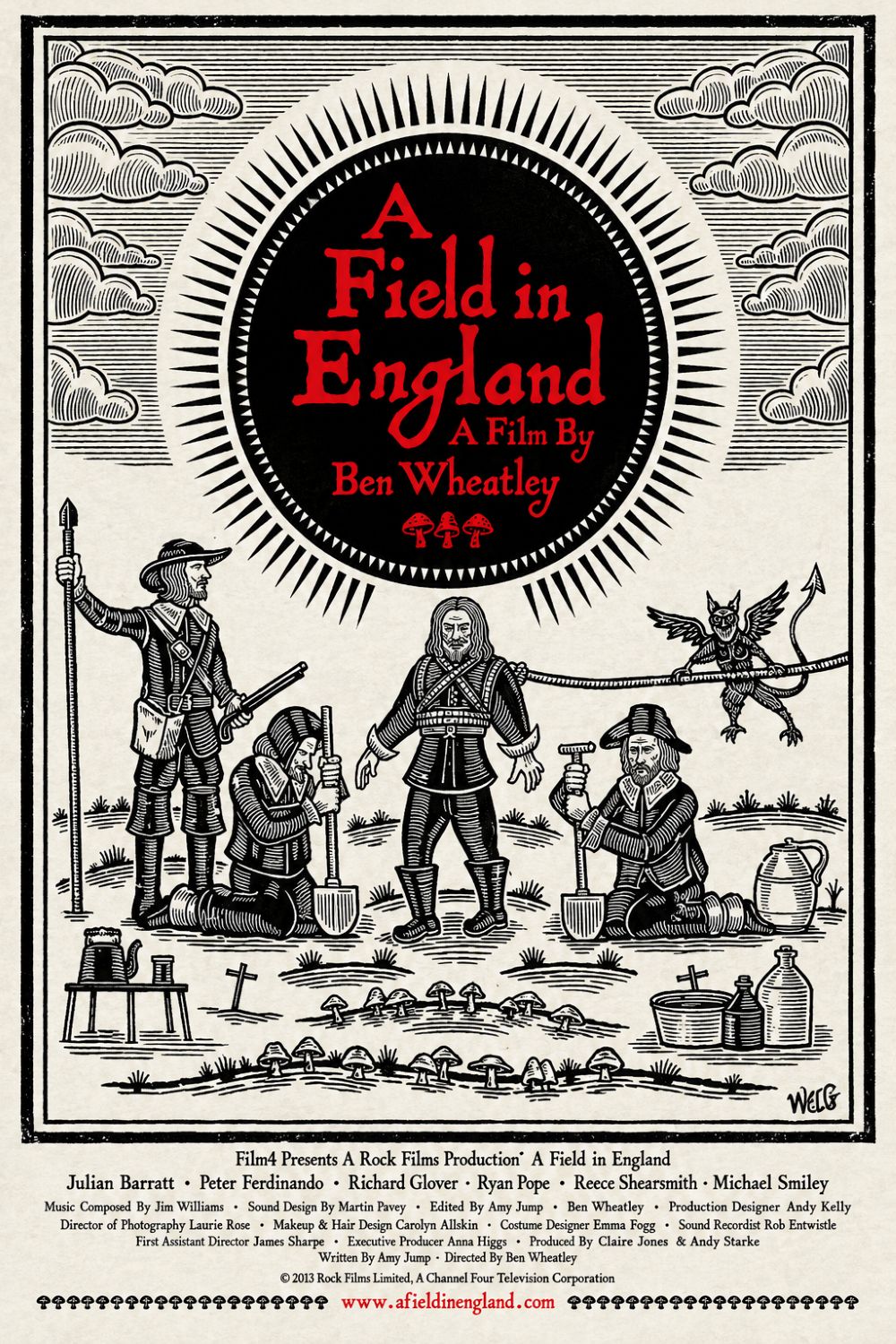
There is something deeply unsettling about a horror film that takes place almost entirely in broad daylight, and A Field in England uses that unease to devastating effect. Ben Wheatley’s 2014 release is a black-and-white nightmare about deserters, mushrooms, occult power, buried treasure, and men slowly losing whatever grip they had on reality. It is cryptic, abrasive, occasionally funny, deliberately repetitive, and sometimes so visually and sonically intense that it feels less like watching a film than being trapped inside a bad trip with several deeply unpleasant Englishmen.
Set during the English Civil War, A Field in England begins with Whitehead, played by Reece Shearsmith, fleeing an unseen battle. He is an educated man and an apprentice to an alchemist, although he is not particularly brave, heroic, or prepared for the chaos around him. Whitehead soon falls in with a small group of deserters: the blunt Cutler, the nervous Friend, and the worldly Trower. Their immediate goal is basic survival. They want food, ale, somewhere safe to rest, and preferably no more involvement in the war. Naturally, things do not work out that way.
The group crosses an enormous field and encounters O’Neill, played with unnerving authority by Michael Smiley. O’Neill is an alchemist, a manipulator, and possibly something more supernatural. He claims there is treasure buried in the field and forces the men into helping him dig for it. From there, the story gets progressively stranger, particularly after the men consume mushrooms that may or may not be supernatural in origin. The film’s central question is never simply whether the characters are hallucinating. Wheatley keeps pushing the viewer toward a more uncomfortable possibility: what if the hallucinations are revealing something real?
That ambiguity is the movie’s greatest strength and its biggest obstacle. A Field in England gives the audience fragments rather than firm answers. There are references to stolen papers, alchemical knowledge, magical control, a rival master, buried riches, and rituals that may have been going on long before these men stumbled into the field. But Wheatley and screenwriter Amy Jump never stop to explain the rules. The field seems both ordinary and impossible. It is a place where history, warfare, class resentment, religious anxiety, superstition, and psychedelic terror all collapse into one ugly patch of grass.
The setting is especially impressive because it is so limited. Much of the film takes place in one open field, but Wheatley makes that restriction feel like a trap rather than a budgetary compromise. The wide, empty landscape should offer freedom, yet it becomes increasingly claustrophobic. There is nowhere to hide, no landmark to guide anyone out, and no real sense that walking away would accomplish anything. The field becomes a purgatory, a prison, and an altered state of mind all at once. The characters are technically outdoors the whole time, but they might as well be locked in a dungeon.
Laurie Rose’s black-and-white cinematography is essential to that effect. The movie is beautiful in a harsh, unfriendly way. The high-contrast images turn grass, clouds, trees, faces, and dirt into something almost mythic. Instead of giving the Civil War setting a polished historical-drama look, the monochrome photography makes it feel ancient and unstable, like a series of damaged photographs or illustrations pulled from a cursed old book. The lack of color also helps detach the film from realism. Blood, mud, sweat, and the field itself lose their normal visual identity, making everything feel one step removed from the world the audience recognizes.
The film’s most famous stylistic choices arrive during its hallucinatory stretches. Wheatley uses strobing images, freeze frames, abrupt flashes, distorted sound, overlapping dialogue, and violently fractured editing to turn the characters’ mushroom-induced breakdowns into sensory assaults. These sequences are not designed to be pleasant or even easily readable. At times, they are exhausting. That is clearly the point. The men are losing control of time, memory, language, and physical space, and the film wants the viewer to feel that disorientation rather than observe it safely from a distance.
This can make A Field in England a demanding watch. There are stretches where the characters repeat themselves, argue in circles, dig holes, pull ropes, or speak in riddles that do not immediately add up. Some viewers will probably find this fascinating, while others will feel that Wheatley is testing their patience for the sake of being weird. Both reactions are fair. The film occasionally comes close to mistaking opacity for depth. Not every bizarre image carries the same force, and the narrative sometimes feels like it is daring the audience to keep watching rather than drawing them in naturally.
Still, the performances keep the movie from floating completely away into abstraction. Shearsmith is especially good as Whitehead, whose intelligence does not save him from terror or humiliation. He plays the character as someone who desperately wants to understand the occult forces surrounding him but may be too frightened and compromised to confront them. There is something deeply sad about Whitehead’s weakness. He is not a clean-cut innocent, but he is also clearly outmatched by O’Neill.
Michael Smiley, meanwhile, is fantastic as O’Neill. He does not play the role as a standard screaming madman. That would be too easy. Instead, he is controlled, smug, and almost conversational, which makes him much more threatening. O’Neill treats cruelty like an intellectual exercise. He speaks as though he is always several steps ahead, and his certainty becomes frightening because nobody else in the film can confidently say whether he is a fraud, a sorcerer, or a man who has simply learned how to exploit frightened people. Smiley gives the character the exact kind of ugly charisma needed for a villain who may be entirely human but feels almost demonic.
The supporting cast also deserves credit. Peter Ferdinando, Richard Glover, and Ryan Pope give the film its rougher, more grounded energy. Their banter provides an odd kind of dark humor, especially early on, before the nightmare fully takes over. Wheatley has always had a talent for making people sound casually vicious and absurd at the same time, and A Field in England contains that familiar bite. These are not noble historical figures delivering grand speeches. They are exhausted, hungry, crude men trying to survive a war they barely understand.
What makes the movie linger is how it turns that survival instinct into something ugly. The field strips away the characters’ supposed identities. Religion, social rank, education, loyalty, and military allegiance all become flimsy protections. Whitehead may be literate and knowledgeable; O’Neill may possess real occult power; Cutler may be physically capable; Trower may seem more practical than the others. None of it guarantees safety. Everyone is vulnerable to fear, manipulation, and the possibility that they have walked into a place where ordinary rules no longer apply.
As horror, A Field in England is less interested in jump scares than spiritual contamination. It is about the horror of not knowing whether you are seeing reality, madness, divine punishment, or the Devil at work. Wheatley uses the English countryside not as a comforting pastoral image, but as something ancient, indifferent, and possibly hostile. The movie shares some DNA with folk horror, but it is rougher and less traditionally structured than something like The Wicker Man. It also has the psychedelic aggression of a 1960s or 1970s experimental film, filtered through Wheatley’s mean streak and dark sense of humor.
Ultimately, A Field in England is not an easy movie to love, but it is difficult to dismiss. It is too committed to its mood, too visually striking, and too full of uneasy ideas to be written off as empty weirdness. Wheatley makes the viewer work, and sometimes he pushes that demand to the point of frustration. But when the film locks into its nightmare rhythm, it is genuinely haunting. The sound design rattles around in your head, the images feel burned into your memory, and the field itself starts to seem like the kind of place you would never want to wander into alone.
For viewers who want a straightforward historical horror movie, A Field in England may feel like a punishing experience. For anyone willing to follow Ben Wheatley into a muddy, surreal, pitch-black vision of war, magic, and madness, it is one of the strangest British horror films of its era. It does not explain itself, it does not comfort the audience, and it definitely does not care whether everyone comes out of it satisfied. That stubbornness is exactly what makes it memorable.