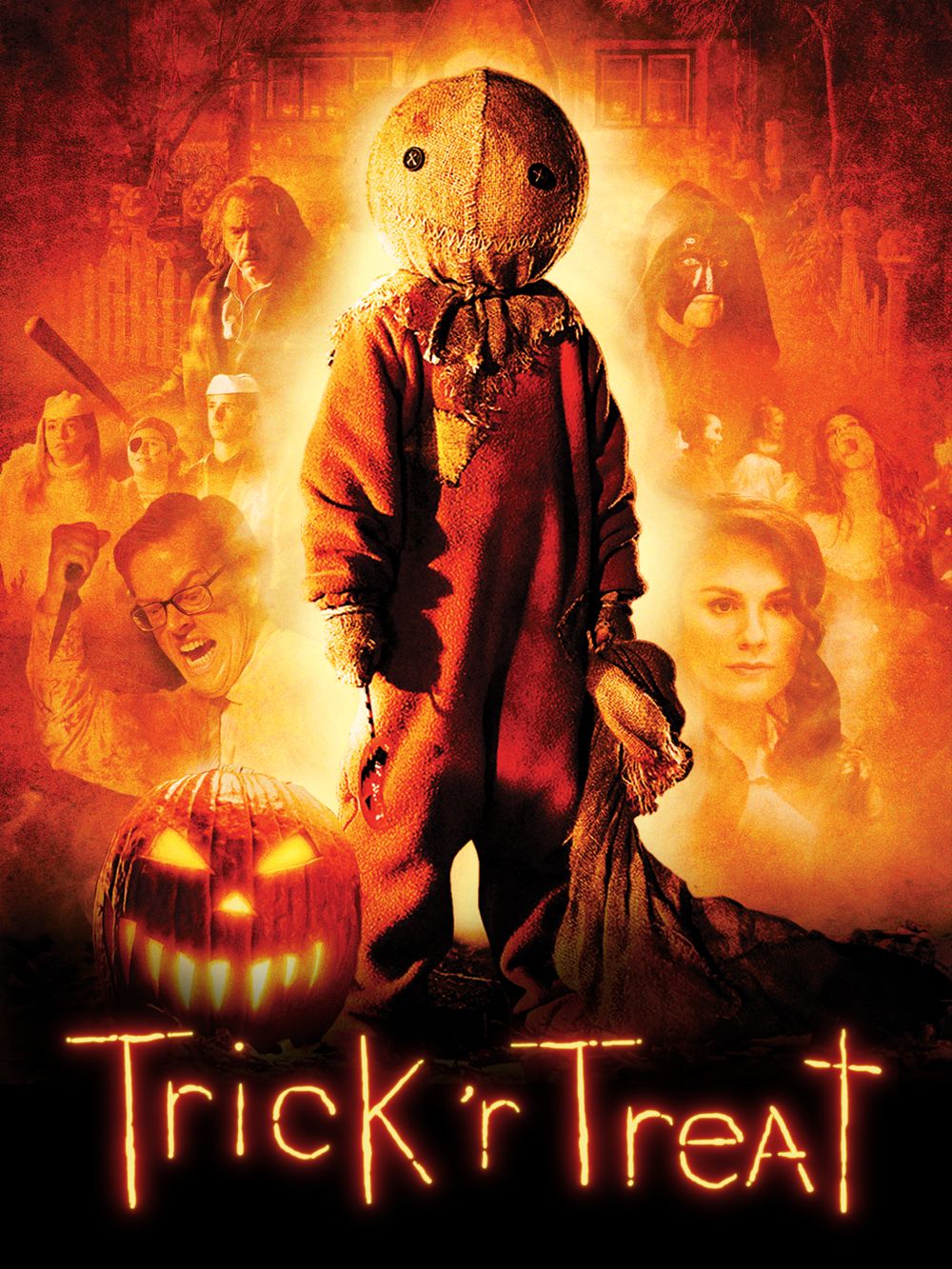
Horror Review: Trick ‘r Treat (dir. by Michael Dougherty)


“All these traditions, jack-o’-lanterns, putting on costumes, handing out treats, they were started to protect us, but nowadays… no one really cares.” — Principal Steven Wilkins

What better and more fun way is there to celebrate the full month of scares and horror that October has become than with Michael Dougherty’s 2007 film Trick ’r Treat? It is the kind of Halloween movie that feels less like it was merely set on the holiday and more like it was built out of everything people love about it. Trick ’r Treat has jack-o’-lanterns glowing on porches, costumes ranging from charming to grotesque, chilly nighttime streets, old local legends, candy bowls, haunted-school-bus stories, werewolves, serial killers, and that ever-present feeling that something is watching from behind a tree. It is funny, nasty, creepy, and strangely cozy at the same time. More than almost any modern horror film, it understands Halloween as a whole atmosphere rather than a collection of familiar props.

At first glance, the movie looks like an anthology film. It is divided into several distinct stories with their own central characters, premises, and horror styles. One segment involves a principal with a murderous secret, another follows a group of kids investigating a grim local legend, another centers on young women looking for dates at a costume party, and another focuses on a bitter old man dealing with a small but persistent visitor. Each story could almost function as its own short horror movie. Dougherty clearly enjoys shifting tones, moving from slasher material to ghost-story melancholy, then into monster-movie lunacy and dark comedy. But the key difference is that Trick ’r Treat is not simply an anthology stitched together by a host or a framing device. Every story told in the film ties into an overarching story unfolding across one night of Halloween.

That structure is one of the movie’s smartest features. Characters drift in and out of one another’s narratives, sometimes briefly and sometimes in ways that completely change the audience’s understanding of what they have already seen. A person who seems like a background extra in one sequence becomes the focus of another. A strange sound, a distant scream, a passing school bus, or a visual detail in one story can gain much more meaning when it reappears elsewhere. The movie plays with chronology too, allowing events to overlap and occasionally revealing that scenes which seemed straightforward were occurring at a different point in the night than viewers assumed. It rewards attention without becoming confusing for the sake of being clever.

Dougherty handles those connections smoothly because the film never stops feeling like one continuous Halloween night. The transitions are playful rather than showy. The camera may follow a character down a street, past a decorated yard, into another group’s story, and suddenly the audience has entered a different kind of nightmare. That makes the town itself feel like a character. It is not a generic horror-movie setting where bad things happen because the script requires them to. It feels like a community with traditions, buried crimes, local myths, annual rituals, and plenty of people who are either hiding something or about to discover something unpleasant.

The town’s Halloween obsession is also what gives the film its personality. Trick ’r Treat treats Halloween rules almost like ancient laws: wear a costume, hand out candy, never blow out a jack-o’-lantern before midnight, and always respect the dead. Breaking those rules does not guarantee immediate punishment in a simple moralistic way, but it certainly puts people at risk. The film’s central icon, Sam, embodies that idea. Wearing orange pajamas, a burlap sack mask, and carrying a lollipop that can become a weapon, Sam is one of the great modern horror mascots because he is both adorable and deeply unsettling. He is not presented as a typical slasher villain with a detailed backstory or a conventional motivation. He feels more like the living spirit of Halloween itself: mischievous, ceremonial, cruel when necessary, and completely devoted to the holiday’s traditions.

Sam’s presence gives the movie a connective thread beyond plot mechanics. He appears in the background, watches over events, and eventually takes center stage in a way that is both amusing and genuinely tense. There is something almost storybook-like about him. He resembles a child going door to door for candy, but his behavior suggests an old supernatural force enforcing rules everyone else has forgotten. The movie wisely never overexplains him. Horror icons often become less interesting once every mystery is reduced to lore, family trees, and exposition. Sam works because Dougherty lets him remain partly unknowable.

The cast is another reason the film holds together so well. Dylan Baker is excellent as Steven Wilkins, the seemingly mild suburban principal whose cheerful politeness becomes much more disturbing once the movie reveals what he is doing after dark. Baker has a talent for making every smile look just slightly too controlled. His storyline is especially effective because it mixes grotesque humor with an unsettling domestic quality. He is not stalking victims through a foggy forest or living in an abandoned asylum. He is cleaning up a mess in his backyard while trying to maintain a normal family routine. That contrast makes his scenes nastier and funnier.

Brian Cox brings real weight to Mr. Kreeg, the grumpy old man at the center of the film’s most memorable Sam-focused material. Cox could have played him as a broad caricature, but he gives the character enough fear, frustration, and hidden sadness to make the confrontation feel more substantial than a simple old-man-versus-monster sequence. The movie’s final act uses his house almost like a haunted maze, with the warm, cluttered interior gradually becoming a battlefield. The tone remains playful, yet there is a real sense of danger whenever Sam drops the cute disguise and shows what he can do.

Anna Paquin also stands out in the segment involving Laurie and her friends. At first, it seems like the film is setting up a familiar vulnerability narrative: young women in costumes, a dark forest, strange men, and the possibility of a predatory attacker. Then Trick ’r Treat gleefully twists expectations. The reveal is not subtle, but it is staged with enough energy and confidence that it lands as a crowd-pleasing monster-movie moment. Dougherty knows that horror does not always need to be grim to be effective. Sometimes the best reaction is an audience laughing in surprise right before a scene turns bloodier than expected.

The school-bus story is probably the film’s creepiest material. The idea of children killed by adults and returning as drowned, decayed figures could have been handled in a cheap or overly cruel way, but the movie gives it a sad, mythic edge. The ghosts are frightening, but the story is also about guilt, buried history, and a town that has allowed its ugliest secret to become a campfire legend. The children may be supernatural monsters by the time they reappear, but the adults who wronged them are even more horrifying. That is a recurring theme throughout Trick ’r Treat: Halloween monsters are dangerous, but human selfishness, cowardice, and cruelty tend to create the worst consequences.

Visually, the film has aged remarkably well because it does not chase a slick, overly polished look. It has a rich autumnal color palette full of oranges, blacks, deep reds, and warm porch-light yellows. The night scenes are dark enough to feel threatening but clear enough that viewers can appreciate the costumes, decorations, and production design. Every street seems covered in leaves, every house has candles or carved pumpkins, and every shadow seems capable of hiding a creature. It feels like a heightened version of childhood Halloween memories, except those memories have been invaded by murderers, werewolves, demons, and ghosts.

The practical effects and creature work add a lot to that charm. The movie uses CGI when needed, but it does not depend on weightless digital spectacle. Sam’s physicality, the werewolf transformations, the decayed school-bus children, and the various masks and props all have a tactile quality. They look like things that belong in a haunted attraction, a particularly elaborate costume shop, or an old EC Comics-style horror story. That handmade texture fits the film perfectly. Trick ’r Treat is polished, but it never feels sterile.

What makes the movie so rewatchable is how comfortably it moves between tones. It can be goofy without becoming stupid, gruesome without becoming exhausting, and sentimental about Halloween without turning saccharine. It embraces the holiday’s childish excitement while acknowledging the darker folklore underneath it. There is candy, costumes, and neighborhood fun, but there are also old grudges, punished sinners, restless dead, and things that hunt after midnight. Dougherty understands that those two sides belong together. Halloween is fun partly because it lets people play with fear in a safe, communal way, and Trick ’r Treat captures that balance better than most horror movies.

The film’s anthology-like design gives it variety, while its overlapping characters, recurring events, and shared setting make it feel like one cohesive story rather than a disconnected collection of shorts. Its lasting popularity has also made the lack of a sequel feel increasingly strange. Fans have been clamoring for another trip through Sam’s Halloween night for years, and Dougherty has repeatedly hinted that he has ideas for where a follow-up could go. He has discussed multiple script drafts, storyboards, concept art, and the possibility of giving Sam a new adversary, but the project still has not received an official greenlight.

That uncertainty is frustrating, especially because Trick ’r Treat feels like a world with plenty more stories left to tell. At the same time, it is probably better that Dougherty has not rushed out a sequel just to cash in on the film’s cult status. The original works because it feels carefully constructed, visually specific, and completely committed to its Halloween setting; any follow-up would need to preserve that same mix of horror, comedy, folklore, and interconnected storytelling. For now, Trick ’r Treat remains an annual October rewatch because it honors Halloween’s old traditions while creating its own: a funny, spooky, blood-soaked celebration of costumes, candy, campfire legends, and the things that come out once the porch lights go dark.


X-Men: Apocalypse Drops In With It’s Final Trailer


X-Men Apocalypse

20th Century Fox have to be feeling quite giddy and confident with their slate of blockbusters this summer. Deadpool slayed everyone that went up against it during it’s February release and has climbed the box-office charts to the levels I think even Fox executives couldn’t imagine.

Now comes it’s main comic book film property returning this summer with it’s biggest story, yet. X-Men: Apocalypse has been a storyline fans of the Marvel Mutants (not part of the MCU) have been clamoring for ever since the first X-Men film surprised everyone all the way back in 2000.

Bryan Singer returns for his 4th go-round with these new band of Merry Mutants (Hugh Jackman as Wolverine the only holdover from his original cast) with the immortal and first mutant En Sabah Nur aka Apocalypse up to no good. We get a bit more of the plot in this final trailer and even more city-wide destruction (I’ll give it a pass considering it’s being committed by someone called Apocalypse and not Superman).

X-Men: Apocalypse will bring the war on May 27, 2016

X-Men Apocalypse Super Bowl TV Spot


X-Men Apocalypse

The X-Men film franchise helped usher in the this golden age of comic book films. Looking back at those early films makes for a love them or hate them reaction. The first two helped establish the beloved characters onto the bigscreen while successive sequels and spinoffs did much to try and tear down the goodwill created by the former.

Matthew Vaughn helped in the franchise course correction with the surprisingly good X-Men: First Class. Bryan Singer’s return with that film’s follow-up with X-Men: Days of Future Past was another step in the right direction. It even marked the beginning of Fox’s attempt to replicate Marvel Studios’ cinematic universe building.

X-Men: Apocalypse is suppose to help build on the foundation laid down by the last film. It also looks to be a sort of reboot of the core characters to their much younger versions. The doomsday vibe of the film really comes off well in the trailer and it shows enough action to excite fans.

Then they show a great looking Psylocke using her psy-blade in a way it was never meant to be as. Just embrace books Fox. Just embrace it instead of mucking it up.

X-Men: Apocalypse will bring the war on May 27, 2016

Review: X-Men: First Class (dir. by Matthew Vaughn)


The name Matthew Vaughn should be familiar with comic book fans everywhere. In 2005, Vaughn was introduced as the director to replace Bryan SInger for the third film in the X-Men franchise. The news was met with some cautious optimism. This was a filmmaker who had quite the loyal and growing following for his work on Stardust and Layer Cake. Months after he was picked my 20th Century Fox news came down that he was backing out of the project due to personal reasons and the film scrambled for a replacement which ended up being Brett Ratner. History was made that day as the beginning of the franchise’s decline began and steep plummet which recently reached it’s nadir with 2009’s Wolverine: Origins.

It’s has now been five years since X-Men: The Last Stand made it to the big-screen and now we have a new film in the franchise. X-Men: First Class has a familiar name behind the director’s seat and it looks like Matthew Vaughn stayed this time around (after directing a smaller superhero film in Kick-Ass for 2010) to craft what could become the best film in the X-Men/Wolverine film franchise. This film is a prequel/reboot of sorts (more on that later) and brings a fresh set of eyes and take on the origin story of this franchise.

X-Men: Last Stand actually begins the film exactly how the first X-Men film began with the 1944 World War II concentration camp setting where a young Erik Lensherr (later to become Magneto) finally manifests his power over magnetic fields as he watches his parents torn from his side. The first film ended that sequence once Erik was knocked out, but this time around it continues with a mysterious man named Schmidt (aka Sebastian Shaw and played with James Bond villainous-flair by Kevin Bacon) taking great interest in Erik and his ability which Erik could only use during bouts of pain and anger. The film continues this slight change in the series’ origins by switching over to Westchester County and into the expansive home of a young Charles Xavier who finds a certain young, blue-skinned shapeshifter named Raven who he invites to stay and become his friend once he realized he wasn’t the only one who was different and with abilities.

These two sequences continue to move the film forward as the we see these two “leaders in the making” adults and trying to find their place in the world of the free-swinging lifestyle and the Cold War culture of the 1960’s. Charles Xavier (played like a well-meaning cad and good-natured naivete about the world by James McAvoy) is a student working on his doctorate in Oxford on genetic theories while his “sister” Raven (Jennifer Lawrence) accompanies him. This is a Xavier who still hasn’t found the patient benevelonce of Patrick Stewart’s Professor X and uses his considerable telepathic abilities to help him pick up on beautiful coeds instead. It’s during such a scene where we see Raven show just a hint of jealousy as Xavier tries his lines and moves on a beautiful British lass. It would seem Raven’s feelings for her ‘brother” may go beyond sibling affection though Xavier doesn’t see her as anything other than a sister for him to protect.

Erik Lensherr’s time as an adult was shown as having become a life of obsession over his treatment at the hands of the Nazi’s and those of Schmidt’s as he travels the world in search of escaped Nazi war criminals. Erik takes him throughout South America as he finds the trail of Nazis hiding out in that region since the end of the war. We see this adult Erik hardened by his anger and single-minded need for revenge on Schmidt and those he worked for. He’s not above using his abilities to kill in order to get the information he requires and there’s a hint of satisfaction when he does kill those he sees as responsible for his tragic upbringing with his magnetic abilities. These two adult sequences continues the film’s theme of the ideological difference between Xavier and Erik being formed through nature and nurture as their lives moved down diverging paths from an early beginning until it convergence for a small, brief period around the time of the Cuban Missile Crisis.

The film’s second act begins with Moira McTaggart (Rose Byrne), now a covert CIA Agent, investigating a certain Col. Hendry who she suspects as having betrayed the nation to the Soviets, but instead finds out that the true nature of Hendry’s associations were much more insidious and dangerous. The iconic Hellfire Club of the comics finally make their appearance with Schmidt who actually happens to be Sebastian Shaw (whose powers grant him the ability to absorb all kinetic energy which he uses to keep himself young and can release with explosive results), Emma Frost (January Jones) who’s a telepath with the ability to turn body in a sort of diamond-form, Riptide who can create tornado-like abilities and finally the demonic-looking Azazel whose ability to teleport might give people not well-versed in the “X-Men Universe” a clue as to one-half of parents who may be responsible for Nightcrawler in the second film.

X-Men: First Class spends much of this second act like it was Ocean’s 11 as Xavier and Erik get recruited by the CIA to find other mutants and create their own mutant team to counter Sebastian Shaw’s Hellfire Club and his goal of initiating World War III between the US and the USSR and thus destroy all of humanity and leave the planet for the mutants to rule over. Yeah, it is this part of the film’s plot which may strain the suspension of disbelief for some audiences who never grew up reading the comics, but it shouldn’t. Ian Fleming’s James Bond series used scenarios just as ludicrous with villains just as Machiavellian in the form of SPECTRE so X-Men: First Class and it’s world domination plans shouldn’t be too farfetched to fans of that British superspy and his adventures.

This middle section of the film is where X-Men: First Class actually begins to lag after a strong first act. I don’t know if the sequences of the new recruits training, bonding and learning how to use their powers could’ve been written to move much faster without losing some of the character building scenes. From how this second act played it seemed to look like scenes were actually cut out to try and keep the film from being too long (it’s final cut being just a tad over two hours already upon release), but I wouldn’t be surprised if the DVD/Blu-Ray release actually has a director’s or uncut version that actually expands this middle section to really give life to it instead of having it play out like a perfunctory training montage with a dash of character beats.

The film hits it’s action-film stride with the third and final act as Xavier and Erik’s team of young mutants must now use their abilities to stop Shaw and his Hellfire Club and at the same time prevent World War III from beginning and not freaking out the humans who are still unaware of their existence as a whole. It’s this third section which we see too much of it in the trailers and tv spots that one might say we’ve seen it all before we even see the film as a whole, but it still kept back a lot from those ads to make the whole final twenty minutes of the film thrilling and action-packed.

All of this could just mean that X-Men: First Class was just your run-of-the-mill superhero action film that we get on a yearly basis come summertime, but it’s a testament to Matthew Vaughn’s direction and the strength of the script by Vaughn, longtime collaborator Jane Goldman and Thor scribes Ashley Edward Miller and Zack Stentz that the film goes beyond being just an action film with all it’s sturm und drang coupled with fancy special effects. The previous films in the series always explored important cultural and moral themes that’s always been the bread-and-butter of the X-Men stories in the comic books. We just don’t see the film explore the ideological difference between Xavier’s peaceful co-existence between humans and mutants alike, but also we get more detail on why Magneto finally comes to the conclusion that war between humans and mutants was an inevitability and why his stance doesn’t fall under the aegis of being evil, but something that anyone could understand and even support whether one was human or mutant.

The story also doesn’t just pay lip-service to the idea of how mutants view themselves and how even within the mutant community there’s a visible rift between those whose abilities are invisible to the general population and those whose abilities and genetic mutation physically manifest themselves in such ways that to many might not look to appealing. This idea really gets a major exploration in the subplot involving Raven (soon to be Mystique), Hank McCoy and, to a certain degree, Xavier and Erik. We see how those like Xavier whose abilities don’t show in a physical manner have a sort of “don’t ask, don’t show” about those like Raven when it comes to their power when in public.

Raven (played beautifully by Jennifer Lawrence) is caught between Xavier who wants her to remain incognito so as not to shock the world too soon in realizing that mutants exists and that of Erik who sees Raven’s original blue-skinned form as beauty and perfection and how she should never hide who she truly is. This tug and pull between her two mentors makes for a convincing subplot in how Raven comes to the conclusion which would take her to the side of Magneto in later films, but also highlight how the two sides in later films have so much intertwining bonds of friendship and relationship that seeing them against each other becomes a tragedy on its own. Civil wars are not just a thing of humans but those who sees themselves apart from them.

The great performances by most of the leads add to the film’s strength. McAvoy and Fassbender, at first, look to be unconvincing in terms of their appearance as the younger versions of Patrick Stewart and Ian McKellen, respectively. This becomes a non-issue once they’ve established themselves through their performances which gives new layers to the personalities of Professor X and Magneto. Many people always saw these two as the comic book version of Martin Luther King, Jr and Malcolm X, but that’s an oversimplification. The film and the performances by McAvoy and Fassbender digs deeper into both their characters’ motivations and ideologies and how their past experiences and upbringing couple with their time together as brothers-in-arms and friends show more about these two than just being mutant-proxies of MLK and Malcolm X. The other young mutants do an adequate enough job that they don’t seem lost in the film. Nicholas Hoult as the young Hank McCoy and how he plays off Lawrence’s Raven during their little subplot in the film is one stand-out that I hope gets explore even more in any follow-up sequel.

There’s a nice burgeoning young love chemistry between him and Lawrence as Beast and Raven that doesn’t seem too tacked on to create a the prerequisite love couple in any film. Their common trait of having physical mutations and how they seem to both feel apart even from their fellow mutants develop their characters in ways the previous films in the series never did. They never want to rid themselves of their mutant powers. They just want to look normal and still keep their abilities. It’s a having your cake and eat it too mentality that has some surprising results for both Raven and Hank.

X-Men: First Class has had some fans of the series put in a very difficult situation. The film definitely is a prequel to the previous films, but it also does a major time in rewriting continuity in the series. I was one of those fans and thought it would ruin the film in the context of the franchise. I’m surprised that in the end I didn’t really care and actually hope that this film actually is a reboot of the franchise. I see this film and forget the previous three as being part of it. This film was just too good and fun in it the end for continuity issues to become the major flaw that sinks it. I liken this film as similar to Christopher Nolan rebooting the Batman film franchise. That film honored the contributions to the character, but went on it’s own way to tell that character’s tale. I see Vaughn doing the same with this film. He has done something which many thought was a near-impossible task and that’s make the X-Men franchise relevant once more in a pop-culture landscape that seems to have left the franchise behind after the disastrous Wolverine: Origins of 2009.

This film delivered on the ideas that made the comic books so beloved by millions of fans for almost a half-century. It made great use of the 1960’s time and setting to tell a story of these characters beginnings as heroes and villains (though the latter shouldn’t be seen as them being truly just evil bad guys). Even the inclusion of real-world historical event like the Cuban Missile Crisis was a nice touch which gave the film a foundation in realism. Again, this film played off like a superhero, Marvel version of an Iam Fleming James Bond story. For those who are huge fans of the previous films there’s even two brief cameos of those films two favorite characters that appear in this film. They don’t come off as cheesy and unnecessary and actually come off as great additions. I won’t mention who these cameos were but the audience’s reaction to them was very vocal and very positive. I say the same should be said for X-Men: First Class as a film that resuscitates the franchise.

X-Men: First Class (2nd Official Trailer)


Today we saw the release of the second official trailer for the upcoming X-Men prequel/reboot helmed by British director Matthew Vaughn.

X-Men: First Class looks to show the early days when Professor X and Magneto were still friends and allies instead of the adversarial relationship they had in the first three films in the franchise. This new trailer shows more of the characters who will be involved in this film. It also shows the mutants and their powers in action. I must admit that I wasn’t too thrilled with the previous trailers shown about this film, but this latest shows more action and finally reveals it’s summer blockbuster pedigree. The sequence with Magneto lifting the submarine out of the water was really cool.

It’s still not the superhero film this summer that tops my must-see list, but this trailer has put this film in the running as one of the films I must-see.

X-Men: First Class is still slated to have a June 3, 2011 release.