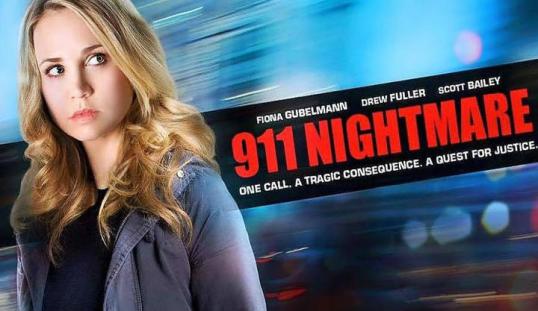
Cleaning Out The DVR: 911 Nightmare (dir by Craig Moss)


911

It’s amazing how quickly a DVR can fill up.  Just a few weeks ago, as December came to a close, I went through my DVR, watched a lot of Christmas movies, and cleared up about 30 hours of space.  At the time, I was pretty proud of myself but now, a month later, I find myself once again in the same situation.  I am running out of space.

In other words, it’s time to clean out the DVR yet again.

I got things started by watching 911 Nightmare, which premiered on the Lifetime Movie Network on January 10th.  And let’s give credit where credit is due.  That is a brilliant title, especially for a Lifetime film.  It not only promises a nightmare (perhaps even a sexy nightmare) but it also promises so much danger that someone is going to have to call 911.  A sexy nightmare and danger?  How can I say no to that!?

(According to the imdb, this film was originally called Dispatch.  911 Nightmare is a clear improvement.)

Anyway, as for the rest of the film, it tells the story of Christine McCullers (Fiona Gubelmann).  When we first meet Christine, she’s a cop and she’s carrying on a family tradition of law enforcement.  However, when she gets cornered by a perp (that’s right, I said “perp” because I love to use that official police talk) in an alley, her partner gets a bullet in the head and Christine gets a bullet in the leg.

Now wearing a big ugly brace and moving with a pronounced limp. Christine is working as a 911 operator.  One night, a call comes in.  Christine answers.

“911,” she says.

“The boogeyman is here!” a little kid says.

Christine tells the kid to get some sleep and to stop playing pranks and she threatens to tell his parents what a bad son they have.  She hangs up on the kid and, as a result, the kid’s best friend is murdered…

And I have to admit that this is where I kind of lost interest in 911 Nightmare.  The rest of the film deals with Christine trying to solve the murder and we’re clearly supposed to feel sorry for her because everyone is blaming her for what happened but you know what?  She deserves to be blamed because she messed up!  The film goes out of its way to convince us that Christine made an understandable (if unfortunate) mistake but it never quite convinces us.

Perhaps it would have worked better if the kid had been attacked while he was on the phone with Christine and killed before the police arrived.  And maybe then the police could try to blame Christine for their own failure (and certainly, they would point to her previous wounding in the line of duty as proof of her incompetence).  Then you would really root for Christine.

But no.  Christine is terrible at her job and it’s difficult to really root for a character who screws up that badly.  There’s a scene where Christine views all of the mean comments that have been posted about her online and it was probably a bad sign, as far as the film’s effectiveness was concerned, that I agreed with almost every single comment.

Anyway, Christine does go on to investigate the murder and, since this is a Lifetime movie, she also gets a boyfriend during the course of her investigation.  Good for her.  Unfortunately, however, the film fell apart as soon as she told that kid to go back to sleep.

Lisa Reviews An Oscar Nominee: For Whom The Bell Tolls (dir by Sam Wood)


For_whom_movieposter

After I watched The Pride of the Yankees, it was time to watch For Whom The Bell Tolls on TCM.  Based on the classic novel by Ernest Hemingway, the film version of For Whom The Bell Tolls was released in 1943 and, when I first started watching it, I was a little bit worried.

For, you see, For Whom The Bell Tolls is an extremely long film.  It’s a film that takes its time.  It’s also a very talky film and I have to admit that one reason I was worried was because the movie started at 11:30 and it was scheduled to last until 2:15 a.m.  Oh my God, I wondered, as the film started to slowly play out before me, am I going to end up dozing off before this is finished?

Well, I need not have worried.  Yes, For Whom The Bell Tolls does take a while to get started but it all pays off in the end.  By the time the film concludes, you realize why it had to take its time and why we had to spend so much time listening to these characters talk about what they did in the past, why they’re doing what they’re doing in the present, and what they’re hoping for in the future.

Not that all of the characters have a future.  At the start of the film, Robert Jordan (Gary Cooper) gets his palm read by Pilar (Katina Paxinou).  Pilar refuses to tell him what she saw in his future but it’s not difficult to guess.  Robert is on a suicide mission and everyone knows it.  Even when he falls in love with the beautiful Maria (Ingrid Bergman), he does so with the knowledge that he’ll be dead in just a few days.

Robert is an idealistic American who, as the film opens, is in Spain.  It’s the 1930s and Spain is embroiled in a civil war between fascists and guerrillas … well, if you’ve read Hemingway’s novel, you know that the guerrillas are communists.  But this is a Hollywood film so, for the most part, we don’t hear much about ideology.  But, then again, audiences in 1943 undoubtedly remembered the Spanish Civil War and understood that the guerrillas were fighting the forces of Gen. Francisco Franco.  And, for audiences today, all that matters it that the guerrillas are trying to overthrow a government.  Seriously, who doesn’t want to see the government overthrown?

(Full disclosure:  My grandmother on my mother’s side came to this country from Spain and frequently insisted that Franco had not been that bad.  At the time, not knowing one way or the other, I usually just smiled and nodded.)

Robert is fighting on the side of the guerrillas.  In four days, a major offensive is going to be launched against the fascists and, in order to keep fascist forces from pursuing the guerrillas, Robert has been assigned to blow up a mountain bridge.  Robert knows that he won’t survive this mission and, as he waits to die, he camps out with a small guerrilla band that is led by Pablo (Akim Tamiroff).  At first, Pablo refuses to take part in a mission that he considers to be futile but he is overruled by his strong-willed wife, Pilar (Katina Paxinou).

Among Pablo’s group is the beautiful Maria (Ingrid Bergman), a young woman whose family was killed by the fascist forces.  Robert and Maria fall in love, even as Robert prepares for his eventual death.

And then, finally, after two hours of screen time, Robert and the guerrillas head for that bridge and suddenly, we understand why the film took its time to reach this point.  By the time Robert reaches the bridge, we’ve come to know and care about both him and the other guerrillas.  And, as a result, we care about whether or not they survive.  When the fascists launch their own counter attack, every death counts.  We feel the loss of every casualty and we understand what they’re dying for.  After two hours of talk, For Whom The Bell Tolls ends with a genuinely exciting and even moving action sequence.  It all leads up to a final shot that will blow you away in more ways than one.

From Whom The Bell Tolls is a film that will reward those with the patience to stick with it and I’m glad that I turned out to be one of those people.  It was nominated for Best Picture of 1943 but lost to another film about an anti-fascist who fought in Spain, Casablanca.

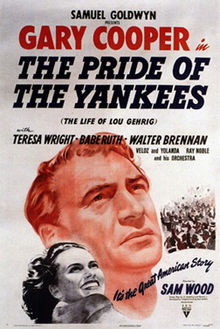
Lisa Reviews An Oscar Nominee: The Pride of the Yankees (dir by Sam Wood)


220px-The_Pride_Of_The_Yankees_1942

“People all say that I’ve had a bad break. But today … today, I consider myself the luckiest man on the face of the Earth.”

— Lou Gehrig (Gary Cooper) at the end of The Pride of the Yankees (1943)

After airing Foreign Correspondent earlier tonight, TCM followed up by showing the 1943 best picture nominee, The Pride of the Yankees.  Knowing that Pride of the Yankees was going to be a baseball film and that I know next to nothing about baseball, I recruited my sister, the Dazzling Erin, to watch the movie with me.  Erin loves baseball and I knew that she would be able to explain anything that went over my head.

Well, I absolutely loved watching this movie with my sister but it turns out that The Pride of the Yankees isn’t really much of a baseball movie.  True, it’s about a real life baseball player.  Several actual players appeared as themselves.  About 85% of the film’s dialogue deals with baseball and probably about 70% of the film features characters playing some form of the game.  But the film never goes into any great detail about baseball or how it’s played.  There’s no talk of strategy or rules or deeper meaning or anything else.  Going into the film, I knew that baseball was a game that involved throwing, swinging bats, and running.  And it turns out that was all that I needed to know.

The Pride of the Yankees is less about baseball and more about celebrity.  It’s a biopic of Lou Gehrig, who today is best known for his battle with ALS, a disease that is also known as Lou Gehrig’s disease.  Lou Gehrig died on June 2, 1941 and The Pride of the Yankees was released just a year later.  Watching the film, it’s obvious that Gehrig was a beloved figure, the type of celebrity who, if he were alive today, would probably be the center of stories like, “Lou Gehrig Did Something This Weekend And It Was Perfect.”  Watching the film, it easy to imagine how traumatic it must have been for the nation when a beloved athlete like Lou Gehrig died at the age of 37.

As a result, The Pride of the Yankees is less a biopic and more a case for canonization.  From the minute that the film’s Lou Gehrig appears on-screen, he is presented as being the type of saintly athlete who, by promising to hit two home runs in one game, inspires a crippled child to walk.  Lou is modest, kind, unpretentious, and never gets angry.  Over the course of the film, he takes care of his mother, displays a worthy work ethic, and marries Eleanor.  He and Eleanor have a perfect marriage without a single argument or a hint of trouble, except for the fact that Lou sometimes gets so busy playing baseball with the local children that he’s late coming home.  There’s not a hint of sadness in their life, until Lou suddenly gets sick.

And really, it should not work.  If ever there’s ever been a film that should be painfully out-of-place in our more cynical times, it would be The Pride of the Yankees.  However, the film still works because Lou is played by Gary Cooper and Eleanor is played by Teresa Wright.  These two excellent performers bring their considerable talents to making overly sentimental scenes feel credible.  Gary Cooper was 40 years old when he made The Pride of the Yankees and there’s a few scenes — especially the ones where Lou is supposed to be a student at Columbia University — where Cooper is clearly too old for the role.  But, for the most part, Gary Cooper did a great job as Lou Gehrig.  Cooper is especially memorable when Lou first starts to show signs of being ill.  Watching Lou struggle to swing a bat, I was reminded of a horse struggling to stand on an injured leg.  It was almost painfully poignant.

The Pride of the Yankees was nominated for 11 Academy Awards, including best picture.  However, it lost to another sentimental film that featured Teresa Wright, Mrs. Miniver.

Lisa Reviews An Oscar Nominee: Foreign Correspondent (dir by Alfred Hitchcock)


ForeignCorrespondent

Before watching a film like 1940’s Foreign Correspondent, it helps to know a little something about history.

Nowadays, when we think about World War II, there’s a tendency to assume that, from the minute that Hitler came to power in Germany and started to invade the rest of Europe, the entire world united against the Nazis.  The truth is actually far more complex.  The world was still recovering from World War I and throughout the 1930s, even as the Axis powers were growing more and more aggressive, respected intellectual leaders and politicians continued to argue that peace must be maintained at all costs.  Pacifism was such a popular concept that otherwise intelligent people were perfectly willing to make excuses for Hitler and Mussolini.  For five years, the UK followed a policy of appeasement towards Nazi Germany.  Even after war broke out between Britain and Germany, the U.S. remained officially neutral.  In the 1940 presidential election, President Franklin D. Roosevelt — running on a platform of neutrality — was overwhelmingly reelected over internationalist Wendell Willkie.

Foreign Correspondent, an American film made by a British director, opens before the start of World War II.  An American newspaper editor, Mr. Powers (Harry Davenport), is frustrated because none of his foreign correspondents seem to be able to understand the truth of the situation in Europe.  They all claim that there is going to be no war in Europe but Mr. Powers feels differently.  He also feels that the newspaper’s most celebrated and respected foreign correspondents are just a bunch of out-of-touch elitists.  Instead of sending another upper class academic, Mr. Powers decides to send a hard-boiled crime reporter to cover the situation in Europe.  Johnny Jones (Joel McCrea) has never been to Europe and that’s exactly why Mr. Powers decides to send him.  In one of the film’s more clever moments, he does, however, insist that Johnny write under the more distinguished sounding name of “Huntley Haverstock.”

(Foreign Correspondent‘s pointed criticism of out-of-touch elitists repeating the establishment line remains just as relevant today as it was in 1940.)

From the minute the brash and tough Johnny arrives in Europe, he finds himself caught up in a huge conspiracy.  He’s been assigned to report on a group known as the Universal Peace Party and, since this film was directed by Alfred Hitchcock, we automatically know that any organization with the word “Peace” in its name has to be up to something shady.  The Universal Peace Party has been founded by Stephen Fisher (Herbert Marshall), who appears to sincere in his desire to avoid war.  Johnny meets and falls in love with Fisher’s daughter, Carol (Laraine Day).

From the minute that Johnny witnesses the assassination of distinguished Dutch diplomat Von Meer (Albert Bassermann), he suspects that things are not how they seem.  Working with Carol and a British journalist named Scott ffolliot* (delightfully played by the great George Sanders), Johnny discovers that Von Meer was not killed at all.  Instead, a double was assassinated and Von Meer was kidnapped by a group of spies.

But who are the spies?  After nearly getting killed by one of Fisher’s bodyguards, Johnny starts to suspect that Stephen Fisher might not be as into world peace as was originally assumed.  Complicating matters, however, is the fact that Johnny is now engaged to marry Carol…

Foreign Correspondent is a wonderfully witty thriller, one that has a very serious message.  While the film is distinguished by Hitchcock’s typically droll sense of humor (eccentric characters abound and the scene where Edmund Gwenn keeps getting interrupted before he can attempt to push Joel McCrea off of a tower is both funny and suspenseful), the film’s message was that America could not afford to stay neutral as war broke out across Europe.  As the all-American Johnny Jones says at the end of the film:

“All that noise you hear isn’t static – it’s death, coming to London. Yes, they’re coming here now. You can hear the bombs falling on the streets and the homes. Don’t tune me out, hang on a while – this is a big story, and you’re part of it. It’s too late to do anything here now except stand in the dark and let them come… as if the lights were all out everywhere, except in America. Keep those lights burning, cover them with steel, ring them with guns, build a canopy of battleships and bombing planes around them. Hello, America, hang on to your lights: they’re the only lights left in the world!”

Foreign Correspondent was nominated for best picture of 1940 but it lost to another far different Hitchcock-directed film, Rebecca.

——

* Yes, that is how he spells his last name.  As he explains, his family dropped the capital name in his surname after an ancestor was executed by Henry II.  Since it was George Sanders doing the explaining, it somehow made perfect sense.

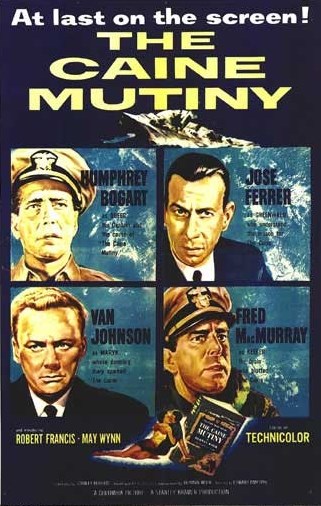
Lisa Reviews An Oscar Nominee: The Caine Mutiny (dir by Edward Dmytryk)


Mutiny_0

It’s the 1940s and World War II is raging.  The U.S. Navy is model of military discipline and efficiency.  Well, except for the U.S.S. Caine, that is.  The Caine is something of a disorganized mess, where no one takes his job seriously and sailors have names like Meatball (Lee Marvin) and Horrible (Claude Akins).  The men love Lt. Commander DeVriess (Tom Tully), largely because he has given up on trying to enforce any sort of discipline.  However, DeVriess has recently been relieved of his command.  As he leaves, Meatball gives him a new watch, a gift from all the men.  DeVriess admonishes them, snapping that the gift is violation of Naval regulations.  He then puts the watch on his wrist and leaves the ship.

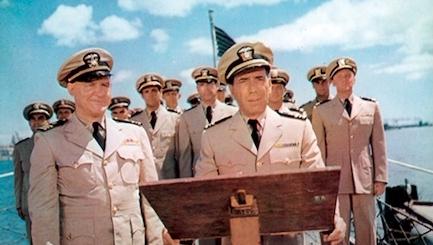
DeVriess’s replacement is Captain Francis Queeg and, at first, we have reason to be hopeful because Captain Queeg is being played by Humphrey Bogart.  Surely, if anyone can get this ship into shape, it’ll be Humphrey Bogart!  From the moment he arrives, Queeg announces that he’s going to enforce discipline on the Caine and if that means spending hours yelling at a man for not having his shirt tucked in, that’s exactly what Queeg is prepared to do.  However, it also quickly becomes apparent that the awkward Queeg has no idea how to talk to people.  He is also overly sensitive and quick to take offense.  Whenever Queeg makes a mistake (and he does make a few), he’s quick to blame everyone else.

the-caine-mutiny-deck

Realizing that the men are turning against him, Queeg even begs his officers for their help.  He asks them if they have any suggestions.  They all sit silently, their heads bowed as Queeg somewhat poignantly rambles on about how his wife and his dog both like him but the crew of the Caine does not.

Queeg’s officers are a diverse bunch, none of whom are quite sure what to make of Queeg or the state of the Caine.  Ensign Willie Keith (Robert Francis) is a wealthy graduate of Princeton University who, at first, likes Queeg but quickly comes to doubt his abilities.  On the other hand, Lt. Steve Marsyk (Van Johnson) has doubts about Queeg from the start but, as a career Navy man, his natural instinct is to respect the chain of command above all else.

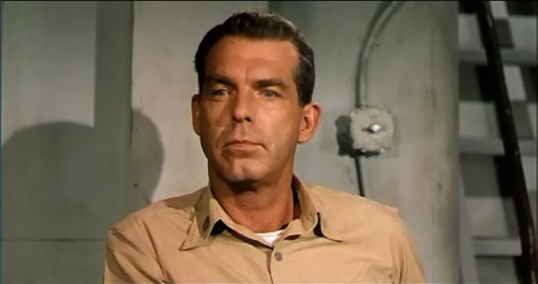
And then there’s Lt. Tom Keefer (Fred MacMurray).  Keefer is a self-styled intellectual, a novelist who is always quick with a snarky comment and a cynical observation.  (If The Caine Mutiny were remade as a B-horror film, Lt. Keefer’s name would probably be Lt. Sardonicus.)  From the minute the viewers meet Lt. Keefer, our inclination is to like him.  After all, he seems to be the only person in the film who has a sense of humor.  If we had to pick someone to have dinner with, most of us would definitely pick the erudite Tom Keefer over the humorless and socially awkward Francis Queeg.  As such, when Keefer starts to suggest that Queeg might be mentally unstable, our natural impulse is to agree with him.

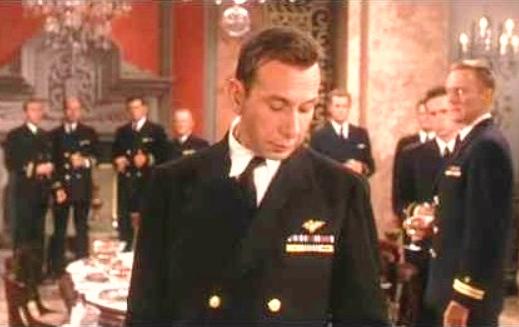
It’s Tom Keefer who first suggests that it may be necessary to take the command away from Queeg.  And yet, when it comes time to take action, it’s Keith and Marsyk who do so while Keefer stands to the side and quietly watches.  And, once the Caine arrives back in the U.S., it Keith and Marsyk who are court martialed.  Will they be found guilty of treason or will their lawyer, Lt. Barney Greenwald (Jose Ferrer), prove that Queeg was unfit for command?

the-caine-mutiny-ferrer

Made in 1954 and based on a novel by Herman Wouk, The Caine Mutiny is one of those big and glossy 1950s productions that holds up a lot better than you might expect.  The film has its flaws.  In the role of Keith, Robert Francis is a bit on the dull side and a subplot in which he courts May Wynn feels unneccessary and only serves to distract from the main story.  But, for the most part, it’s an intelligent and well-directed film.  Humphrey Bogart turns Queeg into a pathetic and lonely figure and you can’t help but feel sorry for him when he talks about how his dog loves him.  Van Johnson also does well as Marsyk, effectively portraying a well-meaning character who is in over his head.  Jose Ferrer gets a great drunk scene at the end of the film and, of course, you can’t go wrong with Lee Marvin as a smirking sailor, even if Marvin only appears for a handful of minutes.

Fred MacMurray The Caine Mutiny

But for me, my favorite character (and performance) was Fred MacMurray’s Tom Keefer.  Technically, Keefer is not meant to be a likable character.  He’s totally passive aggressive.  He’s pretentious.  He’s smug.  At times, he’s rather cowardly.  And yet, Tom Keefer remains the most memorable and interesting character in the entire film.  He gets all of the good one-lines and MacMurray delivers them with just the right amount of barely concealed venom.  (“If only the strawberries were poisoned…” he says as he considers dinner aboard the Caine.)  It’s a great role and Fred MacMurray gives a great performance.  And you know what?  I don’t care how bad a character he may have been.  I still want to read Tom Keefer’s book!

The Caine Mutiny was nominated for best picture of 1954.  However, it lost to On The Waterfront.

Blast From the Past: A Day In The Death of Donny B (dir by Carl Fick)


Just a few hours earlier, I was going through my DVR and I discovered that I had recorded, off of TCM, a film called A Day In The Death of Donny B.  That title immediately caught my attention (and I imagine that the title is probably what inspired me to record the film in the first place).  A Day In The Death of Donny B sounds like the title of something that would have come out of Andy Warhol’s Factory in the late 60s, maybe starring Joe Dallesandro as Donny B and Edie Sedgwick as herself.

So, of course, I simply had to watch it to discover just who Donny B was and how many days it would take him to die.  Add to that, I also noticed that the film only lasted 15 minutes, making it the perfect viewing experience for someone, like me, who has absolutely no attention span.

Anyway, I watched it and I discovered that it’s not a Warhol film.  However, it was filmed in 1969 and it contains a lot of cinéma vérité-style footage of the slums of New York City, which means that it takrd place in roughly the same world as some of Warhol’s films.  It turns out that The Death of Donny B was produced by the Substance Abuse and Mental Health Services Administration.  It’s an anti-drug film, obviously designed to speak to young and black audiences.

The film follows an African-American addict named Donny B as he wanders through the shadows of New York City and tries to scrounge up enough money to buy heroin.  While we watch him go about his day, we listen to voice overs from former addicts and some of Donny’s family members.  They all agree that Donny is basically a huge loser.  Donny B. is credited as playing himself and he has a definite screen presence, even if he looks a bit too healthy for someone who, we’re told, shoots heroin several times a day.

The film itself is shot in harshly beautiful black-and-white and the soundtrack features a droning song (credited to someone named Harry Holt) that, for the most part, consists lyrically of: “It’s a day in the death of Donny B…” and trust me, that song will get stuck in your head.  Today, of course, the main appeal of The Death of Donny B is that it’s a time capsule of when it was made.  For those of us who might be curious as to what New York was like back in the dangerous 1960s, The Death of Donny B is our time machine.

And you can watch it below!

And if you happen to be Donny B, leave a comment below because we would love to hear from you!

Playing Catch-Up: The Hateful Eight (dir by Quentin Tarantino)


The_Hateful_Eight

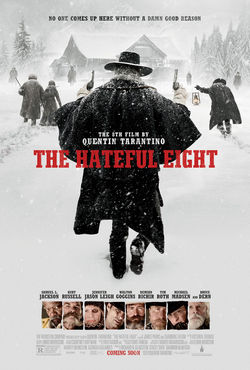
Remember how I said that it was intimidating to admit that The Big Short didn’t do much for me as a viewer?  Well, it’s even more intimidating for me to admit that I felt much the same way about The Hateful Eight as well.

Nearly everyone I know loves The Hateful Eight and, going into it, I really wanted to love it as well.  After all, this is — as the opening credits remind us — Quentin Tarantino’s 8th film!  Tarantino is one of my favorite directors.  I thought his last film, Django Unchained, was a masterpiece and one of the most important films ever made about slavery.  Like many of you, I’ve followed all the details of the making of The Hateful Eight, from the initial script leak to the controversy over Tarantino’s comments on the police.  I was excited because the cast looked great and was full of veteran actors — like Kurt Russell, Jennifer Jason Leigh, and Bruce Dern — who all seemed likely to benefit from the Tarantino touch.  (Say what you will about Quentin Tarantino, it cannot be denied that he’s given good roles to talented actors who are rarely given the opportunities that they deserve.)  When I heard that Ennio Morricone was going to be providing the score, I got even more excited.  Morricone and Tarantino; it seemed like the perfect combination for greatness.

Well, Morricone’s score is spectacular.  There’s talk that Morricone might finally win an Oscar for his work on The Hateful Eight and I certainly don’t have a problem with that.  (Hopefully, Morricone will have learned a lesson from the Golden Globes and, if he is nominated, he will either come to the ceremony himself or arrange for someone other than Tarantino to accept for him.)  And Jennifer Jason Leigh takes full advantage of her role, giving a truly ferocious performance.

But otherwise, The Hateful Eight just didn’t do much for me.  It’s not that I disliked the film.  There was a lot that worked but, for whatever reason, The Hateful Eight never enthralled me the way that past Tarantino films have.  The Hateful Eight left me saying, “Is that it?”

A lot of my reaction to The Hateful Eight has to do with the film’s length.  Taking place, for the most part, in only one location and structured more like a play than a film, The Hateful Eight would be a great 90 minute murder mystery.  Instead, it lasts nearly 3 hours and, at times, the film drags interminably.  As usual, Tarantino plays with time and, at one point, stops the action so that we can see what happened earlier in the day.  Unfortunately, as opposed to other Tarantino films, we don’t really learn anything new from this flashback and you get the feeling that it was included most because flaskbacks are a Tarantino trademark and because he wanted to find a way to work a somewhat pointless Zoe Bell cameo into the film.

As for Tarantino’s widely acclaimed script, I have to admit that I got kind of bored with this talky film.  Yes, the actors were all good and it’s always fun to listen to Samuel L. Jackson be a badass but the dialogue itself was largely repetitive and occasionally, the film itself threatened to turn into Tarantino-on-autopilot.

(Interestingly enough, Tarantino’s script features several creative euphemisms for oral sex and the characters come up with a handful of different ways to point out that Jackson is black but, when it comes to Jennifer Jason Leigh’s character, nobody can come up with anything more imaginative than repeatedly calling her a bitch.  While, unlike some critics, I don’t think The Hateful Eight is a misogynistic movie, I do have to admit that I was rolling my eyes around the fifth time that Leigh’s character was called a bitch and kept rolling them for the entire movie.  For a writer well-known for his ability to come up with colorful and memorable insults, Tarantino’s refusal to come up with anything more imaginative than “bitch” just felt lazy.)

What can I say?  The Hateful Eight just didn’t do much for me.  However, I do think that the film looked great and I certainly hope that Morricone and Leigh are at least nominated for their excellent work.  I look forward to Tarantino’s next film but I doubt I’ll be revisiting The Hateful Eight any time soon.

(By the way, with this review, I am now officially caught up on reviewing the films of 2015!)

Playing Catch-Up: Carol (dir by Todd Haynes)


Carol_(film)_POSTER

(Minor Spoilers Below)

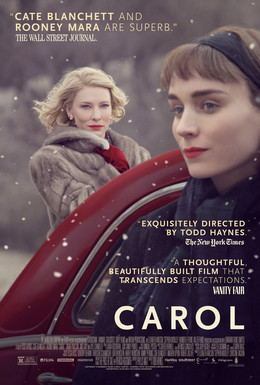
Carol is the best film of 2015.

I say that without a hint of hesitation or doubt.  2015 was a wonderful year for movies and I would say that there were at least 20 film released that I would call great.  And, out of those 20, Carol is the best.

Carol opens in 1952.  Therese Belivet (Rooney Mara) is young, lonely, and living in New York City.  She’s an aspiring photographer who can’t afford a decent camera, a secret bohemian living in a world where morality and culture are defined by the bourgeoisie.  She has a boyfriend named Richard (Jake Lacey) and he’s eager to marry her and move to France but, try as she might, Therese simply cannot bring herself to feel the same way about him that he feels about her.  Though she lives with him, she refuses to have sex with him.  At one point, she asks him if he’s ever heard of men being attracted to other men and she asks if he thinks the same can be true of women.  Richard says sure, before adding that it’s always the result of “something wrong” psychologically.

It’s Christmas.  Therese gets a temporary job, working at a department store in Manhattan.  From the moment we see Therese surrounded by the Christmas crowds, we realize that she feels totally out-of-place among the rest of the world.  She is withdrawn and quiet and rarely looks anyone in the eye.  That is until she meets Carol (Cate Blanchett).

Carol is searching for a gift for her daughter and accidentally leaves her gloves behind at the store.  When Therese arranges for the gloves to be returned to Carol, Carol thanks her by taking her out to lunch.  Soon, Carol is inviting Therese to spend Christmas at her house in New Jersey and a jealous Richard is complaining that Therese has a “crush” on the older woman.

Carol is going through a difficult divorce.  Her alcoholic husband, Harge (Kyle Chandler), is demanding full custody of their children.  Harge knows that years ago, Carol had a brief affair with her best friend, Abby (Sarah Paulson), and he can’t handle it.  When he stops by, drunk and belligerent, on Christmas, he discovers Therese visiting Carol and he freaks out even more.

(With all the attention being paid to the exquisite performances of Blanchett and Mara, now would be good place to mention that Kyle Chandler does a great job playing a loathsome character.  With his performance here and his role in The Spectacular Now, Chandler has cornered the market on playing abusive alcoholics.)

For New Year’s, Carol and Therese go on a trip and they finally consummate their relationship (in Iowa, of all places).  But what they don’t know is that Harge has hired men to follow them and to get proof of their relationship.  If Carol wants to see her daughter again, she knows that it means seeing a psychotherapist for help with her “problem” and never seeing Therese again…

Carol is an amazing and beautiful film, a portrait of both forbidden love and the struggle to survive in a society that demands total and complete conformity.  In many scenes, director Todd Haynes pays homage to the masters of 50s melodrama, filmmakers like Mark Robson, Douglas Sirk and Nicholas Ray.  The film’s lushly vibrant colors and attention to detail feels reminiscent of the films that Sirk made for MGM, with Cate Blanchett often made up to resemble Lana Turner.  Meanwhile, Rooney Mara often resembles Natalie Wood from Rebel Without A Cause.  One shot in particular, with the shadows of a window bar falling across Blanchett’s face like the bars of a prison cell, immediately brought to mind the end of Ray’s Bigger Than Life.

For the longest time, I have complained about Rooney Mara’s performance in David Fincher’s rehash of The Girl With The Dragon Tattoo.  Well, I’m prepared to stop complaining because Mara is brilliant in Carol.  Her blossoming as an actress mirrors Therese’s blossoming as a woman.  Rooney Mara is being promoted for best supporting actress but make no mistake.  There’s nothing “supporting” about Rooney Mara’s performance.  Carol is all about Therese and it works because of Mara’s wonderful performance.

Regardless of what may or may not happen with the Oscar nominations on Thursday, Carol is the best film of 2015.  It’s a film that we will still be talking about decades from now.

mara_blanchett_carol

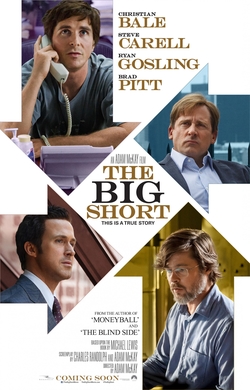
Playing Catch-Up: The Big Short (dir by Adam McKay)


The_Big_Short_teaser_poster

The Big Short is a film that is so critically acclaimed and that has been so passionately embraced by those who enjoyed it that it’s a bit intimidating to admit that it really didn’t do much for me.  (It’s even more intimidating for me to admit that I nearly included it on my list of the 16 worst films of 2015.)  It’s a big, angry movie and, even though it’s not really that good, it definitely taps into the zeitgeist.  It captures the anger, the frustration, and the fears that people (including me) are feeling right now.  It didn’t do much for me but I can understand why others have so passionately embraced it.

As for the film itself, it’s about the housing collapse and the financial crisis of 2008.  The main characters are all people who realized that the economy was about to collapse and who managed to make a profit off of the crisis.  For the most part, everyone gets at least two scenes where they get to rail about how angry they are that they’re making a profit off of other people’s misery.  However, they all still collect their money at the end of the film.

For the most part, our main characters are the type of quirky eccentrics who always tend to pop up in ensemble films like this.  They’re all played by recognizable actors and they all have an identifiable trait or two so we can keep them straight.  For instance, Christian Bale has trouble relating to people socially, plays drums, and looks like he probably has terrible body odor.  Steve Carell has a bad haircut and spends a lot of time yelling at people.  He’s also haunted by the suicide of his brother and he’s married to Marisa Tomei but she only gets to appear in two scenes and doesn’t really do much because this is a film about menfolk, dagnabit.  (I love Steve Carell but this is probably the least interesting performance that he’s ever given.)  John Magaro and Finn Wittrock are two young investors and they especially get upset when they realize that the economy is about to collapse.  Their mentor is played by Brad Pitt.  Since this is an important film, Brad Pitt plays his role with his important actor beard.

And then there’s Ryan Gosling.  Gosling plays a trader and he also narrates the film.  And really, Gosling probably gives the best performance in the film, perhaps because his character is the only one who is actually allowed to enjoy making money.  I think we’re supposed to be outraged when he brags about making money while people lose their houses but Gosling’s so charismatic and the character is so cheerful that it’s hard to dislike him.

(Of course, listening to Gosling’s narration, it’s impossible not to be reminded of The Wolf of Wall Street.  And it’s appropriate because The Big Short is kind of like The Wolf of Wall Street for people who don’t want to have to deal with ambiguity or nuance.)

The film has gotten a lot of attention for Adam McKay’s direction, which is flashy and always watchable but, at the same time, also rather shallow.  For the most part, McKay’s directorial tricks only served to remind me of other movies.  The narration, of course, made me think about The Wolf of Wall Street.  The scenes where characters look straight at the camera and say, “This isn’t the way it really happened,” only reminded me of how much more effective it was when the same thing happened in Michael Winterbottom’s 24 Hour Party People.

And then there’s the celebrity cameos.  These are the scenes where a special guest celebrity is brought on screen to explain to us how Wall Street actually works.  The first time, it’s Margot Robbie in a bubble bath and it works well because it admits the debt that The Big Short owes to Wolf of Wall Street.  (Plus, it ends with Robbie telling the viewers to “fuck off,” which is probably what I would do if a huge group of strangers interrupted my bubble bath.)  If McKay had limited himself to just doing it once, it would have been brilliant.  But McKay drags out three more celebs and, with repeated use, the technique gets less and less interesting.

But I guess it’s debatable whether any of that matters.  The Big Short taps into the way people are feeling now.  It’s a zeitgeist film.  People are rightfully angry and The Big Short is all about that anger.  A decade from now, it’ll probably be as forgotten as Gabriel Over The White House.  But for now, it’s definitely the film of the moment.

Playing Catch-Up With 6 Mini-Reviews: Amy, Gloria, Pitch Perfect 2, Sisters, Spy, Trainwreck


Amy_Movie_Poster

Amy (dir by Asif Kapadia)

Amy opens with brilliant and, in its way, heartbreaking footage of a 14 year-old Amy Winehouse and a friend singing Happy Birthday at a party.  Even though she’s singing deliberately off-key and going over-the-top (as we all tend to do when we sing Happy Birthday), you can tell that Amy was a star from the beginning.  She’s obviously enjoying performing and being the center of attention and, try as you might, it’s impossible not to contrast the joy of her Happy Birthday with the sadness of her later life.

A star whose music touched millions (including me), Amy Winehouse was ultimately betrayed by a world that both wanted to take advantage of her talent and to revel in her subsequent notoriety.  It’s often said the Amy was self-destructive but, if anything, the world conspired to destroy her.  By focusing on footage of Amy both in public and private and eschewing the usual “talking head” format of most documentaries, Amy pays tribute to both Amy Winehouse and reminds us of what a great talent we all lost in 2011.
Gloria_(2014_Film_Poster)

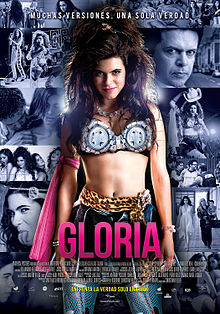
Gloria (dir by Christian Keller)

The Mexican film Gloria is a musical biopic of Gloria Trevi (played by Sofia Espinosa), a singer whose subversive songs and sexual image made her a superstar in Latin America and challenged the conventional morality of Catholic-dominated establishment.  Her manager and lover was the controversial Sergio Andrade (Marco Perez).  The movie follows Gloria from her first audition for the manipulative Sergio to her arrest (along with Sergio) on charges of corrupting minors.  It’s an interesting and still controversial story and Gloria tells it well, with Espinosa and Perez both giving excellent performances.

Pitch_Perfect_2_poster

Pitch Perfect 2 (dir by Elizabeth Banks)

The Bellas are back!  As I think I’ve mentioned a few times on this site, I really loved the first Pitch Perfect.  In fact, I loved it so much that I was a bit concerned about the sequel.  After all, sequels are never as good as the original and I was dreading the idea of the legacy of the first film being tarnished.

But the sequel actually works pretty well.  It’s a bit more cartoonish than the first film.  After three years at reigning ICCA champions, the Bellas are expelled from competition after Fat Amy (Rebel Wilson) accidentally flashes the President.  The only way for the Bellas to get the suspension lifted is to win the World Championship of A Capella.  The plot, to be honest, really isn’t that important.  You’re watching the film for the music and the interplay of the Bellas and, on those two counts, the film totally delivers.

It should be noted that Elizabeth Banks had a great 2015.  Not only did she give a great performance in Love & Mercy but she also made a respectable feature directing debut with Pitch Perfect 2.
Sisters_movie_poster

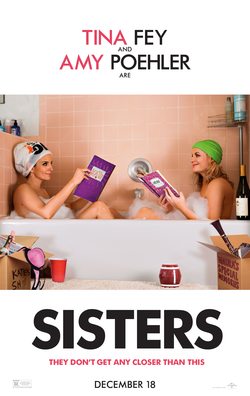
Sisters (dir by Jason Moore)

It’s interesting how opinions can change.  For the longest time, I really liked Tina Fey and I thought that Amy Poehler was kind of overrated.  But, over the past two years, I’ve changed my opinion.  Now, I like Amy Poehler and Tina Fey kind of gets on my nerves.  The best way that I can explain it is to say that Tina Fey just seems like the type who would judge me for wearing a short skirt and that would get old quickly, seeing as how I happen to like showing off my legs.

Anyway, in Sisters, Tina and Amy play sisters!  (Shocking, I know.)  Amy is the responsible one who has just gotten a divorce and who wants to make everyone’s life better.  Tina is the irresponsible one who refuses to accept that she’s no longer a teenager.  When their parents announce that they’re selling the house where they grew up, Amy and Tina decide to throw one last party.  Complications ensue.

I actually had two very different reactions to Sisters.  On the one hand, as a self-declared film critic, it was easy for me to spot the obvious flaw with Sisters.  Tina and Amy should have switched roles because Tina Fey is simply not believable as someone who lives to have fun.  Sometimes, it’s smart to cast against type but it really doesn’t work here.

However, as the youngest of four sisters, there was a lot of Sisters that I related to.  I saw Sisters with my sister, the Dazzling Erin, and even if the film did not work overall, there were still a lot of little scenes that made us smile and go, “That’s just like us.”  In fact, I think they should remake Sisters and they should let me and Erin star in it.
Spy2015_TeaserPoster

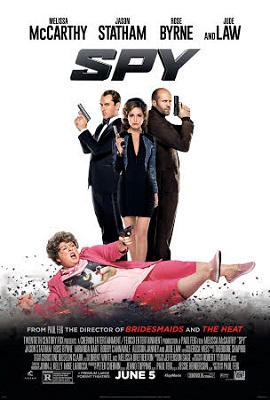
Spy (dir by Paul Feig)

There were a lot of very good spy films released in 2015 and SPECTRE was not one of them.  In fact, the more I think about it, the more disappointed I am with the latest Bond film.  It’s not so much that SPECTRE was terrible as there just wasn’t anything particular memorable about it.  When we watch a film about secret agents saving the world, we expect at least a few memorable lines and performances.

Now, if you want to see a memorable spy movie, I suggest seeing Spy.  Not only is Spy one of the funniest movies of the year, it’s also a pretty good espionage film.  Director Paul Feig manages to strike the perfect balance between humor and action.  One of the joys of seeing CIA employee Susan Cooper (Melissa McCarthy) finally get to enter the field and do spy stuff is the fact that there are real stakes involved.  Susan is not only saving the world but, in the film’s best scenes, she’s having a lot of fun doing it and, for that matter, McCarthy is obviously having a lot of fun playing Susan and those of us in the audience are having a lot of fun watching as well.

Spy also features Jason Statham as a more traditional action hero.  Statham is hilarious as he sends up his own macho image.  Seriously, who would have guessed that he could such a funny actor?  Here’s hoping that he, McCarthy, and Feig will all return for the inevitable sequel.

Trainwreck_poster

Trainwreck (dir by Judd Apatow)

There’s a lot of great things that can be said about Trainwreck.  Not only was it the funniest film of 2015 but it also announced to the world that Amy Schumer’s a star.  It was a romantic comedy for the 21st Century, one that defied all of the conventional BS about what has to happen in a romcom.  This a film for all of us because, let’s just be honest here, we’ve all been a trainwreck at some point in our life.

But for me, the heart of the film was truly to be found in the relationship between Amy and her younger sister, Kim (Brie Larson).  Whether fighting over what to do with their irresponsible father (Colin Quinn) or insulting each other’s life choices, their relationship is the strongest part of the film.  If Brie Larson wasn’t already guaranteed an Oscar nomination for Room, I’d demand that she get one for Trainwreck.  For that matter, Amy Schumer deserves one as well.

Seriously, it’s about time the trainwrecks of the world had a film that we could truly call our own.