Film Review: Unforgettable (dir by John Dahl)


You have to give the makers of the 1996 film, Unforgettable, some credit.  It takes a certain amount of courage to give your movie a title like Unforgettable.  You’re practically asking some snarky critic to comment on the fact that she can’t remember your movie.

Well, I’ll resist the temptation because I can remember enough about this movie to review it.  I saw it a few days ago on This TV and, at first, I was excited because it was a Ray Liotta movie.  Ray Liotta is an entertaining and likable actor who, nowadays, only seems to get cast in small, tough guy roles.  Nowadays, a typical Liotta role seems to be something like the character he played in Killing Me Softly.  He showed up.  He was tough.  He got killed for no good reason.  So, whenever you come across a film in which Liotta gets to do something more than just get shot, you kind of have an obligation to watch.

In Unforgettable, Liotta plays Dr. David Krane, who is haunted by the unsolved murder of his wife.  Fortunately (or perhaps, unfortunately), Dr. Martha Briggs (Linda Fiorentino) has developed a formula that can be used to transfer memories from one person to another.  All you have to do is extract some spinal fluid!  Or something like that.  It doesn’t make any sense to me and I have to admit that I kinda suspect that the science might not actually check out.

Anyway, Dr. Krane is all like, “I want to inject myself with my dead wife’s spinal fluid so I can experience her final moments!”

And Dr. Briggs is all like, “But this could kill you because there’s all these vaguely defined side effects!”

But Dr. Krane does it anyway and he discovers that his wife was murdered by a lowlife criminal named Eddie Dutton (Kim Coates)!  So, Dr. Krane chases Eddie all ocer the city and it’s interesting to see that a doctor can apparently keep up with a career criminal.  I mean, you would think that Eddie’s experience with being chased and Krane’s inexperience with chasing would give Eddie an advantage.  Anyway, regardless, it doesn’t matter because Eddie is eventually gunned down by the police and Dr. Krane is fired from his job.

Hmmm … well, that was quick.  I guess the movie’s over…

No, not quite!  It turns out that someone hired Eddie to kill Dr. Krane’s wife!  And it turns out that person was a cop!  But which cop!?  Well, there’s only two cops in the film who actually have any lines so it has to be one of them.  And one of the cops is so unlikable that it’s obvious from the start that he’s a red herring.  So, I guess that means the actual murderer is the one that you’ll suspect from the first moment he shows up.

(For the record, the two cops are played by Christopher McDonald and Peter Coyote.  I won’t reveal which one is unlikable and which one is a murderer but seriously, you’ve already guessed, haven’t you?)

Anyway, it’s all pretty stupid and a waste of everyone involved.  Ray Liotta is likable and sympathetic but the film gets bogged down with trying to convince us that crimes can be solved through spinal fluid.  It’s a dumb premise that the movie takes way too seriously and it never quite works.

Still, I hope that someone will give Ray Liotta another good role at some point in the future.  He deserves better than supporting roles and Chantix commercials.
Insomina File No. 16: Kill The Messenger (dir by Michael Cuesta)


What’s an Insomnia File? You know how some times you just can’t get any sleep and, at about three in the morning, you’ll find yourself watching whatever you can find on cable? This feature is all about those insomnia-inspired discoveries!

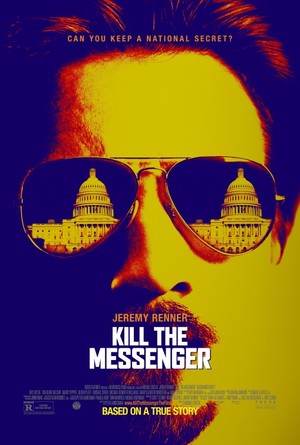
Kill_the_Messenger_poster

Last night, if you were awake and unable to get any sleep at 1:45 in the morning, you could have turned over to Cinemax and watched the 2014 conspiracy thriller, Kill The Messenger.

Kill The Messenger opens with one of those title cards that assures us that the movie we’re about to see is based on a true story.  We are then introduced to Gary Webb (Jeremy Renner), a California-based reporter who we know is a rebel because he has a precisely trimmed goatee.  Gary is interviewing a suspected drug smuggler (Robert Patrick) at the smuggler’s luxurious mansion.  Suddenly, the DEA storms the house, shouting insults and roughly throwing everyone to the ground, including Gary.  It’s actually exciting and promising opening, one that perfectly establishes both Gary as a truth seeker and the U.S. government as an invading army that’s fighting a war that’s full of collateral damage.

Gary, of course, has nothing to do with smuggling drugs.  He was just in the wrong place at the wrong time.  If he was treated unfairly by the DEA, it’s just because the government is serious about winning the war on drugs!

Or is it?

Following up on a tip, Gary comes across evidence that, in order to raise money for pro-Amercian rebels in Central America, the CIA not only helped to smuggle drugs into the U.S. but also arranged for the drugs to largely be sold in poor, minority neighbors where, in theory, no one would notice or care.

When the story is finally published, Gary is briefly a celebrity.  Not surprisingly, the government denies his accusations and start tying to discredit him.  However, Gary also finds himself being targeted by his fellow journalists.  Angry over being outscooped by a relatively unknown reporter, The Los Angeles Times and The Washington Post both launch their own investigations.  Instead of investigating Gary’s allegations, they jealously and viciously investigate Gary himself.

Soon, both Gary’s career and his family are falling apart and Gary finds himself growing more and more paranoid…

Remember when everyone was expecting Kill The Messenger to be a really big deal?  It was due to come out towards the end of 2014, right in the middle of Oscar season.  Jeremy Renner was being talked up as a contender for best actor.  Then the film came out, it played in a handful of theaters for a week or two, and then it sunk into obscurity.  Some commentators even complained that Focus Features buried the release of Kill The Messenger and that the film was ignored because of its leftist politics…

Of course, it’s just as probable that Focus Features realized that The Theory of Everything was more likely to charm audiences than a movie that suggested the U.S. government was behind the drug epidemic.

Or it could have just been that, despite telling a potentially intriguing story, Kill The Messenger was an oddly bland film.  Other than one scene in which he admits to cheating on his wife, Gary Webb is portrayed as being such a saint that it actually causes the film to lose credibility.  (Don’t get me wrong.  For all I know, he was a saint.  But, from a cinematic point of view, sainthood is never compelling.)  This is one of those earnest films that gets so heavy-handed that, even if you agree with what the movie is saying, you still resent being manipulated.  (Of course, some of us have grown so cynical about the media that we automatically doubt the veracity any movie that opens with those dreaded words: “Based on a true story.”)  Watching Kill The Messenger, one gets the feeling that a documentary about Gary Webb would probably be more compelling (and convincing) than a fictionalized dramatization.

(Unfortunately, if you think it’s difficult to get an audience to watch a movie that suggested the U.S. government was behind the drug epidemic, just try to get them to watch a documentary about … well, anything.  I know most of our readers would probably happily watch a documentary but that’s because y’all are the best and a thousand times better than the average person.  Love you!)

Here’s what did work about Kill The Messenger: the performances.  Jeremy Renner, who also produced this film, gives an excellent performance as Gary, especially in the scenes where he realizes that both the government and the press are now conspiring about him.  Rosemarie DeWitt has the traditionally thankless role of being the supportive wife but she still does a good job.  And finally, Ray Liotta shows up for one scene and is absolutely chilling in that way that only Ray Liotta can be.

Kill The Messenger doesn’t quite work but, thanks to the cast, it is, at the very least, a watchable misfire.

Previous Insomnia Files:

  1. Story of Mankind
  2. Stag
  3. Love Is A Gun
  4. Nina Takes A Lover
  5. Black Ice
  6. Frogs For Snakes
  7. Fair Game
  8. From The Hip
  9. Born Killers
  10. Eye For An Eye
  11. Summer Catch
  12. Beyond the Law
  13. Spring Broke
  14. Promise
  15. George Wallace

Here Are The Very Confusing SAG Nominations!


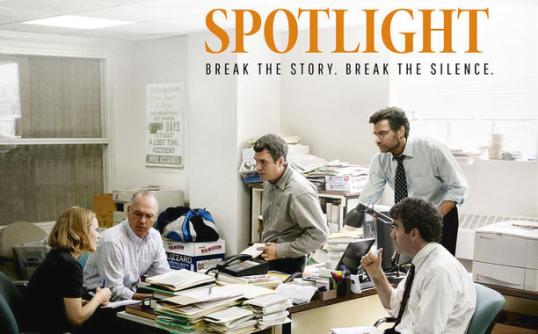
Spotlight

The nominees for the SAG Awards were announced earlier today!  The SAG Awards are usually one of the more accurate of the various Oscar precursors.  Because so many members of the Academy are also members of the Screen Actors Guild, the SAG Awards are usually a pretty good indication of what films are on the Academy’s radar and which ones aren’t.  Occasionally, an actor will be nominated by SAG and then snubbed by the Academy.  Last year, for instance, SAG nominated Jake Gyllenhall for Nightcrawler, Jennifer Aniston for Cake, and Naomi Watts for St. Vincent.  None of those three received any love from the Academy.  But, for the most part, SAG is one of the most reliable precursors out there.

And that’s why so many of us are in shock today!  The SAG Awards in no way resembled what many of us were expecting.  Other than Spotlight, none of the film’s that many of us expected to be nominated for best ensemble (the SAG’s equivalent of the Academy’s best picture) were nominated (and even Spotlight only received one other nomination, for Rachel McAdams who, up to this point, hasn’t really figured into the Oscar discussion).  The Martian was not nominated for best ensemble or anything else for that matter.  Creed was totally snubbed.  Brooklyn was nominated for actress but not ensemble.  Mad Mad: Fury Road was nominated for its stunt work and nothing else.  Helen Mirren received two nominations, for films that hardly anyone (outside of the SAG, obviously) was really paying any attention to.  Sarah Silverman received a best actress nomination for I Smile Back, which I hadn’t even heard of until about a week ago.  It’s an unexpected and strange group of nominees.

Keep in mind, it’s not necessarily a bad thing that the nominees are unexpected.  Beasts of No Nation and Straight Outta Compton will both receive deserved boosts in their hunt for Oscar gold.  At the same time, I have to admit that I wasn’t happy to see either The Big Short or Trumbo nominated for best ensemble because I know I’m going to feel obligated to see them and they both look so freaking tedious and blandly political!  But consider this: if The Big Short and Trumbo are both huge Oscar contenders, we may face a situation where both Jay Roach and Adam McKay are nominated for best director in the same year.  I think that’s one of the signs of the apocalypse and, at this point, I’m kind of ready to welcome the end of the world.

Anyway, here are the SAG nominations!  Look them over and, after the Golden Globe nominations are announced tomorrow, update your Oscar predictions accordingly.

Best Performance by a Cast Ensemble in a Motion Picture

Best Performance by a Male Actor in a Leading Role

Best Performance by a Female Actor in a Leading Role

  • Cate Blanchett – Carol
  • Brie Larson – Room
  • Helen Mirren – Woman in Gold
  • Saoirse Ronan – Brooklyn
  • Sarah Silverman – I Smile Back

Best Performance by a Male Actor in a Supporting Role

Best Performance by a Female Actor in a Supporting Role

  • Rooney Mara – Carol
  • Rachel McAdams – Spotlight
  • Helen Mirren – Trumbo
  • Alicia Vikander – The Danish Girl
  • Kate Winslet – Steve Jobs

Best Performance by a Stunt Ensemble in a Motion Picture

Best Performance by an Ensemble in a Drama Series

  • Downton Abbey
  • Game of Thrones
  • Homeland
  • House of Cards
  • Mad Men

Best Performance by a Male Actor in a Drama Series

  • Peter Dinklage – Game of Thrones
  • Jon Hamm – Mad Men
  • Rami Malek – Mr. Robot
  • Bob Odenkirk – Better Call Saul
  • Kevin Spacey – House of Cards

Best Performance by a Female Actor in a Drama Series

  • Claire Danes – Homeland
  • Viola Davis – How to Get Away with Murder
  • Julianna Marguilles – The Good Wife
  • Maggie Smith – Downton Abbey
  • Robin Wright – House of Cards

Best Performance by an Ensemble in a Comedy Series

  • The Big Bang Theory
  • Key and Peele
  • Modern Family
  • Orange is the New Black
  • Transparent
  • Veep

Best Performance by a Male Actor in a Comedy Series

  • Ty Burrell – Modern Family
  • Louis CK – Louie
  • William H. Macy – Shameless
  • Jim Parsons – The Big Bang Theory
  • Jeffrey Tambor – Transparent

Best Performance by a Female Actor in a Comedy Series

  • Uzo Aduba – Orange is the New Black
  • Edie Falco – Nurse Jackie
  • Ellie Kemper – Unbreakable Kimmy Schmidt
  • Julia Louis-Dreyfus – Veep
  • Amy Poehler – Parks and Recreation

Best Performance by a Male Actor in a TV Movie or Mini-Series

  • Idris Elba – Luther
  • Ben Kingsley – Tut
  • Ray Liotta — Texas Rising
  • Bill Murray – A Very Murray Christmas
  • Mark Rylance – Wolf Hall

Best Performance by a Female Actor in a TV Movie or Mini-Series

Best Performance by a Stunt Ensemble in a Comedy or Drama Series

  • Blacklist
  • Game of Thrones
  • Homeland
  • Marvel’s Daredevil
  • The Walking Dead

Embracing the Melodrama Part II #57: Saturday Night Fever (dir by John Badham)


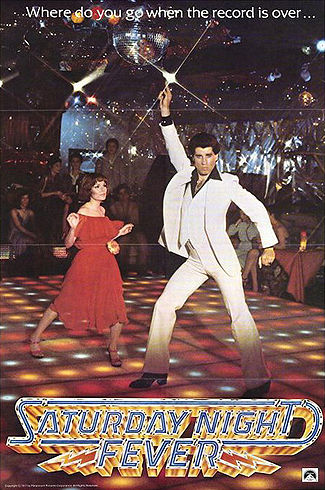
Saturday_night_fever_movie_posterHere’s a little bit of trivia about the iconic 1977 film Saturday Night Fever.

First off, according to the imdb, Saturday Night Fever was the first mainstream Hollywood film to ever use the term “blow job.”  That actually took me by surprise.  I mean, with all of the risks that the major studios took in the 70s, it still took them until 1977 to have someone say “blow job” in a movie?  But somehow, it seems appropriate that it would turn up in Saturday Night Fever.  We tend to think of Saturday Night Fever as being a movie where the soundtrack is nonstop disco and John Travolta dances in that iconic white suit.  But actually, Saturday Night Fever is a film about four guys who neither understand nor respect women.

When Tony (John Travolta), Joey (Joseph Cali), Double J (Paul Pape), and Bobby (Barry Miller) go down to that disco, it’s because they want to get laid.   Joey and Double J take turns having sex with insecure Annette (Donna Pescow) and, afterwards, Tony scornfully ask her if she‘s proud of herself.  When Bobby discovers that his girlfriend is pregnant, he is so terrified of having to be a father that he becomes suicidal.  As for Tony, he looks down on the women who are so eager to dance with him.  When he enters a dance contest with Stephanie (Karen Lynn Gorney), he can’t handle the fact that she wants more out of her life than just being his latest partner.

So, it makes sense that this would be the first mainstream movie to feature someone talking about a blow job because that’s what these boys are obsessed with.  Sexually primitive, hypocritically puritanical, and emotionally repressed, a blow job is all the intimacy that these boys can handle.

Another piece of trivia: while John Travolta was always the first choice for Tony Manero, several actors were seen for the roles of Joey and Double J.  At one point, both Ray Liotta and David Caruso were nearly cast in the role of Tony’s friends.  Imagine this: in some alternative universe, while white-suited John Travolta rules over the dance floor, Ray Liotta and David Caruso are standing in the background and cheering him on.

Of course, if Liotta and Caruso had been cast, it would be a totally different movie.  Whenever you watch Saturday Night Fever, you’re surprised by how much John Travolta totally dominates the film.  Even though the film devotes a good deal of time to Annette, Stephanie, Bobby and to Tony’s brother who has recently left the priesthood, Tony Manero is the only character that you remember.  That’s largely because Travolta is the only one of them who gives a truly memorable performance.

In theory, it’s easy to laugh at the thought of Travolta in that white suit, striking a dramatic pose on that cheap-looking dance floor.  But then you watch the film and you realize that Travolta truly did give a great performance.  And, to your surprise, you don’t laugh at Tony with his white suit because you know that the only time Tony has any control over his life is when he’s dancing.  He may work in a paint store.  He may regularly get slapped around by his family.  He may not be very smart or sensitive.  But when Tony’s dancing, he’s a king and you’re happy that he at least has one thing in his life that he can feel good about.

Even if he is kind of a jerk.

Of course, it helps that Tony is a really good dancer.  There’s actually a lot more going on in Saturday Night Fever than you might think but ultimately, it’s a dance movie and it’s one of the best.

Embracing the Melodrama #58: The Place Beyond The Pines (dir by Derek Cianfrance)


The-Place-Beyond-The-Pines

First released in 2013, the underrated (and, as far as end-of-the-year awards ago, underappreciated) The Place Beyond The Pines is actually three cinematic melodramas in one.  Much like a great novel, this movie is split into multiple pieces with each part telling a different part of a larger story.  It’s an interesting and ambitious concept, the type that we sometimes fear that audiences are no longer capable of appreciating.

The first third of the story centers on Luke Glanton (Ryan Gosling), a motorcycle stuntman who performs at state fairs.  During one such fair in upstate New York, he meets and has a brief affair with Romina (Eva Mendes, giving an excellent performance).  When he returns to New York a year later, Luke discovers that he is now a father.  Luke quits the fair and decides that he wants to be a part of his son’s life but Romina, who is now in a stable relationship with a good man named Kofi (Mahershala Ali), asks him to stay away.  Determined to be part of his son’s life and also looking to win back Romina, Luke stays in town and gets a job working with Robin (the always excellent Ben Mendelsohn).  Robin owns an auto garage and, as he explains to Luke, he also used to be a bank robber.  Soon, with Robin’s help, Luke is robbing banks and sending the money to Romina.

Place

Luke’s story is probably the strongest in the film.  Ryan Gosling is charismatic as the dangerous yet likable Luke and he and Eva Mendes have a lot of on-screen chemistry.  Ben Mendelsohn brings yet another one of his trademark burned out characters to life and Mahershala Ali is sympathetic as Kofi, a man, who despite being good and responsible, is simply no Ryan Gosling.

The second part of the story deals with Avery Cross (Bradley Cooper), the cop who chases Luke after one of his bank robberies.  Avery is the politically ambitious son of a former judge (Harris Yulin) and, much like Luke, he also has newborn son.  When Avery is originally hailed as hero for his pursuit of Luke, Avery’s feelings are far more ambivalent.  It gets even more difficult for him when he catches some of his fellow cops (led, of course, by Ray Liotta) stealing the money that Luke sent to Romina.  When Romina rejects Avery’s attempt to return the money to her, Avery is left with little choice but to try to take down the crooked cops himself.  It’s the only way for him to clear his conscience.

movies-the-place-beyond-the-pines-still-7

And, finally, in the third part of the story, teenager Jason Cankham (Dane DeHaan) meets and befriends Avery’s son, AJ (Emory Cohen).  What neither one of them realizes is that Jason is Luke’s son.  The interesting thing here is that the two sons have, on the surface at least, turned out to be the exact opposites of their father.  Jason is the good kid while AJ is probably one of the most despicable movie teenagers of all time.  When Jason learns the truth about both of their fathers, he has to decide whether he’s his father’s son or if he is his own human being.

the-place-beyond-the-pines03

As you might be able to guess from the above plot description, The Place Beyond the Pines is a big epic of a film and, perhaps not surprisingly, the end results are intriguing if occasionally uneven.  The film starts out so strongly with Ryan Gosling roaring down empty roads on his motorcycle that it’s hard for the rest of the movie to live up to that opening’s promise.  And yet somehow, the film manages to do just that.  Even the parts of the film that didn’t particularly intrigue me — like the whole subplot with the corrupt cops — were saved by the efforts of a perfectly chosen cast.  The third and final part of the film provides the perfect climax, helping us to both understand the legacy of Luke Glanton and Avery Cross but also to understand why both of their stories are important, both as individual tales and as parts of a greater whole.

The Place Beyond The Pines may not be perfect, not in the way that a film like Winter’s Bone is perfect.  However, we should still be glad that films like it are being made.

Place-Beyond-the-Pines

Embracing the Melodrama #34: The Lonely Lady (dir by Peter Sasdy)


The_lonely_lady

“I guess I’m not the only who has had to fuck her way to the top!” — Jerilee Randall (Pia Zadora), accepting an award at The Awards Ceremony in The Lonely Lady (1983)

When I first started doing research on which movies were worthy of being considered for inclusion in this series about embracing the melodrama, I had no idea that it would eventually lead to me watching the worst film ever made.

However, that is exactly what happened.  1983’s The Lonely Lady is without a doubt the worst film that I have ever seen.  Normally, this is where I would say that the film is entertaining specifically because it is so bad but no, this movie just terrible.  Is it so bad that its good?  No, it’s just bad.  Is it one of those films that you simply have to see to believe?  Well, that depends on how much faith you have in God.  Does the film at least have a curiosity value?  Well, maybe.  As bad as you think this movie may be, it’s even worse.

Seriously, to say this film is a piece of crap is to do a disservice to crap.

The Lonely Lady tells the story of Jerilee Randall (Pia Zadora, who also played the girl martian in the classic Santa Claus Conquers the Martian), an aspiring writer who learns about the dark side of Hollywood.  The movie opens with Jerilee graduating from Valley High School and receiving a special prize for being the school’s most promising English major.  Now, from the very beginning, we run into several issues.  Number one, Pia looks way too old to be in high school and the fact that they decided to put her hair in pig tails doesn’t change the fact.  Number two, Pia Zadora is even less convincing as a writer than she was as a girl martian.

At the graduation party, Joe (played by Ray Liotta, of all people) violates Jerilee with a garden hose, in an amazingly ugly scene that pretty much sets the tone for the rest of the film.  No longer an innocent optimist, Jerilee moves out to Hollywood where she ends up married to award-winning screenwriter Walter Thornton (Lloyd Bochner).  When she secretly helps Walter rewrite his latest script (she replaces a long monologue with two lines of dialogue: “Why!?  Why!?”), Walter grows jealous and starts to taunt her by holding up a garden hose.  Jerilee and Walter divorce and Jerilee ends up sleeping with everyone else in Hollywood in an attempt to get a screenplay of her own produced.  Eventually, this leads to Jerilee having a nervous breakdown in which the keys of her typewriter are replaced with the accusatory faces of everyone in her life…

Bleh!  You know what?  Describing this plot is probably making The Lonely Lady sound a lot more interesting than it actually is.  Imagine if Beyond The Valley Of The Dolls was meant to be taken seriously and you have a pretty good idea what The Lonely Lady is like.

Furthermore, I’ve seen a lot of films that claim to be about writers.  Occasionally, we get lucky and the writer is played be an actor who you could actually imagine writing something worth reading.  (Perhaps the best recent example would be Paul Dano, who was completely believable as a critically acclaimed writer in Ruby Sparks.)  However, most of the time, we end up with actors who you can hardly imagine having the either the discipline or the intellectual ability to write anything worth reading.  And then, in the case of The Lonely Lady, we get Pia Zadora who is not only unbelievable as a writer but also as a human being as well.  Watching her performance, you’re shocked that she can remember to breathe from minute to minute, much less actually write anything longer than her first name.

I know it’s a pretty big claim to say that one movie is the worst ever made.  So, feel free to watch The Lonely Lady and then let me know if you agree.

(Be warned — this movie is NSFW and generally sucks.)

Trailer: Sin City: A Dame to Kill For (Official Teaser)


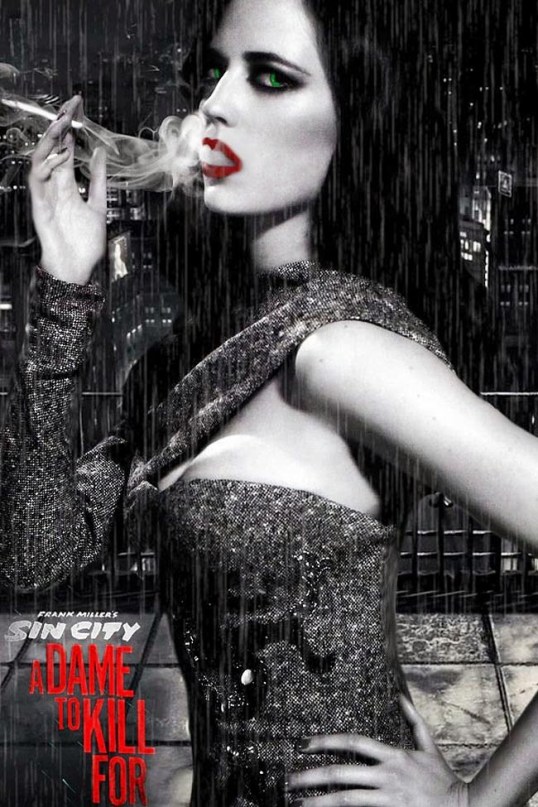
Sin City A Dame to Kill For

Hard to imagine it’s been 9 years since the original Sin City hit the big screen. It was a comic book adaptation that many thought wouldn’t work, especially how Rodriguez envisioned it to be slavishly loyal to not just Miller’s dialogue but also his unique art style.

The original film’s success quickly ramped up rumors that a sequel was already being planned using the second graphic novel in the Sin City series. Rodriguez himself stated he wanted Angelina Jolie for the role of Ava Lord, the titular “Dame to Kill For”, but after years and years of delay the role finally landed on Eva Green‘s lap (not a bad choice and one I fully support).

So, we’re now going back to Basin City for more tales of booze, broads and bullets in this hyper-noir film that should be loved or hated in equal measures by those who have followed Frank Miller’s career. Once again the directing duties have been split between Rodriguez and Miller. Here’s to hoping that Miller has learned how to be a much better directer after his last film, The Spirit, tanked.

Sin City: A Dame to Kill For is set for an August 22, 2014 release date.

6 Reviews of 6 More Films That Were Released in 2013: The Company You Keep, Dracula 3D, Getaway, Identity Thief, Pawn, Welcome to the Punch


In part of my continuing effort to get caught up on my 2013 film reviews, here are 6 more reviews of 6 more films.

The Company You Keep (dir by Robert Redford)

Shia LeBeouf is a journalist who discovers that attorney Bill Grant (Robert Redford) is actually a former 60s radical who is still wanted by the FBI for taking part in a bank robbery in which a security guard was killed.  In one of those coincidences that can be filed directly under “Because it was convenient for the plot,” LeBeouf’s girlfriend (Anna Kendrick) works for the FBI.  Anyway, all of this leads to Grant going on the run and meeting up with a lot of his former radical colleagues (all of whom are played by familiar character actors like Susan Sarandon, Nick Nolte, Richard Jenkins, and Julie Christie).  Ben pursues him and discovers that Grant could very well be innocent and … oh, who cares?  The Company You Keep is a big smug mess of a film.   It’s full of talented actors — like Stanley Tucci, Brendan Gleeson, and Brit Marling (who, talented as she may be, is actually kinda terrible in this film) — but so what?  I lost interest in the film after the first 20 minutes, which was a problem since I still had 101 more minutes left to go.

Has there ever been a movie that’s actually been improved by the presence of Shia LeBeouf?

Dracula 3D (dir by Dario Argento)

Dario Argento’s version of the classic Dracula tale got terrible reviews when it was briefly released here in the States but I happen to think that it was rather underrated.  No, the film can not compares to classic Argento films like Deep Red, Suspiria, and Tenebre.  However, the film itself is so shamelessly excessive that it’s impossible not to enjoy on some level.  The film’s moody sets harken back to the classic gothic villages of the old Hammer films, Thomas Kretschman turns Dracula into the type of decadent European aristocrat who you would expect to find doing cocaine in 1970s New York, and Rutger Hauer is wonderfully over-the-top as Van Helsing.  Yes, Dracula does turn into a giant preying mantis at one point but if you can’t enjoy that then you’re obviously taking life (and movies) too seriously.

Getaway (dir by Courtney Solomon)

I saw Getaway during my summer vacation and the main thing I remember about the experience is that I saw it in Charleston, West Virginia.  Have I mentioned how in love I am with Charleston?  Seriously, I love that city!

As for the movie, it was 90 minutes of nonstop car chases and crashes and yet it somehow still managed to be one of the dullest films that I’ve ever seen.  Ethan Hawke’s wife is kidnapped by Jon Voight and Hawke is forced to steal a car and drive around the city, doing random things.  Along the way, he picks up a sidekick played by Selena Gomez.  Hawke and Voight are two of my favorite actors and, on the basis of Spring Breakers, I think that Gomez is a lot more talented than she’s given credit for.  But all of that talent didn’t stop Getaway from being forgettable.  It’s often asked how much action is too much action and it appears that Getaway was specifically made to answer that question.

Identity Thief (dir by Seth Gordon)

My best friend Evelyn and I attempted to watch this “comedy” on Saturday night and we could only get through the first hour before we turned it off.  Jason Bateman’s a great actor but, between Identity Thief and Disconnect, this just wasn’t his year.  In this film, Bateman is a guy named Sandy (Are you laughing yet?  Because the movie really thinks this is hilarious) whose identity is stolen by Melissa McCarthy.  In order to restore both his credit and his good name, Bateman goes down to Florida and attempts to convince McCarthy to return to Colorado with him.  The film’s “humor” comes from the fact that McCarthy is sociopath while Bateman is … not.

It’s just as funny as it sounds.

Pawn (dir by David Armstrong)

An all-night diner is robbed by three thieves led by Michael Chiklis and, perhaps not surprisingly, things do not go as expected.  It turns out that not only does Chilklis have a secret agenda of his own but so does nearly everyone else in the diner.  Pawn is a gritty little action thriller that’s full of twists and turns.  Chiklis gives a great performance and Ray Liotta has a surprisingly effective cameo.

Welcome to the Punch (dir by Eran Creevy)

In this British crime drama, gangster Jacob (Mark Strong) comes out of hiding and returns to London in order to get his son out of prison.  Waiting for Jacob is an obsessive police detective (James McAvoy) who is determined to finally capture Jacob.

In many ways, Welcome To The Punch reminded me a lot of Trance and n0t just because both films feature James McAvoy playing a morally ambiguous hero.  Like Trance, Welcome to the Punch is something of a shallow film but Eran Creevy’s direction is so stylish and Mark Strong and James McAvoy both give such effective performances that you find yourself entertained even if the film itself leaves you feeling somewhat detached.

Have you seen The Iceman?


The Iceman, a gangster biopic that stars the amazing Michael Shannon, came and went earlier this year.  It got respectful, if not rave, reviews but it certainly didn’t get the attention that it deserved.  That’s a shame because The Iceman is one of the best films of 2013.

Directed by Ariel Vromen, The Iceman tells the true story of Richard Kuklinski (Shannon), a Mafia contract killer who claimed to have killed anywhere from 100 to 250 people over the course of his three decade long career.  At the same time that Kuklinski was murdering the equivalent of the population of a small rural community, he was also living a double life as a suburban family man.  When he was finally arrested in 1986, neither his wife nor his daughters had any idea that he was a killer.  After being sentence to spend the rest of his life in prison, Kuklinski gave countless interviews (and was the subject of a creepy documentary that still shows up on HBO occasionally) until he finally died, under mysterious circumstances, in 2006.

When Kuklinski is first seen in the Iceman, it’s the 50s and he’s flirting with Deborah (Winona Ryder).  When another man speaks to Deborah, Kuklinski reacts by casually following the man outside and killing him.  Kuklisnki goes on to marry Deborah before he eventually meets crime boss Roy DeMeo (Ray Liotta) and is recruited to kill for a living.  It’s a good arrangement for Kuklinski because it turns out that killing is the only thing he’s good at and his marriage to Deborah allows him to tell himself that he’s just a blue collar family man doing his job.

As opposed to other cinematic sociopaths, Kuklinski is no glib charmer.  Instead, as the film repeatedly demonstrates, he is a remorseless killer who feels neither shame nor joy as a result of his actions.  Much like the character played by Michael Rooker in Henry: Portrait of a Serial Killer, Kuklinski is not defined by what hides behind his blank expression but by the fact that there’s nothing to hide because nothing’s there.

Even Kuklinski’s love for his family is, in one particularly harrowing sequence, revealed to be hollow and false.  As becomes apparent, the only thing that keeps Kuklinski from taking out his homicidal impulses on his family is the fact that there’s a never-ending supply of Mafia lowlifes who need to be executed.  Kuklinski and his associates exist in a moral vacuum and friendship and family life are ultimately a disguise as opposed to a reality.

If this makes The Iceman sound like a rather dark film, that’s because it is.  And yet, the film is never less than watchable.  It helps that Ariel Vromen gets excellent performances from his entire cast.  Both Winona Ryder and Ray Liotta are perfectly cast.  Robert Davi shows up as a mobster and James Franco has a very effective cameo as one of Kuklinski’s victims.  Stephen Dorff plays Kuklinski’s brother, who is serving a life sentence because, unlike his brother, he never figured out a way to turn his dark impulses into a business.  Best of all,  Chris Evans plays an especially sleazy hitman who drives an ice cream truck in his spare time.  When Evans first shows up, he seems almost like a comical character but, as the film progresses, Evans’ performance becomes more and more sinister until eventually, he’s calmly talking about killing his own children.  For those of us who have been conditioned to associate Chris Evans with the clean-cut Capt. America, it’s a revelation of a performance.

However, the film is truly dominated by Michael Shannon.  It’s not easy to make an empty character compelling but Shannon does so.  Shannon is such a charismatic performer that you want to like him when he first appears on screen.  As The Iceman plays out, you keep finding yourself hoping that Kuklinski will reveal some shred of human decency.  You find yourself studying Shannon’s rigid stance and cold eyes and hoping to find some evidence of compassion.  The genius of Shannon’s performance is that he makes Richard Kuklinski a fascinating character even as he slowly reveals just how hollow he actually is.

Is Michael Shannon the best American actor working today?  That was a question that filmgoers were forced to ask after seeing Shannon’s performance in 2011’s Take Shelter.  It’s a question that they should ask again after seeing his performance in The Iceman.  Without Shannon’s performance, The Iceman would be just another gangster film.  However, thanks to Shannon, it’s one of the best films of the year so far.

Film Review: Killing Them Softly (dir. by Andrew Dominik)


Killing Them Softly is perhaps the most unpleasant film of 2012.

Taking place in 2008, Killing Them Softly tells the story of how a poker game got robbed in New Orleans and how that robbery led to a lot of people getting killed.  The poker game is run by Markie (Ray Liotta), a likable and well-meaning gangster who made a big mistake in the past.  A few years  previously, Markie arranged for one of his poker games to get robbed.  Though everyone knew that Markie was guilty, nobody could prove it and Markie continued to claim his innocence even while being tortured by a legendary hitman named Dillon (Sam Shepard).  So, years later, three small-time crooks figure that if they rob another one of Markie’s games, the Mafia will automatically blame Markie and hold him responsible.

Unfortunately, one of the crooks (played by Ben Mendelsohn, who was so good in Animal Kingdom) is also a heroin addict and something of an idiot.  He talks to the wrong people and soon the Mafia knows who was actually responsible.  Since Dillon is in the hospital, his protegé Jackie (Brad Pitt) is sent down to New Orleans to take care of the situation.  As Jackie explains to the mob’s representative (played by Richard Jenkins who gives a very Richard Jenkinsy performance here), not only do the three criminals have to die but Markie has to die as well.  It’s all strictly business.

Speaking of business, this entire story plays out against the backdrop of the 2008 elections.  For some reason, all of these sleazy criminals seem to be obsessed with watching CNN.  As a result, nearly every scene features either George W. Bush or Barack Obama speaking in the background.  At one point, Jackie says, “This is America,” just in case you couldn’t figure out that the film’s plot is supposed to be allegorical.

Killing Them Softly is an odd film, a well-made film that never quite convinces us that its story needs to be told.  Brad Pitt is miscast as Jackie and James Gandolfini has a truly annoying cameo as an alcoholic killer but otherwise, the film is perfectly cast.  Mendelsohn and Scoot McNairy are believable as two of the stupidest criminals to ever appear on-screen and Ray Liotta is likable and sympathetic as the tragic Markie.  Director Andrew Dominik makes good use of the New Orleans locations and the film has a few genuinely suspenseful moments.  That said, the film’s graphic and brutal violence quickly goes from being shocking to just being tedious.

If for no other reason, I did appreciate the fact that Killing Them Softly was brave enough to lump Barack Obama in with every other politician whose words are used to punctuate the film’s action.  Here in America, filmmakers tend to be very hypocritical when it comes to criticizing the government, going to almost ridiculous lengths to excuse Obama for following the same policies that they previously spent eight years attacking George W. Bush for instituting.  Instead of attempting to promote any partisan position, Killing Them Softly argues that the business of America will remains the same regardless of who is in charge.  Normally, that would seem to be a pretty obvious point but, in today’s cult-like political climate, it’s practically revolutionary.

Critics have been mixed on Killing Them Softly but, judging on both the film’s anemic box office and a lot of the comments that have been left online, audiences seem to absolutely loathe this film.  This isn’t particularly surprising because Killing Them Softly, with its constant emphasis on everything that’s ugly and dirty about life, seems to be a film that was specifically made to annoy audiences.  Even the film’s strengths ultimately serve to alienate the viewer.  I suspect that was Andrew Dominik’s ultimate goal and, on that count, he definitely succeeded.

Ultimately, I guess that’s why I ended up developing a strange sort of respect for Killing Them Softly, even though I found it impossible to enjoy the film itself and I would rather visit my gynecologist than ever have to sit through it again.  This is a film that stays true to itself, even at the risk of becoming unwatchable as a result.