Late Night Retro Television Review: Hunter 1.14 “The Snow Queen: Part Two”


Welcome to Late Night Retro Television Reviews, a feature where we review some of our favorite and least favorite shows of the past!  On Thursdays, I will be reviewing Hunter, which aired on NBC from 1984 to 1991.  The entire show is currently streaming on Tubi and several other services!
This week, the story of the snow queen comes to a close.

Episode 1.14 “The Snow Queen: Part Two”

(Dir by Richard Colla, originally aired on March 30th, 1985)

The second part of The Snow Queen saga opens with a stylish action sequence.  As Huey Lewis sings I Want A New Drug on the soundtrack, we watch as both Molinas (Dennis Franz) and Hunter approach, from opposite sides, the boat where Sally LaPone is hiding out with one of her friends.  Molinas is approaching the boat so that he can murder Sally for the mob bosses in New York.  Hunter, on the other hand, is approaching the boat to try to save Sally’s life.  The guards that surround the boat have no idea what’s going on and they end up getting into a gunfight with both Molinas and Hunter.  Molinas, being the sleaze that he is, pretends that he drew his gun to help Hunter as opposed to killing Sally.

Meanwhile, at a club, a smitten Vic Terranova (Dennis Farina) pushes McCall, who is working undercover, to take the stage.  Shots of McCall performing are mixed with shots of Molinas and Hunter shooting people and Sally once again escaping.

Molinas wants to kill Sally while McCall wants to use Sally’s testimony to take down Terranova and his drug-fueled empire.  Hunter wants to stop Molinas from killing anyone else and Sally just wants to be left alone.  The episode does a good job of switching from one character to the next, capturing the desperation of everyone involved.  One especially memorable sequence features Dennis Franz showing Sally’s pictures to a group of teenagers outside of a punk club.  Just from the reactions of Franz and the punks, one gets the feeling that the sequence wasn’t actually scripted.  There’s a gritty authenticity to the action in this episode and it makes for compelling viewing.

Of course, this is an episode of Hunter so everything does eventually lead to another shoot out.  Both Vic and Molinas go down in a hail of bullets and it’s actually kind of a shame.  Both Farina and Franz did such a good job in these two episodes that it’s unfortunate that their characters won’t be able to return in the future.  Franz, in particular, was brilliantly sleazy as the loathsome Molinas.  If only he hadn’t pulled that gun on Hunter, Molinas could have been one of those recurring villains that audiences would love to hate.

Still, all things come to an end and, since this is Hunter, they end in gunfire instead of arrests.  Sally survives but the final shot of the episode reveals that she’s been traumatized beyond belief by everything she’s seen and experienced.  McCall’s hope was that Sally would get immunity in return for testifying against Vic.  But, with Vic dead, Sally really doesn’t have any leverage that she could use to avoid jail.

Seriously, this was a dark episode!  But it was a compelling one and I’m glad that, for once, Hunter showed that not everyone just shrug off violence and move on.  Not everyone is Rick Hunter.
Late Night Retro Television Review: Hunter 1.13 “Snow Queen: Part One”


Welcome to Late Night Retro Television Reviews, a feature where we review some of our favorite and least favorite shows of the past!  On Thursdays, I will be reviewing Hunter, which aired on NBC from 1984 to 1991.  The entire show is currently streaming on Tubi and several other services!

This week, we have part one of a two part story.

Episode 1.13 “Snow Queen: Part One”

(Dir by Tony Mordente, originally aired on March 23rd, 1985)

This week’s episode features two tough guys who are both named Dennis.

Dennis Farina appears as Vic Terranova, a gangster who owns a nightclub and who loves country music.  McCall is working undercover as a country-western singer in order to take both him and his cocaine-dealing operation down.

Meanwhile, Dennis Franz appears as Sgt. Jackie Molinas, a sleazy detective from New York who comes to Los Angeles to extradite Sally LaPone (Lycia Neff), a former New York drug dealer who relocated to Los Angeles after she witnessed a murder in the Big Apple.  Sally is now the exclusive drug dealer for rock star Darby Slash (Brendan Hughes).  When she’s arrested at a raid on one of Terranova’s clubs, Molinas demands that she be turned over to him.  Correctly assuming that Molinas is planning on killing her, Sally escapes his custody.  Molinas’s search for Sally leads to him apparently killing both Darby Slash and also one Hunter’s informants.

Hunter can’t prove that Molinas is the killer but he suspects it.  It seems like he could just ask his Mafia relatives if Molinas is working for the Mob but this show has kind of forgotten that Hunter has relatives in the Mafia.

This episode was part one of two so this review is going to feel incomplete.  When the episode ended, McCall had gotten a job singing for Terranova and Molinas was closing in on Sally.  We’ll see how it all plays out next week.  For this week, I’ll simply say that Dennis and Dennis delivered.  Dennis Farina was properly smooth as Terranova.  Meanwhile, Dennis Franz turned Jackie Molinas into one of the sleaziest, most obnoxious characters that I’ve ever seen.  He’s the type of guy who walks into a place, insults all of the men, crudely hits on all of the women, and then attempts to murder a stranger.  Franz made Molinas into a character worthy of loathing.

I always find it interesting when Rick Hunter has to deal with a bad cop.  It’s like the show is saying, “Yes, Rick kills a lot of people but at least he’s not that guy!”

We’ll see how things work out next week.

Late Night Retro Television Review: Freddy’s Nightmares 2.9 “Monkey Dreams”


Welcome to Late Night Retro Television Reviews, a feature where we review some of our favorite and least favorite shows of the past! On Fridays, I will be reviewing Freddy’s Nightmares, a horror anthology show which ran in syndication from 1988 to 1990. The entire series can be found on Tubi!

This week, Freddy has a message!

Episode 2.9 “Monkey Dreams”

(Dir by Robert Englund, originally aired on December 3rd, 1989)

At a college science lab, Joe (Joseph Cali) tries to communicate with aliens.  Next door, Jeannie (Sharon Mahoney) tries to teach her monkey to speak.  When Joe starts getting strange messages on his computer, he thinks that it’s an alien code.  Then it turns out that it’s actually just the monkey trying to type out its name on its own computer.  Joe is then murdered by his bookie.

Meanwhile, Dr. Lynch (Sherman Howard) is using the monkey for some experiments to see how much pain a living creature can take.  Dr. Lynch seems to change his mind when he hears the monkey speak.  But it turns out that we were just seeing the monkey’s dream.

“Think about it!” Freddy tells us.

Freddy Krueger, animal rights activist?  I guess it makes sense when you consider that Robert Englund directed this episode.  The episode’s message was heartfelt but it seemed a bit out-of-place on a show about a undead child molester.  Whatever message you want to deliver, Freddy Krueger probably isn’t the best one to do it.

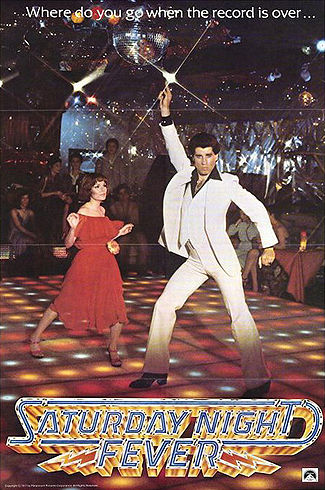
Embracing the Melodrama Part II #57: Saturday Night Fever (dir by John Badham)


Saturday_night_fever_movie_posterHere’s a little bit of trivia about the iconic 1977 film Saturday Night Fever.

First off, according to the imdb, Saturday Night Fever was the first mainstream Hollywood film to ever use the term “blow job.”  That actually took me by surprise.  I mean, with all of the risks that the major studios took in the 70s, it still took them until 1977 to have someone say “blow job” in a movie?  But somehow, it seems appropriate that it would turn up in Saturday Night Fever.  We tend to think of Saturday Night Fever as being a movie where the soundtrack is nonstop disco and John Travolta dances in that iconic white suit.  But actually, Saturday Night Fever is a film about four guys who neither understand nor respect women.

When Tony (John Travolta), Joey (Joseph Cali), Double J (Paul Pape), and Bobby (Barry Miller) go down to that disco, it’s because they want to get laid.   Joey and Double J take turns having sex with insecure Annette (Donna Pescow) and, afterwards, Tony scornfully ask her if she‘s proud of herself.  When Bobby discovers that his girlfriend is pregnant, he is so terrified of having to be a father that he becomes suicidal.  As for Tony, he looks down on the women who are so eager to dance with him.  When he enters a dance contest with Stephanie (Karen Lynn Gorney), he can’t handle the fact that she wants more out of her life than just being his latest partner.

So, it makes sense that this would be the first mainstream movie to feature someone talking about a blow job because that’s what these boys are obsessed with.  Sexually primitive, hypocritically puritanical, and emotionally repressed, a blow job is all the intimacy that these boys can handle.

Another piece of trivia: while John Travolta was always the first choice for Tony Manero, several actors were seen for the roles of Joey and Double J.  At one point, both Ray Liotta and David Caruso were nearly cast in the role of Tony’s friends.  Imagine this: in some alternative universe, while white-suited John Travolta rules over the dance floor, Ray Liotta and David Caruso are standing in the background and cheering him on.

Of course, if Liotta and Caruso had been cast, it would be a totally different movie.  Whenever you watch Saturday Night Fever, you’re surprised by how much John Travolta totally dominates the film.  Even though the film devotes a good deal of time to Annette, Stephanie, Bobby and to Tony’s brother who has recently left the priesthood, Tony Manero is the only character that you remember.  That’s largely because Travolta is the only one of them who gives a truly memorable performance.

In theory, it’s easy to laugh at the thought of Travolta in that white suit, striking a dramatic pose on that cheap-looking dance floor.  But then you watch the film and you realize that Travolta truly did give a great performance.  And, to your surprise, you don’t laugh at Tony with his white suit because you know that the only time Tony has any control over his life is when he’s dancing.  He may work in a paint store.  He may regularly get slapped around by his family.  He may not be very smart or sensitive.  But when Tony’s dancing, he’s a king and you’re happy that he at least has one thing in his life that he can feel good about.

Even if he is kind of a jerk.

Of course, it helps that Tony is a really good dancer.  There’s actually a lot more going on in Saturday Night Fever than you might think but ultimately, it’s a dance movie and it’s one of the best.

Embracing the Melodrama #34: The Lonely Lady (dir by Peter Sasdy)


The_lonely_lady

“I guess I’m not the only who has had to fuck her way to the top!” — Jerilee Randall (Pia Zadora), accepting an award at The Awards Ceremony in The Lonely Lady (1983)

When I first started doing research on which movies were worthy of being considered for inclusion in this series about embracing the melodrama, I had no idea that it would eventually lead to me watching the worst film ever made.

However, that is exactly what happened.  1983’s The Lonely Lady is without a doubt the worst film that I have ever seen.  Normally, this is where I would say that the film is entertaining specifically because it is so bad but no, this movie just terrible.  Is it so bad that its good?  No, it’s just bad.  Is it one of those films that you simply have to see to believe?  Well, that depends on how much faith you have in God.  Does the film at least have a curiosity value?  Well, maybe.  As bad as you think this movie may be, it’s even worse.

Seriously, to say this film is a piece of crap is to do a disservice to crap.

The Lonely Lady tells the story of Jerilee Randall (Pia Zadora, who also played the girl martian in the classic Santa Claus Conquers the Martian), an aspiring writer who learns about the dark side of Hollywood.  The movie opens with Jerilee graduating from Valley High School and receiving a special prize for being the school’s most promising English major.  Now, from the very beginning, we run into several issues.  Number one, Pia looks way too old to be in high school and the fact that they decided to put her hair in pig tails doesn’t change the fact.  Number two, Pia Zadora is even less convincing as a writer than she was as a girl martian.

At the graduation party, Joe (played by Ray Liotta, of all people) violates Jerilee with a garden hose, in an amazingly ugly scene that pretty much sets the tone for the rest of the film.  No longer an innocent optimist, Jerilee moves out to Hollywood where she ends up married to award-winning screenwriter Walter Thornton (Lloyd Bochner).  When she secretly helps Walter rewrite his latest script (she replaces a long monologue with two lines of dialogue: “Why!?  Why!?”), Walter grows jealous and starts to taunt her by holding up a garden hose.  Jerilee and Walter divorce and Jerilee ends up sleeping with everyone else in Hollywood in an attempt to get a screenplay of her own produced.  Eventually, this leads to Jerilee having a nervous breakdown in which the keys of her typewriter are replaced with the accusatory faces of everyone in her life…

Bleh!  You know what?  Describing this plot is probably making The Lonely Lady sound a lot more interesting than it actually is.  Imagine if Beyond The Valley Of The Dolls was meant to be taken seriously and you have a pretty good idea what The Lonely Lady is like.

Furthermore, I’ve seen a lot of films that claim to be about writers.  Occasionally, we get lucky and the writer is played be an actor who you could actually imagine writing something worth reading.  (Perhaps the best recent example would be Paul Dano, who was completely believable as a critically acclaimed writer in Ruby Sparks.)  However, most of the time, we end up with actors who you can hardly imagine having the either the discipline or the intellectual ability to write anything worth reading.  And then, in the case of The Lonely Lady, we get Pia Zadora who is not only unbelievable as a writer but also as a human being as well.  Watching her performance, you’re shocked that she can remember to breathe from minute to minute, much less actually write anything longer than her first name.

I know it’s a pretty big claim to say that one movie is the worst ever made.  So, feel free to watch The Lonely Lady and then let me know if you agree.

(Be warned — this movie is NSFW and generally sucks.)