Lisa Watches An Oscar Nominee: The Verdict (dir by Sidney Lumet)


Verdict1

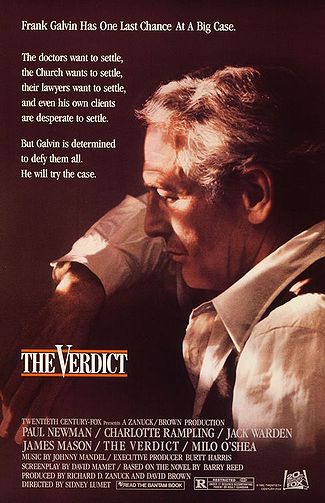
Speaking of the good, old-fashioned star power of Paul Newman, The Hustler and Butch Cassidy and the Sundance Kid were not the only films to receive an oscar nomination as the result of his charisma.  There’s also The Verdict, a 1982 best picture nominee that would probably be forgotten if not for Paul Newman’s performance.  However, since Paul Newman did play the lead role in The Verdict and he did give an amazing lead performance, The Verdict was nominated for best picture and, 33 years later, it ended up on TCM where I just watched it.

That’s the power of good acting.

Paul Newman plays Frank Galvin, a Boston-based attorney.  At one time, Frank was a lawyer at an elite firm.  But he has since fallen on hard times.  Now, he’s the type of attorney who crashes funerals and hands out his card.  He spends his spare time at his favorite bar, playing pinball and telling long jokes while stumbling about in a drunken haze.  In many ways, Frank represents everything that people hate about personal injury attorneys but, since he’s played by Paul Newman, you know that he’s going to turn out to be a good guy.

Frank only has one friend left in the world, his former mentor Mickey (Jack Warden).  Looking to help Frank out, Mickey sends Frank a medical malpractice suit.  A woman at a Catholic Hospital was given an anesthetic during child birth that has led to her now being brain dead.  Both the woman’s family and the Archdiocese are looking for a settlement.  The family needs the money to pay for her medical care.  The Archdiocese just wants the case to go away.  All Frank has to do is accept whatever settlement deal is offered…

However, something has changed for Frank.  He’s visited the comatose woman and, looking at her trapped in a vegetative state, he’s decided that the hospital needs to be held responsible for its mistake.  He rejects the settlement and takes the case to court, looking for both justice for the victim and redemption for himself.

That’s easier said than done, of course.  The Archdiocese has hired Ed Concannon (James Mason, perfectly cast), one of the best and most powerful attorneys in Boston.  Ed has a huge legal team working on the case.  Frank has Mickey.  As well, the Judge (Milo O’Shea) makes little effort to hide his contempt for Frank.

Probably the only bright spot in Frank’s life is that he’s met a woman.  Laura (Charlotte Rampling) meets him in a bar and soon, they’re lovers and Frank is confiding in her about the case.  What he doesn’t suspect is that Laura herself is a spy, hired by Concannon.

It looks like all is lost but then Frank discovers that there is one nurse (Lindsay Crouse) who might be willing to tell the truth about what happened at the hospital…

In many ways, The Verdict is a predictable film.  From the minute we first meet him, we know that Frank is going to be redeemed.  From the minutes that we hear about the case, we know who we’re supposed to root for and who we’re supposed to hiss.  Just about every courtroom cliché is present, right down to a surprise witness or two…

But no matter!  The Verdict may be predictable but it works.  As he proved with 12 Angry Men, Director Sidney Lumet knew how to make legal deliberations compelling and the entire film is full of small but memorable details that elevate it above its simplistic storyline.  As a director, Lumet gets good performances from his cast and, as a result, this is a film where the hero is flawed and the antagonists aren’t necessarily evil.  Even the Bishop of the Archdiocese of Boston (who, in most films, would have been a cardboard villain) is given a scene where he’s allowed to show some humanity.

And, of course, Paul Newman is great in the role of Frank.  When we first meet Frank, he looks and sounds terrible.  Indeed, it’s strange to see Paul Newman playing a character who is essentially such a loser.  (Even Eddie Felson in The Hustler had an appealing swagger about him.)  It’s during the scenes where Frank considers the woman in a coma that Newman starts to reveal that there’s more to Frank than what’s on the rough surface.  By the end of the film, Frank may be a hero but Newman doesn’t play him as such.  He’s still has that alcoholic rasp in his voice and his eyes still betray hints of insecurity and a fear that, at any minute, he’s going to screw up and mess everything up.  It’s a great performance, one for which Newman received a nomination for best actor.

Speaking of star power, Bruce Willis also shows up in The Verdict.  He’s an extra who appears as an observer in the courtroom.  He’s sitting a few rows behind Paul Newman.  (He’s also sitting beside Tobin Bell, the Jigsaw Killer from the Saw films).  It’s probably easiest to spot Willis towards the end of the film, when the verdict is read.  Bruce breaks out into a huge grin and almost looks like he’s about to start clapping.  Bruce only gets about 10 second of screen time but he acts the Hell out of them!

Thanks to Paul Newman, The Verdict is a memorable and entertaining film.  Be sure to watch it the next time it shows up on TCM.
Lisa Watches An Oscar Nominee: Butch Cassidy and the Sundance Kid (dir by George Roy Hill)


Butch_sundance_poster

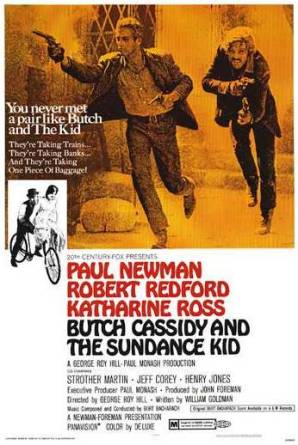
Should I start this post by ticking everyone off or should I start out by reviewing the 1969 best picture nominee Butch Cassidy and The Sundance Kid?

Let’s do the review first.  I recently watched Butch Cassidy and the Sundance Kid when it aired as a part of TCM’s 31 Days of Oscar.  This was actually my third time to see the film on TCM.  And, as I watched Butch Cassidy and the Sundance Kid for the third time, I was shocked to discover how much I had forgotten about the film.

Don’t get me wrong.  I remembered that it was a western and that it starred Paul Newman and Robert Redford as real-life outlaws Butch Cassidy and the Sundance Kid.  I remembered that it opened and ended with sepia-toned sequences that suggested that Butch and Sundance represented the last gasp of the old west.  I remembered that Butch won a fight by kicking a man in the balls.  I also remembered that they robbed the same train twice and, the second time, they accidentally used too much dynamite.  I remembered that, for some reason, Butch spent a lot of time riding around on a bicycle.  I remembered that Butch and Sundance ended up getting chased by a mysterious posse.  I remembered that Sundance could not swim.  And I remembered that the film eventually ended on a tragic note in South America…

And I know what you’re saying.  You’re saying, “It sounds like you remembered the whole movie, Lisa!”

No, actually I did not.  The thing with Butch Cassidy and the Sundance Kid is that the scenes that work are so memorable that it’s easy to forget that there’s also a lot of scenes that aren’t as memorable.  These are the scenes where the film drags and you’re thankful that Paul Newman and Robert Redford were cast as Butch and Sundance, because their charisma helps you overlook a lot of scenes that are either too heavy-handed or which drag on for too long.  You’re especially thankful for Newman, who plays every scene with a twinkle in his wonderful blue eyes and who is such a lively presence that it makes up for the fact that Redford’s performance occasionally crosses over from being stoic to wooden.  It can be argued that there’s no logical reason for a western to feature an outlaw riding around on a bicycle while Raindrops Keep Fallin’ On My Head plays on the soundtrack but Paul Newman’s so much fun to watch that you can forgive the film.

Newman and Redford both have so much chemistry that they’re always a joy to watch.  And really, that’s the whole appeal of Butch Cassidy and the Sundance Kid, the chance to watch two iconic actors have fun playing opposite each other.  Even though Katharine Ross appears as their shared romantic interest, the film’s love story is ultimately between Butch and Sundance (and, by extension, Newman and Redford).  You can find countless reviews that will give all the credit for the film’s appeal to William Goldman’s screenplay.  (You can also find countless self-satisfied essays by William Goldman where he does the exact same thing.)  But, honestly, the film’s screenplay is nothing special.  This film works because of good, old-fashioned star power.

Now, for the part that’ll probably tick everyone off (heh heh), I think that Butch Cassidy and the Sundance Kid is actually a pretty good pick for a future remake.  All you have to do is pick the right actors for Butch and Sundance.  I’m thinking Chris Pratt as Butch and Chris Evans as Sundance…

Oh, c’mon!  It’ll be great!

Lisa Reviews An Oscar Nominee: Bound for Glory (dir by Hal Ashby)


Bound_for_glory_Poster

One of my favorite online film reviewers is Mitch Lovell of the Video Vacuum.  The thing I like about Mitch is that he doesn’t worry about how many Oscars a film has been nominated for or whether or not a film’s politics are currently in fashion.  Unlike a lot of online reviewers, he doesn’t worry about whether or not he’s going against the “accepted” views of the critical establishment.  Instead, he’ll watch a film and tell you exactly how he felt about it.

For example, Mitch Lovell’s review of the otherwise critically acclaimed 1976 best picture nominee Bound for Glory can be summed up in three words: “boring as fuck.”  Every other online review that I’ve found for Bound for Glory offers up polite but rarely inspiring praise for this rather lengthy film about the folk singer Woody Guthrie.  Most of those reviews do acknowledge that the film moves at its own pace but we are told that we will be rewarded for being patient.  If the review was written after 2010, you can be sure that the reviewer will be sure to say that Bound for Glory reminds us of why labor unions are still important and need to be protected from the Tea Party.  (The idea apparently being that, if a film has the right politics, it doesn’t have to actually be all that interesting.)  It’s all rather predictable and that’s why we’re lucky to have reviewers like Mitch Lovell around.  Whether you agree with him or not, it’s good to have a reviewer who will go against the conventional wisdom.

I recently watched Bound for Glory as a part of TCM’s 31 Days of Oscars and, to a large extent, I have to agree with Mitch Lovell’s review.  This is a movie that is not only long but which moves slowly as well.  It’s not that the film has a deliberate pace.  It’s just slow!  (If you want to see a film that makes good use of a deliberate pace, check out Barry Lyndon.)  David Carradine plays Woody Guthrie, a sign painter who, during the Great Depression, abandons his family in Texas and, by hopping trains, makes his way to California.  He works with fruit pickers.  He tries to convince his fellow workers to form a union.  He gets beat up a lot.

And he plays his guitar.

If there’s anything that remains consistent about Bound for Glory, it’s that Woody is always playing his guitar and that every time he starts to play, something terrible either has happened or does happen.  There’s a huge dust storm.  Woody plays his guitar.  A fight breaks out at a union meeting.  Woody plays his guitar.  A bunch of hoboes on a train get beat up.  Woody plays his guitar.  Woody shows up at a textile mill and starts to play his guitar.  He gets beaten up by a bunch of thugs.  Woody impresses Pauline (Gail Strickland) by playing his guitar and soon, he’s cheating on his wife.  Woody partners up with another folk singer, Ozark Blue (Ronny Cox), and they get their own radio show where Woody plays guitar.  Woody promptly gets fired.

It quickly became apparent to me that Woody Guthrie’s guitar was cursed.  Whenever he played it, poor people ended up getting oppressed.

In many ways, Bound for Glory is a prototypical example of what it means to be an acclaimed-at-its-time-but-subsequently-forgotten best picture nominee.  It’s a big epic film that tells a fictionalized account of a real person’s life story.  Woody Guthrie is best known for writing This Land Is Your Land, which is a song that I mostly associate with pretentious super bowl commercials.  As Bound for Glory details, Woody was also a union organizer and political activist but what’s odd is that the film keeps the exact details of what he believed rather vague.  We’re given the general idea of what Woody believed but we’re not given any specifics.  As a result, Woody just comes across like another part-time social protestor as opposed to being a true political thinker (much less a revolutionary).

On a positive note, Bound for Glory is impressive to look at.  The film’s cinematographer was the famous Haskell Wexler (who also directed Medium Cool, a film that was as upfront about its politics as Bound for Glory is vague) and Wexler captures some hauntingly beautiful images of the American wilderness.  The scene where a gigantic wall of dust crashes down onto a small Texas town is especially memorable.

Otherwise, though, Bound for Glory is pretty much a snoozefest.  It was nominated for best picture of 1976 and, when you compare it to fellow nominees like All The President’s Men, Network, Taxi Driver, and even Rocky — Bound for Glory does feel a bit out of place.

Then when you consider some of the other films that came out in ’76 — Carrie,  Face to Face, The Front, God Told Me To, Logan’s Run, The Man Who Fell To Earth, Marathon Man, The Omen, The Outlaw Josey Wales, Lipstick, Robin and Marian, The Sailor Who Fell From Grace With The Sea, and The Town That Dreaded Sundown — the nomination of Bound for Glory feels like even more of a mistake.

Oh well.

Occasionally, the Academy gets it wrong.

Shocking, I know.

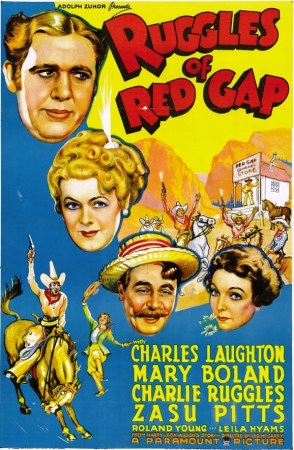
Lisa Watches An Oscar Nominee: Ruggles of Red Gap (dir by Leo McCarey)


Ruggles_of_red_gap

After watching Barry Lyndon, I decided to continue to explore my DVR by watching another film that was shown as a part of TCM’s 31 Days of Oscar.

First released way back in 1935, Ruggles of Red Gap was nominated for best picture but it lost to Mutiny of the Bounty.  Interestingly enough, both Ruggles and Bounty featured the great Charles Laughton.  In Bounty, Laughton played a tyrannical villain, Capt. Bligh.  In Ruggles, however, Laughton is the film’s hero, a gentle and comedic butler named Marmaduke Ruggles who, after having his contract gambled away in a poker game, finds himself living in the frontier town of Red Gap, Washington.

It’s also interesting to note that Ruggles of Red Gap is one of the few best picture nominees to receive absolutely no other nominations.  To a certain extent, it’s understandable.  Ruggles of Red Gap was made at a time when the Academy had less categories but still nominated ten films for best picture.  As a film, Ruggles mostly serves as a showcase for Charles Laughton but, that year, he received his best actor nomination for his work in Mutiny.  (At that time, there were no supporting categories.  Had there been, it’s likely that Laughton could have received a lead actor nomination for Ruggles and a supporting nomination for Bounty.)  The next time that someone complains that Selma only received two nominations, you remind them that’s one more than Ruggles of Red Gap received.

As for the film itself … well, for a modern audience, the film’s deliberate pace takes some getting used to.  The film’s best moments occur at the start.  Ruggles wakes up one morning to discover that his boss (Roland Young) lost him in a poker game.  Ruggles spends the day meeting and attempting to get used to his new employer, a nouveau riche cowboy named Egbert Floud (Charlie Ruggles).  The joke here, of course, is that Ruggles is stereotypically reserved and British while Egbert is loud, brash, and American.  Ruggles lives his life by the rules of the class system.  Egbert comes from a world where there is no class and everyone is equal.  Ruggles refuses to call Egbert by his first name.  Egbert gets Ruggles drunk.  The scenes of Egbert and Ruggles in Europe are a lot of fun, largely because the two actors were obviously having a lot of fun playing off each other and Laughton clearly relished getting to play comedy as opposed to villainy.

The second half of the film features Ruggles settling into life in Red Gap, Washington.  The citizens of Red Gap are, of course, all honest and hard-working folks who don’t have the slightest hint of pretension.  (Red Gap may have been in Washington but it was obviously nowhere close to Seattle.)  They welcome Ruggles into the community but they also mistake him for being a colonel and soon, everyone is under the impression that Ruggles himself is a war hero.  It’s an odd subplot, one that doesn’t seem to really be necessary to make the film’s point.

And that point, by the way, is that America is a land where everyone is equal and where butlers have the same rights as their employers.  Ruggles goes from being somewhat horrified by his new surrounding to being a proud American, an entrepreneur who is now capable of being his own man.  And it may sound corny and I’m sure all of my cynical friends are rolling their eyes but you know what?  Charles Laughton pulled it off.  As uneven as the film may sometimes be, Laughton’s sincere performance holds it all together.  He’s the main reason to watch Ruggles of Red Gap.

How proud of an American does Ruggles become?  He’s enough of an American that he can even recite the Gettysburg address!  Watch below!

Lisa Watches An Oscar Nominee: Barry Lyndon (dir by Stanley Kubrick)


Barry_Lyndon_A

“It was in the reign of George III that the aforesaid personages lived and quarreled; good or bad, handsome or ugly, rich or poor, they are all equal now.”

— Barry Lyndon (1975)

As I may have mentioned yesterday on this site, Texas has finally caught up with the rest of this frozen country.  Starting on Sunday night, it has finally been cold and wintry down in my part of the world!  For two days straight, schools have been closed and the streets have been covered in ice.  And, even though the temperature got slightly above freezing today, I have been told that I can expect to wake up tomorrow morning to a snowy wonderland.

And I hope that’s the case because I would love to stay home on Wednesday!  Ever since the 31 Days of Oscar began, I have recorded so many movies off of TCM that I am running dangerously close to running out of space on the DVR.  The best thing about being snowed (or iced) in is that it gives me an opportunity to watch some of those films.

For instance, I spent this afternoon watching the 1975 best picture nominee Barry Lyndon.  And when I say that I spent an afternoon, I mean that literally.  Clocking in at a little over 3 hours, Barry Lyndon is a film that’s so long that it even provides an intermission so the you can stand up and stretch your legs.

Seriously, I was really thankful for that intermission.

Which not to say that Barry Lyndon is a bad film.  Far from it!  It’s actually one of the best films to be included in this year’s 31 Days of Oscars.  While I may have no first hand knowledge of what it was like to live in the 1700s, I can now say that I definitely have a clue on account of the fact that I’ve seen Barry Lyndon.

Directed by the great Stanley Kubrick and based on a novel by William Makepeace Thackery, Barry Lyndon tells the story of a penniless Irishman Redmond Barry (Ryan O’Neal) who, following a duel with a wealthy British captain, is forced to flee from his home.  After being robbed by a highwayman, Barry joins the British army but, upon being sent to fight in Germany, discovers that he has no love for combat.  As such, Barry deserts but is then captured by and forced to enlist in the Prussian Army.  Once the war ends, Barry is order to spy on a professional gambler who the Prussians suspect might, himself, be a spy.  Barry and the gambler soon become partners and travel around Europe together.  However, Barry has decided that he now wants to marry into wealth and he gets that chance when he meets the Countess of Lyndon (Marisa Berensen), whose husband is dying.

And that’s when the intermission kicks in.

When we come back, Redmond Barry is now known as Barry Lyndon and appears to have everything that he’s ever wanted.  However, while Barry may have been naturally lucky when he was poor, the opposite is true once he’s rich.  Despite his new station in life, Barry is never truly accepted by his wife’s circle of friends.  Furthermore, his son, Bryan (David Morley) is injured while out riding a horse and Lady Lyndon has a nervous breakdown as a result.  Meanwhile, Barry’s stepson, Lord Bullington (Leon Vitali), hates him and spends most of his time plotting ways to get rid of his stepfather.

And, naturally enough, it all leads to one final duel in a barn, in which two men point guns while surrounded by the deafening sounds of hundreds of pigeons cooing.

I’m at something of a disadvantage when it comes to reviewing Barry Lyndon because I watched it on television and Barry Lyndon is one of those films that demands to be seen on a big screen.  For all of the dramatic moments and satirical asides (this film has a wonderfully snarky narrator), Barry Lyndon is ultimately most concerned with recreating the past as authentically as possible.  Watching this film, you really do feel as if you’ve traveled back to the 18th Century, where all of the rooms are lit by candle light and one’s station in life can be determined by the ornateness of his or her costume.

As I watched Barry Lyndon, I had to wonder — whatever happened to Ryan O’Neal?  I recently saw O’Neal in a film called The List and it was hard to believe that the terrible actor from that film was the same guy who starred in Barry Lyndon.  Kubrick may not have a reputation for being an actor’s director but Ryan O’Neal gives a great performance in Barry Lyndon.  (Compare O’Neal’s performance in the earlier Love Story to his performance here and you’ll see how good a job Kubrick did when it came to directing O’Neal.)  When we first meet Barry, he is an almost passive aggressive character, a cunning guy who has the patience necessary to wait for his opportunity to advance.  It’s only during the second half of the film that Barry becomes a truly sympathetic character, redeemed by both his love for his son and the fact that all of his enemies are even worse than him.  The strength of Ryan O’Neal’s performance can be found in the fact that Barry can be both amoral and sympathetic at the same time.

So, I’m glad that the streets were icy on Tuesday.  I’m thankful because it gave me a chance to watch Barry Lyndon.

And yes, I’m also very thankful for that intermission.

Three Films From Jeremiah Kipp: Berenice, Minions, and Painkiller


I recently had the chance to view three short horror films that were directed by Jeremiah Kipp.  Before I get into the specifics of each film, let me just say that I recommend all three of them.  As a director, Kipp does a good job of building and maintaining the proper atmosphere of dread that’s necessary for good horror (especially good short horror) to work.  If you’ve read my previous reviews on this site or over at Horrorcritic.com, you know that I am an unapologetic fan of surreal and dream-like horror and, needless to say, that’s what all three of the films below deliver.

berenice-bloody

“You and I have some unfinished business from back in the day.” — Berenice (2014)

The first film that I watched was Berenice, a 19-minute adaptation of a short story by Edgar Allan Poe.  Though the story has been updated so that it now takes place in present day New York, Berenice closely follows the original Poe short story.  Edward (Thomas Mendolia) is a mentally unstable man who seems to spend most of his time locked away in his room, where he obsessively tinkers with a light.

When his cousin, Berenice (Cheryl Koski), moves in with him and his parents, Edward is, at first, reluctant to get close to her.  However, he is slowly won over by the fact that Berenice is as much as an outsider as he is.  She is dying from an unknown illness and regularly suffers seizures.  While everyone else chooses to ignore Berenice, Edward grows closer and closer to her.  But, haunted by visions of her savagely biting off his lower lip, Edward cannot stop obsessing over her teeth…

Full of gloomy atmosphere, Berenice is an effectively morbid mood piece.  It can be appreciated as a literary adaptation but, even if you haven’t read Poe’s original short story, Berenice still works as a succession of increasingly surreal and disturbing images.  In many ways, Berenice can be positively compared to the work of the great French director, Jean Rollin.  A scene where Berenice and Edward visit a cemetery brings to mind a similar scene from Rollin’s Two Orphan Vampires.  And, in the role of Berenice, Cheryl Koski bares more than a passing resemblance to Francoise Blanchard, the star of Rollin’s The Living Dead Girl.  In the scenes were blood runs down her chin or she suddenly appears awkwardly walking naked down a dark hallway, Koski could be Blanchard’s twin.

Speaking of Cheryl Koski, she’s like a force of nature in this film.  Whether she’s somewhat desperately trying to get people to talk to her at a party or awkwardly flirting with Edward, or biting someone’s face off, Cheryl Koski gives an energetic, heartfelt, and even poignant performance.  Playing the far more repressed Edward, Thomas Mendolia deserves praise as well.  It’s not easy to make introversion compelling but he does it.

Berenice is part of a horror anthology called Creepers, which can be ordered from Creepersfilm.com

minions-long

“There’s a cruelty in your heart. Is it love or is it hate?” — The Minions

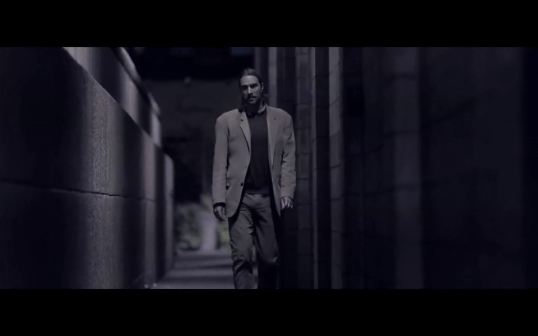
Speaking of dream-like, the next Kipp film that I watched was practically a filmed nightmare and I mean that in the best possible way.  The Minions opens with William (played by Lukas Hassel, who has a really handsome movie star look about him) standing in a dark room.  As he stares out a window, he has a conversation with an unseen woman.  Their dialogue is wonderfully cryptic.  We see flashbacks of William walking down the streets of Manhattan.  He meets two girls who appear to be drunk. He escorts them back to their apartment and he promises the drunker of the two a kiss when they reach her destination.  Needless to say, the girls are not quite what they seem and a kiss is more than just a kiss…

The Minions is only 11 minutes long but it’s an amazingly effective and atmospheric 11 minutes, full of creepy images and growing paranoia.  Looking over the notes that I took while watching the movie, I notice that I twice jotted down that The Minions has a “great soundtrack.”  That’s not just in reference to the music, though the film’s score is appropriate ominous.  Instead, I meant that The Minions is just a fascinating film to which to listen.  The music playing in the background, the footsteps of people walking through the city, the sound of constant (but never seen) traffic, and the melody of Lukas Hassel’s voice; they all combine to provide the perfect soundtrack for the film’s shadowy and haunting images.

It all adds up to a very haunting piece of moody atmosphere.

PLK1

“You’ll pay for this, won’t you?” “Someone will. Someone always does.” — Painkiller (2014)

The final Jeremiah Kipp short film that I watched was Painkiller, a wonderfully over-the-top look at pain and pleasure.

Two scientists (Kelly Rae LeGault and Berenice‘s Thomas Mendolia) are looking for a non-addictive way to treat the pain of being ill, a substitute for the drugs that — while they may relieve pain — are ultimately so addictive that they put the patient’s health at risk.  They engineer an organism (one that actually looks a bit like a miniature version of theTtingler from the classic Vincent Price film) that will attach itself to a patient’s nervous system.  The organism feeds on pain and releases endorphins while feeding.  LeGault volunteers to be the test subject and, in a scene that is full of Cronenberg-style sexual imagery, Mendolia inserts a gigantic hypodermic needle into her spine.

As they soon discover, the inserted organism works.  In fact, it works far too well.  LeGault soon becomes addicted to pain and when she doesn’t get it, she goes as far as to attack Mendolia with an iron.  (That scene made me go, “Agck!,” largely because it reminded me of when I was four and I accidentally grabbed an iron and burned my fingertips.)  Even a dominatrix, hired by Mendolia, fails to satiate LeGault’s need for pain.

However, a mysterious man in a suit (played by Jerry Janda) shows up and says that LeGault is exactly what he’s been looking for…

Now, I’m not going to tell you too much about the man in the suit because that would give away the film’s twist.  I’ll just say that Jerry Janda gives a really good and creepy performance here.  When, towards the end of film, he explains that somebody always pays, he does so with just the hint of a self-satisfied smirk, one that tells you everything that need to know about the character and how he views the world.

Along with playing that creepy man, Jerry Janda also wrote the script for Painkiller and what a script it is.  It neatly straddles the line between horror and parody, as does Kipp’s direction.  Ultimately, it’s a film that suggests that addiction is a part of human nature and that pleasure and pain need each other in order to survive.

Want to see Painkiller?  You can click here to buy or rent the film!

What Lisa Watched This Afternoon #114: Babysitter’s Black Book (dir by Lee Friedlander)


Earlier today, I watched last night’s Lifetime original movie, Babysitter’s Black Book!

babysitters-black-book-lifetime

Why Was I Watching It?

I love Lifetime movies about out-of-control teenagers.

What Was It About?

Ashley (Spencer Locke) wants to go to a good college and is terrified of getting stuck at a community college.  She’s even started a babysitting service in order to help pay for school.  However, she soon finds herself having an affair with one of her clients (Ryan McPartin).  Meanwhile, one of her employees has turned the babysitting service into a prostitution ring.

And while that may seem extreme to some, never underestimate the lengths people will go to avoid having to enroll in a community college…

What Worked?

Before I watched this film, I thought there was a very good chance that either Sugar Daddies or Back to School Mom would be the best Lifetime film of 2015.  But then I watched Babysitter’s Black Book and oh my God!  Babysitter’s Black Book is one of the best Lifetime films that I have ever seen.  How good was it?  It’s almost as good as Confessions of a Go Go Girl!

(And that’s pretty freaking good…)

Babysitter’s Black Book features everything that you could possibly want from a Lifetime film.  Melodrama, comedy, pretty clothes, sordid happenings in artfully decorated settings, and wonderfully over-the-top dialogue.  When Rachel tries to convince her friends to have sex for money, she very reasonably says, “Use it before you lose it.”  When Mark offers Ashley something to eat, he tells her, “Try it and you’ll never want to have another thing in your mouth.”  How can you not love this film?

The film was also remarkably well-directed and acted.  In the role of the greedily pragmatic Rachel, Angeline Appel stole every scene that she appeared in.  Another scene stealer was an actor named Jeff L. Williams.  Playing the role of the decadent Walker, Williams only appeared in a handful of scenes but he definitely made an impression.  The minute he smirked and said, “Let’s take some real pictures,” you just knew that bad things were going to happen.

This was exactly the type of film that we watch Lifetime to see.

What Did Not Work?

It all worked.  This was a perfect Lifetime movie.

“Oh my God!  Just like me!” Moments

Not that we ever would but, if for some reason we did decided to start a prostitution business, I would hope that my best friends and I would be as cheerful, giggly, and supportive about it as the girls in this film.  And I really do think we would be.  That’s one of the best things about Babysitter’s Black Book.  It’s a film that — much like Sofia Coppola’s Bling Ring — is honest about the fact that sometimes it’s fun to be bad.  (Especially when you’re still too sheltered and naive to understand the consequences…)

Babysitter’s Black Book perfectly captured the feeling of just how exhilarating and scary it can be to have your entire future in front of you.  Whenever Ashley dreaded the prospect of having to stay home and attend a community college, I found myself nodding and thinking, “Oh my God.  Just like me….”

Lessons Learned

Actions have consequences but it’s still fun to have money.

7_14

Lisa’s Way Too Early Oscar Predictions For February


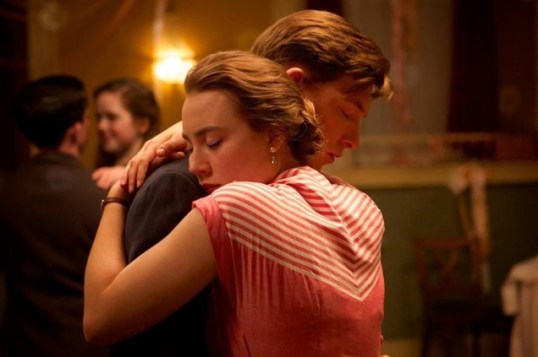
Brooklyn

Well, tonight’s the night!  Soon, we will know which 2014 films have won Oscars.

And, as soon as the ceremony ends, it will be time to start speculating about which 2015 films will be nominated next year!  I am sharing and updating my predictions on a monthly basis and below you’ll find my latest predictions.  You can read my predictions for January by clicking here.

Some of these films and performers — like End of the Tour and Grandma — were acclaimed at Sundance.  (The recently concluded Berlin Film Festival, on the other hand, mostly just served to confirm that Knight of Cups and Queen of the Desert will probably not be contenders.)  Kristen Stewart recently won a Cesar Award for Clouds of Sils Maria.  Otherwise, the majority of predictions below are the results of my own wild guesses.

A year from now, we’ll probably look back at these predictions and laugh.

Best Picture

Black Mass

Brooklyn

The End of the Tour

Grandma

The Hateful Eight

In The Heart of the Sea

The Revenant

St. James Place

The Walk

Woman in Gold

Best Actor

Bryan Cranston in Trumbo

Matt Damon in The Martian

Leonardo DiCaprio in The Revenant

Michael Fassebender in Steve Jobs

Jason Segel in The End of the Tour

Best Actress

Blythe Danner in I’ll See You In My Dreams

Jennifer Lawrence in Joy

Helen Mirren in Woman in Gold

Saoirse Ronan in Brooklyn

Lily Tomlin in Grandma

Best Supporting Actor

Jim Broadbent in Brooklyn

Albert Brooks in Concussion

Paul Dano in Love and Mercy

Tom Hardy in The Revenant

Kurt Russell in The Hateful Eight

Best Supporting Actress

Julia Garner in Grandma

Jennifer Jason Leigh in The Hateful Eight

Kristin Scott Thomas in Suite Francaise

Kristen Stewart in Clouds of Sils Maria

Meryl Steeep in Suffragette

Best Director

John Crowley for Brooklyn

Ron Howard for In The Heart of the Sea

James Ponsoldt for The End of the Tour

Steven Spielberg for St. James Place

Robert Zemeckis for The Walk

Clouds of Sils Maria

Lisa Tries To Predict The Oscars!


Oscars

Well, it’s almost here!

Tomorrow night, the Oscars will be handed out!  Now, I have to admit that, despite all of the time that I spent keeping up with all of the guild awards and the critics award and all the other precursors, I kinda lost interest in the Oscar race after the actual nominations were announced.  I took one look at Jeff Wells claiming to be solely responsible for the success of Birdman and Sasha Stone going on and on about Selma and Ryan Adams doing whatever the Hell it is that he supposedly does over at Awards Daily and I just found myself saying, “Fuck it, who cares?”

Seriously, 2015 will be remembered as the year that Oscar punditry jumped the shark.  Hopefully, within the next few years, new voices will emerge and we’ll be spared from having to deal with Jeff Wells, Sasha Stone, and all the rest.

The Oscar commentary this year has been so negative and so toxic and so predictably strident and so tediously bitter that I did get a little bit burned out.  It just hasn’t been as much fun this year.  When, earlier this week, I was reminded that the Oscars were this Sunday, I have to admit that I was taken a little bit by surprise.  For some reason, I had gotten into my head that the Oscars were next week.

But anyway, they’re not next week.  They’re tomorrow and that means that it is now time for me to try to predict who and what will win tomorrow night.  A lot of people are saying that this is the closest Oscar race in years.  But you know what?  They say that every year.

Remember how there were going to be a lot of upsets last year?

And, in the end, exactly what everyone thought would win did win.

I imagine the same thing will happen this year.

Here are my predictions!  I will be listing both what I think will win and what I think should win.

Need to kill some time?  Look through all the posts since November and count up how many times this picture has appeared on the site!

Need to kill some time? Look through all the posts since November and count up how many times this picture has appeared on the site!

Best Picture: 

Will Win: Birdman

Should Win: Boyhood

Best Director:

Will Win: Alejandro Gonzalez Inarritu for Birdman

Should Win: Richard Linklater for Boyhood

Best Actor

Will Win: Eddie Redmayne for The Theory of Everything

Should Win: Michael Keaton for Birdman

Best Actress

Will Win: Julianne Moore for Still Alice

Should Win: Reese Witherspoon for Wild

Best Supporting Actor

Will and Should Win: J.K. Simmons for Whiplash

Best Supporting Actress

Will and Should Win: Patricia Arquette for Boyhood

Best Original Screenplay

Will Win: Birdman

Should Win: Boyhood

Best Adapted Screenplay

Will and Should Win: Whiplash

Best Animated Feature:

Will Win: How to Train Your Dragon 2

Should Win: Big Hero 6

Best Foreign Language Film

Will Win: Leviathan

Should Win: Ida

Best Documentary Feature

Will Win: CitizenFour

Should Win: Finding Vivian Maier

Best Documentary Short Subject:

Will Win (random guess): Crisis Hotline: Veterans Press 1

Should Win: ???

Best Live Action Short Film:

Will Win (random guess): The Phone Call

Should Win: ???

Best Animated Short Film:

Will and Should Win: My Moulton

Best Original Score:

Will and Should Win: The Theory of Everything

Best Original Song:

Will Win: “Glory” from Selma

Should Win: “Hooray for Everything” from The Lego Movie

Best Sound Editing

Will and Should Win: American Sniper

Best Sound Mixing

Will Win: American Sniper

Should Win: Whiplash

Best Production Design

Will and Should Win: The Grand Budapest Hotel

Best Cinematography

Will Win: Unbroken

Should Win: Ida

Best Makeup and Hairstyling

Will Win: Foxcatcher

Should Win: Guardians of the Galaxy

Best Costume Design

Will Win: The Grand Budapest Hotel

Should Win: Inherent Vice

Best Film Editing

Will and Should Win: Boyhood

Best Visual Effects

Will Win: Interstellar

Should Win: Guardians of the Galaxy

Guardians of the Galaxy

Well, those are my predictions!  Will I be right or will I be wrong?  We’ll find out tomorrow!

Lisa Watches An Oscar Nominee: The Sand Pebbles (dir by Robert Wise)


The_Sand_Pebbles_film_posterAfter watching Witness For The Prosecution, I continued TCM’s 31 Days of Oscar by watching the 1966 Best Picture nominee, The Sand Pebbles.

Considering that The Sand Pebbles is close to four hours long, it’s interesting how little there is to really say about it.  Taking place in 1926, The Sand Pebbles follows the crew of the USS San Pablo, a gunboat that patrols the Yangtze River in China.  The San Pablo is there to protect American business interests, which are in particular danger because China is caught up in a communist revolution.  For the most part, the crew of the San Pablo are portrayed as being lazy and racist.  They have little interest in understanding the culture of the people around them and they use Chinese laborer to do the work on the boat.

When Jake Holman (Steve McQueen) is transferred to the San Pablo, he upsets his fellow crewmen by insisting on working in the ship’s engine room himself, the fear being that if Holman is willing to work then the rest of them will be expected to work as well.  The ship’s commander, Lt. Collins (Richard Crenna), views Holman as being a threat to morale and starts to make plans to get Holman off of his boat.  But, first, the boat is going to have to get out of China…

The Sand Pebbles is an episodic film and some of those episodes are more interesting than others.  Typically, an episode will start out positively and then end with some sudden tragedy.  For instance, Holman trains one laborer (Mako) to be a boxer and then watches as he beats the most racist crewman on the ship.  However, just a few minutes later, the laborer is captured and savagely tortured by the communists and Holman is forced to perform a mercy killing.

In another subplot, Holman’s only friend, Frenchy (Richard Attenborough), marries a local prostitute (Emmanuelle Arsan, who would later write an autobiography that would serve as the basis for a very different type of film).  However, in order to see his wife, Frenchy has to continually swim to shore in the middle of the night.  Frenchy soon develops pneumonia and dies while his wife is dragged off and apparently executed.

And finally, Holman strikes up a romance with Shirley Eckert (Candice Bergen), an innocent missionary.  However, when her arrogant and naive boss, Jameson (Larry Gates), refuses to leave the country despite the revolution, the San Pablo is ordered to rescue them.  This, of course, leads to a final battle with the communists which leaves a good deal of the cast dead.

As I watched The Sand Pebbles, my main impression was that it was an extremely long movie.  The film’s climatic battle was exciting and Steve McQueen (not to be confused with the director of 12 Years A Slave and Shame) gave a good performance but otherwise, the film often seemed to drag.  While the movie’s theme of Americans struggling (and failing) to understand another country’s culture had a definite resonance, The Sand Pebbles did not seem to be quite sure what it truly wanted to say about it.

Let’s face it — over 500 films have been nominated for best picture.  And, while a good deal of them hold up surprisingly well and are still entertaining to watch, there’s also a handful like The Sand Pebbles, ambitious films that never quite reached their potential but were probably nominated because they seemed like the type of epic film that should be nominated.  Many of these films were nominated and a few even won.

However, in the case of The Sand Pebbles, a nomination would have to be enough.  That year, the Oscar for Best Picture was won by A Man For All Seasons.