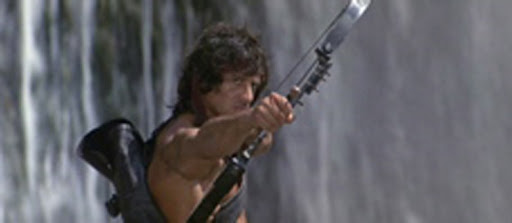
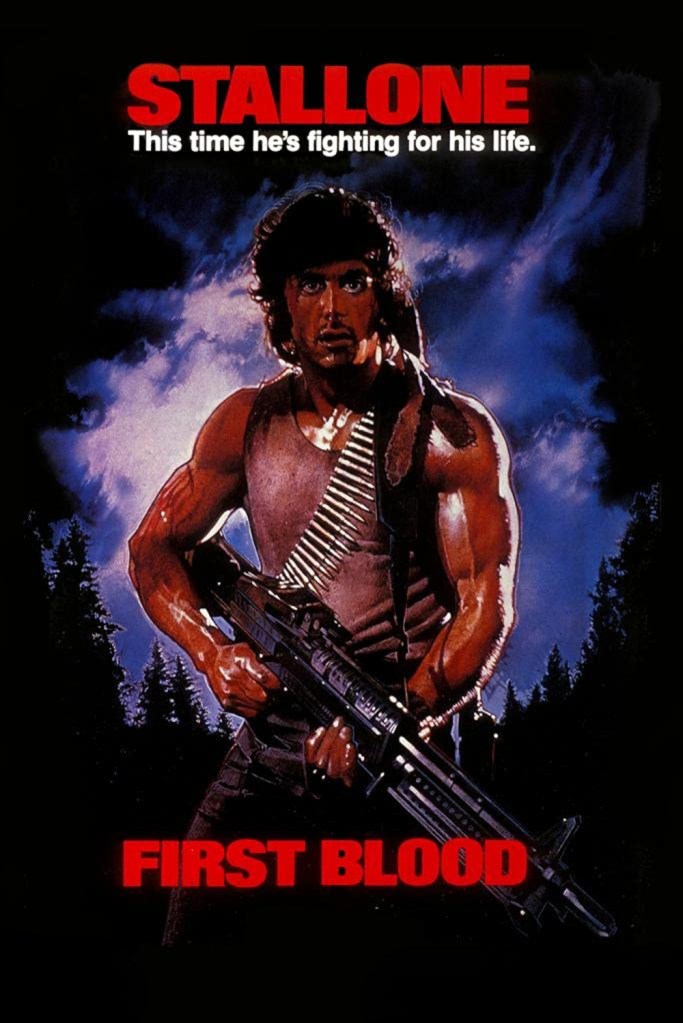
Review: First Blood (dir. by Ted Kotcheff)


“In the field we had a code of honor: you watch my back, I watch yours. Back here there’s nothing!” — John Rambo

You sit down expecting a brainless 80s action flick, and instead you get a meditation on trauma, bureaucracy, and the American wilderness. That’s First Blood for you. Directed by Ted Kotcheff and released in 1982, this is the movie that introduced the world to John Rambo, but don’t go in hoping for a body count or one-liners. What you actually get is a lean, gritty, and surprisingly sad drama about a guy who just wants to eat a hot meal and ends up accidentally declaring war on an entire small-town police force. And honestly? It holds up to this day. The film is adapted from David Morrell’s 1972 novel of the same name, but if you’ve read the book, you’ll notice some serious tonal differences right away. Morrell’s novel is bleak, brutal, and deeply nihilistic—a product of its era’s raw disillusionment with Vietnam. Kotcheff and Stallone sanded down some of those rougher edges, not to sell out, but to make Rambo a more sympathetic figure. The bones are the same, but the spirit is just a little warmer, and that choice changes everything.

Let’s break down the plot, because it’s deceptively simple. Sylvester Stallone plays John Rambo, a former Green Beret and Vietnam War hero who wanders into the town of Hope, Washington, looking for a fellow soldier he served with. He finds out the guy died of cancer from Agent Orange exposure. That’s the first gut punch. Rambo, already drifting and clearly struggling with PTSD, just wants to grab some food and keep moving. But the local sheriff, Will Teasle (a perfectly cast Brian Dennehy), takes one look at Rambo’s long hair, army jacket, and tired face and decides he’s a vagrant who needs to be run out of town. From a structural standpoint, Teasle isn’t a cartoon villain—he’s a classic dramatic antagonist: a rigid, small-town authoritarian who sees drifters as a threat to his orderly world. That realism makes the whole thing sting because you can almost see both sides. Almost.

When Teasle tries to escort Rambo to the city limits, Rambo walks back into town. That’s his big crime. He gets arrested, and at the station, the deputies start pushing him around. One of them, a veteran deputy named Galt (played with sneering menace by Jack Starrett), is the real problem here. Galt isn’t some young hothead. He’s an older, seasoned deputy who’s clearly been in his role for years, and he’s become entitled on the power of his badge. You can see it in the way he leans into the booking process, the casual cruelty in his eyes, the way he treats Rambo like a stray dog he’s finally allowed to kick. During the shaving scene, as deputies try to clean Rambo up after the arrest, Galt is the one who holds Rambo down, restraining him while another deputy wields the straight razor. He’s not waving the razor himself, but that almost makes it worse—he’s the enforcer, the guy who pins you in place while someone else does the dirty work. It’s a veteran cop who knows exactly how to exert control without getting his own hands bloody. That makes Galt far more chilling than some screaming bully. He represents the rot of unchecked authority, the way small-town power can curdle into casual sadism over time. And that whole humiliating process—being held down, having a straight razor brought to his face—triggers a full-blown flashback for Rambo. Then something clicks. Rambo explodes, beats down half the station, and escapes into the nearby mountains.

Now the hunt begins. Teasle calls in the State Patrol, the National Guard, and eventually his old mentor, Colonel Trautman (Richard Crenna), who knows exactly what kind of animal they’re chasing. Trautman warns Teasle that Rambo isn’t just a drifter; he’s a trained killer with a “purple heart, a silver star, and a congressional Medal of Honor.” And here’s the core irony: Rambo doesn’t want to hurt anyone. He just wants to be left alone. But the chase escalates, people die, and by the end, you’re not cheering for the hero to win—you’re hoping he gets some peace.

From an analysis perspective, where First Blood really earns its stripes is its restraint. The action sequences are tense but never escalate into cartoon violence. Rambo uses the forest like a ghost, setting traps, crawling through mud, and surviving on raw squirrel meat. He doesn’t mow down dozens of cops with a machine gun. In fact, the only person he kills is Galt, who falls to his death while hanging off a helicopter because Rambo throws a rock at the chopper. And Rambo immediately looks horrified. That’s the key. Even Galt, as entitled and cruel as he is, isn’t a villain Rambo wants to execute. The kill is accidental, a desperate act of survival. The movie takes its time showing how the very skills that made Rambo a hero in Vietnam—his survival instincts, his aggression, his ability to turn anything into a weapon—now make him a monster in peacetime America. The local cops are out of their depth, but aside from Galt, they’re mostly just scared men doing a job. Nobody else is pure evil. Just broken systems and broken people.

But let’s talk about that novel, because the comparison is crucial for understanding the film’s choices. David Morrell’s First Blood is a much darker animal. In the book, Rambo is more feral, less a wounded hero and more a walking death sentence. He kills multiple cops, not by accident or in self-defense, but with cold, tactical efficiency. The novel has no Colonel Trautman to serve as a moral anchor—Trautman is there, but he’s just as ruthless. And the ending? Devastating. In Morrell’s version, Rambo and Teasle essentially murder each other in a final, bloody standoff. Trautman finishes Rambo off with a shotgun blast to the gut. There’s no catharsis, no plea for understanding. Just bodies and regret. The tone is nihilistic to the core: the system destroyed these men long before the first page, and there was never any hope. Kotcheff’s film pulls back from that abyss. It keeps the violence lean and mostly off-screen. It gives Rambo that famous final monologue where he sobs about his friend dying next to him, about protesters spitting on him, about not being able to turn off the war inside his head. That scene isn’t in the book—not like that. The movie says, “This man is suffering, and maybe he can still be saved.” The novel says, “This man is already dead, and he’s taking everyone with him.” Both are valid responses to Vietnam, but the film’s slightly toned-down approach is why Rambo became an icon instead of a footnote.

From a performance standpoint, Stallone gives the work of his career here. Forget the grunting one-liners of later sequels. In First Blood, he barely speaks, and when he does, his voice cracks. Watch his eyes during that final monologue. After Trautman finally talks him down, Rambo dissolves into a sob. “Nothing is over!” he screams at Trautman. “You don’t just turn it off!” It’s raw, uncomfortable, and genuinely moving. You realize that the whole movie has been one long panic attack for this character. The Rambo that pops up in Rambo: First Blood Part II is a cartoon superhero. The Rambo here is a guy who needed a therapist and a hug about thirty years ago. That vulnerability is the film’s great deviation from the source material. Morrell’s Rambo never asks for understanding. Kotcheff’s does. And that small shift in tone—from nihilism to wounded humanity—is what elevates the film from a grim exploitation picture to a legitimate character study.

On the technical side, Ted Kotcheff’s direction is patient and atmospheric. He shoots the Pacific Northwest like a character—vast, wet, dark, and full of hiding places. The chase scenes are grounded, with long takes and practical stunts. When Rambo jumps off a cliff into a tree and lands with a thud that sounds real, it hurts. There’s no CGI safety net. Jerry Goldsmith’s score is mournful, with lonely woodwinds and a simple, haunting main theme that never pumps you up for a fight. It just makes you sad. The movie even has the guts to end on a downer—but not as brutal as the book’s. Rambo surrenders, crying in Trautman’s arms, and the final shot is him walking away in handcuffs into the rain. No freeze-frame high five. No sequel tease. Just rain. And yet, compared to the novel’s blood-soaked finale, that rain feels almost like mercy. That’s tonal balancing at its finest: the film acknowledges the darkness without drowning in it.

Of course, the cultural memory of First Blood has been completely buried by its sequels. Most people under thirty know Rambo as the muscle-bound machine gun guy from memes and video games. But the original is closer to a western like The Deer Hunter meets a paranoid 70s thriller like The French Connection. It’s a movie about a country that used its soldiers and then discarded them. Teasle represents the willful ignorance of middle America—“I don’t care about your war” is basically his attitude. And Rambo represents the bill coming due. Galt, as that entitled veteran deputy, represents the everyday cruelty of those who’ve held power too long and forgotten what it’s for—the guy who doesn’t need to swing the blade because he’s the one holding you still. That theme hits even harder today, decades later, when veterans are still fighting for basic support and stories of badge-heavy misconduct still dominate headlines. The novel took that theme to its logical, horrific conclusion: no survivors, no lessons learned. The film pulls back just enough to let you breathe, and that one small change turned First Blood from a bleak cult artifact into a mainstream classic. You can argue which version is more honest. But you can’t argue that Stallone and Kotcheff made the right call for the screen.

First Blood rules. It’s a rainy, sad, surprisingly smart action movie that will stick with you longer than any explosion-fest. It’s also a masterclass in adaptation, showing how a slight shift in tone—from nihilistic to wounded—can transform a story without betraying its core. Brian Dennehy is perfect as the stubborn but not evil sheriff. Jack Starrett makes Galt a quietly terrifying portrait of bureaucratic sadism, a veteran deputy who’s learned to love the leash and the privilege of pinning a man down while someone else does the cutting. Richard Crenna brings real weight as Trautman, a father figure who knows he helped raise a weapon he can no longer control. And Stallone acts his soul out. When he whispers “I could have killed them all” in the final scene, he’s not bragging. He’s confessing. That’s why First Blood is a classic. It’s not a recruitment poster. It’s a eulogy—just a little less hopeless than the novel that birthed it. Four stars, easily. Just don’t go in expecting explosions every five minutes. Go in expecting to feel bad, and you’ll leave feeling like you watched something real.

Film Review: Rambo: First Blood Part II (dir by George Pan Cosmatos)


Three years after blowing up the town of Hope, John Rambo (Sylvester Stallone) is …. workin’ on the chain gang…. (I hope you sang it.)  However, Colonel Sam Trautman (Richard Crenna) has a suggestion for Rambo.  He can get a full pardon if he infiltrates Vietnam and investigates what might be a POW camp….

So begins 1985’s Rambo: First Blood Part II!

When viewers first met John Rambo in 1982’s First Blood, he was a drifter who was obviously uncomfortable with dealing with other people.  Haunted by both his experiences in Vietnam and the way he was treated when he returned to his own country, Rambo was someone who largely wanted to be left alone.  He was the ultimate outsider.  When he asked Brian Dennehy’s Sherriff Teasle where he could get a cop of coffee, Teasle told him to go over the border and have his coffee in Canada.  (Is there anything more insulting than to tell a Vietnam veteran to go to Canada like a draft dodger?)  Rambo was someone who could take care of himself.  He was someone who knew how to survive in the wilderness.  But, in the first movie, he was not superhuman.  Rambo was considerably banged up by the end of First Blood.  The other thing that is sometimes overlooked is that, as far as his time in Hope was concerned, Rambo never deliberately killed anyone.  The only person who died in First Blood was a sadistic police officer who was so determined to get a shot at Rambo that he accidentally tumbled out of a helicopter.  When Rambo fought, it was in self-defense.  Rambo had plenty of opportunities (and, by today’s cultural standards, reasons) to kill Sheriff Teasle and his deputies but he didn’t.  Things are a bit different in the sequel.  Rambo: First Blood Part II transforms Rambo from a relatively realistic character into the comic book action hero that everyone knows today.  Rambo’s gone from being a hulking drifter to being a muscle-bound warrior.

The film doesn’t waste any time getting Rambo out of prison and over to Thailand.  The obviously duplicitous Murdock (Charles Napier) tells Rambo that his mission is solely to take pictures and not to engage with the enemy.  (You may be wondering why anyone would recruit Rambo for a mission that doesn’t involve engaging with the enemy and it’s a fair question.)  Soon, Rambo is in the jungles of Vietnam, meeting up with a rebel named Co (Julia Nickson), and heading up river with a bunch of pirates.  Needless to say, Rambo is soon engaging with the enemy.

Rambo: First Blood Part II is an undeniably crude film.  Clocking in at 96 minutes, the film makes it clear that it doesn’t have any time to waste with characterization or debate.  Sylvester Stallone rewrote James Cameron’s original script and he gives a performance that has little of the nuance that was present in the first film.  And yet, the film has an undeniable hypnotic power to it.  It’s pure action.  Rambo exists to blow up his enemies, whether it’s with a gun or an explosive arrow or the missiles fired from a stolen helicopter.  Because the bad guys are all arrogant sadists who exist to remind American viewers of the humiliation of its first military defeat, there’s an undeniable pleasure in watching them get defeated by one motivated warrior who refuses to be held back by the paper pushers in charge.  Murdock tells Rambo not to rescue any POWs.  Rambo responds by machine gunning Murdock’s office.  It’s pure wish fulfillment and it is cathartic to watch.  It’s perhaps even more cathartic to watch today, after the twin traumas of the COVID lockdowns and the chaotic withdrawal from Afghanistan.  Murdock becomes a stand-in for every incompetent bureaucrat who ever let America down.  The Murdock who tells Rambo not to rescue any Americans is little different from the men who told business that they had to close and who tried to dictate whether or not people could leave their homes.  The Murdock who was prepared to leave American behind is the same person who did leave Americans behind in Kabul.  Rambo’s anger is the anger of everyone who values freedom above obedience.

Rambo kills a lot of people in the sequel but none of them are American.  He’s a patriot, albeit an angry one who will never forgive his country for not caring about its veterans as much as they cared about it.  “Do we get to win this time?” Rambo ask Trautman and it’s a moment that, like much of the movie, is both crudely simplistic but is powerful in its refusal to be complicated.  Rambo: First Blood Part II is a fantasy but it’s also a plea to be allowed to succeed.  Forget the rules.  Forget the regulations.  Just allow the people to win.

Rambo: First Blood Part II (1985, dir by George Pan Cosmatos, DP: Jack Cardiff)

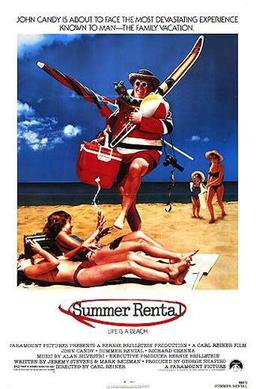
Summer Rental (1985, directed by Carl Reiner)


After a blow-up at work, air traffic controller John Chester (John Candy) is given five weeks of paid leave.  He takes his family to Florida, where they rent a beach house and discover that their summer town is controlled by snobbish sailing champion Al Pellett (Richard Crenna).  It’s the snobs vs slobs as Pellett tries to kick John and his family out of their summer rental and John tries to prove himself to his son and daughter (Joey Lawrence and Kerri Green) by winning the local sailing championship.  Luckily, John has Sully (Rip Torn), a modern-day pirate captain, on his side.

John Candy was a remarkable talent.  It’s just a shame that he didn’t appear in more good films.  He will always be remembered for films like Splash, Uncle Buck, Planes, Train, and Automobiles, and Only The Lonely but unfortunately, most of his starring roles were in lightweight, forgettable far like Summer Rental.  Candy is likable as John Chester and sympathetic even when he’s losing his temper over every minor inconvenience.  But the film itself never really does much to distinguish itself from all of the other 80s comedies about middle class outsiders taking on the richest man in town.  Candy is stuck playing a role that really could have been played by any comedic actor in 1985.  It’s just as easy to imagine Dan Aykroyd or even Henry Winkler in the role.  It feels like a waste of Candy.

The best thing about the film is Rip Torn’s performance as Sully.  Torn’s performance here feels like a dry run for his award-winning work as Artie on The Larry Sanders Show.  I would have watched an entire movie about Sully.  As it is, Summer Rental is inoffensive and forgettable.

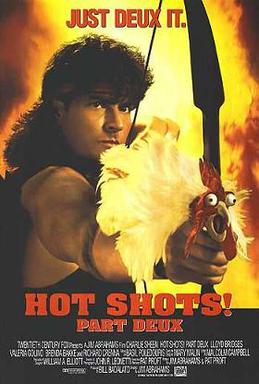
Hot Shots! Part Deux (1993, directed by Jim Abrahams)


Topper Harley (Charlie Sheen) is back but instead of being a knock-off of Tom Cruise, he’s now Sylvester Stallone.

When two separate teams of U.S. soldiers fail to rescue a group of hostages who are being held by Saddam Hussein (Jerry Haleva, who built an entire career out of his resemblance to the Iraqi dictator), it not only embarrasses America but threatens the reelection campaign of President Tug Benson (Lloyd Bridges).  President Benson can get away with throwing up on the Japanese ambassador and knocking over all the other Presidents with a shovel (though Gerald Ford falls on his own) but he can’t survive a hostage crisis.  Colonel Denton Waters (Richard Crenna) and Michelle Huddleston (Brenda Bakke) attempt to recruit Topper Harley from the Buddhist monastery, where he’s been living since the disappearance of Ramada (Valeria Golino).  Topper refuses to help with a third mission but, after Water is captured by Saddam, Topper does decide to lead the fourth mission.  Working with Ryan Stiles and Miguel Ferrer, Topper heads into the jungle to save Colonel Waters, reunite with Ramada, and discover his destiny.

The sequel to Hot Shots! is more of the same, a non-stop cavalcade of jokes, movie references, and deadpan one liners.  There are enough laugh out loud moments to make up for the jokes that don’t work.  I’ll always like the moment when Charlie Sheen sees Martin Sheen on another patrol boat.  (“Loved you in Wall Street!”)  It’s a movie made in the vein of Airplane! but the jokes aren’t as timeless as in that classic.  Everyone remembers Rambo enough to get the main joke and the interrogation scene in Basic Instinct has left enough of an impression that Topper’s “I know what to get your for Christmas,” comment to Michelle still draws a chuckle but do you remember Body of Evidence and the first President Bush vomiting at a state dinner?  Not all of the jokes have aged well but Charlie Sheen does a decent Rambo impersonation and Lloyd Bridges’s dim bulb President is one of the more relatable parts of the movie.  Fortunately, jokes about Saddam Hussein getting flattened by a piano will always be funny.

Wrongfully Accused (1998, directed by Pat Proft)


Ryan Harrison (Leslie Nielsen) is a world-famous concert violinist who plays his instrument like Jimmy Page plays his guitar.  Harrison is invited to a party but when his host, Hibbing Goodhue (Michael York), is murdered, Harrison is wrongfully accused.  No one believes his story that the murder was committed by a one-eyed, one-armed, one-legged man.  Harrison is convicted of a crime he didn’t commit.  Maybe he should have asked for a preemptive pardon but that would probably have been too ludicrous an idea for even a parody film like this one.  An accident on the way to prison allows Harrison to escape.  He must now prove his innocence while being pursued by the determined Fergus Falls (Richard Crenna).

Wrongfully Accused is the only film to be directed by comedy writer Pat Proft and it’s a parody film in the style of Airplane!  There are sight gags, movie references, and a lot of ridiculous dialogue delivered in deadpan fashion by Leslie Nielsen.  Richard Crenna does a decent impersonation of Tommy Lee Jones.  There’s a North By Northwest parody that involves a toy airplane.  It’s not that there weren’t enough funny moments, it’s just that there weren’t enough of them.  Most of the jokes instead felt uninspired, as if Proft just turned on his TV and tossed in a joke about whatever movie he saw being advertised.  It feels like the script was written by using parody movie mad libs.  One reason why Airplane! holds up  so well is because it genuinely loved disaster movies and there was a sense of innocence to even the wildest of the jokes.  Wrongfully Accused has some funny moments but there’s no real affection for the movie being poked fun at.  The Fugitive feels like almost too easy a target.  Leslie Nielsen and Richard Crenna score some laughs but even they sometimes seem to be just going through the motions.

As the old saying goes, dying is easy.  Comedy is hard.

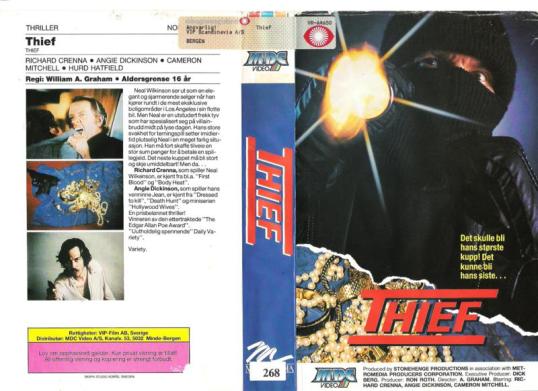
Retro Television Review: Thief (dir by William A. Graham)


Welcome to Retro Television Reviews, a feature where we review some of our favorite and least favorite shows of the past!  On Sundays, I will be reviewing the made-for-television movies that used to be a primetime mainstay.  Today’s film is 1971’s Thief!  It  can be viewed on Tubi and YouTube.

Neal Wilkinson (Richard Crenna) would appear to be living a great life.  He has a nice house in the suburbs.  He has a beautiful girlfriend named Jean Melville (Angie Dickinson).  As he heads into middle-age, he is still fit and handsome and charming.  He dresses well, or at least well by the standards of the early 70s.  (By the standards of today, a few of his ties are a bit too wide.)  Everyone believes that Neal has a nice and comfortable job as an insurance agent.

Of course, the truth is far different.

Neal is a veteran con man and a thief.  He’s just recently been released from prison and his deceptively friendly parole officer (played by the great character actor, Michael Lerner) is convinced that Neal will screw up again eventually.  And, of course, Neal has screwed up.  A gambling addict, he is $30,000 in debt.  Can Neal steal enough jewelry from enough suburban homes to pay off his debt?  Can a man like Neal change his ways?

This is a surprisingly somber made-for-TV movie.  Just from the plot description and the film’s first few minutes, you might expect Thief to be a light-hearted caper film in which Neal and Jean work together to pull off one last heist so that Neal can retire.  Instead, Neal spends almost the entire film lying to Jean and there’s hardly a light moment to be found.  Neal says that he wants to retire from his life of crime but, as the film makes clear, that’s a lie that he’s telling himself.  Neal cannot stop stealing and gambling because he’s as much of an addict as the wild-haired junkie (Michael C. Gwynne) who briefly confronts Neal at the parole office.  At one point, Jean tells Neal, “The more I know you, the less I know you,” but the truth of the matter is that Neal is so deep in denial about the futility of his life that he doesn’t even know himself.

It’s not a particularly happy film.  Richard Crenna is ideally cast as Neal, playing him with enough charm that the viewer can buy that he could talk his way out of being caught in a stranger’s backyard but with also with vulnerability that the viewer can see his fate, even if he can’t.  Thief also provides a rare opportunity to see Cameron Mitchell playing a sympathetic role.  Mitchell is cast as Neal’s attorney, who continually tries to get Neal to stop messing up but who ultimately knows that his attempts to reform Neal are just as futile as Neal’s attempts to go straight.

The movie ends on a surprisingly fatalistic note, one that suggests that there’s only one way to truly escape from a life of crime.  I can only imagine how viewers responded in 1971, when they turned on their television and found themselves watching not a light-hearted caper film but instead a bleak examination of criminal ennui.  It’s not a happy film but it is more than worth watching for Richard Crenna’s lead performance.

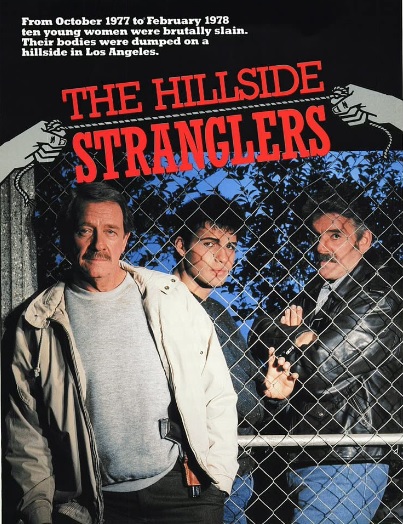
October True Crime: The Case of the Hillside Stranglers (dir by Steve Gethers)


1989’s The Case of the Hillside Stranglers is based on the killing spree of Angelo Buono and Kenneth Bianchi, two cousins who terrorized Los Angeles in the late 70s.  Buono owned his own garage and aspired to be a tough and macho pimp.  Bianchi was an aspiring police officer who supported himself as a security guard.  Over the course of just five months, they murdered ten women.  They probably would never have been caught if not for the fact that Buono eventually tired of Bianchi and kicked him out of his house.  Bianchi moved up to Washington where he committed two murders on his own.  When he was arrested, he attempted to convince the cops that he was suffering from dissociative identity disorder and that the murders were committed by his other personalities.

The Case of the Hillside Stranglers starts with the murder spree already in progress.  Buono is played by Dennis Farina while Bianchi is played by a very young Billy Zane.  Both of them are well-cast, with Farina especially making an impression as a misogynistic bully who thinks that he is untouchable.  (In real life, Farina spent 18 years as a Chicago cop and, watching his performance in this film, it’s hard not to get the feeling that he had to deal with more than one guy like Angelo Buono over the course of his time on the force.) For all of their cockiness, the film emphasizes that neither Angelo nor Kenneth were particularly clever.  The fact that they got away with their crimes for as long as they did was largely due to a combination of luck and witnesses who did not want to get involved.  Early on in the film, one woman who is harassed and nearly abducted by Buono and Bianchi refuses to call the police afterwards because she doesn’t want to relive what happened.

That said, the majority of the film actually focuses on Bob Grogan (Richard Crenna), the tough veteran detective who heads up the Hillside Strangler taskforce and who becomes so obsessed with tacking down the elusive killers that he soon finds himself neglecting both his family and his own health.  Whenever we see Grogan trying to enjoy any quality time with his children, we know that his beeper is going to go off and he’s going to have to search for a telephone so that he can call into headquarters.  (Remember, this film was set in the 70s.)  His children are a bit miffed about it, which I can understand though I really do have to say that his son, in this film, really does come across as being a brat.  (“Just ignore it, Dad,” he says, as if there aren’t two serial killers murdering innocent people in the city.)  The recently divorced Grogan pursues a tentative romance with a woman (played by Karen Austin) who, at one point, decides to investigate Angelo on her own.  Crenna, not surprisingly, is sympathetic as Grogan.  The film works best as an examination of what it does to one’s soul to spend all day investigating the worst crimes that can be committed.  Grogan gets justice but, the film suggests, he does so at the sacrifice of his own peace of mind.

It’s a well-made and well-acted film, one that will probably appeal more to fans of the police procedural genre as opposed to those looking for a grisly serial killer film.  In real life, Bianchi is serving a life sentence and Angelo Buono died in prison.  And the real Bob Grogan?  He appeared in this movie, slapping the handcuffs on Billy Zane.

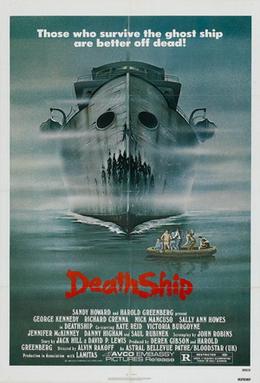
International Horror Film Review: Death Ship (dir by Alvin Rakoff)


The 1980 Canadian film, Death Ship, opens with a black freighter ominously sailing across the ocean in the middle of the night.  The freighter appears to be deserted but, when a cruise ship appears over the horizon, we suddenly hear disembodied German voices announcing that the enemy is in sight and it’s time to take battle stations.  The freighter changes direction and starts to rapidly move straight towards the cruise ship.

On the cruise ship, a really bad comedian named Jackie (played by Saul Rubinek) is telling a series of unfunny jokes.  Fortunately, before he can further offend anyone else’s comedic sensibilities. the freighter crashes into the cruise ship and sinks it.  The next morning, we see a small group of survivors floating on a piece of debris.  There’s the firm and harsh Captain Ashland (George Kennedy), who was on the verge of being forced into retirement before his boat sank.  There’s Mrs. Morgan (Kate Reid), the odd religious passenger.  There’s Trevor Marshall (Richard Crenna), his wife Margaret (Sally Ann Howes), and their two annoying kids.  There’s a guy named Nick (Nick Mancuso) and a woman named Lori (Victoria Burgoyne), who are in love but obviously doomed.  And then there’s Jackie.  That’s right, Jackie survived!  And he’s still telling bad jokes!

Suddenly, the survivors spot the freighter in the distance.  Not realizing that it’s the same freighter that previously rammed them, they board the boat and discover that it appears to be totally abandoned.  Jackie stands on the deck, encourages everyone to be positive, and makes more jokes.  Suddenly, a cable wraps around his ankles, one of the ship’s cranes suddenly moves, and Jackie is tossed back into the ocean.  The comedy Gods have spoken.

Anyway, once Jackie is no longer around to make them laugh, the cruise ship survivors set about going crazy.  It’s not that difficult to do because it turns out that not only is the freighter full of ghosts but the ship’s engine is fueled by pure hate.  That means that one passengers takes a shower just to have the water turn to blood.  Another makes the mistake of watching an old movie and eating a cursed piece of hard candy.  Yet another ends up getting tossed into the gears of the ship and loses an arm.

Meanwhile, Captain Ashland stumbles around the ship and hears voices telling him that the ship is now his.  After Ashland discovers and then puts on an old officer’s uniform, he declares that he’s in charge of the freighter and then he proceeds to try to kill everyone else on the ship.  Captain Ashland is possessed and there’s not even anyone on the boat who can make a joke about it.

Death Ship is a dumb but crudely effective movie.  This is one of those films where everyone could have saved themselves a lot of trouble by sticking together as a group instead of splitting up to search the freighter but it’s not like you’re watching a movie called Death Ship because you’re looking for a coherent narrative or anything.  The main reason you’re watching is so you can see George Kennedy get possessed and go crazy.  Fortunately, George Kennedy was just the type of character actor who you could depend upon to act the hell out of getting possessed.  There’s not a hint of subtlety to be found in Kennedy’s performance and, if nothing else, that certainly makes him entertaining to watch.  Kennedy attacks this role with the ferocity of a cheetah pouncing on a gazelle in a nature documentary.  He basically grabs hold of the film and snarls at the rest of the cast, “This is my movie!  If you steal a scene from me in your dreams, you better wake up and apologize!”  It’s fun to watch.

The same can be said about Death Ship, which is a totally over-the-top movie but which, thanks to Kennedy’s performance and a few atmospheric shots of the freighter, is also far more entertaining than it has any right to be.
Marooned (1969, directed by John Sturges)


Imagine The Martian or Apollo 13 without any humor or narrative momentum and you’ve got an idea what Marooned is like.

Three American astronauts (played by Richard Crenna, Gene Hackman, and James Franciscus) are returning to Earth after serving on an experimental space station when the engine to their spacecraft fails.  Now stuck in orbit around the Earth, they only have two days before they run out of oxygen.  While flight commander Crenna tries to keep everyone calm and make sure that all the proper procedures are followed, Gene Hackman yells at NASA and demands to be rescued.

Down on Earth, the head of NASA (Gregory Peck) says that there’s nothing that can be done.  There’s no way to get a rescue mission set up quickly enough to save the lives of the astronauts.  Both the President and David Janssen disagree with him.  Janssen demands to be sent into space immediately, regardless of the dangers, so that he can bring America’s astronauts home.

Marooned is a painfully slow movie that went into production at the height of the space race and which was released just a few weeks before the first successful moon mission.  Because it was made at a time when there were still many who claimed that NASA was a waste of money, the movie goes out of its way to explain that, even though the astronauts are probably going to die in space, NASA is in no way to blame.  Richard Crenna absolves NASA of blame after being told that a rescue mission isn’t feasible.  Gregory Peck holds a press conference, where he gives a lengthy speech about why space exploration is still important.  The movie is very detailed in showing that NASA is staffed by personality-free professionals, which might have boosted confidence in NASA but which also leads to a dull story.  You’ll notice that I haven’t referred to anyone in this film by the names of their characters.  That’s because their names don’t matter because, other than Gene Hackman and David Janssen, none of them is really distinguished by any sort of identifiable personality.  Hackman chews the scenery while Janssen plays another surly character who seems like he has a permanent hangover.  I wouldn’t trust Janssen to pilot a spaceship.

Marooned won an Oscar for its Special Effects, which were probably impressive back in 1969 but which are dull by modern standards.  Winning that Oscar meant that Marooned would eventually earn the distinction of being the only Oscar winner to be featured on Mystery Science Theater 3000.  On MST 3K, it aired under the title Space Travelers, which is a perfectly generic name for a perfectly generic film.


Footsteps (1972, directed by Paul Wendkos)


Paddy O’Connor (Richard Crenna) is a former football player-turned-coach whose record of success has been overshadowed by his own arrogance and heavy drinking.  O’Connor has such a bad personal reputation that he’s found himself unemployable.  Only one man is willing to give him a chance.  Jonas Kane (Clu Gulager) played football with Paddy and he’s now coaches for a small college.  Kane may not like O’Connor but he knows that O’Connor might be the key to turning around his team’s fortunes and, at the same time, saving Kane’s job.  Kane hires O’Connor to serve as a his defensive coordinator.

At first, O’Connor’s cockiness rubs people the wrong way.  It’s not until O’Connor moves offensive player J.J. Blake (Bill Overton) to defense that the team starts to win.  And once the team stars to win, everyone’s problems with O’Connor disappear.  Kane can only watch helplessly as O’Connor moves in on his girlfriend (Joanna Pettet), knowing that he owes his job to O’Connor remaining at the school.

However, when Blake gets a concussion, O’Connor is forced to decide whether or not to let him play.  Boosters like Bradford Emmons (Forrest Tucker) want Blake to play, regardless the risk.  The NFL scouts, who are looking for the next number one pick, want to see Blake on the field.  Blake says he wants to play but O’Connor can tell that he’s lying about the extent of his injury.  With everyone breathing down his neck and a syndicate of gamblers pressuring O’Connor to shave points so that the spread pays off, O’Connor has to decide what to do.

Though this made-for-TV movie may not be as well-known as some other films, it’s one of the best movies ever made about college football.  Though it may be short (only 74 minutes), it still examines all of the issues that have always surrounded college football.  Despite not getting paid for their efforts, the players risk serious and permanent injury during every game, just on the slight hope that they might someday make it to the NFL.  The coaches, who are supposed to be looking after the players, are more interested in padding out their win-loss record and hopefully moving onto bigger and better-paying jobs.  Meanwhile, aging alumni and boosters demand that the team win at all costs, regardless of what happens to the men on the field.  Footsteps intelligently explores all of those issues and suggests that the risks are ultimately not worth the rewards.

Along with an intelligent script, Footsteps is helped by a talented cast.  Crenna and especially Gulager both give excellent performance as the two rival coaches.  Al Lettieri (Sollozzo from The Godfather) plays one of the gamblers.  Beah Richards plays Blake’s mother, who makes the mistake of believing O’Connor when he says that he’s going to always have Blake’s best interests at heart.  Ned Beatty has a small role as another assistant coach who is forced to make an important decision of his own.  Keep an eye out for Robert Carradine and James Woods, both of whom have tiny roles.

As far as I know, Footsteps has never officially been released on DVD.  I saw it late one night on the Fox Movie Channel.