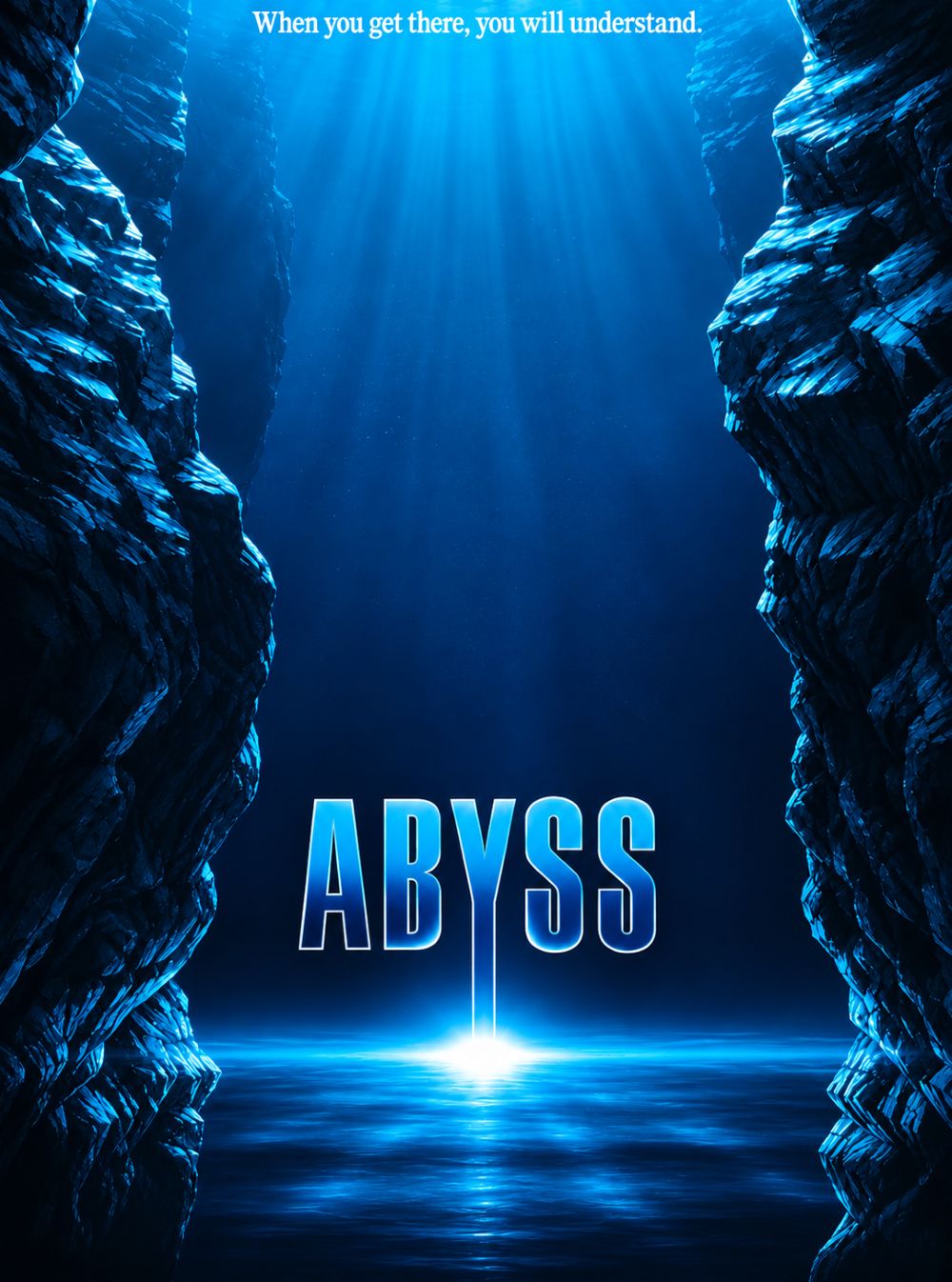
Film Review: The Abyss (dir. by James Cameron)


“We all see what we want to see. Coffey looks and he sees Russians. He sees hate and fear. You have to look with better eyes than that.” — Lindsey Brigman

James Cameron has never seemed particularly interested in keeping things small, but The Abyss gets much of its power from people who can barely move. They’re trapped in tight compartments, weighed down by equipment, and forced to make decisions while the ocean presses in around them. His 1989 underwater adventure turns those restrictions into gripping entertainment, then asks the story to carry a troubled marriage and a message about humanity’s future. It’s an uneven combination, but an engaging one. This review covers the 171-minute extended Special Edition, which can be considered Cameron’s preferred cut, with its fuller character development and substantially expanded ending.

The story begins with an American nuclear submarine sinking after an encounter with something unexplained. A civilian drilling crew is recruited to assist a Navy SEAL team, turning its underwater platform into the headquarters for a tense recovery operation. Bud Brigman, played by Ed Harris, runs the civilian side with the weary confidence of someone accustomed to solving problems without outside help. Then his estranged wife, Lindsey, arrives because she designed the platform and understands its capabilities. That’s good news for the operation, less welcome news for Bud, and an effective way to make an already uncomfortable workplace even more volatile.

Cameron gives that workplace enough personality that the danger matters before the plot gets especially strange. The crew members tease each other, complain about instructions, and handle complicated machinery with practiced familiarity. Their conversations don’t always advance the story, which is part of why they work. These people seem to have lives and routines beyond whatever emergency the movie has prepared for them. Some supporting characters remain broad sketches, but their reactions help establish the group’s identity. You believe they’ve spent enough time together to recognize when an argument is harmless and when someone has become a genuine problem.

The platform itself contributes just as much to that credibility. Its passageways, working areas, and sleeping quarters feel designed around necessity rather than comfort. Cameron gives you enough familiarity with the space that damage has consequences beyond the immediate thrill of water bursting through an opening. A flooded room means a route lost, equipment gone, or another reduction in the crew’s already narrow options. Outside, lights reveal only fragments of an environment that remains overwhelmingly dark. The contrast is unsettling: the platform is claustrophobic, but leaving it means entering a space so vast and indifferent that the cramped interior starts looking reassuring.

Harris anchors the film by making Bud capable without making him invulnerable. He has the authority of a man who will take the difficult job himself, but that same stubbornness causes problems when persistence isn’t the answer. You can see why the crew trusts him and why living with him might be exhausting. Harris lets those qualities coexist rather than separating Bud into admirable and flawed versions. His warmth doesn’t erase his defensiveness, and his courage doesn’t mean he always knows what he’s doing. That makes him a useful center for a story that eventually moves far beyond anything its characters can reasonably understand.

Mary Elizabeth Mastrantonio gives Lindsey the sharp edges needed to make their relationship convincing. She isn’t simply waiting for Bud to demonstrate his worth, and her professional confidence doesn’t disappear whenever the film wants an emotional moment. She can be impatient and cutting, sometimes unnecessarily so, but Mastrantonio allows concern to surface beneath the defensiveness. Her scenes with Harris suggest arguments repeated so often that both people know their parts. They’re good at identifying each other’s weaknesses and less accomplished at acknowledging their own. The affection remains visible, though neither seems eager to make the first move toward admitting it.

The extended edition gives that conflict more room, which matters because the romance needs to function as more than an interruption between emergencies. Bud and Lindsey don’t resolve their differences through one convenient conversation. Instead, the situation gradually exposes how much attention they still pay to each other. Irritation and concern keep occupying the same moments. The wedding ring becomes a particularly effective detail, connecting the marriage to the physical action without requiring another argument about what commitment means. Cameron isn’t always subtle, but he understands the value of giving an emotional idea a concrete object that can matter within a scene.

Michael Biehn’s Lieutenant Coffey brings a more dangerous response to uncertainty. Biehn plays him with a rigid intensity that becomes increasingly unsettling as his judgment deteriorates. Coffey responds to confusion by tightening control, even when that response makes the situation worse. There’s something frightening about a man who mistakes escalating fear for clear thinking, especially when he retains the authority and weapons to act on it. The writing occasionally leans too heavily on the contrast between aggressive soldiers and adaptable civilians. Still, Biehn gives Coffey enough nervous physicality that he registers as an immediate threat rather than merely the representative of a bad idea.

As an action director, Cameron understands how to make a simple objective feel almost impossible. A character has to reach a doorway, repair a system, or cover a distance with too little air. The underwater setting adds resistance to everything, and the film makes that resistance tangible. People struggle with equipment, lose visibility, and spend precious time doing things that would be easy on land. The sequences generally establish their geography and stakes clearly, so suspense comes from anticipating failure rather than trying to understand the editing. Even success rarely brings much relief. Everyone looks increasingly exhausted, and the next task always seems to demand energy nobody has left.

That exhaustion becomes emotionally devastating in the resuscitation sequence. Cameron keeps the scene going long enough to strip away the reassurance that a movie usually offers when a major character is in danger. Harris lets Bud’s practical determination collapse into desperation, exposing feelings he has struggled to express in ordinary conversation. It’s forceful, openly manipulative filmmaking, and not everyone will welcome how hard it pushes. But the intensity has a foundation. The relationship has established what could be lost, while the crew’s helpless presence makes the moment feel painfully public. People accustomed to fixing problems reach the limit of what effort and expertise can accomplish.

The visitors offer something beyond another threat, and the water-tentacle encounter works beautifully because curiosity briefly takes over from fear. There’s humor in it, and an intimacy that feels surprising after so much noise and conflict. The effect matters because it allows a strange intelligence to interact with people on a recognizable emotional level. For a moment, the movie stops treating the unknown as an obstacle. The extended ending then expands that possibility into a confrontation with human violence, bringing international tensions and enormous thousand-foot waves into the resolution. It gives the visitors a clearer purpose, but turns suggestion into a rather blunt explanation. Cameron’s sincerity remains appealing even when his argument becomes too simple.

What makes The Abyss memorable is the way its tenderness survives all that machinery, noise, and pressure. The extended edition occasionally explains what its strongest scenes have already made clear, and its global ambitions aren’t as persuasive as its intimate observations. Yet Harris and Mastrantonio keep pulling it toward something believable: two difficult people discovering that their attachment still matters. Cameron gives that possibility the same attention he gives a failing oxygen supply, treating trust as something that requires effort and carries consequences. Not every grand statement lands, but the quieter feeling underneath does. After so much struggle just to stay alive, having someone worth reaching for feels like a convincing reward.

Retro Television Review: Miami Vice 5.14 “The Lost Madonna”


Welcome to Retro Television Reviews, a feature where we review some of our favorite and least favorite shows of the past!  On Mondays, I will be reviewing Miami Vice, which ran on NBC from 1984 to 1989.  The entire show can be purchased on Prime!

This week, Crockett and Tubbs — or is it Burnett and Cooper? — enter the art world.

Episode 5.14 “The Lost Madonna”

(Dir by Chip Chalmers, originally aired on March 17th, 1989)

When Crockett and Tubbs take down what they think is a drug deal, they’re shocked to discover that Stanley Costa (Stephen G. Anthony) was actually smuggling two paintings!  They could always ask Stanley what’s going on but — whoops!  They killed him during the show’s precredit sequence.

Detective Whitehead (Michael Chiklis) comes down from New York City and explains that the two paintings are the side pieces for a triptych called The Last Madonna.  It was recently stolen from a Paris museum and Whitehead is convinced that theft was masterminded by Joey Scianti (Peter Dobson).

It’s time for Tubbs and Crockett to — *sigh* — go undercover.  Why they’re still always going undercover, I have never really understood.  Every time they go undercover, their cover gets blown.  Do the members of the Miami underworld just not communicate with each other?  Shouldn’t everyone know, by this point, that Tubbs and Crockett are cops?  In this case, Tubbs goes undercover as someone who appreciates art.  Crockett goes undercover as the crude Sonny Burnett….

Yes, Crockett is still using the Burnett cover.  He’s doing this despite the fact that he just recently had a mental breakdown that led to him not only thinking that he actually was Burnett but also becoming Miami’s biggest drug lord.  Even if the Scianti family was dumb enough to not know that Crockett was a cop, surely they would have heard enough about drug lord Sonny Burnett to wonder why he would be hanging out with a connoisseur of fine art.

(Indeed, it’s hard not to notice that everyone has apparently moved on rather quickly from Sonny’s mental breakdown and his time as a drug lord.  For that matter, Sonny certainly doesn’t seem to ever give much thought to his dead second wife.  Remember her?  The world-famous singer who was literally gunned down in front of him?  She appears to have been forgotten.)

This episode was dull, largely because the Scianti family was never really a credible threat.  They came across as being a bunch of buffoons and, as such, it was hard to really get that concerned about whether or not they would figure out that Crockett and Tubbs were actually cops.  This is another episode that features a twist that you’ll see coming from miles away.  From the minute Michael Chiklis first showed up, I knew that he was eventually going to try to steal the The Lost Madonna for himself.

Considering that there was a lot of humor in this episode (Crockett, not surprisingly, struggled with understanding modern art), there’s also some surprisingly graphic violence.  Crockett and Tubbs gun down Stanley Costa and blood splatters all over the wall.  Whitehead shoots Joey Scianti and the shocked Joey looks down at his wound and says that it’s “real blood.”  Tonally, this episode is all over the place.

Everyone seemed kind of bored with this episode.  This was definitely a final season entry.

Retro Television Review: Miami Vice 4.2 “Amen …. Send Money”


Welcome to Retro Television Reviews, a feature where we review some of our favorite and least favorite shows of the past!  On Mondays, I will be reviewing Miami Vice, which ran on NBC from 1984 to 1989.  The entire show can be purchased on Prime!

This week, Miami Vice takes an unwelcome detour.

Episode 4.2 “Amen …. Send Money”

(Dir by James Quinn, originally aired on October 2nd, 1987)

This was pretty dumb.

Tubbs, working undercover, busts Leona Proverb (Anita Morris), who just happens to be the wife of Billy Bob Proverb (Brian Dennehy).  Billy Bob is a television preacher who continually asks his followers to send him cash so he can live the lifestyle that he says God wants him to live.  On paper, this sounds like a great role for Brian Dennehy but this episode’s script lets him (and, for that matter, everyone else in the cast) down.  Somehow, the fact that the guy is named Billy Bob Proverb is the least heavy-handed aspect of this episode.

Faye Nell (Jo Anderson), who is one of Billy Bob’s followers, calls Tubbs to the studio and says she has information on what the Proverbs are doing.  As soon as Tubbs shows up, Faye tosses herself on him, rips her dress, and starts to yell, “Rape!”  Tubbs finds himself being investigated by Internal Affairs while Faye claims that God told her to call Tubbs down to the studio and she even passes a lie detector test.

“I’m being set up by a preacher!” an angered Tubbs says but it turns out that Billy Bob Proverb is not the one behind all of Tubbs’s problems.  In fact, Billy Bob is actually sincere, in his own strange way.  Instead, the villain turns out to be another television preacher, Mason Mather (James Tolkan).  Mather has the ability to make himself go into a coma, which makes it difficult to arrest him.

Before I started watching this season, I read online that season 4 featured some of Miami Vice‘s worst episodes.  Amen …. Send Money feels almost like a parody of Miami Vice.  The episode itself is meant to be largely comedic and perhaps if this episode had centered on Switek and Zito instead of Crockett and Tubbs, it would have worked.  Unfortunately, the show killed off Zito last season so instead, it’s Crockett and Tubbs making odd jokes and rolling their eyes in shock.  The thing is, Miami Vice has — up until this episode — been a show about ruthless dealers and the futility of the War on the Drugs.  The thing that set Miami Vice apart from other 80s cop shows was that it was thematically dark, the endings were frequently unhappy, and Crockett and Tubbs were always the epitome of cool, no matter what happened.  This episode features cartoonish villains and a silly plot and both Crockett and Tubbs come across as being a little …. well, dorky.

(On the plus side, the show does continue its tradition of featuring future stars by giving Ben Stiller a small role as a con artist.)

Oh well.  Not every episode can be a great one.  Hopefully, next week will be an improvement.

Retro Television Review: Miami Vice 3.15 “Duty and Honor”


Welcome to Retro Television Reviews, a feature where we review some of our favorite and least favorite shows of the past!  On Mondays, I will be reviewing Miami Vice, which ran on NBC from 1984 to 1989.  The entire show can be purchased on Prime!

This week, another figure from Castillo’s past comes to Miami.

Episode 3.15 “Duty And Honor”

(Dir by John Nicollela, originally aired on February 6th, 1987)

There is apparently some controversy over what this episode should be called.  When it originally aired in 1987, it was called The Savage, after the serial killer who is pursued by Castillo.  When the episode later turned up in syndication, the title was changed to Duty and Honor, a reflection of the fact that the episode links back to Castillo’s (and, to a lesser extent, Crockett’s) service in Vietnam.  Since the imdb has chosen to go with Duty and Honor, I’ve decided to do the same.

The episode opens in Saigon, in the early 70s.  A clean-shaved Castillo (with a pony tail!) investigates the ritualistic murder of a prostitute.  It’s one of several murders that have occurred over the past few days, with all of the victims being sex workers.  Jump forward to Miami in the 80s and prostitutes are now once again being murdered.  Castillo recognizes the M.O. and soon, Crockett and Tubbs are investigating the local VA.  The doctor (Gary Basaraba) refuses to compromise the confidentiality of what his patients have told him but he does allow Crockett and Tubbs to speak to some of them.  One of the patients talks about a mysterious man who was known as The Savage, who was used as an assassin by the CIA.  The Savage was obsessed with killing and hated women because one violent encounter led to him getting castrated.

Tranh (Haing S. Ngor), who investigated the Saigon murders with Castillo, comes to Miami and shows Castillo that, whenever an enemy or critic of the United States has been assassinated overseas, it’s always coincided with a serial killer targeting prostitutes.  Tranh believes The Savage has come to Miami to assassinate a South American activist who is in town to give a speech.  Tranh and Castillo’s investigation leads them to the Savage’s CIA handler, Jack Colman (Brad Sullivan).  Colman makes clear that he really doesn’t care what The Savage does on his own time.

And yes, The Savage (played by Michael Wright), is indeed in Miami and he is killing prostitutes.  As played by Wright, The Savage is one of the most frightening villains to show up on Miami Vice.  He’s a relentless and sadistic killer who has no control over his impulses.  The CIA turned him into a weapon of war and now that the war is over, he no longer has a place in the real world.  Instead, he’s a nightmare creature who exists to execute anyone who Colman considers to be a threat.

(Around the same time this episode aired, Michael Wright also played the high school gang lord in The Principal.)

Up until the final twist, this episode is Miami Vice at its best — dark, moody, thought-provoking, and morally ambiguous.  After spending most of the season staring at the floor, Edward James Olmos finally gets to be the center of the action.  Unfortunately, the film ends with Tranh revealing that he was actually a spy for North Vietnam and that he’s now a colonel in the Vietnamese army.  He leaves Castillo a note, saying that he hopes they can still be friends and promote the type of peaceful world where nations will not create men like The Savage.  And while I agree that the CIA should not be breeding assassins, I still have to say, what’s up with all the pro-commie crap this season, Miami Vice?

Anyway, other than that, this was a good episode.  I should mention that Helena Bonham Carter briefly appears as Sonny’s new girlfriend.  Apparently, she’ll be the center of next week’s episode.