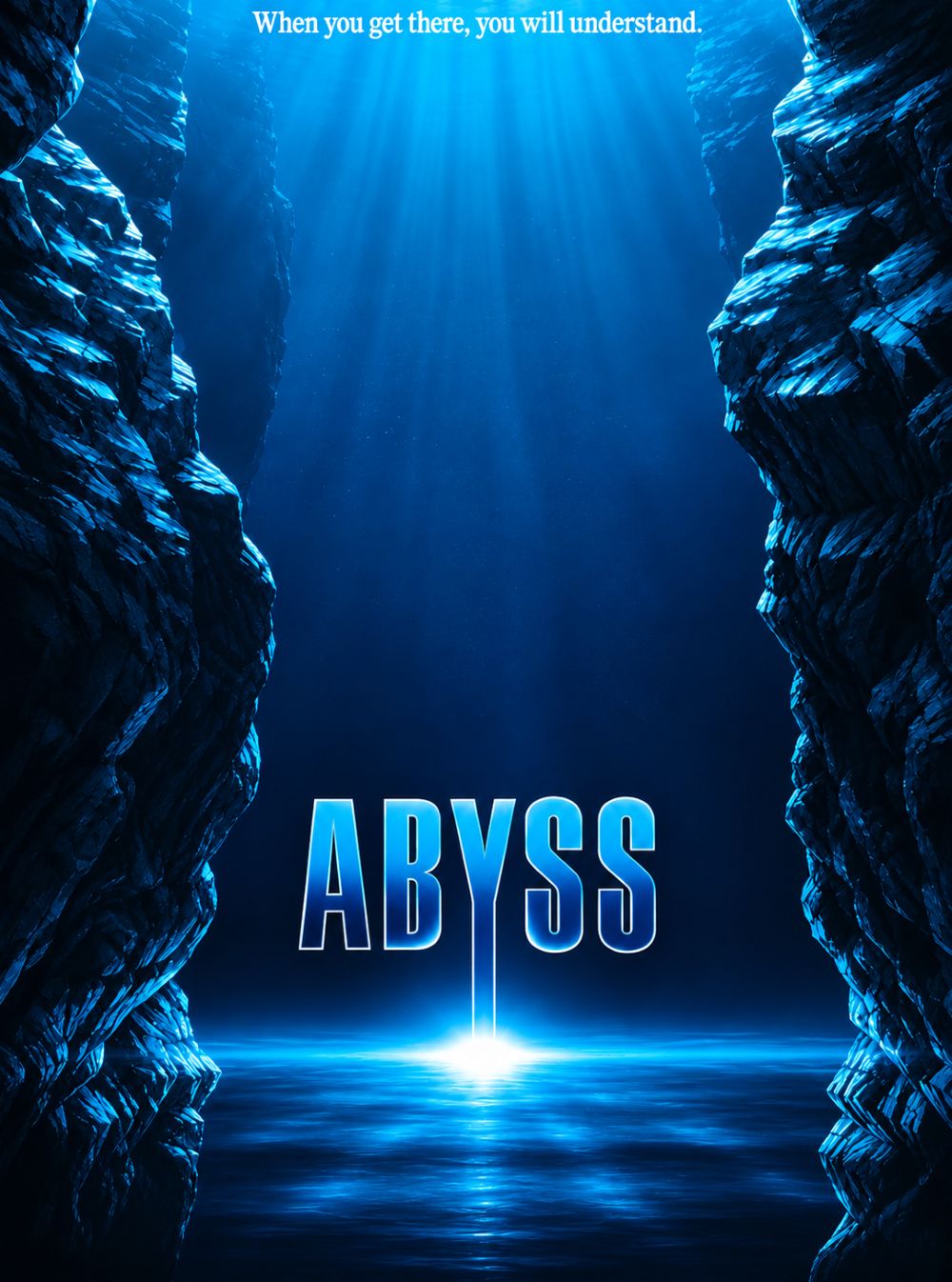
Film Review: The Abyss (dir. by James Cameron)


“We all see what we want to see. Coffey looks and he sees Russians. He sees hate and fear. You have to look with better eyes than that.” — Lindsey Brigman

James Cameron has never seemed particularly interested in keeping things small, but The Abyss gets much of its power from people who can barely move. They’re trapped in tight compartments, weighed down by equipment, and forced to make decisions while the ocean presses in around them. His 1989 underwater adventure turns those restrictions into gripping entertainment, then asks the story to carry a troubled marriage and a message about humanity’s future. It’s an uneven combination, but an engaging one. This review covers the 171-minute extended Special Edition, which can be considered Cameron’s preferred cut, with its fuller character development and substantially expanded ending.

The story begins with an American nuclear submarine sinking after an encounter with something unexplained. A civilian drilling crew is recruited to assist a Navy SEAL team, turning its underwater platform into the headquarters for a tense recovery operation. Bud Brigman, played by Ed Harris, runs the civilian side with the weary confidence of someone accustomed to solving problems without outside help. Then his estranged wife, Lindsey, arrives because she designed the platform and understands its capabilities. That’s good news for the operation, less welcome news for Bud, and an effective way to make an already uncomfortable workplace even more volatile.

Cameron gives that workplace enough personality that the danger matters before the plot gets especially strange. The crew members tease each other, complain about instructions, and handle complicated machinery with practiced familiarity. Their conversations don’t always advance the story, which is part of why they work. These people seem to have lives and routines beyond whatever emergency the movie has prepared for them. Some supporting characters remain broad sketches, but their reactions help establish the group’s identity. You believe they’ve spent enough time together to recognize when an argument is harmless and when someone has become a genuine problem.

The platform itself contributes just as much to that credibility. Its passageways, working areas, and sleeping quarters feel designed around necessity rather than comfort. Cameron gives you enough familiarity with the space that damage has consequences beyond the immediate thrill of water bursting through an opening. A flooded room means a route lost, equipment gone, or another reduction in the crew’s already narrow options. Outside, lights reveal only fragments of an environment that remains overwhelmingly dark. The contrast is unsettling: the platform is claustrophobic, but leaving it means entering a space so vast and indifferent that the cramped interior starts looking reassuring.

Harris anchors the film by making Bud capable without making him invulnerable. He has the authority of a man who will take the difficult job himself, but that same stubbornness causes problems when persistence isn’t the answer. You can see why the crew trusts him and why living with him might be exhausting. Harris lets those qualities coexist rather than separating Bud into admirable and flawed versions. His warmth doesn’t erase his defensiveness, and his courage doesn’t mean he always knows what he’s doing. That makes him a useful center for a story that eventually moves far beyond anything its characters can reasonably understand.

Mary Elizabeth Mastrantonio gives Lindsey the sharp edges needed to make their relationship convincing. She isn’t simply waiting for Bud to demonstrate his worth, and her professional confidence doesn’t disappear whenever the film wants an emotional moment. She can be impatient and cutting, sometimes unnecessarily so, but Mastrantonio allows concern to surface beneath the defensiveness. Her scenes with Harris suggest arguments repeated so often that both people know their parts. They’re good at identifying each other’s weaknesses and less accomplished at acknowledging their own. The affection remains visible, though neither seems eager to make the first move toward admitting it.

The extended edition gives that conflict more room, which matters because the romance needs to function as more than an interruption between emergencies. Bud and Lindsey don’t resolve their differences through one convenient conversation. Instead, the situation gradually exposes how much attention they still pay to each other. Irritation and concern keep occupying the same moments. The wedding ring becomes a particularly effective detail, connecting the marriage to the physical action without requiring another argument about what commitment means. Cameron isn’t always subtle, but he understands the value of giving an emotional idea a concrete object that can matter within a scene.

Michael Biehn’s Lieutenant Coffey brings a more dangerous response to uncertainty. Biehn plays him with a rigid intensity that becomes increasingly unsettling as his judgment deteriorates. Coffey responds to confusion by tightening control, even when that response makes the situation worse. There’s something frightening about a man who mistakes escalating fear for clear thinking, especially when he retains the authority and weapons to act on it. The writing occasionally leans too heavily on the contrast between aggressive soldiers and adaptable civilians. Still, Biehn gives Coffey enough nervous physicality that he registers as an immediate threat rather than merely the representative of a bad idea.

As an action director, Cameron understands how to make a simple objective feel almost impossible. A character has to reach a doorway, repair a system, or cover a distance with too little air. The underwater setting adds resistance to everything, and the film makes that resistance tangible. People struggle with equipment, lose visibility, and spend precious time doing things that would be easy on land. The sequences generally establish their geography and stakes clearly, so suspense comes from anticipating failure rather than trying to understand the editing. Even success rarely brings much relief. Everyone looks increasingly exhausted, and the next task always seems to demand energy nobody has left.

That exhaustion becomes emotionally devastating in the resuscitation sequence. Cameron keeps the scene going long enough to strip away the reassurance that a movie usually offers when a major character is in danger. Harris lets Bud’s practical determination collapse into desperation, exposing feelings he has struggled to express in ordinary conversation. It’s forceful, openly manipulative filmmaking, and not everyone will welcome how hard it pushes. But the intensity has a foundation. The relationship has established what could be lost, while the crew’s helpless presence makes the moment feel painfully public. People accustomed to fixing problems reach the limit of what effort and expertise can accomplish.

The visitors offer something beyond another threat, and the water-tentacle encounter works beautifully because curiosity briefly takes over from fear. There’s humor in it, and an intimacy that feels surprising after so much noise and conflict. The effect matters because it allows a strange intelligence to interact with people on a recognizable emotional level. For a moment, the movie stops treating the unknown as an obstacle. The extended ending then expands that possibility into a confrontation with human violence, bringing international tensions and enormous thousand-foot waves into the resolution. It gives the visitors a clearer purpose, but turns suggestion into a rather blunt explanation. Cameron’s sincerity remains appealing even when his argument becomes too simple.

What makes The Abyss memorable is the way its tenderness survives all that machinery, noise, and pressure. The extended edition occasionally explains what its strongest scenes have already made clear, and its global ambitions aren’t as persuasive as its intimate observations. Yet Harris and Mastrantonio keep pulling it toward something believable: two difficult people discovering that their attachment still matters. Cameron gives that possibility the same attention he gives a failing oxygen supply, treating trust as something that requires effort and carries consequences. Not every grand statement lands, but the quieter feeling underneath does. After so much struggle just to stay alive, having someone worth reaching for feels like a convincing reward.
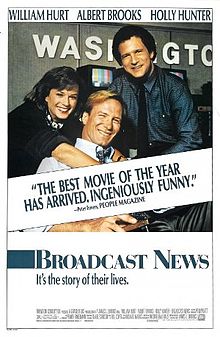
Cleaning Out The DVR #29: Broadcast News (dir by James L. Brooks)


(For those following at home, Lisa is attempting to clean out her DVR by watching and reviewing 38 films by the end of this Friday.  Will she make it?  Keep following the site to find out!)

220px-Broadcast_News

I’ll give you three chances to guess what the 1987 film Broadcast News is about.

Broadcast News takes place at the Washington bureau of a major network news operation.  (You can tell this film was made in the 80s in that nobody’s working for a blog and there’s no mention of Fox, MSNBC, or CNN.)  This is where a group of hard-working men and women do their best to make the national news anchor, Bill Rorish, look good.

Bill Rorish is played by Jack Nicholson and, even though he only has about five minutes of screen time (out of a 133 minute movie), he pretty much dominates the entire film.  Some of that is because he’s Jack Nicholson and he kicks ass.  All Jack has to do to dominate a scene is show up and arch an eyebrow.  But, beyond that, everyone in the movie is obsessed with impressing Bill Rorish.  Whenever a reporter and his producer get a story on the air, they obsessively watch to see if Bill smiles afterward.  Bill Rorish is the God they all hope to please and the film (as well as Nicholson’s performance) suggests that he barely even knows that they’re alive.  It’s telling that the only time Bill shows up in person (as opposed to appearing on a TV screen), it’s because a huge number of people at the Washington bureau are being laid off.

When Bill says that it’s a shame that budget cuts are leading to so many good newspeople being laid off, someone suggests that maybe Bill could help by taking a cut in his million-dollar salary.  Needless to say, Bill Rorish is not amused.

Broadcast News centers on three of the characters who work at the Washington Bureau.  First off, there’s Jane Craig (Holly Hunter), a producer.  Jane is a true believer in the mission and the importance of journalism.  Her ethics and her belief in what constitutes proper journalism are everything to her and, at times, she can get more than a little self-righteous about it.  (If Broadcast News were made today, Jane would spend the entire movie whining about how new media is destroying the country.)  At the same time, Jane is completely neurotic, a self-described “basket case” who, at one point, ends up sobbing in a hotel room as she prepares to go to sleep by herself.

Jane’s best friend is Aaron Altman (Albert Brooks), a reporter who wants to someday be an anchor.  Aaron is smart and funny (and he better be, seeing as how he’s being played by Albert Brooks) but he’s not telegenic and he’s almost as neurotic as Jane.  Like Jane, Aaron is all about journalistic ethics but there’s a defensiveness to Aaron.  Whenever Aaron complains about vapid news anchors, it’s obvious that he’s more jealous than outraged.

And then there’s Tom Grunick (William Hurt), who represents everything that Jane and Aaron claim to be against.  He’s handsome, he’s smooth, he’s charismatic, and he’s definitely not an intellectual.  He knows little about the specifics of current events.  However, he has great instincts.  He knows how to sell a story and he knows how to present himself on camera.  He’s also a surprisingly nice and sincere guy, which makes it all the more difficult for Aaron to justify his belief that “Tom is the devil.”

From the minute that Tom arrives at the Washington bureau, there’s a strong attraction between Tom and Jane.  (Jane even sends another reporter to Alaska after she finds out that Tom slept with her.)  Tom wants to be a better reporter.  Jane wants to be happy but fears compromising her ethics.  And Aaron … well, Aaron wants Jane.

Not surprisingly, considering that the film was made 29 years ago, there were some parts of Broadcast News that felt extremely dated.  A scene where Aaron complains about a story that Tom did on date rape feels especially uncomfortable when viewed today and both Jane and Aaron occasionally came across as being a bit too self-righteous.  In today’s media world, Tom’s sins really didn’t seem like that big of a deal.

But, for the most part, I enjoyed Broadcast News.  It was an intelligent film, one the featured people having actual conversations about actual ideas and, listening to them, I realized how rare, in both movies and real life, that actually is.  It’s a witty film, full of good performances.  While I hope I never become as self-righteous as Jane, I could still relate to her in her more neurotic moments.  And who wouldn’t want a best friend like Aaron?

And, for that matter, who wouldn’t want a lover like Tom?

(That’s something I never expected to write about a character played by William Hurt.)

And, of course, there’s this scene.  Poor Aaron!

Broadcast News was nominated for best picture of 1987.  However, it lost to The Last Emperor.


Song of the Day: One Day More (by Claude-Michel Schönberg & Alain Boublil)


This coming December 2012 will see another stage musical make it onto the big screen. It was in 2004 that Joel Schumacher first brought The Phantom of the Opera to the big-screen as a musical. For 2012, it will be Academy Award-winner Tom Hooper who will be bringing the musical Les Misérables to the big-screen with a star-studded cast that includes Hugh Jackman in the role of Jean Valjean and Russell Crowe as his arch-nemesis Inspector Javert. It’s also from this musical that I chose the latest “Song of the Day” with the ensemble piece that ends Act 1: “One Day More”.

It was Les Misérables the musical that first introduced me to the world of musicals. Prior to having seen the touring production which stopped over in San Francisco during the late 80’s and early 90’s I always thought of musicals as just not my thing even though I never truly witnessed one. All that changed when I saw Les Misérables and I have been hooked since.

One of my favorite songs from the musical was the ensemble piece that ends Act 1 and brings together all the players introduced in the first act. It wasn’t just the whole cast singing but how they sang as each character were given voice and as the song reaches an epic crescendo to curtains closing everyone joins in a rousing chorus with overlapping lyrics from different main players that at first sounded confusing to follow, but was still understandable.

Most musical nowadays rarely go for such grand closing before intermissions. Listening to “One Day More” shows me that its a lost art but when done well it comes off as amazing.

One Day More

VALJEAN
One day more!
Another day, another destiny.
This never-ending road to Calvary;
These men who seem to know my crime
Will surely come a second time.
One day more!

MARIUS
I did not live until today.
How can I live when we are parted?

VALJEAN
One day more.

MARIUS & COSETTE
Tomorrow you’ll be worlds away
And yet with you, my world has started!

EPONINE
One more day all on my own.

MARIUS & COSETTE
Will we ever meet again?

EPONINE
One more day with him not caring.

MARIUS & COSETTE
I was born to be with you.

EPONINE
What a life I might have known.

MARIUS & COSETTE
And I swear I will be true!

EPONINE
But he never saw me there!

ENJOLRAS
One more day before the storm!

MARIUS
Do I follow where she goes?

ENJOLRAS
At the barricades of freedom.

MARIUS
Shall I join my brothers there?

ENJOLRAS
When our ranks begin to form

MARIUS
Do I stay; and do I dare?

ENJOLRAS
Will you take your place with me?

ALL
The time is now, the day is here!

VALJEAN
One day more!

JAVERT
One more day to revolution,
We will nip it in the bud!
We’ll be ready for these schoolboys
They will wet themselves with blood!

VALJEAN
One day more!

M. & MME. THENARDIER
Watch ’em run amuck,
Catch ’em as they fall,
Never know your luck
When there’s a free for all,
Here a little `dip’
There a little `touch’
Most of them are goners
So they won’t miss much!

Students (2 Groups)
1: One day to a new beginning

2: Raise the flag of freedom high!

1: Every man will be a king

2: Every man will be a king

1: There’s a new world for the winning

2: There’s a new world to be won

ALL
Do you hear the people sing?

MARIUS
My place is here, I fight with you!

VALJEAN
One day more!

MARIUS & COSETTE
I did not live until today.

EPONINE
One more day all on my own!

MARIUS & COSETTE
How can I live when we are parted?

JAVERT(overlapping)
I will join these people’s heros
I will follow where they go
I will learn their little Secrets,
I will know the things they know.

VALJEAN
One day more!

MARIUS & COSETTE
Tomorrow you’ll be worlds away

EPONINE
What a life I might have known!

MARIUS & COSETTE
And yet with you my world has started

JAVERT (overlapping)
One more day to revolution
We will nip it in the bud
We’ll be ready for these

Schoolboys

THENARDIERS (overlapping)
Watch ’em run amok
Catch ’em as they fall
Never know your luck
When there’s a free-for-all!

VALJEAN
Tomorrow we’ll be far away,
Tomorrow is the judgement day

ALL
Tomorrow we’ll discover
What our God in Heaven has in store!
One more dawn
One more day
One day more!