Film Review: The Crucible (dir by Nicholas Hytner)


In 1692 and 1693, over 200 people were accused witchcraft in colonial Massachusetts.  Thirty people were found guilty.  19 were executed, fourteen women and five men.  One man died while being tortured in an effort to get a confession out of him.  At least five more people died in their jail cells, awaiting their trial.

There’s a lot of debate about how the witch trials actually began but it’s generally agreed that the initial accusations were made by four girls in the village of Salem.  The oldest was 17 while the youngest was just nine.  (One of the girls, 12 year-old Abigail Williams, was related to the village’s pastor, Samuel Parris.  Traditionally, she has been portrayed as being the ringleader of the accusers.)  The girls claimed that the women of the village had caused them physical pain through witchcraft.  Soon, other girls in nearby villages were making similar accusations.  Some of the accused confessed to being witches to avoid execution.  Others claimed to be innocent but also said they knew who the real witches were.  And, of course, many refused to confess and were executed as a result.

Today, it’s easy to see that the Salem Witch Trials were an early “moral panic.”  What is often forgotten is that, even at the time the trials were taking place, there were many prominent thinkers who condemned them as being a case of mass hysteria.  In the years immediately following the trials, the majority of its victims were posthumously exonerated.  The Reverend Samuel Parris wrote an official apology letter for his role in the trials.  One of the legacies of the Salem Witch Trials was that the First Amendment of the United States Constitution made clear that “Congress shall make no law respecting an establishment of religion.”

Arthur Miller’s 1953 play, The Crucible, was set during the Salem Witch Trials and, for many people, it’s the defining work about the trials, despite the fact that Miller acknowledged to taking dramatic liberties with some of the characters and events.  Miller, who had recently been questioned by the House Unamerican Activities Committee, meant for the play to be both a commentary on McCarthyism and a rebuke towards people like his former friend, Elia Kazan, who “named names” to protect themselves.   Of course, one could argue that the main difference between the Salem Witch Trials and the Red Scare is that communists were real while the Salem witches were not.  But, no matter.  It’s one of Miller’s better plays.  If Elia Kazan could justify his testimony by imagining himself as a punch-drunk boxer standing up to a corrupt union, I suppose Arthur Miller could pretend to be a man accused of witchcraft.  The play was initially not as acclaimed as some of Miller’s other works but, over the years, it has come to be widely acknowledged as one of the classic works of American theater.

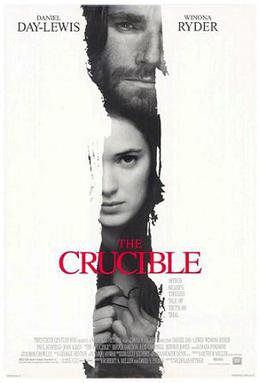
In the 90s, Miller wrote the screenplay for a film adaptation of the The Crucible.  First released in 1996, this adaptation starred Daniel-Day Lewis as the wrongly accused John Proctor, Joan Allen as Proctor’s wife, Elizabeth, and Winona Ryder as Abigail Williams.  For the purposes of Miller’s dramatization, Abigail was reimagined as being a teenage girl who had a brief affair with John Proctor and who was still obsessed with him.  When the Reverend Parris (Bruce Davison) catches Abigail and some of her friends trying to cast a “love spell” on John, the girls try to avoid punishment by accusing Parris’s slave, Tituba (Charlayne Woodard), of being a witch.  Tituba gives a false confession to avoid being hanged.  The girls are soon accusing numerous other women, including Elizabeth Proctor, of witchcraft.

As a film, The Crucible is a fine adaptation of Miller’s play and it’s always a little bit surprising to me that the movie itself isn’t better-known.  Daniel Day-Lewis, Winona Ryder, Joan Allen, and Bruce Davison all give excellent performances, as does Rob Campbell as a reverend who comes to doubt the accusations of witchcraft.  The great Paul Scofield also does a good job as Danforth, the stern judge who attempts to be fair but ultimately is not willing to admit that the law itself is in error.  The film recreates Salem is such detail that you feel as if you’re walking its streets.  The film also recreates the horrible conditions that a colonial prisoner would have to deal with while imprisoned.  Watching Daniel Day-Lewis go from being handsome and rugged to being an emaciated man with rotten teeth really drives home the story’s portrayal of casual, state-sanctioned cruelty.  By the end of the movie, Day-Lewis is a testament to what authoritarians will do to someone who insists on thinking for himself.

The film is at its strongest when showing how a moral panic begins.  The unstable Abigail is looking for revenge against John Proctor.  The other girls, immature and trying to be avoid being punished, make their accusations without giving much thought to the consequences.  Soon, the adults of Salem — all of whom have no excuse for not knowing better — are making accusations because it’s better to be an accuser than to be one of accused.  The film presents a disturbing portrait of how quickly a community can turn on itself.

The film ends on a note of devastating sadness.  Though the witch trials were eventually seen for being the farce that they were, it was too late for the twenty-five people who died as a result of the hysteria.  (Today, with a clear mind, it’s easy to see that the Salem Witch Trials had more in common with Stalin’s show trials and China’s Cultural Revolution than anything else.)  The Crucible is a powerful film adaptation that deserves to be better-known.

Late Night Retro Television Review: Saved By The Bell 1.13 “The Babysitters”


Welcome to Late Night Retro Television Reviews, a feature where we review some of our favorite and least favorite shows of the past!  On Saturdays, I will be reviewing Saved By The Bell, which ran on NBC from 1989 to 1993.  The entire show is currently streaming on Prime and Tubi!

This week, Kelly is irresponsible.

Episode 1.13 “The Babysitters”

(Dir by Don Barnhart, originally aired on December 1st, 1990)

This episode stresses me out.

Kelly’s parents go off on a ski vacation and leave Kelly with the responsibility of taking care of her infant brother.  (Really?)  When they get stranded at the lodge, Kelly has to bring the baby to school.  She asks her idiot friends to help look after him.

Of course, Zack loses the baby.  Fortunately, Mr. Belding finds him but still…

Seriously, I hate this episode.  I hate that Kelly’s parents are irresponsible enough to abandon their baby so that they can go skiing.  I hate that Kelly has to find someone to take care of the baby while she goes to cheerleader practice.  I hate that Zack is dumb enough to lose the baby.  I hate that no one ever says, “Wow, this whole situation is really messed up.”  This is the one episode that I always turned off whenever I came across it on TV.

This episode, I just can’t take it.


Late Night Retro Television Review: Highway to Heaven 5.7 “The Squeaky Wheel”


Welcome to Late Night Retro Television Reviews, a feature where we review some of our favorite and least favorite shows of the past!  On Thursdays, I will be reviewing Highway to Heaven, which aired on NBC from 1984 to 1989.  The entire show is currently streaming on Tubi and several other services!

This week, Jonathan and Mark help out a vet.

Episode 5.7 “The Squeaky Wheel”

(Dir by Michael Landon, originally aired on June 16th, 1989)

Jonathan and Mark attempt to turn Wayne Secret (Robert David Hall) into a disability activist.  Having lost his legs in Vietnam, Wayne wants to live a quiet life with his wife (Deborah Benson) but, while staying at a recently renovated hotel, he is woken up by a fire alarm.  With the the elevators not working and no ramps, Wayne is forced to depend on the kindness of a stranger who carries him down a flight of stairs.  The fire turns out to be a false alarm but the experience leads to Wayne protesting the fact that the hotel is not wheelchair accessible.

The owner of the hotel not only agrees to make changes to the building but he also offers Wayne a job.  Things are looking up for Wayne!  But, when a gang of young men harass him and his wife at a drive-in movie, Wayne snaps.  He buys an Uzi and then heads down to their clubhouse to take them out.  Luckily, Jonathan appears and talks Wayne out of becoming a mass murderer.  Wayne goes on to receive a “man of the year” award while Jonathan beats up the leader of the gang.

This episode felt very familiar.  In the past, this episode would have featured Mark’s brother-in-law, Scotty.  Instead, it features Wayne, who is not a particularly compelling character.  I think that this episode would have worked if it had just focused on Wayne advocating for wheelchair accessible buildings.  I also think it would have worked if it had just focused on Wayne’s anger to the gang and his struggle to let go of his bitterness over his war experiences.  Unfortunately, trying to cram both those storylines into one 45-minute show led to the whole thing feeling half-baked.

There was one poignant scene in this episode.  It opened with Mark and Jonathan visiting the Hollywood Walk of Fame.  Mark got excited when he came across Michael Landon’s star. “Never heard of him,” Jonathan shrugged.  “I forget you’ve been dead for forty years,” Mark replies.  It captured Jonathan and Mark’s friendship, which was always been one of the more underrated aspects of Highway to Heaven.  That said, it was also a bit of a sad scene as the episode itself aired a day after the death of Victor French and Landon himself would pass away nearly two years later.

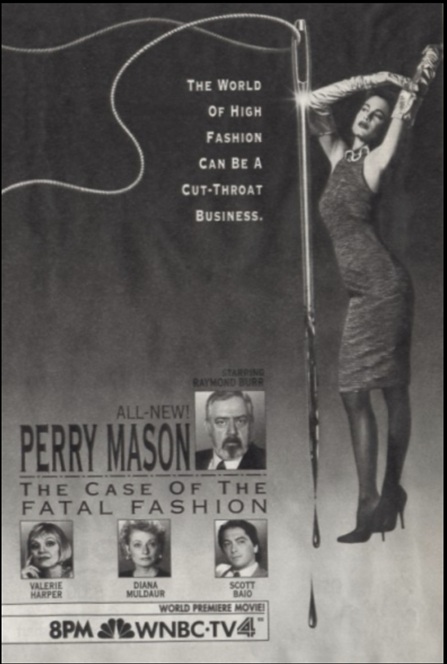
I Watched Perry Mason: The Case of the Fatal Fashion (1991, Dir. by Christian I. Nyby II)


Perry Mason (Raymond Burr), Della Street (Barbara Hale), and Ken Malansky (William R. Moses) are in New York when an old friend of Perry’s, magazine editor Lauren Jeffreys (Diana Muldaur) is accused of murdering a rival editor, Dyan Draper (Valerie Harper). Dyan was infamous for writing about the personal lives of celebrities in her column so there’s a ton of possible suspects. While Ken teams up with a mobster named Tony Loomis (Robert Clohessy) to search for clues, Perry finds himself facing off against a young district attorney (Scott Baio) who is smarter than he seems.

This Perry Mason movie is unique because, for once, the prosecutor is as good an attorney as Perry.  It reminded me of how, when the movies started, David Ogden Stiers always played the prosecutor and came across like someone who would probably win if he has going up against anyone other than Perry Mason.  Even though I immediately thought of Bob Loblaw as soon as I saw him, Scott Baio gives a good performance as a lawyer who worships Perry and can’t wait to face him in court.  For once, there’s mutual respect between the two sides.

The mystery was another one of those where I was able to guess who the killer was from the start.  They had to really stretch things to get the mob involved so that Ken could team up with Tony.  (Ken wanted to bring the killer to court while Tony just waned to shoot them.)  Also, it was obvious that Raymond Burr was not doing well when he filmed this movie.  In almost every scene, he’s either seated or leaning against something.  There are only 6 more Perry Mason films featuring Burr after this one and one of those aired after he died.  Burr still gives a commanding performance whenever Perry’s in court, though.  Sick or not, there’s no other attorney you want on your side.

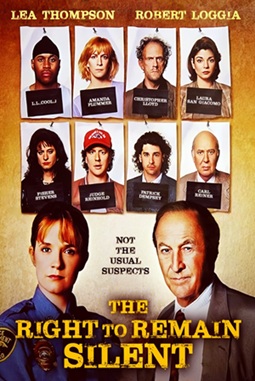
The Right To Remain Silent (1996, directed by Hubert de La Bouillerie)


It’s one very busy night at a police station.  Everyone who is brought in from off the streets has the right to remain silent but no one exercises it.  Rookie cop Lea Thompson listens to everyone’s stories.  LL Cool J is the documentarian who thought it would be smart to put on Klan robes and a hood and try to infiltrate a demonstration undercover.  Patrick Dempsey is the drunk who killed a kid.  Carl Reiner comes in and confesses to mercy killing his wife.  Christopher Lloyd is homeless.  Fisher Stevens is a trans streetwalker.  Judge Reinhold, I don’t even know what he was supposed to be.  Reinhold actually plays two characters in this film and he’s miscast in both roles.  Amanda Plummer is a pizza delivery person who shoots someone in self-defense.  No one asks for a lawyer.  No one lies about what they did.  Instead, they just talk and talk and talk and talk some more.  Thompson listens while Robert Loggia, as the chief, growls about donuts.

The Right To Remain Silent is based on a play and that is its downfall.  Instead of being a story about a rookie cop and her first night on the job, it’s just a collection of rambling stage monologues.  Some of the actors, like Carl Reiner and Christopher Lloyd, do okay.  Most of them still seem to be acting for the folks sitting in the back row.  It ultimately doesn’t add up too much because the stories are too predictable to make much of an impression.  Everyone in this film had the right to remain silent and I wish they had exercised it.

Late Night Retro Television Review: Highway to Heaven 4.9 “Why Punish the Children?”


Welcome to Late Night Retro Television Reviews, a feature where we review some of our favorite and least favorite shows of the past!  On Thursdays, we will be reviewing Highway to Heaven, which aired on NBC from 1984 to 1989.  The entire show is currently streaming on Amazon Prime, Tubi and other services!

Episode 4.9 “Why Punish the Children?”

(Dir. by Michael Landon, originally aired on November 25th, 1987)

In this Thanksgiving episode, Jonathan Smith (Michael Landon) and Mark Gordon (Victor French) take on roles as history teachers in a women’s prison. It seems a compassionate social worker named Melanie Canner (Sally Spencer) has been fighting hard to improve the lives of the women on the inside and has been getting close to nowhere with prison warden Thomas Inman (Bruce French). The first positive step that Melanie has been able to secure for the inmates from the warden are these history classes. Once on the inside, we meet inmates like Maria Rojas (Tasia Valenza), a young woman who’s just about to have her first baby, and Reba Williams (Bebe Drake), a mother of five. Both women want to straighten out their lives in order to give their children a better chance in life. It soon becomes clear that Jonathan, Mark, and Melanie are on a mission to convince the warden to open up more opportunities for the women to improve their lives and spend more quality time with their kids. The warden isn’t an easy case, as he seems convinced that the women shouldn’t be given any real favors as they pay their debts to society. As you might imagine, Jonathan has a couple of divine tricks up his sleeve.

I liked this episode of HIGHWAY TO HEAVEN even if it’s not the most realistic story you’ll ever see. Each woman we meet has 100% accepted the error of their ways and are determined to be a productive member of society if they can get just one more chance. The cynical part of me has to overcome this unrealistic element of the story, and the “women in prison” movie lover in me would have enjoyed a couple of good catfights. Alas, this is HIGHWAY TO HEAVEN and director Michael Landon is not in the business of going for complete realism or providing B Movie fan service! Rather, Landon is interested in creating a world where basically good people have done wrong, honestly regret how their choices negatively impact those they love, and vow to do better for their children. This series built its five seasons on the prospect of people turning their lives around, and I’ll admit I got pretty emotional again with this one. This episode really focuses in on a mother’s love for her children, and I certainly want to believe that these women would do anything for theirs. Each mother is given a beautiful moment, at Thanksgiving no less, and the chance that they need to be the mom their children deserve. I’m getting a little misty just thinking about it as I type these words. The character of the warden is there to learn the lesson that we all need to learn, which is to try to see situations from different points of view. He gets a little angelic help in this area, which is quite heavy handed and completely in line with the show’s expectations.

Overall, I again enjoyed this episode as a nostalgic trip down memory lane with a series I grew up watching with my mom. The fact that I got a little emotional is also no surprise because the older I get the more I cry when watching movies and TV shows. The fact that I was bawling in my office while I watched the show at work could have been a little hard to explain… luckily, nobody came by during those waterworks moments.

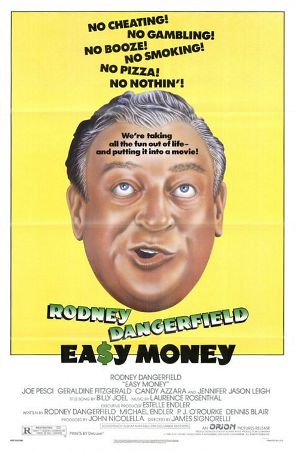
A Movie A Day #151: Easy Money (1983, directed by James Signorelli)


Rodney Dangerfield.  He didn’t get no respect but he did smoke a lot of weed.

It’s true.  Rodney first lit up in 1942 when he was a 21 year-old struggling nightclub comic.  According to his widow, the moment meant so much to Rodney that, decades later, he could still remember the room number — 1411, at the Belvedere Hotel in New York City — where he and fellow comedians Bobby Byron and Joe E. Ross smoked that first joint.  That was back when Rodney was performing under the name Jack Roy.  (His was born Jacob Cohen.)  Rodney’s first comedy career went so badly that he quit and spent the next twenty-two years as an aluminum siding salesman until he found the courage to return to the stage.  However, whether he was selling or performing, Rodney never stopped smoking marijuana.  When he was working on his autobiography, he wanted to call it My Lifelong Romance With Marijuana.  His wife convinced him to go with a different title:  It’s Not Easy Bein’ Me: A Lifetime of No Respect but Plenty of Sex and Drugs.

There’s plenty of drugs in Easy Money, which is a problem for baby photographer Monty Capuletti (Rodney, of course).  Monty likes to gamble, drink, and smoke pot, much to the disapproval of his wealthy mother-in-law (Geraldine Fitzgerald).  When she dies, she stipulates in her will that if Monty goes for a year without indulging in any of his vices, he and his family will receive 10 million dollars.  Sounds easy, right?  The only problem is that Monty really likes to eat, drink, gamble, and get high.  His best friend (Joe Pesci) doesn’t think he can do it.  His mother-in-law’s former assistant, Quincy Barlow (Jeffrey Jones), is determined to catch Monty slipping back into his old ways so that he can inherit the money.  Monty’s determined, though, to win the money for his family, especially now that his daughter (Jennifer Jason Leigh) has married the bizarre Julio (Taylor Negron).

The episodic plot is really just an excuse for Rodney to be Rodney, spouting off one liners and making snobs like Quincy look foolish.  Rodney and Joe Pesci were a surprisingly effective comedy team.  The scene where they get stoned and try to drive home without damaging the huge wedding cake in the back of the van is a hundred times funnier than it has any right being.  Even though it is hard to imagine her being, in any way, related to Rodney Dangerfield, Jennifer Jason Leigh is always a welcome presence.  Like many comedies of that era, Easy Money is uneven, with as many jokes failing as succeeding but, for Rodney Dangerfield fans, it is a must see.

What Horror Lisa and the Snarkalecs Watched Last Night #106: Finders Keepers (dir by Alexander Yellen)


Last night, the Snarkalecs and I watched the latest SyFy original film, Finders Keepers!

FK

Why Was I Watching It?

I had been watching Big Driver over on Lifetime but that film proved to be unusually disturbing and I really wasn’t in the right mood to deal with it.  Sometimes, you need to just be entertained and SyFy original movies are always entertaining!  So, after watching an hour of Big Driver, I turned over to SyFy and watched Finders Keepers.

What Was It About?

Recently divorced writer Alyson Smith (Jaime Pressly) moves into a nice, old house with her daughter, Claire (Kylie Rogers).  At first the house seems ideal but soon, cracks start to appear on this perfect fantasy of home ownership.  Claire starts to act strangely.  A crazy old cat lady (Marina Sirtis) keeps coming by the house.  Alyson does some research and discovers that the reason the house was empty was because, years before, it was the scene of a brutal mass murder.  And, of course, Claire finds a creepy doll in her bedroom and becomes extremely attached to it.

Soon, everyone who knows Alyson and her ex-husband (Patrick Muldoon) is turning up dead.  Could it be that the doll is evil or could it all be a coincidence?

Actually, there’s really no question.  That is one messed up doll…

What Worked?

SyFy hasn’t been showing as many original movies this year as they did last year.  Fortunately, the ones that they have shown have all been excellent and Finders Keepers keeps the streak going.  Finders Keepers is an effectively creepy horror film, featuring excellent performances from Jaime Pressly and Patrick Muldoon, atmospheric direction from Alexander Yellen, and a clever script from Peter Sullivan.

Incidentally, Finders Keepers probably featured one of the bigger body counts that I’ve ever seen in a SyFy film.  Nobody’s safe from that doll!

What Did Not Work?

Over the course of the film, two cats and a crazy old cat lady are killed.  As most of you know, I am about 40 years away from becoming a crazy old cat lady so that was a little bit difficult for me to deal with.

“Oh my God!  Just like me!” Moments

So, beyond the crazy old cat lady and her two cats, this film also featured a vivacious, 20-something redhead who ended up being murdered by the evil doll.  And then, once the redhead and the cat lady had been dispatched, we were introduced to an incredibly efficient office administrator and guess what happened to her?  That’s right — murdered by the crazy doll.  Speaking as a vivacious and efficient redheaded office administrator and future crazy cat lady, I really have to wonder just what exactly this film had against me!

Lessons Learned

Do not let your daughter keep any creepy old voodoo dolls that she just happens to find in her bedroom.  If she won’t get rid of the voodoo doll, consider giving her up for adoption because, seriously — voodoo is nothing to mess with.