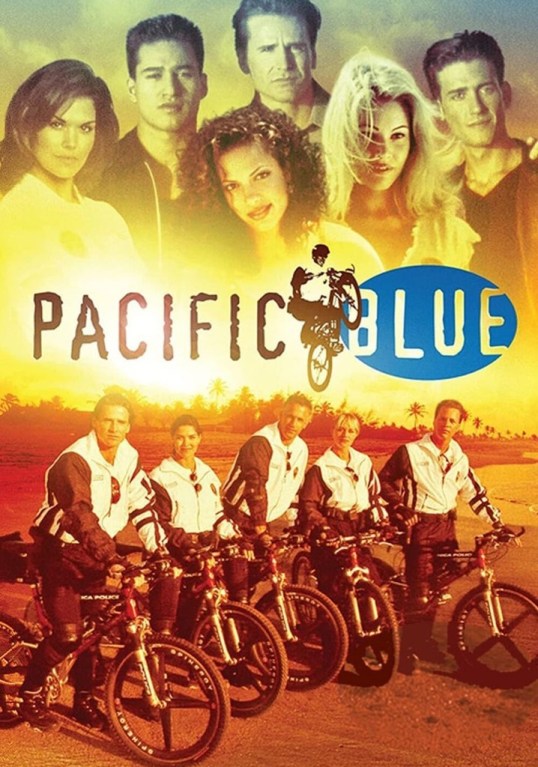
Welcome to Late Night Retro Television Reviews, a feature where we review some of our favorite and least favorite shows of the past! On Tuesdays, I will be reviewing Pacific Blue, a cop show that aired from 1996 to 2000 on the USA Network! It’s currently streaming everywhere, though I’m watching it on Tubi.
This week, we start season 4!
Episode 4.1 “Glass Houses”
(Dir by Michael Levine, originally aired on July 26th, 1998)
The fourth season of Pacific Blue opens with many changes.
Palermo and Victor have retired. Cory is now dating Doug Fraser (Owen McKibbin). At the start of the episode, Cory and Doug accompany TC and Chris to Vegas, where they are married by — you guessed it! — an Elvis impersonator.
TC is now in charge of Pacific Blue and, while Chris and Cory both make plans to take the sergeant’s exam, TC focuses on bringing in some new blood. At the police academy, he recruits two recent graduates — hyper-competent Jaime Strickland (Amy Hunter) and edgy rebel Russ Granger (Jeff Stearns). He asks and gets undercover cop Monica Harper (Shanna Moakler) transferred to Pacific Blue so that she can go undercover to break up a meth operation at the local college. Everyone is shocked when Monica turns out to be young and blonde. Were they expecting a 40 year-old undercover college student?
Not happy about having to ride a bicycle, Russ decides to insert himself into Monica’s undercover operation. Monica and Russ meet the two main dealers, Quincy (Joe Michael Burke) and Cherry (Michelle Beauchamp). They discover that they’re getting their drugs from a chemistry professor (Robin Thomas). What they don’t do is make an arrest. Quincy and Cherry murder the professor and escape after setting off a bomb in the chemistry lab.
TC is not happy with his new cops. In fact, the episode ends with him telling them that he has doubts about whether or not to keep them at Pacific Blue. Fortunately, we the viewers know that they’ll be okay because they are all now listed in the opening credits.
Also listed in the opening credits is Bobby Cruz (Mario Lopez), the campus cop who drags Monica out of the laboratory right before it explodes. Bobby has a history. He was a member of the LAPD but, disgusted by the anti-Mexican racism that he saw, he became a campus cop instead. (Where I went to college, the campus cops were the biggest joke around.) TC offers Bobby a chance to be a member of Pacific Blue. Bobby says that he’ll think about it. We all know that means yes.
And that’s a good thing because this show could definitely use more Mario Lopez! In fact, the only reason I started reviewing this stupid series was because I knew Mario would be joining the cast eventually. Let’s hope Mario’s magic starts to make things better soon!
As for this episode, it was …. well, it wasn’t good. Other than Lopez, none of the new characters really made much of an impression. But, I am an optimist. I have hope.
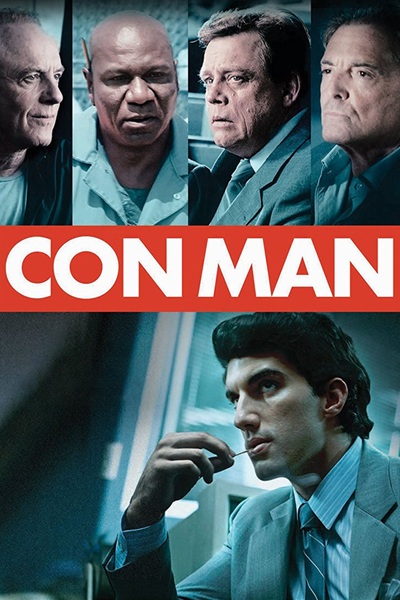
Originally filmed in 2010 but not released until 2018, Con Man is one of the strangest vanity projects that I’ve ever seen.
Originally entitled Minkow, Con Man tells the story of Barry Minkow. When Minkow was a teenager, he started a carpet cleaning business and he quickly learned how to both promote himself and how to lie about how much money he was making. The media ate up the story of the teenager became a millionaire by cleaning carpets. His father (Mark Hamill) was proud of him. His mother (Talia Shire) worried that he was moving away from God. A local mobster (Armand Assante) decided to get involved. It was eventually discovered that Barry was kiting checks, lying to insurance companies, and massively defrauding both his investors and his employees. After being busted by the FBI (represented here by James Caan), Barry Minkow was sent to prison.
In the film, teenage Barry Minkow is played by a young, handsome, and charismatic Justin Baldoni. When Barry gets out of jail, he’s suddenly been transformed into …. well, Barry Minkow. That’s right. Barry Minkow plays himself. Needless to say, Barry Minkow looks nothing like Justin Baldoni. It’s not just that the two men are different ages. It’s also that there’s no way to imagine Justin Baldoni transforming into the gargoyle that is Barry Minkow.
In prison, Barry Minkow is converted to Christianity by a prisoner named Peanut (Ving Rhames). After Minkow serves his sentence, he not only helps the FBI track down other con artists but he becomes the pastor of his local church. Despite his past, everyone loves and trusts Barry Minkow. Everyone talks about how charismatic he is, despite the fact that the adult Barry Minkow delivers his lines in a flat monotone and looks like he should be sitting over the entrance of a cathedral. People who suspect that they’ve been a victim of financial fraud start to come to Barry, asking him for advice. The always humble Barry is concerned that he’ll let people down but, in the end, even James Caan says that Barry is a great guy. “I’m doing the work of God!” Barry proclaims.
Yes, the film is fueled by pure ego. Unfortunately, it took more than ego to pay the bills so Minkow embezzled money from his own church, stole money from his congregation, and resorted to his old track of “clipping” checks to finance the whole thing. Shortly after the film was completed, Minkow was arrested and sent back to prison. (A hot mic caught Minkow bragging to James Caan about how he financed the film. After his arrest, Minkow denied he had ever said that and dared anyone with proof to turn it over. The film’s director proceeded to do just that. Barry Minkow was not only a criminal. He was a stupid criminal.)
As for the film, it sat in limbo for eight years. Eventually, talking head interview with Minkow’s actual victims talking about how much they disliked Barry were sprinkled throughout the film. (Shortly before Minkow starts playing himself, we hear one of his business partners say that everyone told him not to play himself.) The original film ended on a triumphant note. The new film — which was retitled Con Man — ended with real people talking about Barry Minkow going back to jail and casting doubt as to whether or not Barry ever even knew a prisoner named Peanut.
The film is a vanity project and not a very good one. Minkow is a terrible actor and, just in case we forget that fact, he reminds us by trying to hold the screen opposite James Caan and Ving Rhames. (Even Elisabeth Rohm manages to outact him.) As bad as the film is, the story behind it is endlessly fascinating. Barry Minkow was determined to become a star. (Spielberg’s Catch Me If You Can was an obvious inspiration.) Instead, he went back to prison and his vanity project was transformed into a roast. And it probably couldn’t have happened to a more deserving guy.
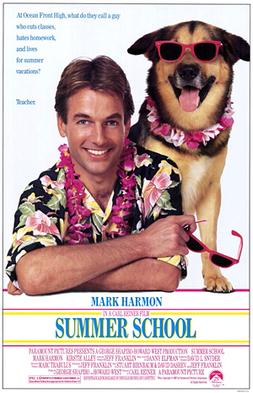
SummerSchool was the movie that made flunking out look like fun.
Freddy Shoop (Mark Harmon) is a relaxed, fun-loving gym teacher who is looking forward to spend his summer in Hawaii until he’s assigned to spend the summer teaching remedial English in summer school. (His girlfriend goes to Hawaii without him.) Freddy’s not happy about giving up his summer and he’s prepared to just spend his days taking his students to the beach, the amusement park, and the zoo. But when he finds out that he’s going to lose his job unless his students pass the big test at the end of the summer, he gets serious and discovers what teaching is supposed to be all about.
When I was growing up, SummerSchool seemed to be on television all the time. If it wasn’t on HBO, it was on one of the local stations, usually right before summer began. The summer school kids seemed to be having too much fun for kids stuck in school. I don’t think my classmates in Baltimore would have been as happy about losing their summer as the students in this film. Everyone who has seen this film remembers Dave and Chainsaw (Gary Riley and Dean Cameron) making jokes and showing everyone The Texas Chainsaw Massacre. They also remember Anna-Maria (Fabiana Udenio), the Italian exchange student who took summer school to work on her English. They remember Freddy letting one of his students move in with him, which doesn’t seem like a good idea even if she was played by Courtney Thorne-Smith. Myself, I remember Robin Bishop, the teacher next door, who was played by an extremely sexy Kirstie Alley. (This was one of the many 80s films in which Kirstie Alley made being uptight seem sexy.) Of course, Robin was dating the snobbish principal who was trying to get Freddy Shoop fired.
I’m not going to sit here and say that SummerSchool is a great film. It’s a dumb comedy with an uplifting message about what a good teacher can accomplish. However, SummerSchool is a very likable film, an enjoyable 80s teen romp that suggests summer school was the place to be in the late 80s. Mark Harmon, Kirstie Alley, and all the students give good performances. How many future horror nerds were inspired by Dave and Chainsaw? Legendary nice guy Carl Reiner directed and the movie itself is amiable and amusing enough to be watchable.
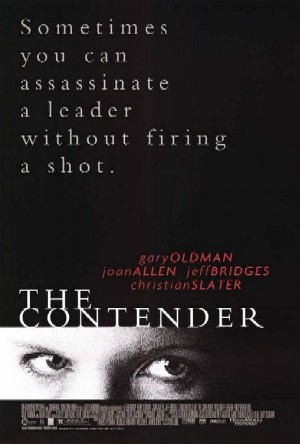
The 2000 political melodrama The Contender is one of the most hypocritical films that I’ve ever seen.
The Contender tells the story of what happens when U.S. Sen. Laine Hanson (played by Joan Allen) is nominated to be vice president by President Jackson Evans (Jeff Bridges). During Laine’s confirmation hearings, Rep. Shelly Runyon (Gary Oldman) dredges up rumors that, at a college frat party, Laine took part in a threesome in exchange for money.
When Runyon asks Laine about the rumors, she replies that she refuses to answer any questions about what she may or may not have done while she was younger. She replies that it is “simply beneath my dignity” and you know what? She’s absolutely right. First off, if someone could be disqualified just because of what they did in college then nobody would eve be eligible to be President. Secondly, and far more importantly, nobody would care about Laine’s sexual history if she was a man.
For over two hours, Laine refuses to answer any questions about the allegations and instead, she turns the tables on her attackers. And while this alone would not have made The Contender a good film (because, after all, The Contender was written and directed by Rod “Straw Dogs” Lurie), it at least would have been a film that I could respect.
But, Rod Lurie being Rod Lurie, he just couldn’t help but fuck it all up.
Towards the end of the film, Laine is attending a White House reception. She and President Evans sit down on the White House lawn and, as the stars shine above them, Evans says, “Just between us, is it true?”
Now, there’s two things that Laine could have said here that would have kept this film from falling apart. Laine could have said, “It’s none of your business.” And that would have been the right thing to say because, quite frankly, it is none of the President’s business. The whole point of the movie has been that it’s not anyone’s business.
Or, if the film actually had any guts, Laine could have said, “Yes, it’s totally true. Like most people, I experimented when I was in college. But that doesn’t have anything to do with whether or not I’m qualified to be your vice president.”
But no. Instead, Laine smiles and says, “Nothing happened. Two guys propositioned me, I said no, and they spread rumors.”
So, basically, the film is saying, “It’s nobody’s business if Laine was sexually active in college but don’t worry, Mr. and Mrs. American Audience, she was a virgin until she turned 30. So, it’s still okay for you to like her…”
And that’s the thing about The Contender. It’s a film that doesn’t have the courage of its own convictions. It’s a film that drags on for over two hours and it expects you to forgive it just because it pretends to have good intentions. As a woman, there’s nothing I hate more than being pandered to and, for all of its attempts to come across as being feminist, The Contender is all about pandering.
What makes The Contender an interesting bad film — as opposed to just your usual bad film — is how even the littlest details feel false. It’s obvious that Lurie knew all of the legal details that go into confirming a Vice President but he didn’t know how to make any of those details dramatically compelling. So, the film becomes a bit of a know-it-all lecture. By the time that Saul Rubinek popped up and said, “Do you know what Nelson Rockefeller said about the vice presidency?,” I found myself snapping back, “No, what did Nelson Rockefeller say about the Vice Presidency? Please tell because ah am so sure that it is just goin’ to be the most fascinatin’ thang that ah will ever hear in mah entire life!”
(The more annoyed I get, the more pronounced my Texas accent.)
There’s a lot of weird little things about The Contender that just don’t work. They may not sound like major problems but when combined together, they start to add up. For instance, there’s a long shot where we see U.S. Rep. Reginald Webster (Christian Slater) and his blonde wife at a White House reception and the shot just lingers on them for no particular reason. Long after you would expect the shot to end, it’s still going. This wouldn’t be an issue if there was some narrative reason for that shot. Instead, it’s just randomly dropped in there.
And then, after Laine is nominated, we see the front page of a newpaper and there, in the middle of the page, is a headshot of Joan Allen. Underneath it, a small headline reads, “It’s Laine!” It just feels so fake. Wouldn’t the nomination of the first female vice present actually rate a bigger headline and a more dynamic picture?
Speaking of fake, towards the end of the film, President Evans picks up a framed magazine cover and stares down at it. The magazine, itself, looks like one of those joke “Man of the Year” pictures that people pose for at a state fair. On the cover is a picture of Last Picture Show era Jeff Bridges. The headline on the magazine reads: “President Jackson Evans. His ideas have changed the world.” Not his actions, mind you. Not his policies. Instead, his ideas have changed the world. But the film shows us no evidence of this and, during Laine’s confirmation hearings, everyone spends the whole time debating the same old shit that they always seem to be debating in Washington.
(Of course, if you’re lucky enough to have a name like Jackson Evans, I guess you might as well become President.)
Of course, when it looks like Laine might not be confirmed, President Evans speaks before Congress. “For the first time, a woman will serve in the executive!” he declares, which seems like a hilariously awkward way to put it. (People in this film don’t talk like human being as much as they talk like characters in some fucked up Washington D.C. fanfic.) He then adds, “There are traitors among us!”
So, I guess the message here is yay for demagogues.
And don’t even get me started on Kathryn Morris, as the cheerful FBI agent who investigates Laine’s past and who, at one point, announces, “Laine is hope!” Would a male FBI agent ever have to deliver a line that stupid?
And also don’t even get me started on the subplot about Gov. Jack Hathaway (William Petersen), who stages an auto accident in an attempt to convince President Evans to nominate him for vice president.
The Contender is not a good film but it could have at least been a respectable film. But then, Rod Lurie had to have President Evans ask whether it was true or not.
Perhaps being a hypocrite was the idea that changed the world.