Icarus File No. 27: Con Man (dir by Bruce Caulk)


Originally filmed in 2010 but not released until 2018, Con Man is one of the strangest vanity projects that I’ve ever seen.

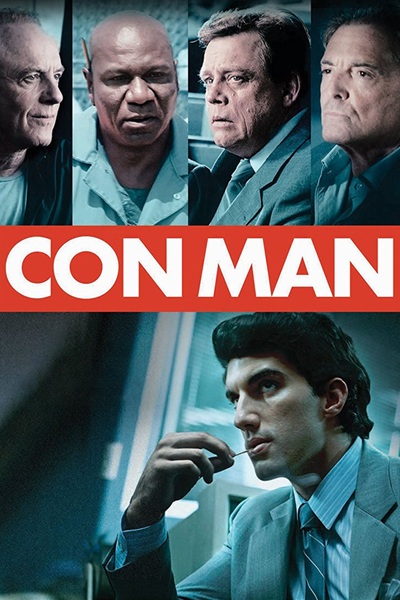
Originally entitled Minkow, Con Man tells the story of Barry Minkow.  When Minkow was a teenager, he started a carpet cleaning business and he quickly learned how to both promote himself and how to lie about how much money he was making.  The media ate up the story of the teenager became a millionaire by cleaning carpets.  His father (Mark Hamill) was proud of him.  His mother (Talia Shire) worried that he was moving away from God.  A local mobster (Armand Assante) decided to get involved.  It was eventually discovered that Barry was kiting checks, lying to insurance companies, and massively defrauding both his investors and his employees.  After being busted by the FBI (represented here by James Caan), Barry Minkow was sent to prison.

In the film, teenage Barry Minkow is played by a young, handsome, and charismatic Justin Baldoni.  When Barry gets out of jail, he’s suddenly been transformed into …. well, Barry Minkow.  That’s right.  Barry Minkow plays himself.  Needless to say, Barry Minkow looks nothing like Justin Baldoni.  It’s not just that the two men are different ages.  It’s also that there’s no way to imagine Justin Baldoni transforming into the gargoyle that is Barry Minkow.

In prison, Barry Minkow is converted to Christianity by a prisoner named Peanut (Ving Rhames).  After Minkow serves his sentence, he not only helps the FBI track down other con artists but he becomes the pastor of his local church.  Despite his past, everyone loves and trusts Barry Minkow.  Everyone talks about how charismatic he is, despite the fact that the adult Barry Minkow delivers his lines in a flat monotone and looks like he should be sitting over the entrance of a cathedral.  People who suspect that they’ve been a victim of financial fraud start to come to Barry, asking him for advice.  The always humble Barry is concerned that he’ll let people down but, in the end, even James Caan says that Barry is a great guy.  “I’m doing the work of God!” Barry proclaims.

Yes, the film is fueled by pure ego.  Unfortunately, it took more than ego to pay the bills so Minkow embezzled money from his own church, stole money from his congregation, and resorted to his old track of “clipping” checks to finance the whole thing.  Shortly after the film was completed, Minkow was arrested and sent back to prison.  (A hot mic caught Minkow bragging to James Caan about how he financed the film.  After his arrest, Minkow denied he had ever said that and dared anyone with proof to turn it over.  The film’s director proceeded to do just that.  Barry Minkow was not only a criminal.  He was a stupid criminal.)

As for the film, it sat in limbo for eight years.  Eventually, talking head interview with Minkow’s actual victims talking about how much they disliked Barry were sprinkled throughout the film.  (Shortly before Minkow starts playing himself, we hear one of his business partners say that everyone told him not to play himself.)  The original film ended on a triumphant note.  The new film — which was retitled Con Man — ended with real people talking about Barry Minkow going back to jail and casting doubt as to whether or not Barry ever even knew a prisoner named Peanut.

The film is a vanity project and not a very good one.  Minkow is a terrible actor and, just in case we forget that fact, he reminds us by trying to hold the screen opposite James Caan and Ving Rhames.  (Even Elisabeth Rohm manages to outact him.)  As bad as the film is, the story behind it is endlessly fascinating.  Barry Minkow was determined to become a star.  (Spielberg’s Catch Me If You Can was an obvious inspiration.)  Instead, he went back to prison and his vanity project was transformed into a roast.  And it probably couldn’t have happened to a more deserving guy.
 

Previous Icarus Files:

  1. Cloud Atlas
  2. Maximum Overdrive
  3. Glass
  4. Captive State
  5. Mother!
  6. The Man Who Killed Don Quixote
  7. Last Days
  8. Plan 9 From Outer Space
  9. The Last Movie
  10. 88
  11. The Bonfire of the Vanities
  12. Birdemic
  13. Birdemic 2: The Resurrection 
  14. Last Exit To Brooklyn
  15. Glen or Glenda
  16. The Assassination of Trotsky
  17. Che!
  18. Brewster McCloud
  19. American Traitor: The Trial of Axis Sally
  20. Tough Guys Don’t Dance
  21. Reach Me
  22. Revolution
  23. The Last Tycoon
  24. Express to Terror 
  25. 1941
  26. The Teheran Incident

Film Review: The Concorde …. Airport ’79 (dir by David Lowell Rich)


In 1979’s The Concorde …. Airport ’79, Joe Patroni (George Kennedy) finally gets to fly the plane.

The plane is question is a Concorde, a supersonic airliner that can travel faster than the speed of sound.  When we first see the Concorde, it’s narrowly avoiding a bunch of dumbass hippies in a hot air balloon as it lands in Washington, D.C.  The recently widowed Joe Patroni joins a flight crew that includes neurotic Peter O’Neill (David Warner), who says that he has dreams in which he’s eaten by a banana, and suave co-pilot Paul Metrand (Alain Delon).  Because this is an Airport film, Mertrand is dating the head flight attendant, Isabelle (Syliva Kristel).  “You pilots are such men,” Isabelle says.  “It ain’t called a cockpit for nothing, honey,” Patroni replies.

(One thing that is not explained is just how exactly Joe Patroni has gone from being a chief technician in the first film to an airline executive in the second to a “liaison” in the third and finally to a pilot in the fourth.)

The Concorde is flying to Moscow with a stop-over in Paris.  There’s the usual collection of passengers, all of whom have their own barely-explored dramas.  Cicely Tyson plays a woman who is transporting a heart for a transplant.  She gets maybe four or five lines.  Eddie Albert is the owner of the airline and he’s traveling with his fourth wife.  (Of course, he’s old friends with Patroni.)  John Davidson is an American reporter who is in love with a Russian gymnast (Andrea Marcovicci).  Avery Schrieber is traveling with his deaf daughter.  Monica Lewis plays a former jazz great who will be performing at the Moscow Jazz Festival.  Jimmie Walker is her weed-smoking saxophonist.  Charo shows up as herself and gets kicked off the plane before it takes off.

The most important of the passengers is Maggie Whelan (Susan Blakely), a journalist who has evidence that her boyfriend, Kevin Harrison (Robert Wagner), is an arms trafficker.  Harrison is determined to prevent that evidence from being released so he programs a surface-to-air missile to chase the Concorde.  Patroni is able to do some swift maneuvers in order to avoid the missile, which means that we get multiple shots of passengers being tossed forward, backwards, and occasionally hanging upside down as Patroni flips over the plane.  Oddly no one really gets upset at Patroni about any of this and no one seems to be terribly worried about the fact that someone is obviously trying blow up their plane.  Even after the stop-over in Paris, everyone gets back on the Concorde!  That includes Maggie, who could have saved everyone a lot of trouble by just holding a press conference as soon as the plane landed in Paris.

A year after The Concorde came out, Airplane! pretty much ended the disaster genre.  However, even if Airplane! had never been released, I imagine The Concorde would have still been the final Airport film.  Everything about the film feels like the end of the line, from the terrible special effects to the nonsensical script to the Charo cameo and Martha Raye’s performance as a passenger with a weak bladder.  The first Airport film was an old-fashioned studio film standing defiant against the “New Hollywood.”  The second Airport film was a camp spectacular.  The third Airport film was an example of changing times.  The fourth Airport film is just silly.

And, really, that’s the main pleasure to be found in The Concorde.  It’s such an overwhelmingly silly film that it’s hard to look away from it.  For all of its weaknesses, The Concorde will always be remembered as the film that featured George Kennedy opening the cockpit window — while in flight — and shooting a flare gun at another plane.  As crazy as that scene is, just wait for the follow-up where Kennedy accidentally fires a second flare in the cockpit.  “Put that out,” Alain Delon says while David Warner grabs a fire extinguisher.  It’s a silly moment that it also, in its way, a great moment.

The Concorde brings the Airport franchise to a close.  At least George Kennedy finally got to fly a plane.

Film Review: The Pursuit of D.B. Cooper (dir by Roger Spottiswoode and Buzz Kulik)


The story of D.B. Cooper has always fascinated me.

D.B. Cooper is the name assigned to a man who, in 1971, hijacked an airplane, demanded $200,000, and then jumped off the plane after he got the money.  Reportedly, he was well-dressed and unfailingly polite during the entire hijacking.  When he jumped off the plane, he was about 10,000 feet over the Washington wilderness.  After he jumped, no further trace was found of him.  Over 50 years after the incident, the identity and the location of D.B. Cooper remains a mystery.

It’s been said that, even though Cooper had a parachute with him when he jumped, there’s no way that he could have survived the jump.  And yet, no body has ever been found.  (Of course, finding a body in the wilderness is not as easy as some people assume.)  Nine years after the the skyjacking, some of the money that Cooper received was found on the banks of the Columbia River, which was several miles away from the area that Cooper jumped over.  Did Cooper survive the jump and lose the money?  No one can say for sure.

Over the years, many people have come forward to say that they know the identity of D.B. Cooper.  Many distant fathers and secretive boyfriends and long lost friends have been accused of being D.B. Cooper.  Some of those suspects are more likely than others.  Even John List, the murderer who inspired the Stepfather films, was suspected at one point.

D.B. Cooper remains a fascinating character precisely because he’s never been captured and the mystery itself will probably never be solved.  Because he remains an enigma, it’s easy to project your own pet obsessions on him and his story.  Myself, I always imagine D.B. Cooper as being some sort of clever, fun-loving international rogue, even though there’s not really any evidence to back that up.  But, the fact of the matter is that I have a weakness for clever, fun-loving international rogues so, of course, that’s who I’m going to imagine D.B. to be.

I certainly would never imagine him to be like the character at the center of 1981’s The Pursuit of D.B. Cooper.

In this film, D.B. Cooper turns out to be Jim Meade (Treat Williams), a Vietnam vet and all around jackass who steals the money so that he can get back together with his estranged wife, Hannah (Kathryn Harrold).  Hannah does take him back because, seriously, who is going to say no to that much money?  Jim and Hannah spend the entire film running from one wilderness location to another.  They steal cars.  They steal trucks.  Meade steals an airplane at one point.  Hannah gets worried often and Jim tends to yell, “Woo hoo!” whenever he gets excited about anything.  At one point, Jim and Hannah are chased across some white water rapids.  When Hannah and Jim reach dry land, Jim gives the finger to the river.  I will say that, as someone who grew up in the South, Jim is a type of character who seems very familiar to me.  I’ve known a lot of Jim Meades and Treat Williams doesn’t do bad job playing Meade as being an impulsive, loud-mouthed good old boy.  The only problem is that, at no point, does Jim Meade come across like someone who could have pulled off what D.B. Cooper pulled off.

Jim is being pursued by two old army buddies.  The scruffier of the two is Remson (Paul Gleason), who somehow manages to keep popping up like a cartoon character at the most inopportune of times.  No matter what bad thing happens to Remson, he still shows up good-as-new a few minutes later.  Paul Gleason gives an energetic performance as Remson, a character who has little in common with the uptight authority figures that Gleason later played in The Breakfast Club and Die Hard.

The other person chasing Jim is Bill Gruen (Robert Duvall), who served with Meade in Vietnam but who is now working as an insurance investigator.  Gruen says that he knew Meade had to be D.B. Cooper because only Meade could survive jumping out of a plane over wilderness terrain.  Gruen wants some of the money for himself.  Despite his greed, it’s hard not to like Gruen because he’s played by Robert Duvall.  The best scene in the film is one where Duvall and Williams, exhausted from chasing each other, have a weary but friendly conversation.  It’s the one moment where Williams actually calms down and provides some hint that there’s actually something going on underneath Meade’s manic exterior.  Acting opposite Duvall brings out the best in him.

The Pursuit of D.B. Cooper had a notoriously troubled production and apparently, there was never a completed script during shooting.  Reportedly, bits of the film were directed by Robert Mulligan, John Frankenheimer, and Buzz Kulik before Roger Spottiswoode took over.  It’s a film that was obviously inspired by 70s chase films like Smokey and the Bandit but it also somehow managed to attract actors like Robert Duvall, who does his best to class up the joint.  The action quickly gets repetitive and the movie never seems to know if it wants to be a comedy or a drama.  On the plus side, Treat Williams and Kathryn Harrold make for a cute couple.

When this picture first came out, Universal Pictures offered a million dollar reward for any information that would lead to the capture and arrest of the real D.B. Cooper.  No one collected.