Yeah, okay, it’s an obvious joke and not a particularly clever one but I’m sure that I’m not the only one who instinctively makes a joke about Taken whenever I see another trailer featuring Liam Neeson holding a gun or cracking a safe.
Anyway, Honest Thief stars Liam Neeson as a veteran thief who wants to retire so that he can marry Kate Walsh. However, he’s just been double-crossed by two FBI agents and now, he has to do what he has to do to get his money back.
Honest Thief is scheduled to be released on October 9th. Here’s the trailer!
Here’s the trailer for Kajillionaire! This comedy has already received some critical acclaim on the festival circuit and, assuming that we’re actually going to give out Oscars next year, there’s been some speculation that Debra Winger could pick a nomination for Best Supporting Actress.
Kajillionaire will be released on September 18th. Though I find the title to be a bit annoying, I always find myself relating to any character played by Evan Rachel Wood so I look forward to seeing the film.
I’m making my monthly predictions on the assumption that most of these movies are even going to be released this year (and during the first two months of 2021). I may be making an even bigger assumption when I predict that they’ll even give out Oscars for 2020. Right now, it’s hard to know what’s going to happen.
But I am going to keep making these predictions because their fun to make and I believe that you do have to have some sort of normalcy in life. You can’t just say, “OH MY GOD, EVERYTHING’S SO NEGATIVE! I’M JUST GOING TO SIT IN FRONT OF TWITTER AND DRINK FOR THE REST OF MY LIFE!” I mean, don’t get me wrong. A lot of people are, in fact, saying and doing just that. It’s kind of sad to think about the number of people who I once liked but who I have still, over the past few months, muted because I’m just sick of all the drama. I suppose I could list them all here just to see if any of them are actually bothering to read my posts but …. no, no. This post is about the movies and the performers and the Oscars who make every year a special year.
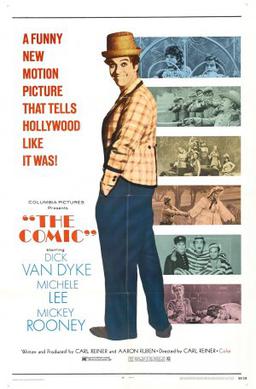
The 1969 film, The Comic, details the long and not particularly happy life of silent screen star Billy Bright (played by Dick Van Dyke). Billy Bright tells us his story from beyond the grave. The film opens with his funeral, which is sparsely attended and features the type of self-consciously mawkish eulogies that are usually trotted out whenever a generally unlikable person dies. The only sign of life at the funeral comes when Billy’s oldest friend, Cockeye (Mickey Rooney), throws a pie at one of the speakers. The speaker says that the pie was Billy’s final joke.
Billy Bright was a funny performer but a miserable man. That’s pretty much the entire plot of The Comic. We see the young Billy, performing in silent films and winning laughs through the seemingly impossible contortions through which he puts his body and his face. Off-screen, Billy marries one of his co-stars (Michele Lee) and starts a production company. When she discovers that he’s been cheating on her, their divorce is a major Hollywood scandal.
Even before the coming of the talkies, Billy struggles with alcohol. Once the talkies do come, his career is pretty much over. Billy became a star in silent films and he stubbornly wants to continue to make silent films, despite the fact that there’s no longer an audience for them. Billy quickly goes from being a star to being forgotten. He’s reduced to walking down Hollywood Boulevard with Cockeye and looking at the names under his feet. When he reaches his name, he discovers that someone has dropped their gum on it.
Billy finally does get his comeback in the late 60s but it’s not much of a comeback. He appears on a talk show and it’s hard not to cringe a little as the clearly infirm Billy duplicates some of his silent era pratfalls. He’s reduced to appearing in a rather awkward commercial for a laundry detergent called, I kid you not, White-ee. “That’s White-ee, baby!” his commercial co-star says after a freshly cleaned Billy emerges from a washing machine.
The idea that most funny performers are actually rather serious and depressing off-stage is certainly nothing new. Judd Apatow has basically built an entire career out of making films about how funny people are actually carrying around tons of emotional baggage. The thing distinguishes The Comic from so many other films about angsty comedians is that Billy Bright himself never seems to have a single moment of self-awareness. Usually, films about miserable celebrities will at least have one scene where the main character realizes that his misery is all his fault. Billy Bright is pretty much a jerk from the minute we meet him and he’s still a jerk when the film ends. He’s the type of guy who makes a big deal about picking up his son from school but who still manages to grab the wrong kid because it’s been so long since he’s spent any time with his family that he’s really not sure what his son looks like. Towards the end of the film, we see him watching one of his old films and what we notice is that he doesn’t seem amused at all. Is he thinking about how he lost it all or is it possible that this man who made millions laugh never really had much of sense of humor himself? The film leaves it to you to decide.
The Comic was written and directed by Carl Reiner, who undoubtedly knew quite a few Billy Brights in his life. As such, the film feels authentic in a way that a lot of other films about creative people do not. The Comic is a well-made film. It’s hard not to appreciate the film’s obviously affection for Old Hollywood. That said, Billy Bright is such an unpleasant character that I found the film difficult to enjoy. Van Dyke is genuinely funny whenever he’s doing Billy’s silent film shtick and he’s genuinely tiresome when Billy’s ego gets out of control. It’s a good performance as a generally unlikable character. How you react to The Comic will probably depend on how much sympathy you can summon up for a character who doesn’t really seem to deserve any.
4 Shots From 4 Films is just what it says it is, 4 shots from 4 of our favorite films. As opposed to the reviews and recaps that we usually post, 4 Shots From 4 Films lets the visuals do the talking!
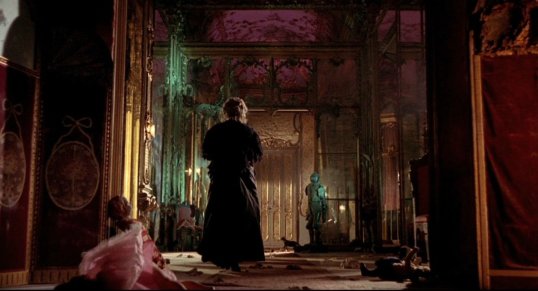
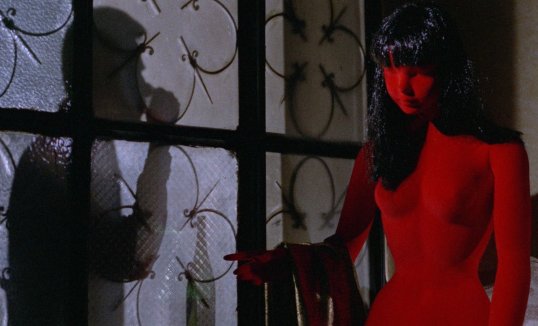
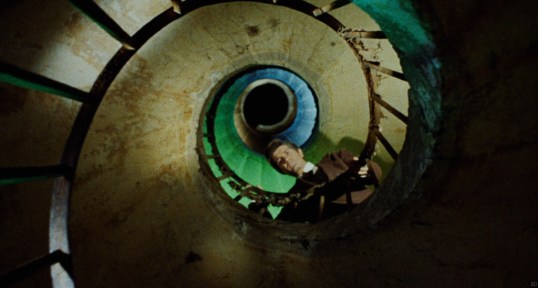
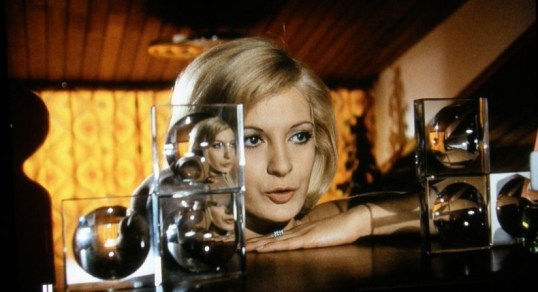
106 years ago today, the greatest of all director, Mario Bava, was born in Italy! Today is a bit of a holiday here at the TSL Bunker. In honor of the great Mario Bava, here are….
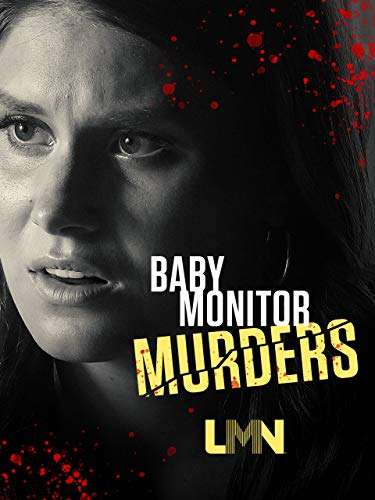
Apple Springs, Washington might seem like a nice little town but appearances can be deceiving. Mallory Raymond has gone missing and no one can find her. The local sheriff seems to suspect that her husband, Glenn (Dustin Lloyd). may have had something to do with it. Meanwhile, Glenn is spending all of his time in the park where Mallory was last seen. Is he searching for his wife or is he searching for another victim?
While Mallory is busy disappearing, Cassie (Natalie Sharp) is busy returning. Cassie grew up in Apple Springs and she’s just returned from college. She thought she was going to get an internship with a music label but that fell through. Now, it looks like like Cassie is going to have to spend the entire summer stuck at her parent’s house. That’s fine with her parents, of course. They’re heading to Paris and they need someone to housesit.
Not wanting to spend another summer working at the local diner, Cassie is very happy when she just happens to run into Chloe Paine (Nicole LaPlaca), a lawyer who is planning on returning to work but who desperately needs someone to look after her daughter, Becca. Chloe asks Cassie if she wants the job and Cassie accepts.
Soon, Cassie is spending hours a day over at the Paine house, taking care of Becca. She gets to know Chloe’s husband, the seemingly friendly Tom Paine (Jon Cor). She also gets to know Glenn, who it turns out just happens to work with Tom. Cassie can’t help but notice that Tom and Glenn seem to always be arguing about something.
Strange things start to happen. One night, Cassie is sure that she’s being watched. Another night, she hears a menacing voice come over the baby monitor but, when she checks out Becca’s room, she doesn’t find anyone there. And then, much like Mallory before her, Chloe disappears!
Where has Chloe gone? Has she been kidnapped? Has she been murdered? And if that’s the case, who’s responsible? Is it Tom, the seemingly perfect husband who seems to have a few secrets hiding underneath the friendly surface? Or is it Glenn, who appears to be obviously unstable but who swears that the only thing he cares about is discovering what happened to his wife? Even though almost everyone tells Cassie that she should just quit her job and stay away from the Paines, Cassie knows that would mean abandoning Beeca and that’s not something that she’s willing to do….
The Baby Monitor Murders, which initially aired way back in January, was originally entitled The Babysitter and really, that’s a better title for the film. While the scene with the voice coming over the baby monitor is an undeniably creepy one, it’s also a rather minor one. The film’s focus is much more on Cassie and her growing realization that she’s found herself in a dangerous and potentially deadly situation. Natalie Sharp gives a good and sympathetic performance as Cassie, making her devotion to Becca feel believable and, as a result, giving this film a bit more emotional depth than the typical Lifetime film. The mystery itself is frequently intriguing and you’ll find yourself going back and forth on whether Glenn or Tom is the one who Cassie should be weary of. All in all, The Baby Monitor Murders is a good Lifetime film that will keep you guessing.
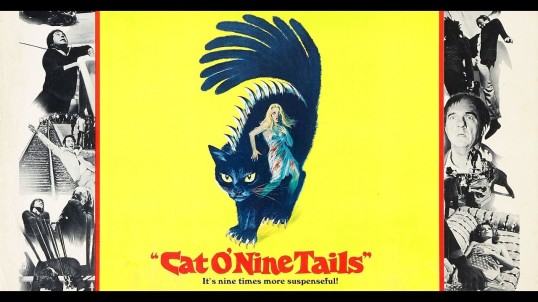
Today’s song of the day the main theme from Dario Argento’s The Cat O’Nine Tails. Ennio Morricone’s score brought a lot of atmosphere to Argento’s classic giallo.
After dating for a very long time, Deanna (Anna Hutchison) and Karl (Jason-Shane Scott) are finally getting married!
Yay! Everyone loves a big wedding!
And, even before Karl asks Deanna to marry him, he’s purchased a large house for them to live in!
Yay! Everyone loves a big house!
But first, Deanna needs to meet Karl’s family and that means going to an even bigger house!
YAY! EVERYONE LOVES AN EVEN BIGGER HOU….
Wait a minute …. Deanna hasn’t met Karl’s family, yet?
Seriously, everyone, that should be a big red flag. I don’t care how rich your boyfriend is, you don’t accept his marriage proposal before you’ve met his family. After all, his family could be …. well, the could be crazy. Or they might meet you and then decide that they don’t like you or maybe they like you but they still think that their son (or brother or stepbrother) could do better. Or — and this especially happens in Lifetime movie — someone might start murdering all the members of your wedding party.
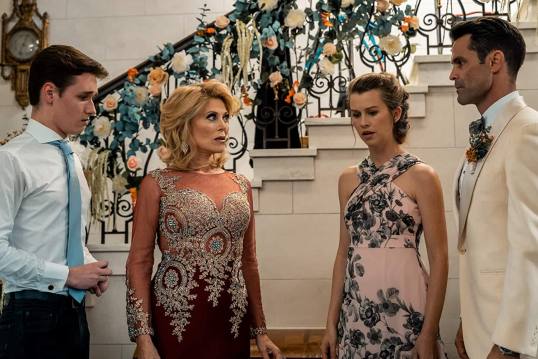
All of that happens in Engaged To A Psycho. Engaged To A Psycho premiered on the Lifetime Movie Network back in May but, according to the imdb, the film was actually around a while before making it’s official LMN premiere. It played in Canada back in 2018 and then, in 2019, it showed up on television in the UK, Spain, and France. At the time, it was known as Murder at the Mansion. By the time it premiered here in the States, the name had been changed to Engaged To A Psycho. (Lifetime was going through a Psycho cycle. Try saying that six times fast.)
Anyway, regardless of the title, Engaged To A Psycho is a fun little movie. As soon as Deanna shows up at, she meets Karl’s mother, Ivy (Audrey Landers) and his adopted sister, Ruby (Melissa Bolona). Ivy makes it clear that she thinks her son could have done better than Deanna. Ruby, meanwhile, is almost too friendly and seems to be trying way too hard to convince Deanna that Deanna is welcome in the family. It soon becomes obvious, than even though the family is living in a gigantic mansion, the rooms and the hallways are full of secrets, lies, and murder. Soon people are dying all over the place.
One thing I liked about Engaged To A Psycho is that there were plenty of POV shots from the killer’s point of view. It gave the whole a film a sort of giallo feel while also hiding the killer’s identity. It also led to a lot of scenes of people looking straight at the camera and saying stuff like, “I knew it was you! Wait here while I go tell everyone!” Well, needless to say, the killer isn’t big on waiting.
The other thing I liked about Engaged To A Psycho is that it had a sense of humor about itself. Ivy is so extremely unimpressed by Deanna that it actually becomes rather hilarious how dismissive she is. It doesn’t matter how many times Deanna nearly gets killed, Ivy refuses to accept her word that there’s something strange going on.
I liked Engaged to a Psycho. There were a lot of murders, a lot of archly delivered dialogue, and a lot of big houses. What more can you ask for?
4 Shots From 4 Films is just what it says it is, 4 shots from 4 of our favorite films. As opposed to the reviews and recaps that we usually post, 4 Shots From 4 Films lets the visuals do the talking!
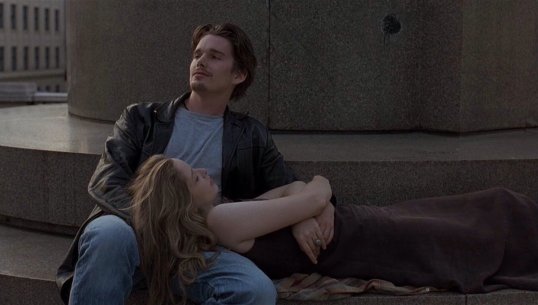
Today, we wish a happy 60th birthday to Texas’s greatest filmmaker, Richard Linklater!
That means that it’s time for….
4 Shots From 4 Films
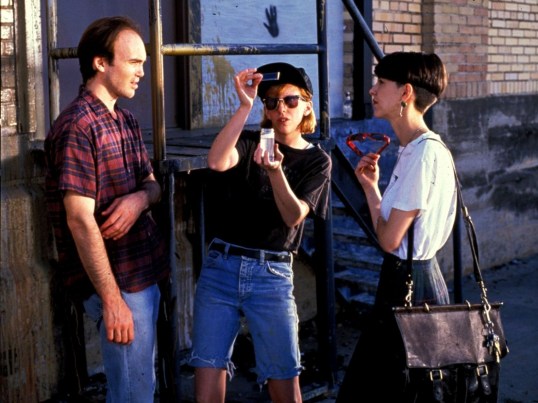
Slacker (1991, dir by Richard Linklater)
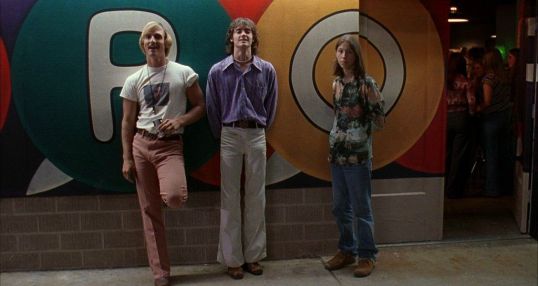
Dazed and Confused (1993, dir by Richard Linklater)
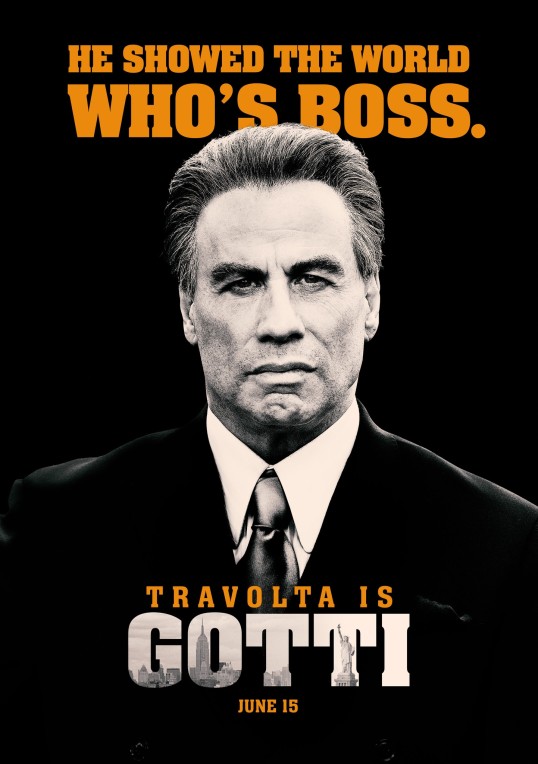
Few recent films have been as misunderstood as Gotti.
When this film was first released in 2018, it was slammed by critics and it flopped at the box office. On Rotten Tomatoes, it managed a score of 0% from the critics. At the same time, the opening day audience score was 80%. (Over subsequent days, the audience score would drop to 46%.) This disparity was blamed on studio employees inflating the audience score, though I think it’s more likely that, after months of negative press about the film’s troubled productions, critics were already looking forward to slamming the film before they even had a chance to see it. At the same time, the buzz on Gotti was so bad that the opening day audience was made up of a combination of John Travolta die-hards (whoever they may be) and people who were expecting such a trainwreck that all Gotti had to do to surpass their expectations was to occasionally be in focus.
Then again, it could be that some members of the audience understood what I instinctively understood when I first watched Gotti. Gotti is not really a film about John Gotti, the flamboyant New York mob boss who ruled the streets with an iron fist and who eventually ended up dying of cancer in prison. Instead, whether it was the filmmaker’s actual intention or not, Gotti is a film about the audience’s fascination with not only gangsters but also the movies that have been made about them.
It’s true that John Travolta may be playing someone namned John Gotti but the film goes out of its way to remind you that he’s not the real John Gotti. The film is full of archival news footage of the real John Gotti, either laughing it up with reporters or smirking while sitting in a courtroom. Every time that we’re shown footage of the real John Gotti, we’re reminded of the fact that, at not point during the film, does Travolta look anything like John Gotti. Add to that, the real Gotti is always smirking whereas Travolta always looks somewhat grim. At the time this film came out, many claimed that this was evidence of lazy filmmaking but I viewed it as being a Brechtian distancing device. Whenever the real Gotti makes an appearance, we’re reminded that we’re just watching a movie and then we’re encouraged to ask ourselves why we would want to watch a movie about such a disreputable figure.
The movie opens with John Travolta standing next to the Brooklyn Bridge and speaking directly to the camera. Though Travolta is meant to be speaking to us as John Gotti, the sight of him standing near a bridge in New York will automatically remind some viewers of a previous Travolta film, Saturday Night Fever. The character that Travolta played in Saturday Night Fever, Tony Manero, has come to epitomize New York in the 70s. The film suggests that, in much the same way, Gotti epitomized New York in the 80s and 90s. Gotti, the film is saying, is as much of an icon of the popular imagination as Tony Manero dancing in a white suit.
Why is Gotti speaking directly to us in that scene? It may seem like a framing device until, a few minutes later, we see a bald and sickly Gotti in a prison meeting room, telling his life story to his son, John, Jr. (Spencer LoFranco). Gotti talking in prison is then established as the narrative’s other framing device. So, why was Gotti speaking to us on the bridge and why did he look so healthy and have a full of head of hair when the film has made it clear that the newly bald Gotti is going to die in prison? When I first saw the film, my initial thought was that the Gotti who speaks directly to the audience was meant to be a ghost. But then it occurred to me that he’s actually not meant to be John Gotti at all. Instead, the Gotti who talks to us on the bridge is meant to be our popular conception of what gangsters like John Gotti as like. He’s what we imagine gangsters to be — i.e., tough-talking, well-dressed, and played by an iconic actor. As such, the film’s narration is not being provided by John Gotti. Instead, it’s being provided by the person that we imagine someone like Gotti to have been.
Is the imprisoned Gotti meant to be the real Gotti? Perhaps. However, it’s hard not to notice that, over the course of the film, Gotti’s son never ages. Though several decades pass, Gotti’s son always looks like he’s in his mid-twenties. When he visits his father in prison and talks about having teenage children of his own, it feels odd because he barely looks old enough to be out of high school. That may seem like lazy filmmaking but again, I would argue that this is a distancing device. It’s a reminder that we’re not watching reality. Instead, we’re choosing to watch actors pretending to be gangsters.
Once you accept that Gotti is a film not about John Gotti but instead about those of us in the audience who are watching, the film makes a lot more sense. The film’s cliches about life in the Mafia are revealed to be not so much the result of an uninspired script as they’re an homage to American folklore. Of course, there’s going to be a scene where Gotti tells his children never to rat on their friends. Of course, there’s going to be random shootings and burly men demanding respect. This is a gangster movie, after all. By populating the cast with people who you normally wouldn’t expect to see playing members of the Mafia — Stacy Keach, Chris Mulkey, Pruitt Taylor Vince — Gotti continually reminds you that you’re watching a movie. The real mafia isn’t like this, Gotti is saying, but the mafia of the popular imagination is. Why are we horrified by real-life crime and yet we flock to movies that claim to recreate it for our entertainment? This is the issue at the heart of Gotti.
Gotti’s flaws are there to remind us that we’re just watching a movie. They’re also there to make us wonder why we’re watching that particular movie. Gotti asks us why audience idolize killers like John Gotti. Why do we turn them into folk heroes? Is it because we imagine them to be characters in films as opposed to actual human beings? Whether or not one feels that the film succeeded in its goal, this is an offer that you cannot refuse.


 Through the Shattered Lens