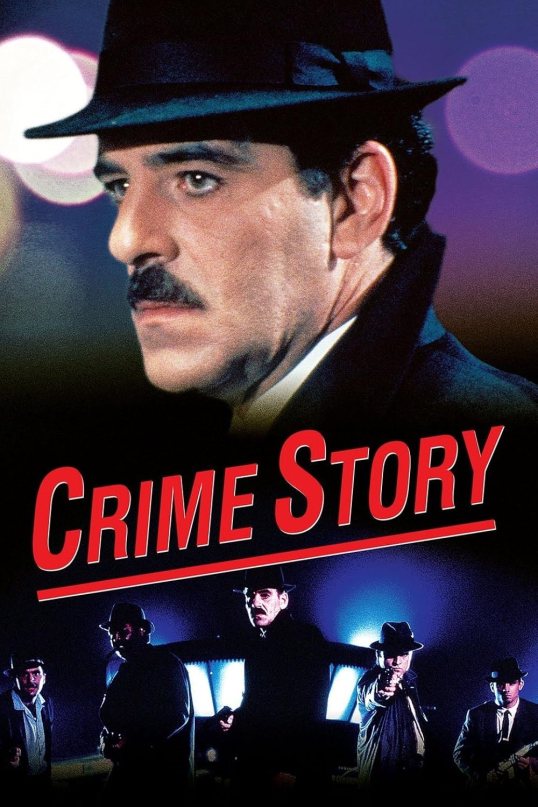
Retro Television Review: Crime Story 1.21 “Ground Zero”


Welcome to Retro Television Reviews, a feature where we review some of our favorite and least favorite shows of the past!  On Mondays, I will be reviewing Crime Story, which ran on NBC from 1986 to 1988.  The entire show can be found on Tubi!
This week, the first season comes to a close.

Episode 1.21 “Gound Zero”

(Dir by Peter Medak, originally aired on March 13th, 1987)

In Las Vegas, the media is focused on two things: the upcoming atomic bomb test at Yucca Flats and the trial of Ray Luca.

Pauli, the star witness, is being kept in an underground bunker at an Air Force base. Danny comments on the fact that, if America and Russia do go to war and an atomic missile hits Nevada, Pauli would probably be the only survivor. It would be up to Pauli to repopulate the planet. Torello eventually allows Pauli’s girlfriend, Donna (Audrey Matson), to start visiting him. Donna says she loves Pauli. Torello shrugs.

Pauli keeps his end of the deal. He testifies against Luca. However, Frank Holman gives an interview outside the courtroom and tells the press that Luca was the king of organized crime in Las Vegas. The next day, the headline of the local newspaper announces that Luca was the “king of crime.” Disguising himself as the waiter assigned to deliver room service to the sequestered jury, Holman makes sure that the jurors see the headline. The trial judge has no choice but to declare a mistrial. As he walks out of the courtroom, Luca stops in front of Pauli and tells him, “You did what you had to do,” and apologizes for raping Donna.

In Vegas, Luca is upset to discover that gangster Nat Martino (James Russo) is moving in on his territory. Luca is prepared to go to war, but Manny Weisbrod informs Luca that he is to work with Martino. Weisbrod no longer has any confidence in Luca’s abilities. At the same time, Torello learns that Martino is actually an informant. Torello arranges for that information to get leaked to Luca. When Luca heads over to Martino’s favorite brothel, Torello and the other members of the MCU are waiting for him.

Breaking into Martino’s room, Luca manages to shoot and kill Martino before taking several bullets himself. Wounded, Luca escapes through a back window. Pauli, having decided that his place is with Luca, is there to pick him up and drive him out of town.

The next day, a bandaged Luca discovers that Pauli has driven him out to his latest hideout, a seemingly abandoned house in the desert. The house is full of mannequins. Luca looks at a chair and sees that it is the property of the Atomic Energy Commission. Realizing that they’re at Yucca Flats, Pauli and Luca run out to Pauli’s car. As they drive through the desert, a mushroom cloud blossoms in the distance.

And the episode ends!

Did Luca and Pauli escape the nuclear test? Hopefully, we’ll find out next week. I hope they did because it’s hard to imagine Crime Story without them. They were a great pair of villains.

The first season was good, if uneven. The pilot was outstanding, but some of the subsequent Chicago episodes seemed to lose their focus. Torello’s domestic drama was never as interesting as the show wanted it to be, and it took me a while to really warm up to David Abrams and his abrasive idealism. The other members of the MCU often felt like ciphers. (Even after 21 episodes, I still don’t feel like I know much about any of them beyond their almost cult-like loyalty to Torello.) But when the show moved to Vegas, things improved immeasurably. The glitz of Vegas worked perfectly for the show’s hyperreal style, and Stephen Lang’s performance in the role of David Abrams improved as well.

That said, Dennis Farina was the main strength of the first season. Farina played Torello as being intense, ruthless, and maybe just a little unhinged. The only real difference between Luca and Torello is that Torello carries a badge and Luca doesn’t have the Constitution holding him back. Otherwise, Luca really does represent Torello’s own dark side. In his pursuit of Luca, Torello isn’t just trying to enforce the law. He’s also trying to destroy the man that, had Torello not joined the police force, he could have become.

Next week, we’ll start the second season!

Retro Television Reviews: Miami Vice 1.9 “The Great McCarthy”


Welcome to Retro Television Reviews, a feature where we review some of our favorite and least favorite shows of the past!  On Mondays, I will be reviewing Miami Vice, which ran on NBC from 1984 to 1989.  The entire show is currently streaming on Tubi!

This week is all about boats!

Episode 1.9 “The Great McCarthy”

(Dir by Georg Stanford Brown, originally aired on November 16th, 1984)

The people behind Miami Vice really liked speedboats.

That’s the best explanation that I come up with for The Great McCarthy, an episode in which the majority of the running time is taken up by scenes of people racing boats.  Even after Crockett, Tubbs, and Zito (John Diehl, getting to do more than usual) figure out how Louis McCarthy (William Gray Espy) is using his boats to smuggle drugs into Miami, their main concern remains winning the race that they’ve entered.

And there’s certainly nothing wrong with that.  After a run a grim and dark episodes, The Great McCarthy was a nice change of pace, a reminder that it’s okay to have a little bit of fun.  For the most part, this was a light and airy episode, featuring scenes of boats skimming across the ocean while Born To Be Wild plays on the soundtrack.  This episode also featured a very 80s party scene and not one but two weaselly informants!

The first informant was Izzy Moreno (Martin Ferrero), a talkative thief who, it turned out, had done some work for Louis McCarthy.  The second informant was Dale Gifford (Charles McCaughan), a crooked accountant who is helping to launder money for not just Louis but also Louis’s girlfriend, Vanessa (Maria McDonald).  Izzy will apparently be returning in the future.  Gifford will not as he ended up getting shot in the back of the head.  Crockett and Tubbs originally assumed McCarthy was the killer but, as Izzy reveals towards the end of the episode, it was actually Vanessa.

By this time, of course, Vanessa has already moved on from McCarthy and is now sleeping with Tubbs.  Crockett warns Tubbs that he’s getting in too deep with Vanessa but Tubbs replies that he’s got it all under control, almost as if he doesn’t remember that almost the exact same thing happened when they went down to the Bahamas to take out Calderone.  When the police show up to arrest Vanessa, Tubbs insists on doing it himself.  “I have to,” he tells her.  He’s a cop, after all.

Okay, so that ending was a little bit downbeat but, for the most part, this was just a fun episode of Miami Vice, one that didn’t require too much thought and which kept the existential dread to a minimum.  Probably the best scene in the episode didn’t even involve McCarthy or Vanessa but instead centered around Gina and Trudy arresting a philosophy professor who sold cocaine on the side.  (The professor was played by Richard Liberty, who also appeared in George Romero’s The Crazies and Day of the Dead.)  Gina and especially Trudy have been underused on this show so it was nice to finally see them getting to do their jobs and proving themselves to be just as effective as Tubbs and Crockett.

I do have to admit that I’m still kind of confused as to how Crockett is managing to maintain his cover as a criminal when almost every other petty criminal in Miami knows that he’s actually a cop.  If Izzy could figure it out, why not Louis McCarthy?  Perhaps McCarthy wasn’t so great after all.

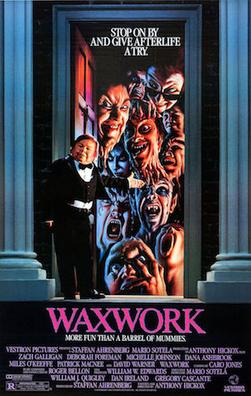
Horror Film Review: Waxwork (dir by Anthony Hickox)


First released in 1988, Waxwork asks the audience with a very important question.

Let’s say that you and your best friend were walking to school one day when you suddenly noticed a gigantic mansion that you had never seen before, sitting in the middle of your neighborhood.  And what if a tall, somewhat sinister Englishman (played by David Warner, none the less) suddenly appeared out of nowhere and told you that the mansion was actually a waxwork.  And what if that Englishman than invited you to come to the waxwork at midnight and specifically asked you to come in a group of 6.  Would you do it?

Now, I know that your first instinct is to say, “Of course, I wouldn’t!”  That’s the type of answer that we’ve been conditioned to give because no one wants to admit that they can be as dumb as a character in a horror movie.  But really, I would go.  Especially if, like the characters in Waxwork, I was a teenager.  (Actually, most of the characters in Waxwork are described as being college students but they all act like high school students and their college appears to be a high school so draw your own conclusions.)  When you’re a certain age, you feel like you’re immortal and an invitation to hang out in a creepy building with a bunch of strangers at midnight feels totally reasonable.

Anyway, four rich kids — Mark (Zach Galligan), China (Michelle Johnson), Sarah (Deborah Foreman), and Tony (Dana Ashbrook, a year before he was cast as Laura Palmer’s boyfriend in Twin Peaks) — visit the waxwork at midnight.  What they discover is that the building is full of macabre exhibits that recreate various moments from horror history.  There’s werewolves, vampires, and Jack the Ripper.  There’s also the Marquis de Sade, a figure that the seemingly innocent Sarah becomes fascinated with.  And, as two of the visitors discover, stepping past the red rope and entering an exhibit transports them into an alternate world where they become the victim of the star of each display.

Not surprisingly, the film is at its best when imagining the world inside each exhibit.  Each exhibit has its own backstory and its own set of guest stars.  John Rhys-Davies shows up as a werewolf.  Miles O’Keeffe is a properly urbane Count Dracula.  J. Kenneth Campbell plays the Marquis de Sade, who the film imagines as a swashbuckling sadist.  That said, I think the most effectively frightening exhibit was one that featured no special guest stars but a very determined and very strong mummy.

What’s going on at the waxwork!?  As explained by Sir Wilfred (Patrick Macnee, bringing some welcome wit and style to the film), it’s all a part of a scheme to bring the most evil beings ever back into existence so that they can conquer the world.  It’s important that none of the waxworks be allowed to enter the real world and soon, Sir Wilfred and his ragtag army are laying siege to the waxwork and bringing things to an apocalyptic conclusion.  The final battle is a bit haphazardly edited and it’s impossible to really keep track of who is fighting on which side.  (Indeed, I’m still not sure where Sir Wilfred even found his army.)  But it does feature plenty of in-jokes for horror fans, including a cameo appearance by the carnivorous plant from Little Shop of Horrors.

Waxwork is entertaining film.  It doesn’t take itself particularly seriously and, indeed, Mark, China, Sarah, Tony, and all of their friends feel as if they could just as easily have been found in the pages of a Bret Easton Ellis novel about pretty but vapid alcoholics.  Mark is the type who gets his maid to write his term papers.  Tony just wants to drink (but, because he’s played by the adorable Dana Ashbrook, he’s still the most likable character in the film).  China says, “I do what I want, when I want,” when confronted about cheating on her boyfriend.  Sarah is the “innocent” one but just seeing the words “Marquis de Sade” causes her to swoon.  Dropping these four idiots into a situation where the fate of the world is at stake feels like a wonderfully sardonic cosmic joke.

In the end, the true pleasure of Waxwork is watching old pros like David Warner, Patrick Macnee, and the exhibit guest stars hamming it up.  Macnee, in particular, seems to enjoy leading the final charge against the forces of evil and, indeed, it’s hard not to wish that he had even more screen time than he did.  David Warner, meanwhile, rolls his eyes at just how difficult it can be to bring the 18 most evil figure in history back to life.  It’s hard work but I guess someone has to do it!

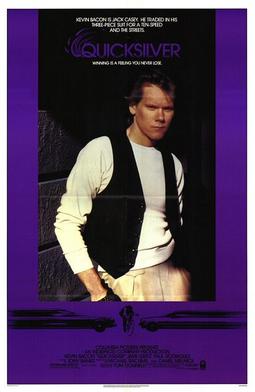
Embracing the Melodrama Part II #77: Quicksilver (dir by Thomas Michael Donnelly)


QuicksilverWho doesn’t love Kevin Bacon?

Seriously, I have yet to meet anyone who doesn’t have a positive reaction to seeing Kevin Bacon on screen.  He may not be a star in the way that Bradley Cooper or Bollywood sensation Shah Rukh Kahn are stars but still, he is one of those actors that everyone just seems to instinctively like.

I think, to a large extent, that is because, despite the fact that he’s been around and acting forever, Kevin Bacon himself still comes across as being a normal, blue-collar sorta guy.  Whenever you see him being interviewed, you get the feeling that Kevin Bacon basically shows up, does his job to the best of his ability, and, as opposed to many other actors, he doesn’t take himself or his movies too seriously.  He’s justifiably proud of the good films that he’s appeared in and he’s never had any problem admitting that he’s been in a lot of bad films as well.

In fact, it was Kevin Bacon’s openness about his bad films that led to me discovering 1986’s Quicksilver.  This is the film that, in a 2008 interview, Kevin Bacon referred to as being “the absolute lowest point of my career.”  (Consider, for a minute, that this is being said by the same Kevin Bacon who had an arrow shoved through his throat in the original Friday the 13th and that will give you some clue of how much disdain Kevin seems to have for Quicksilver.)

Naturally, having read that, I knew that I simply had to see Quicksilver.  I’ll admit right now that I was hoping to discover that it was some sort of loss and unappreciated classic.  I wanted this to be the review where I defended the unacknowledged brilliance of Quicksilver.  I wanted to say, “Don’t be so hard on yourself, Kevin!  Give Quicksilver another chance!”

But no.

Quicksilver doesn’t quite suck but it definitely comes close.

At the same time, it is interesting as a classic example of what happens when a filmmaker tries to assign some sort of deeper meaning to or find inherent nobility in an activity or job that really isn’t that interesting.  Often times, this will happen with sports movies.  A director or producer will make the mistake of thinking that just because he’s obsessed with beach volleyball that means that there’s a huge audience out there just waiting for someone to make the ultimate beach volleyball film.  Or, you’ll get a film like 1999’s Just The Ticket, where Andy Garcia is described as being the “world’s greatest ticket scalper” and the audience is supposed to be impressed.

In the case of Quicksilver, it’s all about being a bicycle messenger.  I’m assuming that, one day, director Thomas Michael Donnelly was stuck in traffic and he happened to see a bike messenger rushing down the street, whizzing past all of the stalled commuters.  And Donnelly probably thought, “I wish I was that guy right now!”  Every day after that, whenever Donnelly was stuck in traffic, he thought back to that bike messenger and slowly he grew obsessed.  All of his friends and his family got sick of listening to him talk about how much he envied the freedom of that bike messenger.  Finally, a little light bulb turned on over Donnelly’s head and he said, “I’ve got to make a movie out of this!”

And then the bulb burned out but nobody noticed.

Quicksilver-photo_625px_8col

Kevin Bacon plays Jack Casey.  When we first meet Jack, he’s a successful stock broker and he’s got a really bad, porn-appropriate mustache.  One day, he’s sitting in the back of a cab and he goads his driver into getting into a race with a bike messenger.  The messenger beats the cab.  Jack is amazed!

And then, perhaps the very same day (the film is so poorly edited that it’s hard to tell), Jack not only loses all of his money but all of his parents’ money as well.  Since poor men couldn’t afford facial hair in the 1980s, he shaves off his mustache.  Desperately needing work, Jack applies to be a  — you guessed it! — bicycle messenger.

The rest of the film is basically Jack delivering messages and talking about how he’s free now to live the life that he’s always wanted to live.  And the thing is, you like Jack because he’s being played by Kevin Bacon.  I mean, Kevin Bacon is so inherently likable that audiences even liked him when he was trying to kill Professor X and Magneto in X-Men: First Class.  But, at the same time, you listen to Jack go on and on about how much better his life is now and you just want to say, “Who are you kidding?”

Needless to say, Jack has a group of quirky coworkers.  Of course, by quirky, I mean that they are all quirky in a very predictable Hollywood sort of way.  For instance, there’s the crusty old veteran and the goofy fat guy and the hard-working Mexican guy who wants to start his own business in America and the cocky black guy who is mostly notable for being played by Laurence Fisburne.  One thing they all have in common is that they all love and damn near worship Jack, who has quite the common touch despite having formerly been a super rich stock broker with a bad mustache.

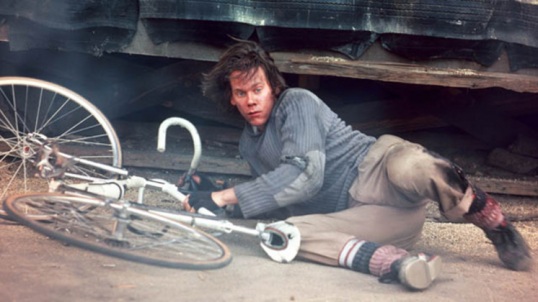
Anyway, Terri (Jami Gertz) also wants to become a bicycle messenger but she’s being used to deliver drugs by Gypsy (Rudy Ramos).  She and Jack fall in love and, along with helping out his quirky coworkers and finding a way to make back his fortune, Jack also has to deal with Gypsy.  It’s all very dramatic (though the drug dealer subplot feels as if it was awkwardly inserted into the film at the last moment) but mostly, the plot is just an excuse for scenes like the one below:

Quicksilver is … well, it’s not particularly good.  It has a few good bike weaving in and out of traffic scenes but it’s definitely no Premium Rush.  But it is kinda fun, in a “Oh my God, look at the 1980s” sorta way.  And, for what it’s worth, it’s a film that proves that Kevin Bacon can be likable in almost anything.