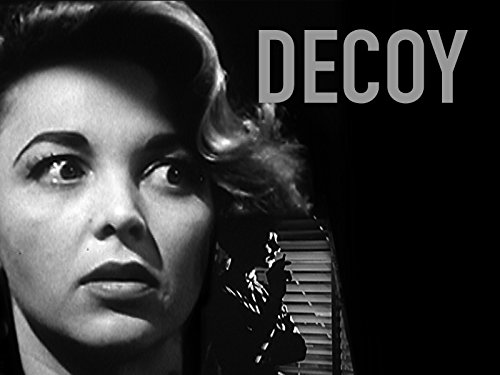
Welcome to Retro Television Reviews, a feature where we review some of our favorite and least favorite shows of the past! On Thursdays, I will be reviewing Decoy, which aired in Syndication in 1957 and 1958. The show can be viewed on Tubi!
This week, it’s the next-to-last episode Decoy!
Episode 1.38 “First Arrest”
(Dir by Arthur H. Singer, originally aired on June 30th, 1958)
Casey meets with a new, rookie policewoman (Ellen Madison) at Coney Island. The rookie just made her first arrest and is now in tears because she’s worried that she’s ruined someone’s life. Casey tells the story of her first assignment and what it was like to make her first arrest.
Flashback time!
The NYPD believes that a fencing operation is being run out of a Coney Island carnival sideshow. Young and eager, Casey gets a job as an exotic dancer at the carnival. (Calm down, boys. She wears one of the least-revealing costumes of all time.) Shy and insecure Willie Graff (Joshua Shelley) develops a crush on Casey. Casey, suspecting that Willie is the fence, plays along but she starts to feel guilty as she realizes that Willie isn’t some sort of dangerous criminal. He’s just a down-on-his-luck guy who is cutting a few corners. He even introduces Casey to his mother (Ruth McDevitt).
When Willie gives Casey a diamond necklace, she assumes that it must be stolen but it turns out that it’s his mother’s necklace and that Mrs. Graff wants Casey to have it. Casey is actually relieved because it seems like Willie isn’t the fence that she’s looking for. However, then Willie gives her a mink coat and admits that he bought it from someone who had stolen it. Though saddened, Casey forces herself to arrest Willie.
In the present, Casey assures the rookie that she will soon get used to arresting people and she won’t care about them anymore. Yikes!
As you may have guessed, I didn’t really care much for this episode. That idea of Casey being someone who doesn’t care about the people who she arrests pretty much goes totally against everything we’ve seen over the past 37 episodes. The thing that always set Casey apart was that she does care. She has to do her job but she also understands that sometimes, people just make mistakes. Unless it’s case in which she was threatened, Casey usually doesn’t take any joy in slapping the handcuffs on someone.
As much as I hate to say it, Beverly Garland is not particularly convincing in the flashback scenes. Young Casey is written as being continually breathless and unsure of herself. There’s nothing about Beverly Garland’s screen presence that suggests insecurity.
This was a disappointing episode. Next week, we’ll be finishing up Decoy and I hope it goes out on a better note than this.
Seriously, I have yet to meet anyone who doesn’t have a positive reaction to seeing Kevin Bacon on screen. He may not be a star in the way that Bradley Cooper or Bollywood sensation Shah Rukh Kahn are stars but still, he is one of those actors that everyone just seems to instinctively like.
I think, to a large extent, that is because, despite the fact that he’s been around and acting forever, Kevin Bacon himself still comes across as being a normal, blue-collar sorta guy. Whenever you see him being interviewed, you get the feeling that Kevin Bacon basically shows up, does his job to the best of his ability, and, as opposed to many other actors, he doesn’t take himself or his movies too seriously. He’s justifiably proud of the good films that he’s appeared in and he’s never had any problem admitting that he’s been in a lot of bad films as well.
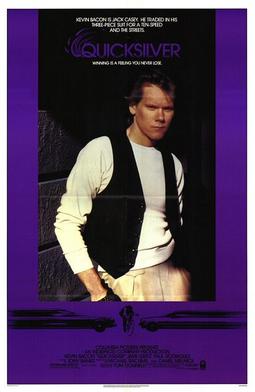
In fact, it was Kevin Bacon’s openness about his bad films that led to me discovering 1986’s Quicksilver. This is the film that, in a 2008 interview, Kevin Bacon referred to as being “the absolute lowest point of my career.” (Consider, for a minute, that this is being said by the same Kevin Bacon who had an arrow shoved through his throat in the original Friday the 13th and that will give you some clue of how much disdain Kevin seems to have for Quicksilver.)
Naturally, having read that, I knew that I simply had to see Quicksilver. I’ll admit right now that I was hoping to discover that it was some sort of loss and unappreciated classic. I wanted this to be the review where I defended the unacknowledged brilliance of Quicksilver. I wanted to say, “Don’t be so hard on yourself, Kevin! Give Quicksilver another chance!”
But no.
Quicksilver doesn’t quite suck but it definitely comes close.
At the same time, it is interesting as a classic example of what happens when a filmmaker tries to assign some sort of deeper meaning to or find inherent nobility in an activity or job that really isn’t that interesting. Often times, this will happen with sports movies. A director or producer will make the mistake of thinking that just because he’s obsessed with beach volleyball that means that there’s a huge audience out there just waiting for someone to make the ultimate beach volleyball film. Or, you’ll get a film like 1999’s Just The Ticket, where Andy Garcia is described as being the “world’s greatest ticket scalper” and the audience is supposed to be impressed.
In the case of Quicksilver, it’s all about being a bicycle messenger. I’m assuming that, one day, director Thomas Michael Donnelly was stuck in traffic and he happened to see a bike messenger rushing down the street, whizzing past all of the stalled commuters. And Donnelly probably thought, “I wish I was that guy right now!” Every day after that, whenever Donnelly was stuck in traffic, he thought back to that bike messenger and slowly he grew obsessed. All of his friends and his family got sick of listening to him talk about how much he envied the freedom of that bike messenger. Finally, a little light bulb turned on over Donnelly’s head and he said, “I’ve got to make a movie out of this!”
And then the bulb burned out but nobody noticed.
Kevin Bacon plays Jack Casey. When we first meet Jack, he’s a successful stock broker and he’s got a really bad, porn-appropriate mustache. One day, he’s sitting in the back of a cab and he goads his driver into getting into a race with a bike messenger. The messenger beats the cab. Jack is amazed!
And then, perhaps the very same day (the film is so poorly edited that it’s hard to tell), Jack not only loses all of his money but all of his parents’ money as well. Since poor men couldn’t afford facial hair in the 1980s, he shaves off his mustache. Desperately needing work, Jack applies to be a — you guessed it! — bicycle messenger.
The rest of the film is basically Jack delivering messages and talking about how he’s free now to live the life that he’s always wanted to live. And the thing is, you like Jack because he’s being played by Kevin Bacon. I mean, Kevin Bacon is so inherently likable that audiences even liked him when he was trying to kill Professor X and Magneto in X-Men: First Class. But, at the same time, you listen to Jack go on and on about how much better his life is now and you just want to say, “Who are you kidding?”
Needless to say, Jack has a group of quirky coworkers. Of course, by quirky, I mean that they are all quirky in a very predictable Hollywood sort of way. For instance, there’s the crusty old veteran and the goofy fat guy and the hard-working Mexican guy who wants to start his own business in America and the cocky black guy who is mostly notable for being played by Laurence Fisburne. One thing they all have in common is that they all love and damn near worship Jack, who has quite the common touch despite having formerly been a super rich stock broker with a bad mustache.
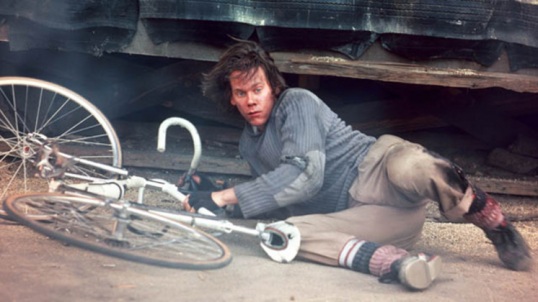
Anyway, Terri (Jami Gertz) also wants to become a bicycle messenger but she’s being used to deliver drugs by Gypsy (Rudy Ramos). She and Jack fall in love and, along with helping out his quirky coworkers and finding a way to make back his fortune, Jack also has to deal with Gypsy. It’s all very dramatic (though the drug dealer subplot feels as if it was awkwardly inserted into the film at the last moment) but mostly, the plot is just an excuse for scenes like the one below:
Quicksilver is … well, it’s not particularly good. It has a few good bike weaving in and out of traffic scenes but it’s definitely no Premium Rush. But it is kinda fun, in a “Oh my God, look at the 1980s” sorta way. And, for what it’s worth, it’s a film that proves that Kevin Bacon can be likable in almost anything.