Horror Series Review: Salem’s Lot (by Tobe Hooper & Paul Monash)


“Open the window, Mark.” — Danny Glick

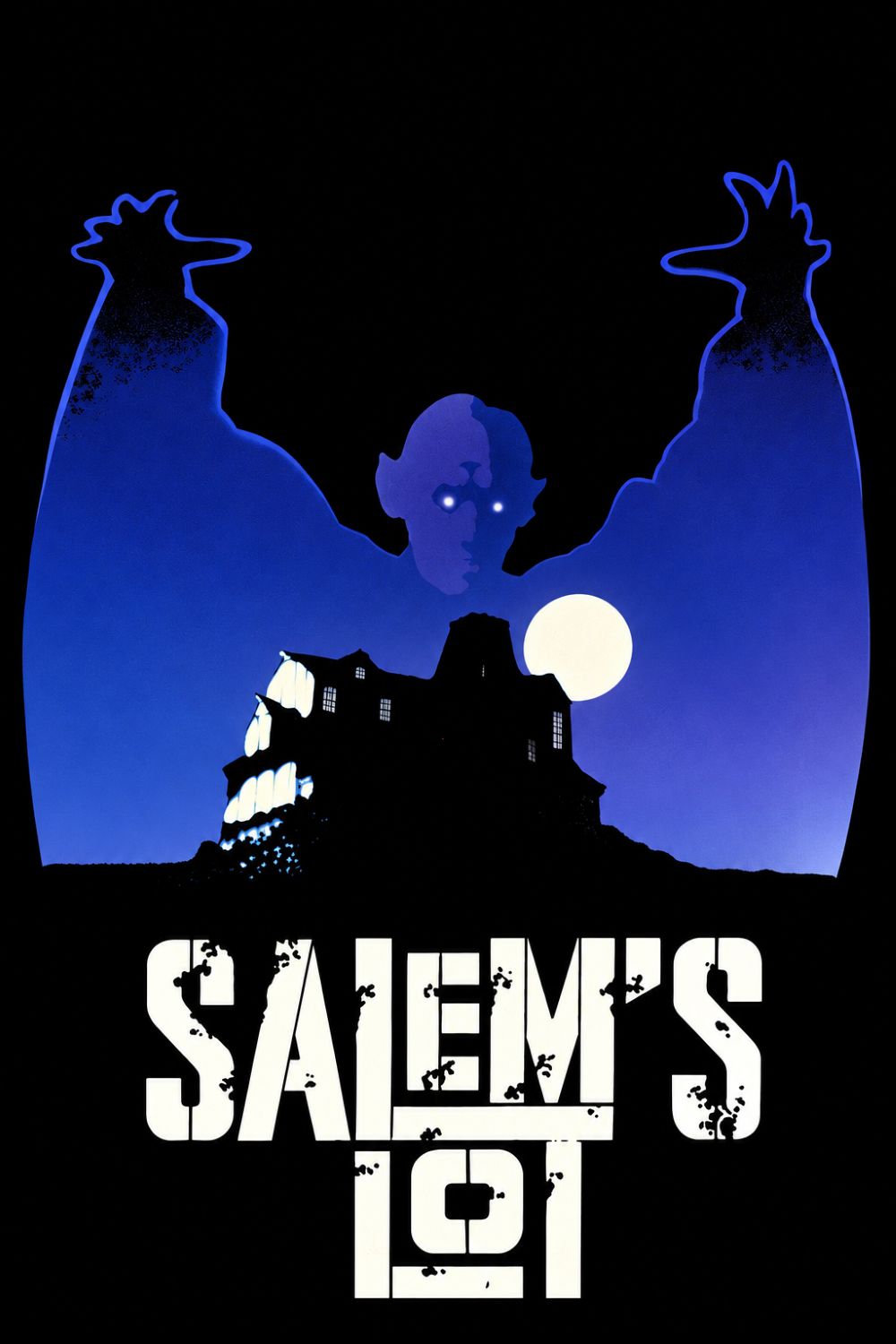
A town doesn’t have to look sinister to be hiding something rotten. That idea gives Tobe Hooper’s 1979 Salem’s Lot much of its staying power. Sure, there’s a creepy old house overlooking the neighborhood, but the real trouble settles into places that should feel reassuring: bedrooms, family homes, and familiar streets. Adapted from Stephen King’s novel, the miniseries turns an ordinary community into a feeding ground without losing sight of what made it ordinary in the first place. It’s uneven, occasionally stiff, and unmistakably a television production, yet its best moments deliver the sort of unease that expensive effects can’t guarantee.

The story begins with novelist Ben Mears, played by David Soul, returning to Jerusalem’s Lot, Maine. He’s drawn back partly by disturbing memories of the Marsten House, a property that seems to concentrate the town’s darkness. Unfortunately, antiques dealer Richard Straker and his mysterious partner, Kurt Barlow, have taken an interest in the place, too. Their arrival coincides with disappearances, illnesses, and deaths that suggest something worse than local bad luck. It’s familiar vampire territory, but familiarity works in its favor. We recognize the warning signs while the characters struggle to explain them away, creating tension between what the audience suspects and what the town will believe.

Hooper takes his time getting everyone into position, which is both a strength and a frustration. The early stretches contain plenty of conversation and everyday business before the supernatural threat becomes impossible to ignore. Some scenes could move faster, and a few supporting characters seem more interesting in principle than in practice. Still, the buildup matters. King’s novel isn’t simply about a vampire turning up; it’s about an entire town becoming vulnerable to him. The miniseries cannot reproduce the book’s full social landscape, but it establishes enough relationships and routines to make the destruction feel like more than a body count.

The town also isn’t an innocent paradise suddenly spoiled by an outside monster. Secrets, resentments, and unpleasant impulses already exist beneath its respectable surface. The vampires don’t invent those weaknesses so much as exploit them. This is an important part of King’s novel to preserve, and the adaptation gets the idea across even when individual subplots feel abbreviated. The Marsten House may be the obvious symbol of evil, but it doesn’t exist in isolation. Its presence above the town suggests a darkness everyone can see and would rather leave alone. That indifference makes the setting more interesting than a collection of unsuspecting victims.

Soul provides a steady center as Ben, even if his restrained performance sometimes borders on flatness. He’s convincing as a man returning to unfinished emotional business, and his seriousness keeps the increasingly bizarre events grounded. There’s little danger of him making the material feel campy. His reserve occasionally creates distance, though, especially when the story needs a stronger emotional response. Ben works best as an observer forced into action, someone whose interest in haunted history becomes considerably less comfortable once it stops behaving like material for a book. Soul conveys that shift more effectively than the warmer aspects of the character.

The romance with Susan Norton, played by Bonnie Bedelia, is less satisfying. Their relationship offers a glimpse of the life Ben might build in town, giving him something to move toward rather than simply something to investigate. That’s useful, but the scenes don’t always generate enough warmth to make the possibility compelling. Bedelia brings an appealing directness to Susan, yet the relationship can feel emotionally hurried even when the surrounding story moves slowly. You understand why it belongs without becoming invested in every exchange. A stronger connection would have given the supernatural threat a more painful personal dimension.

Lance Kerwin makes a livelier impression as Mark Petrie, a horror-loving kid whose interests become unexpectedly practical. Mark could have been a convenient walking instruction manual, but Kerwin gives him enough vulnerability to avoid that trap. He recognizes the danger without becoming immune to it. There’s also something satisfying about a character who takes the evidence seriously rather than endlessly refusing to accept it. His imagination helps him understand the situation, but it doesn’t make everything manageable. That distinction captures something essential about King’s treatment of childhood: knowing what the monster is can help you survive, but it won’t stop you from being terrified.

James Mason is the cast’s great weapon. As Straker, he brings such controlled unpleasantness that a polite conversation can feel like a threat. His calm suggests someone completely comfortable with things everyone else would find horrifying. Is he being dismissive, quietly amused, or openly contemptuous? Often, the answer seems to be all three. Mason gives the production authority whenever he appears, making civilized behavior look like something a predator has learned to imitate. He’s particularly effective because he doesn’t strain for menace. The performance lets us sense the cruelty beneath the manners without constantly dragging it into view.

That elegance becomes especially important because Barlow departs sharply from the novel. King’s vampire can speak, manipulate, and present a recognizable personality. Hooper and actor Reggie Nalder instead give us a largely silent creature, leaving Straker to handle the smooth conversation. Readers who miss the original Barlow have a fair argument: something is lost when an articulate villain becomes primarily a physical menace. Onscreen, though, the decision pays off. With his bald head, pointed ears, and jutting teeth, this Barlow recalls Nosferatu rather than a charming drawing-room vampire. He looks fundamentally unwelcome, and Hooper limits his appearances enough to keep that impression potent.

Even so, Barlow isn’t responsible for the miniseries’ most haunting imagery. That honor belongs to the children floating outside bedroom windows. These sequences create a nasty collision of recognition and wrongness: the face is familiar, but its position, movement, and expression are not. The glass offers protection, yet the request to be let inside makes that protection uncertain. Hooper turns the instinct to welcome someone you know into something dangerous. The possibility that affection might defeat caution makes these scenes more troubling than a straightforward attack. They threaten not only physical safety but the trust that makes a home feel secure.

The windows themselves are wonderfully simple horror devices. They let the characters see the danger while leaving them exposed to its attention. A wall would conceal it; an open doorway would admit it. The glass suspends the scene between those possibilities, stretching out the question of whether the barrier will hold. Mist and unnatural movement complete the effect without requiring elaborate explanations. Almost everyone understands the feeling of being awake in a dark room, looking toward a window and wishing something more substantial separated inside from outside. Hooper takes that common vulnerability and gives it a face.

Moments like these make the television restrictions feel less like a handicap than a challenge Hooper knows how to use. Without relying on graphic violence, he builds horror through faces, shadows, sound, and timing. The production doesn’t always escape its limitations: some exchanges feel conventional, transitions can be abrupt, and the pacing occasionally stalls. But the ordinary interiors also help establish the world being invaded. These look like rooms where people eat dinner, argue, and sleep. The adaptation sacrifices some of the novel’s complexity, thinning supporting characters and narrowing the town’s communal collapse, yet preserves the frightening contrast between everyday surroundings and impossible events.

What finally makes Salem’s Lot worth returning to isn’t perfect fidelity or flawless pacing. It’s the way Hooper understands what the vampires take away before they take anyone’s life: the ability to trust familiar surroundings and familiar faces. King explores that collapse more deeply, but the miniseries preserves its central nightmare with remarkable force. Its quieter stretches give the horror somewhere recognizable to live, and its strongest images make that recognition uncomfortable. By the end, the town’s comforting routines have become part of the trap. For a production working within network television’s boundaries, that’s an impressive achievement—and a more lasting scare than extra blood would have provided.
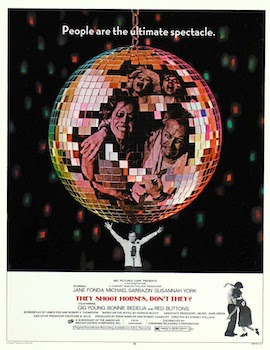
Film Review: They Shoot Horses, Don’t They? (dir by Sydney Pollack)


1969’s They Shoot Horses, Don’t They? is a film about many different things.

On its simplest level, it’s a film about a group of people who, during the Great Depression, take part in a brutal dance marathon in hopes of winning a $1,500 cash prize and maybe the chance to be spotted by a Hollywood talent scout. It’s a film about the desperation of being poor and forgotten, and it’s all the more effective because it was based on a novel that was actually written during the Great Depression. There’s an authenticity to the characters in They Shoot Horses, Don’t They? The original 1935 novel, which I read a few years ago, was written by Horace McCoy, a hard-living Dallas journalist who sometimes supplemented his income by working as a bouncer. McCoy knew the world about which he was writing.

The film is also about the power and allure of fame. The dancers may be exhausted, but they have fans who sit in the stands and who, in return for a smile and a kind word, will sometimes buy them new shoes or a decent meal. At one point, Hollywood director Mervyn LeRoy appears in the audience, and all of the dancers make a point of smiling as they pass in front of him. Meanwhile, the grueling derbies, in which the dancers tandem race in circles around the dance hall, predict the humiliation rituals of reality television. In its way, They Shoot Horses, Don’t They? is just as prophetic a film as Network.

The film is also about memory. The film is full of flashbacks and flash-forwards, giving us a portrait of the life of Robert Syverten (Michael Sarrazin), a homeless man who wandered into a dance marathon in Santa Monica. In a flashback, young Robert watches as his grandfather euthanizes a horse that has broken its leg. In a flash-forward, we watch as Robert talks to the police about a crime. And, in what we assume is the story’s “present,” we watch as Robert is partnered up with Gloria Beatty (Jane Fonda), a weary woman who continues to dance even though she no longer believes any of the hype that emcee Rocky Gravo (Gig Young) spouts about how the marathon can be the start of a brand new life.

It took me a while to get used to the flashbacks and the flash-forwards. At first, I thought they were a mistake. They seemed like a gimmicky addition to an otherwise straightforward story. But as the story played out, I came to appreciate the film’s nonlinear structure. Ultimately, the film is about Robert trying to come to terms not only with his actions but also with the actions of everyone involved with the marathon. I also came to realize that the film’s present was actually Robert in the police station and that the scenes of Robert at the dance marathon were his own memories of the vent. The film becomes less about the Depression and more about one person, a lost soul in a cold world, trying to figure out how his life eventually led to him sitting in an interrogation room, accused of a terrible crime.

The entire cast does a good job. Susannah York, who plays an aspiring actress, has an intense scene in which she breaks down when she can’t find the dress she wants to wear. Bruce Dern and Bonnie Bedelia are sympathetic as a young couple. Veteran tough guy Michael Conrad rolls around on roller skates and barks at everyone to keep moving. When Red Buttons shows up as a kind-hearted veteran dancer, your immediate response is to smile because, as a lover of classic films, you immediately associate Buttons with comedy and optimism. In The Poseidon Adventure, he was the one passenger who never gave up hope. But even his character is soon dwarfed and consumed by the ominous atmosphere inside the dance hall. At first, I thought Michael Sarrazin was a bit too stiff as Robert and Jane Fonda was too brittle as Gloria, but as the film progressed, I warmed to both of their performances. Say what you will about Jane Fonda’s political activism (and I personally think that many of her actions during the Vietnam War and her subsequent claims that American POWs were lying about being tortured were and are unforgivable), she was one of the best actresses of her generation.

Though Robert and Gloria may be at the center of the film, the narrative’s diseased heart belongs to Rocky Gravo. Rocky is the emcee and the promoter, the one who implores the crowd to applaud as their favorite dancers attempt to keep moving on the dance floor after weeks of little sleep or food. “Yowzah, yowzah!” Rocky exclaims, hyping up the audience and promising everyone that good times are right around the corner. Of course, since Rocky is also the event’s promoter, the longer the dancers suffer, the more money he makes. Whenever Rocky is on screen, the viewer can almost smell the gin and the cigars and the flop sweat. Gig Young won an Oscar for playing Rocky Gravo, and he undoubtedly deserved it. At times, it seems less like a performance and more like Young trying to exorcise his own demons. Ten years later, he would murder his fifth wife and then shoot himself.

They Shoot Horses, Don’t They? received a total of nine Oscar nominations. Sydney Pollack received his first nomination for Best Director, and Jane Fonda her first for Best Actress. Susannah York was nominated for Supporting Actress. The film received nominations for its screenplay, its editing, its art direction, and its score. The only winner was Gig Young. At the time, the film set a record for receiving the most Oscar nominations without also receiving a nomination for Best Picture. It’s tempting to say that the film was too dark and too depressing for the Academy, but then you have to consider that the Academy’s pick for Best Picture for that year was Midnight Cowboy.

(Interestingly enough, Michael Sarrazin was also a top contender for the role of Joe Buck in that film.)

It’s not a happy film or a particularly subtle film. But it remains a powerful film, one that truly sticks with you. The film haunts the viewer, as surely as Gloria will always haunt Robert.

Presumed Innocent (1990, directed by Alan J. Pakula)


Harrison Ford stars as Rusty Sabich, a smart and ambitious prosecutor who is accused of murdering his former mistress, Carolyn Polhemus (Greta Scacchi).

A lot of people were taken by surprise when Presumed Innocent first came out in 1990.  After a career of always being the hero and the type of person who took his fate into his own hands, Presumed Innocent featured a passive Harrison Ford whose fate was in the hands of his lawyer, Sandy Stern (Raul Julia) and in the prosecutors who are trying to send him to prison.  For most of the movie, the audience doesn’t know if Rusty is innocent and a lot of what Rusty does makes him seem to be guilty.  Just the fact that Harrison Ford was playing someone who would cheat on his wife (played by Bonnie Bedelia, who everyone had last seen sticking up for Bruce Willis in Die Hard) was considered to be shocking at the time.  It says a lot about Ford’s appeal as an actor that he remains sympathetic even though he’s playing a character who does a lot of bad things.  He remains compelling, even though Rusty is forced to spend a good deal of the movie as a passive spectator.  To anyone who underrates Harrison Ford an actor, this is the film to show them.

Presumed Innocent is a murder mystery but it’s also a sad-eyed look at a corrupt judicial system.  Rusty is accused of murder largely due to the whims of fate.  If Raymond Horgan (Brian Dennehy), Rusty’s former patron, had been reelected as district attorney, Rusty would never have been charged.  When the trial moves to the courtroom, the Judge (Paul Winfield) himself is revealed to have been compromised by his own relationship with Carolyn, something that Sandy is willing to use to the defense’s advantage.  John Spencer plays a detective who is willing to hide evidence to protect Rusty.  Joe Grifasi plays a former detective who is motivated less by the evidence in the case and more by a personal grudge against Rusty.  The idea of getting justice for Carolyn is pushed to the side by everyone’s personal drama.  The ending challenges all of our preconceived notions about Rusty and the meaning of guilt and innocence.

Intelligently directed by Alan J. Pakula and featuring an excellent cast, Presumed Innocent is a top-notch legal thriller and also one of Harrison Ford’s best films.


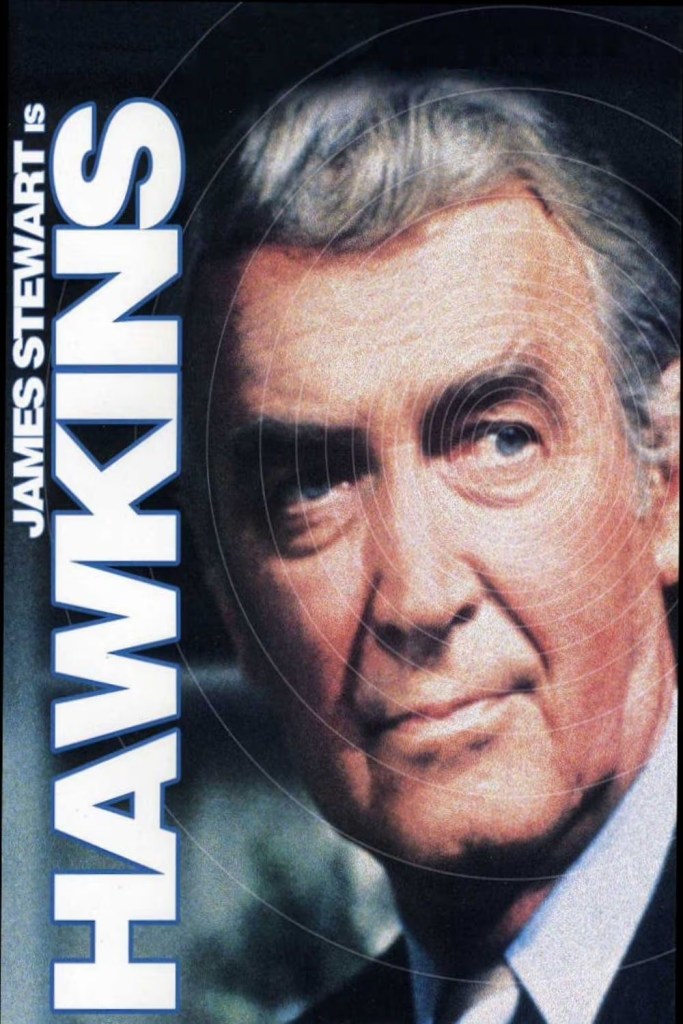
HAWKINS: Death and the Maiden (1973) – starring Jimmy Stewart!


In this pilot episode of the TV-Movie series HAWKINS, Jimmy Stewart plays Billy Jim Hawkins from the fictional town of Beauville, West Virginia, who just happens to be the best defense lawyer in the business. A former prosecutor who changed sides, he has a perfect record for getting his clients off. Billy Jim gets a call to come out to Los Angeles when an heiress, Edith Dayton-Thomas (Bonnie Bedelia), is charged with the murder of her dad, stepmom, and stepdaughter. Billy Jim and his team, which is basically just his cousin R.J. Hawkins (Strother Martin), set about getting to know all the people in her life. There’s the family lawyer Carl Vincent (Robert Webber) who’s been dipping his hand in the family till while also carrying on an affair, much to the chagrin of his wife Vivian (Antoinette Bower). There’s Edith’s aunt Julia (Kate Reid), who doesn’t seem to have a very strong opinion of her now deceased brother in law and was seen arguing with him on the day of his murder. And there’s Edith herself, whose diary would indicate that she hated her dad and her stepmom so much that she wanted them dead. She also just happens to have the reputation for being a little strange and / or crazy. The evidence seems to be stacked against Edith, but Billy Jim doesn’t get to charge those extremely high legal fees for nothing. If anyone can get to the bottom of the case, it’s him. 

I’ll just go ahead and say that Jimmy Stewart and the character of Billy Jim Hawkins are a match made in heaven. Any person who has seen him in the classic Otto Preminger film ANATOMY OF A MURDER (1959) knows how great he is at playing a down home defense attorney. He excels in the role, and he’s reason alone to invest in the DVD collection from Warner Brothers Archive like I did several years back. It’s so fun watching him question people in his easy going, slow talking, country boy way which almost always leads to the discovery of exactly what he needs to know. And Strother Martin is perfect as his cousin and associate, one of 174 first cousins, according to Billy Jim himself. You see, one of the interesting things about Billy Jim’s family is that he’s one of 14 kids, with 52 nieces and nephews to go along with all those first cousins. That’s some fun character history for a guy like me, whose mom is one of 15 kids, and I also have tons of first cousins. Stewart and Martin are a perfect duo, and their sharing of different theories as the episodes progress make up some of the best scenes. Add to Stewart and Martin a solid group of guest stars in this episode including Bonnie Bedelia (DIE HARD), Robert Webber (THE DIRTY DOZEN), Kate Reid (THIS PROPERTY IS CONDEMNED), and Antoinette Bower (THE EVIL THAT MEN DO), and you can’t help but have an entertaining show. There’s never any doubt that Stewart is going to uncover the murderer, but the fun of course is in seeing how he puts all the clues together. 

HAWKINS: Death and the Maiden is the first of eight “Hawkins” TV movies starring Jimmy Stewart in 1973 and 1974. The character of Billy Jim Hawkins is a clear pre-cursor to the character of Matlock that Andy Griffith would have so much success with a little over a decade later. In a strange move at the time, CBS chose to alternate HAWKINS on Tuesday nights with a series of SHAFT TV movies. Imagine wanting to watch SHAFT only to turn on your TV to discover Jimmy Stewart and Strother Martin solving murder mysteries, or Vice-Versa. Conventional wisdom suggests that this release strategy was probably confusing to the respective audiences for the shows based on their vastly different demographics. I personally think they both sound awesome, but I can see how pairing such different shows in this way could have been a problem for the ratings. Regardless of its short lived tenure, if you’re a fan of Jimmy Stewart, you need to watch HAWKINS. Each episode is a joy to behold. 

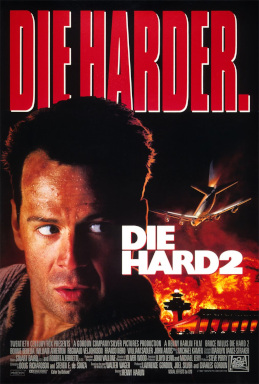
Holiday Film Review: Die Hard 2: Die Harder (dir by Renny Harlin)


During 1990’s Die Hard 2, John McClane (Bruce Willis) asks himself, “How can the same shit happen to the same person twice?” and he does have a point.

I mean, consider the situation.  In 1988, McClane spent his Christmas sneaking around a skyscraper and saving his wife from a group of sadistic mercenaries.  Two years later, John McClane spends his Christmas sneaking around an airport and saving his wife from a group of sadistic mercenaries.

There are a few differences of course.  In 1988, the mercenaries were only interested in stealing as much money as they could and each mercenary had his own properly ghoulish personality.  In 1990, the mercenaries are really more of a cult, led by the fanatical Col. Stuart (William Sadler).  And, along with trying to make some money, they are also trying to free General Ramon Esperanza (Franco Nero), a Central American drug lord and former CIA asset.  Despite the fact that the mercenaries are played by familiar actors (like Robert Patrick, John Leguizamo, Tony Ganois, and Vondie Curtis-Hall), none of them are quite as memorable as the henchmen that Alan Rickman commanded in the first film.  And while Sadler has charisma and makes a big impression during his first scene, his character is nowhere near as interesting or entertaining as Hans Gruber.  Franco Nero, it must be said, is as dashing as ever.  He really seems to be having fun in this movie.

A lot more people die in Die Hard 2 than died in the first Die Hard and the majority of them are innocent bystanders.  This isn’t like the first film, where Harry Ellis died because his coke-addled mind led him to believe that he could outsmart Gruber.  The victims in Die Hard 2 include a friendly church caretaker and over 200 passengers of an airplane that Stuart tricks into crashing on an airport runway.  The scene where the plane crashes remains disturbing no matter how many times that you see it and it truly makes you hate Colonel Stuart.  When the plane crashes, despite McClane’s futile efforts to warn the pilots, McClane sobs and it’s a powerful scene because it’s the first scene in which McClane has not had a quip or a one-liner ready to go.  In this scene, McClane fails to save the day and, for a few minutes, he’s helpless.  I usually end up crying with McClane.  Today, those tears are also a reminder of what a good actor Bruce Willis truly could be whenever he let down his defenses and allowed himself to be vulnerable on screen.

Die Hard 2 is usually dismissed as not being as good as the first movie and …. well, that’s correct.  It’s not as good but then again, few actions films are.  There’s a reason why Die Hard continues to be held in such high regard.  That said, Die Hard 2 is not bad.  The stakes are a bit higher and the action scenes a bit more elaborate, as you would expect from a film directed by Renny Harlin.  Bruce Willis plays McClane with the blue collar swagger that made his such an awesome hero in the first film.  Bonnie Bedelia and William Atherton also return from the first film and Atherton once again gets his comeuppance in a crowd-pleasing moment.  The cast is full of character actors, all of whom get a chance to make an impression.  Dennis Franz is the profane head of security who eventually turns out to be not such a bad guy.  John Amos is the major who eventually turns out to be not such a good guy.  Colm Meaney has a few heart-breaking moments as the pilot of the doomed airplane.  My favorite supporting performance is given by Fred Thompson, bringing his quiet authority to the role of tough but fair-minded Air Traffic Control director.  Watching Die Hard 2, it does feel as if the viewer has been dropped in the middle of these people’s lives.  Everyone seems real.  No one seems like a mere plot device.

Is Die Hard a Christmas movie?  You bet it is!  But so is Die Hard 2 and it’s not a bad one.

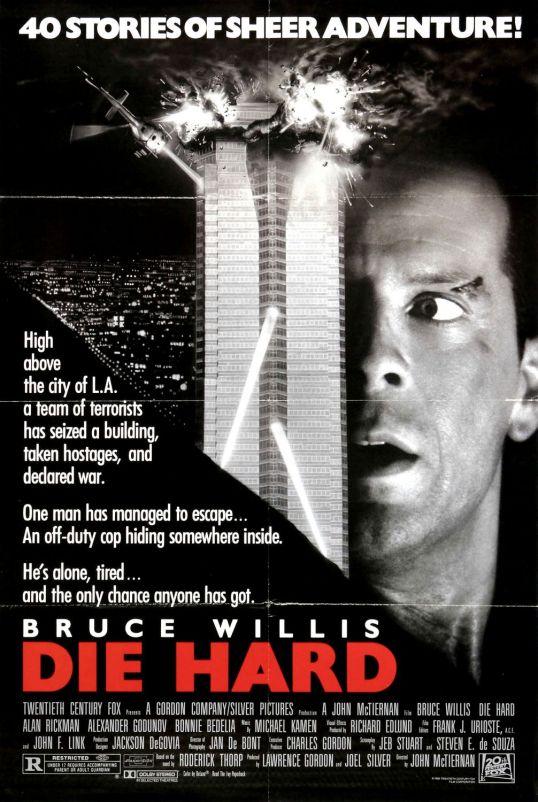
Holiday Film Review: Die Hard (dir by John McTiernan)


Yes, Die Hard is a Christmas movie.

And, in an alternative universe, it was a Frank Sinatra movie.

Released into theaters in 1988, Die Hard was based on a novel called Nothing Lasts Forever.  Nothing Lasts Forever told roughly the same story as Die Hard, with one of the big exceptions being that the cop fighting the terrorists was not the youngish and quippy John McClane but instead was a weary, aging and retired detective named Joe Leland.  Leland previously appeared in another novel called The Detective.  In 1968, The Detective was turned into a film and the role of Leland was played by Frank Sinatra.  As a part of his contract, Sinatra had the right to play Leland in any sequels to The Detective.  When Die Hard was in pre-production, Sinatra could have demanded that the film be a Joe Leland film and that he be allowed to star in it.  Fortunately, Sinatra did not do that and Joe Leland was instead transformed into John McClane.  And, after the role was was turned down by Arnold Schwarzenegger, Sylvester Stallone, Clint Eastwood, Nick Nolte, Mel Gibson, Don Johnson, Harrison Ford, Burt Reynolds, Paul Newman, James Caan, Al Pacino, and Richard Dean Anderson, popular television actor Bruce Willis finally received the role.

Seriously, just consider that.  Bruce Willis was not only not the first choice for John McClane but even Richard Dean Anderson was offered the role before the filmmakers finally went with Willis.  It’s hard to imagine anyone else starring in Die Hard because, to most of us, Bruce Willis is John McClane.  Growing up and watching Die Hard on television every Christmas, it was very easy to assume that Willis probably spent all of his spare time fighting terrorists and coming up with snarky quips.  Definitely, it’s difficult to imagine Stallone and Schwarzenegger in the role.  What made McClane such a compelling hero was that he wasn’t superhuman.  He was just a blue collar guy who hurt his feet, got tired, and had his moments of frustration just like everyone else.  He was the relatable action hero.  It didn’t matter how many stories that one heard about Bruce Willis having an ego or occasionally being difficult to work with.  Bruce Willis was John McClane and, after everything that McClane had been though, he had every right to occasionally be difficult.

You’ll notice that I haven’t really discussed the plot of Die Hard because …. well, everyone knows that plot.  I mean, this is one of those films that has such a permanent place in pop cultural history that even people who somehow haven’t seen the film still know what it’s about.  John McClane is an NYPD cop who flies to Los Angeles to see his estranged wife, Holly, for Christmas.  Holly (Bonnie Bedelia) works for the Nakatomi Corporation.  During the company’s Christmas party, terrorists led by Hans Gruber (Alan Rickman) take over the skyscraper.  The terrorists claim to be politically-motivated but, actually, they just want to break into the building’s vault and make off with a lot of money.  McClane makes his way through the unfinished skyscraper, killing the terrorists one-by-one.  He only has two allies.  Al Powell (Reginald VelJohnson) is an LAPD sergeant who is outside the building and who communicates with McClane via radio.  Argyle (De’Veroux White) is the friendly limo driver who spends almost the entire siege oblivious in the parking garage.  (The first time I ever watched Die Hard, I was so worried something bad would happen to Argyle.)

McClane has a lot of enemies and not all of them are terrorists.  The Deputy Chief of the LAPD (Paul Gleason) thinks that McClane is making the situation worse.  Two FBI agent, both named Johnson (and played by Robert Davi and Grand L. Bush), seem to view the entire siege as being a game with the older Johnson talking about how much it reminds him of Vietnam.  A reporter (William Atherton) makes the situation worse with his on-the-spot reports.  Meanwhile, there’s Harry Ellis (Hart Bochner).  A coke-addled executive, Ellis actually thinks that he’s helping McClane by trying to negotiate with Gruber.  I know that some people can’t stand Ellis but I always feel sorry for him.  In his way, he was trying to help and you could tell that he was so proud of himself for not telling Gruber that McClane was in Los Angeles to see Holly.

Needless to say, there’s a lot of action in Die Hard.  A lot of people die.  One thing that I appreciate the movie is that the bad guys get as upset over their friends and family being killed as McClane gets over Holly being threatening.  No one in the film is one-dimensional and even the bad guys have their own distinct personalities.  Theo (Clarence Gilyard) gets so excited about the idea of opening the vault that you can’t help but relate.  Karl (Alexander Godonuv) appears to be nearly indestructible.  Hans Gruber may be totally evil but he has a quick wit and there’s something intriguing about how confident he is.  Alan Rickman, famously, was not happy that his first role led to him being typecast as an international villain and one can’t blame him.  Still, almost every action movie villain who has followed has owed something to Alan Rickman.  Just as it’s difficult to imagine anyone other than Bruce Willis as John McClane, it’s impossible to imagine anyone other than Alan Rickman as Hans Gruber.

(That said, I’m sure there’s another alternate universe out there, right next to the Sinatra universe, where Blade Runner was not as troubled a production as it was and, as a result, Die Hard was made with Ridley Scott directing, Harrison Ford starring as McClane, and Rutger Hauer playing Hans.)

For all of the action, there’s also a lot of moments that make me laugh out loud and I’m not just talking about McClane’s one liners.  The two FBI agents don’t get much screentime but Davi and Bush make the most of what they have.  Paul Gleason is wonderfully deadpan as the clueless Chief Robinson.  Even Rickman gets his share of laughs.  “I read about them in Time Magazine” indeed.

Die Hard is a Christmas tradition with my family and a lot of other families as well.  Does Die Hard count as a Christmas movie?  I would say yes.  The terrorists may not respect the holiday but John McClane does.  No one ruins McClane’s Christmas!

Horror Scenes I Love: Salem’s Lot (Part 2)


sddefault

“Look at me teacher.”

Those were some of the most terrifying words I’ve ever heard growing up. It’s all because of one scene from the tv mini-series which adapted Stephen King’s vampire novel, Salem’s Lot. It was a scene in the novel that terrified me as a young boy reading King for the first time.

I’ve always been gifted (or I sometimes say cursed) with having a very overactive imagination. This is why horror has always been such a fascinating genre for me. Even where the horror is all up in one’s face with it’s gore and messy aftermath my mind’s eye would make things worst or just constantly play it on repeat in my head days after the film has ended. It’s even worst when the horror comes across less through gore and more through atmosphere and built-up dread moving towards a jump-scare or something more insidious.

This particular scene is my second favorite from the Salem’s Lot mini-series. The first one I had posted a couple years back which just barely lags behind this one for third. What made this scene so effective despite it’s tv-style production was Tobe Hooper’s direction. Despite working with the censorship inherent in broadcast tv, Hooper was able to create a palpable sense of dread as the old English teacher Matt Burke senses a presence up in one of his house’s rooms. It was the same room where one of his former students had passed away in his sleep.

As the audience we already have an idea who or what is in that second floor room. Matt Burke has an idea as well, but his morbid curiosity wins out as he decides to investigate. Yet, despite such a lack in judgement he does come armed with a crucifix in hand. The way the scene builds and builds as Burke climbs the stairs and hesitating before opening the door to the room was almost too much to bear.

The reveal of his former student, Mike Ryerson, back in the room sitting in the rocking chair as one of the undead only increases the horror of the scene. His snake-like mannerisms was a new take on the vampire behavior. It’s not the usual silk and lace bloodsucker we grew up watching. This was a vampire that behaved like a predator beguiling it’s next prey. From the way Ryerson (played by Geoffrey Lewis) hissed his words and undulated his body as he stood to face his former teacher was disturbing at the very least.

Just writing about it and seeing the scene for the umpteenth time still gives me the shakes.

Scenes I Love: Salem’s Lot (Part 1)


Stephen King’s novels and short stories were mined relentlessly during the late 70’s and through the 80’s and the early 90’s. For the most part the film and tv adaptations of his work were adequate and passable. Some were downright awful and made one wonder if King was just trying to cash as many of his work for licensing paychecks or if he really thought the studios who purchased the rights would actually do a good job adapting them. One such studio which seemed to have done a very good job adapting one of King’s greatest works, Salem’s Lot, was Warner Brothers who adapted the classic vampire novel to become a mini-series for CBS.

I never saw the mini-series when it first aired in 1979, but I did see it a few years later when it re-aired on TV and then many more times on VHS and then on DVD. Tobe Hooper directed the hell out of this mini-series and turned what was a very complex modern retelling of Bram Stoker’s Dracula into a 3-hour mini-series that was both gothic and downright terrifying despite the restraints of TV.

While the mini-series does seem dated now it still retains that creepiness, foreboding atmosphere and scares which made Hooper’s Salem’s Lot one of the better King adaptations. The scene which will always stick with me and still gives me the chills whenever I watch it is when Danny Glick’s younger brother visits him in the hospital. This scene is just downright scary whether watching it as a 9 year-old or one in their 30’s.