Welcome to Retro Television Reviews, a feature where we review some of our favorite and least favorite shows of the past! On Fridays, I will be reviewing St. Elsewhere, a medical show which ran on NBC from 1982 to 1988. The show can be found on Daily Motion.
Life goes on at St. Eligius.
Episode 4.19 “Out On A Limb”
(Dir by Eric Laneuville, originally aired on February 26th, 1986)
A new crop of residents has come to the hospital. Among them is Carol Novino (Cindy Pickett), who we are told was a nurse at the hospital before Dr. Westphall encouraged her to go to medical school. That’s right — Carol is a protégée of Donald’s. That really should put fear in the heart of anyone who has been watching this show from the start. The only people more depressing than Donald are the people who look up to him. Just look at Jack Morrison.
Novino has a difficult first day. The nurses think that she’s a snob. Dr. Chandler gets mad at her for disagreeing with him while doing rounds. She manages to get on Dr. Craig’s bad side… well, everyone gets on Dr. Craig’s bad side so I’m not sure why she should be any different. That said, I’ve already checked and I’ve discovered that Novino is going to be with the show to the end. It pays to be friends with Westphall. At least, I hope they’re just friends. If this turns into a romance, it’s going to be the most depressing romance ever.
There were a few other things that happened. Jack, paranoid after Pete got abducted, carried his son around with him while doing his job. Meanwhile, Dr. Craig carried his granddaughter with him. Axelrod and Fiscus went to California for a medical conference. Axelrod loved the sunny weather while Fiscus realized that he’s a Boston guy at heart. Morrison had to tell a little boy that he was going to lose his arm. Alan Autry showed up as a football player who could barely walk after all the damage he had sustained on the field.
It was …. well, to be honest, this season was kind of boring. After Bobby leaving the hospital and the two-part flashback episode, I guess it was inevitable that St. Elsewhere would need at least one episode to reset. This was a reset episode and a reminder that not every day is a melodrama.
A town doesn’t have to look sinister to be hiding something rotten. That idea gives Tobe Hooper’s 1979 Salem’s Lot much of its staying power. Sure, there’s a creepy old house overlooking the neighborhood, but the real trouble settles into places that should feel reassuring: bedrooms, family homes, and familiar streets. Adapted from Stephen King’s novel, the miniseries turns an ordinary community into a feeding ground without losing sight of what made it ordinary in the first place. It’s uneven, occasionally stiff, and unmistakably a television production, yet its best moments deliver the sort of unease that expensive effects can’t guarantee.
The story begins with novelist Ben Mears, played by David Soul, returning to Jerusalem’s Lot, Maine. He’s drawn back partly by disturbing memories of the Marsten House, a property that seems to concentrate the town’s darkness. Unfortunately, antiques dealer Richard Straker and his mysterious partner, Kurt Barlow, have taken an interest in the place, too. Their arrival coincides with disappearances, illnesses, and deaths that suggest something worse than local bad luck. It’s familiar vampire territory, but familiarity works in its favor. We recognize the warning signs while the characters struggle to explain them away, creating tension between what the audience suspects and what the town will believe.
Hooper takes his time getting everyone into position, which is both a strength and a frustration. The early stretches contain plenty of conversation and everyday business before the supernatural threat becomes impossible to ignore. Some scenes could move faster, and a few supporting characters seem more interesting in principle than in practice. Still, the buildup matters. King’s novel isn’t simply about a vampire turning up; it’s about an entire town becoming vulnerable to him. The miniseries cannot reproduce the book’s full social landscape, but it establishes enough relationships and routines to make the destruction feel like more than a body count.
The town also isn’t an innocent paradise suddenly spoiled by an outside monster. Secrets, resentments, and unpleasant impulses already exist beneath its respectable surface. The vampires don’t invent those weaknesses so much as exploit them. This is an important part of King’s novel to preserve, and the adaptation gets the idea across even when individual subplots feel abbreviated. The Marsten House may be the obvious symbol of evil, but it doesn’t exist in isolation. Its presence above the town suggests a darkness everyone can see and would rather leave alone. That indifference makes the setting more interesting than a collection of unsuspecting victims.
Soul provides a steady center as Ben, even if his restrained performance sometimes borders on flatness. He’s convincing as a man returning to unfinished emotional business, and his seriousness keeps the increasingly bizarre events grounded. There’s little danger of him making the material feel campy. His reserve occasionally creates distance, though, especially when the story needs a stronger emotional response. Ben works best as an observer forced into action, someone whose interest in haunted history becomes considerably less comfortable once it stops behaving like material for a book. Soul conveys that shift more effectively than the warmer aspects of the character.
The romance with Susan Norton, played by Bonnie Bedelia, is less satisfying. Their relationship offers a glimpse of the life Ben might build in town, giving him something to move toward rather than simply something to investigate. That’s useful, but the scenes don’t always generate enough warmth to make the possibility compelling. Bedelia brings an appealing directness to Susan, yet the relationship can feel emotionally hurried even when the surrounding story moves slowly. You understand why it belongs without becoming invested in every exchange. A stronger connection would have given the supernatural threat a more painful personal dimension.
Lance Kerwin makes a livelier impression as Mark Petrie, a horror-loving kid whose interests become unexpectedly practical. Mark could have been a convenient walking instruction manual, but Kerwin gives him enough vulnerability to avoid that trap. He recognizes the danger without becoming immune to it. There’s also something satisfying about a character who takes the evidence seriously rather than endlessly refusing to accept it. His imagination helps him understand the situation, but it doesn’t make everything manageable. That distinction captures something essential about King’s treatment of childhood: knowing what the monster is can help you survive, but it won’t stop you from being terrified.
James Mason is the cast’s great weapon. As Straker, he brings such controlled unpleasantness that a polite conversation can feel like a threat. His calm suggests someone completely comfortable with things everyone else would find horrifying. Is he being dismissive, quietly amused, or openly contemptuous? Often, the answer seems to be all three. Mason gives the production authority whenever he appears, making civilized behavior look like something a predator has learned to imitate. He’s particularly effective because he doesn’t strain for menace. The performance lets us sense the cruelty beneath the manners without constantly dragging it into view.
That elegance becomes especially important because Barlow departs sharply from the novel. King’s vampire can speak, manipulate, and present a recognizable personality. Hooper and actor Reggie Nalder instead give us a largely silent creature, leaving Straker to handle the smooth conversation. Readers who miss the original Barlow have a fair argument: something is lost when an articulate villain becomes primarily a physical menace. Onscreen, though, the decision pays off. With his bald head, pointed ears, and jutting teeth, this Barlow recalls Nosferatu rather than a charming drawing-room vampire. He looks fundamentally unwelcome, and Hooper limits his appearances enough to keep that impression potent.
Even so, Barlow isn’t responsible for the miniseries’ most haunting imagery. That honor belongs to the children floating outside bedroom windows. These sequences create a nasty collision of recognition and wrongness: the face is familiar, but its position, movement, and expression are not. The glass offers protection, yet the request to be let inside makes that protection uncertain. Hooper turns the instinct to welcome someone you know into something dangerous. The possibility that affection might defeat caution makes these scenes more troubling than a straightforward attack. They threaten not only physical safety but the trust that makes a home feel secure.
The windows themselves are wonderfully simple horror devices. They let the characters see the danger while leaving them exposed to its attention. A wall would conceal it; an open doorway would admit it. The glass suspends the scene between those possibilities, stretching out the question of whether the barrier will hold. Mist and unnatural movement complete the effect without requiring elaborate explanations. Almost everyone understands the feeling of being awake in a dark room, looking toward a window and wishing something more substantial separated inside from outside. Hooper takes that common vulnerability and gives it a face.
Moments like these make the television restrictions feel less like a handicap than a challenge Hooper knows how to use. Without relying on graphic violence, he builds horror through faces, shadows, sound, and timing. The production doesn’t always escape its limitations: some exchanges feel conventional, transitions can be abrupt, and the pacing occasionally stalls. But the ordinary interiors also help establish the world being invaded. These look like rooms where people eat dinner, argue, and sleep. The adaptation sacrifices some of the novel’s complexity, thinning supporting characters and narrowing the town’s communal collapse, yet preserves the frightening contrast between everyday surroundings and impossible events.
What finally makes Salem’s Lot worth returning to isn’t perfect fidelity or flawless pacing. It’s the way Hooper understands what the vampires take away before they take anyone’s life: the ability to trust familiar surroundings and familiar faces. King explores that collapse more deeply, but the miniseries preserves its central nightmare with remarkable force. Its quieter stretches give the horror somewhere recognizable to live, and its strongest images make that recognition uncomfortable. By the end, the town’s comforting routines have become part of the trap. For a production working within network television’s boundaries, that’s an impressive achievement—and a more lasting scare than extra blood would have provided.
Welcome to Late Night Retro Television Reviews, a feature where we review some of our favorite and least favorite shows of the past! On Mondays, I will be reviewing CHiPs, which ran on NBC from 1977 to 1983. The entire show is currently streaming on Prime!
This week, not Ponch can smile his way out of the darkness.
Episode 4.8 “Wheels of Justice”
(Dir by Gordon Hessler, originally aired on December 21st, 1980)
The streets of Los Angeles are dangerous in this week’s episode.
Stan West (Basil Hoffman) is a reckless driver who is constantly causing accidents by driving too fast and making unsafe lane changes. He gets away with it because he keeps changing his name.
Arthur Holmes (Joshua Bryant) is a drunk who Jon and Ponch have pulled over several times. Arthur gets away with it by claiming, after every accident, that his wife was the one driving, Denise (Christine Belford) goes along with it, even though she hates the fact that she’s enabling her husband.
A group of cheerleaders drive around and do their cheers while driving!
Finally, a gas leak at the hospital leads to all the newborn babies being loaded into an ambulance for transport. When the ambulance is side-swiped by Stan, the babies end up at the station. Getraer gives everyone a lesson on how to properly soothe a crying baby. It’s cute but it’s also so manipulative that it leaves you feeling oddly used. But, hey, at least it’s cute!
This episode of CHiPs took a serious turn towards the end when the drunk driver swerved to avoid the cheerleaders and the end result is that his wife was thrown from the car and killed. When the car was shown crashing in slow motion, the wife’s mannequin actually fell out of the car. While I imagine that was probably not planned, it still created a memorably macabre image. In the end, Arthur ends up sobbing while Denise lies dead just a few feet away from him. That’s a pretty dark ending for an episode of CHiPs. Not even a quick scene of the officers holding the babies could change the fact that this was a really downbeat episode.
And you know what? There’s nothing wrong with that. Driving drunk is selfish, stupid, and dangerous and CHiPs deserves some credit for not holding back.
Malibu, CA will not be reviewed tonight so that we might bring you this special presentation….
My retro television reviews will return next week but, for now, why not enjoy something even better than me discussing my hatred of Malibu, CA? 1982’s Wait Until Dark is a videotaped record of a stage production of Frederick Knott’s classic play about a blind woman who is menaced by three criminals. (I assume it was filmed for PBS. According to Lettrboxd, this aired on television on June 20th, 1982.) This play was famously adapted into an Audrey Hepburn film in 1967. The production below gives us a chance to see how the suspense plays out in a theatrical setting. The cast, including Katharine Ross and Stacy Keach, is excellent!
Welcome to Late Night Retro Television Reviews, a feature where we review some of our favorite and least favorite shows of the past! On Mondays, I will be reviewing CHiPs, which ran on NBC from 1977 to 1983. The entire show is currently streaming on Freevee!
This week, Ponch attacks a reporter …. or does he?
Episode 2.4 “Disaster Squad”
(Dir by Gordon Hessler, originally aired on October 7th, 1978)
In a change-of-pace for this show, it’s Officer Jon Baker who gets a girlfriend in this week’s episode. Ellen Roberts (Liberty Godshall) is a recently divorced woman with an annoying 4 year-old named Chris (Christian Zika). Because Baker doesn’t want any kids around to ruin his action, he gets Ponch to hang out with Chris. Fortunately, it turns out that Chris loves motorcycle and even owns his own mini-bike.
Impressed by how well Chris can handle his bike, Ponch enters Chris in a children’s dirt bike race. When one of the other racers knocks Chris down in the middle of the race, an angry Chris says that he’s going to hit the other racer. Ponch tells Chris to never hit anyone and he says that he’s ashamed to hear Chris speak like that. Chris promises not to ever fight.
But then, the next morning, Chris turns on the TV and sees a report about Ponch punching out an obnoxious news reporter (Harvey Jason) who got in the way while Ponch and Jon were dealing with a suicidal motorist. The anchorman (played by Regis Philbin!) then comes on TV and basically says that Ponch is the epitome of everything bad about the police. Chris starts sobbing. Ponch lied about not fighting! Chris hops on his mini-bike and, still crying, drives away.
What Chris doesn’t know is that Ponch was set up. Lee and the members of “the Disaster Squad” have been following Ponch and Baker around, filming accidents, and getting in the way. (At one point, one of Lee’s men event tosses a road flair under a car that’s leaking oil, causing an explosion.) Lee doctored the tape of an earlier confrontation with Ponch to make it appear the Ponch threatened and hit him.
But that doesn’t matter to Chris. With tears flowing down his cheeks, he drives his little motorcycle into the Los Angeles river. Fortunately, Ponch and Baker find him in time to save his life and teach him an important lesson about fake news.
This episode …. where to begin? It opened with a good chase scene and it featured a truck flipping over so that was good. But then bratty little Chris showed up and the whole episode went downhill. The child playing Chris was, to be charitable, not exactly the world’s best actor and his over-the-top reaction to seeing Ponch hit someone was bit too silly to inspire anything other than a chuckle. “Ponch said never to hit anyone!” Chris wails. Well, kid, Ponch is a damn hypocrite. Sorry.
It was all pretty silly. Baker finally got to do something other than gaze at Ponch in amazement but, in the end, the story was still pretty much Ponch-centered. One thing I noticed about this episode is that Getraer had absolutely no sympathy for Ponch, even though he believed Ponch was being set up. Seriously, I get that Getraer has a lot to deal with but does he have to be a jerk all the time?
Next week …. Ponch and Baker continue to keep California safe!
Welcome to Retro Television Reviews, a feature where we review some of our favorite and least favorite shows of the past! On Wednesdays, I will be reviewing the original Love Boat, which aired on ABC from 1977 to 1986! The series can be streamed on Paramount Plus!
Love exciting and new….
Come aboard! We’re expecting you!
Episode 1.8 “Lost and Found / The Understudy / Married Singles”
(Directed by Stuart Margolin, originally aired on November 19th, 1977)
This week’s cruise is all about secrets and lies.
For instance, Durwood Moss (Steve Allen) and Maisie Nolan (Polly Bergen) are currently separated and their therapist has suggested that they try taking separate vacations. Maisie books a cabin on the cruise so Durwood books the cabin next door. As Durwood explains it, being in separate cabins counts as being on separate vacations. Not letting anyone know that they’re married (albeit unhappily so), Durwood pursues Barbie (Loni Anderson) and Maisie flirts with Jack (Joshua Plymouth). Of course, Durwood and Maisie end up realizing that they’re still in love. Fortunately, Jack and Barbie also fall in love with each other!
Meanwhile, 8 year-old Theodore Denison, Jr. (James Bond III) lies and says that he has his parents’ permission to be on the cruise by himself. Of course, it turns out that he’s actually a runaway. On the cruise, he meets Sharon and Richard Baker (Sandy Duncan and Jim Stafford), a married couple that is struggling to come to terms with the death of their son. Sharon wants to adopt Theodore and Theodore wants to be adopted. But then Theodore’s real parents show up and apologize for the fight that caused Theodore to run away in the first place. Still, Sharon and Richard at least find the courage to try to move on from their tragedy.
Finally, Connie Evans (Jo Ann Harris) is an assistant cruise director who has been assigned to the ship. Julie (Lauren Tewes) is supposed to be training Connie but it soon becomes clear that, in typical All AboutEve fashion, Connie is plotting to steal Julie’s job. Connie’s plan is … well, it’s interesting. She continually screws up the simplest of duties and then claims that she was only doing what Julie trained her to do. When she shows up for dinner in a skimpy outfit, she claims that it’s what Julie told her to wear. I guess the plan is to make Julie look like she’s bad at training people but just because someone isn’t good at training, that doesn’t mean that they’re bad at their overall job. In fact, it would seem that most people would look at Connie’s actions and say, “You should have had enough common sense to know better, even if that’s what Julie told you.” Anyway, it all works out, albeit somewhat bizarrely. The captain reprimands Connie. The crew hates Connie and goes out of its way to humiliate her. And yet, even after it become obvious that Connie has been trying to get her fired, Julie agrees to help Connie because she thinks Connie has the makings of being a great cruise director. Just how painfully nice is Julie?
This was not a bad episode. The stuff with Durwood and Maisie was a bit dull but the other two storylines worked. Sandy Duncan brought a lot of emotional sincerity to her plotline and Jo Ann Harris was hilariously conniving in the role of Connie. This episode was a cruise that I enjoyed.
Will I also enjoy the next cruise? Find out next week!
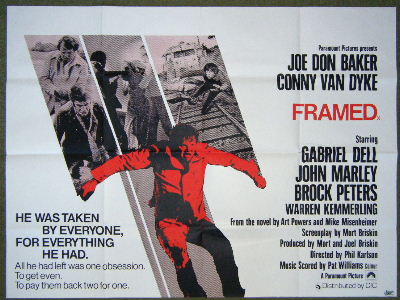
Revenge can be brutal, especially when you’ve been framed.
Joe Don Baker plays Ron Lewis, a surly nightclub owner and gambler who wins a small fortune, witnesses a crime, and nearly gets shot all in the same night. When he reaches his house, he’s planning on calling the police but he’s confronted in his own garage by a sheriff’s deputy who tries to kill him! In a lengthy and brutal scene, Ron beats the deputy to death and gouges out his eyes. Even though Ron was only acting in self-defense, he’s charged with murder. Told that there is no way that he’ll be able to win an acquittal, Ron pleads guilty to a lesser charge and is sent to prison for four years.
While he’s in prison, Ron befriends a mob boss (John Marley, who famously woke up with a horse’s head in his bed in The Godfather) and the boss’s number one hitman, Vince (Gabriel Dell). While Ron is in prison, a group of men assault his girlfriend (country singer Conny Van Dyke) and tell her not to ask any questions about the events that led to Ron being framed.
After serving his sentence and getting into numerous fights with the guards, Ron is finally released. When Vince shows up and tells Ron that he’s been hired to kill him, the two of them team up with an honest deputy (Brock Peters) and set out to find out why Ron was set up and to get revenge.
Framed is a brutal movie, Ron and his friends hold nothing back in their quest to get revenge. Whether he’s shooting a man in cold blood or hooking someone up to a car battery in order to get information out of him, there’s little that Ron won’t do and the movie lingers over every act of violence. Several pounds overweight and snarling out of his lines, Joe Don Baker may not be a conventional action hero but he’s believable in his rage. He’s the ultimate country boy who has been pushed too far and now he doesn’t care how much blood he has to get on his hands. However, because Baker does seem more like an ordinary person than a Clint Eastwood or a Charles Bronson-type, he retains the audience’s sympathy even as he splashes blood all over the screen. As violent as his action may be, they always feel justified.
Baker’s performance and the believable violence are the film’s biggest strengths. It’s biggest weakness is a plot that revolves around an elaborate conspiracy that doesn’t always make sense and some notably weak supporting performances. Ron’s revenge may be brutal but it takes a while to get there and the first hour gets bogged down with Ron’s struggle to adjust to life in prison. John Marley does a good job as Ron’s prison mentor but then he abruptly disappears from the movie.
Before making Framed, Baker and director Phil Karlson previously collaborated on Walking Tall. Framed is far more violent than that film was but its plot doesn’t hold together as well. However, if you’re just looking for a violent action film that features Joe Don Baker doing what he does best, Framed delivers.