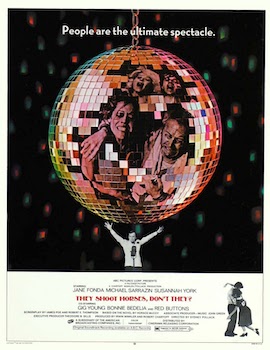
1969’s They Shoot Horses, Don’t They? is a film about many different things.
On its simplest level, it’s a film about a group of people who, during the Great Depression, take part in a brutal dance marathon in hopes of winning a $1,500 cash prize and maybe the chance to be spotted by a Hollywood talent scout. It’s a film about the desperation of being poor and forgotten, and it’s all the more effective because it was based on a novel that was actually written during the Great Depression. There’s an authenticity to the characters in They Shoot Horses, Don’t They? The original 1935 novel, which I read a few years ago, was written by Horace McCoy, a hard-living Dallas journalist who sometimes supplemented his income by working as a bouncer. McCoy knew the world about which he was writing.
The film is also about the power and allure of fame. The dancers may be exhausted, but they have fans who sit in the stands and who, in return for a smile and a kind word, will sometimes buy them new shoes or a decent meal. At one point, Hollywood director Mervyn LeRoy appears in the audience, and all of the dancers make a point of smiling as they pass in front of him. Meanwhile, the grueling derbies, in which the dancers tandem race in circles around the dance hall, predict the humiliation rituals of reality television. In its way, They Shoot Horses, Don’t They? is just as prophetic a film as Network.
The film is also about memory. The film is full of flashbacks and flash-forwards, giving us a portrait of the life of Robert Syverten (Michael Sarrazin), a homeless man who wandered into a dance marathon in Santa Monica. In a flashback, young Robert watches as his grandfather euthanizes a horse that has broken its leg. In a flash-forward, we watch as Robert talks to the police about a crime. And, in what we assume is the story’s “present,” we watch as Robert is partnered up with Gloria Beatty (Jane Fonda), a weary woman who continues to dance even though she no longer believes any of the hype that emcee Rocky Gravo (Gig Young) spouts about how the marathon can be the start of a brand new life.
It took me a while to get used to the flashbacks and the flash-forwards. At first, I thought they were a mistake. They seemed like a gimmicky addition to an otherwise straightforward story. But as the story played out, I came to appreciate the film’s nonlinear structure. Ultimately, the film is about Robert trying to come to terms not only with his actions but also with the actions of everyone involved with the marathon. I also came to realize that the film’s present was actually Robert in the police station and that the scenes of Robert at the dance marathon were his own memories of the vent. The film becomes less about the Depression and more about one person, a lost soul in a cold world, trying to figure out how his life eventually led to him sitting in an interrogation room, accused of a terrible crime.
The entire cast does a good job. Susannah York, who plays an aspiring actress, has an intense scene in which she breaks down when she can’t find the dress she wants to wear. Bruce Dern and Bonnie Bedelia are sympathetic as a young couple. Veteran tough guy Michael Conrad rolls around on roller skates and barks at everyone to keep moving. When Red Buttons shows up as a kind-hearted veteran dancer, your immediate response is to smile because, as a lover of classic films, you immediately associate Buttons with comedy and optimism. In The Poseidon Adventure, he was the one passenger who never gave up hope. But even his character is soon dwarfed and consumed by the ominous atmosphere inside the dance hall. At first, I thought Michael Sarrazin was a bit too stiff as Robert and Jane Fonda was too brittle as Gloria, but as the film progressed, I warmed to both of their performances. Say what you will about Jane Fonda’s political activism (and I personally think that many of her actions during the Vietnam War and her subsequent claims that American POWs were lying about being tortured were and are unforgivable), she was one of the best actresses of her generation.
Though Robert and Gloria may be at the center of the film, the narrative’s diseased heart belongs to Rocky Gravo. Rocky is the emcee and the promoter, the one who implores the crowd to applaud as their favorite dancers attempt to keep moving on the dance floor after weeks of little sleep or food. “Yowzah, yowzah!” Rocky exclaims, hyping up the audience and promising everyone that good times are right around the corner. Of course, since Rocky is also the event’s promoter, the longer the dancers suffer, the more money he makes. Whenever Rocky is on screen, the viewer can almost smell the gin and the cigars and the flop sweat. Gig Young won an Oscar for playing Rocky Gravo, and he undoubtedly deserved it. At times, it seems less like a performance and more like Young trying to exorcise his own demons. Ten years later, he would murder his fifth wife and then shoot himself.
They Shoot Horses, Don’t They? received a total of nine Oscar nominations. Sydney Pollack received his first nomination for Best Director, and Jane Fonda her first for Best Actress. Susannah York was nominated for Supporting Actress. The film received nominations for its screenplay, its editing, its art direction, and its score. The only winner was Gig Young. At the time, the film set a record for receiving the most Oscar nominations without also receiving a nomination for Best Picture. It’s tempting to say that the film was too dark and too depressing for the Academy, but then you have to consider that the Academy’s pick for Best Picture for that year was Midnight Cowboy.
(Interestingly enough, Michael Sarrazin was also a top contender for the role of Joe Buck in that film.)
It’s not a happy film or a particularly subtle film. But it remains a powerful film, one that truly sticks with you. The film haunts the viewer, as surely as Gloria will always haunt Robert.


Not much has changed either.
LikeLike
Take dance marathons and replace them with cage fights. That’s our world now. Panem et circenses.
Yowza, yowza, yowza!
LikeLike
Isn’t that the truth!
LikeLike
Pingback: Lisa Marie’s Week In Review: 6/29/26 — 7/5/26 | Through the Shattered Lens