Film Review: They Shoot Horses, Don’t They? (dir by Sydney Pollack)


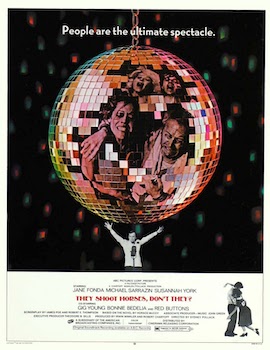
1969’s They Shoot Horses, Don’t They? is a film about many different things.

On its simplest level, it’s a film about a group of people who, during the Great Depression, take part in a brutal dance marathon in hopes of winning a $1,500 cash prize and maybe the chance to be spotted by a Hollywood talent scout. It’s a film about the desperation of being poor and forgotten, and it’s all the more effective because it was based on a novel that was actually written during the Great Depression. There’s an authenticity to the characters in They Shoot Horses, Don’t They? The original 1935 novel, which I read a few years ago, was written by Horace McCoy, a hard-living Dallas journalist who sometimes supplemented his income by working as a bouncer. McCoy knew the world about which he was writing.

The film is also about the power and allure of fame. The dancers may be exhausted, but they have fans who sit in the stands and who, in return for a smile and a kind word, will sometimes buy them new shoes or a decent meal. At one point, Hollywood director Mervyn LeRoy appears in the audience, and all of the dancers make a point of smiling as they pass in front of him. Meanwhile, the grueling derbies, in which the dancers tandem race in circles around the dance hall, predict the humiliation rituals of reality television. In its way, They Shoot Horses, Don’t They? is just as prophetic a film as Network.

The film is also about memory. The film is full of flashbacks and flash-forwards, giving us a portrait of the life of Robert Syverten (Michael Sarrazin), a homeless man who wandered into a dance marathon in Santa Monica. In a flashback, young Robert watches as his grandfather euthanizes a horse that has broken its leg. In a flash-forward, we watch as Robert talks to the police about a crime. And, in what we assume is the story’s “present,” we watch as Robert is partnered up with Gloria Beatty (Jane Fonda), a weary woman who continues to dance even though she no longer believes any of the hype that emcee Rocky Gravo (Gig Young) spouts about how the marathon can be the start of a brand new life.

It took me a while to get used to the flashbacks and the flash-forwards. At first, I thought they were a mistake. They seemed like a gimmicky addition to an otherwise straightforward story. But as the story played out, I came to appreciate the film’s nonlinear structure. Ultimately, the film is about Robert trying to come to terms not only with his actions but also with the actions of everyone involved with the marathon. I also came to realize that the film’s present was actually Robert in the police station and that the scenes of Robert at the dance marathon were his own memories of the vent. The film becomes less about the Depression and more about one person, a lost soul in a cold world, trying to figure out how his life eventually led to him sitting in an interrogation room, accused of a terrible crime.

The entire cast does a good job. Susannah York, who plays an aspiring actress, has an intense scene in which she breaks down when she can’t find the dress she wants to wear. Bruce Dern and Bonnie Bedelia are sympathetic as a young couple. Veteran tough guy Michael Conrad rolls around on roller skates and barks at everyone to keep moving. When Red Buttons shows up as a kind-hearted veteran dancer, your immediate response is to smile because, as a lover of classic films, you immediately associate Buttons with comedy and optimism. In The Poseidon Adventure, he was the one passenger who never gave up hope. But even his character is soon dwarfed and consumed by the ominous atmosphere inside the dance hall. At first, I thought Michael Sarrazin was a bit too stiff as Robert and Jane Fonda was too brittle as Gloria, but as the film progressed, I warmed to both of their performances. Say what you will about Jane Fonda’s political activism (and I personally think that many of her actions during the Vietnam War and her subsequent claims that American POWs were lying about being tortured were and are unforgivable), she was one of the best actresses of her generation.

Though Robert and Gloria may be at the center of the film, the narrative’s diseased heart belongs to Rocky Gravo. Rocky is the emcee and the promoter, the one who implores the crowd to applaud as their favorite dancers attempt to keep moving on the dance floor after weeks of little sleep or food. “Yowzah, yowzah!” Rocky exclaims, hyping up the audience and promising everyone that good times are right around the corner. Of course, since Rocky is also the event’s promoter, the longer the dancers suffer, the more money he makes. Whenever Rocky is on screen, the viewer can almost smell the gin and the cigars and the flop sweat. Gig Young won an Oscar for playing Rocky Gravo, and he undoubtedly deserved it. At times, it seems less like a performance and more like Young trying to exorcise his own demons. Ten years later, he would murder his fifth wife and then shoot himself.

They Shoot Horses, Don’t They? received a total of nine Oscar nominations. Sydney Pollack received his first nomination for Best Director, and Jane Fonda her first for Best Actress. Susannah York was nominated for Supporting Actress. The film received nominations for its screenplay, its editing, its art direction, and its score. The only winner was Gig Young. At the time, the film set a record for receiving the most Oscar nominations without also receiving a nomination for Best Picture. It’s tempting to say that the film was too dark and too depressing for the Academy, but then you have to consider that the Academy’s pick for Best Picture for that year was Midnight Cowboy.

(Interestingly enough, Michael Sarrazin was also a top contender for the role of Joe Buck in that film.)

It’s not a happy film or a particularly subtle film. But it remains a powerful film, one that truly sticks with you. The film haunts the viewer, as surely as Gloria will always haunt Robert.

Retro Television Review: Miami Vice 5.17 “Freefall”


Welcome to Retro Television Reviews, a feature where we review some of our favorite and least favorite shows of the past!  On Mondays, I will be reviewing Miami Vice, which ran on NBC from 1984 to 1989.  The entire show can be purchased on Prime!

This week, Crockett and Tubbs are burned out.

Episode 17 “Freefall”

(Dir by Russ Mayberry, originally aired on May 12th, 1989)

As this episode begins, we find Crockett and Tubbs at their most cynical.  After five years as partners, they’ve seen a lot of bad guys go down.  They’ve seen a lot of innocent people die.  Larry Zito was killed by drug dealers.  Switek has developed a gambling addiction.  Gina has shot numerous men in cold blood.  Trudy was kidnapped by aliens.  Castillo has never once smiled.  None of it seems to make any difference.

When the government approaches them and orders Crockett and Tubbs to go into a war-torn island country and smuggle out dictator General Manuel Borbon (Ian McShane), Crockett is not happy about the assignment.  Tubbs, however, believes that the government is telling the truth about Borbon having information that could take down the world’s biggest drug cartel.  The government, for their part, think that Crockett and Tubbs have the undercover experience to pull off the operation.  Has the government not noticed that Crockett and Tubbs have had their covers blown in nearly every episode?

Of course, it turns out that the government is lying.  They just wanted Borbon out of the country so he wouldn’t reveal what he knows about American intelligence’s activities in Central America.  Crockett and Tubbs manage to get Borbon to Miami but they then find themselves under constant attack from the drug gangs that want Borbon dead.  Borbon proves to be untrustworthy.  Because of his gambling addiction, Castillo suspects that Switek may have sold out his partners.  Switek responds by tracking down three hitmen and gunning them down.  Did Switek sell out Crockett and Tubbs?  The answer isn’t clear but it does seem like his time as a detective is coming to an end.

Finally, Tubbs and Crocket do what they have to do.  They go on a “suicide” mission that involves them firing their weapons at Borbon’s sea plane until it explodes.  Borbon is killed and so are several of his American associates.  When the CIA man in charge of the operation threatens to have their badges, Crockett and Tubbs toss their badges on the ground.  Castillo offers to back them up if they chose to stay on the force.  Tubbs says thanks but no thanks.  Tubbs is going back to New York.  Crockett is heading further south, presumably to live in the Florida everglades.

And so, Miami Vice ends.

Except it doesn’t!  There were four so-called “lost episodes” that aired in syndication.  We’ll take a look at them over the next four weeks.

As for Freefall, it’s not a terrible conclusion to the story of Crockett and Tubbs.  It stays true to the cynicism that ran though the entire series.  Crockett and Tubbs finally admit that the War on Drugs is a sham and they quit.  It’s a shame that Gina and Trudy didn’t get to do much in the finale.  I wasn’t happy with the idea of Switek being a traitor but it actually did work for his character.  Switek had been spiraling ever since Zito was killed.  This episode has a lot of surprisingly violent action, the show’s trademark political subtext, and Johnson and Thomas bringing their characters to life one last time.

Apparently, this episode was originally envisioned as ending with both Crockett and Tubbs dying.  That actually would have been a totally appropriate ending as both characters have often seemed as if they had a death wish.  However, the network turned down that idea because they were hoping to do a spin-off series.  Crockett and Tubbs were spared by the higher-ups.  The series ends — or it would end if not for the four extra episodes — with Crockett and Tubbs speeding through the streets of Miami and it’s had not to feel that’s the way it should be.

Retro Television Review: Miami Vice 5.15 “Over The Line”


Welcome to Retro Television Reviews, a feature where we review some of our favorite and least favorite shows of the past!  On Mondays, I will be reviewing Miami Vice, which ran on NBC from 1984 to 1989.  The entire show can be purchased on Prime!

This week, the Vice Squad learns that a man has to know his limitations.

Episode 5.15 “Over The Line”

(Dir by Russ Mayberry, originally aired on April 28th, 1989)

“All of our heroes are dead.”

That line was delivered in 1973’s Magnum Force, by a motorcycle cop-turned-vigilante who justified his murderous actions by claiming that he was a part of the first generation without heroes.  That line could have just as easily been delivered by the cops in this episode of Miami Vice.

Crockett and Tubbs are recruited by Walter Stevens (Thomas Arana), a cop-turned-vigilante who explains to them that, once they join his organization, they can never leave.  Of course, Crockett and Tubbs are only pretending to be vigilantes so that they can take down both the drug dealers and Walter’s organization.  They do this despite the fact that, in many ways, Crockett agrees with Walter.  But when Walter’s methods lead to three good cops getting killed, Crockett realizes that Walter has to be stopped.  Even worse, he discovers that Walter is funding his operation by selling the cocaine that he confiscates from the dealers.

When Crockett pulls his gun on Walter and tells him to surrender, Walter appears to be doing so.  Walter warns Crockett that there’s a lot more to the organization than Crockett realizes.  Suddenly, a police captain named Robert Highsmith (Robert Fields) pops up and shoots Walter.  Crockett says that Walter was surrendering.  Highsmith insists that he saved Crockett’s life.

With the drug dealers and the bad cops taken down, Highsmith takes all the credit.  Highsmith is not only a police captain but he’s also a candidate for Dade County Supervisor.  At a televised “meet-the-candidate” forum, Highsmith brags about how he personally is helping to clean up the city.  Crockett watches and says, “Whatever it takes, right?”

Agck!

Seriously, this episode is cynical even by the standards of Miami Vice.  Legitimate cops like Crockett and Tubbs can’t do their job because of budget cuts.  The vigilante cops are taking down the drug dealers but they’re also stealing and selling cocaine so they’re not actually doing anything to stop the flow of drugs into Miami.   Walter becomes the first Miami Vice bad guy to both show remorse and to willingly surrender but he’s still gunned down by Captain Highsmith who, at the end of the episode, appears poised to be elected to political office.  Miami Vice was often critical of the War on Drugs.  This episode showed why the war couldn’t be won, despite the best efforts of soldiers like Crockett, Tubbs, and Castillo.  Men like Highsmith had to appear to be winning the war so that they could accumulate more power but if they actually did win the war, they would no longer be given carte blanche to do whatever they wanted.

This was a dark but effective episode.  Crockett’s hair has never been longer and he’s never appeared more defeated.

Horror On The Lens: Frankenstein Meets The Space Monster (dir by Robert Gaffney)


Last night, I watched Poltergeist on TCM and I found myself thinking about how much I’ve always liked James Karen’s performance in that film.  Karen plays Craig T. Nelson’s boss, the guy who moved the headstones but left the bodies.  Karen also appeared in Return of the Living Dead and, up until his death a few years ago, he was a busy character actor.  He almost always seemed to play slightly sinister executive types.  If you saw him in a film, you knew he would probably be a crooked businessman, a corrupt lawyer, or a politician on the take.  And yet, even though he often played less than savory characters, he always played them not as being evil but instead, at worst, merely misguided.  Anyway, as I watched him get yelled at by Craig T. Nelson in Poltergeist, I decided that our next horror on the lens would be a James Karen film.

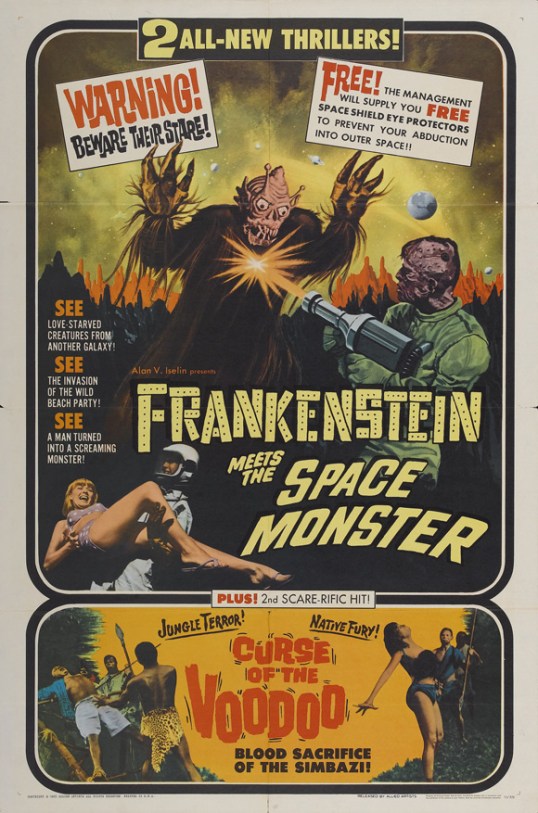
Today’s horror on the lens is the 1965 film, Frankenstein Meets The Space Monster.  This film features not only the debut of James Karen but it also gave him a rare lead role.  For once, james Karen gets to the hero!  Though he’s much younger than he was when he appeared in films like Poltergeist and Return of the Living Dead, you’ll know James Karen as soon as you see him.

Despite the movie’s title, it’s not about Frankenstein.  Instead, it’s about an astronaut named Frank who is actually an android.  When his latest mission into space goes wrong, Frank ends up crashing in Puerto Rico.  Now malfunctioning, Frank causes some major chaos.  Can his creator, Dr. Adam Steele (James Karen), track Frank down and put an end to his reign of terror?

And what about the Martians?  Android Frank isn’t the only threat in Puerto Rico.  A group of Martians have landed and are determined to kidnap any girl wearing a bikini so that they can use them to repopulate their race.  We’re told that every woman on Mars — with the apparent exception of Princess Marcuzan, played with evil haughtiness by Marilyn Hanold — has been killed as the result of an atomic war.  Assisting Princess Marcuzan is Dr. Nadir (Lou Cutell), a short, bald Martian with pointy ears.

One of the oddest things about Frankenstein Meets The Space Monster is that, despite being a standard — if wonderfully nonsensical — low-budget B-movie, it features a great soundtrack!  Just try to get “That’s The Way It’s Got To Be” out of your head.

Enjoy!

Horror On The Lens: Frankenstein Meets The Space Monster (dir by Robert Gaffney)


Today’s horror on the lens is the 1965 film, Frankenstein Meets The Space Man.  This film features not only the debut of character actor James Karen but it also gave him a rare lead role.  You may not recognize the name but you’ll know James Karen as soon as you see him.  He’s probably best known, among horror fans, for his roles in Poltergiest and Return of the Living Dead.

Despite the movie’s title, it’s not about Frankenstein.  Instead, it’s about an astronaut named Frank who is actually an android.  When his latest mission into space goes wrong, Frank ends up crashing in Puerto Rico.  Now malfunctioning, Frank causes some major chaos.  Can his creator, Dr. Adam Steele (James Karen), track Frank down and put an end to his reign of terror?

And what about the Martians?  Android Frank isn’t the only threat in Puerto Rico.  A group of Martians have landed and are determined to kidnap any girl wearing a bikini so that they can use them to repopulate their race.  We’re told that every woman on Mars — with the apparent exception of Princess Marcuzan, played with evil haughtiness by Marilyn Hanold — has been killed as the result of an atomic war.  Assisting Princess Marcuzan is Dr. Nadir (Lou Cutell), a short, bald Martian with pointy ears.

One of the oddest things about Frankenstein Meets The Space Monster is that, despite being a standard — if wonderfully nonsensical — low-budget B-movie, it features a great soundtrack!  Just try to get “That’s The Way It’s Got To Be” out of your head.

Enjoy!

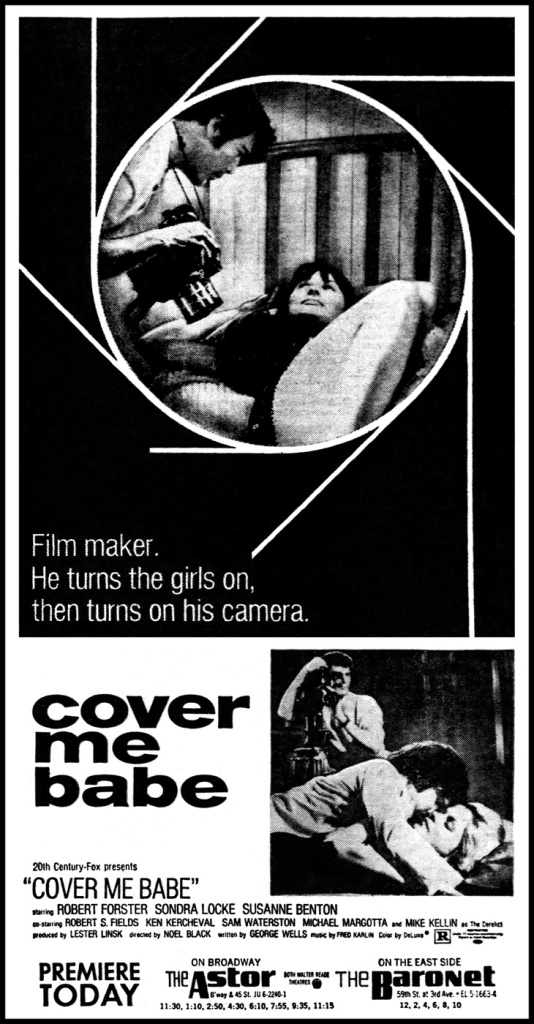
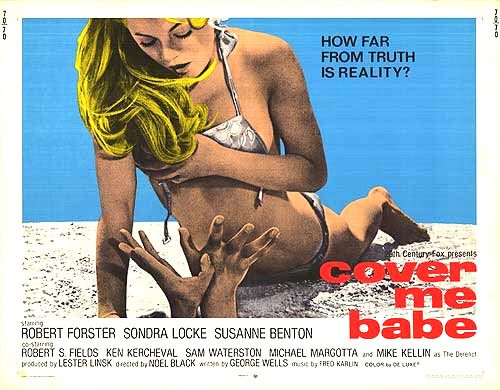
Film Review: Cover Me, Babe (dir by Noel Black)


I don’t know if I’ve ever come across a non-horror film that featured a more off-putting lead character than Tony, the protagonist of 1970’s Cover Me, Babe.

A film student, Tony (Robert Forster, even in 1970, who was too old for the role) aspires to make avant-garde films.  Everyone in the film continually raves about how talented Tony is.  The footage that we see, however, tends to suggest that Tony is a pretentious phony.  The film opens with footage of a student film that Tony shot, one that involves his girlfriend, Melisse (Sondra Locke) sunbathing in the desert and getting groped by a hand that apparently lives under the sand.  It was so self-consciously arty that I assumed that it meant to be satirical and that we were supposed to laugh along as Tony assured everyone that it was a masterpiece.  And, to be honest, I’m still not sure that Cover Me, Babe wasn’t meant to be a satire on film school pretension.  I mean, that explanation makes about as much sense any other.  (Hilariously enough, Tony’s film had the same visual style as the film-within-a-film around which the storyline of Orson Welles’s The Other Side of the Wind revolved.  At least in the case of Welles, we know that his intent was satirical.)

Tony is not only pretentious but he’s also a bit of a prick.  He treats Melisse terribly and he manipulates everyone around him.  He wanders around the city with his camera, filming random people and then editing the footage together into films that feel like third-rate Godard.  He answers every criticism with a slight smirk, the type of expression that will leave you dreaming of the moment that someone finally takes a swing at him.  Tony’s arrogant and he treats everyone like crap but, for whatever reason, everyone puts up with him because …. well, because otherwise there wouldn’t be a movie.  Of course, eventually, everyone does get sick of Tony because otherwise, the movie would never end.

A Hollywood agent (Jeff Corey) calls up Tony and offers to get him work in Hollywood.  Tony is rude to the guy on the phone.  Tony meets a big time producer who could get Tony work.  Tony’s rude to him.  Guess who doesn’t get a job?  Tony has to get money to develop his latest film from one of his professors so he’s rude to the professor.  Guess who doesn’t get any money?  Tony cheats on his loyal girlfriend.  Tony’s cameraman (played by a youngish Sam Waterston) walks out when Tony tries to film two people having sex.  By the end of the movie, no one wants anything to do with Tony.  Tony goes for a run on the beach.  He appears to be alienated and disgruntled.  We’re supposed to care, I guess.

The problem with making a movie about an arrogant artist who alienates everyone around him is that you have to make the audience believe that the artist is talented enough to justify his arrogant behavior.  For instance, if you’re going to make a movie about a painter who is prone to paranoid delusions and obsessive behavior, that painter has to be Vincent Van Gogh.  He can’t just be the the guy who paints a picture of two lion cubs and then tries to sell it at the local art festival.  You have to believe that the artist is a once-in-a-lifetime talent because otherwise, you’re just like, “Who cares?”  The problem with Cover Me, Babe is that you never really believe that Tony is worth all of the trouble.  The film certainly seems to believe that he’s worth it but ultimately, he just comes across as being a jerk who manipulates and mistreats everyone around him.

That said, from my own personal experience, a lot of film students are jerks who treat everyone them like crap.  So, in this case, I think you can make the argument that Cover Me, Babe works well as a documentary.  The fact of the matter is that not every film student is going to grow up to be the next Scorsese or Tarantino or Linklater.  Some of them are going to turn out to be like Tony, running along the beach and wondering why no one agrees with him about George Stevens being a less interesting director in the 50s than he was in the 30s.  As a docudrama about the worst people that you’re likely to meet while hanging out on campus, Cover Me, Babe is certainly effective.  Otherwise, the film is a pretentious mess that’s done in by its unlikable protagonist.  Everyone in the film says that Tony has what it takes to be an important director but, if I had to guess, I imagine he probably ended up shooting second unit footage for Henry Jaglom before eventually retiring from the industry and opening up his own vegan restaurant in Vermont.  That’s just my guess.

The poster has little to do with the film.

Horror On The Lens: Frankenstein Meets The Space Monster (dir by Robert Gaffney) (RIP, James Karen)


Today’s horror on the lens is dedicated to the memory of the great character actor James Karen.  Horror fans will remember him from Return of the Living Dead and Poltergeist.  He appeared in a countless number of films, usually playing men of authority.  1965’s Frankenstein Meets The Space Monster featured him in a rare starring role.

Despite the movie’s title, it’s not about Frankenstein.  Instead, it’s about an astronaut named Frank who is actually an android.  When his latest mission into space goes wrong, Frank ends up crashing in Puerto Rico.  Now malfunctioning, Frank causes some major chaos.  Can his creator, Dr. Adam Steele (James Karen), track Frank down and put an end to his reign of terror?

And what about the Martians?  Android Frank isn’t the only threat in Puerto Rico.  A group of Martians have landed and are determined to kidnap any girl wearing a bikini so that they can use them to repopulate their race.  We’re told that every woman on Mars — with the apparent exception of Princess Marcuzan, played with evil haughtiness by Marilyn Hanold — has been killed as the result of an atomic war.  Assisting Princess Marcuzan is Dr. Nadir (Lou Cutell), a short, bald Martian with pointy ears.

One of the oddest things about Frankenstein Meets The Space Monster is that, despite being a standard — if wonderfully nonsensical — low-budget B-movie, it features a great soundtrack!

Enjoy!

Horror on the Lens: Frankenstein Meets The Space Monster (dir


For today’s selection of horror on the lens, we offer up the odd 1965 horror/sci-fi/beach movie hybrid, Frankenstein Meets The Space Monster.  Despite the movie’s title, it’s not about Frankenstein.  Instead, it’s about an astronaut named Frank who is actually an android.  When his latest mission into space goes wrong, Frank ends up crashing in Puerto Rico.  Now malfunctioning, Frank causes some major chaos.  Can his creator, Dr. Adam Steele (played by character actor James Karen, who years later would appear in Return of the Living Dead), track Frank down and put an end to his reign of terror?

And what about the Martians?  Android Frank isn’t the only threat in Puerto Rico.  A group of Martians have landed and are determined to kidnap any girl wearing a bikini so that they can use them to repopulate their race.  We’re told that every woman on Mars — with the apparent exception of Princess Marcuzan, played with evil haughtiness by Marilyn Hanold — has been killed as the result of an atomic war.  Assisting Princess Marcuzan is Dr. Nadir (Lou Cutell), a short, bald Martian with pointy ears.

One of the oddest things about Frankenstein Meets The Space Monster is that, despite being a standard — if wonderfully nonsensical — low-budget B-movie, it features a great soundtrack!

Enjoy!

Horror on the Lens: Frankenstein Meets The Space Monster (dir by Robert Gaffney)


Frankenstein_Meets_the_Space_Monster

For today’s selection of horror on the lens, we offer up the odd 1965 horror/sci-fi/beach movie hybrid, Frankenstein Meets The Space Monster.  Despite the movie’s title, it’s not about Frankenstein.  Instead, it’s about an astronaut named Frank who is actually an android.  When his latest mission into space goes wrong, Frank ends up crashing in Puerto Rico.  Now malfunctioning, Frank causes some major chaos.  Can his creator, Dr. Adam Steele (played by character actor James Karen, who years later would appear in Return of the Living Dead), track Frank down and put an end to his reign of terror?

And what about the Martians?  Android Frank isn’t the only threat in Puerto Rico.  A group of Martians have landed and are determined to kidnap any girl wearing a bikini so that they can use them to repopulate their race.  We’re told that every woman on Mars — with the apparent exception of Princess Marcuzan, played with evil haughtiness by Marilyn Hanold — has been killed as the result of an atomic war.  Assisting Princess Marcuzan is Dr. Nadir (Lou Cutell), a short, bald Martian with pointy ears.

One of the oddest things about Frankenstein Meets The Space Monster is that, despite being a standard — if wonderfully nonsensical — low-budget B-movie, it features a great soundtrack!

Enjoy!