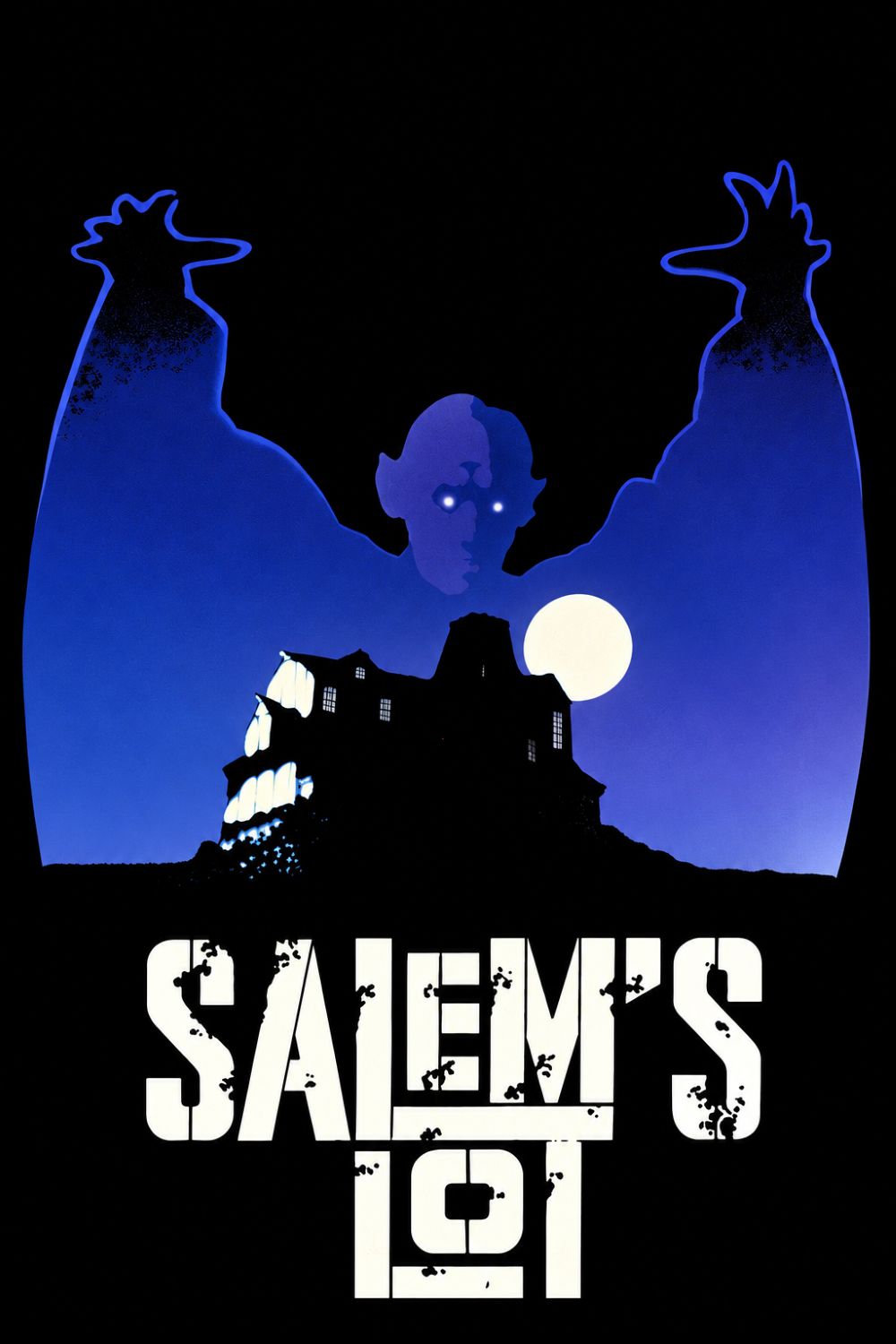
Horror Series Review: Salem’s Lot (by Tobe Hooper & Paul Monash)


“Open the window, Mark.” — Danny Glick

A town doesn’t have to look sinister to be hiding something rotten. That idea gives Tobe Hooper’s 1979 Salem’s Lot much of its staying power. Sure, there’s a creepy old house overlooking the neighborhood, but the real trouble settles into places that should feel reassuring: bedrooms, family homes, and familiar streets. Adapted from Stephen King’s novel, the miniseries turns an ordinary community into a feeding ground without losing sight of what made it ordinary in the first place. It’s uneven, occasionally stiff, and unmistakably a television production, yet its best moments deliver the sort of unease that expensive effects can’t guarantee.

The story begins with novelist Ben Mears, played by David Soul, returning to Jerusalem’s Lot, Maine. He’s drawn back partly by disturbing memories of the Marsten House, a property that seems to concentrate the town’s darkness. Unfortunately, antiques dealer Richard Straker and his mysterious partner, Kurt Barlow, have taken an interest in the place, too. Their arrival coincides with disappearances, illnesses, and deaths that suggest something worse than local bad luck. It’s familiar vampire territory, but familiarity works in its favor. We recognize the warning signs while the characters struggle to explain them away, creating tension between what the audience suspects and what the town will believe.

Hooper takes his time getting everyone into position, which is both a strength and a frustration. The early stretches contain plenty of conversation and everyday business before the supernatural threat becomes impossible to ignore. Some scenes could move faster, and a few supporting characters seem more interesting in principle than in practice. Still, the buildup matters. King’s novel isn’t simply about a vampire turning up; it’s about an entire town becoming vulnerable to him. The miniseries cannot reproduce the book’s full social landscape, but it establishes enough relationships and routines to make the destruction feel like more than a body count.

The town also isn’t an innocent paradise suddenly spoiled by an outside monster. Secrets, resentments, and unpleasant impulses already exist beneath its respectable surface. The vampires don’t invent those weaknesses so much as exploit them. This is an important part of King’s novel to preserve, and the adaptation gets the idea across even when individual subplots feel abbreviated. The Marsten House may be the obvious symbol of evil, but it doesn’t exist in isolation. Its presence above the town suggests a darkness everyone can see and would rather leave alone. That indifference makes the setting more interesting than a collection of unsuspecting victims.

Soul provides a steady center as Ben, even if his restrained performance sometimes borders on flatness. He’s convincing as a man returning to unfinished emotional business, and his seriousness keeps the increasingly bizarre events grounded. There’s little danger of him making the material feel campy. His reserve occasionally creates distance, though, especially when the story needs a stronger emotional response. Ben works best as an observer forced into action, someone whose interest in haunted history becomes considerably less comfortable once it stops behaving like material for a book. Soul conveys that shift more effectively than the warmer aspects of the character.

The romance with Susan Norton, played by Bonnie Bedelia, is less satisfying. Their relationship offers a glimpse of the life Ben might build in town, giving him something to move toward rather than simply something to investigate. That’s useful, but the scenes don’t always generate enough warmth to make the possibility compelling. Bedelia brings an appealing directness to Susan, yet the relationship can feel emotionally hurried even when the surrounding story moves slowly. You understand why it belongs without becoming invested in every exchange. A stronger connection would have given the supernatural threat a more painful personal dimension.

Lance Kerwin makes a livelier impression as Mark Petrie, a horror-loving kid whose interests become unexpectedly practical. Mark could have been a convenient walking instruction manual, but Kerwin gives him enough vulnerability to avoid that trap. He recognizes the danger without becoming immune to it. There’s also something satisfying about a character who takes the evidence seriously rather than endlessly refusing to accept it. His imagination helps him understand the situation, but it doesn’t make everything manageable. That distinction captures something essential about King’s treatment of childhood: knowing what the monster is can help you survive, but it won’t stop you from being terrified.

James Mason is the cast’s great weapon. As Straker, he brings such controlled unpleasantness that a polite conversation can feel like a threat. His calm suggests someone completely comfortable with things everyone else would find horrifying. Is he being dismissive, quietly amused, or openly contemptuous? Often, the answer seems to be all three. Mason gives the production authority whenever he appears, making civilized behavior look like something a predator has learned to imitate. He’s particularly effective because he doesn’t strain for menace. The performance lets us sense the cruelty beneath the manners without constantly dragging it into view.

That elegance becomes especially important because Barlow departs sharply from the novel. King’s vampire can speak, manipulate, and present a recognizable personality. Hooper and actor Reggie Nalder instead give us a largely silent creature, leaving Straker to handle the smooth conversation. Readers who miss the original Barlow have a fair argument: something is lost when an articulate villain becomes primarily a physical menace. Onscreen, though, the decision pays off. With his bald head, pointed ears, and jutting teeth, this Barlow recalls Nosferatu rather than a charming drawing-room vampire. He looks fundamentally unwelcome, and Hooper limits his appearances enough to keep that impression potent.

Even so, Barlow isn’t responsible for the miniseries’ most haunting imagery. That honor belongs to the children floating outside bedroom windows. These sequences create a nasty collision of recognition and wrongness: the face is familiar, but its position, movement, and expression are not. The glass offers protection, yet the request to be let inside makes that protection uncertain. Hooper turns the instinct to welcome someone you know into something dangerous. The possibility that affection might defeat caution makes these scenes more troubling than a straightforward attack. They threaten not only physical safety but the trust that makes a home feel secure.

The windows themselves are wonderfully simple horror devices. They let the characters see the danger while leaving them exposed to its attention. A wall would conceal it; an open doorway would admit it. The glass suspends the scene between those possibilities, stretching out the question of whether the barrier will hold. Mist and unnatural movement complete the effect without requiring elaborate explanations. Almost everyone understands the feeling of being awake in a dark room, looking toward a window and wishing something more substantial separated inside from outside. Hooper takes that common vulnerability and gives it a face.

Moments like these make the television restrictions feel less like a handicap than a challenge Hooper knows how to use. Without relying on graphic violence, he builds horror through faces, shadows, sound, and timing. The production doesn’t always escape its limitations: some exchanges feel conventional, transitions can be abrupt, and the pacing occasionally stalls. But the ordinary interiors also help establish the world being invaded. These look like rooms where people eat dinner, argue, and sleep. The adaptation sacrifices some of the novel’s complexity, thinning supporting characters and narrowing the town’s communal collapse, yet preserves the frightening contrast between everyday surroundings and impossible events.

What finally makes Salem’s Lot worth returning to isn’t perfect fidelity or flawless pacing. It’s the way Hooper understands what the vampires take away before they take anyone’s life: the ability to trust familiar surroundings and familiar faces. King explores that collapse more deeply, but the miniseries preserves its central nightmare with remarkable force. Its quieter stretches give the horror somewhere recognizable to live, and its strongest images make that recognition uncomfortable. By the end, the town’s comforting routines have become part of the trap. For a production working within network television’s boundaries, that’s an impressive achievement—and a more lasting scare than extra blood would have provided.
I Watched Perry Mason: The Case of the Poisoned Pen (1990, Dir. by Christian I. Nyby II)


When an arrogant true crime writer named Bradley Thompson (David Warner) is poisoned while attending a writers conference, his ex-wife (Barbara Babcock) is arrested and charged with his murder.  Perry Mason (Raymond Burr) and Ken Malansky (William R. Moses), who had their own run-in with Thompson, defend her in court and try to track down the real murderer.

This was a good whodunit.  The mystery was pretty easy to solve but all of the suspects were memorable and the supporting cast, which included Cindy Williams, Tony Lo Bianco, and Earl Boen, were entertaining to watch.  My favorite character was Max Mulgrew, a tough-guy crime writer who was played by Kiel Martin.  When Mulgrew was asked if he hated Thompson enough to murder him, Mulgrew says yes but he would have shot him instead of poisoning him!

Amy Hastings, who Alexandra Paul played in the previous three movies, is not in this movie and nobody says anything about her so, hopefully, her character has moved on.  Without Amy around, that means that Della (Barbara Hale) gets to help out with the investigation for once.  It was nice to see Della showing why she was the best assistant that Perry could have ever hoped for.

I remember enjoying this movie when I watched it with my aunt a few years ago.  I enjoyed it again when I watched it last night.

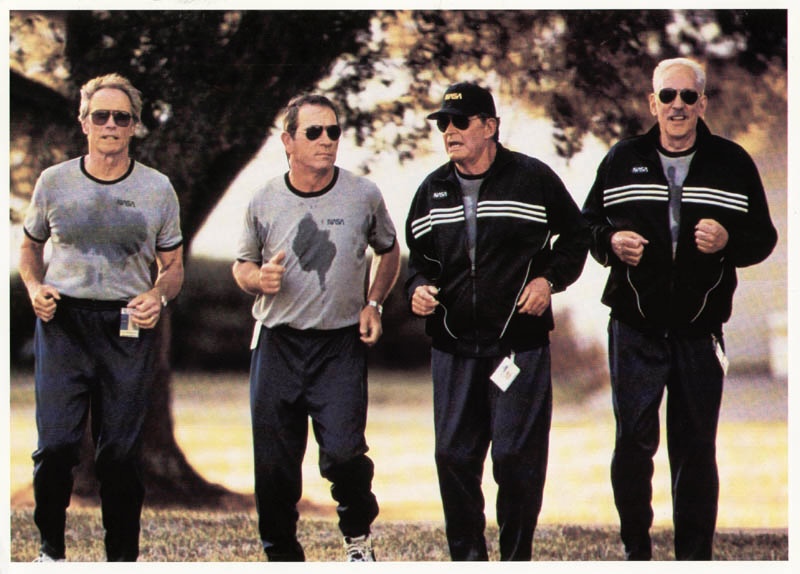
I review SPACE COWBOYS (2000) – starring Clint Eastwood, Tommy Lee Jones, Donald Sutherland and James Garner!


Here at The Shattered Lens, we’re definitely celebrating Clint Eastwood’s May 31st birthday. As part of that celebration, I decided to revisit his 2000 film, SPACE COWBOYS. 

SPACE COWBOYS opens in 1958 on the day that Air Force Test Pilot Frank Corvin (Clint Eastwood) and his team of Hawk Hawkins (Tommy Lee Jones), Jerry O’Neill (Donald Sutherland), and Tank Sullivan (James Garner) find out that their test program is being shutdown due to the formation of NASA. Their dreams of someday making it to space are crushed, and to make it worse, they were stabbed in the back by their leader Bob Gerson (James Cromwell) and not invited to be part of NASA’s new testing program. Fast forward to the present time, where a Soviet communications satellite seems to be unresponsive and NASA is working with Russian General Vostov (Rade Serbedzija) to figure out how to keep it from crashing back to Earth. The satellite is a relic of the Cold War that somehow ended up with a guidance system on board that’s so old that it was designed by Frank, and the young folks don’t know how to work with it. And to complicate things even further, the guidance system can only be fixed on site, which means in space. So it seems that NASA finally needs Frank after all this time, and he’ll only agree to help if he’s able to bring his old team on board. Their old nemesis Bob, the project’s manager at NASA, reluctantly agrees. We see that he’s still the same bastard he’s always been as he and General Vostov are holding back critical information about the cargo of the satellite. So let the training and preparation for the mission begin! 

The premise of SPACE COWBOYS may not be very realistic, but I think it’s one hell of a fun movie, especially during its first half. I really enjoy watching this amazing cast of veteran actors do their thing. Of course they get the cool walk into NASA headquarters wearing sunglasses and leather jackets, while N’ Sync’s “Space Cowboy” plays over the soundtrack. Clint Eastwood plays the character he has perfected over his career, that of the tough, grizzled leader with a dry sense of humor. Tommy Lee Jones is the fearless hotshot who has never been good at following orders, but has the kind of talent that everyone wishes they had. Jones is actually by far the youngest of the primary cast, a full 16 years younger than Eastwood. Donald Sutherland gets some of the best laughs as the ladies man of the team. The scene where he answers Jay Leno’s question about his reputation as a lothario made me laugh out loud! James Garner’s character became a Baptist minister after his days with the Air Force and prays often for the group. He’s good here, but his character is the least memorable. With their mission labeled “The Ripe Stuff” by the media, watching these great older actors go through their training, and deal with their much younger counterparts and the NASA brass, is a joy. I also want to shout out William Devane as the NASA flight director for the mission. He has a couple of really strong scenes. 

The legendary cast of this film can’t help but give a seasoned moviegoer like me a warm sense of nostalgia based on their amazing body of work. I remember introducing KELLY’S HEROES to my son when he was a boy. He watched my DVD over and over again. Seeing Eastwood and Sutherland together here brought those memories back. One of my very favorite revenge films is ROLLING THUNDER with William Devane and Tommy Lee Jones. Seeing them together here helps me remember just how great they are in that badass classic. Heck, Garner’s character name of “Tank” Sullivan takes me back to one of the very first movies our family rented when we got our VCR in the mid-80’s! Do y’all remember Garner’s film TANK from 1984? I certainly do! 

I will admit that once the crew takes off and begins the actual mission, which comprises about the last 45 minutes of the film, the entertainment level goes down a couple of notches for me. The technical aspects of completing the mission are not as interesting to me as the character interplay in the earlier portions of the film. With that said, there are still some exciting moments to be had, including the nailbiter of a landing at the end. 

I enjoyed revisiting SPACE COWBOYS after quite a few years. This movie is ultimately a crowd pleaser, and for me, it does its job well. Enjoy the trailer below:

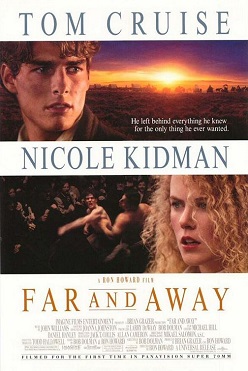
Far and Away (1992, directed by Ron Howard)


The year is 1892 and Joseph Donnelly (Tom Cruise) is a poor tenant famer in Ireland, used and exploited by the wealthy landowners.  Joseph falls in love with Shannon Christie (Nicole Kidman), the rebellious daughter of his landlord.  Shannon dreams of going to America, where rumor has it that land is being given away in the territory of Oklahoma on a first come/first serve basis.  Shannon even has some valuable spoons that she can use to raise money once they arrive in America.  Joseph, after being challenged to a duel by the Christies’ money manger, Stephen Chase (Thomas Gibson), also decides that heading to America might be a good idea.

Life in America is not as easy as Joseph and Shannon thought it would be.  They first end up in the dirty town of Boston, where Shannon loses her spoons and Joseph works for a corrupt political boss (Colm Meaney) and makes money as a bare-knuckles boxer.  They’ll reach Oklahoma eventually but not before Stephen and the Christies come to Boston and Joseph ends up working on the railroad and getting called “that crazy mick” multiple times.

Far and Away was Ron Howard’s attempt to make an American epic, in the style of John Ford.  It doesn’t work because Tom Cruise is too contemporary to be believable as a 19th century Irish immigrant and Howard tries so hard to push everything to an epic scale that it just makes it even more obvious how slight and predictable the movie’s story is.  Far and Away is full of big movie moments but it lacks the small human moments necessary to really engage its audience.  I will always remembers Far and Away because it was one of those films that seemed to take up permanent residence on HBO when I was growing up.  I didn’t really care about the film’s flaws back then.  Nicole Kidman was attractive and tall and she had wild red hair and back then, that’s all a movie needed to hold my attention.  Unlike Cruise, Nicole Kidman can effortlessly move between historical and contemporary films and, of the two leas, she comes off the best.  The movie is really stolen, though, by Colm Meaney, playing a ruthless political boss who could have taught Boss Tweed a thing or two.

Tomorrow is St. Patrick’s Day, when we will be celebrating the legacy of immigrants like the Christies and the Donnellys.  Far and Away tries to pay tribute to their courage and their refusal to give up, even when things were tough and deadly on the frontier.  For me, though, Far and Away will always just make me think of HBO in the 90s.

Retro Television Reviews: The Last Child (dir by John Llewellyn Moxey)


Welcome to Retro Television Reviews, a feature where we review some of our favorite and least favorite shows of the past!  On Sundays, I will be reviewing the made-for-television movies that used to be a primetime mainstay.  Today’s film is 1971’s The Last Child!  It  can be viewed on YouTube!

Welcome to the “near future.”

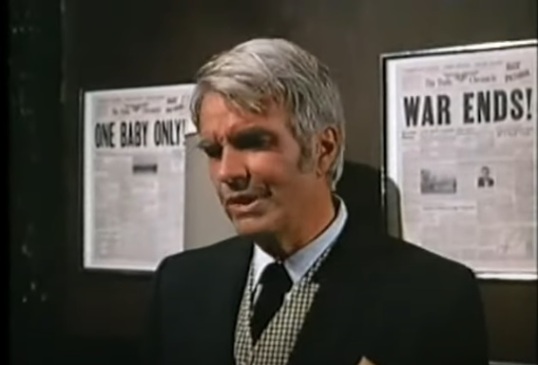
Panicked by hysterical claims about overpopulation and environmental catastrophe, Americans have sacrificed the majority of their civil liberties.  Smiling policeman stand on every corner and in every public hallway.  Of course, once their authority is challenged, those smiles quickly disappear.  Crude posters have been put up everywhere, demanding that everyone watch their consumption of natural resources.  The social engineers and the eugenicists are in charge.  Anyone over the age of 65 is ineligible for medical care and encouraged to consider euthanasia.  Couples are allowed to have only one child and the government requires that anyone who gets pregnant a second time have an abortion.  Anyone who questions the policy is told that they have no choice but to follow the law.  It’s their civic duty.  The media, meanwhile, runs headlines declaring that the one child policy has led to world peace.
Alan and Karen Miller (played by Michael Cole and Janet Margolin) have already had their one child.  That their child died shortly after birth doesn’t matter in the eyes of Barstow (Ed Asner), the Himmleresque head of the Population Control Police.  Every couple is allowed one child and that’s it.  When Karen gets pregnant a second time, she is determined to have the baby.  She and Alan know that their only hope is to cross the border into Canada.  Helping them is a retired U.S. Senator (Van Heflin, in his final performance) who is opposed to the government’s policies.  Caught in the middle of Karen’s brother, Howard (Harry Guardino).  Howard works for the Population Control Police and he knows just how far Barstow is willing to go to keep Karen from having her baby.

The Last Child opens with a title card informing us that the film takes place in the “not-too-distant future.”  Along with all of the propaganda posters, that’s the only real sign that this film is meant to be taking place in the future.  There’s no “futuristic” technology.  Everyone dresses in the latest 1971 fashions.  Everyone drives the latest 1971 automobiles.  Though the decision may have been motivated by the film’s low-budget, the lack of the typical sci-fi trappings serves the film well.  The Last Child does not take place in a sleekly designed future and it doesn’t takes place in an apocalyptic wasteland.  Instead, it takes place in a world that is just as shabby as you would expect a world controlled and decorated by a government bureaucracy to be.  It’s a gray dystopia, populated by people who have given up their individuality.  It’s a world that’s visually boring by design and that makes it all the more disturbing.

The Last Child is an effective and well-acted film.  It probably feels more plausible today than it did when it aired back in 1971.  In many ways, with its portrait of unfeeling government officials and bland authoritarianism, it’s the perfect film for the age of COVID.  Indeed, the government’s policy of refusing to provide life-saving care for people over the age of 65 is reminiscent of what many pundits advocated for at the height of the COVID pandemic.  As for the film’s one child policy, that too is a concept that has become recently popular with many American academics.  Among many members of the so-called “elites,” there’s a definite need to try to control people and that very real need is what makes The Last Child so disturbingly plausible.  In The Last Child, sanctuary is found in Canada.  Today, of course, Canada is at the forefront of the euthanasia trend.  Of course, in 1971, the Prime Minister of Canada was Pierre Trudeau and not Justin.

Pierre Trudeau’s personal motto was “Reason before passion” and that’s certainly the philosophy that fuels the dystopian society at the center of The Last Child.  It’s a film that holds up today as both a thriller and a prophecy,

Retro Television Review: Quarterback Princess (dir by Noel Black)


Welcome to Retro Television Reviews, a feature where we review some of our favorite and least favorite shows of the past!  On Sundays, I will be reviewing the made-for-television movies that used to be a primetime mainstay.  Today’s film is 1983’s Quarterback Princess.  It  can be viewed on YouTube!

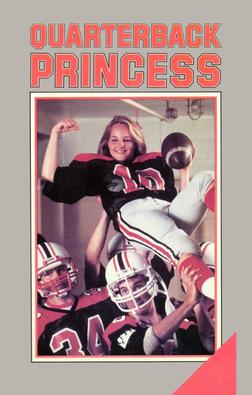
Quarterback Princess begins with Ralph Maida (Don Murray) dropping in on the coach of a high school football team in the small town of Minnvile, Oregon.  Ralph explains that he and his family are going to be relocating to the town from Canada.  His eldest child wants to play football and Ralph is curious as to when the team will be holding the tryouts.  The coach asks what position Ralph’s son plays.  Ralph explains that Tami is his daughter and she plays quarterback.  After an awkward moment of silence, the coach explains that he’ll have to talk to the school board.

Yes, Quarterback Princess is one of those films.  It’s an only girl on the team film, in which an athletic teenager has to convince not only her male teammates but also all of the stodgy old people that she can play just as well as the boys.  On the one hand, films (and shows, as Degrassi had an entire storyline about Jane trying to get on the school’s football team) like this are usually entertaining because it’s fun to watch a girl succeed while all of the men sputter with outrage until the team starts winning.  On the other hand, they’re always a little bit difficult for me to relate to because I would honestly have no interest in doing what Tami’s doing and it’s hard for me to understand why anyone else would either.  I mean, seriously why would anyone want to live in Oregon when Montana’s just a short drive away?

Quarterback Princess is based on a true story.  In real life, Tami Maida was 14 year old when she joined her high school football team as their quarterback.  That season, the team had a record of 7-1 and they won the state championship.  Tami was also elected Homecoming Queen that seem year.  The parts of the movie that seem like the type of thing that only a screenwriter could come up actually happened.  Helen Hunt, who was 20 years old at the time, plays Tami.  When I watched the film, I thought Hunt did a good job in the scenes off field but I thought she was a bit unconvincing when she was actually playing the game and throwing the ball.  Fortunately, I did some research before I actually wrote this review and I discovered that Tami served as Helen Hunt’s stand-in during the film and, in most of the game scenes, that actually is Tami throwing the ball and running around the field.  That shows you how much I know about football.

Quarterback Princes is definitely a made-for-television production.  These are the only high school football players in existence who neither drink nor curse.  For that matter, the coaches are surprisingly nice as well.  That said, it isn’t bad.  The best scenes are the ones that feature Tami and her family adjusting to Tami’s sudden fame.  Daphne Zuniga gives a sympathetic performance as Tami’s sister, who is not particularly happy about how Tami’s sudden fame has changed everyone’s lives.  The always likable John Stockwell plays Tami’s boyfriend and the two of them are a believable couple.  Noel Black, who also directed Pretty Poison, does a good job of keeping the action moving at a steady pace.  Probably the worse thing you can say about this film is that it was a bit predictable but, in this case, all of the predictable stuff actually happened so what can you do?