Film Review: They Shoot Horses, Don’t They? (dir by Sydney Pollack)


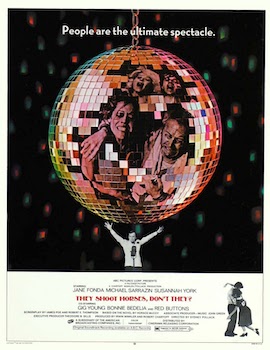
1969’s They Shoot Horses, Don’t They? is a film about many different things.

On its simplest level, it’s a film about a group of people who, during the Great Depression, take part in a brutal dance marathon in hopes of winning a $1,500 cash prize and maybe the chance to be spotted by a Hollywood talent scout. It’s a film about the desperation of being poor and forgotten, and it’s all the more effective because it was based on a novel that was actually written during the Great Depression. There’s an authenticity to the characters in They Shoot Horses, Don’t They? The original 1935 novel, which I read a few years ago, was written by Horace McCoy, a hard-living Dallas journalist who sometimes supplemented his income by working as a bouncer. McCoy knew the world about which he was writing.

The film is also about the power and allure of fame. The dancers may be exhausted, but they have fans who sit in the stands and who, in return for a smile and a kind word, will sometimes buy them new shoes or a decent meal. At one point, Hollywood director Mervyn LeRoy appears in the audience, and all of the dancers make a point of smiling as they pass in front of him. Meanwhile, the grueling derbies, in which the dancers tandem race in circles around the dance hall, predict the humiliation rituals of reality television. In its way, They Shoot Horses, Don’t They? is just as prophetic a film as Network.

The film is also about memory. The film is full of flashbacks and flash-forwards, giving us a portrait of the life of Robert Syverten (Michael Sarrazin), a homeless man who wandered into a dance marathon in Santa Monica. In a flashback, young Robert watches as his grandfather euthanizes a horse that has broken its leg. In a flash-forward, we watch as Robert talks to the police about a crime. And, in what we assume is the story’s “present,” we watch as Robert is partnered up with Gloria Beatty (Jane Fonda), a weary woman who continues to dance even though she no longer believes any of the hype that emcee Rocky Gravo (Gig Young) spouts about how the marathon can be the start of a brand new life.

It took me a while to get used to the flashbacks and the flash-forwards. At first, I thought they were a mistake. They seemed like a gimmicky addition to an otherwise straightforward story. But as the story played out, I came to appreciate the film’s nonlinear structure. Ultimately, the film is about Robert trying to come to terms not only with his actions but also with the actions of everyone involved with the marathon. I also came to realize that the film’s present was actually Robert in the police station and that the scenes of Robert at the dance marathon were his own memories of the vent. The film becomes less about the Depression and more about one person, a lost soul in a cold world, trying to figure out how his life eventually led to him sitting in an interrogation room, accused of a terrible crime.

The entire cast does a good job. Susannah York, who plays an aspiring actress, has an intense scene in which she breaks down when she can’t find the dress she wants to wear. Bruce Dern and Bonnie Bedelia are sympathetic as a young couple. Veteran tough guy Michael Conrad rolls around on roller skates and barks at everyone to keep moving. When Red Buttons shows up as a kind-hearted veteran dancer, your immediate response is to smile because, as a lover of classic films, you immediately associate Buttons with comedy and optimism. In The Poseidon Adventure, he was the one passenger who never gave up hope. But even his character is soon dwarfed and consumed by the ominous atmosphere inside the dance hall. At first, I thought Michael Sarrazin was a bit too stiff as Robert and Jane Fonda was too brittle as Gloria, but as the film progressed, I warmed to both of their performances. Say what you will about Jane Fonda’s political activism (and I personally think that many of her actions during the Vietnam War and her subsequent claims that American POWs were lying about being tortured were and are unforgivable), she was one of the best actresses of her generation.

Though Robert and Gloria may be at the center of the film, the narrative’s diseased heart belongs to Rocky Gravo. Rocky is the emcee and the promoter, the one who implores the crowd to applaud as their favorite dancers attempt to keep moving on the dance floor after weeks of little sleep or food. “Yowzah, yowzah!” Rocky exclaims, hyping up the audience and promising everyone that good times are right around the corner. Of course, since Rocky is also the event’s promoter, the longer the dancers suffer, the more money he makes. Whenever Rocky is on screen, the viewer can almost smell the gin and the cigars and the flop sweat. Gig Young won an Oscar for playing Rocky Gravo, and he undoubtedly deserved it. At times, it seems less like a performance and more like Young trying to exorcise his own demons. Ten years later, he would murder his fifth wife and then shoot himself.

They Shoot Horses, Don’t They? received a total of nine Oscar nominations. Sydney Pollack received his first nomination for Best Director, and Jane Fonda her first for Best Actress. Susannah York was nominated for Supporting Actress. The film received nominations for its screenplay, its editing, its art direction, and its score. The only winner was Gig Young. At the time, the film set a record for receiving the most Oscar nominations without also receiving a nomination for Best Picture. It’s tempting to say that the film was too dark and too depressing for the Academy, but then you have to consider that the Academy’s pick for Best Picture for that year was Midnight Cowboy.

(Interestingly enough, Michael Sarrazin was also a top contender for the role of Joe Buck in that film.)

It’s not a happy film or a particularly subtle film. But it remains a powerful film, one that truly sticks with you. The film haunts the viewer, as surely as Gloria will always haunt Robert.
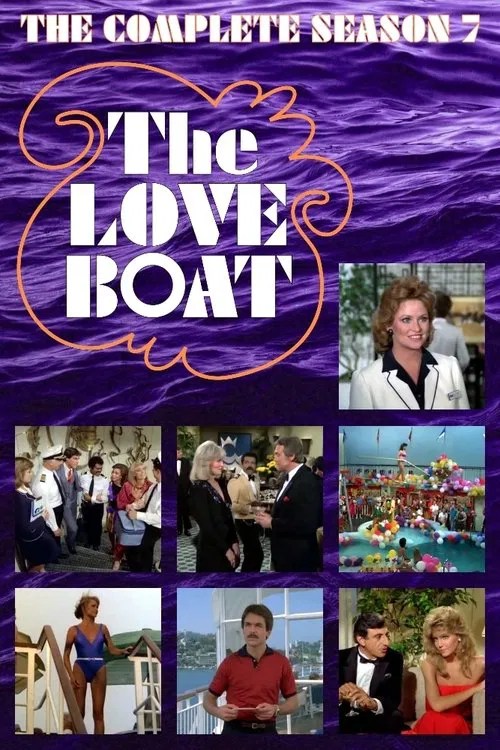

Retro Television Review: The Love Boat 7.14 “The Last Case/Looking for Mr. Wilson/Love on Strike”


Welcome to Retro Television Reviews, a feature where we review some of our favorite and least favorite shows of the past!  On Wednesdays, I will be reviewing the original Love Boat, which aired on ABC from 1977 to 1986!  The series can be streamed on Paramount Plus!

Come aboard, we’re expecting you….

Episode 7.14 “The Last Case/Looking for Mr. Wilson/Love on Strike”

(Dir by Richard A. Wells, originally aired on December 17th, 1983)

This week, an old high school friend of Julie’s is on the cruise.  Whenever anyone from Julie’s past shows up, it means drama.  Five years ago, when Jan Maddox (Jeanine Wilson) told her boyfriend, Michael, that she was pregnant, he ran out on her.  Jan lied to her father, the rigid Colonel Maddox (Claude Akins), and told him that she and Michael had gotten married.  For five years, Jan has been telling her father that she’s married.  When Colonel Maddox boards the ship and meets his grandson Richie (R.J. Williams) for the first time, Jan continues to lie.  She says that Michael got called away on business.

However, when Jan meets a charming single passenger (Tony Dow) and starts to fall for him, she decides to tell her father the truth.

“My grandson is illegitimate?” Maddox says, in a tone more worthy of 1883 than 1983.

Colonel Maddox says that he never wants to see his daughter or his grandson again.  Seriously?  Okay, good riddance.  Colonel Maddox is a terrible person and Jan seems to be doing fine without him.  However, Julie mentions to Maddox that Michael walked out on Jan and now the Colonel is doing the same thing.  And then Richie tracks him down and yells, “You’re a mean old man and I hate you!”  Colonel Maddox sees the error of his ways and that magically fixes everything.  Jan forgives him.  Richie forgives him.  I would not have forgiven him.  Then again, I also wouldn’t have lied about being married in the first place.

While this is going on, Jenny (Didi Conn) boards the ship and spends the cruise harassing her ex-boyfriend (Grant Goodeve) and his new girlfriend (Wendy Schaal).  Jenny boards with two signs, each declaring that her ex is a louse.  She follows him around the ship, chanting about what a louse he is.  When she sees him dancing with his new girlfriend, she grabs a microphone and starts to talk about him to all the other passengers.  Jenny probably should have been taken into custody and kicked off the boat at the next port-of-call.  Instead, everyone acts as if Jenny’s actions are cute.  It’s a weird story.

Finally, a mysterious woman known as the Contessa has disappeared from her cabin.  Stubing convinces an old friend, retired detective Manfred Benusse (John Hillerman), to investigate.  (I would think that the Captain would be required — by law and company policy — to report a missing passenger as soon as it was discovered that she was missing but whatever.)  It turns out that there never was a Contessa.  The whole thing was a set up, engineered by Benusse’s secretary, Liliane Pendergrast (Allyn Ann McLerie).  Lillian didn’t want Benusse to retire and she thought that, if she gave him an unsolvable case, he would change his mind and I presume spend the rest of his days searching for a non-existent human being.  I’m not sure how that would have been a good thing but, once Benusse figures it all out, he falls in love with Ms. Pendergrast.  When you consider the fact that he could have easily been fired if Benusse hadn’t figured out what his secretary was doing, the Captain is surprisingly forgiving.

This was a really weird episode but the detective storyline was kind of charming in its nonsensical way.  Hillerman did such a good job as the detective that it made up for the fact that the other two stories were kind of annoying.  The end result was a pleasant cruise.


Retro Television Review: St. Elsewhere 2.14 “Drama Center”


Welcome to Retro Television Reviews, a feature where we review some of our favorite and least favorite shows of the past! On Fridays, I will be reviewing St. Elsewhere, a medical show which ran on NBC from 1982 to 1988.  The show can be found on Hulu and, for purchase, on Prime!

This week, things get depressing.

Episode 2.14 “Drama Center”

(Dir by David Anspaugh, originally aired on February 15th, 1984)

This week’s episode opens with a disturbing scene in which a woman, trying to get her car to start on a snowy night, is attacked and raped in the parking lot of St. Eligius.  The rapist is wearing a green jacket and a ski mask.

At first, I assumed that the rapist was a random lowlife, someone who would likely never be seen again.  But then Dr. Cavanero’s wealthy boyfriend tried to force himself on her and I was left wondering if maybe he would be revealed as the man in the ski mask.  However, towards the end of the episode, there was scene featuring Dr. Peter White.  Having been banned from working in the ER and from prescribing medicine, White is now working in the morgue and, needless to say, he spends this entire episode bitching about it.  As the episode ends, we see that Peter is holding a capsule in his hand, suggesting that he is once again abusing drugs.  However, I also noticed that Peter was wearing the same green jacket as the man in the ski mask!

This was a good episode, well-written and well-acted.  It was also pretty depressing.  Dr. Westphall brings his severely autistic, noncommunicative son Tommy (Chad Allen) to St. Eligius so that Dr. Ridley can examine him.  Dr. Ridley warns Westphall that Tommy is aggressive and that Westphall might not be able to continue to care for him at home, despite the fact that Westphall’s daughter (Dana Short) is planning on forgoing her dream college to stick around and help.  Westphall ends his day reading Tommy a book (“Your mom bought you this book.”) and breaking down into tears and it made me cry a little too.

Meanwhile, a TV crew followed around Dr. Craig for a documentary.  Needless to say, they got in the way and they got on Craig’s nerves.  The director was played by Michael Richards, who, of course, is best-known for playing Kramer on Seinfeld and then having a racist meltdown when he got heckled at a comedy club.   In an episode that was, emotionally, pretty dark, it was almost a relief to get some scenes of Dr. Craig losing his temper with the documentary crew.  As someone who knows William Daniels best as the kindly Mr. Feeney from countless Boy Meets World reruns, it’s been a real pleasure to Daniels as the prickly and arrogant Dr. Craig.  Dr. Craig wouldn’t have had much use for the Matthews clan and all of their drama.

This was an intense and sad episode.  It was St. Elsewhere at its most emotional.

Retro Television Reviews: The Love Boat 1.14 “Isaac’s Double Standard / One More Time / Chimpanzeeshines”


Welcome to Retro Television Reviews, a feature where we review some of our favorite and least favorite shows of the past!  On Wednesdays, I will be reviewing the original Love Boat, which aired on ABC from 1977 to 1986!  The series can be streamed on Paramount Plus!

It’s time for love and monkeys!

Episode 1.14 “Isaac’s Double Standard / One More Time / Chimpanzeeshines”

(Dir by James Sheldon and Richard Kinon, originally aired on January 14th, 1978)

This is a bit of an odd episode.

It’s odd because it features yet another stowaway.  Somehow various characters were always managing to stow away on the boat.  This week, the stowaway was a chimpanzee.  How did a chimpanzee get on the boat?  Gopher brought her on.  Apparently, Gopher was under the impression that he had the week off so he agreed to look after a friend’s chimpanzee.  Then he discover that he actually was working that week so he decided that it would be a good idea to smuggle the chimpanzee onto the boat.  Of course, it doesn’t take long for Isaac and Julie to discover that Gopher has a chimpanzee in his cabin.  Neither one of them appears to be surprised that Gopher has a friend who owns a chimpanzee.  Me, I would want more information on whether or not Gopher’s friend worked for a circus or a zoo or a research lab.  I mean, most people just don’t own chimpanzees as pets.  Instead, everyone just accepts that Gopher is living with a monkey and that it is now their duty to keep Captain Stubing from finding out.

Of course, the chimpanzee gets loose.  She runs around the ship, stealing food and clothes and surprising passengers.  Fortunately, she’s a well-trained chimpanzee and she doesn’t try to kill anyone.  In real life, Chimpanzees are known for being extremely dangerous and unpredictable.  On shows like this, they’re adorable! 

While looking for the chimp, Gopher meets and has a romance with Anne Parker (Kim Lankford), who has just had a nose job.  She’s insecure about her new nose.  Everyone assures her that her new nose looks great.  And it does!  As someone who spent most of her teen years planning on getting a nose job, I was really impressed with it.  (For the record, I still have my original nose and I now realize I wouldn’t change it for the world.)

While Gopher is dealing with the chimp, Isaac is freaking out because his mother (Pearl Bailey) is on the ship with her new boyfriend (Arthur Adams) and they’re sharing a cabin!  Isaac is being a little bit hypocritical because he happens to be sharing a cabin with his girlfriend, Charlene (Tracy Reed).  Isaac finally realizes he’s not being fair and he accepts the fact that his mother is having sex at his workplace.  So, it all works out.

Meanwhile, in our third storyline, Nanentte Fabray is a singer who is hired to provide the cruise’s entertainment.  She’s upset to discover that her pianist (Don Adams) is also her ex-partner.  Don’t worry, they get back together by the end of the cruise.  Of course, everyone’s too busy looking for the chimpanzee to notice.

This was not a terrible episode, just an odd one.  The Nanette Fabray/Don Adams storyline was pretty forgettable and, though it’s always cool when Ted Lange actually gets to do something other than make drinks, Isaac’s family situation played out predictably.  What made this episode stand out, for better or worse, was all the business with the chimpanzee.  How Gopher kept his job after that, I have no idea.  Chimpanzees have been known to kill people if they get stressed out and being dragged onto a cruise ship by a stranger seems like it would be a stressful situation.  Still, after all that, Gopher kept his job.  I’m beginning to think that Captain Stubing might not be the disciplinarian that the crew things he is.

Next week, we’ve got more love but hopefully less monkeys.