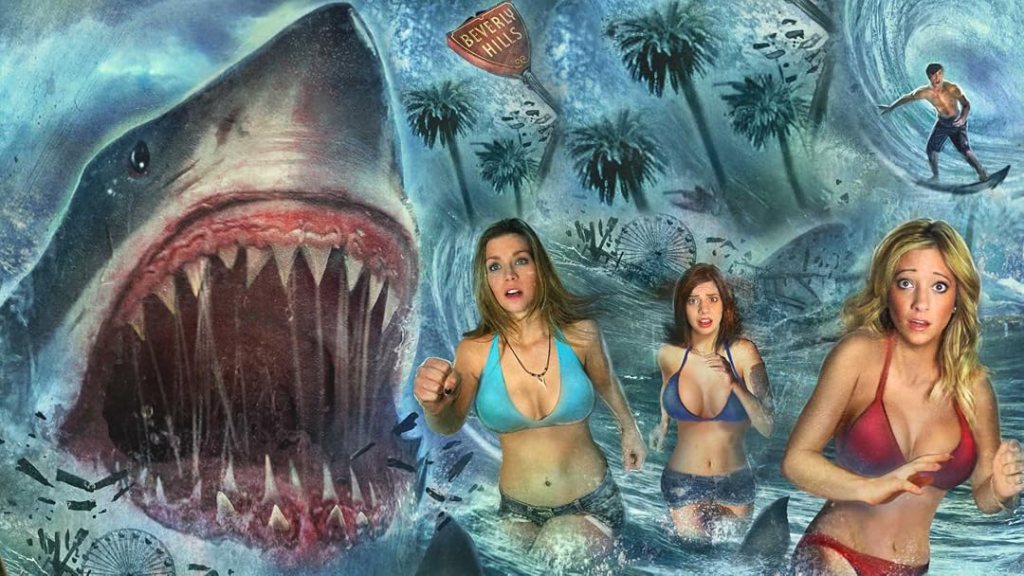
Brad reviews 90210 SHARK ATTACK (2014)!


There are bad movies, there are worse movies, and then there are the worst possible movies. 90210 SHARK ATTACK just may be the worst of the worst.

I’m not going to spend a lot of time on the plot, but it revolves around a group of horny college students who are spending the weekend in a beautiful mansion in Beverly Hills. They’re there for an Oceanic Anthropology class, where they’ll be working on special projects under the supervision of their scheming professor, Pamela Vantzen (Donna Wilkes). Unknown to the rest of the students, Alyssa (Stephanie Shemanski) is in possession of a cursed shark tooth necklace, and when she gets excited, bad things tend to happen.  

I knew I was in trouble when the movie opened on a Beverly Hills trolley car with Christmas decorations on it, signs like “Deck the Hills” and various artwork of Christmas presents. The movie is set during the summer. I also kept wondering how they would encounter sharks since the mansion they’re staying in is “miles away from the ocean,” but it turns out that the filmmakers didn’t care about this issue, so I soon stopped worrying about it myself. What this movie does have is a loop of stock footage that includes Beverly Hills, CGI sharks, a beach, and an aquarium that it cuts back to time after time. Between the extensive credit sequences and the stock footage, I would guess the actual actors are not on the screen more than 45 minutes of the entire 75-minute runtime.   

It doesn’t get much better when the actors are on the screen. I watched this because Donna Wilkes is in it. I had recently watched her in JAWS 2, and I remember her back in the ‘80’s in the enjoyable, low-budget exploitation film ANGEL (“High School Honor Student by Day. Hollywood Hooker by Night”). She doesn’t have anything to work with here, and neither do the other actors. The characters and dialogue are as ridiculous as you would expect, but in a boring way, not a fun way. So much time is spent watching them walk from room to room, or across the yard, or taking a shower, or gallivanting in the pool. I couldn’t even enjoy the shower scenes, because they only focused on the men!

When it’s all said and done, there’s very little time left for the sharks. And based on our movie, that’s not a big issue. Our CGI shark gets less than 30 seconds for the entire film. This part is sad, because the one thing that I did find ridiculously fun in a “wtf” kind of way is when the demonic ghost-shark first appears at about the 47-minute mark.

At the end of the day, I blame director David DeCoteau for this mess. I’ve been watching some of his “Wrong” series of Lifetime TV movies with the #MondayMania live tweet group. Those movies aren’t high art, but they are fun, campy thrillers, so I know he can make an enjoyable film. At the end of the day, I didn’t expect something great, but I did expect him to try to entertain us. Apparently, that was too much to ask!  

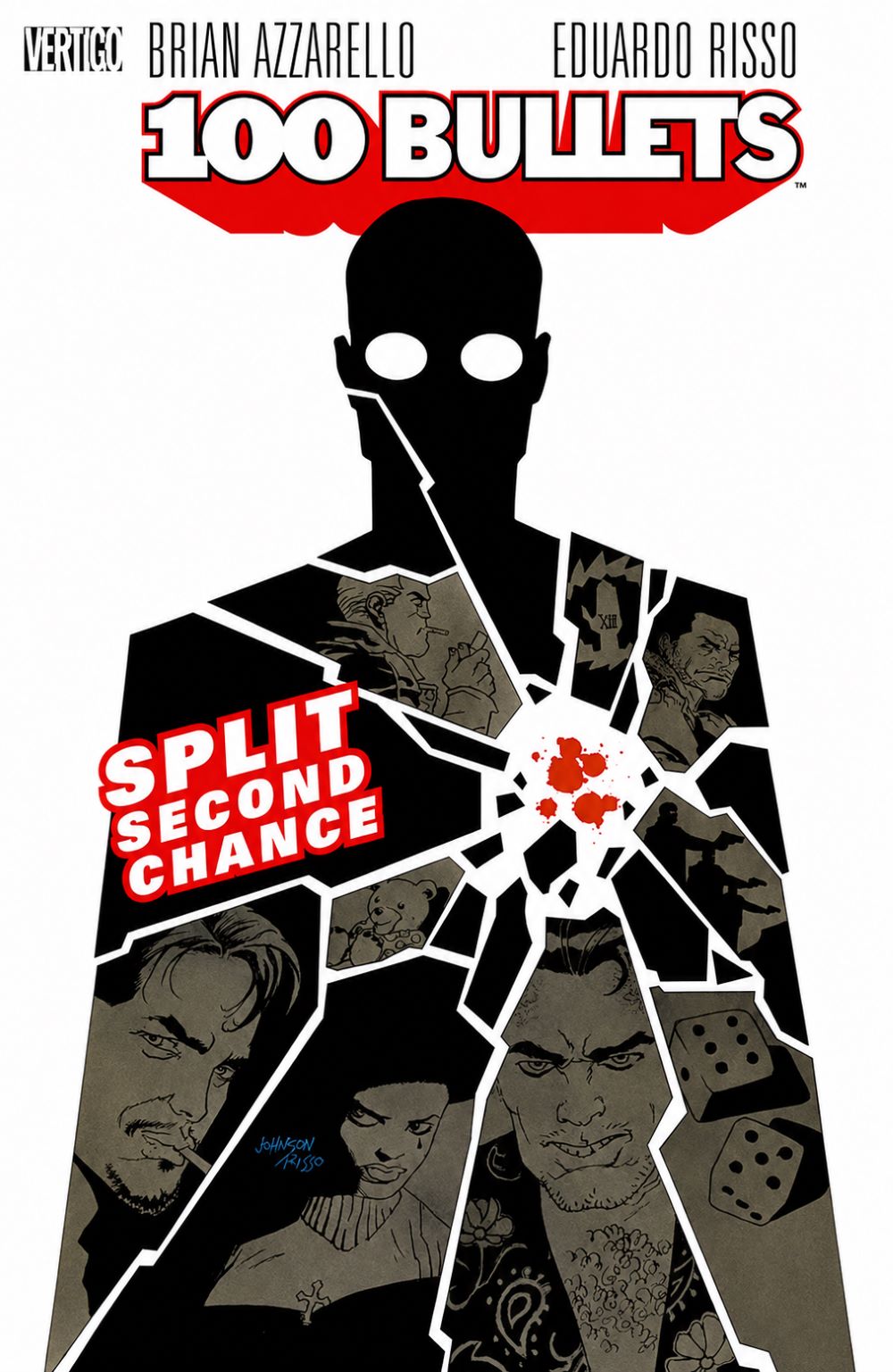
Review: 100 Bullets Vol. 2 – Split Second Chance


“Asking questions is free… but the answers—they can cost you your life.” — Agent Graves

In the first volume of 100 Bullets, Brian Azzarello and Eduardo Risso laid down a stunning thesis for their magnum opus: a world where the wronged are offered the ultimate temptation of consequence-free vengeance. That volume, First Shot, Last Call, functioned as a potent thematic introduction, establishing the series’ central moral quandary through self-contained stories. With Split Second Chance, the creative team makes a crucial pivot. This collection, gathering issues #6-14, successfully preserves the gritty, anthology-style explorations of revenge while beginning to weave a much larger, more intricate conspiracy that feels poised to consume everything in its path. If the first book was a promise, this second volume is the first, gripping step toward its fulfillment, even if it occasionally stumbles under the weight of its own ambition.

The volume opens with “Short Con, Long Odds,” a two-part story that initially feels like familiar territory. We are introduced to Chucky, a small-time gambler fresh out of prison, who is approached by Agent Graves. As before, Graves offers incontrovertible proof of a betrayal and the tools for retribution—this time against Chucky’s childhood friend, Pony, who has seemingly built a successful gambling empire on his partner’s misery. What makes this story stand out is its focus on the petty, desperate world of gambling. Risso’s art is especially potent here, capturing the sad, seedy underbelly of street-corner hustles and back-alley games. The story’s conclusion, which unfolds off-panel, is a masterclass in implication, leaving the reader to piece together the grim aftermath. It is a solid entry that reinforces the series’ core premise, but its real purpose becomes clear retroactively as the larger plot comes into focus.

This is the volume where the series’ title begins to earn its meaning. Agent Graves is no longer just a cipher; he is revealed to be a man with a history, and Split Second Chance doles out those histories with deliberate, tantalizing precision. The most significant revelation comes in “Day, Hour, Minute… Man,” where we learn about The Trust and the enigmatic Minutemen. This arc peels back the curtain, suggesting that Graves and his associate, Mr. Shepherd, were once part of this shadowy organization before faking their deaths to escape its clutches. The introduction of Lono, the chilling hitman from the first volume’s “The Samurai,” becomes far more significant. His meeting with Graves is charged with a dangerous, unspoken history, confirming that Graves’s “gifts” are a part of a larger, more personal agenda. The plot is thickening nicely, and the promise of a sprawling, interconnected narrative starts to feel exhilaratingly real.

However, it is in the standalone stories that Azzarello’s writing truly shines, showcasing his ability to extract raw, human emotion from his noir framework. The standout is undoubtedly “Heartbreak, Sunnyside Up,” a single-issue story that follows a hard-working diner waitress named Rose. Rose’s life is a grinding cycle of poverty and worry for her runaway daughter. When Agent Graves appears, he doesn’t just offer her a gun and a target; he delivers a slow, agonizing explanation of how her daughter became a heroin-addicted prostitute after being molested by her own father. It is a moment of pure, unflinching tragedy. The brilliance of the story lies not in the revenge itself, but in the horror of the revelation. Azzarello forces the reader and the character to sit with the unbearable truth, making the subsequent act of violence feel less like empowerment and more like a desperate, last resort. It serves as a powerful reminder that “sometimes evil is closer to home than we think.”

“The Right Ear, Left in the Cold” offers a fascinating twist on the formula by introducing Cole Burns, a deadly assassin living undercover as a neighborhood ice cream man. This story introduces the concept of the “sleeper agent,” a tool that Graves and Shepherd can “reactivate” for their own ends. Cole is a more capable and cold-blooded protagonist than the average victim, which makes his story less about moral choice and more about professional obligation. Yet, it deepens the mythology, showing that Graves has an entire network of operatives at his disposal, further blurring the line between righteous avenger and puppet master. His ultimate task of retrieving the briefcase from Dizzy Cordova in the final arc, “Parlez Kung Vous,” masterfully ties this new plot thread back to the series’ very first protagonist.

Throughout it all, Eduardo Risso’s artwork remains the series’ undeniable and consistent anchor. His style, which perfectly captured the cold, deliberate mood in the first volume, continues to excel in Split Second Chance. Risso’s panels have a cinematic rhythm; his compositions are economical yet expressive, using deep shadows and stark contrasts to build a world that feels dangerous and morally unstable. He excels at conveying unspoken tension and character attitude through posture and expression, a vital skill for a noir story where much is left unsaid. While some readers may find the depiction of female characters hyper-sexualized, Risso and colorist Grant Goleash unquestionably create a visual language that is sleek, uneasy, and unmistakably noir. The story’s pace may occasionally lag, but the art is always arresting.

100 Bullets: Split Second Chance is a more challenging and rewarding book than its predecessor. It sacrifices some of the first volume’s focus and self-contained impact to lay the foundation for something much grander. This is the volume where the series starts to earn its reputation for dense, interwoven plotting. It is a work of deliberate, intricate world-building that asks the reader to be patient and pay close attention. It is not without its flaws—some stories feel more like necessary setups than complete narratives, and the unrelentingly grim tone can be exhausting. Yet, the moments of genuine human tragedy, like Rose’s story, and the thrilling expansion of the central mystery make Split Second Chance an essential step in the journey. It confidently expands the world of 100 Bullets, deepening its mythology and proving that this is a saga built for the long haul.

100 Bullets Volume Reviews
Live Tweet Alert: Join #FridayNightFlix for Kickboxer 2!


As some of our regular readers undoubtedly know, I am involved in a few weekly watch parties.  On Twitter, I host #FridayNightFlix every Friday and I co-host #ScarySocial on Saturday.  On Mastodon, I am one of the five hosts of #MondayActionMovie!  Every week, we get together.  We watch a movie.  We tweet our way through it.

Tonight, at 10 pm et, I will be hosting #FridayNightFlix!  The movie?  Kickboxer 2!

If you want to join us this Friday, just hop onto twitter, find Kickboxer 2 on Prime, start the movie at 10 pm et, and use the #FridayNightFlix hashtag!  I’ll be there happily tweeting.  It’s a friendly group and welcoming of newcomers so don’t be shy.

See you there!


Song of the Day: Deep Down by Ennio Morricone


Danger: Diabolik (1968)

Since today is Mario Bava’s birthday, it only seems appropriate that today’s song of the day should come from one of his films.

From Ennio Morricone’s score to Mario Bava’s 1968 film Danger: Diabolik, here is Deep Down!


Scenes That I Love: The Opening of Mario Bava’s Black Sunday


Since today is the birthday of the great Mario Bava, today’s scene that I love comes from one of Bava’s best films.  Here is the wonderfully atmospheric and ominous opening of 1960’s Black Sunday:

4 Shots From 4 Films: Special Mario Bava Edition


4 Shots From 4 Films is just what it says it is, 4 shots from 4 of our favorite films. As opposed to the reviews and recaps that we usually post, 4 Shots From 4 Films lets the visuals do the talking.

112 years ago today, the most important Italian filmmaker of all time was born.  Today is Mario Bava’s birthday!  And, as we often do here at the Shattered Lens, it’s time to celebrate with…

4 Shots From 4 Mario Bava Films

Black Sunday (1960, dir by Mario Bava)

Kill, Baby, Kill (1966, dir by Mario Bava)

Lisa and the Devil (1972, dir by Mario Bava)

Shock (1977, dir by Mario Bava)

Music Video of the Day: Dirty Black Summer by Danzig (1992, directed by Anton Corbijn)


This video was directed by Anton Corbijn, the Dutch photographer who directed videos from Depeche Mode, U2, and Nirvana.  (He was the director behind the video for Heart–Shaped Box).  Corbijn has since gone on to direct feature films as well, Control, The American, and Most Wanted Man.

Long before Hugh Jackman got the role, Glenn Danzig was considered for the role of Wolverine in a potential X-Men feature film.  I think he would have rocked that roll.

Enjoy!

Late Night Retro Television Review: Hunter 1.14 “The Snow Queen: Part Two”


Welcome to Late Night Retro Television Reviews, a feature where we review some of our favorite and least favorite shows of the past!  On Thursdays, I will be reviewing Hunter, which aired on NBC from 1984 to 1991.  The entire show is currently streaming on Tubi and several other services!

This week, the story of the snow queen comes to a close.

Episode 1.14 “The Snow Queen: Part Two”

(Dir by Richard Colla, originally aired on March 30th, 1985)

The second part of The Snow Queen saga opens with a stylish action sequence.  As Huey Lewis sings I Want A New Drug on the soundtrack, we watch as both Molinas (Dennis Franz) and Hunter approach, from opposite sides, the boat where Sally LaPone is hiding out with one of her friends.  Molinas is approaching the boat so that he can murder Sally for the mob bosses in New York.  Hunter, on the other hand, is approaching the boat to try to save Sally’s life.  The guards that surround the boat have no idea what’s going on and they end up getting into a gunfight with both Molinas and Hunter.  Molinas, being the sleaze that he is, pretends that he drew his gun to help Hunter as opposed to killing Sally.

Meanwhile, at a club, a smitten Vic Terranova (Dennis Farina) pushes McCall, who is working undercover, to take the stage.  Shots of McCall performing are mixed with shots of Molinas and Hunter shooting people and Sally once again escaping.

Molinas wants to kill Sally while McCall wants to use Sally’s testimony to take down Terranova and his drug-fueled empire.  Hunter wants to stop Molinas from killing anyone else and Sally just wants to be left alone.  The episode does a good job of switching from one character to the next, capturing the desperation of everyone involved.  One especially memorable sequence features Dennis Franz showing Sally’s pictures to a group of teenagers outside of a punk club.  Just from the reactions of Franz and the punks, one gets the feeling that the sequence wasn’t actually scripted.  There’s a gritty authenticity to the action in this episode and it makes for compelling viewing.

Of course, this is an episode of Hunter so everything does eventually lead to another shoot out.  Both Vic and Molinas go down in a hail of bullets and it’s actually kind of a shame.  Both Farina and Franz did such a good job in these two episodes that it’s unfortunate that their characters won’t be able to return in the future.  Franz, in particular, was brilliantly sleazy as the loathsome Molinas.  If only he hadn’t pulled that gun on Hunter, Molinas could have been one of those recurring villains that audiences would love to hate.

Still, all things come to an end and, since this is Hunter, they end in gunfire instead of arrests.  Sally survives but the final shot of the episode reveals that she’s been traumatized beyond belief by everything she’s seen and experienced.  McCall’s hope was that Sally would get immunity in return for testifying against Vic.  But, with Vic dead, Sally really doesn’t have any leverage that she could use to avoid jail.

Seriously, this was a dark episode!  But it was a compelling one and I’m glad that, for once, Hunter showed that not everyone just shrug off violence and move on.  Not everyone is Rick Hunter.

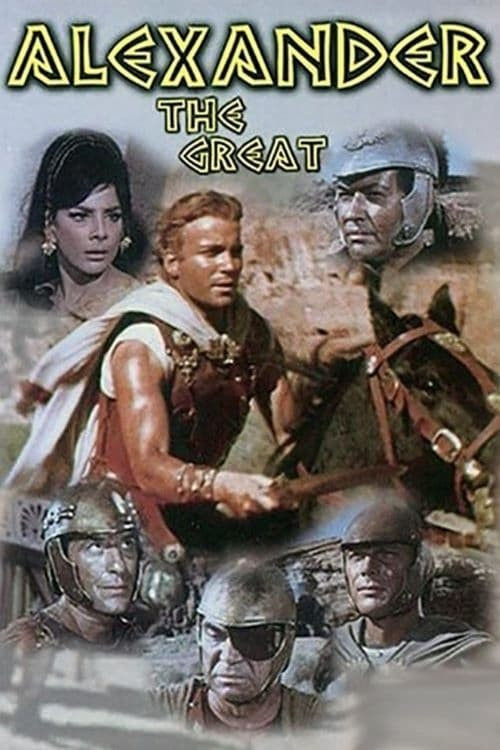
Retro Television Review: Alexander The Great (dir by Phil Karlson)


Welcome to Retro Television Reviews, a feature where we review some of our favorite and least favorite shows of the past!  This Thursdays, I will be reviewing Alexander The Great, which was filmed in 1963 but didn’t air on CBS until 1968.  The show can be found on YouTube!

This week, we take a look at William Shatner and Adam West in Alexander The Great, a pilot that never became a series.

Episode 1.1 “Alexander The Great”

(Dir by Phil Karlson, originally aired on January 26th, 1968)

Greek leader Alexander the Great (a very blonde William Shatner) is determined to defeat the forces of King Darius and conquer all of Persia.  But, before he can fight his latest battle, he has to rescue his kidnapped best friend Cleander (Adam West), calm the nerves of his mentor Antigonus (Joseph Cotten), and deal with two insubordinate generals (John Cassavetes and Simon Oakland).  Only then will Alexander be ready to defeat the fearsome, beheading-obsessed Persian general, Memmon (Cliff Osmond, wearing a truly horrifying wig and fake beard).

This hour-long episode features a lot of talking, a lot of scheming, and one good battle scene.  Unfortunately, that good battle scenes becomes a lot less impressive once you discover that it was lifted from the 1959 film, The Giant of Marathon.  As for the scheming, it’s not really a surprise when the generals plays by Cassavetes and Oakland reveal that they’re planning on assassinating Alexander during the battle.  Both characters are so obviously villainous that their very presence amongst the ranks will lead most viewers to doubt whether Alexander is truly the tactical genius that everyone seems to think he is.

For most viewers, the main appeal of Alexander the Great will be the chance to see William Shatner and Adam West playing best friends.  This pilot was made before Shatner was cast as Captain Kirk and West as Batman.  While West gives a relatively sober performance as Cleander, Shatner shows that he had all of his famous acting tics long before he boarded the Enterprise.  Shatner delivers every line as if he’s expecting to be handed an Emmy at any moment.  The halting cadence is present.  The overly dramatic punctuation is present.  The habit of telegraphing every line and emotion by moving his head is present.  This is the type of performance that feels more like William Shatner imitating himself than actually trying to play a character.  Today, we’re all used to William Shatner poking fun at his reputation so it’s always a bit jarring to watch something like Alexander the Great and see just how seriously Shatner used to take himself.

Alexander the Great ends with Alexander achieving victory over both Memmon and his own duplicitous generals.  He buries Antigonous, who was earlier murdered by the mutineers.  And then, with a big smile on his face, Alexander hopes on his horse and rides off with Cleander and his surviving generals.  Watching Shatner riding his horse, it becomes obvious that, had this pilot become a show, it would have been a western that just happened to take place in ancient Greece and which featured togas and mini-skirts instead of chaps and hats.

This pilot was shot in 1963 but it was rejected by the network and shelved.  In 1968, when West was Batman and Shatner was Kirk, the pilot was taken out of storage and aired as an episode of an anthology show.  Needless to say, it didn’t lead to a series.  Adam West later poked fun at the pilot in his autobiography, saying that it was the greatest waste of an hour ever made.  I think West was a bit too hard on the pilot.  It’s not terrible as much as it’s just bland.  No production featuring not only Shatner and West but also Joseph Cotten, Simon Oakland, and John Cassavetes has a right to be this mild.

One does wonder how, if the pilot had become a series, it would have deal with Alexander eventually drinking himself to death.  Imagine what Shatner and West could have done with that!