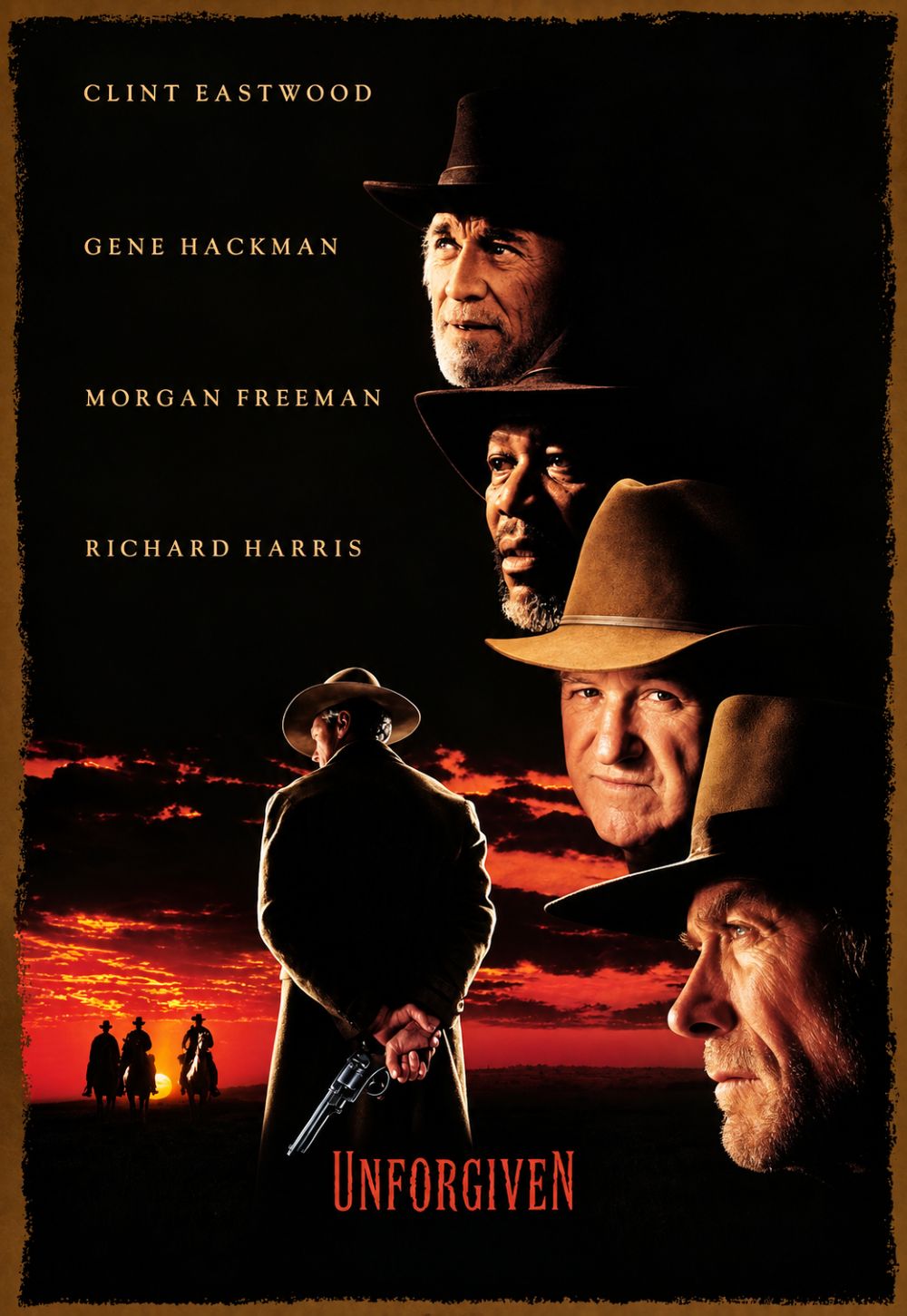
Review: Unforgiven (dir. by Clint Eastwood)


“It’s a hell of a thing, killing a man. You take away all he’s got and all he’s ever gonna have.” — William Munny

There is a point in Unforgiven when the familiar fantasy of the Western gunfighter finally collapses under the weight of what killing actually means. Clint Eastwood’s 1992 masterpiece is a revenge story, a character study, and an unusually merciless critique of the myths that turned killers into folk heroes. It takes nearly every image associated with the classic Western—the lone rider, the righteous bounty, the corrupt frontier town, the feared gunslinger, the climactic saloon showdown—and asks what those images would look like if the people involved had to suffer the consequences afterward. The answer is bleak, often grimly funny, and far more powerful than a simple “anti-Western” label suggests.

Eastwood stars as William Munny, a former outlaw and murderer trying to survive as a widowed pig farmer in Kansas. He has two young children, a failing farm, and little talent for the peaceful life he has supposedly embraced. At the beginning of the film, Munny is practically the opposite of the cool, razor-sharp gunfighters Eastwood played in his younger years. He falls into mud, cannot shoot straight, and looks exhausted before the real journey even begins. That physical decline matters because Eastwood wants the audience to see the distance between a Western legend and the actual, aging human being beneath it.

Munny’s chance to return to violence arrives when the Schofield Kid, an arrogant young would-be gunslinger, offers him a share of a bounty. In the town of Big Whiskey, Wyoming, two cowboys have viciously cut up a prostitute named Delilah Fitzgerald. The town’s sheriff, Little Bill Daggett, punishes them with a fine paid to the brothel owner rather than giving Delilah anything resembling justice. Furious, the other prostitutes gather money and put out a reward for the men responsible. Munny initially hesitates, but the bounty is enough to draw him out of retirement. He convinces his old partner Ned Logan to ride with him, and the three men head toward Big Whiskey.

On paper, that setup sounds like the start of a traditional revenge Western. The crime is vicious, the local law is corrupt, and armed men set out to punish the guilty. Unforgiven, though, immediately complicates every part of that formula. The women have every reason to be furious, but their bounty does not turn the mission into a clean act of justice. Munny and Ned may be targeting cruel men, but they are still going to kill them for money. The Schofield Kid talks about the bounty like it is an adventure, but he has no real idea what killing another person does to someone. The film keeps refusing the easy emotional release that a more conventional Western would offer.

Eastwood’s direction is particularly sharp whenever violence finally breaks out. There are no elegant shootouts designed to make the viewer cheer. Guns misfire, men miss, people panic, and the victims do not fall over conveniently after being hit. When Munny and Ned shoot one of the cowboys, the sequence is awkward, tense, and almost miserable to watch. The wounded man suffers for a long time, calling out for water while his companions are too frightened to help him. Munny does not suddenly look like an unbeatable hero. He looks like a man who has made a terrible choice and now has to stand there listening to the result.

That approach makes Unforgiven feel much harsher than most Westerns, but it also gives the film its emotional weight. It is not saying that violence is never understandable. The cowboys who attacked Delilah are not treated as innocent victims, and Little Bill’s indifference to her suffering is infuriating. What the movie understands is that a justified act can still be ugly, frightening, and spiritually damaging. Killing someone may solve a practical problem, but it does not automatically restore dignity or erase pain. The movie’s view of revenge is not that it never works; it is that it always costs more than the stories promise.

Eastwood’s performance is one of the reasons the film lands so hard. William Munny is clearly connected to the Eastwood screen persona audiences knew from earlier Westerns, but he is a far sadder and more frightening version of it. Munny’s past is revealed gradually through other characters’ stories. Before he married Claudia, he was drunk, violent, and seemingly capable of killing anyone who got in his way. Claudia helped turn him toward a better life, and after her death he has tried to honor that change. Yet the movie never suggests that redemption has erased who he was. It only suggests that he has managed to keep that part of himself under control.

As the story moves forward, Munny becomes increasingly sick, angry, and emotionally stripped down. His old skills come back, but the return is not triumphant. It is more like watching someone relapse into a destructive part of themselves. Eastwood plays this change with remarkable restraint. He does not overdo the anger or announce the transformation with long speeches. Instead, Munny’s face gets harder, his voice becomes flatter, and his decisions become more final. By the end, he has become the frightening killer people said he was, and the movie makes that feel tragic rather than exhilarating.

Gene Hackman gives one of the film’s best performances as Little Bill Daggett, the sheriff of Big Whiskey. Little Bill is cruel, blunt, and completely convinced that he is the only person keeping the town from falling apart. He sees himself as a realist. In his mind, the cowboys have paid for their crime, the prostitutes are causing unnecessary trouble, and every outside gunman is a threat to the peace he has built. But his “peace” depends on denying Delilah justice and beating anyone who challenges his authority. He is not a noble lawman protecting civilization from barbarism. He is a violent man with a badge who has decided that his version of order matters more than anyone else’s pain.

Hackman makes Little Bill compelling because he never plays him as a cartoon villain. The character can be funny, conversational, and even oddly charming when he is talking about building his house or explaining how a gunfight really works. Those ordinary details make his cruelty more believable. Little Bill is not a monster because he twirls his mustache or enjoys evil for its own sake. He is a monster because he has made violence routine. He can beat a man nearly to death, then return to discussing carpentry as if nothing meaningful has happened.

The movie’s fascination with mythmaking is another reason it remains so great. Unforgiven constantly contrasts what people say about gunfighters with what gunfighters are actually like. Richard Harris appears as English Bob, an aging outlaw who has turned himself into a storybook figure. He travels with W. W. Beauchamp, a writer who records exaggerated tales of duels, bravery, and glamorous frontier violence. English Bob wants to be remembered as the sort of man old Westerns love: a polished, fearless killer who can outdraw anyone in a fair fight.

Little Bill quickly destroys that image, humiliating English Bob and explaining that most gunfights are not won by the fastest hand or the bravest heart. They are won by whoever gets lucky, whoever fires first, or whoever is less scared at the right moment. That speech is one of the clearest examples of what Unforgiven is doing with the genre. It does not merely say that the old stories were exaggerated. It shows why people prefer exaggeration. The truth is messy, cowardly, and often too ugly to make a satisfying legend.

The Schofield Kid represents the danger of believing those legends too completely. He talks big about killing men, insists he is a famous gunfighter, and assumes the bounty will make him rich and important. But when the moment comes, he cannot handle the reality of what he has done. After taking a life, he drinks heavily and admits that he has never killed anyone before. His fantasy collapses almost instantly. Munny’s response is one of the film’s coldest and most honest moments: when you kill a man, you take away everything he has and everything he is ever going to have. There is no speech about courage, justice, or glory. There is only the permanent fact of death.

Morgan Freeman is excellent as Ned Logan, Munny’s old partner and closest friend. Ned has a quiet decency that does not erase his violent past but makes clear that he wants no part of it anymore. His scenes with Munny feel lived-in, as if the two men understand each other without needing to explain their history. Ned knows exactly what Munny used to be, and that knowledge makes him nervous about what his friend may become again. Freeman brings warmth and humor to the movie, which makes the eventual loss of that warmth feel devastating.

Ned is especially important because he shows that a person can decide not to keep living by old violent rules. He has a life with Sally Two Trees, and when the killing becomes real, he chooses to leave rather than continue. That choice separates him from Munny. Both men have done terrible things, but Ned recognizes that he has reached the point where he cannot go back. Munny, on the other hand, is eventually pulled all the way back into the identity he thought he had escaped.

Visually, Unforgiven is one of Eastwood’s most beautiful films, although “beautiful” may not be the first word that comes to mind while watching it. The landscapes are often gray, rainy, muddy, and lonely. Big Whiskey is not a romantic frontier town full of colorful saloons and grand main streets. It is wet, cramped, and miserable. The open country does not feel liberating either. It feels empty and dangerous, a place where a wounded man can die slowly because help is too far away. Cinematographer Jack N. Green gives the film a somber, dusk-like look that fits its mood perfectly.

The final confrontation in the saloon is one of the most famous scenes in Eastwood’s career because it briefly gives viewers the kind of gunfighter moment they have been waiting for. Munny walks into Big Whiskey through the rain, enters the saloon, and becomes the nightmare Little Bill and the others have feared. He kills with shocking speed and delivers lines that sound immediately iconic. For a few minutes, the old Eastwood myth appears to return in full. The silent killer is back, the bad men are terrified, and the audience can feel the raw force of the scene.

But Unforgiven refuses to turn that climax into a victory lap. Munny’s rampage is not heroic liberation. It is grief, rage, alcohol, and guilt exploding through a man who has lost the fragile stability he built after leaving violence behind. He is not reclaiming some glorious identity. He is becoming the worst version of himself again. The scene is undeniably thrilling in a purely cinematic sense, but Eastwood makes sure the thrill feels contaminated. We are watching a legend come alive, but the movie has spent two hours teaching us that legends are usually built on suffering.

That is why Unforgiven became Eastwood’s Western magnum opus. It is not just a great Western made by a star who knew the genre inside out; it is the film where he fully confronted the meaning of his own Western image. Eastwood began deconstructing that image with High Plains Drifter, where the mysterious stranger was less a traditional hero than a ghostly, cruel force of revenge. He continued the process in The Outlaw Josey Wales, a more expansive and emotional film that questioned authority and showed an outlaw finding a kind of community, even while preserving much of the old gunslinger charisma. With Unforgiven, Eastwood completes that deconstruction of the Western film genre.

In Unforgiven, there is no clean heroism left behind the gunfighter’s reputation. The lone rider is exhausted and morally compromised. The sheriff is a bully. The bounty is not justice in any simple sense. The famous gunfighter is often a fraud, a coward, or simply lucky. And the man who really is capable of becoming a legend is also capable of committing horrifying acts. Eastwood does not dismiss the Western’s power; if anything, he understands that power better than almost anyone. He knows why audiences respond to the image of a lone man walking into a saloon to face impossible odds.

What makes the film so enduring is that it asks viewers to look beyond that image. Who dies so the hero can become a legend? Who gets turned into a footnote in someone else’s story? What does the survivor carry afterward? Those questions give Unforgiven a moral weight that few Westerns, revisionist or otherwise, can match. It is a film about violence, but it is also about memory, regret, masculinity, and the lies people tell to make brutality seem noble. By its final fade-out, Unforgiven leaves the Western standing not as a celebration of violence, but as a haunted reckoning with everything violence destroys.
Live Tweet Alert: Join #ScarySocial For American Psycho!


As some of our regular readers undoubtedly know, I am involved in a few weekly live tweets on Twitter and Mastodon.  I host #FridayNightFlix every Friday, I co-host #ScarySocial on Saturday, and I am one of the five hosts of #MondayActionMovie!  Every week, we get together.  We watch a movie.  We tweet our way through it.

Tonight, at 10 pm et, #ScarySocial presents American Psycho!

If you want to join us this Saturday, just hop onto twitter, start the movie at 10 pm et, and use the #ScarySocial hashtag!  It’s a friendly group and welcoming of newcomers so don’t be shy.

American Psycho is available on Prime!  See you there!

4 Shots From 4 Films: Special David Hess Edition


4 Shots From 4 Films is just what it says it is, 4 shots from 4 of our favorite films. As opposed to the reviews and recaps that we usually post, 4 Shots From 4 Films lets the visuals do the talking!

Today, we remember actor David Hess on his birthday.  It’s time for….

4 Shots From 4 David Hess Films

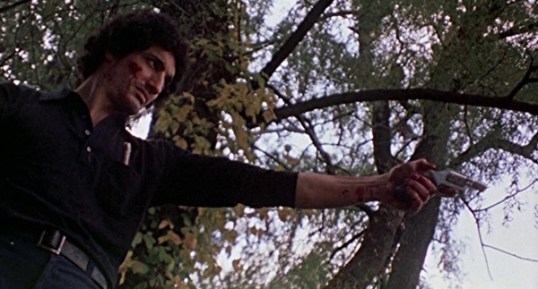
The Last House On The Left (1972, dir by Wes Craven, DP: Victor Hurwitz)

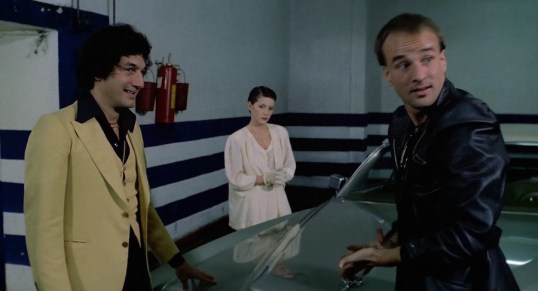
Hitch-Hike (1977, dir by Pasquale Festa Campanile, DP:
Franco Di Giacomo and Giuseppe Ruzzolini)

The House On The Edge of the Park (1980, dir by Ruggero Deodato, DP: Sergio D’Offizi)

Body Count (1986, dir by Ruggero Deodato, DP: Emilio Loffredo)

Music Video of the Day: White Lines by Duran Duran, feat. Grandmaster Melle Mel and The Furious Five (1995, directed by Nick Egan)


In 1995, Duran Duran released an album of cover tunes.  The one that got the most attention was this cover of Grand Master Melle Mel’s anti-cocaine anthem, White Lines.  Listen as Duran Duran raps!  The 90s were a wondrous time that we will never know again.

Enjoy!

Late Night Retro Television Review: Sledge Hammer 1.6 “To Sledge, With Love”


Welcome to Late Night Retro Television Reviews, a feature where we review some of our favorite and least favorite shows of the past! On Fridays, I will be reviewing SLEDGE HAMMER!, a cop comedy which ran on ABC from 1986 to 1988. The entire series can be found on Prime!

This week, Sledge is going back to school!

Episode 1.6 “To Sledge, With Love”

(Dir by David Wechter, originally aired on October 31st, 1986)

When an obnoxious man insists on smoking a cigar in the police station despite it being against the rules, Sledge Hammer shoots the cigar out of his mouth. Later, when Hammer asks Captain Trunk if he’s going to yell at him about shooting the cigar, Trunk asks what difference it would make.

It’s good to see that Trunk is learning.

Speaking of learning, the local high school has been taken over by a gang! It’s time for Sledge Hammer and Dori to go back to school. Unfortunately for Hammer, that means that he can’t shoot or even hit anyone. “You mean I have to wait until this punk is 18 before I can toss him off the roof?” Hammer asks. Sorry, Hammer!

The school has a lot of problems, but the main one is a delinquent named Turk (Shawn Klugman). Turk is more concerned with stealing cars for Mr. Roscoe (Norman Alden) than with going to class. When Sledge Hammer tries to get through to him by showing off his gun and challenging him to a fight, Turk laughs him off. When Sledge Hammer tries to teach Turk that he’s a “homosapien,” Turk angrily declares that he has lots of girlfriends and then walks out of class.

It looks like Turk is a lost cause, but Hammer has one more trick up his sleeve. He reveals how much money Roscoe is making by selling used cars. Turk realizes that he deserves to get paid a lot more than just $500 for his hard work. Turk helps Hammer take down Roscoe and then, at the end of the episode, he announces that he’s going to join the Police Academy as soon as he graduates.

Good work, Hammer!

I enjoyed this episode more than last week’s. While last week’s episode sometimes seemed to be a bit too much of a straight crime drama, this week’s episode returns to the format of nonstop jokes. The entire episode is a parody of those painfully earnest films where a teacher comes to a tough school and manages to change the lives of their students. Hammer changes lives not with confidence-building and smart lesson plans but instead with a big gun. Hey, whatever gets the job done!

How do you thank someone who took you from crayons to perfume? It’s not easy, but I’ll try….

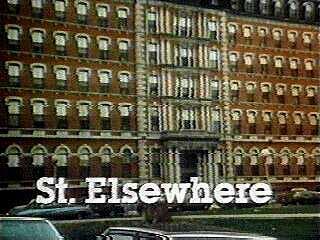
Retro Television Review: St. Elsewhere 4.11 “Santa Claus Is Dead”


Welcome to Retro Television Reviews, a feature where we review some of our favorite and least favorite shows of the past! On Fridays, I will be reviewing St. Elsewhere, a medical show which ran on NBC from 1982 to 1988.  The show can be found on Daily Motion.

It’s Christmas in Boston.

Episode 4.11 “Santa Claus Is Dead”

(Dir by Leo Penn, originally aired on December 18th, 1985)

It’s the holidays and, of course, Westphall is depressed.

Are we surprised? It’s Christmas. Everyone else is making an effort to spread some holiday cheer. Westphall is being his usual glum self. Westphall is — and I know this is just going to be the most shocking reveal ever, so I’ll give you a chance to get ready for it — an agnostic who doesn’t celebrate the holidays. WOW! Who would have guessed?

Yes, yes, I know: Westphall is supposed to be the moral center of this show, the man who takes all the burdens of running the hospital on his shoulders. That may have been the writers’ intention, but for the most part he just comes across like a self-righteous bore.

Lizzie (Dana Short) and her boyfriend, Rick (Casey Siemaszko), visit Westphall for the holidays. Rick seems like a genuinely nice guy who is sad because he’s away from his family and their Christmas traditions. Westphall isn’t much help. When Rick gives him a present, Westphall smiles glumly. When Rick talks about how it’s Christmas Eve and his Catholic family usually attends midnight mass, Westphall says that he and Lizzie should go to a movie because “there won’t be any lines.” When Rick and Lizzie decide to go to the midnight service at St. Barnabas and agree to take Tommy with them, Westphall says that he won’t be joining them. If Rick, a Catholic, is willing to spend Christmas with a bunch of Episcopalians, the least Westphall could do is set aside his boring agnosticism for one night.

Dr. Craig hosts his annual Christmas party. Feeling sad about Stephen, Craig drinks too much and ends up crying in the kitchen. When Ellen tells him that it’s time to go to St. Barnabas, Craig refuses and complains that he can’t worship a God who would so “arbitrarily” kill his son. My heart broke for the Craigs. Still, there’s always something annoying about people who have no problem believing in God when bad things happen to other people, then have a sudden crisis of faith as soon as something bad happens to them. On the one hand, I felt Mark pain.  On the other hand, there was a part of me that thought, Hey, Mark — your son was a drug addict who got high and drove. What do you expect God to do about it?

At the hospital, the man hired to play Santa Claus (Aaron Fletcher) has a heart attack and collapses right in front of a bunch of horrified children. At first it appears that Santa is going to live, but after surgery he has another heart attack and dies. Because Axelrod was Santa’s doctor, Dr. Auschlander’s grandson, Max (Danny McMurphy), accuses Axelrod of killing Santa.

Fortunately, before Santa died, Max did tell him that he wants a snow globe to replace one that belonged to his grandmother. (Max accidentally broke it.) After Santa dies, Max’s grandmother discovers that a gift has been left for her under the hospital’s Christmas tree. It’s the snow globe! So the old man really was Santa.

And now he’s dead.

The episode ends at St. Barnabas. Westphall shows up at the service, and Tommy, who usually tries to hit his father, runs down the aisle to hug him. Meanwhile, Dr. Craig walks in the rain.

Wow, what a depressing Christmas episode. It was also a pretty moving one. I will admit that I started crying as soon as Santa had his heart attack. Seeing Santa in the hospital brought back memories of sitting with Dad when he was in home hospice care. I was the one who was there when he died, and I was the one who sat there for two hours, waiting for the hospice nurse to arrive. Back in 2023, I had no idea that would be the last time I would ever give him a Christmas present. As this episode showed, there’s a lot of sadness in the world, but there are also those moments of happiness and, if we’re lucky, community.

Yes, Santa died. But at least he got to deliver one final gift.

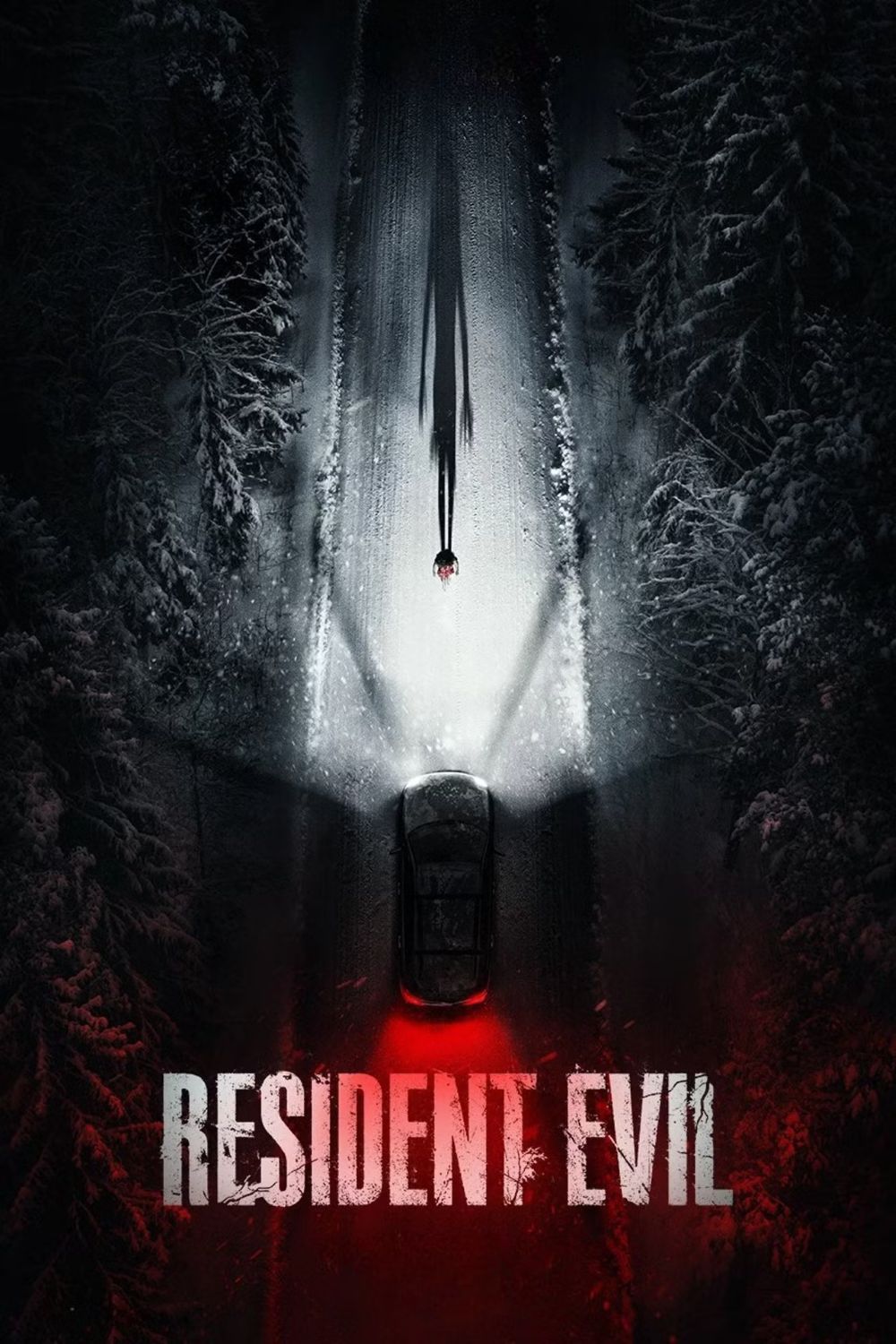
Review: Resident Evil (dir. by Zac Cregger)


“I’ve only used a gun in video games.” — Bryan

Resident Evil is a smart, tense, and surprisingly faithful reinvention of Capcom’s long-running survival-horror series—not because it tries to copy a single game beat for beat, but because it understands what makes the games unnerving in the first place. Written and directed by Zac Cregger, the film uses the world of Resident Evil as its foundation while telling a new story during the Raccoon City outbreak. Its main character is Bryan, played by Austin Abrams, an ordinary medical courier whose attempt to complete a delivery to Raccoon City General Hospital drops him into the early stages of a biological disaster. He is not a S.T.A.R.S. officer, a government agent, or a pre-established franchise hero. He is simply a guy trying to finish a job and survive a night that becomes more horrifying, chaotic, and impossible with every block he crosses.

That basic setup proves to be one of the movie’s smartest choices. Resident Evil has no shortage of iconic protagonists, from Chris Redfield and Jill Valentine to Leon S. Kennedy and Claire Redfield, but Bryan gives the film a fresh perspective on its apocalypse. He is not entering Raccoon City with a gun, years of training, or inside knowledge of Umbrella. He starts as someone who does not understand why parts of the city are suddenly locked down, why emergency rooms are overwhelmed, or why ordinary people are behaving with terrifying violence. That makes him a natural audience surrogate, but he is not just a blank stand-in. Austin Abrams gives Bryan a nervous, tightly wound energy that fits someone constantly trying to keep pace with a situation that has already moved beyond anyone’s control.

The decision to center an everyman is also a strong way of translating the vulnerability of the games. In a great Resident Evil game, the player might eventually find a shotgun, healing items, and enough ammunition to handle a dangerous enemy, but the first hours are defined by instability. There is never quite enough ammo. There is never a guarantee that the room ahead is safe. You learn the layout of a location because you have to, not because exploration is relaxed. Cregger’s movie cannot reproduce the exact tension of an inventory screen or the anxiety of deciding whether to use a green herb now or save it for later, but it captures the emotional logic behind those mechanics. Bryan makes choices with incomplete information, moves through increasingly hostile spaces, and keeps going even when every instinct tells him to turn around and run.

What makes the film especially interesting is that it does not adapt any one game in the series. This is not a straight retelling of the Spencer Mansion incident from Resident Evil, Leon and Claire’s first night in Resident Evil 2, or Jill’s escape from Nemesis in Resident Evil 3. Instead, Cregger uses the games as backdrop and inspiration for an original story set in the franchise’s universe. The film takes place alongside the Raccoon City outbreak associated with Resident Evil 2, but Bryan’s journey is separate from the established storylines that fans already know. That may disappoint viewers who want an exact cinematic recreation of every familiar character and location, but it is ultimately the movie’s greatest advantage.

A strict adaptation would have to navigate an almost impossible set of fan expectations. If the movie directly followed Resident Evil 2, viewers would be waiting for the exact arrival at the Raccoon City Police Department, the exact early meetings between Leon and Claire, the exact role of Ada Wong, the exact appearances of William Birkin and Mr. X, and the exact descent into Umbrella’s underground facilities. A direct version of the original Resident Evil would carry the same burden with the Spencer Mansion, the S.T.A.R.S. team, the laboratory, and the Tyrant. That approach can quickly make a movie feel less like a story and more like a checklist. Cregger avoids that trap by taking the series’ atmosphere, visual identity, rules, and mythology, then building a new nightmare around them.

That freedom restores a sense of uncertainty. Even viewers who know Resident Evil 2 inside and out cannot assume they know where Bryan’s route will take him, who can be trusted, or when the next threat will appear. The film can nod toward familiar Resident Evil concepts without making them feel like obligatory fan-service stops. A locked facility, an Umbrella insignia, a contaminated corridor, or the emergence of a more elaborate biological threat carries weight because it serves the story first. The pleasure comes from seeing the franchise’s DNA interpreted in a fresh way, not from watching the movie pause so the audience can recognize a collectible reference.

Umbrella is treated as much more than a logo or a few bits of background lore. The company remains the central force behind the horror, and that gives the film a more specific personality than a typical zombie outbreak story. Umbrella is terrifying because it represents private power with no moral limit: a corporation able to hide experiments, manipulate information, weaponize biology, and treat ordinary people as expendable collateral. Its infected victims and bio-organic weapons are not random monsters wandering into the story. They are products. Someone designed them, approved them, tested them, and determined that whatever potential value they offered was worth the risk. That is the darker edge of Resident Evil: the monsters are terrible, but the systems that created them are worse.

Cregger understands that this corporate horror needs to feel physical. A zombie is frightening because it is a person reduced to a violent, decaying shell. A more advanced creature is frightening because it reveals experimentation that has pushed life beyond recognizable limits. The body horror works best when it does not feel ornamental. It should make the audience imagine the research process behind the mutation, the human cost of the experimentation, and the awful combination of arrogance and indifference that allowed it to happen. Resident Evil does not need to constantly escalate into larger monsters merely for spectacle. Its creatures matter when they feel like increasingly disturbing evidence of what Umbrella has been building in secret.

Cregger’s background makes him an unusually strong fit for this material. Barbarian worked because it transformed a familiar location into a space of escalating dread. The house at the center of that film is not just a setting; it becomes a trap, a maze, and a place with its own buried history. Cregger knows how to make architecture feel dangerous. He understands that a corridor, a basement, an unlit stairwell, or a locked door can generate more tension than an explosion if the audience believes something might be waiting just outside the frame. That is basically the visual language of Resident Evil.

The games have always relied on locations that feel compromised. The Spencer Mansion in Resident Evil, the Raccoon City Police Department in Resident Evil 2, and the ruined streets in Resident Evil 3 turn places that should represent order, security, or civilization into traps. A police station becomes a fortress that cannot protect anyone. A hospital becomes a source of infection. A laboratory becomes proof that the disaster was not an accident. Cregger’s film channels that environmental fear well. Bryan’s path through Raccoon City is not just a string of monster encounters. It becomes a worsening descent through spaces that are failing one after another, with every new location offering a possible route forward while also revealing another level of the catastrophe.

The basic premise involving Bryan’s medical delivery gives the movie a focused sense of movement without spoiling the larger story. He has a practical objective, but each step toward completing it pushes him deeper into Raccoon City’s outbreak. The film lets the audience learn alongside him through half-understood warnings, panicked strangers, sealed-off areas, fragments of information, and signs that the official story does not add up. Cregger does not rush to explain every piece of Umbrella’s involvement immediately. He lets the mystery build around Bryan’s immediate need to survive, which is exactly how the strongest Resident Evil games turn scattered notes, hidden rooms, and locked pathways into part of their storytelling.

The influence of Weapons is especially clear in that willingness to let confusion and dread hang in the air. Cregger has shown an interest in narratives where the audience slowly pieces together a larger horror from incomplete perspectives and disturbing details. Resident Evil applies that instinct to a world built around secrecy. Umbrella does not announce itself with a complete explanation. Its presence is felt through the consequences: infected civilians, closed facilities, experiments that have slipped into the open, and the growing realization that Raccoon City’s crisis has roots much deeper than a random medical emergency. That approach turns exposition into suspense. The audience wants answers, but it also understands that every answer is likely to lead somewhere worse.

The film’s tone is another area where Cregger’s sensibility helps. Resident Evil should be scary, but it should not pretend that the series is grounded, ordinary horror. The franchise has always mixed genuine survival dread with B-movie science fiction, action-movie intensity, melodrama, and moments of pure, glorious weirdness. The same series that can make a player afraid of opening a narrow hallway door can also introduce giant mutant reptiles, insects, experimental super-soldiers, and outlandish biological mutations. Cregger seems comfortable operating in that space. Barbarian showed that he can move between dark humor, disgust, shock, and legitimate tension without flattening the experience into parody. That balance is crucial for Resident Evil, which should be intense without becoming embarrassed by its own pulp imagination.

The film is strongest when it lets the strange material land through the characters’ reactions rather than making a joke of it. Bryan does not become an instant action hero who dispatches monsters with effortless confidence. His fear, exhaustion, and disbelief help ground the increasingly bizarre developments around him. When the story introduces threats beyond the initial infected, those moments work because they feel like the next horrible stage of Umbrella’s hidden program rather than a required entry in a franchise encyclopedia. Cregger understands that a recognizable monster or concept only matters if it changes the stakes for the character in front of it.

There is also welcome restraint in the scale of the movie. Raccoon City’s outbreak is huge, but Resident Evil keeps the experience close to the ground. It is not mainly about elite military units, globe-spanning conspiracies, or invincible heroes fighting through armies of infected. It is about one man trying to get through a city that has become a death trap. A blocked street becomes a serious obstacle. A working car becomes a lifeline. A few infected people can be overwhelming when Bryan has limited ammunition, no clear escape route, and no way to know who has already turned. That survival focus lets the film preserve the essential question behind every good Resident Evil scenario: not “How can the hero kill everything?” but “How can the hero make it through the next room?”

Cregger’s narrative choices will probably alienate a certain segment of the fanbase, and that is understandable. Some viewers will want a movie built around Leon, Claire, Chris, Jill, or another established character. Others will want a cleaner adaptation of a specific game, with its canonical set pieces, key relationships, and familiar story beats intact. Those are reasonable desires, especially because Resident Evil has such an enormous cast of beloved characters and such a rich backlog of stories that have never been adapted faithfully. Cregger’s movie is taking a chance by prioritizing an original protagonist and a separate narrative over direct adaptation.

But that risk is also what makes the film work. Fans who go in with open expectations may be surprised by how naturally it fits inside the Resident Evil universe. It does not need to repeat every event from the games to understand their identity. The movie has the oppressive spaces, the escalating survival pressure, the corporate conspiracy, the infection-driven horror, and the feeling that any new revelation will only lead deeper into a nightmare. Bryan’s story feels like a side route through Raccoon City’s catastrophe—a story that could exist in the margins of the games without contradicting the dread, danger, and bizarre biohazard logic that define them. The film asks fans to accept that it is not trying to replace the games they love. It is trying to tell another story that could only happen in this universe.

Ultimately, Zac Cregger’s Resident Evil succeeds because it recognizes that the franchise’s appeal is not limited to familiar names, costumes, creatures, or Umbrella logos. It is about the sickening feeling of being trapped in a hostile place with too little information, too few resources, and no guarantee that the person beside you will still be alive—or human—by the next scene. By making Bryan an ordinary medical courier caught in an outbreak, Cregger gives the audience a vulnerable and compelling guide through Raccoon City. By using the games as inspiration instead of adapting a single title word for word, he gives the story space to surprise viewers who already know the series inside and out.

As a fan of the games, the film more than hits the mark of what a Resident Evil movie should feel like. It has the oppressive locations, slow-burn conspiracy, grotesque biological horror, corporate corruption, and sense of escalating hopelessness that define the series at its best. More importantly, it captures the survival-horror tension that has always been at the heart of the games: the dread of stepping into an unfamiliar room, the suspicion that supplies will not last, and the sinking realization that every answer leads deeper into Umbrella’s nightmare.

As a horror fan, Resident Evil also confirms that Zac Cregger is one of the best filmmakers currently working in the genre. After Barbarian and Weapons, this makes him three for three. Each film has its own identity, but all three display the same gifts: command of suspense, strikingly unsettling imagery, a feel for dark humor that never entirely breaks the danger, and the confidence to take an audience somewhere more disturbing than it expects. Resident Evil turns Raccoon City into a living maze of infection, secrecy, and panic, where every locked door feels like it might lead to an escape—or to the worst possible decision. It is not merely a strong video-game adaptation. It is another major win for Cregger, and a reminder that the right filmmaker can make even one of horror gaming’s most familiar worlds feel frighteningly new.