Playing Catch-Up: The Accountant, Carnage Park, The Choice, The Legend of Tarzan


Continuing my look back at the films of 2016, here are four mini-reviews of some films that really didn’t make enough of an impression to demand a full review.

The Accountant (dir by Gavin O’Connor)

2016 was a mixed year for Ben Affleck.  Batman v. Superman may have been a box office success but it was also such a critical disaster that it may have done more harm to Affleck’s legacy than good.  If nothing else, Affleck will spend the rest of his life being subjected to jokes about Martha.  While Ben’s younger brother has become an Oscar front runner as a result of his performance in Manchester By The Sea, Ben’s latest Oscar effort, Live By Night, has been released to critical scorn and audience indifference.

At the same time, Ben Affleck also gave perhaps his best performance ever in The Accountant.  Affleck plays an autistic accountant who exclusively works for criminals and who has been raised to be an expert in all forms of self-defense.  The film’s plot is overly complicated and director Gavin O’Connor struggles to maintain a consistent tone but Affleck gives a really great performance and Anna Kendrick reminds audiences that she’s capable of more than just starring in the Pitch Perfect franchise.

Carnage Park (dir by Mickey Keating)

I really wanted to like Carnage Park, because it was specifically advertised as being an homage to the grindhouse films of the 1970s and y’all know how much I love those!  Ashley Bell plays a woman who gets kidnapped twice, once by two bank robbers and then by a psycho named Wyatt (Pat Healy).  Healy chases Bell through the desert, hunting her Most Dangerous Game-style.  There are some intense scenes and both Bell and Healy are well-cast but, ultimately, it’s just kind of blah.

The Choice (dir by Ross Katz)

The Choice was last year’s Nicholas Sparks adaptation.  It came out, as all Nichols Sparks adaptations do, just in time for Valentine’s Day and it got reviews that were so negative that a lot of people will never admit that they actually saw it.  Benjamin Walker and Teresa Palmer play two people who meet, fall in love, and marry in North Carolina.  But then Palmer is in a car accident, ends up in a coma, and Walker has to decide whether or not to turn off the life support.

As I said, The Choice got terrible reviews and it’s certainly not subtle movie but it’s actually better than a lot of films adapted from the work of Nicholas Sparks.  Walker and Palmer are a likable couple and, at the very least, The Choice deserves some credit for having the courage not to embrace the currently trendy cause of euthanasia.  That alone makes The Choice better than Me Before You.

The Legend of Tarzan (dir by David Yates)

Alexander Skarsgard looks good without his shirt on and Samuel L. Jackson is always a fun to watch and that’s really all that matters as far as The Legend of Tarzan is concerned.  It’s an enjoyable enough adventure film but you won’t remember much about it afterward.  Christoph Waltz is a good actor but he’s played so many villains that it’s hard to get excited over it anymore.
4 Shots From 4 Films: The Awful Truth, Notorious, North By Northwest, Charade


4 Shots From 4 Films is just what it says it is, 4 shots from 4 of our favorite films. As opposed to the reviews and recaps that we usually post, 4 Shots From 4 Films is all about letting the visuals do the talking.

Happy birthday, Cary Grant!

4 Shots From 4 Films

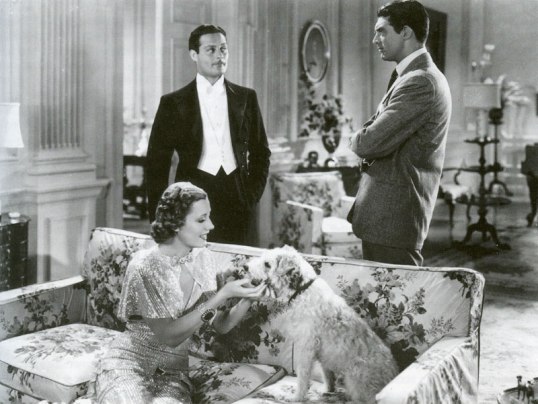
The Awful Truth (1937, dir by Leo McCarey)

The Awful Truth (1937, dir by Leo McCarey)

Notorious (1946, dir by Alfred Hitchcock)

Notorious (1946, dir by Alfred Hitchcock)

North by Northwest (1959, dir by Alfred Hitchcock)

North by Northwest (1959, dir by Alfred Hitchcock)

Charade (1963, dir by Stanley Donen)

Charade (1963, dir by Stanley Donen)

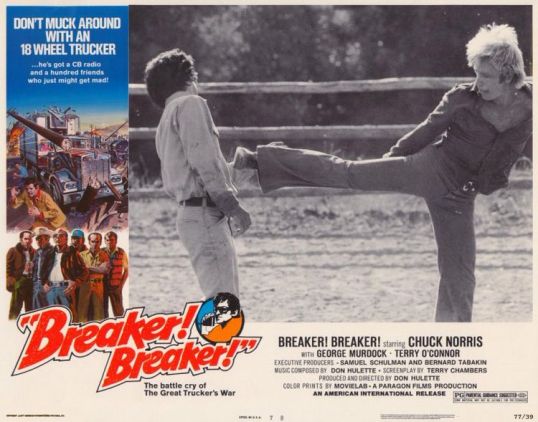
A Movie A Day #18: Breaker! Breaker! (1977, directed by Don Hulette)


breaker-breaker-lobby-card-2

Somewhere, in Southern California, there’s a small town called Texas City.  Texas City is run by a corrupt judge (George Murdock) and a sadistic cop (Don Gentry).  The residents of Texas City make their money by arresting truckers, forcing them to pay huge fines, and selling their rigs to the savage yard.  But they made a mistake when they arrested a trucker named Billy Dawes (Michael Augensten).  Billy has an older brother who is also a trucker.  His name is J.D. and he’s Chuck Norris!

After appearing as an “honorable” villain in Bruce Lee’s The Way of the Dragon and providing martial arts training to the Hollywood elite, Chuck Norris made his starring debut in Breaker!  Breaker!  This is one of those weird only in the 70s hybrid movies.  Mix in a little Deliverance, add a little Smokey and the Bandit, and then toss in Chuck Norris doing a roundhouse kick.  Shake it up and you get Breaker!  Breaker!

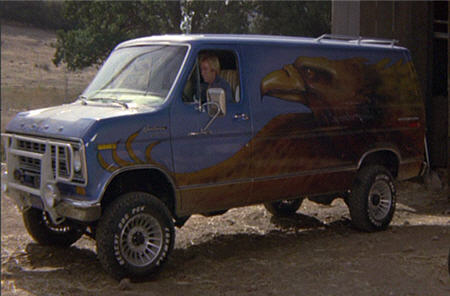
The main problem with Breaker!  Breaker! is that it does not really know what to do with Chuck Norris.  While he’s stil a step above someone like Steven Seagal, Chuck has never exactly been a great actor but, in Breaker!  Breaker!, his inexperience in front of the camera is especially noticeable.  Chuck is at his best when he’s fighting but he spends too much of Breaker!  Breaker! sitting behind the wheel of either his truck or his super groovy 70s van (check out the eagle painted on the side) and doing CB radio patter.  When he does fight, his opponents are all rednecks who, unlike Bruce Lee in Way of the Dragon, don’t stand a chance against him.

norris-van

I did like the movie’s ending, in which an army of big rigs descend on Texas City.  Don’t mess with truckers!

Two final notes: Breaker! Breaker! was edited by Steven Zaillian, who 16 years later, would win an Oscar for writing Schindler’s List.  Also, keep an eye out for Eraserhead himself, Jack Nance, as one of J.D.’s friends.

jack-nance

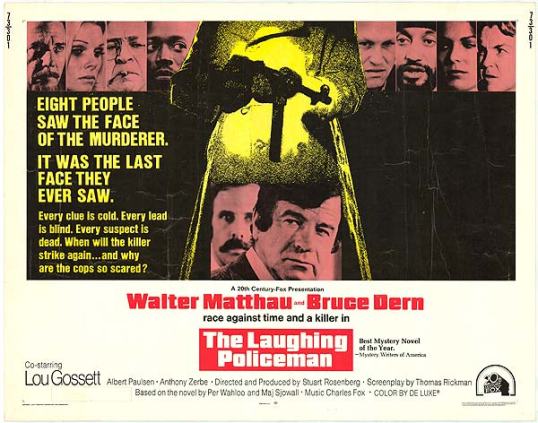
A Movie A Day #17: The Laughing Policeman (1973, directed by Stuart Rosenberg)


8232729_orig

San Francisco in the 1970s.  Revolution is in the air.  Hippies are on every street corner.  A man named Gus Niles knows that he’s being tailed by an off-duty cop, Dave Evans.  Gus boards a city bus, knowing that Evans will follow him.  On the bus, an unseen gunman suddenly opens fire with an M3 submachine gun, not only killing both Evans and Gus but six other people as well.  After the bus crashes, the gunman calmly departs.  At first, it is assumed that the massacre was another random mass shooting, like Charles Whitman in Austin or Mark Essex in New Orleans.  But one San Francisco detective is convinced that it wasn’t random at all.

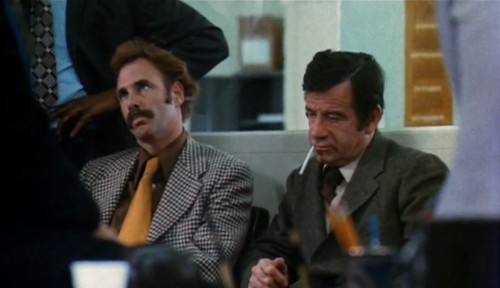
The Laughing Policeman was one of the many police procedurals to be released after the box office success of Dirty Harry and The French Connection and, despite the name, it’s also one of the grimmest.  While the complex mystery behind why Evans was following Gus and who killed everyone on the bus is intriguing, The Laughing Policeman‘s main focus is on the often frustrating nitty gritty of the investigation, complete with false leads, uncooperative witnesses, unanswerable questions, and detectives who frequently make stupid mistakes.  The movie’s first fifteen minutes are devoted to the police processing the bus, with Stuart Rosenberg (best known for directing Paul Newman in Cool Hand Luke) using overlapping dialogue to give the entire scene a documentary feel.  As Detective Jake Martin, Walter Matthau is even more cynical and downbeat than usual while Bruce Dern provides good support as a younger, more volatile detective.  The supporting cast is full of 70s character actors, like Lou Gossett, Anthony Zerbe, Gregory Sierra,and playing perhaps the sleaziest drug dealer ever seen in an American movie, Paul Koslo.

The Laughing Policeman was based on a Swedish novel that took place in Stockholm but, for the movie, Swedish Detective Martin Beck became world-weary Sgt. Jake Martin and Stockholm became San Francisco.  Rosenberg directed the entire film on location, giving The Laughing Policeman the type of realistic feeling that would later be duplicated by TV shows like Hill Street Blues, NYPD Blue, and Law & Order.  Though it may not be as well-known as either Dirty Harry or The French Connection, The Laughing Policeman is a dark and tough police procedural, an underrated classic of the genre.

Incidentally, The Laughing Policeman was one of the first films for which character actor Bruce Dern shared top billing.  According to Dern’s autobiography, Matthau generously insisted that Dern be credited, with him, above the title.

bruce_dern_walter_matthau_the_laughing_policeman_1973-500x288

Star Vehicle: Burt Reynolds in WHITE LIGHTNING (United Artists 1973)


gary loggins's avatarcracked rear viewer

wl1

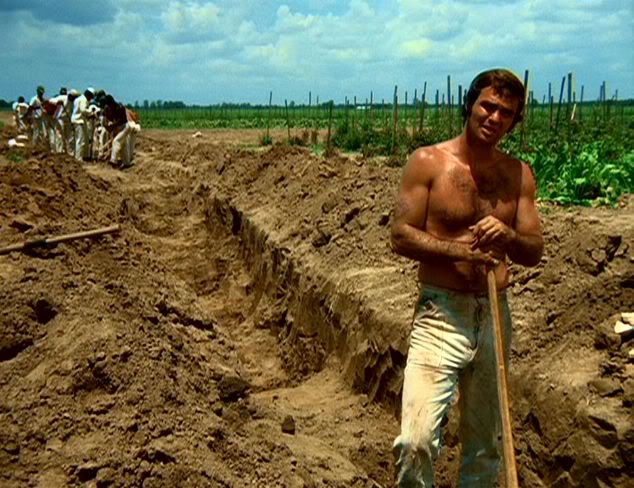
Burt Reynolds labored for years in the Hollywood mines, starring in some ill-fated TV series (his biggest success on the small screen was a three-year run in a supporting role on GUNSMOKE) and movies (nonsense like SHARK! and SKULLDUGGERY) before hitting it big in John Boorman’s DELIVERANCE. Suddenly, the journeyman actor was a hot property (posing butt-naked as a centerfold for COSMOPOLITAN didn’t hurt, either!), and studios were scurrying to sign him on to their projects. WHITE LIGHTNING was geared to the Southern drive-in crowd, but Reynolds’ new-found popularity, along with the film’s anti-authority stance, made it a success across the nation.

wl22

WHITE LIGHTNING takes place in rural Arkansas, and Gator McKluskey (Burt) is doing a stretch in Federal prison for running moonshine. His cousin visits and tells Gator his younger brother Donnie was murdered by Sheriff J.C. Connors, the crooked boss of Bogan County. A raging Gator tries to escape, but is immediately caught, so he…

View original post 690 more words

A Movie A Day #16: Boycott (2001, directed by Clark Johnson)


boycott

Originally made for HBO, Boycott is one of the best and, unfortunately, least-known films made about the life of Martin Luther King, Jr.  Boycott tells the story of the Montgomery Bus Boycott, starting with the arrest of Rosa Parks for refusing to sit in the back of the bus to the eventual integration of the Montgomery public transportation system.  Clark Johnson directs Boycott in a semi-documentary, handheld style, which adds an immediacy to the oft-told story.

Boycott focuses on the role that 24 year-old Martin Luther King, Jr. (played by Jeffrey Wright) played as the leader of the Montgomery Bus Boycott and how the boycott’s success turned King into a national figure.  Jeffrey Wright does a great job playing the young King and it’s interesting to watch as the initially uncertain King finds both his voice and his strength as a leader.  Boycott works as a good companion piece to Selma, not the least because Carmen Ejogo plays Coretta Scott King in both of them.

Also giving a noteworthy performances are Terrence Howard as King’s second-in-command, Ralph Abernathy and Erik Dellums in the role of Bayard Rustin, who was one of King’s closest confidants but, because he was gay, was often left outside of the movement’s inner circle.  Before they worked together on Boycott, Dellums, the son of former U.S. Rep. Ron Dellums, co-starred with Clark Johnson on Homicide: Life on the Street.

Boycott is a tribute to not just Martin Luther King but also the entire civil rights movement.

A Movie A Day #15: Special Bulletin (1983, directed by Ed Zwick)


specialbulletin2

“We interrupt our regularly scheduled programming for a special report…”

Led by veteran anchor John Woodley, the RBS news team is providing continuing coverage of a developing crisis in Charleston, South Carolina, where terrorists are holding several members of the coast guard, a local new reporter, and his cameraman hostage on a small tugboat.  These are not typical terrorists, though.  Two of them are nuclear scientists.  One of them is a social worker.  Another one is a nationally-renowned poet.  The final terrorist is a former banker robber who was just recently released from prison.  This unlikely group has only two demands: that the U.S. government hand over every single nuclear trigger device at the U.S. Naval Base and that RBS give them a live television feed so that they can explain their actions to the nation.  If either of those demands are not met, a nuclear bomb will be detonated and will destroy Charleston.

This made-for-TV movie was shot on video tape, to specifically make it look like an actual news broadcast.  Though much of the movie seems dated when compared to today’s slick, 24-hour media circus, Special Bulletin was convincing enough that, when it was originally broadcast in 1983, it caused a mini-panic among viewers who missed the opening disclaimer:

specbull_disclaimer

Because the movie deals with the threat of nuclear terrorism instead of a U.S.-Soviet nuclear war, it still feels relevant in a way that many of the atomic disaster films of the 1980s do not.  Beyond making an anti-nuclear statement, Special Bulletin is also a critical look at how the news media sensationalizes every crisis, with the RBS news team going from smug complacency to outright horror as the situation continues to deteriorate.  David Clennon and David Rasche are memorable as the two most outspoken of the terrorists and Ed Flanders is perfectly cast as a veteran news anchor struggling to maintain control in the middle of an uncontrollable situation.  Special Bulletin won an Emmy for Outstanding Drama Special and can be currently be found on YouTube.

Keep an eye out for Michael Madsen, who shows up 57 minutes in and gets the movie’s best line: “That guy’s a total psycho ward.”

madsen-special-bulletin

A Movie A Day #14: Eyewitness (1970, directed by John Hough)


eyewitness-1970-film

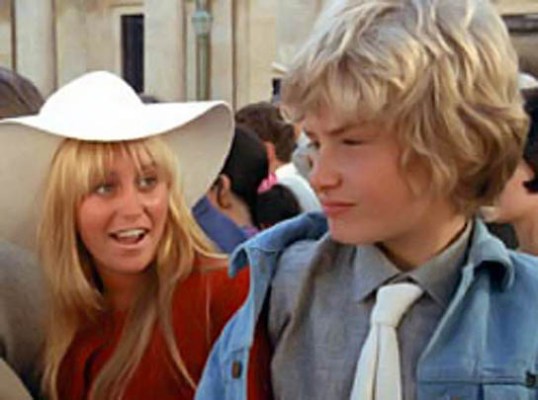
In Eyewitness (which is also known as Sudden Terror), eleven year-old Ziggy (Mark Lester) witnesses a policeman (Peter Vaughan) assassinating a visiting African dignitary but, because he has a history of “crying wolf,” he can’t get anyone to believe him.  Not his older sister, Pippa (Susan George).  Not his grandfather (Lionel Jeffries), the lighthouse keeper.  Not the housekeeper, Madame Robiac (Betty Marsden).  Not even Tom Jones (Tony Bonner), a tourist who fancies Pippa.  When he sees two policemen driving up to his grandfather’s lighthouse, Ziggy panics and runs.  Though John Hough’s direction, which is full of zoom shots and Dutch angles, is dated, Eyewitness holds up well as a tight thriller.  Susan George was beautiful in 1970 and Peter Vaughan is a great villain.

If Sam Peckinpah had ever made a children’s movie, it would probably look a lot like Eyewitness.  The movie starts out with Ziggy playing on the beach and pretending to be a soldier while imaginary gunshots and explosions are heard in the background.  It ends with a strange joke about a man who looks like Hitler, followed by a cheery freeze frame.  In between all that cheeriness, the assassin and his brother (Peter Bowles) chase Ziggy across Malta and kill anyone who gets in their way, from a friendly priest to a ten year-old girl being held by her father.  I counted ten onscreen death, which is a lot considering that this British movie was released at a time when some were still arguing that Jon Pertwee-era Dr. Who was too scary for children.  There’s even an exciting car chase that ends with one car overturned and the blood-covered survivors struggling to drag themselves out from underneath the wreckage.  How many British children were traumatized by Eyewitness?


Growing Pains: YOU’RE A BIG BOY NOW (Warner Brothers 1966)


gary loggins's avatarcracked rear viewer

ybb1

Francis Ford Coppola  was still a UCLA film student when he made YOU’RE A BIG BOY NOW, the 1966 coming of age comedy he used as his MFA thesis. The young Coppola was 27, and had gained experience working for Roger Corman ; indeed, Corman gave him his first break when he hired Coppola to write and direct the horror quickie DEMENTIA 13. But YOU’RE A BIG BOY NOW was his first major studio release, and put him on the map as a talent to keep an eye on.

ybb2

Bernard Chanticleer is a 19 year old nerd with a way-overprotective mother and disinterested, authoritarian father. He works for Dad at a New York City library, and is constantly goofing up on the job. Dad thinks it’s time for Bernard to spread his wings and move on his own, much to Mom’s displeasure. She finds him a room at a house owned by Miss Thing, who’s tenants include conservative…

View original post 450 more words

2016 in Review: Lisa Marie Picks The 26 Best Films of 2016!


Well, the time is here!  It’s time for me to reveal my picks for the best 26 films of 2016!

If there’s been any theme that I’ve found myself constantly returning to while looking back at the previous year, it’s that 2016 just wasn’t as good as 2015.  That’s certainly true as far as movies are concerned.  Whereas 2015 provided us with an embarrasment of riches, 2016 was — overall — a pretty bland year as far as cinema is concerned.

That doesn’t mean there weren’t some great films released in 2016.  I’m proud of this list below.  At the same time, I’m also a little bit frustrated.  As happens every year, there are a few films that, as of this writing, I have yet to see.  Weather permitting, I will see Silence and Jackie tomorrow and on Monday.  If I feel that they need to be included in my top 26, I will come back and edit this list.  And, of course, I still need to see some of the films that are no longer playing in theaters — Captain Fantastic, Hunt for the Wilderpeople, and some others.  The list below should be considered my picks for the best 2016 films that I actually got to see.

Also, I still need to write reviews for two of the films listed below.  Hopefully, I’ll be able to do that today.  As soon as those reviews are posted, I’ll add links.

With all that in mind, here’s the list!

american_honey_poster

  1. American Honey
  2. Arrival
  3. Kubo and the Two Strings
  4. The Neon Demon
  5. La La Land
  6. Moonlight
  7. The Nice Guys
  8. Hell or High Water
  9. A Monster Calls
  10. Love & Friendship
  11. Sing Street
  12. The Witch
  13. Hacksaw Ridge
  14. Sully
  15. The Green Room
  16. 10 Cloverfield Lane
  17. Captain America: Civil War
  18. Finding Dory
  19. Popstar: Never Stop Never Stopping
  20. Fences
  21. Manchester By The Sea
  22. Eye in the Sky
  23. Hush
  24. The Conjuring 2
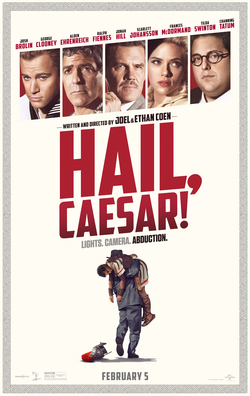
  25. Hail Caesar
  26. Everybody Wants Some!!

Hail,_Caesar!_Teaser_poster

You can check out my picks for previous years by clicking on 2010, 2011, 2012, 2013, 2014, and 2015!

Agree?  Disagree?  Have a list of your own?  Let us know in the comments!

Previous Entries In The Best of 2016:

  1. TFG’s 2016 Comics Year In Review : Top Tens, Worsts, And Everything In Between
  2. Anime of the Year: 2016
  3. 25 Best, Worst, and Gems I Saw In 2016
  4. 2016 in Review: The Best of SyFy
  5. 2016 in Review: The Best of Lifetime
  6. 2016 in Review: Lisa Picks the 16 Worst Films of 2016!
  7. Necromoonyeti’s Top Ten Albums of 2016
  8. 2016 In Review: Lisa Marie’s 14 Favorite Songs of 2016
  9. 2016 In Review: 10 Good Things I Saw On Television in 2016
  10. 2016 in Review: Lisa Marie’s 10 Favorite Non-Fiction Books of 2016
  11. 2016 in Review: Lisa Marie’s 20 Favorite Novels of 2016