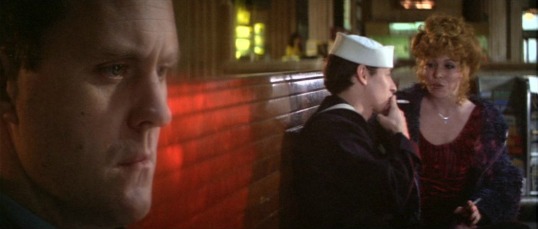
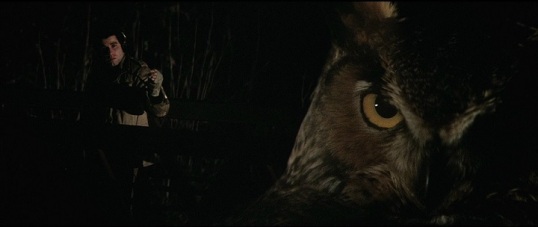
October Hacks: Psycho (dir by Gus Van Sant)


Gus, what were you thinking!?

1998’s Psycho tells the story of real estate secretary Marion Crane (Anne Heche). Marion is in love with Sam Loomis (Viggo Mortensen), but Sam feels that they can’t get married because he doesn’t have much money and he has to send a monthly alimony payment to his ex-wife. Sam says he doesn’t want Marion to have to spend her married life “licking the stamps.” “I’ll lick the stamps,” Marion replies in a tone that suggests she has no intention of ever licking a stamp.

Marion steals some money from work and goes on the run. While she drives around the Southwest with a blank expression on her face, she thinks about how everyone will react to the theft. She imagines what people are saying about her. She has a scary experience with a highway patrolman (James Remar). She imagines her sister (Julianne Moore) looking for her. Eventually, when it starts to rain, she pulls into an isolated motel for the night and she meets a nervous man named Norman Bates (Vince Vaughn).

Fresh from the success of Good Will Hunting, director Gus Van Sant decided that it was time to pursue a dream project. He remade Alfred Hitchcock’s Psycho. That in itself was a pretty dumb idea. The first film is one of the few films that almost everyone seems to agree is perfectly made. There was no great need to remake it and, after several sequels, there was probably not great demand for it either. Van Sant also decided that he would remake the film by using the exact same script (with just a few minor updates to reflect changing times) and that he would recreate Hitchcock’s film shot-for-shot.

Now, I know what you may be thinking. If Van Sant used the same script and the exact same shot list from the first film, why did he even bother to remake the movie in the first place? My personal theory is that remaking Psycho was probably something that Van Sant first thought of doing while he was a film student. It’s probably something that he came up with and he carried with him for years. Because no one ever thought it would actually happen, his friends humored him and didn’t tell him what a pointless idea it was. Then Van Sant became a success and, once you’re a success, no one’s going to tell you no. Making an Oscar-friendly box office hit like Good Will Hunting temporarily gave Van Sant the opportunity to do whatever he wanted and what he wanted to do was remake Psycho without changing the script or any of the shots.

Despite all of that, there are a few differences. This version of Psycho is shot in color and is full of tacky wallpaper and garish colors. Marion wears some of the ugliest outfits that I’ve ever seen. Of course, the cast is entirely new. The instantly relatable Janet Leigh is replaced by the dull and androgynous Anne Heche. Viggo Mortensen is equally dull as Sam. Julianne Moore is much more take-charge as Lila but, physically, is in no way believable as being related to Anne Heche. (Vera Miles and Janet Leigh, on the other hand, very much seemed like sisters even if they didn’t share any scenes together.) Martin Balsam’s wiseguy private eye is replaced by William H. Macy’s nerdy detective. The biggest change is that Anthony Perkins has been replaced by a totally miscast Vince Vaughn. Norman Bates is someone who has spent the last ten years of his life isolated from the world, living like a hermit. Vince Vaughn, an actor who I usually like, comes across like he can’t wait to get down to the local bar and order everyone a beer.

You don’t hear much about Gus Van Sant’s Psycho anymore. Everyone pretends like it doesn’t exist and that’s probably for the best. If anything, it’s a reminder that almost every director has at least one bad idea that he’s waiting to spring on the world once he becomes successful enough. For Gus Van Sant, the idea was Psycho.

SOV Horror Review: The Groundhog’s Day Massacre (dir by Harold Olminsky)


1986’s The Groundhog’s Day Massacre takes place in Ohio. Someone who is apparently known as Baggyface is obsessed with saws and killing people. He does indeed wear a bag over his face and he goes around with an electrical saw, though I’m not really sure how he keeps it running. Maybe he has a really long extension cord. Despite the danger of Baggyface, a couple still decide to have a nice romantic picnic outside. They eat, they frolic, and they toss around a frisbee. Eventually, Baggyface shows up.

The Groundhog’s Day Massacre is only 26 minutes long. About twenty minutes into the action, the screen is suddenly filled with static and we hear someone off-camera saying, “Technical difficulties.” The static goes on for about three minutes and then we get back to what passes as the action. I have to admit that I actually did smile when the static started and that “technical difficulties” line made me laugh. It’s film nerd humor and, more specifically, it’s horror nerd humor. Any true horror fan has seen countless low-budget films that suffered from at least one technical difficulty. (If you don’t know what I’m talking about, I can only assume you’re one of those “I love American Horror Story” snobs.) Tossing it into the middle of this film is a reminder that we’re not meant to take any of this seriously.

Shot on video, The Groundhog’s Day Massacre is semi-legendary amongst SOV fans, both because of its “so bad it’s good” reputation and the fact that, for years, it wasn’t easy to find. (It’s on YouTube now.) The title was obviously meant to poke fun at the slasher habit of trying to co-opt popular holidays. The footage is grainy, there’s next to zero dialogue, and three cast members were clearly amateurs. Heavy metal music drones in the background. Watching two people play frisbee is not made any more exciting by playing an 80s hair band.

(One thing that people forget about the early days of the Internet is that people would beg you to check out their “extreme sports” videos and then it would inevitably turn out to be just like twelve minutes of some douchebag with a manbun trying to steer a unicycle while Pantera played in the background. That’s what the frisbee scenes reminded me of.)

The Groundhog’s Day Massacre is not very good, but I imagine the people who made the film would probably agree with me on that. It does have a certain charm that comes from watching it and knowing that, one weekend, four or five people got together and filmed it and now, 40 years later, it can still be viewed on YouTube. The man and the woman who get chased by Baggyface are probably in their 60s now! I wonder if they know people are watching them on YouTube? That said, The Groundhog’s Day Massacre is only 26 minutes long and it really makes you feel every one of those 26 minutes. There were plenty of technical difficulties with The Groundhog’s Day Massacre and I certainly don’t plan on watching it again.

And yet, I’m still glad it was made. I’m glad that it’s still being watched. I’m glad people are still laughing at the moments that they were meant to laugh at. I’m happy for the people who made this movie, wherever they may now be.

This poster, which I got off of Letterboxd, has nothing to do with the movie and I imagine it was probably made years after the film’s initial release. You’ll notice that they corrected the name of the movie. As someone who still cringes at the typos in her 2010n reviews, I understand.

The TSL Horror Grindhouse: Sisters (dir by Brian De Palma)


1972’s Sisters begins by introducing us to a likable ad executive named Philip Woode (Lisle Wilson). Woode is the victim of a prank show and, for his trouble, he wins dinner for two at a nice Manhattan restaurant. Daniele Breton (Margot Kidder), the model/actress who set him up for the show, agrees to be his date. They have a lovely night that ends at Daniele’s apartment. In the morning, Daniele explains that it’s not only her birthday but also the birthday of her twin, Dominique. Philip, being a nice guy, goes not only to refill Daniele’s prescription but also to pick up a birthday cake. He then comes back to the apartment and, in true Psycho fashion, is promptly stabbed to death by one of the sisters.

Across the street, journalist Grace Collier (Jennifer Salt) looks out her window just in time to see Philip getting stabbed and then using his own blood to write “help” on the apartment window. Director Brian De Palma makes good use of his trademark split-screen technique. On one side of the screen, we watch Philip dying. On the other side, we explore Grace’s apartment and see that, in the past, she’s written an editorial headlined “Why We Call Them Pigs.” We know that Grace is the only person who has witnessed Philip’s murder, and we also know why the police are not going to be inclined to believe her.

And indeed, by the time the police arrive, Daniele and her creepy ex-husband, Emil (William Finley), have already hidden Philip’s body in a couch. With the police proving to be of no help, Grace hires a private detective named Joseph Larch (Charles Durning) to break into Daniele’s apartment and search for clues. Durning doesn’t have a huge role in Sisters, but he definitely makes an impression as he proceeds to follow that couch across the country. De Palma’s dark sense of humor is evident as the couch eventually ends up in the wilds of Canada, where Durning uses his binoculars to keep an eye on it.

Sisters was an early De Palma film, one that gives him a chance to show off both his ability to generate suspense and the style that would become his trademark. It’s an effective film, one that has a plot that is full of twists but which can still easily be followed by the audience. Indeed, I doubt anyone will be shocked to discover the truth about Daniele and Dominique, but Margot Kidder gives such a good performance and De Palma directs with such confidence that the story still holds your attention. As for Jennifer Salt, she’s playing the type of radical journalist who probably would have identified with the politics of Greetings and Hi, Mom! while ultimately rejecting both films for their casual misogyny. It undoubtedly says something about De Palma’s worldview that, while he obviously sympathized with Grace’s politics, he still ultimately portrayed her as being an ineffectual investigator.

In the end, Grace is as much of a sister to Daniele as Dominique is. They’ve found themselves being manipulated by the same society, and they’ve both been forced to the fringes—Daniele by her past and Grace by her politics. In typical De Palma fashion, this film ends with the audience knowing more than the majority of the characters. We know what happened but, for everyone else, the truth is still hidden in a couch that’s sitting in the middle of nowhere.

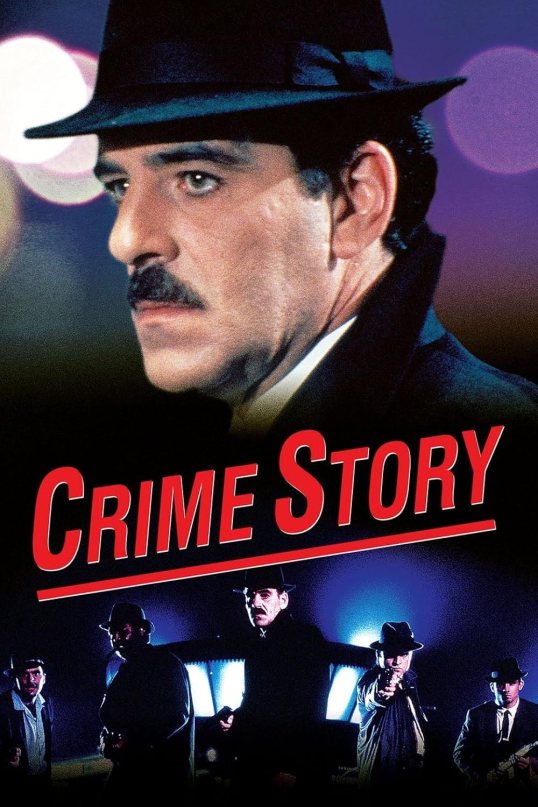
Retro Television Review: Crime Story 2.4 “Atomic Fallout”


Welcome to Retro Television Reviews, a feature where we review some of our favorite and least favorite shows of the past!  On Mondays, I will be reviewing Crime Story, which ran on NBC from 1986 to 1988.  The entire show can be found on Tubi!

This week, a major player returns!  Actually, two major players….

Episode 2.4 “Atomic Fallout”

(Dir by Bill Duke, originally aired on October 27th, 1987)

Two new members of the Task Force, who were assigned to keep an eye on Max Goldman, are discovered dead and burned to a crisp at a landing strip in the desert. At the same time, a scientist who is suspected of being a serial killer disappears from Las Vegas just as Torello is on the verge of arresting him.

Torello immediately assumes that the two things are connected. Unfortunately, the Atomic Energy Commission wants Torello to back off on his investigation of Dr. Gantman (George Bartenieff), the scientist-turned-serial killer. Gantman is working on a special project for the government. Torello and the Task Force head to Mexico to capture him anyway.

Torello isn’t the only Vegas resident in Mexico. Manny Weisbord is visiting Mexican crime boss Jorge Senterro (Ismael “East” Carlo). Two old friends of Manny’s are currently living with Senterro, and I bet you can already guess who they are.

That’s right! LUCA AND PAULI LIVE!

Despite having found themselves on a nuclear testing site at exactly the wrong time, Pauli and Luca survived. Pauli appears to be no worse for the experience. Luca, meanwhile, has only recently had his bandages removed. His back is scarred. Weisbord watches as Luca receives a shot from a very large hypodermic needle held by a chain-smoking doctor. Luca has survived, but he’s changed. He’s no longer content with building a national crime syndicate. Luca tells Manny that he’s planning on going international.

Weisbord is impressed with Luca’s ambition. However, he’s considerably less happy to learn that Luca and Senterro have teamed up to smuggle heroin into the United States. Weisbord has always been opposed to getting involved in the drug trade. Luca used to be opposed as well, but, as he explains it, drugs are where the money is going to be in the future. When Weisbord says that dealing drugs will cause the Justice Department to come after him, Luca says that he’s being protected by the U.S. government. The implication is obvious. The time of honorable crime bosses like Manny Weisbord has come to an end. Luca is the future.

While Luca is talking to Weisbord, Torello and his men are tracking down Dr. Gantman. They find him in a small safehouse, protected by Mexican soldiers. After a gunfight with the soldiers (and one has to wonder how that’s not going to become a diplomatic incident), Torello bursts in on Gantman just as he’s about to murder another woman. Torello guns the scientist down, and whatever information Gantman may have had about what the U.S. government is doing in Mexico dies with him.

In the episode’s final scene, Lt. Col. Milton Dance (Richard Zobel) meets with Luca and Pauli. Luca mentions that he heard about Gantman’s death and asks who was responsible. Dance replies that it was no one that Luca would know. Dance then hands Luca and Pauli their passports so that they can return to the United States.

This episode was a true treat for those of us who are interested in conspiracy theories. Dr. Gantman brought to mind the Nazi rocket scientists who were recruited by the CIA after World War II and who eventually ended up working for NASA. Luca working for the government would be implausible if not for the fact that the CIA and the Mafia actually did work together in the early ’60s to try to assassinate Fidel Castro. This episode was full of atomic imagery. When Luca talked about surviving the nuclear test, there was a quick flashback to a mushroom cloud rising over the desert. Torello and his men enjoy hanging out at a bar decorated with neon signs of mushroom clouds. A picture of a mushroom cloud was prominently displayed in Gantman’s house. This episode was all about atomic-age paranoia.

Best of all, Luca and Pauli are back. The first few episodes of the second season suffered because Torello himself seemed directionless without Luca to pursue. With this episode, we know that Luca is returning. Torello might not know it, but we know it.

And I can’t wait to see what happens!


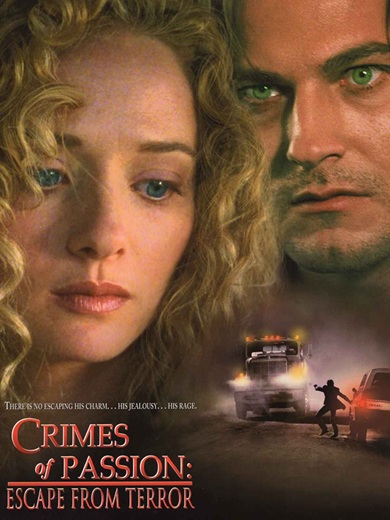
October Truer Crime: Escape From Terror: The Theresa Stamper Story (dir by Michael M. Scott)


First aired in 1995, Escape From Terror stars Maria Pitillo as Theresa Stamper. When the film begins, Theresa is a naive 23-year-old woman who lives in Oklahoma with her mother (Cindy Williams). She gets a job working as a secretary for Paul Stamper (Adam Storke), the owner of Stamper Oil Company. She soon becomes more than just Paul’s secretary. At first, Paul is charming. He’s a little rough around the edges and he’s quick to get jealous, but Theresa just tells herself that Paul is under a lot of stress and that she can fix whatever’s wrong with him.

Paul and Theresa get married in Las Vegas and things quickly go downhill. Paul becomes physically abusive, along with being emotionally manipulative. He fires her from her job because no wife of Paul Stamper is going to work, especially not where other men can look at her. Theresa continues to tell herself that Paul is just under stress. Everyone else tells her that Paul is clearly on drugs and they point out that he always wears long sleeves, even in the Oklahoma heat. When Theresa eventually catches Paul hanging out at a bar and shooting up heroin in the bathroom, he proceeds to beat her badly enough to send her to the hospital. When Theresa takes her daughter and leaves Paul, Paul goes crazy and shoots her new boyfriend.

Paul goes on the run. Eventually, he’s arrested and convicted, but he manages to escape from prison and then he disappears. Five years later, Theresa starts to get threatening calls and realizes that, wherever he is, Paul is still obsessed with her. What can Theresa do?

How about telling her story to Unsolved Mysteries?

Escape From Terror was produced by Unsolved Mysteries, so it shouldn’t be a surprise when a good deal of the film’s final moments is dedicated to showing just how efficiently the show and its audience were able to track down Paul Stamper. Sheriff Bill Douglas (Brad Dourif), who has been manning the Unsolved Mysteries phone lines, tells everyone in the studio to quiet down after word comes in that Paul has been arrested. “I’ve got one more call to make,” he says.

And yes, it would be tempting to call this movie out for mythologizing the people who produced it, but the fact of the matter is that it is a true story and the real Paul Stamper actually was arrested (and subsequently sentenced to 35 years in prison) after Unsolved Mysteries aired a story about him, so the show is probably justified in patting itself on the back. It’s kind of like America’s Most Wanted. As easy as it was to occasionally make fun of the show, it did work.

As for the movie, it’s actually not bad. I’ve spent enough time in rural Oklahoma that the film seems very familiar to me. Maria Pitillo and Adam Storke gave good performances as Theresa and Paul, with Adam Storke doing an especially good job of capturing Paul’s manipulative nature. It was also nice to see Brad Dourif playing a sympathetic character. Dourif may have made his name playing bad guys, but in this film, he’s the ideal small-town lawman.

I might binge Unsolved Mysteries after Horrorthon is over. Who knows? Maybe one of my older neighbors has been on the run since the ’90s. There’s really only one way to find out!

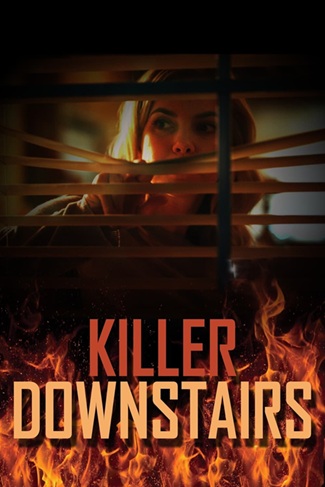
October On Lifetime: The Killer Downstairs (dir by Tony Dean Smith)


In this 2019 Lifetime film, Cindy Busby stars as Allison. Allison spent a lot of money on law school, but she hasn’t been able to get a job with a top-rated firm. Instead, she’s working at a grocery store that is definitely not meant to be Target, despite the fact that it looks like Target and all of the employees appear to be wearing blue versions of the Target uniforms.

Despite having a low-paying job and what one can only assume is a mountain of student debt, Allison lives in a mansion. One of the most comforting things about Lifetime films is that, no matter how bad life gets, everyone can still always afford to live in a giant house with a really impressive kitchen. (This is why I’m a capitalist.) Still, Allison could use a little extra money to help pay the bills, so she puts her basement up for rent on MiCassaSuCasa.com.

Soon, she gets a tenant. James (Marcus Rosner) is handsome, sensitive, and in need of companionship after his divorce. James is the type of guy who will show up at work and save you from your obnoxious boss while still finding time to make you a fabulous dinner. He seems like he’s perfect, but, of course, this is a Lifetime film, so no one has any excuse to be shocked when James starts planting secret cameras all over the house. James is clever enough to worm his way into Allison’s life and to start to win her heart, but he’s not smart enough to turn off his laptop whenever he leaves the basement. Nor does he really seem to be prepared for Allison’s best friend, Sarah (Donna Benedicto), and her skill at doing Google searches. That said, James does manage to kill a few people without anyone noticing him lurking around beforehand, and he also sabotages Allison’s upcoming interview with a law firm. What is James’s plan?

The Killer Downstairs is a typical Lifetime film, in that the plot depended upon Allison being way too trusting and James being way too eager to try to take over her life. If you’ve watched enough of these films, you’ll be able not only to guess exactly who James is going to kill but also when he’s going to do it. Unfortunately, Allison has never watched a Lifetime film and, as such, she’s noticeably slow to consider that maybe it’s the mysterious new guy in her life who is disrupting everything. Maybe it’s due to the fact that I spent several years as an office administrator for an actual attorney, but there’s absolutely nothing about Allison that suggests she would be a particularly good lawyer. Even before James shows up, she seems to be a bit scatterbrained. Ultimately, the message of this film becomes that some people are just meant to work in a grocery store, but that’s okay because they can still live in a mansion with a really nice kitchen. In the end, isn’t that what life is all about?

The Films of Dario Argento: The Card Player


In 2004’s The Card Player, a serial killer is haunting the streets of Rome. He’s abducting women and then taunting the police by demanding that they play online poker with him. If the police win a hand, the woman goes free. If the police lose, the woman is tortured and killed on a webcam. Unfortunately, it turns out that the police are lousy at playing poker. Actually, they’re lousy at just about everything. Whenever I watch The Card Player, I find myself imagining that I’m watching an episode of Law & Order: Remedial Police Unit. That’s a spin-off from the original Law & Order. It features incompetent, poorly trained detectives who are constantly forgetting to Mirandize suspects. I’m surprised that no one else has ever seen it.

There are two cops who are slightly competent. Anna Mari (Stefania Rocca) is the daughter of a man who wrote a book about how to play poker. (Hey, that might be helpful!) John Brennan (Liam Cunningham) is a tough Irish cop who is sent to Italy after the Card Player kills two British tourists. While the rest of the police force stands around and stares at the office computer all day, Anna Mari and Brennan actually try to track the killer down.

Oh, The Card Player. This film is often cited as being Dario Argento’s worst. To be honest, I think that’s a bit of an overreaction. The film’s not so much bad as it’s just kind of boring. It plays out like a police procedural and there’s little of Argento’s signature visual flair. There are way too many shots of people staring at screens with serious expressions on their faces. Like so many other directors before him, Argento struggles to find a way to make watching someone else play an online game interesting. Eventually, the police do win a hand and I cringed as all of the extras in the police station broke out into cheers. It felt corny and a bit silly. It definitely did not feel like Argento.

That said, the murders are memorably gruesome and the scenes where the bodies are recovered and then examined in the morgue are pure nightmare fuel. Argento tosses in a dancing coroner who takes way too much pleasure in discussing things like the cause of death. The sight of the coroner dancing brings to mind the moment in Tenebrae where John Saxon is stabbed in public and none of the witnesses seem to be particularly disturbed. There’s a chilling callousness to the moment and a reminder of why Argento often portrays insects as being more trustworthy and empathetic than humans. Stefania Rocca gives a good performance in a role that was originally meant to be played by Asia Argento. Liam Cunningham is today known more for his political vacuousness than his acting talent but he’s still believably rugged and cynical as Brennan.

Finally, the film’s depiction of online poker is very much a late-90s version of the Internet. Everything loads slowly, the graphics are awkward and stiff, and the whole thing projects a feeling of “Can you believe people actually pay for this?” Seen in 2026, it’s actually kind of charming. The old internet was so dorky that it was impossible not to love it.

The Card Player is pretty forgettable, especially when compared to Argento’s earlier films or, for that matter, a film like Sleepless. It’s not as bad as some say but it’s definitely not top-rate Argento.

The (Reviewed) Films of Dario Argento:

  1. The Bird With The Crystal Plumage
  2. Cat O’Nine Tales
  3. Four Flies on Grey Velvet
  4. Deep Red
  5. Suspiria
  6. Inferno
  7. Tenebrae
  8. Phenomena
  9. Opera
  10. Two Evil Eyes
  11. Trauma
  12. The Stendhal Syndrome
  13. The Phantom of the Opera
  14. Sleepless
  15. Dracula 3D (Reviewed by Brad Crain)

6 Argento Trailers For October 26th


Today’s edition of Lisa Marie’s Favorite Grindhouse Trailers features some of my favorites from Dario Argento!

Deep Red (1975)

Inferno (1980)

Tenebrae (1983)

Phenomena (1985)

Opera (1987)

Trauma (1993)

What do you think, Trailer Kitties?


by Erin Nicole

I agree, Mom Cat!  Those trailers aren’t meant for kittens!

Film Review: Body Double (dir by Brian De Palma)


Rumor has it that Brian De Palma’s motivation for directing 1984’s Body Double was that he was angry with the MPAA. After being forced to (unfairly, in his opinion) recut almost all of his previous films to avoid an X-rating, De Palma decided to make a film that was actually worthy of an X. It would feature the bloodiest and most sexually suggestive murder that he had filmed up to that point. Because a good deal of the film would deal with the adult film industry and would co-star Melanie Griffith as an actress named Holly Body, the film would be full of nudity. The film would even feature Frankie Goes to Hollywood performing their then-controversial hit song, “Relax.” De Palma said that the film would be a “real X,” and, indeed, it was rated X when it was first submitted. De Palma later said that he actually only had to cut a few seconds of nudity to get an R-rating, which was quite a contrast to what he went through with his previous films. The nudity was cut. The scene of Deborah Shelton getting murdered by a killer with a very phallic drill was untouched, just in case you were wondering about the MPAA’s priorities.

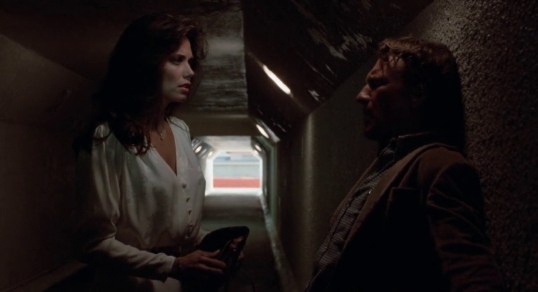
Body Double stars one of my favorite underrated actors, Craig Wasson. Wasson plays Jake Scully, a struggling actor with extreme claustrophobia. When he freezes up while lying in a coffin, Jake is fired from the vampire film in which he’s appearing. Jake’s friend, Sam Bouchard (Gregg Henry), takes some pity on him and arranges for Jake to housesit a luxurious apartment. Sam points out that, every night, Jake’s neighbor appears to dance naked in her apartment. Jake becomes obsessed with Gloria Revelle (Deborah Shelton) and starts to follow her across Los Angeles. (That Jake remains likable even after he watches her shop for underwear is a testament to Wasson’s amiable screen presence.) Jake realizes that he’s not the only one following Gloria. After a man who appears to be extremely scarred snatches Gloria’s purse, Jake chases after him. Jake doesn’t catch the man because his claustrophobia acts up when he has to run through a tunnel. But Gloria shares an impulsive kiss with him before leaving. Later that night, Jake looks into Gloria’s apartment and witnesses her being murdered by the man who earlier stole her purse….

Jake’s investigation into Gloria’s death leads him into the world of adult films and body doubles. In a typical De Palma twist, it also leads to Jake becoming a better actor as he’s forced to take on different identities and lie about his intentions. He meets Holly Body, an actress he’s shocked to discover he’s seen before.

Body Double is one of those De Palma films that seem to divide people. Viewers either love the twisty plot, the elaborate set pieces, and the deliberate homages to Hitchcock or else they find it all to be terribly self-indulgent. This film is De Palma at his most stylish. When Gloria and Jake kiss, De Palma doesn’t just show us the kiss. Instead, the camera spins around them and, for a few moments, De Palma’s thriller becomes a grand romance. There’s a dark sense of humor running through Body Double and, again, how one reacts to it will depend on how much one is already on De Palma’s wavelength. Just as Blow Out ended with Travolta finding the perfect scream, Body Double ends with Jake learning how to stay in the coffin until the director yells “Cut!” Big tragedies lead to small victories.

I have to admit that the first time I saw Body Double, I was a little bit annoyed with it. Every time that I started to get invested in the story, De Palma would launch into another lengthy set piece that ultimately seemed to be designed to remind me that it was just a movie. On repeat viewings, though, I’ve come to appreciate the film’s dark humor and the performances of Wasson, Griffith, and Gregg Henry. Now, I can appreciate the film for what it is, an exercise in glorious style and excess. Body Double is De Palma paying tribute to the masters (like Hitchcock) while also telling an unapologetically sordid story. De Palma’s real X holds up well.


Film Review: Blow Out (dir by Brian De Palma)


Before the shouting starts, allow me to say that I fully understand that 1981’s Blow Out is not a horror film .… or at least, it isn’t in the traditional way. It’s a conspiracy thriller starring John Travolta as Jack Terry, a Philadelphia sound technician. While recording outside sounds, he witnesses a car careen off a bridge and crash into a creek. Though the driver is killed in the crash, Jack is able to pull the car’s passenger, an escort named Sally (Nancy Allen), out of the water. Later, Jack learns that the driver was Governor George McRyan, a presidential candidate. And when Jack listens to his tapes of the crash, he becomes convinced that he can hear someone shooting out one of the tires.

So, yes, the film is definitely a conspiracy thriller, one that owes quite a bit to the lore surrounding the Kennedys. Jack’s sound tape and the later discovery that a sleazy guy with the unforgettable name of Manny Karp (Dennis Franz) filmed the accident bring to mind the Zapruder film and the ongoing debate about what it showed and didn’t show. (Watching the film, one is reminded that it took several years for people to acknowledge that a key moment in the Zapruder Tape was actually shown in reverse when it was first released to the public.) The crash into the creek brings to mind the night that Ted Kennedy drove off a bridge at Chappaquiddick and left Mary Jo Kopechne to die while he returned to his hotel and got some sleep. There were some conspiracy theorists who claimed that the accident was actually the result of an attempt on Ted’s life. (It’s always interesting how Chappaquiddick is described as being a Kennedy tragedy when, in actuality, Mary Jo Kopechne is the one who died and Ted was the one reelected to the Senate.) Just a year before Blow Out was released, Ted Kennedy ran for President and discovered that voters outside of Massachusetts actually did care about what he did at Chappaquiddick. Meanwhile, director Brian De Palma’s interest in the Kennedy assassination could be traced all the way back to Greetings and Gerrit Graham’s performance as a conspiracy-obsessed hipster.

That said, Blow Out is definitely horror-adjacent. The film opens with footage from a believably bad slasher film called Co-Ed Frenzy. The footage makes use of all the expected slasher tropes, from the prowling camera to the gratuitous nudity to the death of a voyeuristic extra. But it falls apart during the inevitable shower scene, when it turns out that the actress cannot scream. It’s a reminder that the violence in horror movies is not real. Instead, it’s carefully choreographed and edited to keep the viewer uneasy. Jack is ordered to record the perfect scream to fool viewers into thinking the horror is real. Jack manages to do so, but at a terrible cost. The scream works in the film. The spell that the film puts over the audience will not be broken. But Jack will never be able to listen to his work.

The film also features John Lithgow as Burke, one of the cruelest villains to be found in De Palma’s entire filmography. Burke knows that he has to kill Sally to cover up the assassination of Governor McRyan but, rather than just kill her, he first kills several women who resemble her so that Sally will be viewed as just being the latest victim of the Liberty Bell Strangler. John Lithgow is a terrifying murderer because he’s so casual about it. For him, it’s just a part of the job. Ever since I saw Blow Out for the first time, I automatically get uneasy whenever John Lithgow shows up in a movie. In a film full of good performances, John Lithgow is terrifying.

Blow Out is a stylish film, which should come as no surprise given that it was directed by Brian De Palma. De Palma goes as far as to create a fictional holiday—“Liberty Day”—so that he can fill the climax with red, white, and blue. The celebrations, which are meant to commemorate the ringing of the Liberty Bell, provide a joyous contrast to the darkness that defines the worlds of the film’s characters. Like the best conspiracy thrillers, Blow Out is drenched in an atmosphere of paranoia. No one can be trusted, and the scariest thing isn’t that people don’t know the truth. It’s that they don’t want to know. And while this theme was undoubtedly something that De Palma carried into the ’80s from the ’60s and the ’70s, it feels even more relevant today as we’re continually told that we shouldn’t still be thinking about the excesses and secrets of the COVID era.

So no, Blow Out is not a horror film.

But it’s definitely scary.