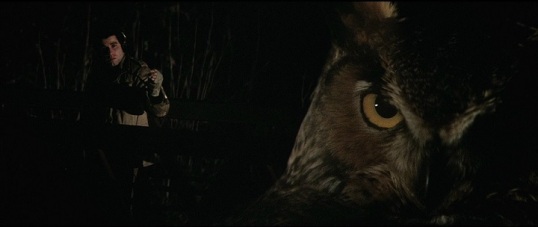
Before the shouting starts, allow me to say that I fully understand that 1981’s Blow Out is not a horror film .… or at least, it isn’t in the traditional way. It’s a conspiracy thriller starring John Travolta as Jack Terry, a Philadelphia sound technician. While recording outside sounds, he witnesses a car careen off a bridge and crash into a creek. Though the driver is killed in the crash, Jack is able to pull the car’s passenger, an escort named Sally (Nancy Allen), out of the water. Later, Jack learns that the driver was Governor George McRyan, a presidential candidate. And when Jack listens to his tapes of the crash, he becomes convinced that he can hear someone shooting out one of the tires.
So, yes, the film is definitely a conspiracy thriller, one that owes quite a bit to the lore surrounding the Kennedys. Jack’s sound tape and the later discovery that a sleazy guy with the unforgettable name of Manny Karp (Dennis Franz) filmed the accident bring to mind the Zapruder film and the ongoing debate about what it showed and didn’t show. (Watching the film, one is reminded that it took several years for people to acknowledge that a key moment in the Zapruder Tape was actually shown in reverse when it was first released to the public.) The crash into the creek brings to mind the night that Ted Kennedy drove off a bridge at Chappaquiddick and left Mary Jo Kopechne to die while he returned to his hotel and got some sleep. There were some conspiracy theorists who claimed that the accident was actually the result of an attempt on Ted’s life. (It’s always interesting how Chappaquiddick is described as being a Kennedy tragedy when, in actuality, Mary Jo Kopechne is the one who died and Ted was the one reelected to the Senate.) Just a year before Blow Out was released, Ted Kennedy ran for President and discovered that voters outside of Massachusetts actually did care about what he did at Chappaquiddick. Meanwhile, director Brian De Palma’s interest in the Kennedy assassination could be traced all the way back to Greetings and Gerrit Graham’s performance as a conspiracy-obsessed hipster.
That said, Blow Out is definitely horror-adjacent. The film opens with footage from a believably bad slasher film called Co-Ed Frenzy. The footage makes use of all the expected slasher tropes, from the prowling camera to the gratuitous nudity to the death of a voyeuristic extra. But it falls apart during the inevitable shower scene, when it turns out that the actress cannot scream. It’s a reminder that the violence in horror movies is not real. Instead, it’s carefully choreographed and edited to keep the viewer uneasy. Jack is ordered to record the perfect scream to fool viewers into thinking the horror is real. Jack manages to do so, but at a terrible cost. The scream works in the film. The spell that the film puts over the audience will not be broken. But Jack will never be able to listen to his work.

The film also features John Lithgow as Burke, one of the cruelest villains to be found in De Palma’s entire filmography. Burke knows that he has to kill Sally to cover up the assassination of Governor McRyan but, rather than just kill her, he first kills several women who resemble her so that Sally will be viewed as just being the latest victim of the Liberty Bell Strangler. John Lithgow is a terrifying murderer because he’s so casual about it. For him, it’s just a part of the job. Ever since I saw Blow Out for the first time, I automatically get uneasy whenever John Lithgow shows up in a movie. In a film full of good performances, John Lithgow is terrifying.
Blow Out is a stylish film, which should come as no surprise given that it was directed by Brian De Palma. De Palma goes as far as to create a fictional holiday—“Liberty Day”—so that he can fill the climax with red, white, and blue. The celebrations, which are meant to commemorate the ringing of the Liberty Bell, provide a joyous contrast to the darkness that defines the worlds of the film’s characters. Like the best conspiracy thrillers, Blow Out is drenched in an atmosphere of paranoia. No one can be trusted, and the scariest thing isn’t that people don’t know the truth. It’s that they don’t want to know. And while this theme was undoubtedly something that De Palma carried into the ’80s from the ’60s and the ’70s, it feels even more relevant today as we’re continually told that we shouldn’t still be thinking about the excesses and secrets of the COVID era.
So no, Blow Out is not a horror film.
But it’s definitely scary.