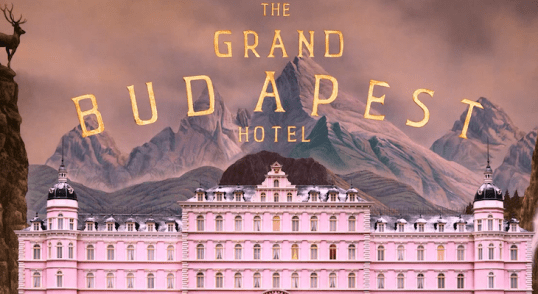
A Few Very Late Thoughts On Wes Anderson’s The Grand Budapest Hotel


grand-budapest-hotel

It took me a while to come around to appreciating The Grand Budapest Hotel.

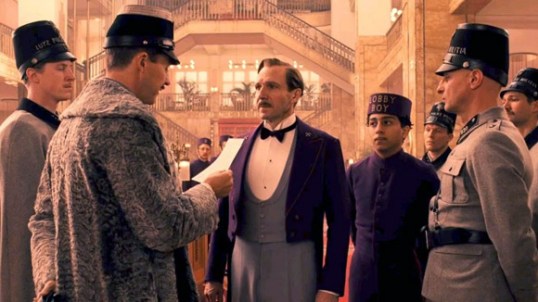
When I first saw Wes Anderson’s latest film, way back in March, I have to admit that I was somehow both impressed and disappointed.  The film’s virtues were obvious.  Ralph Fiennes gave a brilliant lead performance as Gustave, the courtly and womanizing concierge of the Grand Budapest Hotel.  As played by Fiennes, Gustave came to represent a certain type of old world elegance that, I’m assuming, died out long before I was born.  As is typical of Anderson’s film, The Grand Budapest Hotel was visual delight.  Even when the film’s convoluted storyline occasionally grew self-indulgent, The Grand Budapest Hotel was always interesting and fun to watch.

At the same time, I had some issues with The Grand Budapest Hotel.

One of the major ones — and I will admit right now that this will seem minor to some of you — is that halfway through the film, a cat is killed.  The evil Dimitri Desgoffe von Taxis (Adrien Brody) is attempting to intimidate a nervous lawyer, Kovacs (Jeff Goldblum).  Kovacs’s owns a cat and, at one point, Dimitri’s henchman, Jopling (Willem DaFoe), tosses the cat out of a window.  Kovacs runs to window and sees his dead cat splattered on the sidewalk below…

And this is when the audience in the theater laughed and I got very angry.

To me, there was nothing funny about killing that man’s cat.  But the more I’ve thought about it, the more that I’ve come to realize that my reaction had more to do with the audience than the film.  The film was not saying that the cat’s death was funny.  The film was saying that Dimitri and Jopling were evil and dangerous, as their actions throughout the film would demonstrate.  It was the audience that decided, since Grand Budapest Hotel is full of funny moments and has the off-center style that one has come to expect from Wes Anderson, that meant every scene in the film was meant to be played strictly for laughs.  The fact of the matter is that a typical Wes Anderson film will always attract a certain type of hipster douchebag.  They were the ones who loudly laughed, mostly because they had spent the entire movie laughing loudly in order to make sure that everyone around them understood that they were in on the joke.

But that’s not the fault of the film.  Despite what you may have heard and what the Golden Globes would have you believe, The Grand Budapest Hotel is not a comedy.  For all the deliberately funny and quirky moments, The Grand Budapest Hotel is actually a very serious film.  For all of the slapstick and for all of Ralph Fiennes’s snarky line readings, The Grand Budapest Hotel ultimately ends on a note of deep melancholy.

When I first saw The Grand Budapest Hotel, it seemed like it was almost too quirky for its own good.  And, to be honest, I could still have done without some of Anderson’s more self-indulgent touches.  The sequence at the end, where Gustave, who has been framed for murder, gets help from a series of his fellow hotel concierges started out funny but, as everyone from Bill Murray to Owen Wilson put in an appearance, it started to feel less like the story of Gustave and more like the story of all of Wes Anderson’s famous friends.

However, the more I’ve thought about it (and The Grand Budapest Hotel is a film that I’ve thought about a lot over the past year), the more I’ve realized that the quirkiness is only a problem if you made the mistake of thinking that the film is meant to be taken literally.

The more I thought about it, the more obvious it became that the most important scenes in The Grand Budapest Hotel were to be found at the beginning and the end of the film.

The film opens with a teenage girl sitting in front of the grave of a great author.  She opens a book and starts to read.

As soon as the girl starts to read, we flashback 29 years to 1985 where the author (Tom Wilkinson) sits behind his office desk and starts to talk about the time that he visited the Grand Budapest Hotel.  

We flashback again to 1969, where we see how the author (now played by Jude Law) met the owner of the Grand Budapest Hotel, a man named Zero (played by F. Murray Abraham).  Over dinner, Zero tells the author the story of how he first came to the Grand Budapest and how he eventually came to own the hotel.

And again, we go back in time, this time to 1932.  We see how the young Zero (Tony Revolori) first met and came to be the protegé of Gustave (Ralph Fiennes).  We see how Gustave taught Zero how to be the perfect concierge.  Eventually, Gustave would be framed for murdering a guest, Zero would meet and fall in love with Agatha (Saoirse Ronan), and then Zubrowska (the fictional Eastern European country in which this all takes place) would be taken over by fascists who would eventually claim the hotel as their own.

After the story of Gustave, Zero, and Agatha has been told, we suddenly flash forward to the author talking to Zero and then to the old author telling the story to his grandson and then finally back to the teenage reader sitting in the cemetery.

In other words, the Grand Budapest Hotel may be the story of Zero but we’re experiencing it through the memories of the author as visualized by the reader.  Gustave, Zero, and the entire Grand Budapest Hotel are not just parts of a story.  Instead, they become symbols of an old way of life that, though it may have been lost, still exists in the memories of old travelers like the author and the imaginations of young readers like the girl in the cemetery.

As I said at the start of this, I was vaguely disappointed with The Grand Budapest Hotel when I first saw it but, perhaps more than any other movie that I saw last year, this has been a film that I haven’t been able to get out of my mind.  Having recently rewatched the film on HBO, I can also attest that both The Grand Budapest Hotel and Ralph Fiennes’s performance not only hold up on a second viewing but improve as well.

I still stand by some of my original criticisms of The Grand Budapest Hotel.  I still wish that cat had not been thrown out the window, even though I now understand that Anderson’s main intent was to show the evil of Dimitri and Jopling.  And I still find some of the cameos to be jarring, precisely because they take us out of the world of the film.

But you know what?

Despite those flaws, The Grand Budapest Hotel is still a unique and intriguing film.  When I sat down tonight and made out my list of my top 26 films of 2014, I was not surprised that Grand Budapest Hotel made the list.  But I was a little bit surprised at how high I ended up ranking it.

But then I thought about it and it all made sense.
The-Grand-Budapest-Hotel-580


Lisa’s Oscar Predictions For October


Julianne Moore in Still Alice

Julianne Moore in Still Alice

Ever since March, I have been posting my monthly Oscar predictions.  Because I was so busy with my Back To School series, I missed my chance to post an update in September.  (And, before you say that missing one month is no big deal, you should take into my consideration my OCD…)  However, it is now October and, as the Oscar picture starts to become a little bit more clear, here are my current predictions!

(Interested in seeing my past predictions?  Check out March, April, May, June, July, and August.)

Best Picture

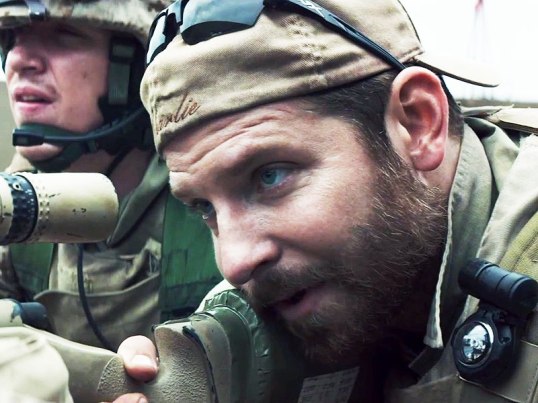
American Sniper

Birdman

Boyhood

Foxcatcher

The Imitation Game

Interstellar

Still Alice

Unbroken

Whiplash

Wild

(Before anyone asks why I haven’t included Gone Girl or Inherent Vice on the list, I ask them to consider the Oscar fate of both The Master and Fincher’s Girl With The Dragon Tattoo.)

Best Actor

Steve Carell in Foxcatcher

Bradley Cooper in American Sniper

Benedict Cumberbatch in The Imitation Game

Michael Keaton in Birdman

Eddie Redmayne in The Theory of Everything

Best Actress

Amy Adams in Big Eyes

Felecity Jones in The Theory of Everything

Julianne Moore in Still Alice

Rosamund Pike in Gone Girl

Reese Whitherspoon in Wild

Best Supporting Actor

John Brolin in Inherent Vice

Edward Norton in Birdman

Mark Ruffalo in Foxcatcher

J.K. Simmons in Whiplash

Tom Wilkinson in Selma

Best Supporting Actress

Patricia Arquette in Boyhood

Laura Dern in Wild

Kiera Knightley in The Imitation Game

Rene Russo in Nightcrawler

Emma Stone in Birdman

Best Director

Clint Eastwood for American Sniper

Alejandro Inarritu for Birdman

Richard Linklater for Boyhood

Bennett Miller for Foxcatcher

Morten Tyldum for The Imitation Game

American Sniper

American Sniper


It’s Time For Lisa Marie’s Early Oscar Predictions for August!


theory-of-everything-new

Every month, around this time, I post my early Oscar predictions.  These predictions are based on random guesses, early buzz, and gut instinct.  Originally, I referred to these as being my way too early Oscar predictions but, now that we’re in August, they are merely early.

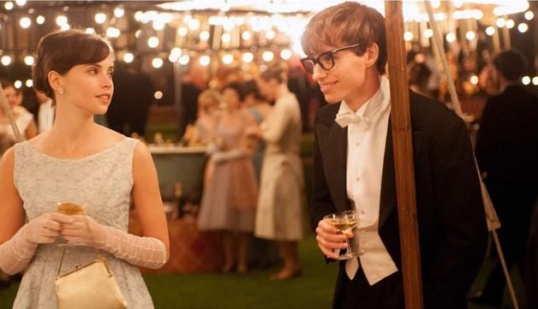
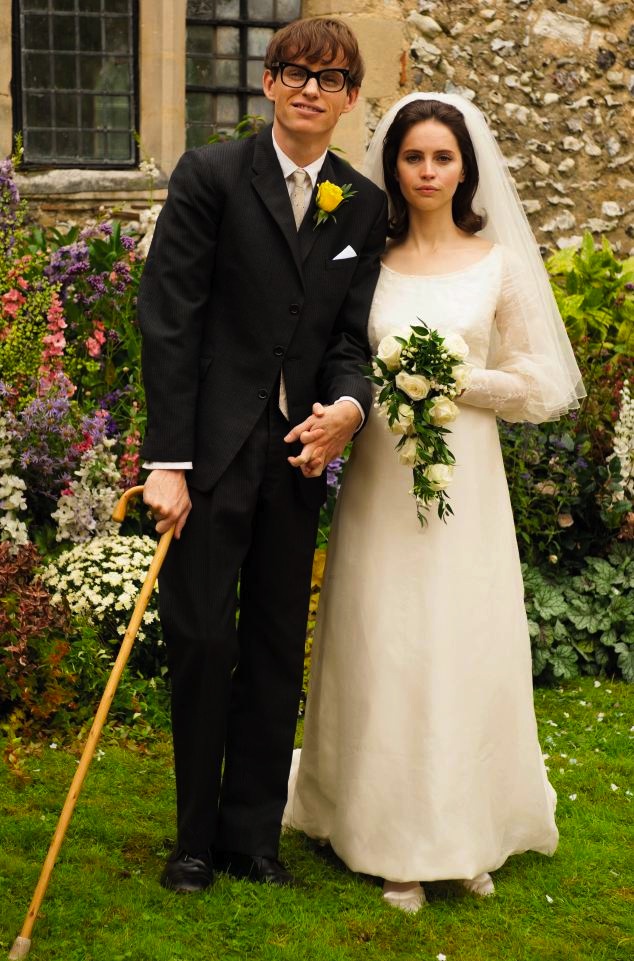
Below you can find my latest set of predictions.  The main change for this month is that I’ve factored in the fact that, based on the trailer, it looks like The Theory of Everything will be a definite contender.

And feel free to check out my predictions for March, April, May, June, and July!


Best Picture

Birdman

Boyhood

Foxcatcher

The Imitation Game

Interstellar

The Theory of Everything

Unbroken

Whiplash

Wild


Best Director

Alejandro Gonzalez Inarritu for Birdman

Richard Linklater for Boyhood

James Marsh for The Theory of Everything

Bennett Miller for Foxcatcher

Morten Tyldum for The Imitation Game


Best Actor

Steve Carell in Foxcatcher

Benedict Cumberbatch in The Imitation Game

Michael Keaton in Birdman

Eddie Redmayne in The Theory of Everything

Timothy Spall in Mr. Turner


Best Actress

Amy Adams in Big Eyes

Jessica Chastain in The Disappearance of Eleanor Rigby

Rosamund Pike in Gone Girl

Reese Whitherspoon in Wild

Shailene Woodley in The Fault In Our Stars


Best Supporting Actor

Ethan Hawke in Boyhood

John Lithgow in Love is Strange

Mark Ruffalo in Foxcatcher

J.K. Simmons in Whiplash

Tom Wilkinson in Selma


Best Supporting Actress

Patricia Arquette in Boyhood

Felicity Jones in The Theory of Everything

Julianne Moore in Map To The Stars

Kristen Stewart in The Clouds of Sils Maria

Emma Stone in Birdman

theory-of-everything-felicity-redmayne

Lisa’s Early Oscar Predictions For July


Foxcatcher

Foxcatcher

It’s time for me to update my early Oscar predictions!  Every month, based on a combination of buzz, reviews, gut feelings, and random guesses, I attempt to predict which films, directors, and performers will receive nominations in 2015!  Originally, I referred to these as being my “way too early Oscar predictions.”  However, we are now halfway through the year and the picture is no longer quite as hazy as before.  Therefore, these are now simply my “early” predictions.

Click on the links to check out my predictions for March, April,  May, and June!

And below you’ll find my predictions for July.

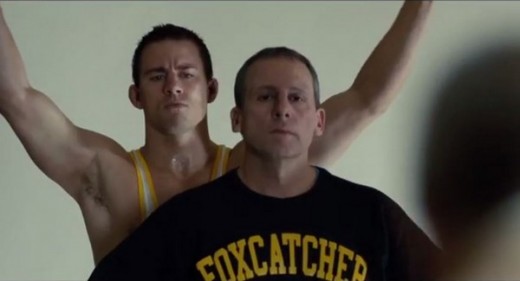
As you may notice, my predictions have remained pretty stable over the past month.  The advance word on Big Eyes has been mixed but, unlike a lot of Oscar watchers, I was never expecting Big Eyes to be a major contender for any award other than best actress.  Meanwhile, Boyhood continues to be one of the most acclaimed films of the year, which makes me even more certain that Boyhood will be a contender in several categories.  Advanced word on Foxcatcher has also been so strong that I can now imagine both Mark Ruffalo and Channing Tatum scoring nominations for best supporting actor.

The big question right now is whether or not the acclaim that’s been given to summer films like Edge of Tomorrow and Dawn of the Planet of the Apes will also translate into major Oscar nominations or will those films simply have to be satisfied with getting all of the usual technical nominations.  Personally, I would love to see Andy Serkis get some love from the Academy but, sadly, I doubt it’s going to happen.

Best Picture

Birdman

Boyhood

Foxcatcher

The Imitation Game

Interstellar

Mr. Turner

Unbroken

Wild


Best Director

Alejandro Gonzalez Inarritu for Birdman

Mike Leigh for Mr. Turner

Richard Linklater for Boyhood

Bennett Miller for Foxcatcher

Jean-Marc Vallee for Wild


Best Actor

Steve Carell in Foxcatcher

Benedict Cumberbatch in The Imitation Game

Ralph Fiennes in The Grand Budapest Hotel

Michael Keaton in Birdman

Timothy Spall in Mr. Turner


Best Actress

Amy Adams in Big Eyes

Jessica Chastain in The Disappearance of Eleanor Rigby

Rosamund Pike in Gone Girl

Reese Whitherspoon in Wild

Shailene Woodley in The Fault In Our Stars


Best Supporting Actor

Ethan Hawke in Boyhood

Mark Ruffalo in Foxcatcher

J.K. Simmons in Whiplash

Channing Tatum in Foxcatcher

Tom Wilkinson in Selma


Best Supporting Actress

Patricia Arquette in Boyhood

Julianne Moore in Map To The Stars

Kristen Scott Thomas in Suite francaise

Kristen Stewart in The Clouds of Sils Maria

Emma Stone in Birdman

Boyhood

Boyhood

Embracing the Melodrama #50: In the Bedroom (dir by Todd Field)


in_the_bedroom_ver3

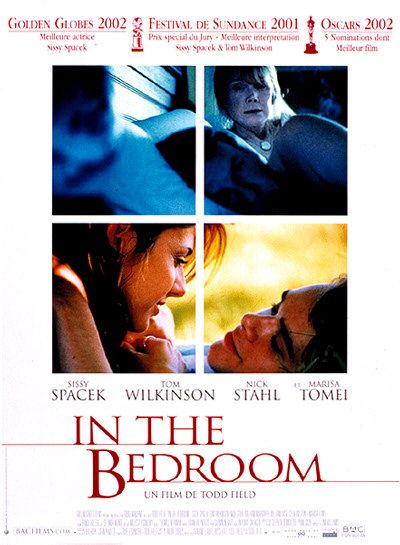
If some enterprising young filmmaker were to try to remake Ordinary People as a film noir, he would probably be wasting his time because director Todd Field already beat him to it with the 2001 best picture nominee In The Bedroom.

In the Bedroom takes place in a small town in Maine, the type of idyllic location where almost everyone is a fisherman and, in one way or another, everyone’s future is dependent on the whims of the rich and powerful Strout family.  Dr. Matt Fowler (Tom Wilkinson) and his wife Ruth (Sissy Spacek) seem to have the perfect life: a happy marriage and a smart and likable son, Frank Fowler (Nick Stahl).  Frank has just graduated from college and appears to have a great future ahead of him except for one thing.  He’s fallen in love with Natalie Strout (Marisa Tomei), the ex-wife of the abusive Richard Strout (William Mapother).  When Frank announces that he’s thinking about not going to grad school but instead staying in town so he can work as a fisherman and marry Natalie, Ruth is horrified that her son is throwing his life away.  However, Matt argues that Frank is just going through a phase.

The violent and unstable Richard is determined to win Natalie back.  When Frank attempts to protect Natalie during one of Richard’s rampages, Richard kills Frank by shooting him in the eye.  Richard is arrested for the murder but, largely as a result of his family’s influence, he is only convicted of accidental manslaughter and gets off with probation.  Matt and Ruth are left to both work through their grief and guilt and to eventually seek their own violent vengeance on Richard Strout.

In the Bedroom is probably one of the darkest films that I’ve ever seen in my entire life.  Not only is the film thematically dark but a good deal of it takes place at night and Todd Field fills the screens with shadows.  In the Bedroom is full of scenes of characters just staring at each other, struggling to find the right words to express their feelings and, far too often, simply giving up and saying nothing.  Field makes good use of the frequent silence though.  When Matt and Ruth yell at each other in the kitchen of their home, it’s both shocking and poignant because it stands in such sharp contrast to their usual silence.  Later. when Matt confronts Richard, the frequent pauses in their strained conversation serves to make the scene all the more ominous and creepy.

However, despite being one of the saddest films ever made, In The Bedroom is worth watching just for the performances of the cast.  You probably know that Tom Wilkinson, Sissy Spacek, and Marisa Tomei are all great so instead, I’m going to focus on the two members of the cast who did not receive Oscar nominations.  William Mapother does a really good job playing an unlikable character.  The dangerous yet dorky vibe that made him so menacing when he played Ethan Rohm on Lost is fully present and put to good use here.  Finally, Nick Stahl gives a wonderful performance as poor, doomed Frank.  With limited screen time, Stahl makes Frank into such a believable and sympathetic character that his death becomes a tragedy that the audience feels as well.

Sadly, Nick Stahl has recently been in the new more for his personal troubles than his film careers.  Films like In The Bedroom and Bully show why Nick deserves a chance to make a comeback.

bedroom-11

Trash Film Guru Vs. The Summer Blockbusters : “The Lone Ranger”


poster1


It all seemed like such a no-brainer, didn’t it?

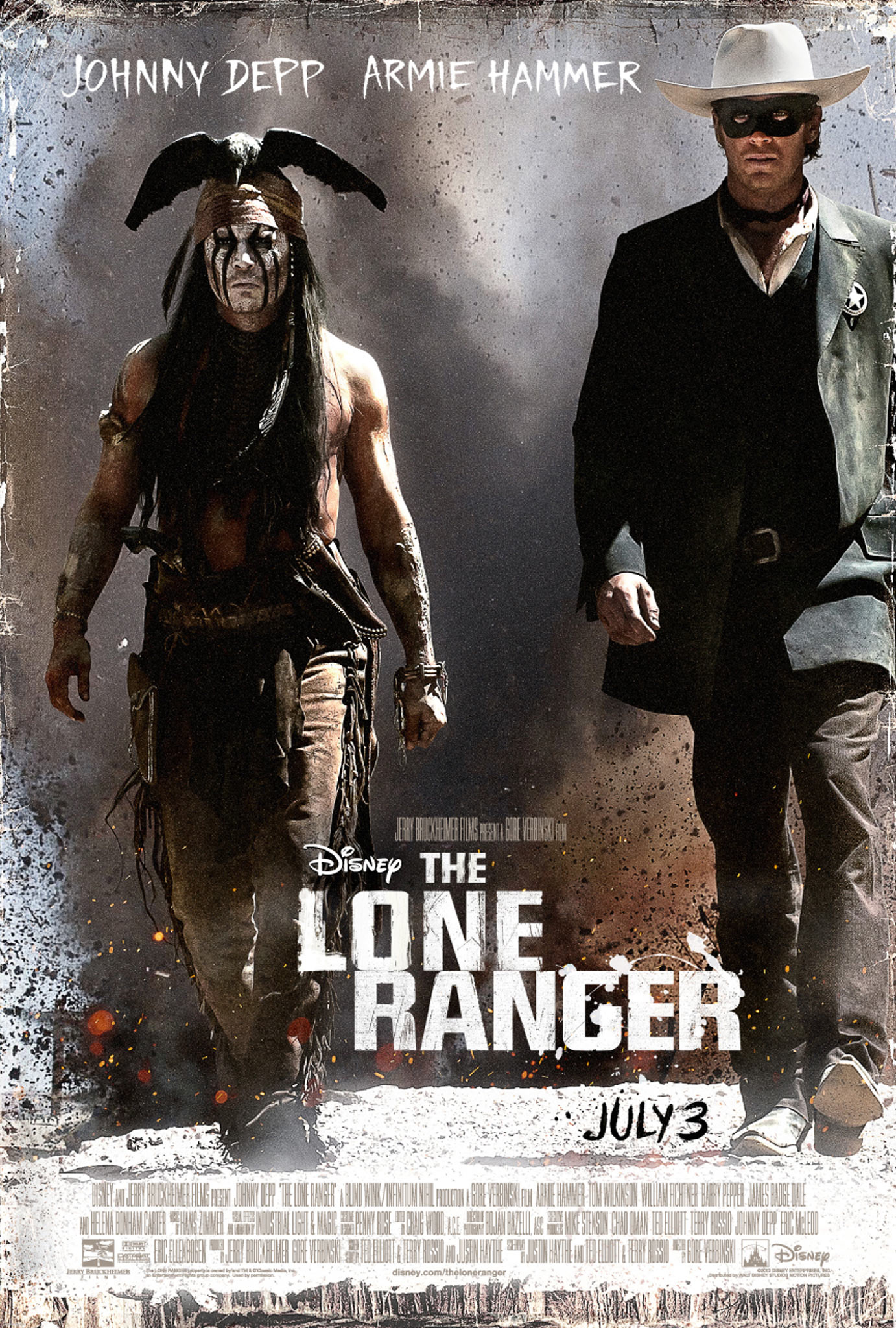
Disney snaps up the cinematic rights to the most famous Western hero of them all — one that hasn’t been “rebooted” since 1981’s disastrous Legend Of The Lone Ranger — and turns it over, naturally enough, to Jerry Bruckheimer, who “gets the band back together,” so to speak, by hiring Gore Verbinski to direct and Johnny Depp to star as Tonto. Pirates Of The Caribbean Goes West, anyone?

It goes without saying that budget wouldn’t be a concern here — special effects, production values, sets and costumes — all would be state-of-the-state-of-the-art. Turn it loose on the public over the extended July 4th holiday weekend, sit back, and collect all that cold, hard cash. What could possibly go wrong? This was fool-proof.

Except for the fact that, well, it hasn’t been. The Lone Ranger has landed at the box office with a thud — not as big a thud as it did back in ’81, but a thud nonetheless. The critics seem to despise it, and while audiences have been considerably kinder in their appraisal of the film, they haven’t been large enough for Disney to come anywhere close to recouping their considerable investment in this rapidly-unfurling boondoggle.

All of which is kind of a shame because, as with last year’s panned (but considerably more successful at the box office) Men In Black 3, I honestly can’t figure out where all the hate is coming from. Simply put, The Lone Ranger is a damn fun movie, full of exactly the kind of kick-ass, jaw-dropping CGI, solid “out for justice” storytelling, tight, pacy plotting, and charismatic acting that makes for a sure-fire crowd-pleaser. Even if the crowds aren’t proving to be all that big.

Not exactly a “revisionist” take on the legend of John Reid (confidently played by Armie Hammer), a Texas Ranger who, when his life is turned tragically upside-down, dons a mask and adopts a new persona. this flick nevertheless provides a different spin on things by telling the tale from the point of view of an older, wiser, and maybe even somewhat broken-down Tonto (Johnny Depp in, quite honestly, one of the finest performances of his career), who earlier in life threw his lot in with Reid to bring to justice the source of all our hero’s troubles, renegade quasi-militia leader Butch Cavendish (William Fichtner, who makes for a terrific bad guy) and ,more generally, to put a stop to all the various shenanigans this good-for-nothing had a hand in.

If this sounds like your idea of a simple-minded, non-stop thrill ride full of all the excitement, adventure, humor, and yes, even human drama that you want in summertime popcorn fare, rest assured — it is. Good supporting turns from the likes of Helena Bonham Carter, Tom Wilkinson, and Ruth Wilson don’t hurt matters any, either.

Yeah, there are some gaping plot holes large enough for an entire herd of cattle to stampede through, but has that stopped folks from liking, say, World War Z or Man Of Steel, both of which are at least as guilty of counting on you to put your suspension of disbelief completely on hold for a couple of hours? If you can do it for them, surely you can do it for this, right?

Look, I won’t kid you — some small, petty, vengeful little corner of my dark and twisted soul is always happy to see a mega-budget Disney project end up costing the studio untold millions in losses. They’re bastards and they deserve it. But truth be told, if you join the legions of people who have already evidently decided to take a pass on The Lone Ranger, you’re not hurting the evil empire much — they’ve already got Monsters University to more than compensate for any bite this takes from their corporate balance sheet. The only thing you’re really doing by skipping it, then,  is robbing yourself of a good time.

It’s summer! Get out there and have some fun — by sitting on your ass in a cool, air-conditioned mega-plex and catching what’s most likely the best action-adventure film of the year so far.

Which Way Forward For The “Batman” Movie Franchise? Take Fifteen : Meet The New (Crime) Boss


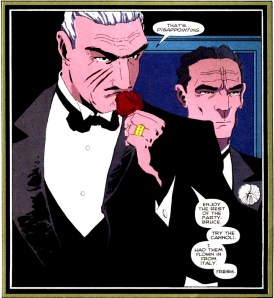
The man you see pictured above is one Carmine Falcone, (former, as far as current Bat-continuity goes) crime boss of Gotham City. You may remember him from Batman Begins, of course, where he was played by Tom Wilkinson — a curious choice being that Mr. Wilkinson neither looks nor sounds especially Italian, but whatever.

He’s also largely immaterial to this post given that we’ve already established that the Harvey Dent/Jim Gordon/”Bat-Vigilante” trifecta has already locked him away at the start of our hypothetical Batman I  movie, but the slack left in the absence of him and the other incarcerated Crime Lords has been picked up, to an extent, in our imaginary flick by one Vincent Lucchesi, a name I dropped earlier but that we now will be meeting in earnest for the first time in a scene that, I freely admit, is heavily influenced by Nolan’s first Bat-flick.

Now, I confess — last time around, I left you with the distinct impression that our next segment would revolve around a TV interview with Bruce Wayne, but looking at things more closely over the last couple of days, I’ve decided that now might be a good time to introduce Mr. Lucchesi, since he’s going to figure prominently in this (again, completely imaginary) film, and because I think I’d like to show Batman in action for the first time at right about this point — although, fair warning, that’s going to be our focus tomorrow : one thing at a time, as always!

Anyway, I started this post with a picture of Falcone because Lucchesi is an entirely invented character (at this point — he’s going to eventually become a fairly well-known member of the Batman “Rogues’ Gallery,” but again, let’s not get too far ahead of ourselves!) but he’s a bad-ass Gotham crime boss, and if you want to find pics of a bad-ass Gotham crime boss to kick off your blog post with, you’re stuck with Falcone images — this one, needless to say, from Loeb and Sale’s Batman : The Long Halloween (yes, again!).

If you’ll recall, busting Lucchesi has proven tough for the Dark Knight Detective because his deepest, darkest, most well-hidden secret seems to be that he’s importing an entirely legal, if obscure, experimental liquid compound through a string of front companies, and it seems only logical that in the two-day interregnum between Bruce Wayne’s “official” return to Gotham and his Monday morning chat-show appearance, he might want to have a look at one of these shipments in his Bat-persona.

To that effect, our next scene will show Lucchesi in a plush, Penthouse-type office, smoking an imported cigarette in a long holder, and meeting with a few of his less-than-trusted henchmen. Their conversation will be revolving around a shipment coming in that night, and Lucchesi will naturally ask who’s been tasked to provide “security” for the set-up. When one of the goons replies “Flass,” Luchessi will slam his fist on the desk and yell “Flass??????? You imbecile! Dent and Gordon just sent him upriver this morning!!!!!!!!!!,” thus hearkening back to our “Meet Jim Gordon” scene from a posts (but only a few minutes, movie-wise) ago. “Aren’t you clowns on top of any of the information that’s going around this town?”

“Gosh, we’re sorry, Mr. Lucchesi, so many guys been going down it’s gettin’ kinda hard to keep up!,” one of the toadies will stammer in response, to which Lucchesi will reply,” Well, it’s gettin’ too damn late to bring in anybody else, and I sure as hell can’t leave it to you nitwits, so it looks like I’m just gonna have to go down and oversee this operation myself. We’re at too critical a stage right now to leave it to a bunch’a goddamn amateurs!” At that point Lucchesi, immaculately dressed in an expensive Italian suit, will grab his equally-expensive Italian overcoat and hat and storm out of his office, his lackeys in tow behind him as he swears on his mother’s grave extreme vengeance, delivered with interest, upon Harvey Dent for all the trouble he’s been causing his operation.

If he knew the gruesome fate that was in store for him, he’d have stayed back at the office and farmed the job out after all —

Lisa Marie Bowman Does Michael Clayton (dir. by Tony Gilroy)


As part of my continuing mission to see and review every single film ever nominated for best picture, I recently rewatched the 2007 Best Picture nominee Michael Clayton. 

The title character (as played by George Clooney) is a sleazy attorney who “fixes” problems for one of the biggest law firms in New York.  When Arthur Edens (Tom Wilkinson), one of the firm’s partners and Michael’s mentor, has a nervous breakdown while at a deposition in Minnesota and ends up in jail, Michael is sent to retrieve him.  Michael soon discovers that Arthur’s mental collapse was due to a class action law suit involving an evil, faceless corporation.  Before he reveals any more details, Arthur flees and is subsequently murdered by two assassins.  With the police calling Arthur’s death a suicide, Michael soon finds himself being pursued by the same assassins.

Though I’ve owned the DVD for a couple of years, this was only the second time that I had ever actually sat down and watched this film.  (The first time was during its initial theatrical run.)  There have been many insomnia-filled nights when I’ve gone to my DVD collection, fully intending on grabbing Michael Clayton and allowing the images of an unshaven George Clooney to flicker in my dark bedroom.  However, every time, I always ended up suddenly remembering a film that I wanted to see more. 

That’s the thing with Michael Clayton.  Having seen the film a second time, I can say that it remains a well-made film and an entertaining film and I can also say that I noticed a whole lot of small details that I had either missed the first time or had subsequently forgotten about.  Like a lot of best picture nominees, Michael Clayton is a good film.  It’s just not a very memorable one.  Seriously, is anyone surprised when business executives and attorneys turn out to be the villains in these type of films?  And if you couldn’t guess that Tom Wilkinson was going to end up dead from the minute he turned up on-screen then you may need to surrender your filmgoer card.

That said, Michael Clayton remains a fun little film and I enjoyed watching it even if it was predictable.  In fact, I may have enjoyed it even more the second time around because I currently work for an attorney so I was able to spend the whole movie playing the “What would my boss do in this situation?” game.  (Hopefully, the first thing he would do would be to send his loyal and capable red-headed assistant on a nice, long, all-expense paid vacation Italy.)  Beyond that, Tony Gilroy’s direction is efficient and fast-paced, George Clooney gives one of his less-smug performances (It can be argued that Michael Clayton — along with Up In The Air and The Descendants — forms Clooney’s Mediocre White Man Trilogy) and Tilda Swinton deserved the Oscar she won for playing a villain who isn’t so much evil as just really insecure.   However, for me, the best performances in this film come from two unheralded actors by the name of Robert Prescott and Terry Serpico.  Playing the two assassins who pursue both Wilkinson and Clooney, Serpico and Prescott play their roles with a nonchalant sort of respectability that is both compelling and genuinely frightening.  During those brief moments when Serpico and Prescott are on-screen, Michael Clayton actually becomes the film that it is obviously trying so hard to be.

Trailer: Mission: Impossible – Ghost Protocol (Official)


I’ll be honest and admit that I wasn’t overly impressed by J.J. Abrams’ Mission: Impossible 3 and when it was announced that a fourth film in the franchise was going into production my initial reaction was an emphatic “meh”. It didn’t help when Pixar veteran Brad Bird was chosen to helm this fourth film. This was a filmmaker who did a great job with Pixar animated films, but still an unknown quantity when it came to live-action projects.

As the months passed and news filtered out from the film’s production the news was positive with many who have seen some rough footage becoming convinced that Brad Bird might know what he’s doing outside the Pixar stable. Mission: Impossible – Ghost Protocol was soon being talked as being one of the most-awaited films of 2011. This newly-released first official trailer goes a long way into adding more positive buzz to a film already hyped up on it.

Also, it has Paula Patton in it, nuff said.

Mission: Impossible – Ghost Protocol is set for a December 16, 2011 release.

Lisa Marie Conspires Against The Conspirator (dir. by Robert Redford)


Robert Redford’s new historical drama The Conspirator is the first prestige picture of 2011 and it’s also (arguably) the worst film of the year so far. 

Oh, I hear you out there: “Really?  Worse than even Season of the Witch and Your Highness?”

Yes.  Way worse.  Season of the Witch and Your Highness might have been bad films but they knew they were bad.  They never truly aspired to be anything other than bad.  The problem with The Conspirator is that it’s obviously meant to be a great and important film.  It’s meant to shape public debate.  We’re supposed to feel like better people for having sat through it and the filmmakers are supposed to be better people just for having made it.  There’s a smugness to these type of self-styled “prestige pictures” that elevates their badness beyond anything to be found in Your Highness.  Indeed, if the makers of Your Highness appeared to be getting high off of herb than the people behind The Conspirator are high off of their own good intentions and that makes them for more annoying.

The Conspirator is based on the trial of Mary Surratt, the only woman to be arrested, tried, and subsequently executed as a result of the conspiracy to assassinate Abraham Lincoln.  The execution of Mary Surratt was controversial because 1) she was a civilian tried by a military tribunal, 2) the evidence against her was largely circumstantial (she owned the boarding house where the conspirators — including her son John Surratt — supposedly met), and 3) she was a woman.

Now, I have to confess that I’m secretly kind of a big history nerd and — unlike most of this film’s audience — I was already familiar with the story of Mary Surratt before I sat down in the theater.  The story of the Lincoln Conspiracy and the aftermath of the assassination is a really interesting one that is full of all sorts of weird twists and turns and odd characters all conspiring together and being mysterious.  It has all the makings of a great grindhouse film. 

However, director Robert Redford is too good to make a grindhouse movie.  No, he has something important to say and, as a result, The Conspirator becomes yet another one of those tedious films where every line of dialogue and every image is supposed to make us go, “Hey, they might be talking about post-Civil War America but, by golly, this is relevent to our post-911 lives!  OH MY GOD!”  So, we get Tom Wilkinson showing up randomly to give speeches about why military tribunals are the work of the devil.  Wilkinson is playing a historical figure Reverdy Johnson but they might as well have just renamed him “Prestige Actor Cast As Mouthpiece.”  And then Kevin Kline (as Secretary of War Edwin Stanton, though they should have just called him Dick Cheney) is there to go, “The whole world has changed.”  Meanwhile, the camera lingers over the conspirators being held in their dirty cells with bags over their heads (“OH MY GOD, HONEY!” we’re supposed to shout at our loved ones, “THAT’S JUST LIKE GUANTANAMO BAY!  WOW!”) and then we’re constantly reminded that Mary Surratt was a devout Catholic and that America in 1865 viewed Catholicism in much the same way that America views Islam in 2011. 

And, yeah, we get it and I’m not saying that director Redford is incorrect in his message or his beliefs.  However, a boring, heavy-handed film is just as boring and heavy-handed regardless of where its heart may lie.  The Conspirator is so busy being good for us that it forgets that it needs to entertain as well.  It preaches at us but it never bothers to engage us.

Mary Surratt is played by Robin Wright and she gives a good performance but because of the way the film is structured, Mary is never allowed to become anything more than a convenient symbol.  Instead, most of the film’s screen time is given to James McAvoy who plays the young lawyer who reluctantly defends her at trial.  Now, I love James McAvoy.  I’ve loved him ever since Atonement and that’s why it’s kinda heart breaking to see what a bad performance he gives here.  He’s good for the first ten minutes or so of the film but then he’s assigned to defend Ms. Surratt and I swear to God, he doesn’t stop yelling for the rest of the movie.  It’s not totally McAvoy’s fault.  As written, his character doesn’t really have much to do other than get mad.  As an actor, McAvoy can do anger quite well (again, check out Atonement) but here his anger just seems to spring out of nowhere.  At first, he is unconcerned about Mary Surratt and resentful that he has to defend her.  Then suddenly, he’s going all late style Al Pacino on everyone. 

Justin Long shows up as McAvoy’s best friend and seriously, if you’re making a historical drama, you don’t cast a guy who automatically makes you think, “He’s a PC and I’m a Mac.”  It’s not Long’s fault.  He’s a likable actor and he’s likable here even if his character doesn’t have any reason for being in the movie.  It’s just that typecasting is a bitch.  Alexis Bedel gets the thankless role of “rich snob who loses faith in her boyfriend” while Evan Rachel Wood, playing Mary Surratt’s daughter, is the only member of the cast who actually seems to truly connect with the material.

Regardless of the film’s historical accuracy, everything about The Conspirator feels false.   I don’t know if it was just the copy that I happened to see but the entire movie just looks like crap, a combination of soft-focus blurriness and respectfully muted colors.  This is another one of those films where the interior scenes are lit so that it appears that sunlight is just flooding in through the windows, making any white article of clothing just appear to throb with radiation.  Seriously, I had a headache after watching 30 minutes of this film.

As I said previously, there’s a great grindhouse movie waiting to be made out of this material.  For instance, did you know that Boston Corbett — the man who shot John Wilkes Booth — was also a religious fanatic who years earlier, in order to resist being tempted by a prostitute, castrated himself with scissors?  Also, did you know that Henry Rathbone — the army major who was sitting with Lincoln at the time of the assassination — was years later named Ambassador to Germany and, while in Germany, suffered a sudden nervous breakdown that led to him chopping off his wife’s head?  Also, one of the men who was arrested (though eventually released and never charged) for taking part in the conspiracy was Frances Tumblety who later moved to England where he would later become one of the many men suspected of being Jack the Ripper? 

And that’s just the tip of the iceberg.

However, The Conspirator is too busy being important to bother with being interesting.  While a grindhouse version of the story would have been both interesting and thought-provoking, The Conspirator is just a smug film that is never manages to live up to its own rather high opinion of itself.